Electra
MPC
From the front, a Les Paul copy. Turn it over and the pedalboard is behind a door in the back.
In 1976 St. Louis Music put two plug-in effect cartridges and a 9-volt battery inside a single-cut Electra. The shape was borrowed. The door in the back was its own.
- Introduced
- 1976
- Type
- Solidbody electric
- Class
- Production
Have a photograph of this guitar? Send a picture
The short version
1971
A house brand
Electra and the cheaper Apollo replace Custom Kraft as St. Louis Music’s guitar names. Many of the first are bolt-neck copies.
1975
Tom Presley arrives
Most histories say St. Louis Music hired him in 1975. He says 1974.
1976
Modular Powered Circuit
The MPC arrives, with two bays in the back for plug-in effects.
1977
The headstock changes
After the Norlin v. Elger lawsuit the open-book copy head gives way to the wave. The swap is dated 1977, or 1978.
1978
More shapes
The Outlaw double-cut, named for the band, and an Explorer-shaped model called the Derringer.
1979
Leslie West, unplugged
In a rental in Ben Lomond, West shows an interviewer his double-cut MPC with two octave dividers aboard.
1983
Electra/Phoenix
A West Coast dealer is selling cheap imports as Electra, so St. Louis Music changes the name.
1984
Westone
The brand merges with Westone. By 1985 at the latest it’s Westone alone, and the cartridges are gone.
Side A
A1
Two octave dividers in Ben Lomond
On 20 July 1979, in a rental in Ben Lomond, Leslie West sat tuning a double-cut guitar that wasn’t plugged in yet. “This is an MPC Electra,” he told his interviewer.
Then the fuzz went on, and a scrap of “Hall of the Mountain King,” and then an octave underneath it. Both bays in the back of the guitar held octave dividers that afternoon. The Les Paul Juniors that made his name were back in New York, “in two pieces, most of them.”
It’s not a synthesizer, now. It’s just like all the pedals Hendrix had…
The rest of that sentence is about not tripping over the wires, in words this page won’t print. That was the whole pitch. From the front, most MPCs looked like somebody else’s guitar. The part nobody else had was behind a door in the back.
A2
A Les Paul, from across the room
Electra was a brand, not a bench. It belonged to St. Louis Music, the same house as Alvarez, and from 1971 it replaced Custom Kraft as the company’s guitar name. A lot of those first electrics were bolt-neck copies.
The MPC was a step up from that, but it was still flattering someone. The common one is a single-cut: mahogany with a maple cap, a set neck, two covered humbuckers. Look closely and the top is bent, not carved. The first ones wore an open-book headstock, too. After the 1977 Norlin v. Elger lawsuit, which was Ibanez’s case and not St. Louis Music’s, the head changed to a wave. Whether that happened in 1977 or 1978 depends who you ask. The company later said only that the early guitars looked enough like “a popular US brand.”
They were built in Japan. Which factory is another argument. Many accounts say Matsumoku. Presley says the solid bodies were Kasuga and the hollow ones Terada, through much of the run.
A3
The cigarette pack in the back
In the mid-’70s, phase and fuzz meant a box on the floor. St. Louis Music’s answer was a cavity.
Tom Presley ran it. He says he was hired in 1974, and most histories say 1975. In 1976 the Modular Powered Circuit went on sale. Each effect lived in a module about the size of a cigarette pack, potted in epoxy at first and later in plastic. Two shielded bays took two of them, with a 9-volt to run them. One account says there was room for a spare battery as well.
On the face you got four knobs: master volume, master tone, and two effect knobs that, in the company’s words, “controlled the intensity of the effect.” Two toggles switched the modules on and off.
Then there was Tone Spectrum, a five-way switch on the upper bass bout that Presley had already put on the Omega. It wired the humbuckers in phase, out of phase, in series, or in parallel. That gave you thin and hollow, fat and loud, and the usual in between, before you plugged in a single module.
Flip the record · By the numbers
2
Effect cartridges in the back at once, each with its own on/off toggle.
12
Modules Leslie West counted in 1979. One later sheet says eleven, then names twelve.
5
Positions on the Tone Spectrum switch, wiring the humbuckers in phase, out of phase, series, or parallel.
9V
One battery ran the lot. One account says a spare rode along.
Side B
B1
Twelve, or eleven
West counted twelve modules: “phasing, flanging, overdrive, octave divide, compressors.” He said a rig at the company held fifty.
The fan histories number twelve: Phase Shifter, Dynamic Fuzz, Treble Bass, Tank Tone, Overdrive, Filter Follower, Auto Wah, Tube Sound, Octave Box, Flanger, Frog Nose, Compressor. Frog Nose was a headphone amp. Tank Tone, one account says, was a fixed wah. Another sheet says eleven types and then names twelve, with a Phase Shifter and a Booster as the pair in the box. Its list has no compressor and calls a few of the others by different names. Nobody’s list is the official one. Leave them all.
The guitar is the common part now. One writer in 2009 doubted any MPC was actually rare. The modules are the thin stock.
B2
“The MPC never had my name on it”
Electra signed up names. Frampton was on the endorser list. So was Rick Derringer, and by 1978 the line had an Explorer-shaped model people call the Derringer. The Outlaw, a neck-through double-cut from the same year, was named for the Outlaws, who endorsed the brand. In October 1981 an ad in Guitar Player put Dickey Betts with an MPC.
None of that is a record. Don’t hang “Mississippi Queen” here: that’s 1970, on a Les Paul Junior, years before the cartridges existed. Dealers like to sell the double-cut X120 as West’s model. West, in 2008, said it plainly: “The MPC never had my name on it.”
B3
No door in the back
The cartridges went with the trademark. In 1983 a West Coast dealer was selling cheap imports as Electra, so St. Louis Music switched to Electra/Phoenix. In 1984 the name merged with Westone. A year or so later it was Westone alone. One history says the distortion modules led to St. Louis Music’s Crate amps, which is a nice place for a cigarette pack to end up.
The Electra name came back in 2012 with a company in Tampa that has been building guitars since 2013. They make an Omega with the old peace-sign logo, an E worked into a G. Set neck, coil-split pickups, a good-looking thing.
There’s no door in the back.
The cast
The people, and the specific guitars, that made the legend.
1979
Leslie West
Double-cut MPC Electra
Showed it off with fuzz and two octave dividers in the bays. Dealers sell the X120 as his model. “The MPC never had my name on it,” he said in 2008.
1976
Tom Presley
Ran the MPC program
St. Louis Music’s man on the project. His St. Louis shop wrote the spec and inspected the guitars coming in from Japan.
1978
Rick Derringer
The Explorer-shaped X910, called the Derringer
On Electra’s endorser list. The model that carried his name arrived in 1978.
Peter Frampton
Electra endorser
On the endorser list. No model or song is tied to him.
1981
Dickey Betts
X930 MPC, in an ad
Endorsed one in the October 1981 Guitar Player. An ad, not a record credit.
Liner notes
Specs, construction, rarity, value, and every source we used.
Two effect cartridges and a 9-volt in the body — Electra’s MPC, not a Les Paul and not a Westone.
- Body
- Single-cut. Blue Book, 1976–77: mahogany, maple top. Wright: most Les Paul-style examples are mahogany with a maple cap, bent, not carved; his X320 is a one-piece mahogany top, possibly a veneer, over one-piece mahogany; the X340 has a rosewood veneer. Mix flagged.
- Neck
- Set. Blue Book: maple. ROCKBOX’s X330 listing says mahogany. Mix flagged.
- Fingerboard
- Blue Book: rosewood, 22 frets, abalone blocks. Wright’s X320: bound, green-pink abalone. One dealer’s 1976 X320 is called ebony with mother-of-pearl. Mix flagged.
- Scale
- Unpublished on the Blue Book sheet and in Wright. Named X330 listings: 24 3/4" and 24 1/2". Mix flagged. Do not average. No millimetres on those listings.
- Pickups
- Two covered humbuckers. Blue Book: Magnaflux. Wright, and the Tampa history page: Super-Magnaflux, assemblies made in the U.S. Keep both names.
- Hardware
- Blue Book: chrome, bridge and stop tailpiece, 3-per-side. Wright: brass fittings typical; the tuners on his example may be Grovers.
- Electronics
- Two bays and a 9-volt. Wright also prints a spare. Master volume, master tone, two effect knobs, two on/off toggles, 5-way Tone Spectrum on the upper bass bout.
- Finish
- 1976–77, Blue Book: natural or sunburst. Standard, 1978–84: antique sunburst, jet black, transparent apple red, satin jacaranda, sunburst curly maple.
- Nut
- Unpublished on the factory sheet. Named X330 listings: 1 11/16" and 1 5/8" (brass, on the second). Mix flagged. No millimetres invented.
Open the full research fileConstruction details, the complete player record, production numbers, dated value estimates, and sources
Classic living example = 1976–77 Electra MPC single-cut, Japan, for St. Louis Music. No current MPC SKU this pass. Ben Chafin’s Tampa company (trademark 2012, guitars from 2013) builds an Omega and other models, not a cartridge guitar. The gloss-white Omega page was sold out (fetched 21 October 2026). Outlaw is a neck-through double-cut. The X120 is the double-cut Leslie West had in July 1979. Outlaw bass is a bass. Super Rock 2245, Electra Rock, and the Omega are other Electra sheets. 2281 is the Elvin Bishop semi. Not a Westone. No Gibson SKUs. No source fetched this pass prints inches and millimetres together. Do not convert 24 3/4" / 24 1/2", or either nut. Do not average them.
Construction
The job was a pedalboard that lived in the guitar. Mid-1970s, phase and fuzz meant a box on the floor. Wright: Gibson was just bringing out Maestro. St. Louis Music’s answer was a cavity.
Electra is a brand, not a bench. Blue Book, citing Wright: a St. Louis Music name, same house as Alvarez. Electra and the cheaper Apollo replace U.S.-built Custom Kraft in 1971. Many of those first electrics are bolt-neck copies. Wikipedia adds Pacific Coast Music, the brothers’ other company, as a second distributor. Wright also remembers a few unadvertised Electras after an Apollo import around 1966, before the name was the catalog brand. Keep 1966 and 1971. This plate is not that copy line.
The cartridges are 1976. Wright, Blue Book, Wikipedia, and the Tampa company’s history page all put Modular Powered Circuit there. Tom Presley ran it. He says St. Louis Music hired him in 1974. Wright, Blue Book, and Tampa say 1975. The fan timeline says 1975–76. Keep 1974 and 1975. John Karpowitz is the engineer Tampa and the fan history name. Wright says “his engineers,” and prints no name.
The circuit is small. Wright: a cigarette-pack of epoxy, later plastic. Two shielded bays. A 9-volt, and on his telling a spare. Tampa prints the battery and not the spare. Humbuckers run through Tone Spectrum, the five-way he had already put on the Omega: in phase, out of phase, series, parallel. On the Omega that switch also opened two toggles into tone capacitors. Wright calls the whole idea a variation on Bill Lawrence’s six-way Varitone for Gibson’s L-6S. On the MPC, he and the Tampa page say those toggles became the module on/off switches. Master volume, master tone, two effect knobs. Tampa: the pots “controlled the intensity of the effect.” Wright gives each module its own volume and intensity. Four knobs on the face. Keep both. Do not draw a fifth.
West, in July 1979, counts 12 and names phasing, flanging, overdrive, octave divide, and compressors. The fan page numbers twelve: Phase Shifter, Dynamic Fuzz, Treble Bass, Tank Tone, Overdrive, Filter Follower, Auto Wah, Tube Sound, Octave Box, Flanger, Frog Nose, Compressor. Wikipedia uses that twelve and spells two of them Treble & Bass Expander and Power Overdrive. Wikipedia and the Tampa page call Frog Nose the headphone module. Tampa also calls Tank Tone a fixed wah, and its list skips the flanger. Blue Book says eleven types, then names a Phase Shifter and a Booster as the pair included with the guitar, and prints Electronic Fuzz, Triggered Filter, and Octave Splitter where the others say Dynamic Fuzz, Filter Follower, and Octave Box. No compressor on that sheet. Twelve names under an “eleven.” Do not pick one list and bury the others.
Who cut the wood is not the badge. Presley, 21 August 2019: MPC solids were Kasuga, hollows were Terada, and both kept building Electra through much of that run. Matsumoku starts, he says, when the brand becomes Electra/Phoenix. His St. Louis shop — 12 to 15 luthiers — wrote the spec and inspected the imports. After prototypes, he says, they moved over 90 percent of production and kept the designs exclusive. That 90 percent is the Phoenix change, not 1976. Westone, once it ramped, was Matsumoku until Matsumoku ended, then Fuji or a Westone-controlled factory in Korea. Wright, September 2009, will not pick the X320 in his photos: “may have been Matsumoku or possibly Kasuga.” The same piece says many early Electras came from Matsumoku. The fan history says most MPCs were Matsumoku, and that some production moved to Korea in the early ’80s. Presley’s Korea line is later, and it is about Westone. Keep all three. An MPC is not a Westone. A comment under a dealer’s 1976 X320 claims an unmarked Kasuga open-book from before production. No year. Launch stays 1976.
Not a Les Paul (gibson-les-paul-standard). The outline is the flattery. Wright: the top is bent, not carved. The headstock year is split. First MPCs wear an open-book copy head. Wright: after the 1977 Norlin v. Elger lawsuit — Ibanez’s case, not a letter he shows to St. Louis — the wave head is the common one, and copy heads run prior to ’77 or ’78. Blue Book’s first sheet is 1976–77. The Standard, 1978–84, is that guitar with, in Blue Book’s words, a “redesigned headstock.” The fan timeline puts the swap in 1978. A dealer says early 1977. Tampa says the first guitars looked enough like “a popular US brand” that the head became the Wave, and gives no year. Keep 1977 and 1978.
Not the Super Rock. Wikipedia calls it the notable MPC, “a Les Paul copy.” Blue Book’s Super Rock is 2245, 1972–77: bolt-on maple, two volumes, two tones, a 3-way, crown inlays. No bays. Electra Rock, 1972–75, is that kind of copy. The Omega, 1976–78, is Tone Spectrum on the Super Rock sheet, still with no modules in the spec. The Tampa Omega after 2013 is a third guitar: set mahogany, ebony, 24 5/8", coil-split MagnaFlux, no door in the back.
The single-cut is the common MPC. Wright: by far. Opaque finishes, curly maple, and the X340’s rosewood veneer are grades of that guitar, not new models. Blue Book’s Outlaw, 1978–84, is a neck-through double-cut. Tampa: named for the Outlaws, who endorsed the brand. The fan timeline’s 1978 adds a semi and the X910, an Explorer outline it calls the Derringer. Wikipedia says 18 guitar models carried the circuit. No catalog fetched here lists them, and 18 is not a shipping total. This table stays the single-cut. The semi is not it. The Outlaw bass — neck-through, 20 frets, a covered Magnaflux and a P-style — is a bass.
The cartridge does not outlast the trademark. Blue Book, from Wright: in 1983 a West Coast dealer was selling cheap imports as Electra, and SLM switched to Electra/Phoenix. In 1984 the mark merged with Westone. Electra/Westone for a year, then Westone only. Wikipedia: Electra Westone 1984, Westone 1985. Fan pages treat 1976–83 as the MPC years and have the Electra name gone by the end of 1984. Blue Book still dates Standard and Outlaw through 1984, and the Japan run as circa 1971 to 1983/1984. Keep 1983, 1984, and 1985. Wright cannot date the fade. Caption: 1981 X340. Text: 1978 X320. Blue Book: the distortion modules led to Crate.
Classic vs current: a 1976 single-cut, two bays, a 9-volt, Magnaflux or Super-Magnaflux — against no cartridge guitar you can order.
Players
Do not hang “Mississippi Queen” here. That record is 1970, and the guitar is a Les Paul Junior (gibson-les-paul-junior). Do not put a Super Rock, an Omega, or Elvin Bishop’s 2281 on a module.
Leslie West. Jas Obrecht, 20 July 1979, a rental in Ben Lomond: West is tuning a double-cut, still unplugged. “This is an MPC Electra.” Fuzz on, a scrap of “Hall of the Mountain King,” then an octave. Two octave dividers in the bays that day. “There are 12 different modules you can put in there — there’s phasing, flanging, overdrive, octave divide, compressors.” Two at a time. A rig at the company, he says, holds fifty. A workshop, not a guitar. “It’s not a synthesizer, now. It’s just like all the pedals Hendrix had but without having to trip over all the fucking wires.” The Juniors are in New York, “in two pieces, most of them.” Dealers sell the X120 as his signature. He told Premier Guitar, May 2008: “The MPC never had my name on it.” A Reverb listing from Presley’s collection says West approved a neck and showed the guitar at a pre-NAMM sales meeting. That is the seller’s account. Not a serial, and not a Mountain album.
Rick Derringer. Wright’s endorser list. The fan timeline and Wikipedia call the X910 the Derringer, Explorer-shaped, and the timeline debuts it in 1978. “Rock and Roll, Hoochie Koo” is 1973.
Peter Frampton. Wright, and the Tampa page. No model. No song.
The Outlaws are why the double-cut has that name. An endorsement, not a track. Tampa also lists Allen Collins and Chris Squire as Electra endorsees. Collins gets no model. Squire plays bass. Not a Lynyrd Skynyrd credit, and not a Yes line on this six-string. Wikipedia says Dickey Betts endorsed an X930 MPC in the October 1981 Guitar Player. The page about Betts has him on Les Pauls. An ad is not “Ramblin’ Man.”
Also known stays short. Elvin Bishop’s name is the 2281, a semi on the Tampa page, and the fan index does not file it under MPC. Eddie Kirkland’s Wikipedia photograph is “an Electra.” The caption does not give a model. Marty Friedman is on that endorser list, not on a bay.
Rarity
You cannot buy a new MPC from St. Louis Music, or from Tampa. The cartridge run ends with the old brand. Chafin’s Omega wears the peace-sign mark — an E worked into a G, the Tampa page says — and none of the door in the back.
Nobody published an MPC total. None invented. The fan dating trick, first digits as the year, is a guideline for 1977–81 and not for every model. It assumes Matsumoku. Presley says much of the MPC run was Kasuga and Terada. A serial fails both ways. That is why a first-year count is unknown, not the chapter.
Wright in 2009 doubts that any MPC is actually rare. Other shapes turn up less than the single-cut. Of those, the rosewood veneer is the one he calls rarest. The modules are the thin stock, and he does not count them. Open-book heads are the early tell. The year that tell ends is the split above. West’s double-cut, that July afternoon, is one guitar. Not a comp.
Value
Informal estimate, 21 October 2026. Not an appraisal.
Ask vs sold labeled. Celebrity lots are not-comps. No invented medians or factory counts. A guitar alone and a guitar with two working modules are different lots. Do not average them. No period list price was on the pages fetched this pass. Blue Book’s dollars are not on the public sheet.
New street. None. The Tampa gloss-white Omega was sold out, and it is not this instrument. A 2014 company note, Omega “starting at $899,” is 2014.
Used modern. No later MPC to peel off. A rewired bay, or a guitar sold without its cartridges, is the same old object. Not a second market.
Vintage / collectible. No Reverb Price Guide band for the guitar. The name collides with Akai’s machines. Flag: thin sold-comp access. Named asks, not hammers, on guitar-list’s Reverb roundup of 16 October 2026. Single-cuts: X320 transparent red, Very Good, $925; another X320, Very Good, $900; X310, Good, $900; a late-1970s X330, Very Good, $1,099. Other outlines, not that pile: a 1976 Outlaw X730 with two modules and a case, Very Good, $950; another X730, Very Good, $1,200; an X720, Good, $1,000; an X960, Very Good, $943.99. Guitar Center’s 1978 X330, used good, item 121371615, is $749.99, from $849.99. Musician’s Friend has that same number at $799.99, from $849.99. Two tags, one guitar. Do not split them. ROCKBOX’s X330, Excellent, fuzz and compressor aboard, ask $1,762.40, from $1,997.54, listed about three months before this pass. The modules are why it sits up there.
Cartridges have their own asks. This pass, on Reverb: Frog Nose $150; Power Overdrive $119.20, from $149; Auto Wah $190, from $200; Tank Tone $199.99; Treble/Bass Expander $199.99 and $269.99; Dynamic Fuzz $229.99; a compressor at $275 and another at $329.99. Wright’s “pretty penny,” in 2009, is not a 2026 median.
See also
- gibson-les-paul-standard — the carved single-cut this bent top is copying, and is not
- gibson-les-paul-junior — West’s guitar on the records; the MPC is the 1979 sponsorship
- roland-g-707 — the circuit is in the body again; that one is a synth controller, not a cartridge
Sources
- Vintage Guitar, Michael Wright, Electra MPC (September 2009) — SLM brand; Presley in ’75; Super-Magnaflux and Tone Spectrum before the MPC; MPC introduced ’76; epoxy then plastic; two bays, 9-volt and a spare; volume and intensity per module; open-book then wave head after the 1977 Norlin v. Elger case; prior to ’77 or ’78; Les Paul-style the common one; mahogany, maple cap, set neck, bent not carved; X340 rosewood veneer; his X320 maybe Matsumoku or Kasuga; Frampton, Derringer, West; modules the expensive part; led to Crate. Caption says 1981 X340; text says 1978 X320
- Blue Book of Guitar Values, Electra — 1971 Electra and Apollo replace Custom Kraft; Presley hired 1975; two battery modules; Crate from the distortion modules; 1983 Electra/Phoenix after a West Coast trademark clash; 1984 merge with Westone; Electra/Westone for a year, then Westone; Japan circa 1971 to 1983/1984. Early trademark paragraph courtesy Wright. MPC 1976–77 sheet: mahogany, maple top, set maple, 22-fret rosewood, abalone blocks, chrome, stop tail, Magnaflux, natural or sunburst. Standard 1978–84, redesigned head. Outlaw 1978–84, neck-through double-cut. Outlaw bass is a bass. Super Rock 2245 is 1972–77, bolt-on, 3-way, no bays. Omega 1976–78 is Tone Spectrum on that copy sheet. Dollar column not public
- Blue Book, Electra MPC series — introduced 1976; “11” types, then Phase Shifter, Booster, and ten more names, no compressor
- Electra Guitars (Tampa), History — company page, not a 1976 catalog. Presley 1975; Karpowitz; U.S.-made Super-Magnaflux; Tone Spectrum on the Omega first; MPC 1976; cigarette-pack modules; 9-volt, no spare printed; eleven module names, Frog Nose as a headphone amp, Tank Tone a fixed wah, no flanger; Wave head, no year; Outlaw named for the Outlaws; 2281 as the Elvin Bishop semi, not described here as an MPC; West, Frampton, Derringer, Collins, Squire as brand endorsees. Trademark and the peace-sign logo, spring 2012
- Tom Presley, 21 August 2019 — hired 1974; Kasuga solids and Terada hollows through much of MPC production; Matsumoku when Electra/Phoenix evolved; St. Louis shop of 12–15 luthiers; later move of over 90 percent, with design exclusivity; Westone was Matsumoku, then Fuji or a Korea factory after Matsumoku ended; Kasuga and Terada guitars mislabeled Matsumoku
- Electra fan history (rivercityamps) — MPC pages dated 1976–83; most MPC models Matsumoku, its claim; Presley 1975–76; Karpowitz; debut 1976; 1978 Outlaw, semi, X910 Derringer, and the headstock change; some production to Korea in the early ’80s; Electra-Phoenix, then Electra-Westone, then Westone by the end of 1984; serial guideline for 1977–81, not every model
- Electra fan module table — twelve numbered names, Flanger 10, Frog Nose 11, Compressor 12
- Wikipedia, Electra Guitars — founded 1971; SLM and Pacific Coast Music; later “all” Matsumoku, its wording; Electra Westone 1984, Westone 1985; Chafin and Donner, 2013; MPC 1976, 18 guitar models, 12 modules; Super Rock called the notable MPC, against the Blue Book sheet above; Betts and an X930 in Guitar Player, October 1981; Kirkland photograph, model not named
- Jas Obrecht, Leslie West interview, 20 July 1979 — double-cut MPC Electra; 12 modules; two octave dividers that day; a fifty-module shop rig; not a synthesizer; Juniors in New York. Published 31 March 2023; the 1979 sitting did not run in Guitar Player
- Premier Guitar, Leslie West, 12 May 2008 — “The MPC never had my name on it.”
- Reverb, X120 from Presley’s collection — seller’s account that West approved a prototype and showed it at a sales meeting; listing has sold; hammer not on the page fetched
- Vintage Japan Guitars, 1976 X320 — dealer calls it Matsumoku; ebony and mother-of-pearl on that guitar; wave head “early 1977,” dealer’s date. A comment claims an unmarked pre-production Kasuga
- Reverb, 1970s X330, ended listing — measured 24 3/4" and 1 11/16" nut; drilled for a synth pickup
- Reverb, Lawman Guitars, 1977 X330 — measured 24 1/2" and a 1 5/8" brass nut
- Reverb, ROCKBOX X330 — mahogany body and neck, maple top, Super Magnaflux, rosewood; ask $1,762.40 from $1,997.54, with fuzz and compressor; listed about three months before this pass
- guitar-list, Electra MPC asks, 16 October 2026 — named Reverb asks, not hammers: X320 $925 and $900; X310 $900; X330 $1,099; Outlaw X730 $950 and $1,200; X720 $1,000; X960 $943.99
- Guitar Center, 1978 X330, item 121371615 — used good, $749.99 from $849.99
- Musician’s Friend, same item 121371615 — $799.99 from $849.99
- Reverb, Electra effects — module asks this pass, not hammers: Frog Nose $150; Power Overdrive $119.20; Auto Wah $190; Tank Tone $199.99; Treble/Bass $199.99 and $269.99; Dynamic Fuzz $229.99; compressor $275 and $329.99
- Electra Guitars, Omega gloss white — sold out this pass; mahogany set neck; ebony; 24 5/8"; 22 frets; MagnaFlux with coil-split; no module bays. Not an MPC
- Electra Guitars, Omega and Omega Prime, 31 July 2014 — “starting at $899,” 2014 company copy
Keep digging
Guitars this one gets compared to, confused with, or descended from.
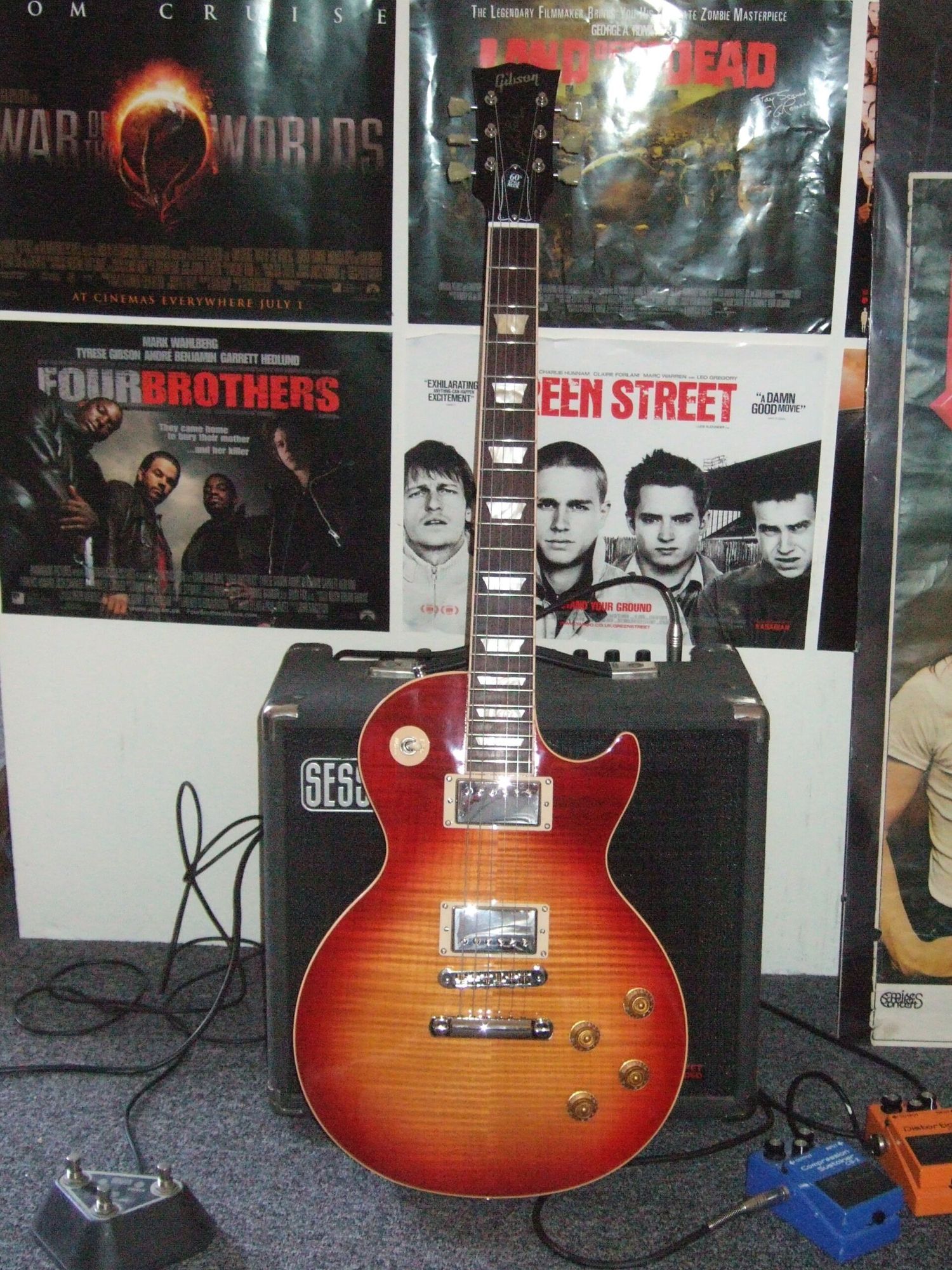
2006 Gibson Les Paul Standard (SN 000660573). Photo by wetwebwork. Licensed under CC BY-SA 2.0. Via Wikimedia Commons. Gibson
Les Paul Standard
1952
Gibson made about 1,500 sunburst Les Pauls, decided nobody wanted them, and stopped. Then the British blues boom happened.
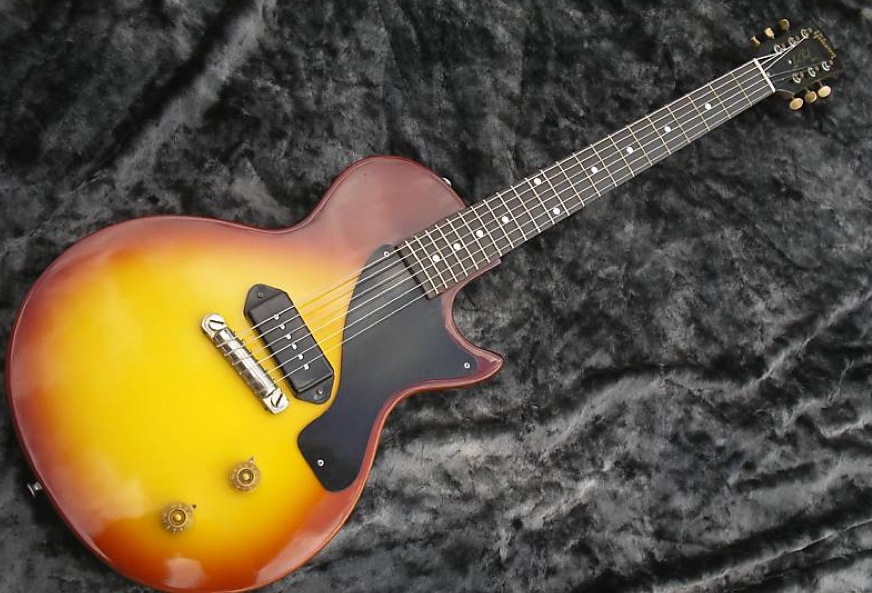
Gibson Les Paul Junior. Photo by Detroit Gorilla. Licensed under CC BY 2.0. Via Wikimedia Commons. Gibson
Les Paul Junior
1954
One pickup, two knobs, no switch. Built for beginners. Mountain and the New York Dolls never needed more.
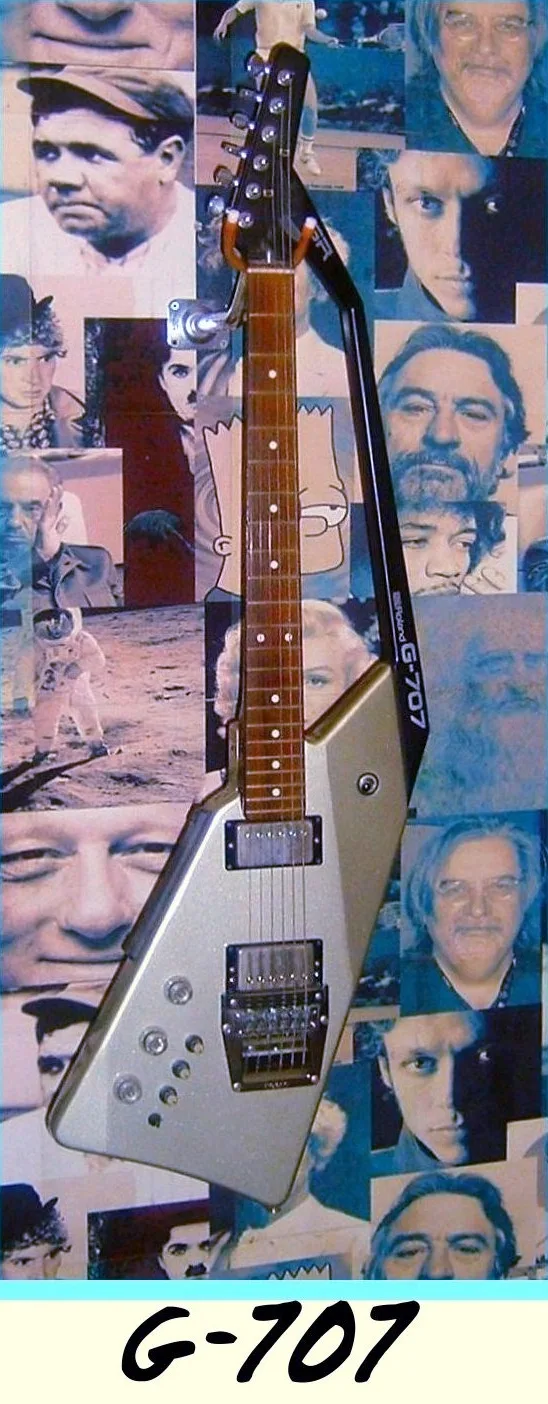
Photo: Some_of_my_lefty_guitars.jpg: Hugh Jarrse / Wikimedia Commons / CC BY-SA 3.0 Roland
G-707
1984
Roland bent a guitar into a strange shape so a machine could hear it. Then the machine learned to hear any guitar.