Gibson
ES-355
B.B. King ran into a burning dance hall to save a guitar. Every Gibson after it was Lucille too.
Twist, Arkansas. A dance on a cold night, a barrel of kerosene burning for heat, and two men fighting over a woman. The barrel goes over and the hall catches fire. A young B.B. King gets out, realizes he’s left his guitar inside, and goes back in for it.
- Introduced
- 1958
- Type
- Thinline semi-hollow electric
- Class
- Production
The short version
1958
Ten guitars
The first 355s ship late in the year. All ten are mono.
1959
Stereo and Varitone
The ES-355TD-SV adds stereo wiring and a six-position tone selector.
1964
Live at the Regal
B.B. King’s famous live record. The guitar was most likely a custom 335, not a 355.
1969
The Thrill Is Gone
King records it on a 355-era Lucille. Or 1970, depending who you ask.
1976
Whitey
Alex Lifeson gets a custom Alpine White 355 that stays with him for decades.
1980
Lucille, the model
A B.B. King signature prototype, with no f-holes. Production comes in 1981.
1982
Replaced
The regular 355 gives way to the B.B. King model. Or 1984, by some counts.
1984
Marr’s
Johnny Marr buys a cherry 355 on 2 January.
Side A
A1
Back into the fire
B.B. King got out of that burning dance hall in Twist, Arkansas, and then went back in for his guitar, a Gibson L-30. He got it. When he found out what the fight had been about, a woman named Lucille, he gave the guitar her name, as a reminder never to do anything that foolish again.
That was years before the ES-355 existed. But the name stuck. Every time King got a new Gibson, it became Lucille.
The name stayed put. The guitars changed underneath it.
Most people, when they say “Lucille,” picture a black Gibson with gold hardware and a fancy headstock. That guitar is the ES-355.
A2
Plain, deluxe, fanciest
Gibson made three versions of the same semi-hollow body. The ES-335 was the plain one. The ES-345 added stereo and some trim. And the ES-355 got everything. One dealer sums it up:
335 plain, 345 deluxe stereo, 355 fanciest.
Underneath it’s the same thin, double-cut body with a solid maple block down the middle. On top, Gibson laid on all the good stuff: extra binding everywhere, an ebony fingerboard with pearl blocks, a split-diamond inlay on the headstock, and gold hardware. Most had a Bigsby vibrato. A 355 that left the factory with a plain stop tailpiece is very rare, and a Bigsby guitar that’s had one fitted later is not the same thing.
The first ten shipped late in 1958. All mono. People sometimes call those “SV” models. They aren’t, not yet.
A3
Six clicks of Varitone
In 1959 Gibson added a version called the ES-355TD-SV. The S is stereo: each pickup could go to its own amp. The V is Varitone, a six-position knob that cuts out a different slice of the tone at each click. Turn it and the guitar gets thinner, hollower, more nasal. It’s a strange sound, and B.B. King made it part of his voice.
1959 was the only year Gibson shipped more plain mono 355s than stereo ones, 177 to 123. After that, stereo won. From 1958 through 1979 Gibson shipped 5,068 in all, which isn’t much next to the 335.
Flip the record · By the numbers
10
ES-355s shipped in 1958. Every one mono.
6
Positions on the Varitone knob, starting in 1959.
5,068
Shipped from 1958 to 1979, mono and stereo together. The busiest year, 1967, was 405.
16
Lucilles King said he’d had, by 1996.
Side B
B1
Whitey, the cherry, and the black one
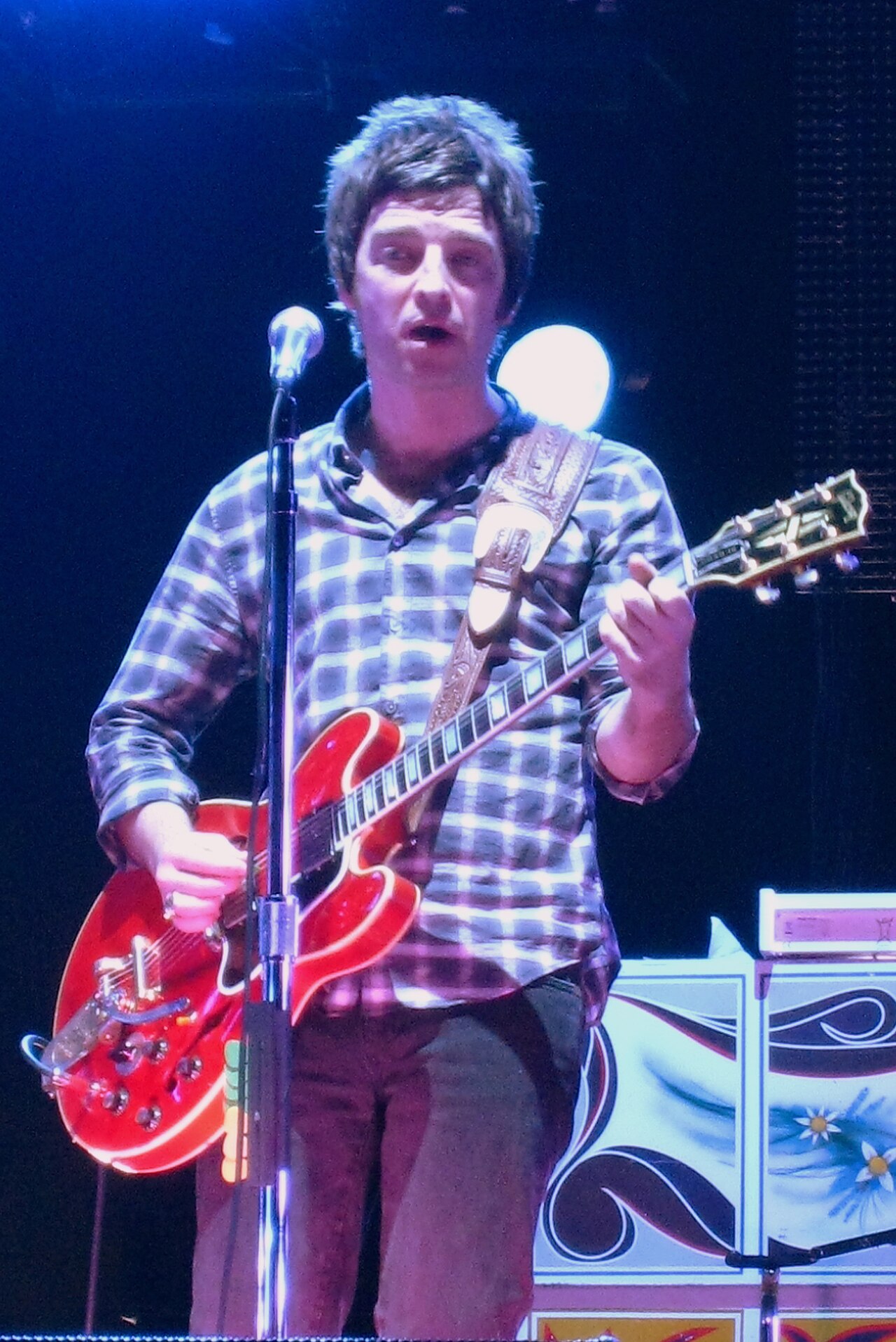
The 355 didn’t stay a blues guitar. Johnny Marr bought a cherry 1959-or-1960 stereo 355 on 2 January 1984, had it rewired to mono, and put it on “Heaven Knows I’m Miserable Now,” “Girl Afraid,” and Meat Is Murder. Alex Lifeson had a custom Alpine White one made in 1976. He called it “Whitey,” played it from A Farewell to Kings through Test for Echo, and still had it on stage for Rush’s R40 tour.
Noel Gallagher owned two from around 1960. One became the model for his signature guitar. A different one got smashed backstage at Rock en Seine on 28 August 2009, the night Oasis split. Keith Richards played a 355 on sessions around 1969, and a black 1960 has been a tour regular of his since 1997. Whether that’s the same guitar is another question. Freddie King played one in his last years. Chuck Berry plays a red one in the 1987 film Hail! Hail! Rock ’n’ Roll, long after his early hits on a different Gibson.
B2
Sixteen Lucilles
Back to B.B. King. Even his story needs a little care. His famous 1964 record Live at the Regal was probably made on a custom sunburst 335 with a Varitone, not a 355. By the late 1960s he was playing 355s. “The Thrill Is Gone” came in 1969, or 1970, depending who you ask, and you can hear that Varitone honk in it.
In 1980 Gibson built a prototype of a B.B. King signature model, and production started the next year. It was based on the 355, and the big change was one he asked for: no f-holes. It’s the Lucille most people know. Gibson dropped the regular 355 around 1982 (or 1984, by some counts) and let the King model take its place. By 1996 King said there had been sixteen Lucilles.
So there isn’t one Lucille. There never was. There’s a name, first given to a guitar he wouldn’t leave behind in a fire, and a man who kept handing it on to the next guitar, and the next.
Put this on
You’ve read about it. Now hear it. Here’s what this guitar sounds like, and what to listen for.
The Thrill Is Gone
From Completely Well, with a 355-era Lucille. Listen for the nasal “honk” in the tone. That’s the Varitone, a 355 feature a stock 335 doesn’t have.
Find it on YouTube (opens in a new tab)Heaven Knows I’m Miserable Now
Johnny Marr’s cherry 355, bought that January and rewired to mono. Bright, chiming, and nothing like the blues.
Find it on YouTube (opens in a new tab)
The cast
The people, and the specific guitars, that made the legend.
1960s
B.B. King
Lucille, an ES-355
The name went to guitar after guitar. The one people picture is a black 355 with a Varitone. His signature model dropped the f-holes.
1984
Johnny Marr
Cherry ES-355TD-SV, 1959 or 1960
Bought 2 January 1984. On “Heaven Knows I’m Miserable Now,” “Girl Afraid,” and Meat Is Murder.
1977
Alex Lifeson
“Whitey,” a 1976 Alpine White 355
From A Farewell to Kings through Test for Echo, and on stage through the R40 tour.
late 1990s
Noel Gallagher
Two ES-355s from around 1960
One became the model for his signature guitar. A different one got smashed at Rock en Seine in 2009.
1997
Keith Richards
Black 1960 ES-355
A tour staple from 1997 on. He first used a 355 around the Sticky Fingers and Exile sessions; it isn’t settled that it was this one.
1973–76
Freddie King
ES-355
His guitar in his last years. Earlier, he played a goldtop and then a 345.
Liner notes
Specs, construction, rarity, value, and every source we used.
The top of the 3x5 — bound ebony, pearl blocks, split-diamond, gold, Bigsby typical; not a 335, not a 345, and not Lucille without f-holes.
- Body
- Double-cut thinline. Laminated maple; maple center block; hollow wings. 16 in × 19 in × 1 3/4 in. Multiple-bound top, triple-bound back. F-holes. Semi-hollow.
- Neck
- Set mahogany; 5-piece split-diamond peghead; bound headstock. Join 19th (guitarhq); VG&B 19th 1958–62 / 20th after.
- Fingerboard
- Bound ebony; 22 frets; pearl blocks.
- Scale
- 24.75 in / 628.65 mm
- Pickups
- Two humbuckers (PAF earliest; patent-number ~1962–63 family drift).
- Hardware
- Gold. ABR-1 Tune-o-matic; Bigsby typical; factory stop very rare. Grover Rotomatics (1959).
- Electronics
- Two harnesses, one body. ES-355TD: 2 volume, 2 tone, 3-way, mono. ES-355TD-SV: stereo + six-position Varitone (from 1959).
- Finish
- Nitro. Cherry at intro; sunburst/natural 1960; walnut 1969.
Open the full research fileConstruction details, the complete player record, production numbers, dated value estimates, and sources
Vintage Kalamazoo deluxe 355. Current Custom Shop Historic is a reissue — mono, no Varitone, typically stop-bar. No USA Original Collection ES-355 (2026). Varitone/Bigsby 355s are Made to Measure, not the Historic table.
Construction
Kalamazoo, late 1958: 10 shipped, all mono ES-355TD. Official intro 1959. Do not call 1958 355s “SV.” Stereo + six-position Varitone (ES-355TD-SV) from 1959.
Same maple center block as 335/345. Hollow wings. Not an ES-330 (fully hollow, no block, P-90s). Joe’s: “335 plain, 345 deluxe stereo, 355 fanciest.” 345 = split parallelograms on rosewood. 355 = bound ebony, pearl blocks, extra binding, split-diamond peghead, gold. TD vs TD-SV is the encyclopedia trap. Shared deluxe body; different harness. A Y-cable photo is not a model ID vs 345.
Vintage 16" × 19" × 1 3/4", 24 3/4" scale, 22 frets. Neck join 19th (guitarhq). VG&B: 19th 1958–62, 20th after — attribute; count the guitar.
F-holes: guitarhq 1959 unbound. VG&B 1970 catalog SV: bound. Year of change not pinned. Edgewater “bound from 1958” conflicts — do not flatten.
Gold. Tune-o-matic. Bigsby typical; factory stop very rare (inverted vs 335). A stop-tail fitted into Bigsby holes is a fake upgrade. guitarhq: long guard 1958–59, short 1960; 1961 sideways vibrato, mono much rarer; 1963 lyre vibrato and gold Klusons; 1969 Bigsby again. VG&B: TP-6 from 1979/80; brief 1980 ES-355TDS/79 (stereo, no Varitone).
Discontinue: prefer VG&B/guitarhq 1982 (superseded by the B.B. King Custom). Wikipedia 1958–1984. MusicRadar TD 1970 / TDSV 1982. Do not force one last year.
Current 2026: No USA Original Collection ES-355. Custom Shop Historic only. Reissues ≠ Kalamazoo.
Players
Carlton, Big Red, and Clapton’s 1964 cherry stay on the 335. Freddie’s mid-60s / Getting Ready 345s, Howe’s Close to the Edge, and the Back to the Future cherry stay on the 345. Wes stays L-5 CES. Do not upgrade Otis Rush from a Guitar Player list.
B.B. King — Lucille is 355-based. Name from the Twist, Arkansas, L-30 fire, then successive Gibsons. The public guitar and the signature are ES-355 (often ES-355TD-SV): typically black later, Varitone, and — on the signature — no f-holes. Live at the Regal (November 1964) is likely a custom sunburst 335 with 345-style Varitone/stereo (Bacon) — not a 355. Later-1960s 355; 1969 endorsement. “The Thrill Is Gone” recorded 1969 (Completely Well); Guitar Interactive cites Varitone “honk” on a 355-era Lucille. Wikipedia Lucille lead dates the track 1970 — flag. Signature 1980 vs 1981 flagged (Bacon: production during 1981; prototype summer 1980). Many Lucilles; King said 16 by 1996. No single “the” Lucille.
Freddie King. Hide Away = goldtop. Mid-60s / Getting Ready = 345. 1973–76 = 355 last years.
Chuck Berry. Maybellene / Johnny B. Goode = ES-350T. Hail! Hail! Rock ’n’ Roll (1987) red 355 is later. Do not pin post-1962 Chess to a sibling.
Johnny Marr — cherry TDSV, 1959–60 (A 32530; year flagged). Bought 2 January 1984 (Seymour Stein / We Buy Guitars). “Heaven Knows I’m Miserable Now,” “Girl Afraid,” Meat Is Murder. Rewired mono.
Noel Gallagher — two ~1960 355s. Number-one (late-1990s/1997) is the signature source. Rock en Seine smash 28 August 2009 is a different 355. Do not write “the Oasis 355.”
Alex Lifeson, “Whitey” — 1976 Alpine White ES-355TD, custom Kalamazoo. A Farewell to Kings through Test for Echo; onstage through R40. His tobacco 335 is not Whitey.
Keith Richards’ black 1960. First 355 use 1969 (Sticky Fingers / Exile sessions) is not automatically the 1997-on tour staple. Not Micawber. Factory black mono is a rarity claim, not a sessionography.
Rarity
Factory shipping (Meiners), not production counts. 1958–69 combined 3,016. Mono 1958–70: 1,343. SV 1959–79: 3,725. Combined 1958–79: 5,068. 1959 is the only year mono outships SV (177 vs 123). Combined peak 1967 (405) — small next to 335 volume, not Flying-V small. 1980–82 unpublished.
1958: 10, all mono. guitarhq: stop-tail examples very rare. Gelber: logbook shows at least four stop-tails in 1959; he knew about a dozen to 15 1958–64. Bigsby is period-correct. A filled-hole “upgrade” is a fake. Current Historics are Nashville Custom reissues, not a 1959 ledger.
Value
Informal estimate, 25 August 2026. Not an appraisal.
Asks ≠ solds. Reverb vintage sold-median blocked this pass. Joe’s July 2026 ranges are asks. A same-year 335 outvalues the fancier 355. Do not average Whitey, Richards, or King lots into model bands.
New / reissue. Custom Shop 1959 Historic VOS stop-bar $6,999. Murphy Lab ~$7,499–$8,700. Used Historic ~$4,500–$6,000 (reissue). Lucille Legacy $7,999 — signature, outside catalog ranges. Richards Collector’s Edition $19,999 / $29,999 — artist limited, outside.
Norlin player. Working ask ~$6,000–$9,000.
Vintage. Joe’s July 2026 asks: 1959 mono cherry factory Bigsby ~$30,000–$45,000; factory mono stop-tail $45,000–$60,000+; 1959 SV ~$22,000–$38,000 (SV −15–30% vs equivalent mono). Edgewater 1958–62 PAF $25,000–$50,000 dealer-comp — does not split mono/SV. Named asks: Certified Vintage 1959 and 1960 SV $34,999. Gelber: a clean mono 1959 can command $40,000. Forum: a 1960 PAF auction sold $22,000 (configuration unspecified). Olivia’s 1961 TDN $85,900 ask is a rare-finish ask, not a median. Working sold-direction for clean PAF Bigsby 1959–61: low $20ks to mid-$40ks.
See also
- gibson-es-335 — the plain sibling; Carlton, Big Red, and Clapton’s 1964 cherry live there; Lucille lives here
- gibson-es-345 — the middle sibling; Freddie’s mid-60s 345s and Howe’s Close to the Edge live there
- gibson-es-295 — gold ES-175-platform hollow; Scotty’s first Elvis guitar, not Lucille
Sources
- guitarhq: ES-355
- guitarhq: ES-335 / 345 / 355 intro lines
- guitarhq: hollowbody shipping 1955–69
- Vintage Guitar and Bass: ES-355TD
- Vintage Guitar and Bass: ES-355TD-SV
- Vintage Guitar and Bass: ES-355TD-SV shipping 1959–79
- Vintage Guitar and Bass: 1960 catalog (first 355TD-SV page)
- True Vintage: 1959 ES-355 T
- Gibson Custom 1959 ES-355 Reissue Stop Bar VOS Ebony
- Gibson Custom 1959 ES-355 Reissue Stop Bar VOS Vintage Natural
- Gibson Custom 60s ES-355 Reissue Maestro Vibrola
- Gibson ES collection (Original Collection: 335 / 345 / 330 — no 355)
- Gibson Custom B.B. King Lucille Legacy
- Joe’s Vintage Guitars: 1959 ES-355 history/value (14 Jul 2026)
- Joe’s Vintage Guitars: Gibson shipping totals 1948–1979
- Charlie Gelber / es-335.com: Year Ender 2023 Part 2
- Charlie Gelber / es-335.com: I’ll Have Mine Rare, Please (2015)
- Edgewater Guitars: 2026 vintage Gibson value guide
- Gibson Certified Vintage 1959 ES-355TDSV
- Gibson Certified Vintage 1960 ES-355TDSV
- Guitar Player: Rod Brakes, Classic Gear ES-355 (22 Mar 2022)
- MusicRadar: Rod Brakes, Classic gear ES-355TD (10 Aug 2018)
- Vintage Guitar: Thinkin’ Thin
- Vintage Guitar: Freddie King’s ’73 ES-355
- Guitar World: Tony Bacon, What kind of guitar was B.B. King’s Lucille? (8 May 2026)
- Guitar Interactive: The Gibson Guitars of B.B. King
- Fretboard Journal: 1962 ES-345 (Lucille as 355)
- Guitar Center Riffs: ES-335 history (Berry 350T / Hail! Hail! 355)
- Guitar World: Johnny Marr’s ES-355 (21 Aug 2026)
- MusicRadar: Johnny Marr’s gear collection (1959 caption)
- Christie’s: Marr ES-355 TDSV 1959–60, A 32530
- Ground Guitar: Johnny Marr’s 1960 ES-355SV
- Julien’s Auctions: Lifeson “Whitey” 1976 ES-355TD
- Guitar World: Alex Lifeson’s ES-355 auction (20 May 2022)
- Gibson Gazette: Keith Richards 1960 ES-355 Collector’s Edition
- Guitar World: Keith Richards 1960 ES-355 (13 Jan 2026)
- Guitar Center Riffs: Richards 1960 ES-355 (factory black mono)
- Guitar World: Noel Gallagher signature 1960 ES-355 (30 Aug 2022)
- MusicRadar: Gallagher Rock en Seine ES-355
- Artpèges: Noel Gallagher’s ES-355
- Wikipedia: Gibson ES-355 (lead only)
- Wikipedia: Lucille (guitar) (lead only)
Keep digging
Guitars this one gets compared to, confused with, or descended from.

Photograph of a vintage 1960 Gibson ES-335TD. Photo by Lightburst. Licensed under CC BY-SA 4.0. Via Wikimedia Commons. Gibson
ES-335
1958
Larry Carlton played three 335s off a shop wall, unplugged, paid $850 for one, and became Mr. 335.
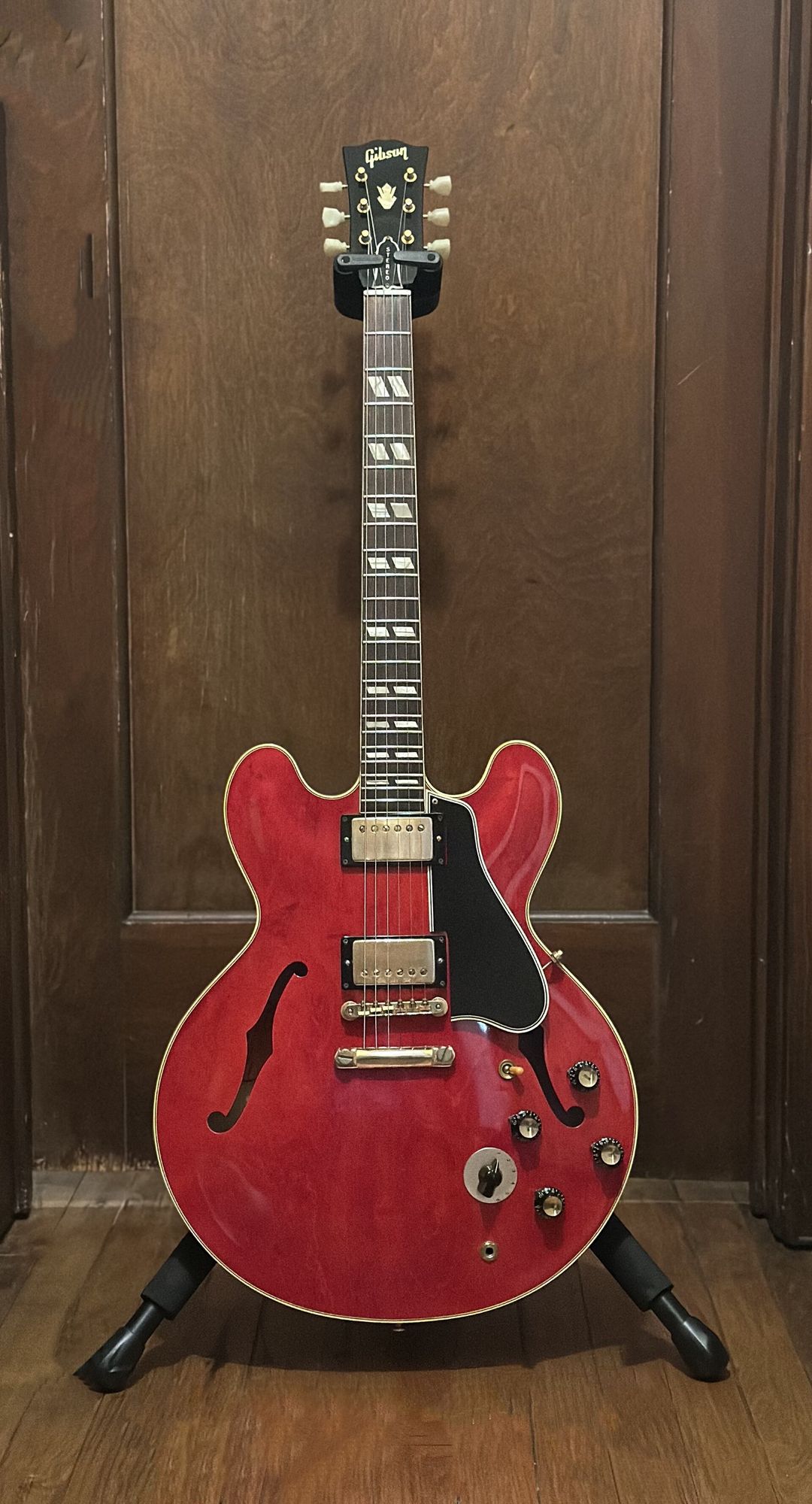
1960 Gibson ES-345TDC. Photo by Lightburst. Licensed under CC BY-SA 4.0. Via Wikimedia Commons. Gibson
ES-345
1959
Marty McFly plays one in 1955, four years before Gibson made it. Nobody in the theater minded.
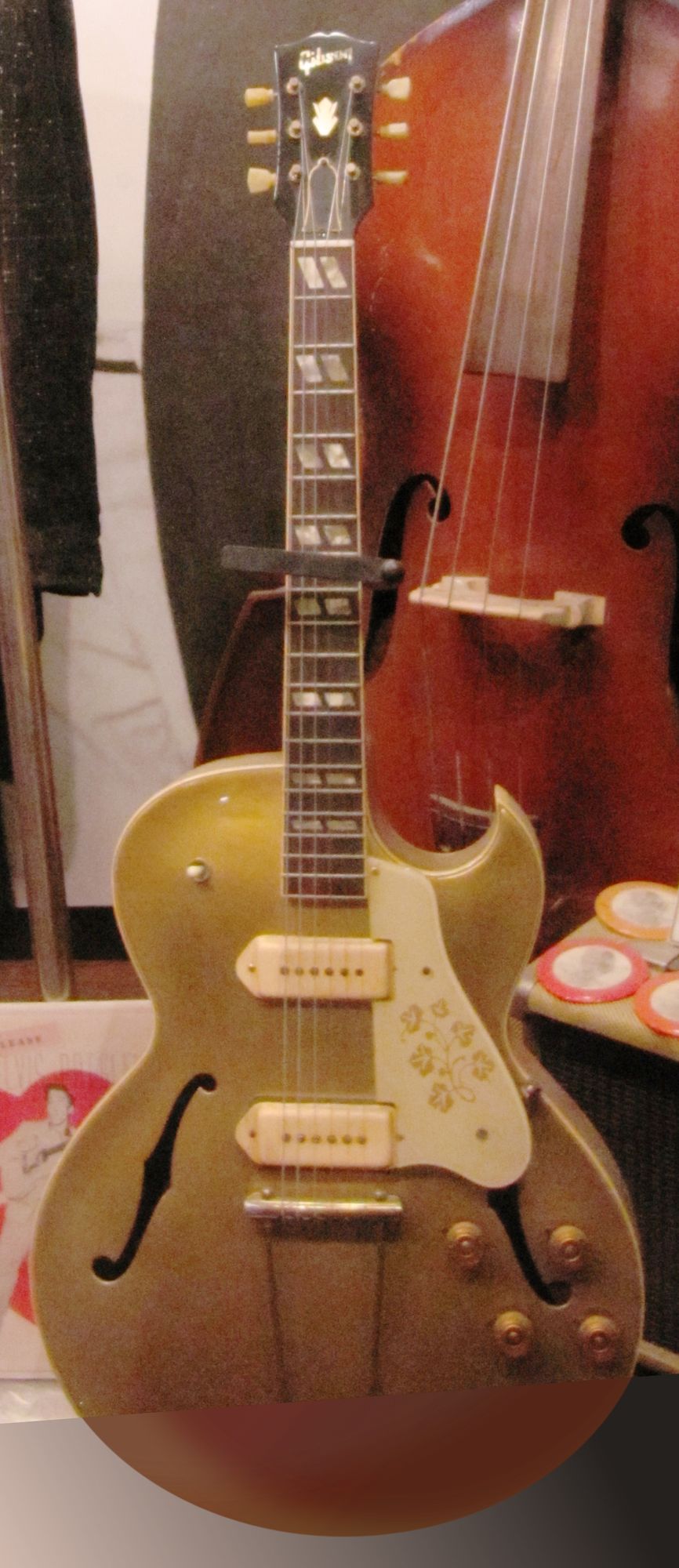
Gibson ES-295, Sun Studio. Clipped from Memphis Sun Studios Elvis instruments.jpg. Photo by Mr. Littlehand; derivative by Clusternote. Licensed under CC BY 2.0. Via Wikimedia Commons. Gibson
ES-295
1952
Scotty Moore traded a Fender for the gold guitar in the window. Four Elvis singles later, he traded it away.