Gibson
Nighthawk
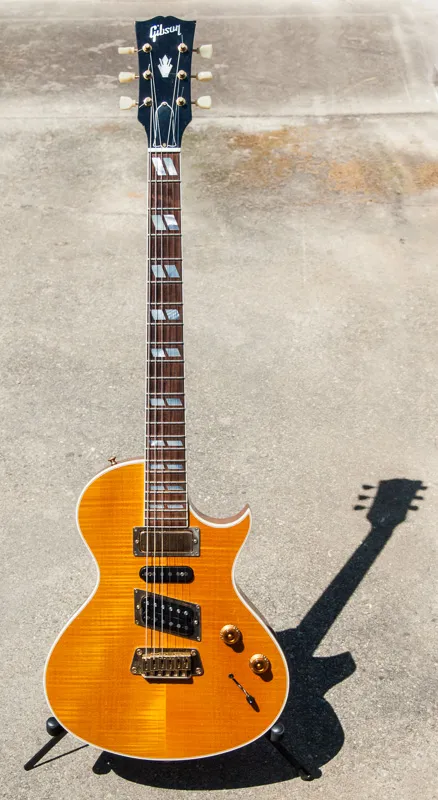
From across the room it’s a Les Paul. Up close it’s Gibson trying to do a Stratocaster’s job.
Winter NAMM, January 1993. Gibson shows a single-cut with gold hardware, a five-way blade, and strings that go straight through the body, and walks away with Most Innovative Guitar. Then it spends the rest of its life explaining that it isn’t a Les Paul.
- Introduced
- 1993
- Type
- Solidbody electric
- Class
- Production
The short version
1991
The switching comes first
The M-III carries the NSX middle pickup and the five-way scheme the Nighthawk will inherit.
1993
Nighthawk at NAMM
Custom, Standard, and Special, two or three pickups each. Most Innovative Guitar for designer J.T. Riboloff.
1994
A numbered hundred
A run of 100 three-pickup Standards, each with its number on the truss-rod cover.
1995
The Hawk series
The Nighthawk becomes the head of a family. The Hawk, the Landmark, the Blueshawk follow.
1998
Gone, or nearly
Some accounts end the original run here. Gibson’s own later page says 1999, “after only six years.”
2009
Back in name
A Limited Run wears the outline, with P-90 and humbucker, a Tune-o-matic, and a three-way toggle.
2013
Twenty years, and Nancy Wilson
A 20th Anniversary Standard, and a two-pickup Fireburst with Wilson’s “Fanatic” truss cover.
Side A
A1
Not a Les Paul
January 1993, Winter NAMM. On the Gibson stand there’s a single-cut with a figured maple top and gold hardware. You’d walk right past it. Everybody knows what a Gibson single-cut is.
Then you pick it up, and it’s wrong in a dozen small ways. The top is flat, not carved. The cutaway goes deeper. There’s a contour on the back for your ribs. The strings don’t stop at a tailpiece; they go through the body. Where the three-way toggle should be there’s a five-way blade. The bridge pickup sits at a slant.
That week it won Most Innovative Guitar, for designer J.T. Riboloff. Which magazine gave the award depends on who’s telling it. Two trade papers get the credit. Keep both.
A2
Doing someone else’s job
The idea was simple to say and hard to do: a Gibson that could cover Strat and Tele work without turning into one. So the Nighthawk took the Fender recipe piece by piece and translated it.
Start with the scale. Almost every Gibson you know runs 24¾ inches. The Nighthawk runs 25½, Fender’s length. More tension, more snap, more of that glassy edge on a clean amp. Then strings through the body on a low, six-saddle bridge, closer to a hardtail Strat than a Les Paul’s Tune-o-matic and stopbar.
The wood stayed Gibson. A one-piece mahogany back and neck, set in, not bolted. A quarter inch of figured maple on top, graded by tier: the best curl on the Custom, plain maple on the Special. Custom got ebony and crown inlays and binding everywhere. Standard got rosewood and split parallelograms. Special got dots.
A3
The five-way that isn’t a Strat five-way
The pickups are the point. A mini-humbucker at the neck. A slanted humbucker at the bridge. On the three-pickup guitars, a single-coil in the middle. Gibson called the two humbuckers M-series. The switching had shown up two years earlier on the M-III, and it moved over almost intact.
What the blade does is the clever part. It mixes full humbuckers with single coils split out of them, so the switch does the job of a second guitar: Gibson-thick at one end, nearly Fender-thin at the other. Exactly which position does what, the maps don’t agree on, or even how to number it. Plug one in and find out.
The switch does the job of a second guitar.
The three-pickup guitars add a push-pull on the tone knob for a second bank of five. Ten sounds. People often say the pull is what splits the humbuckers. It isn’t, quite. Every Nighthawk is already splitting coils with the knob pushed down.
Flip the record · By the numbers
25½"
The scale. Fender’s length, not the 24¾" of nearly every other Gibson.
10
Sounds on a three-pickup guitar, five on the blade and five more with the tone knob pulled.
¼"
Figured maple on a mahogany back, cut flat, not carved.
100
The numbered 1994 run.
Side B
B1
A family, then a gap
By 1995 the Nighthawk was the head of what Gibson officially called the Hawk series. In 1994 there was a numbered run of a hundred three-pickup Standards, each with its number on the truss-rod cover. Then came relatives: The Hawk, a cheaper two-humbucker guitar with conventional pickups and a three-way. The Landmark, in national-park colors. The Blueshawk and the Little Lucille, partly hollow, with f-holes. They share the name, not the circuit.
The end is a smear. Some accounts stop the original in 1998, after five years. Gibson’s own page, looking back in 2009, says 1999, “after only six years.” A Nashville Standard dated March 1998 is real. Keep both years. Gibson never published how many were made.
B2
Back in name only
The outline came back in 2009 as a Limited Run, chambered, with a P-90 at the neck, a Tune-o-matic, and a three-way toggle. Reviews put it on the shorter Gibson scale. It wore the shape. It wasn’t doing the Nighthawk’s job.
More versions followed: a 2010 Standard on chambered poplar, a Studio in 2011 with no maple cap. Then, in 2013, the 20th Anniversary Standard brought back the 25½-inch scale, the strings through the body, and the three-pickup layout, though not the 1990s wiring. Twenty years in, Gibson’s own spec sheet was still explaining the silhouette: a scaled-down body, a deeper cutaway, a contour for your ribs.
B3
Her drawing, his credit
The same year, Gibson issued a Nancy Wilson Nighthawk Standard: two pickups, Fireburst, and “Fanatic” on the truss-rod cover. Wilson had been a fan of the 1993 guitar for a long time. Years later, she told the story her way:
“I designed the shape for Gibson when they asked me to come up with a new body style. This was back in the ’80s, but then they changed management shortly after that.”
“I guess they found the old drawings,” she said, “and decided to make the Nighthawk into the Fanatic.” Gibson’s timeline names Riboloff as the designer. Both stories stand. Neither side has to lose.
You can’t buy a new Gibson USA Nighthawk today. There’s nothing on Gibson’s site. Wilson, though, says she still plays the original Gibson built for her in the ’80s. From across the room it looks like a Les Paul. It never was one.
The cast
The people, and the specific guitars, that made the legend.
1993
J.T. Riboloff
Designer of the 1993 Nighthawk
Gibson’s named production designer, credited with the Most Innovative Guitar award at NAMM.
2013
Nancy Wilson
Nancy Wilson Nighthawk Standard, Fireburst
Heart’s guitarist, long a fan of the 1993 Nighthawk. Her signature is two-pickup with a “Fanatic” truss cover. Says she drew the shape for Gibson in the ’80s.
1999
Lita Ford
Nighthawk Standard
Her name is printed at the foot of Gibson’s 1999 Nighthawk Standard spec sheet. An endorsement. Which records, if any, is not on file.
Liner notes
Specs, construction, rarity, value, and every source we used.
A 25½-inch set-neck, a slanted M-series bridge, and a five-way knife — Gibson’s Nighthawk, not a Les Paul.
- Body
- Mahogany back, ¼" figured maple top; compact single-cut, deeper cutaway, ribcage contour. Flat-topped.
- Neck
- Set mahogany, one-piece. Gibson 1999 sheet: narrow taper round.
- Fingerboard
- Bound rosewood, split parallelograms, 22 frets (Standard). Custom: bound ebony, crowns. Special: dots, body bound only.
- Scale
- 25½". Twelfth Fret, on a 1998 ST: 25.5 in / 647.7 mm. Mix flagged. Not Gibson’s 24¾".
- Pickups
- M-series mini-humbucker (neck), NSX single-coil (middle), M-series slanted humbucker (bridge). Two-pickup drops the NSX.
- Hardware
- Gold. Low-profile string-through bridge, six saddles. Optional Floyd Rose on three-pickup only.
- Electronics
- Master volume, master tone (push/pull on three-pickup), five-way blade. Passive.
- Finish
- Standard: Fireburst, Translucent Amber, Vintage Sunburst. Custom: Antique Natural, Fireburst, Translucent Amber. Special: Ebony, Heritage Cherry, Vintage Sunburst.
- Nut
- Gibson 1999 sheet 1 5/8". Twelfth Fret 1998 ST: 1.62 in / 41.37 mm. One 1995 Custom listing: 1.66". Mix flagged.
Open the full research fileConstruction details, the complete player record, production numbers, dated value estimates, and sources
Classic living example = 1990s Gibson USA Nighthawk ST3, the three-pickup M-series guitar. At launch: Custom (CST / CST3), Standard (ST / ST3), Special (SP / SP3). No current Gibson USA Nighthawk this pass (fetched 1 October 2026). 2009 Limited is P-90 / 498T, Tune-o-matic; reviews put it on 24¾" — not this table. 2010–11, Studio, 20th Anniversary, and Nancy Wilson are later runs, different circuits. The Hawk, Landmark, Blueshawk, and Little Lucille are other Hawks. Epiphone (including Waxx Nighthawk Studio) stays off. Reverb product pages print 24.75" for 1990s ST-3 / CST-3 — a sheet error, not a second scale. Mixed inch/mm flagged on Twelfth Fret’s 25.5 in / 647.7 mm and 1.62 in / 41.37 mm. Do not average the nut widths, or treat 647.7 mm as a different scale.
Construction
The job was a Gibson that could do Strat and Tele work without becoming one. Set mahogany. Maple cap. Nashville. Scale 25½", not 24¾". Strings through the body. A five-way blade instead of a three-way toggle. A slanted bridge humbucker. It is not a Les Paul (gibson-les-paul-standard). It is not an SG. It is not an ES.
J.T. Riboloff is the named production designer. Gibson’s own centennial timeline: the Nighthawk wins Most Innovative Guitar at the January NAMM show from Music and Sound Retailer, “for designer J.T. Riboloff.” A Gibson forum cites Walter Carter, The Gibson Electric Guitar Book (2007): Winter NAMM 1993, award from The Music Trades. Keep both magazine names. Reverb News (Tony Bacon, 11 January 2024): Riboloff designed these models; from 1995 they were known officially as the Hawk series. Vintage Guitar (Michael Wright, August 2023) puts the same switching family on the M-III (1991) and then on the Nighthawk (’93–’99). This plate starts in 1993.
It looks like a single-cut from across a room. It is a different platform. Reverb News: “wide, flat-topped, deep-cut” — not a carved Les Paul cap. Gibson’s 20th Anniversary sheet, later, still has to explain the silhouette: scaled-down body, deeper cutaway, ribcage contour. Unique Guitar Blog: smaller than a Les Paul, cutaway more pronounced, top flat. Gibson’s factory “Making of the Gibson Nighthawk” pamphlet: one-piece mahogany back and neck; maple top graded by tier — Custom “Premium Plus” curly, Standard curly “plus,” Special plain maple. Custom gets ebony; Standard and Special get rosewood.
The pickups are the point. Two-pickup (CST, ST, SP): M-series mini-humbucker at the neck, M-series slanted humbucker at the bridge. Three-pickup (CST3, ST3, SP3): those two plus an NSX single-coil in the middle — the same NSX Vintage Guitar names on the M-III. Gibson’s 1999 Standard page: Special M-Series mini-humbucker, optional NSX, Special M-Series slanted humbucker. Unique Guitar Blog files the neck as a Bill Lawrence OBL L-500. Prefer Gibson’s M-series name. The blog is one attribution, not the factory sheet.
The five-way is not a Strat five-way. Reverb News, two-pickup map: bridge single / bridge hum / bridge+neck singles / neck single / neck hum. Twelfth Fret, on a 1998 ST: positions 1, 3, and 5 split; position 3 a coil from each; positions 2 and 4 both coils of one pickup. Wikipedia: only positions 2 and 5 use both coils of the same pickup; the other three are split. Keep the maps. They do not agree on numbering. Three-pickup adds a push-pull tone for a second set of five — ten combinations. Wikipedia’s caution, worth keeping: it is often said the pull splits the humbuckers; all Nighthawks already mix humbucking and split-coil tones with the knob down.
Hardware is gold. The bridge is a low-profile string-through with six saddles, closer to a hardtail Strat than a Tune-o-matic and stopbar. Floyd Rose is catalog on three-pickup only (Gibson 1999); Reverb News and guitar-list put Floyd options on Standard and Custom, 1994–99.
Three cosmetics, same circuit. Custom: bound headstock, body, and neck; ebony; crowns; Antique Natural, Fireburst, Translucent Amber. Standard: body and neck bound, headstock unbound with the holly crest; rosewood; split parallelograms; Fireburst, Translucent Amber, Vintage Sunburst. Special: body bound only, dots, no holly crest; Ebony, Heritage Cherry, Vintage Sunburst. Wikipedia: Special about $200 below the Standard. Relative, not a 1993 list in hand. No catalog dollar located this pass. None invented.
Siblings, not this table. The Hawk (Reverb News 1996–97): two 490R humbuckers, wrapover, three-way — Wikipedia’s “low-cost alternative” with conventional Alnico, not M-series. Landmark: Reverb News 1996–98; guitar-list 1995–1999. Keep both. blueshawk.info lists Glacier Blue, Sequoia Red, Mojave Burst, Navajo Turquoise, Everglades Green. Two M-series mini-humbuckers, no slanted bridge. 1994 numbered run of 100: Wikipedia, ST3, chocolate-burst, truss cover Limited Edition and the guitar’s number/100. Blueshawk and Little Lucille, 1996: partly hollow, f-holes, Blues 90s. Hollow. Not this solid.
The stop is a smear. Wikipedia: discontinued 1998 after five years. Gibson’s own 2009 product page: retired 1999, “after only six years.” Vintage Guitar and Reverb News print ’93–’99. guitar-list: Standard discontinued 1999. Twelfth Fret has a Nashville ST dated 26 March 1998. Keep 1998 and 1999. Gibson did not publish a Nighthawk factory total. None invented.
2009. Limited Run, Translucent Amber, chambered mahogany with AAA maple. Gibson’s page: P-90 neck and 498T bridge, Tune-o-matic and stopbar, three-way toggle, Corian nut about 1.695", 12" radius, MSRP $2,775. Guitar Gear’s review and later Reverb listings put the scale at 24¾" — Gibson’s 2009 sheet as captured here does not print a scale. One review (Guitar Gear, 20 February 2010) specs a BurstBucker 3 at the bridge instead of the 498T. Keep Gibson’s 498T, and the review. It wears the outline. It is not an M-series 25½-inch Nighthawk.
2010–11. Wikipedia: Nighthawk Standard 2010, quilted maple on chambered poplar, Chicago Blue / Memphis Mojo / St. Louis Sauce, BurstBucker 1 / Gold Blade / BurstBucker 2, gold, granadillo. Sellers claimed one hundred of each color; Gibson never confirmed that. 2011 Vintage Sunburst, MSRP $300 higher, not limited. Studio, late 2011 (Sonic State, 21 November 2011): no maple cap, BurstBucker 1 and 2, independent coil-splits, torrefied maple dots, Goldtop / Pelham Blue / Silverburst. Reverb News dates Studio 2011–12.
2013. 20th Anniversary Nighthawk Standard: 25½", string-through, mini-humbucker / NSX / Nighthawk Lead, push-pull on the bridge only — Wikipedia notes the pickup map is not the 1990s map. Antique Natural or Fireburst, AAA maple, split parallelograms, gold, MSRP $2,498, street starting $1,499 on Gibson’s page. Same year, Nancy Wilson Nighthawk Standard: two-pickup, Fireburst, “Fanatic” truss cover, same $2,498. Unique Guitar Blog: Gibson discontinued the Nighthawk as of 2014. Wikipedia’s period line runs 2009–c. 2020. No Gibson USA Nighthawk on gibson.com this pass. Classic against current: the 1993 ST3 — 25½", M-series trio, string-through, ten tones — and no new Gibson USA Nighthawk to order in October 2026.
Players
Do not hang a Les Paul, an SG, or an ES on this plate. Do not move Heart’s 1970s records onto a 1993 guitar. Do not recruit The Hawk, the Blueshawk, or an Epiphone as if they were this one. Wikipedia’s unsourced crowd — Frampton on Comes Alive II, Dave Davies “in recent years,” Joe Louis Walker — is not repeated here as fact.
Nancy Wilson — the 2013 signature, and an 1980s drawing. Gibson (Anne Erickson, 17 July 2013) and MusicRadar the same day: Heart guitarist, long a fan of the 1993 Nighthawk; two-pickup Standard in Fireburst; “Fanatic” cover; MSRP $2,498. Guitar Player (Mark McStea, 3 November 2021), on the later Epiphone Fanatic: “I designed the shape for Gibson when they asked me to come up with a new body style. This was back in the ’80s, but then they changed management shortly after that. I guess they found the old drawings and decided to make the Nighthawk into the Fanatic.” She still plays “the original model that Gibson built for me in the ’80s.” That is her sentence. Riboloff remains the named production designer on Gibson’s timeline. Keep both. Album-to-guitar credits for Heart sides are unpublished here.
Lita Ford. Gibson’s 1999 Nighthawk Standard page prints her name at the foot of the spec. Endorsement on the factory sheet. Which records on which Nighthawk are unpublished here.
Also known to play stays last and empty of inventions. No session log invented.
Rarity
You cannot buy a new Gibson USA Nighthawk. The 2009–13 revivals are gone, and most of them were different circuits anyway. Epiphone’s later Nighthawks, including the Waxx Studio, are other factories on this silhouette.
Gibson did not publish Nighthawk unit totals. None invented. Nashville serials date a guitar. They don’t count a year. That is why a 1993 census is unknown, not the chapter. Reverb’s “1992–1999” product-page window is a dating band, not a factory intro; Gibson, Vintage Guitar, and Reverb News start the model in 1993.
What is actually thinner: first-year CST3 / ST3 / SP3 with the M-series trio and the ten-tone pull still stock; the 1994 numbered 100; Landmark park finishes; a real Floyd three-pickup from the mid-run. The 2009 Limited, the 20th Anniversary, and Wilson’s 2013 Fireburst are later objects. They are not a 1993 Nighthawk.
Value
Informal estimate, 1 October 2026. Not an appraisal.
Asking prices are not sold prices. Celebrity lots are not-comps. A Special is not a Custom. A 2009 P-90 Limited is not 1993 M-series money. The Hawk and the Blueshawk are other guitars. No 1993 catalog list located this pass; Wikipedia’s “about $200 below” for Special versus Standard is relative, not a street. Historical $2,775 (2009 Limited MSRP) and $2,498 (2013 20th Anniversary and Nancy Wilson MSRP) are old lists, not 2026 street.
New street. None under Gibson USA Nighthawk this pass. gibson.com (1 October 2026) has no current Nighthawk SKU. Epiphone Waxx Nighthawk Studio is an import signature on the outline, not this table.
Used modern. 2009 Limited, 2010–11 Standard, Studio, 20th Anniversary, and 2013 Wilson trade used. Reverb Price Guide dollar widgets on ST-3 and CST-3 product pages did not render a band this pass. Flag: thin sold-comp access on Standard and Custom. Don’t invent a midpoint from the dead list prices.
Vintage / collectible. Reverb Price Guide on Nighthawk Special SP-2 1992–1999 (54 orders, Good to Mint): $625–$1,084. That page’s band, not a Custom. Named solds on Custom CST-3 Floyd Rose, not a series: Very Good $2,200 (5 January 2026); Very Good $2,600 (29 August 2024); Good $2,294.15 (28 May 2024); Good $1,900 (4 March 2022). Named asks, not hammers: Imperial Vintage 1995 CST-3 Trans Amber $3,495 on the shop page, $3,295 as the Reverb featured listing of the same guitar; 1993 Custom sunburst $2,300 (from $2,950); 1993 Special red $1,260. Do not average the Special widget, the Floyd solds, and the asks. Wilson’s 1980s prototype, if it ever trades, is one object. Not a comp.
See also
- L-6S — another non-LP Gibson solid with a switching scheme. Maple slab, 24¾", six-way. Not this 25½-inch M-series
- Firebird — mini-humbuckers on a Gibson that is not a Les Paul. Neck-through reverse, 1963. Not a Nighthawk
- Stratocaster — the 25½-inch, five-way, string-through job this set-neck was built to answer
Sources
- Gibson, 120 Years of Innovation: A Gibson Timeline (Russell Hall, 8 January 2014) — Nighthawk introduced to mark the 1994 centennial; Most Innovative Guitar, January NAMM
- The History of Gibson Guitars (Gibson timeline PDF) — 1993–94; Nighthawk wins Most Innovative Guitar at January NAMM from Music and Sound Retailer for designer J.T. Riboloff
- Gibson, Nighthawk Standard 2-Pickup (archived 30 September 2007) — ¼" figured maple, mahogany back; narrow taper round; rosewood parallelograms; 25½" / 1 5/8"; multi-ply top and single-ply board; string-through; Floyd optional on three-pickup; gold; M-series mini, optional NSX, M-series slanted humbucker; volume, tone (push/pull on three-pickup), five-way; Fireburst, Translucent Amber, Vintage Sunburst; Lita Ford named
- Gibson, 20th Anniversary Nighthawk Standard (archived 16 July 2013) — unveiled 1993; 25½"; ribcage contour, deeper cutaway, scaled-down body; AAA maple, mahogany; neck 0.818" / 0.963"; rosewood split parallelograms; mini-humbucker / NSX / Nighthawk Lead; push-pull coil-split; string-through; gold; Antique Natural / Fireburst; MSRP $2,498, starting $1,499
- Gibson, Nancy Wilson Nighthawk Standard (legacy product page) — 2013 two-pickup; Fireburst; Fanatic cover; 25½"; 0.818" / 0.963"; mini-humbucker and Nighthawk Lead; MSRP $2,498
- Gibson, Introduces the Nancy Wilson Nighthawk Standard (Anne Erickson, 17 July 2013) — Fanatic cover; 25½"; string-through; mini-humbucker and Lead; five-way
- Gibson, Nighthawk 2009 (archived 1 June 2013) — original retired 1999 after six years; chambered; AAA maple / mahogany; P-90 / 498T; Tune-o-matic and stopbar; 3-way; Corian ~1.695"; 12" radius; Trans Amber MSRP $2,775
- The making of the Gibson Nighthawk (Gibson pamphlet, via Gibson forum, 15 August 2015) — one-piece mahogany back and neck; Custom Premium Plus curly maple and ebony; Standard curly “plus” and rosewood; Special plain maple and rosewood
- Vintage Guitar, Michael Wright, Gibson M-III Standard (August 2023) — M-III 1991; NSX middle; five-way plus coil-tap toggle, ten tones; switching also on the Nighthawk (’93–’99)
- Reverb News, Tony Bacon, A Timeline of “Other” Gibsons (11 January 2024) — Nighthawk / The Hawk / Landmark 1993–99; Riboloff; Hawk series name from 1995; 25.5"; string-through; gold; Special dots / Standard figured, bound rosewood, twin angled blocks / Custom ebony, fancy markers; M-series mini + slanted humbucker, optional NSX; two-pickup five-way map; Floyd on Standard and Custom; The Hawk 1996–97 (two 490R, wrapover); Landmark 1996–98 (two M-series minis); Studio 2011–12
- Reverb News, 5 Guitar Makers Reveal the Thinking Behind Their Unusual Electrics (27 February 2019) — Riboloff on the 90 series: hired a year before 1988; 25½-inch scale on those Gibsons
- Wikipedia, Gibson Nighthawk — introduced 1993; discontinued 1998 after five years; 2009–c. 2020 revival; CST / ST / SP cosmetics and finishes; M-series mini + slanted humbucker, optional NSX; ten-tone three-pickup; two-pickup split map; Landmark; 1994 numbered 100; The Hawk; Blueshawk / Little Lucille 1996; 2009 / 2010 / 2011 / Studio / 20th / Nancy Wilson specs; 25½" vs 24¾"; Special about $200 below Standard. Player list mostly unsourced; not used as fact
- Twelfth Fret, Gibson Nighthawk ST Standard 2-pickup Sunburst, 1998 — CST / ST / SP, -3 = three pickups; original 1993–1998, again 2009–2020; Nashville 26 March 1998; two-pickup five-way map; 25.5 in / 647.7 mm; nut 1.62 in / 41.37 mm; 7.26 lbs. Mix flagged
- MusicRadar, Gibson announces Nancy Wilson Nighthawk (17 July 2013) — MSRP $2,498; Fireburst; Fanatic cover; 25½"; 0.818" / 0.963"; two-pickup five-way
- Guitar Player, Mark McStea, Nancy Wilson on the Fanatic (3 November 2021) — 1980s shape for Gibson; management change; later Nighthawk / Fanatic; still plays the 1980s Gibson they built for her
- Unique Guitar Blog, The Gibson Nighthawk Guitar (7 July 2015) — 1993 intro; smaller flat-top single-cut; OBL neck claim (prefer Gibson M-series); 1994 100; Landmark; The Hawk; Blueshawk 1996; 1998 stop / 2009 return; 20th Anniversary priced $1,500; Gibson discontinued as of 2014
- blueshawk.info, NightHawk (archived 20 December 2012) — 1993 outline and 25½" continued on later Hawks; Landmark park finishes named; Landmark twin mini-humbuckers
- Sonic State, New Variation On The Nighthawk (21 November 2011) — Nighthawk Studio; Burstbucker 1 / 2; Goldtop, Pelham Blue, Silverburst; 25½"; SlimTaper .808" / .875"; torrefied maple dots
- guitar-list, Gibson Nighthawk Standard — DSNS; 1993 to 1999; discontinued 1999; 25½"; ¼" figured maple
- guitar-list, Gibson Nighthawk Series — Hawk series designed by J.T. Riboloff; CST3 1993–1999; Floyd Custom 1994–1999; Landmark 1995–1999
- Blue Book, Gibson Nighthawk Standard 3 Pickup (DSS3) / Special — 25.5 in. scale; mfg. 1993–98; Special Firebird mini + slanted exposed humbucker
- Reverb Price Guide, Nighthawk Special SP-2 1992–1999 — estimated used $625–$1,084 (54 orders, Good to Mint)
- Reverb, Nighthawk Standard ST-3 1992–1999 — M-series / NSX / humbucker; Price Guide widget did not render a dollar band this pass; product spec prints 24.75" (error)
- Reverb, Nighthawk Custom CST-3 1992–1999 — Price Guide widget did not render a dollar band this pass; featured ask Imperial 1995 Trans Amber $3,295; product spec prints 24.75" (error)
- Reverb, Nighthawk Custom CST-3 Floyd Rose 1992–1999 — used estimate unavailable; named solds $2,200 / $2,600 / $2,294.15 / $1,900
- Imperial Vintage Guitars, 1995 Nighthawk Custom CST-3 Transparent Amber — shop ask $3,495; ebony; nut 1.66"; 7 lbs 4 oz. Reverb featured the same listing at $3,295
- Guitar Gear, Gear Review: Gibson Limited Run Nighthawk 2009 (20 February 2010) — 24¾" scale; P-90 / BurstBucker 3; 3-way on the upper bout; 1.69" nut; ’60s thin neck. Disagrees with Gibson’s 498T on the bridge
- Gibson forum, Does anyone think gibson should bring back the Nighthawk? (2008) — Walter Carter, The Gibson Electric Guitar Book (2007): Winter NAMM 1993; award from The Music Trades
- Epiphone Waxx Nighthawk Studio (gibson.com) — current living Epiphone on the outline, not a Gibson USA Nighthawk; page leftover, no longer available
- gibson.com product search, 1 October 2026 — no current Gibson USA Nighthawk SKU
Keep digging
Guitars this one gets compared to, confused with, or descended from.
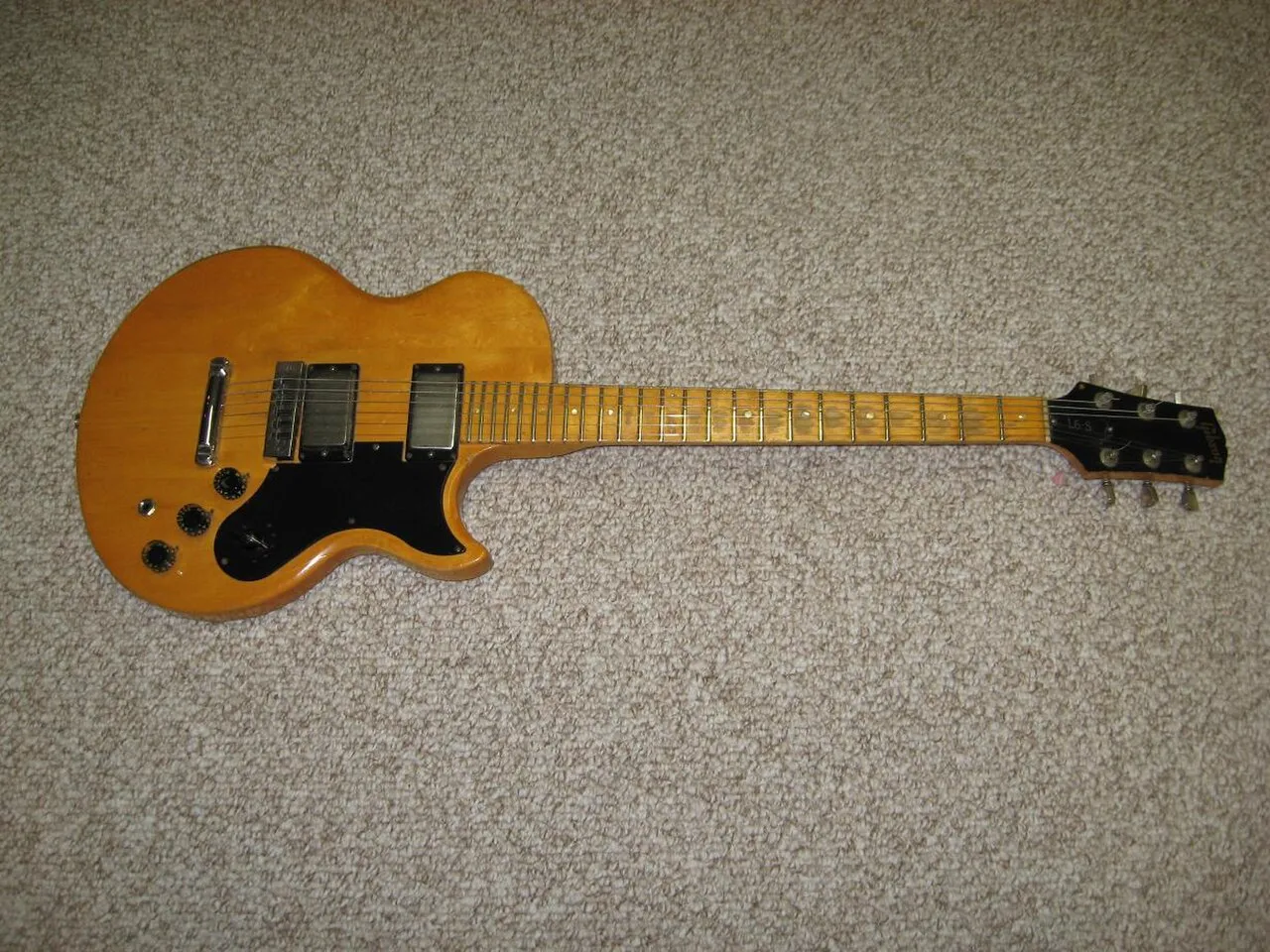
Photo: Glamafez / Wikimedia Commons / Public domain Gibson
L-6S
1973
Bill Lawrence drew a guitar with nine sounds. The budget cut it to six. Santana called it his rainbow.
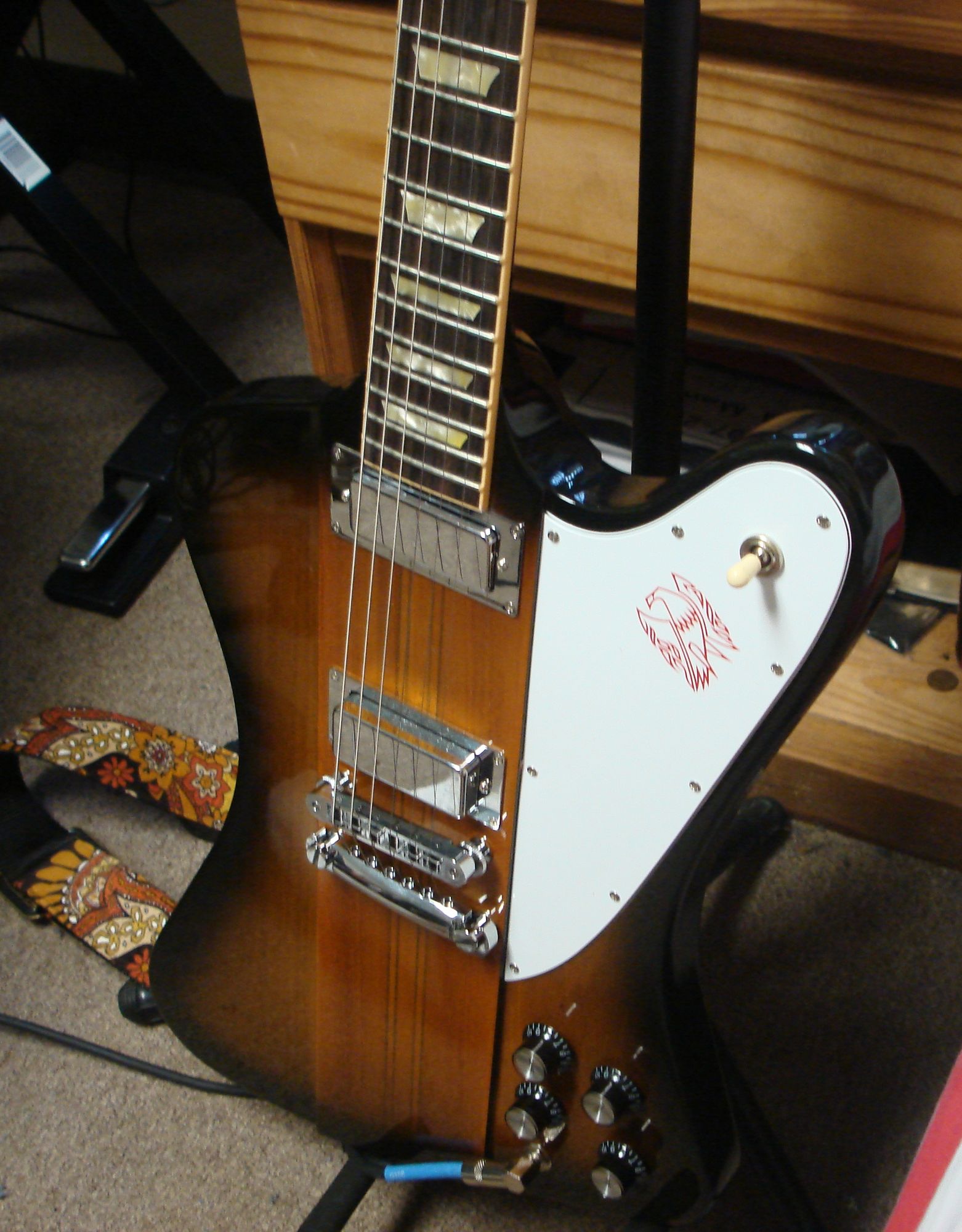
Gibson Firebird V. Photo by Jones629. Public domain (PD-self). Via Wikimedia Commons. Gibson
Firebird
1963
Gibson fixed the Firebird in 1965. Players have been hunting for the unfixed one ever since.

Photo: Lightburst / Wikimedia Commons / CC BY-SA 4.0 Fender
Stratocaster
1954
The guitar most people mean when they say “electric guitar.” Designed by a man who didn’t play one.