Ibanez
JEM
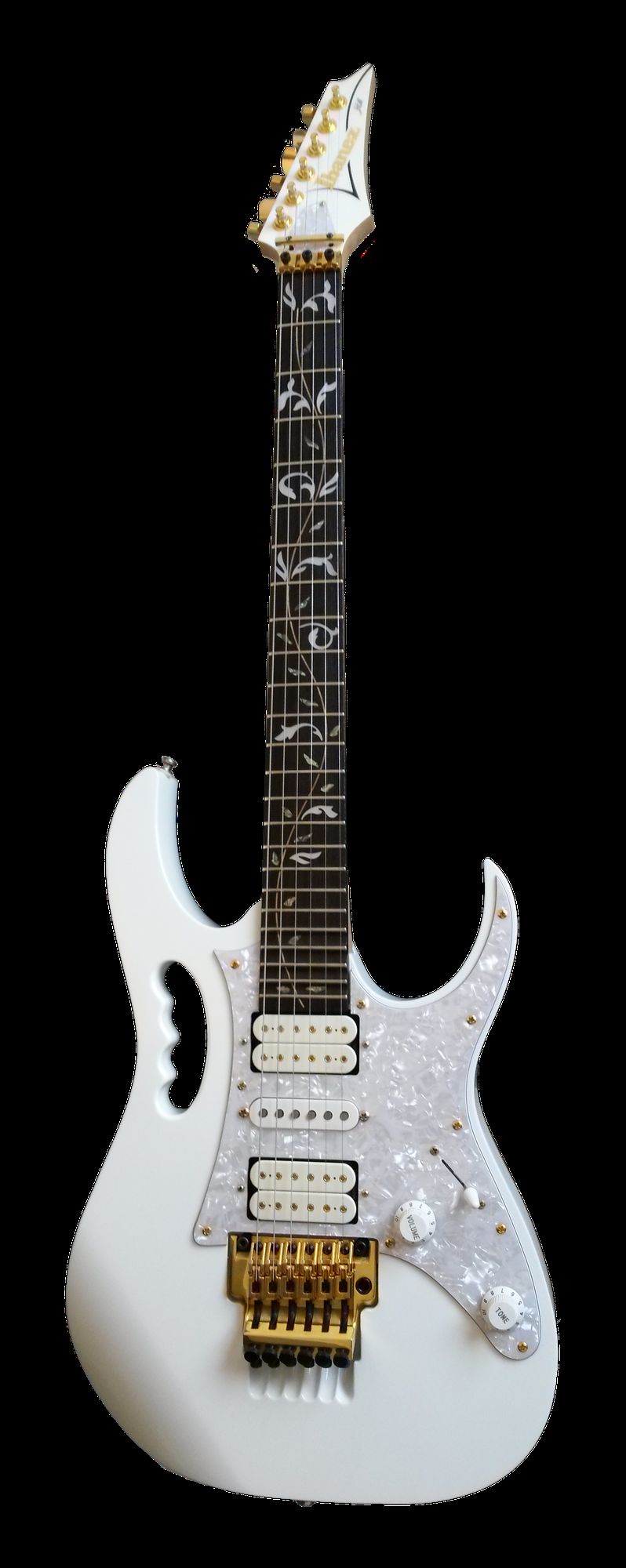
Steve Vai wanted a handle through the body and a finish that matched his curtains. Ibanez put it in the catalog.
Late 1986. Steve Vai sends Ibanez his idea of a guitar: 24 frets with the top four scooped out, a deep bite taken out of the body behind the bridge, and a handle cut clean through the wood. Samples come back from Japan. By Summer NAMM 1987 it has a name, borrowed from a friend’s guitar shop.
- Introduced
- 1987
- Type
- Solidbody electric
- Class
- Production
The short version
1986
The spec
Vai sends his design. Ibanez builds samples in Japan.
1987
JEM777
Launched at Summer NAMM in three loud colors, with a handle in the body.
1988
The floral one
The JEM77FP, with fabric that matched the curtains in Vai’s house.
1993
Evo
An alder JEM with new DiMarzio Evolution pickups becomes Vai’s main guitar.
2019
The Premium JEM
Today’s white JEM7VP arrives from Indonesia as the Japanese JEM7V winds down.
Side A
A1
A guitar with a handle
Most signature guitars are a famous name stamped on something the factory already made. A different color, maybe a special pickup. You’re buying the name.
The JEM is the other kind. It started in late 1986 as Steve Vai’s own list of what he wanted, and almost every strange thing on it is there because he asked. Ibanez built samples in Japan and launched it at Summer NAMM in 1987. The name came from a friend of his, Joe Despagni, who had a shop called JEM Guitars.
Then there’s the hole. Near the edge of the body, a handle is cut clean through the wood. People call it the monkey grip. It does nothing at all to the sound. What it does is make the guitar unmistakable from the back row of an arena. Nobody needed that. He wanted it.
A2
What the weird bits do
The rest of the odd stuff earns its keep.
Behind the bridge, there’s a big scoop out of the body, called the lion’s claw. It gives the locking whammy bar room to pull up as well as dive, so a note can scream up in pitch instead of only sagging down. On the originals, the top four frets were scalloped, the wood scooped out between them, so up there your finger only touches the fret. Wide, wobbly vibrato gets easier. (Don’t assume the current model has the scallops. Check the one in front of you.)
The pickups are a humbucker, a single coil, and another humbucker, and the five-way switch is wired in a way worth knowing about. The ends are the full humbuckers. The middle is the single coil alone. The two in-between spots pair the single coil with half of a humbucker, and that’s where the glassy, quacky sounds live. The classic JEM also had a filter on the volume knob, so turning down didn’t turn the sound to mud.
A3
Loch Ness Green, Desert Sun Yellow, Shocking Pink
The 1987 JEM777 came in three colors, all of them loud, with colored hardware to match and little pyramid inlays that disappear up the neck. The Loch Ness Green ones were signed and numbered, 777 of them, in that year and that color only. It’s easy to assume every JEM777 was limited to 777. They weren’t. Just the green ones.
In 1988 Vai went further. The JEM77FP has a floral finish, fabric under clear coat, and the fabric matched the curtains in his house. His own site calls it “Steve’s favorite of the flock.” I can’t name another production guitar picked to go with the drapes.
One trap, since people fall into it. The swirly guitar you picture from the Passion and Warfare era is often a Universe, the seven-string sibling Vai launched with Ibanez in 1990. JEMs and Universes were both onstage then. They aren’t the same guitar.
Flip the record · By the numbers
777
Signed, numbered Loch Ness Green JEMs from 1987. That color only, not every JEM777.
24
Jumbo frets. On the originals, the top four were scalloped.
5
Switch positions, including two in-between sounds you can’t get on a plain humbucker guitar.
100
Signed JEM EVOs, named for Vai’s own main guitar.
Side B
B1
Evo
In 1993 Vai got a white alder JEM with new DiMarzio Evolution pickups, gold hardware, and the vine-shaped Tree of Life inlay running up the board. It was a prototype for the new JEM7V, and he called it Evo. Years later his website was still calling it his main guitar. Ibanez eventually made 100 signed JEM EVOs in its honor.
The Japanese JEM7V ran from 1993 until about 2019. Plenty of players still think of that one as the real JEM. Today’s white JEM, the JEM7VP, comes from Indonesia with the same basic recipe: alder body, Evolution pickups, Tree of Life, gold hardware. There’s also a JEMJR with the look and simpler parts. And there are counterfeits, which is its own kind of compliment. Check before you buy.
The RG550 came out of Ibanez the same year as the JEM. It has its own story, and it’s a good one.
B2
His, and yours for a while
You can buy a guitar with 24 frets, a locking trem, and a humbucker, single, humbucker layout from lots of companies, Ibanez included. None of them has a handle.
By any sensible standard, the JEM has no business existing as a production guitar. A hole for no tonal reason, a scoop behind the bridge, a finish picked to match somebody’s curtains. It’s one man’s taste, all the way down, and Ibanez has been building it since 1987 so the rest of us can borrow some. Pick one up by the handle and you’re holding a piece of the inside of Steve Vai’s head.
The cast
The people, and the specific guitars, that made the legend.
1993
Steve Vai
“Evo,” a white JEM7V
Co-designer. Evo started as a prototype for the Evolution-pickup JEM and stayed his main guitar for years.
1988
Steve Vai
JEM77FP, the floral one
His site calls it “Steve’s favorite of the flock.”
1987
Joe Despagni
The name
Vai’s friend. The JEM is named after his shop, JEM Guitars.
Denis D’Amour
JEM777
Voivod’s guitarist, one of the better-known players on an original JEM777.
Liner notes
Specs, construction, rarity, value, and every source we used.
Vai’s monkey-grip superstrat — currently an Indonesian Premium JEM7VP, historically a Japan JEM7V, originally a 1987 JEM777. Same silhouette. Three different guitars.
- Body
- Solid alder; monkey grip (treble-side handle); Lion’s Claw trem rout
- Neck
- Bolt-on Wizard 5-piece maple/walnut with KTS titanium rods
- Fingerboard
- Ebony, Tree of Life, 24 jumbo; Premium fret-edge treatment
- Scale
- 25.5" (648 mm)
- Pickups
- DiMarzio Evolution HSH (ceramic H / alnico S / ceramic H)
- Hardware
- Edge double-locking trem, 10.8 mm spacing, gold; Gotoh machines
- Electronics
- Volume, tone, 5-way
- Finish
- White (WH) catalog hero; gold hardware
- Nut
- 43 mm
Open the full research fileConstruction details, the complete player record, production numbers, dated value estimates, and sources
Current production typical = JEM7VP (Indonesia Premium, from 2019). Classic production identity is Japan JEM7V / JEM7VWH (1993–c.2019). Origin identity is JEM777 (1987). Do not assume scalloped last-four frets on the Premium: classic Prestige had them; the JEM7VP feature list fetched here emphasizes edge treatment, not scallops.
Construction
Ibanez JEM is Steve Vai’s co-designed superstrat, launched Summer NAMM 1987 (samples built in Japan after Vai’s late-1986 spec). Not a generic RG. Monkey grip, lion’s claw / bear-claw trem cavity, Tree of Life (or earlier disappearing-pyramid) inlay, DiMarzio HSH. Name from Vai’s friend Joe Despagni’s JEM Guitars shop.
RG is the related non-signature superstrat family launched alongside JEM in 1987. Premier Guitar: RG550 shared HSH switching, 24 frets, crescent heel, Edge cavity — without monkey grip, DiMarzios, scallops, six-finger claw. Cousin, not this guitar. Universe is the 7-string sibling, not a JEM sub-model. JEMJR is Indonesia entry: monkey grip + Tree of Life look, Quantum HSH, Jatoba board, Edge-III-class trem. Same silhouette, different instrument. SMAP $549.99 (2026) per Ibanez wiki citing Guitar Center/Adorama.
JEM7VP (current, ibanez.com/usa). Alder body. Bolt-on Wizard 5-piece maple/walnut with KTS titanium rods; 25.5"; nut 43 mm; 24F 58 mm; 18 mm / 20 mm depth at 1F/12F; 400 mm radius. Ebony board, Tree of Life, 24 jumbo, Premium fret-edge treatment. Classic Prestige also scalloped 21–24. Confirm on a given JEM7VP; do not assume scallops on Premium without a spec line.
Pickups: DiMarzio Evolution H (ceramic) neck, Evolution S (alnico) middle, Evolution H (ceramic) bridge. 5-way: full H / split-H+S / S / S+split-H / full H (Vai/Blucher in-between wiring). Edge double-locking trem, gold; Gotoh machines. Volume, tone, 5-way. Classic JEM also had a high-pass on the volume (Premier Guitar 2012). White/gold “Evo” look is the catalog hero. Street $1,999.99 (Sweetwater, August 2026). This is the guitar Ibanez is actually shipping as the white JEM.
Classic JEM7VWH (1993–2019, Japan Prestige). Alder. Tree of Life. Evolutions (middle was JEM single until later all-Evolution). Edge / Lo-Pro Edge / Edge Pro depending on year: Lo-Pro Edge, then Edge Pro (2003–10), then Edge (2010–). Ebony, then a rosewood period (Ibanez said Evo/Flo went rosewood ~2003). Vai’s stage guitar “Evo” is this family. Japan JEM7V is discontinued as a current Prestige catalog item. Used JEM7VWH is the collector “real JEM” for many players. That is a different used band than JEM7VP.
1987 JEM777. American basswood. Edge. DiMarzio PAF Pro + JEM single-coil. Disappearing-pyramid inlays. Colored hardware. Last-four scallops. Crescent heel. Colors: Loch Ness Green (777 signed/numbered, 1987 only), Desert Sun Yellow, Shocking Pink. Pickup timeline: PAF Pro 1987–92; Evolution era from 1993 JEM7V; Breed on some late-’90s/2000s; JEM555 used Evolutions earlier than other SKUs. Don’t say “always Evolutions.”
JEM77 floral: fabric (or later paper) floral under clear; basswood; often Lo-Pro Edge; PAF Pro era then later Evolutions. JEM77P BFP was Indonesia Premium floral, offered 2015–2025 per Ibanez wiki — treat as discontinued or end-of-life unless a 2026 catalog page is found.
Players
This is a signature line. The primary documented player is Steve Vai. Do not recruit RG users into JEM. RG is the sister mass platform. Universe is the 7-string sibling, not a JEM. The Passion and Warfare cover swirl is often a Universe, not a JEM.
Steve Vai — co-designer and primary user. Personal JEM7VWH “Evo” (1993 alder/Evolution prototype, still described on vai.com as his main guitar years later). Floral JEM77FP (1988): fabric matching the curtains in his home; vai.com: “Steve’s favorite of the flock.” Original 1987 colors (LNG / DY / SK) on Passion and Warfare-era stages — six-string JEM and seven-string Universe both exist in that period; do not call the cover swirl a JEM. Monkey grip is stage character and the silhouette civilians recognize, not a tone circuit. Premier Guitar 2012; Ibanez JEM7VP page.
Denis D’Amour (Voivod) — noted JEM777 user (Wikipedia JEM). Secondary.
No long “also played by” list without model-specific sources.
Rarity
JEM7VP and JEMJR: current production, not rare. RG550 is the 1987 mass sibling (no grip/claw) — high-volume related platform, not this guitar.
Japan JEM7VWH: out of regular production; plentiful on used market but premium to Premium.
JEM777 LNG: 777 signed/numbered, that color only, not all 777s (Ibanez Wiki + Vai.com). Do not compress the entire JEM777 run to 777 units.
JEM10TH: <900 (Vai.com); Liberty Music / common claim 852, “although higher serial numbers do exist.” JEM2KDNA: 300. JEM EVO: 100 signed. JEM77WFP: 14.
Counterfeit “Chibanez” JEMs exist (Wikipedia JEM warning). Factory production totals for the mainline JEM are unpublished in the sources used here. None invented.
Value
Informal estimate, 25 August 2026. Not an appraisal.
New street. Current SKU is JEM7VP: $1,999.99 (Sweetwater, August 2026). JEMJR $550 SMAP (wiki 2026). Japan JEM7V is not a current new catalog item. JEM77P-BFP (Indonesia floral Premium, 2015–2025) street was **$1,600** (SMAP $1,599.99) — different SKU, treat as discontinued/end-of-life unless a 2026 catalog page is found. RG550 Genesis: new long held at $999; used ~$700–$750 going rate (The Gear Page) — mass-production floor under JEM, not a JEM substitute.
Used modern. Sold comps are thin. Used JEM7VP: no guide number; logically under ~$2,000 street. Used Japan JEM7V / JEM7VWH asking examples (not sold comps): roughly $2,600–$4,200 typical asks; signed/mint outliers $5,000–$6,200. Treat as asks. That Japan band is not a JEM7VP comp. JEMJR used: well below $500 likely; not researched here.
Vintage / collectible. Reverb JEM777 Steve Vai Signature (1987–1996) solds $2,250–$8,300 (estimated $2,780–$5,204 on 92 orders, Good to Mint). Named solds: $2,250 (10 Dec 2024, good); $3,200 (24 Dec 2024, good); $4,000 (29 Dec 2024, VG); $4,250 (28 Feb 2025, excellent); $7,500 (27 Jan 2025, VG); $8,300 (26 Mar 2025, good). Spread is finish/condition/LNG vs DY. LNG sits at the top of that spread when original signed/numbered; no LNG-only sold table. JEM77WFP: 14, bundled Ultra Edition asking $25,350 (2024 announcement) — book+guitar package, not a secondary sold. JEM2KDNA (300) and JEM EVO (100): no 2024–26 solds captured; do not invent five-figure bands. Vai-owned instruments are a separate provenance market (one 1998 JEM7V-WH listed at a dealer ~$45k — asking, not a market level).
See also
- fender-stratocaster — the superstrat’s parent layout
- prs-custom-24 — 24-fret US production, different universe
- gibson-sg — the other double-cut players treat as a lead guitar
- jackson-soloist — Grover’s neck-through superstrat; not a Rhoads V and not this JEM
Sources
Ibanez JEM7VP — current construction
Sweetwater JEM7VP WH — $1,999.99 street
Premier Guitar, how Vai’s JEM revolutionized the super-strat — 1987 NAMM; DiMarzio/Blucher switching; bear claw; scallops; monkey grip; pyramids; RG550 cousin
Ibanez wiki, JEM7VP — Premium Indonesia 2019–; price history
Ibanez wiki, JEM77P — floral Premium 2015–2025
Ibanez wiki, JEMJR — 2026 SMAP $549.99
sellmyjem, JEM777 — 1987 colors; name origin (secondary commercial page)
Ibanez wiki, JEM77 Floral Pattern — floral construction
Wikipedia JEM — origin, sub-models, Evo, pickup chronology (some lists citation-needed)
Reverb, JEM777 Steve Vai Signature — 1987–96 solds $2,250–$8,300
Ibanez wiki, JEM777 — LNG 777 that color only; RG550 sibling
vai.com, Ibanez Guitars / Jem, Universe, and Me — 1987 finishes; LNG 777 that color; floral curtains; Universe 1990; Evo 1993; monkey grip
Guitar World, JEM77WFP / Wire & Wood — 14; ask $25,350
The Gear Page, RG550 used prices — ~$700–$750 going rate
Ibanez, Steve Vai artist page — JEM signature; RG as sister mass platform; Universe 7-string
Liberty Music, JEM10TH — ~852
Keep digging
Guitars this one gets compared to, confused with, or descended from.

Photo: Lightburst / Wikimedia Commons / CC BY-SA 4.0 Fender
Stratocaster
1954
The guitar most people mean when they say “electric guitar.” Designed by a man who didn’t play one.
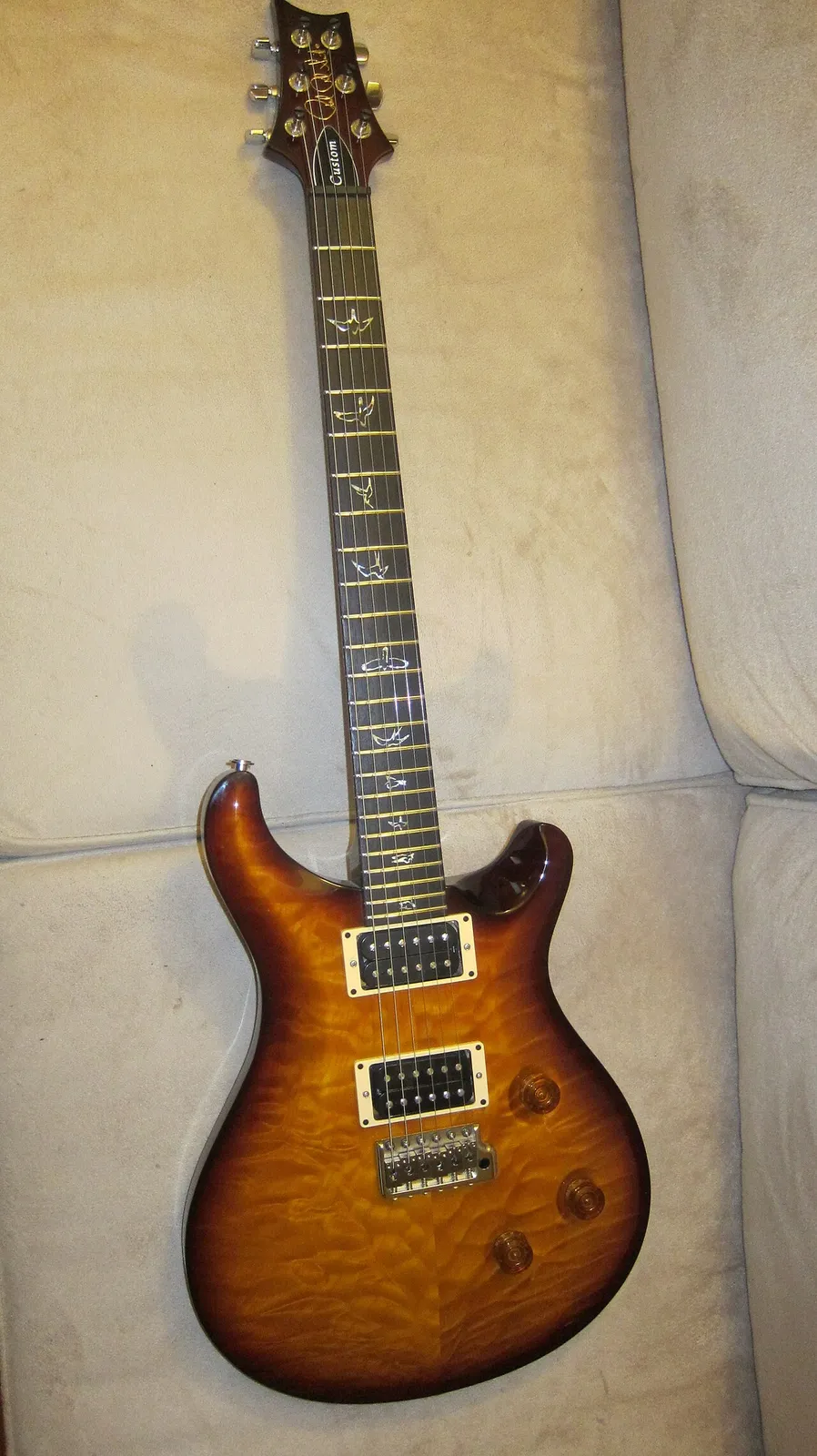
Photo: sbaimo / Wikimedia Commons / CC BY 2.0 PRS
Custom 24
1985
Paul Reed Smith spent a decade building guitars one at a time for touring stars. The Custom was for everybody else.
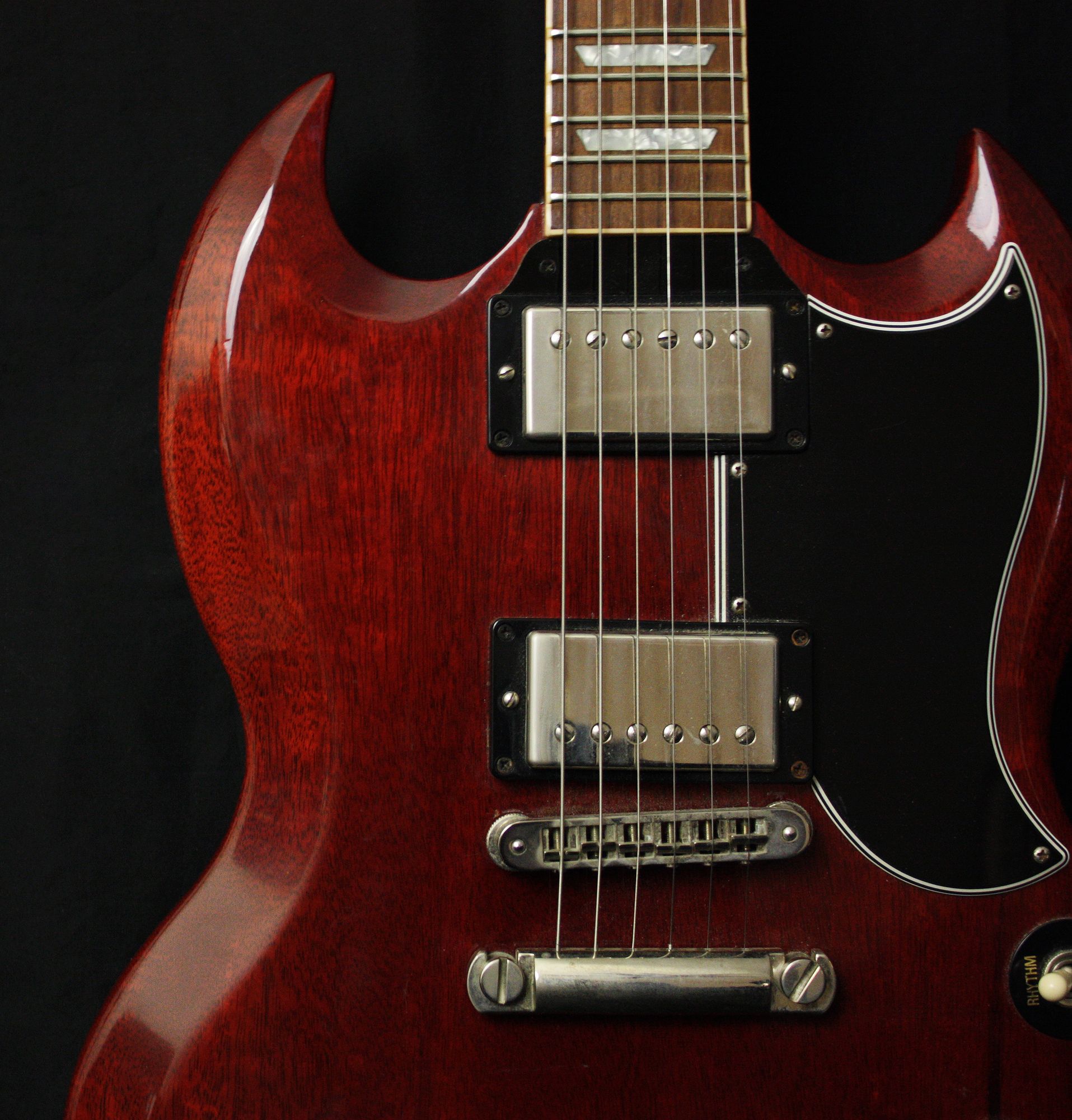
Gibson SG Standard ’61 Reissue, photographed 18 March 2010. Photo by John Tuggle. Licensed under CC BY 2.0. Via Wikimedia Commons. Gibson
SG
1961
Gibson has never stopped making SGs. Angus Young has lost count of his. He still only means one.