 Guitaripedia
Fender
Esprit
Fender built a 335 for people who wouldn't buy a Gibson. Robben Ford says he was the only guy playing it.
Matsumoto, Japan, the mid-1980s. Fender in America sends a rough draft: two cutaways, two humbuckers. The Fujigen team does the rest. What comes back is a set-neck, chambered solidbody with symmetrical horns and a Fender logo.
- Introduced
- 1984
- Type
- Solidbody electric (chambered)
- Class
- Closed run
Have a photograph of this guitar? Send a picture
The short version
Early 1980s
Not copies
Fender, under CBS, wants high-quality alternatives to Gibson. It asks Dan Smith.
1983–85
The Master Series
The Flame, the Esprit, and a D'Aquisto archtop. The books say 1984. Smith says guitars shipped from late 1983 through 1985.
1985
The review
A British magazine plays a Frost White Esprit Elite. The price is £830.
1986
Robben Ford
Fender brings him on to endorse the Esprit.
1988
Talk to Your Daughter
Ford makes the album on his Esprit Ultra.
1991
Still on it
On tour with the Blue Line, Ford is playing the Ultra when he walks into a San Francisco shop.
Side A
A1
The only guy playing it
Robben Ford had been playing a 335 and wanted a solidbody. Fender came to him.
"I was the only guy playing that guitar. It was their version of a semi-hollow, which it wasn't, but it had sound cavities in it and the woods were very bright."
It was a Fender Esprit Ultra, a set-neck, double-cutaway, two-humbucker guitar built in Japan. It looked nothing like a Stratocaster. It wasn't meant to. And it came from a line that, by its own designer's account, barely got going before it was over.
A2
Alternatives, not copies
Early 1980s. Fender belonged to CBS, and it wanted high-quality alternatives to Gibson guitars. Not copies. The company asked Dan Smith, and two of his designs got built.
The Flame was the Les Paul alternative: offset cutaways, slightly bigger than a Les Paul. The Esprit was a step bigger again, with symmetrical horns, and it was the answer to the ES-335. Neither was hollow. The bodies were alder, routed with tone chambers under a maple top, which the catalogue described as "strategically shaped and positioned hollow channels carved in the body." Set maple necks. Special Schaller humbuckers. A fine-tuning tailpiece. A 24¾-inch scale, a Gibson number.
They went out as the Master Series, beside an archtop with James D'Aquisto's name on it. The Starcaster, Fender's earlier semi, was a bolt-on with f-holes. Nobody describes f-holes on an Esprit.
A3
Made in Matsumoto
They weren't built in California. The United States sent a rough draft, a double cutaway and two humbuckers, and Takayuki Hirabayashi's team at Fujigen in Matsumoto did the rest. According to one factory visit, they weren't even offered to Japanese buyers.
There were three grades. The Standard had dots, two knobs, and a three-way switch. The Elite added a coil-tap, four knobs, and snowflake or diamond-flake inlays, depending which description you read. The Ultra, by one account, got a carved spruce top, a bound ebony board, split-block inlays, and gold hardware. By another, it was made to order.
A British magazine got a Frost White Elite in January 1985. The neck joined the body with almost no heel, a habit the reviewer traced to Smith's years at Yamaha, and the neck itself was slim, wide, and flat. The humbuckers on their own were "soft and furry." The passive TBX tone control did more of the single-coil job than the coil-tap did. The fine-tuners came with a warning: unscrew one too far and the knob comes off and disappears. Sustain up the neck on a bend was short. The reviewer liked the Flame better, and called both of them very expensive. The Elite Esprit was £830.
Flip the record · By the numbers
24¾ in
Scale, a Gibson length on a Fender
3
Grades, Standard, Elite, and Ultra
£830
An Esprit Elite in Britain, January 1985
A few thousand
Flames and Esprits together, Dan Smith's estimate. Nobody found the records.
Side B
B1
But they weren't Fender
Smith, years later, on why so few turned up:
"We introduced the line, we had pretty good response, but Fuji had manufacturing problems and we didn't get any for over a year."
Then CBS pulled the plug. Smith thought the sale of Fender, and the changeover around it, may have ended the line early. "They were good guitars, they were made real well, they sounded good and everything else," he said, "but they weren't Fender."
Nobody's sure how many were made. Smith couldn't find the records and guessed a few thousand, Flames and Esprits together, shipped from late 1983 through 1985. The price guides say 1984 only. Esprits dated 1983 and 1985 keep turning up anyway.
B2
One guitar, a few years
That's where Ford comes in. In 1986 Fender brought him on to endorse the Esprit. He says he helped choose the woods and the design, and he calls his guitar "the Robben Ford custom model, the Esprit Ultra," though it wasn't called that at first.
"I used that guitar a ton. That's the Talk to Your Daughter [1988] album. And I used one guitar exclusively for a few years."
People started asking about it, and Fender turned it into a Robben Ford signature model, made in Japan and later in the Custom Shop. That's a later guitar, and so is the Squier Esprit from the 2000s. A 1984 Standard isn't his guitar either.
He was still on the Ultra in 1991, touring with the Blue Line, when he walked into a San Francisco shop for strings, played a Telecaster, and bought it. Later on, people would know him for an Epiphone Riviera, a Telecaster, a PRS with his name on it.
They weren't Fender, Smith said. For a few years, one of them was Robben Ford's.
Put this on
You’ve read about it. Now hear it. Here’s what this guitar sounds like, and what to listen for.
Talk to Your Daughter
Ford's own word is that this album is the Esprit Ultra, before Fender made him a signature model. Bright woods, a solidbody with sound cavities.
Find it on YouTube (opens in a new tab)
The cast
The people, and the specific guitars, that made the legend.
1986–1991
Robben Ford
Fender Esprit Ultra
The one player the accounts name. He used one guitar exclusively for a few years, and it led to his signature model.
Early 1980s
Dan Smith
Designer
Drew the Flame and the Esprit for Fender. "They were good guitars."
Mid-1980s
Takayuki Hirabayashi
Fujigen
His team in Matsumoto turned the American rough draft into the finished guitars.
1985
Paul Colbert
Reviewer
Played an Elite for a British magazine, preferred the Flame, and warned about the vanishing fine-tuner knobs.
Liner notes
Specs, construction, rarity, value, and every source we used.
Chambered alder, a set neck, and symmetrical horns — Fender’s Japanese answer to a 335, sold beside the Flame.
- Body
- Double-cutaway, symmetrical horns, bound. Vintage Guitar: alder, routed with tone chambers, maple top. Blue Book: carved maple top on the Standard and Elite; carved spruce top on the Ultra. Slightly larger than the Flame.
- Neck
- Maple, set. One Two Testing (January 1985): joined almost without a heel. Three-per-side tuners (Blue Book).
- Fingerboard
- Standard and Elite: rosewood. Ultra: bound ebony (Blue Book). 22 tall frets (One Two Testing). Standard: dots. Elite inlay: diamond-flake in Vintage Guitar, snowflake in the Blue Book and on ATB’s 1983 Elite. Ultra: split-block, shell in Vintage Guitar. ATB prints a 12 in radius on that one Elite.
- Scale
- 24¾ in (One Two Testing, January 1985). The Twelfth Fret’s card for one 1984 Standard prints 24.75 in and 628.65 mm. tcgakki calls the Elite a medium scale and does not print a number.
- Pickups
- Two special-design Schaller humbuckers, exposed poles (Vintage Guitar; Blue Book). Black plastic covers on the January 1985 review guitar.
- Hardware
- Fine-tuning tailpiece on the Flame and the Esprit as Vintage Guitar describes the pair, and on the Elite the 1985 review played: roller saddles, miniature fine-tuners. Blue Book gives the Standard an individual-string bridge and tailpiece, and the fine-tuner to the Elite and Ultra. Chrome tuners on the Standard; pearloid buttons on the Elite; ebony buttons and gold hardware on the Ultra. Kahler vibrato was an option. Few shipped (Vintage Guitar).
- Electronics
- Standard: two knobs, three-way, and no coil split (Blue Book; One Two Testing). Elite and Ultra: four knobs and a coil-tap (Blue Book). The reviewed Elite had two passive TBX tones, center at 5. tcgakki lists coil tap and TBX on the Elite.
- Finish
- Vintage Guitar: Standard in Black, Autumn Sunburst, or Cherry Sunburst. Elite and Ultra also in White or Pink Frost, and Candy Red or Candy Green Metallic burst. The Blue Book’s Standard list is shorter: Black or Sunburst. Its Elite and Ultra line is “Sunburst or other colors.”
- Nut
- No factory width has been published. All Music, one 1984 Elite: 1.69 in. The Twelfth Fret, one 1984 Standard: 1.720 in, which that card also prints as 43.72 mm.
Open the full research fileConstruction details, the complete player record, production numbers, dated value estimates, and sources
The specs above are the Japanese Master Series Esprit, the mid-1980s set-neck. No current Fender model carries the name. Standard, Elite, and Ultra differ in the rows above. The Robben Ford signature and the Squier Master Series Esprit are later guitars.
Construction
The job was a 335 for a player who would not buy a Gibson, without the guitar pretending to be a Strat. Set neck. Two humbuckers. Chambers in a solid body. Symmetrical horns, a step larger than the sister model. It went out in the Master Series, beside the Flame and beside an archtop with James D’Aquisto’s name on it.
Early 1980s, under CBS. Fender wanted high-quality alternatives to Gibson. Not copies. The company asked Dan Smith. Vintage Guitar, first published January 1998, says two of his designs were built: the Flame and the Esprit. Alder, routed tone chambers, maple tops, set necks. The Flame is slightly larger than a Les Paul, with offset cutaways, and it was the Les Paul alternative. The Esprit is slightly larger again, the horns are symmetrical, and it was the alternative to an ES-335. Both got special-design Schaller humbuckers and a fine-tuning tailpiece. The D’Aquisto is the archtop. The Flame is the other double-cut. Neither is this guitar.
Not Fullerton. One Two Testing, January 1985: Japanese-built, American-designed. The Blue Book of Guitar Values: produced in Japan. Fachblatt Musikmagazin, February 1987, on a factory visit later translated at daeschler.com, puts the Master Series in Matsumoto and calls the Flame and the Esprit Fujigen guitars. The United States supplied the rough draft, a double cutaway and two humbuckers. Takayuki Hirabayashi’s team did the rest. That visit says they were not offered to Japanese buyers.
Dan Smith told Reverb News, published 12 April 2018, why so few arrived. “We introduced the line, we had pretty good response, but Fuji had manufacturing problems and we didn’t get any for over a year.” Then CBS pulled the plug. “They were good guitars, they were made real well, they sounded good and everything else — but they weren’t Fender.” To Vintage Guitar he added that they had succeeded as instruments and in public perception, and that the sale, and the transition around it, may have ended the line early.
The books call the launch 1984. Smith’s shipping window is wider. The Blue Book: introduced in 1984, and Standard, Elite, and Ultra each made in 1984 only. tcgakki’s Fender Japan history dates the Master Series to 1984. One Two Testing was already reviewing a Frost White Elite in January 1985. Smith could not find quantity records. He estimated a few thousand Flame and Esprit guitars together, late 1983 through 1985. Shop cards and auctions also date Esprits to 1983 and to 1985. ATB’s Elite card says 1983. That card, and the start of his estimate, are earlier than the Blue Book’s 1984. A 1985 guitar is later than “1984 only.”
Fender’s catalogue line, quoted in that review, calls the body tone-chambered: “strategically shaped and positioned hollow channels carved in the body.” Scale 24¾ in. The neck joins almost without a heel, which the reviewer marks as a Yamaha habit from Smith’s years there, and the neck itself — slim, wide, flat — is what those fingers called a Dan Smith neck. The Esprit’s was fuller than the Flame’s, the body fractionally weightier. Twenty-two frets, quite tall. Named weights are single guitars and they do not agree. Gardiner Houlgate’s 1984 Standard: 3.87 kg. The Twelfth Fret’s 1984 Standard: 9.038 lbs, also printed there as 4.10 kg. All Music’s 1984 Elite: 9 lbs 6 oz.
The grades are in the specs above. The arguments are not. Vintage Guitar calls the Elite inlay diamond-flake. The Blue Book calls it a snowflake, and so does ATB’s 1983 card. Vintage Guitar’s design note gives the series maple tops. The Blue Book moves the Ultra onto a carved spruce top and a bound ebony board. tcgakki says that Ultra, with the three D’Aquisto models, was made to order. A shop history, not an order book.
The review played an Elite. Black plastic covers. Roller saddles into miniature fine-tuners, and a warning: loosen one too far and the knob unscrews and vanishes. Humbuckers alone were “soft and furry.” The TBX tones are passive, center at 5 — an ordinary tone to the left, a mid-and-treble lift to the right, two resistors and a capacitor, no battery. The coil tap goes cleaner and thinner. The reviewer thought the TBX did more of the single-coil job. The Standard, in that review, has no splittable coils, which matches the Blue Book’s two knobs and a three-way, against four knobs and a coil-tap on the Elite and Ultra. Against the chamber talk, the complaint was short sustain up the neck on a bend. The reviewer preferred the Flame. Both, the magazine said, were very expensive.
No current Fender carries the name. The Robben Ford signature is a later guitar, and so is the Squier Master Series Esprit. Guitar World, 12 March 2026, dates a Japan signature to 1987–1993 and a U.S. Custom Shop run to 1994–2002, at 24.75 in, and calls that model discontinued. Blue Book Squier 034-3000 is 2005–06: basswood body, set mahogany neck, dot-block rosewood, Duncan Designed humbuckers. MusicRadar, 30 October 2007, describes chambered mahogany instead, a three-a-side headstock less traditional than the Fender’s, and heads the review at £399. Sources differ on that Squier’s body wood. Either wood, it is not this Fujigen guitar.
The Starcaster is the earlier American semi: bolt-on, f-holes, a center block, 25.5 in. The 1985 review and Vintage Guitar describe chambers cut into a solid body. Neither describes f-holes.
Players
Robben Ford is the player the sources name. The guitar is easy to fold into the signature that followed. The accounts do not fold that way.
Vintage Guitar: in 1986 Fender brought him on as an endorser of the Esprit, then reworked the concept and called the result the Robben Ford signature. Ford’s own telling, to Guitarist, reported by Guitar World in March and April 2026, sits next to that. He calls it “the Robben Ford custom model, the Esprit Ultra,” and says it was not called that at first. “I was the only guy playing that guitar. It was their version of a semi-hollow, which it wasn’t, but it had sound cavities in it and the woods were very bright.” He was part of the choice of woods and of the design. He had been on a 335 and wanted a solidbody. Fender came to him. “I used that guitar a ton. That’s the Talk to Your Daughter [1988] album. And I used one guitar exclusively for a few years.” Then people asked, “and they decided to make it a Custom Shop Robben Ford model.”
On his account, the 1988 album is the guitar he was already playing, before that Custom Shop model. Guitar World’s 1987–2002 window, above, is the magazine’s dating of the later instrument. A 1986 endorsement and a 1987 Japan signature can both be true. Neither date turns a 1984 Standard into his guitar.
He was still on one in 1991. Premier Guitar, 9 April 2026: on tour with the Blue Line, “playing the Fender Esprit Ultra,” he went into Black Market in San Francisco for strings, played a Telecaster, and bought it. That Telecaster is a different guitar. The Ultra is what was in his hands when he found it.
What he is known for later is not this instrument. Premier Guitar in 2013 has Bringing It Back Home on a 1966 Epiphone Riviera, one pickup, the whole record. A 2014 rig rundown has that Riviera and a 1960 Telecaster on the road. The PRS McCarty with his name, announced in 2022, is another maker. Guitar World: 200 of them that year. No other player is named on an Esprit in these accounts.
Rarity
You cannot order a new one. Fender has not put the Esprit back under its own name.
No Esprit total has been published. Smith told Vintage Guitar he could not find the records. The “few thousand” is Flame and Esprit together, late 1983 through 1985, and it is his estimate. The Blue Book’s “1984 only” is a dating claim, not a count, and it is narrower than his window and narrower than the 1985 guitars in the sale rooms. tcgakki’s made-to-order note, if it holds, puts the Ultra at the thin end of that run. It is not a serial list.
What is actually thinner: Schallers still under the black covers, a fine-tuner with its knobs, an Ultra on the spruce top the Blue Book describes. Ford’s own Ultra, if it survives, is one object. A Squier Esprit, and a Custom Shop guitar with his name on the truss-rod cover, are later instruments.
Value
Informal estimate, 30 October 2026. Not an appraisal.
Asking prices are not sold prices. A Stratocaster band, a Starcaster band, or an ES-335 band does not apply. No American list price for the Master Series Esprit has turned up. The period price in print is British. One Two Testing, January 1985, has the Elite Esprit at £830, and the Ultra Flame reviewed beside it at £820. The magazine called both very expensive. That is 1985 money.
New street. None. No current Fender Esprit.
Used. Reverb’s guide for its Esprit Elite bucket, filed there as 1985–1987, showed no sold estimate when the page was checked. The guide says a range appears once more of them sell. The Standard’s guide showed no used estimate either. There is no order-counted band.
Named asks on Reverb’s Esprit index, as that index stood on 19 October 2026. A modified 1984 Elite at $2,149.95. The seller replaces the Schallers and the fine-tuner, so it is not a clean one. An early-1980s Standard in Autumn Burst at $1,999. A 1985 Standard at $1,797. A 1985 sunburst at $1,259.99, down from $1,399.99. A Frost White Elite at $2,100. A black Standard at $1,050, down from $1,400. A 1984 tobacco sunburst at $1,500, down from $1,600. Asks. Off that index, the Twelfth Fret was asking $2,750 for a 1984 Standard, and ATB listed a 1983 Elite at £995.
Named hammers, not a median. Gardiner Houlgate, 5 December 2025, a 1984 Standard in black, original hard case, sold for £700. The estimate was £800–£1,200. Great Western Auctions, 10 May 2023, a Japan Esprit in cherry burst, circa 1985, serial 40300609, with a Fender case, hammer £820. Two British auction results. They are not an American sold series.
The signature is a different market. One ask on the same Reverb index, a 1986 Japan Robben Ford signature in cherry sunburst, was $3,570.34. One listing. Not a Master Series Esprit, and not a guitar he owned. No auction of an Esprit he played has turned up.
The Squier has its own used market, under that name. Those sales are not this guitar’s.
See also
- Starcaster — Fender’s 1976 bolt-on semi, f-holes and a 25.5 in scale; not this set neck
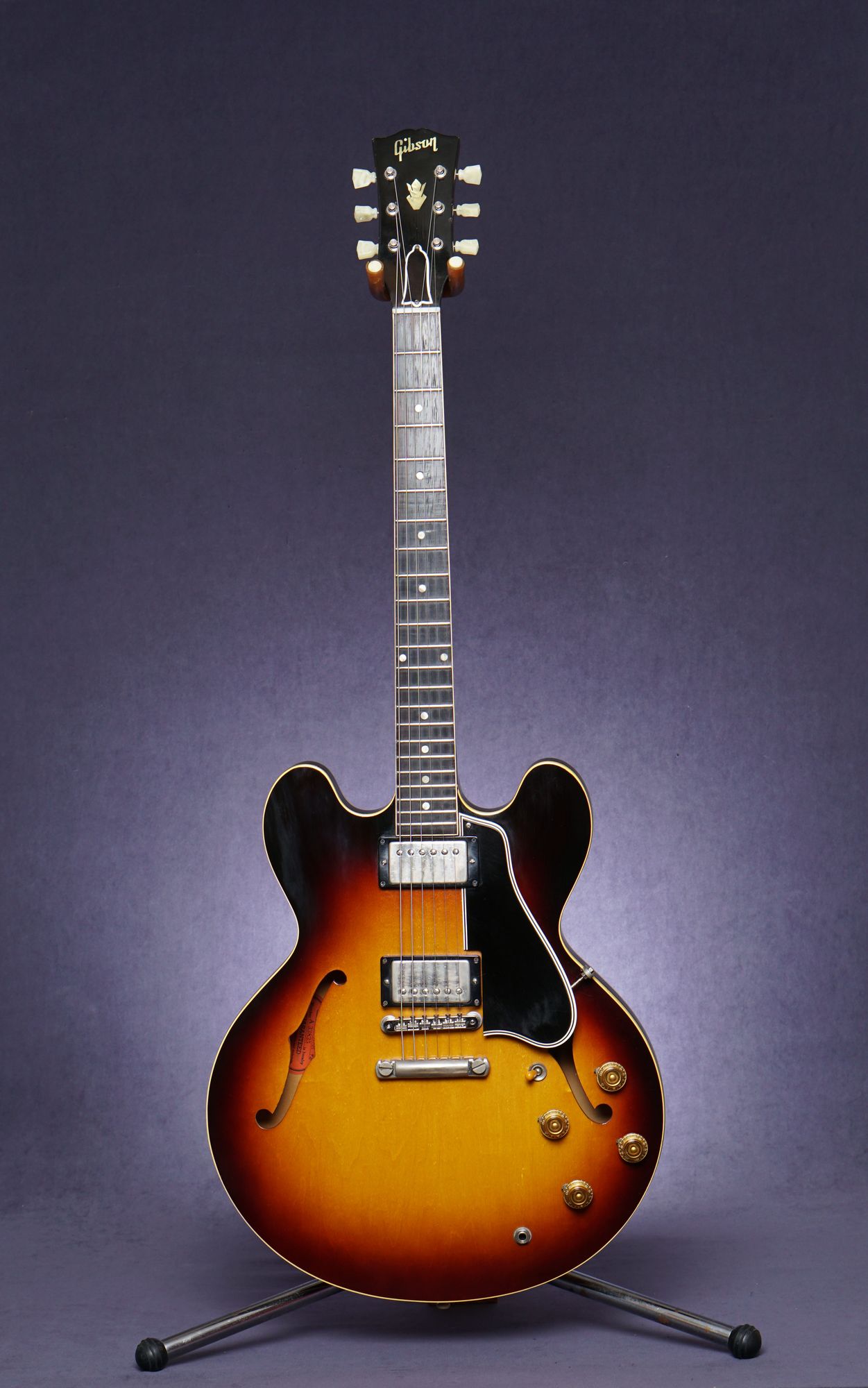
- ES-335 — the thinline, center-block Gibson this chambered solid was drawn against
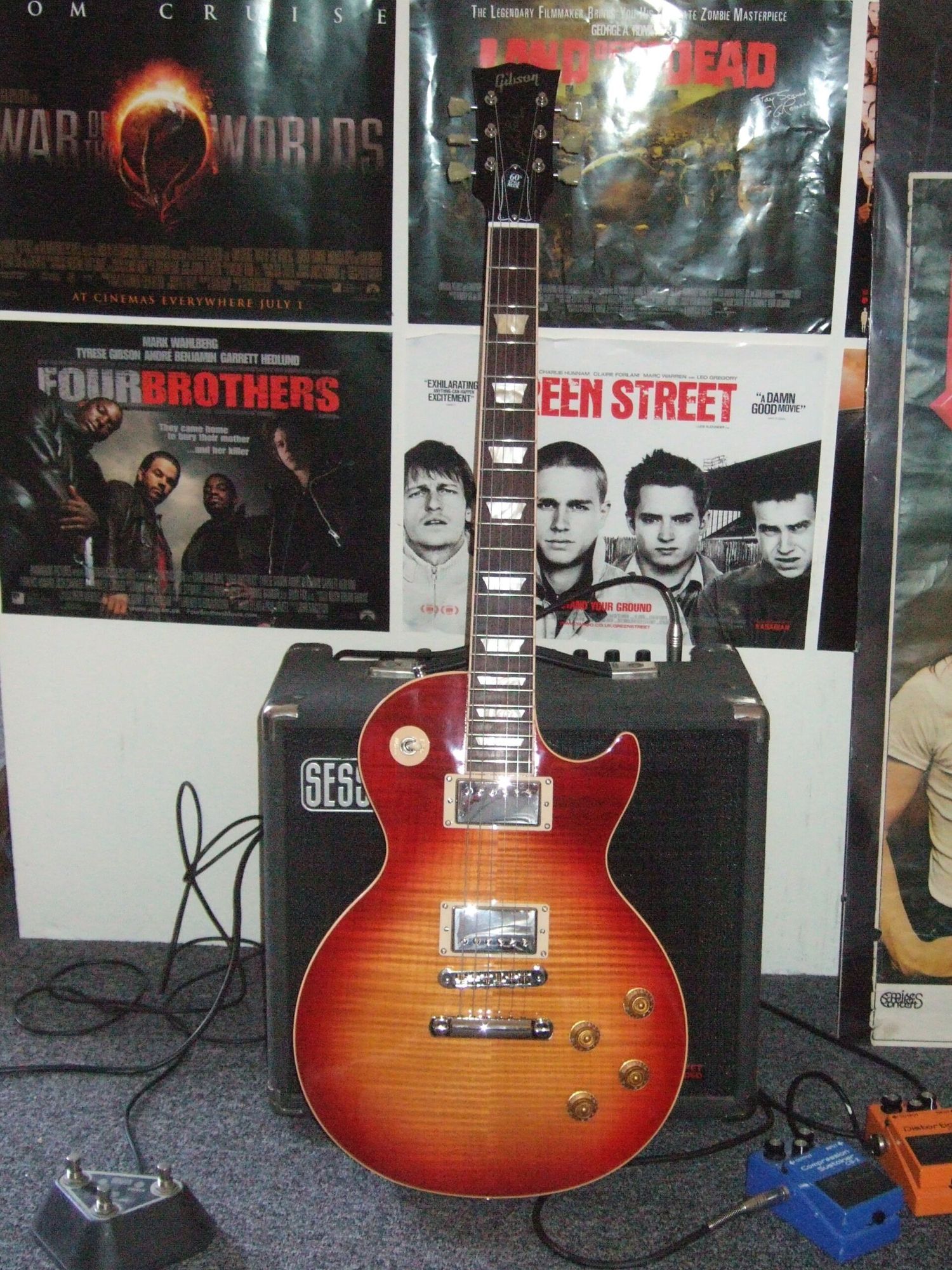
- Les Paul Standard — the solid the sister Flame was aimed at; the Flame is a different Master Series model
Sources
- Vintage Guitar: The Fender Master Series (Gary Koehler; originally January 1998) — Smith’s chambered solidbody; alder, maple tops, set necks; Esprit as the 335 alternative, slightly larger than the Flame, symmetrical cutaways; Schaller humbuckers; fine-tuning tailpiece; Standard, Elite, and Ultra appointments; finish lists; Kahler option, few shipped; a few thousand Flame and Esprit shipped late 1983–85, no records found; 1986, Ford as Esprit endorser, then the signature
- Reverb News: Dan Smith interview (published 12 April 2018) — Fuji manufacturing delay of over a year; CBS pulled the plug; “they weren’t Fender”
- One Two Testing: Fender Flame/Esprit (Paul Colbert, January 1985) — Japanese-built, American-designed, Dan Smith; 24¾ in; tone-chambered wording; TBX; roller saddles and fine-tuners; 22 tall frets; Standard without coil-split; Frost White Elite Esprit reviewed; short sustain on bends; Elite Esprit £830, Ultra Flame £820
- Blue Book of Guitar Values: Esprit and Flame (Master Series) — introduced 1984, Japan; Standard, Elite, and Ultra each “mfg. 1984 only”; woods, inlays, knobs, coil-tap, tuners, spruce top on the Ultra; Flame smaller
- Fachblatt Musikmagazin 2/1987, translated at daeschler.com — Matsumoto; Flame and Esprit as Fujigen guitars; U.S. rough draft, Hirabayashi’s team for the rest; not offered to Japanese buyers, on that visit
- tcgakki: Fender Japan history, Master Series — 1984; D’Aquisto, Esprit, and Flame, each in Ultra, Elite, and Standard; Esprit Ultra and the three D’Aquistos made to order; Elite as maple top, chambered alder, medium scale, coil tap and TBX; Ford, then the ES-RF signature
- Guitar World: Robben Ford on the Esprit Ultra (12 March 2026) — Ford to Guitarist; signature dated by the magazine as Japan 1987–1993, U.S. Custom Shop 1994–2002, 24.75 in, discontinued
- Guitar World: Robben Ford, Two Shades of Blue (14 April 2026) — his account of the Ultra, Talk to Your Daughter (1988), and the later Custom Shop model
- Premier Guitar: Robben Ford’s slow burn (9 April 2026) — 1991, Blue Line tour, playing the Esprit Ultra; the Black Market Telecaster is a different guitar
- Premier Guitar: one guitar, one album (15 April 2013) — Bringing It Back Home on a 1966 Epiphone Riviera, not an Esprit
- Premier Guitar: Rig Rundown, Robben Ford (19 March 2014) — 1966 Riviera and 1960 Telecaster on the road
- Guitar World: PRS Robben Ford signature (11 October 2022) — a PRS McCarty, 200 examples in 2022; not this Fender
- MusicRadar: Squier Master Series Esprit (30 October 2007) — later Squier; chambered mahogany in that review; three-a-side headstock; review headed £399
- Blue Book: Squier Esprit, no. 034-3000 — 2005–06; basswood body; set mahogany neck; Duncan Designed humbuckers
- The Twelfth Fret: 1984 Esprit Standard — one guitar: 24.75 in and 628.65 mm; nut 1.720 in and 43.72 mm; 9.038 lbs and 4.10 kg; ask $2,750
- All Music: 1984 Esprit Elite, modified — one guitar: 24.75 in scale, 1.69 in nut, 9 lbs 6 oz; Schallers and fine-tuner replaced; ask $2,149.95, also on Reverb
- ATB Guitars: 1983 Esprit Elite — shop card dated 1983; chambered alder, carved maple, snowflake inlays, 24.75 in scale, 12 in radius, Schaller humbuckers, coil-split, TBX; listed at £995
- Reverb: Fender Esprit marketplace index — asks as the index stood on 19 October 2026, including the signature ask at $3,570.34, which is a different model
- Reverb: Esprit Elite guide, filed 1985–1987 — no sold estimate on the guide when the page was checked
- Gardiner Houlgate, 5 December 2025, lot 415 — 1984 Standard, black, 3.87 kg, sold £700, estimate £800–£1,200
- Great Western Auctions, 10 May 2023, lot 454 — Japan, cherry burst, circa 1985, serial 40300609, hammer £820
Keep digging
Guitars this one gets compared to, confused with, or descended from.
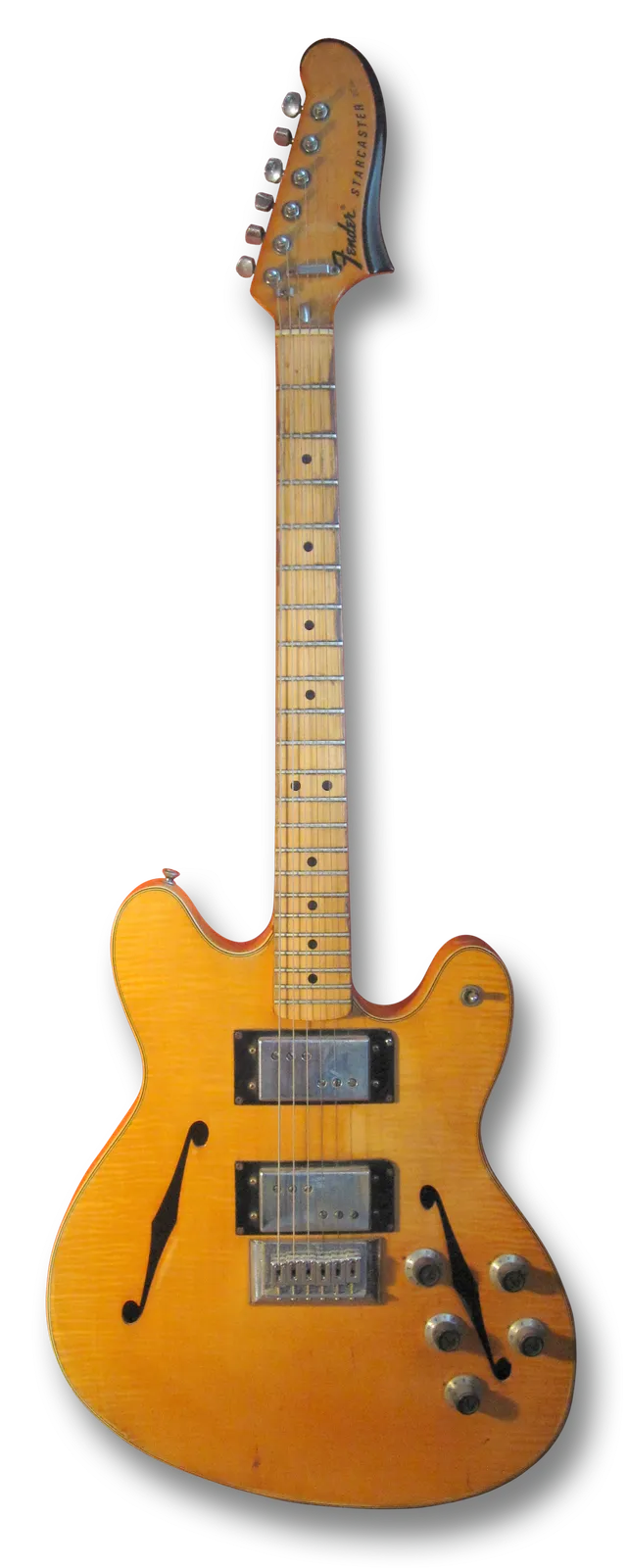
Photo: Tasmer / Wikimedia Commons / CC BY-SA 3.0 Fender
Starcaster
1976
Fender built it for 335 players. They walked right past it. Twenty years later, Radiohead didn’t.
Photograph of a vintage 1960 Gibson ES-335TD. Photo by Lightburst. Licensed under CC BY-SA 4.0. Via Wikimedia Commons. Gibson
ES-335
1958
Larry Carlton played three 335s off a shop wall, unplugged, paid $850 for one, and became Mr. 335.
2006 Gibson Les Paul Standard (SN 000660573). Photo by wetwebwork. Licensed under CC BY-SA 2.0. Via Wikimedia Commons. Gibson
Les Paul Standard
1952
Gibson made about 1,500 sunburst Les Pauls, decided nobody wanted them, and stopped. Then the British blues boom happened.