Fender
Lead II
Fender built it to fill a gap in the price list. It kept turning up as somebody’s first.
Fullerton, California, fall 1979. CBS-era Fender is losing the cheap end of the market to Japanese copies, and it wants a guitar that sits under the Stratocaster without feeling like a student model. Marketing names it the Lead. The second version gets two pickups and a switch the Strat never had.
- Introduced
- 1979
- Type
- Solidbody electric
- Class
- Production

The short version
1979
The Lead arrives
Fall 1979, Fullerton. Steve Morse premieres the series at NAMM in Atlanta.
1978–79
The first guitar on the wall
Eric Clapton gives Hard Rock Cafe London a guitar. Sources split on the year, and on whether it was a Lead II.
1980
On tour with the Cars
Elliot Easton takes the Leads on the road in 1980 and ’81.
1981
A black Lead 2
U2 Magazine No. 1 reports Bono playing one through a Roland Bolt 60.
1982
The run ends
Fender Japan and the Squier JV guitars take over the price slot.
1985
Still onstage
A Redferns photograph catches Bono with a Lead II on the Unforgettable Fire tour.
2020
The homage
A Mexican-made Player Lead II arrives in January. By Player II in 2024, it’s gone again.
Side A
A1
A guitar over a bar stool
The Hard Rock Cafe collection starts with one guitar. Eric Clapton gives it to the London cafe, and it goes up on the wall over his usual seat. Pete Townshend answers with a Les Paul and a note:
Mine’s as good as his! Love, Pete.
Hard Rock Cafe Vienna and a 2021 dpa report say Clapton’s guitar was a Fender Lead II. The Independent says “a red Fender” and leaves the model out. dpa dates it to 1978; the London cafe’s own tour sheet and The Independent say around 1979. Nobody has settled it, so neither will I.
But if it was a Lead II, notice what kind of guitar that is. Not a Strat. Not a vintage anything. A new, mid-priced Fender that nobody was supposed to get romantic about. That turns out to be a habit with this one. It was never anybody’s dream guitar, and it kept turning up as somebody’s first.
A2
Priced under a Strat, not under a Yamaha
The Lead was a business decision. By the late ’70s, CBS-era Fender was losing the cheap end to Japanese copies, and it needed a Fullerton-built solidbody that cost less than a Stratocaster. Dennis Handa, the marketing director, named it the Lead. Gregg Wilson and Freddie Tavares worked on it, then John Page. It came out in the fall of 1979.
German Wikipedia says it was meant to replace the Bronco, the Mustang, and the Musicmaster. It didn’t beat the imports on price. In West Germany it went for 850–900 DM with the case. A Strat was about 1,300–1,400 DM, and the Japanese guitars sat around 500–700 DM. In the U.S., Wikipedia gives roughly $495. So it was cheaper than a Strat, but it was never the bargain bin.
What you got for that money was a small headstock, closer to 1954 than the big CBS one still on the Strat. German Wikipedia calls it Fender’s first narrow headstock since 1965. The neck is a soft C with a round 7¼" board and 21 frets, the kind of neck players already liked.
A3
Two pickups and a switch
The Lead II is not a Strat, and the controls tell you right away. It has two X-1 single-coils, slanted, one at the neck and one at the bridge, with flat Alnico V pole pieces. There’s a master volume, a master tone, a three-way toggle, and then a second toggle.
That second one is the whole trick. With both pickups on, it flips one out of phase. On a Strat, the in-between sounds come from mixing three coils. On a Lead II, the middle sound is two coils fighting each other: thinner, hollower, a little nasal.
The bridge is a hardtail with the strings through the body, so no tremolo. If you see one with a whammy bar, somebody added it.
And don’t confuse it with its siblings. The Lead I has one split humbucker at the bridge. The Lead III, from 1982, has two humbuckers. The Lead II is the one with the two single-coils.
Flip the record · By the numbers
~$495
Approximate U.S. price at launch, per Wikipedia. Priced under a Strat, not under the imports.
850–900 DM
West German price with case, against about 1,300–1,400 DM for a Strat.
2
Slanted X-1 single-coils, plus a phase switch that only works when both are on.
0
New Lead IIs you can order from Fender in September 2026.
Side B
B1
The guy who really played it
Steve Morse was the first endorser. He premiered the series at NAMM in Atlanta and is the player in the original ads. People sometimes pin a Dregs track on him and this guitar, but Night of the Living Dregs was recorded in 1978, before the Lead existed.
Elliot Easton of the Cars has the better claim. During Panorama, Fender “made me a couple” of the new Leads and put him in the catalog. He took both models on tour in 1980 and ’81. He calls himself “the first guy to play the Lead One and Lead Two, like really play it.”
He’s careful about the famous part, though, so we should be too. “The Lead I is what I used for the solo in ‘Touch and Go.’” That’s the humbucker guitar. The Lead II was on the road with him, not on that record.
B2
Bono’s first stage guitar
In November 1981, the first issue of U2 Magazine described Bono playing “a black Fender Lead 2” through a Roland Bolt 60. A Redferns photo by Richard E. Aaron, dated March 1985, shows him with a Lead II on the Unforgettable Fire tour. Hard Rock owns one of his and calls it his “first stage guitar from the early ’80s.”
It’s a funny fit. One of the biggest bands in the world started out with its singer on a sensible, mid-priced Fender with a phase switch.
B3
Gone, then back, then gone
The Fullerton run ended in 1982. Fender Japan and the Squier JV guitars took over the price slot. In January 2020 Fender brought the Lead II back in the Mexican Player series, with a flatter 9.5" board, 22 frets, and Player pickups instead of the X-1s. By the time the Player II line came out in July 2024, it wasn’t on the list.
So there’s no new Lead II to buy right now. What’s left are the originals, made for three years to fill a gap in a price list. Fender never meant it as anybody’s holy grail. It was meant for the kid who couldn’t quite stretch to a Strat. One of those guitars hangs over a bar stool in London where the whole Hard Rock collection started, and another was the first stage guitar of a young singer from Dublin.
Put this on
You’ve read about it. Now hear it. Here’s what this guitar sounds like, and what to listen for.
Bono’s Fender Lead II
Hard Rock’s own clip on the guitar it calls Bono’s “first stage guitar from the early ’80s.” Look for the two slanted pickups and the extra toggle.
Watch it on YouTube (opens in a new tab)
The cast
The people, and the specific guitars, that made the legend.
1979
Steve Morse
Lead series, first endorser
Premiered the series at NAMM in Atlanta and fronted the original ads.
1980
Elliot Easton
Lead I and Lead II
Fender “made me a couple” during Panorama. Both went on tour in 1980 and ’81. The “Touch and Go” solo is the Lead I.
1981
Bono
Black Lead II
Reported in U2 Magazine No. 1 and photographed with one in 1985. Hard Rock calls it his first stage guitar.
1978–79
Eric Clapton
The Hard Rock London wall guitar
The first piece in the Hard Rock collection. Hard Rock Vienna and dpa call it a Lead II; The Independent says only “a red Fender.”
1979
Dennis Handa
Named it
Fender’s marketing director, who called the series the Lead.
Liner notes
Specs, construction, rarity, value, and every source we used.
Two slanted X-1 single-coils and a phase switch on a string-through double-cut — Fender’s Lead II, not a Strat, and not the one-humbucker Lead I.
- Body
- Ash or alder; double-cut, slightly smaller than a Strat; hardtail, strings through the body
- Neck
- Bolt-on maple, four-bolt, vintage “Soft C”; truss rod at the heel
- Fingerboard
- Maple or rosewood, 7¼" (184 mm) radius, 21 medium frets
- Scale
- 25.5". Wikipedia also prints 65 cm. Mix flagged.
- Pickups
- Two X-1 single-coils, neck and bridge; flat unstaggered Alnico V poles
- Hardware
- String-through hardtail; lock nuts on the saddle screws, not springs; West German “F” tuners; four-bolt “F” neck plate
- Electronics
- Master volume, master tone; 3-way toggle; phase switch, only when both pickups are on
- Finish
- 1979–81: black, wine red transparent. 1981–82 also Arctic white, cherry sunburst, sienna sunburst
- Nut
- White plastic, 1.60" (40.64 mm)
Open the full research fileConstruction details, the complete player record, production numbers, dated value estimates, and sources
Classic living example = 1979–82 Fullerton Lead II. No current Fender Lead II: the 2020 Mexican Player homage is discontinued and is not on the Player II list. Mixed inch/mm flagged. Wikipedia pairs 7¼" (184 mm) and a 1.60" (40.64 mm) nut, then prints scale as 25.5" (65 cm). 65 cm is a rounded conversion, not the 648 mm on Fender’s Player sheet. Do not average 7¼" with 9.5", or 21 frets with 22. Not a Stratocaster, Telecaster, Bass VI, Lead I, Lead III, or the unshipped Lead Bass.
Construction
The job was a Fullerton solidbody under a Strat’s price, with a neck players already liked and pickup options the Strat didn’t have. CBS was losing the cheap end to Japanese copies. Dennis Handa, marketing director, named it Lead. Fall 1979 through 1982, Gregg Wilson and Freddie Tavares, then John Page. Fender’s Player copy dates the series to 1979.
It did not undercut the imports, and it was not a Mustang with a new badge. German Wikipedia: Lead I and Lead II were meant to replace Bronco, Mustang, and Musicmaster. The Mustang stayed a while. West German price, 850–900 DM with the case, against a Strat at about 1,300–1,400 DM and Japanese guitars around 500–700 DM. English Wikipedia’s U.S. figure is approximate $495. Period money, not 2026. Keep both. Neither is a scanned price list in hand.
Wikipedia’s string spacing is 0.404" (10.26 mm) — mixed inch/mm, not a second scale. The neck is a small headstock, nearer 1954 than the big CBS headstock still on the late-1979 Strat. German Wikipedia calls it the first narrow headstock back since 1965. StratCollector: the 1980 “Strat” also got a small, inaccurate pre-CBS headstock, and the Dan Smith Standard of late 1981 a better one. The Lead is the 1979 guitar. Not those Strats. Soft C, 7¼", 21 medium frets, truss at the heel, four-bolt “F” plate, West German “F” tuners (the Japanese edition names Schaller), white plastic nut.
Both pickups are X-1s, slanted, neck and bridge. Not three Strat coils. English Wikipedia and StratCollector put that same pickup in the bridge of “The Strat” and the Dan Smith Strat, hotter than the other two coils. Japanese Wikipedia puts it in the front position on those Strats. Keep both. On this guitar both seats are X-1s. Flat poles, not staggered, Alnico V. Japanese Wikipedia: about 7.5 kΩ, about 9,600 turns. Early bobbins green or grey fiberboard; later ones molded plastic. Carter Vintage read 7.5k and 7.4k on one 1982. One guitar. Don’t average it into a factory spec.
The switch is the point the outline doesn’t show. Master volume, master tone, three-way toggle, and a second toggle that flips phase only when both pickups are on. A Strat’s in-between sounds are three coils and, after 1977, a five-way. This middle is two coils out of phase.
Not a Lead I. One bridge split-humbucker, coil select, series/parallel. Easton’s “Touch and Go” solo is that guitar. Not a Lead III. Two humbuckers. Wikipedia dates it 1982 only. Reverb’s product page files all three as 1979 and the Lead II bucket as 1979–1983. Keep 1982 and the 1983 bucket. Not a Lead Bass. Wikipedia: a 1979 prototype, two slanted single-coils, 34", never shipped. Not this guitar, and not a Bass VI.
Inside the short run: colors go from black and wine red transparent (1979–81) to those plus Arctic white, cherry sunburst, and sienna sunburst (1981–82). Pickguard black-white-black through 1981, white-black-white in 1982, foil-backed. At some point in 1982 the lower bout of the headstock shifted toward the body. Ash or alder — Wikipedia doesn’t split the years. The line ends when Fender Japan and the Squier JV models take the price slot. No published Lead II total. Shared serials date a guitar. They don’t count a year.
January 2020. Lead II and Lead III come back in the Player series, Mexico — Modern C, 9.5" (241 mm), 22 frets, synthetic-bone nut 1.650" (42 mm), Player Series Alnico V coils instead of the X-1. Guitar Player’s sample weighed 8 lb; Guitar.com’s weighed 3.1 kg / 6.8 lb. Don’t average them. Player II (9 July 2024) does not list a Lead. Classic against current: the 1979–82 X-1 hardtail, and no new Lead II you can order in September 2026.
Players
Do not hang a Strat or a Tele on this plate. Do not put “Touch and Go” here. That solo is a Lead I. Do not recruit the Bass VI, or the Lead Bass that never shipped.
Steve Morse. Wikipedia: first endorser, and he premiered the series at NAMM in Atlanta. Guitar Player (23 October 2020): he is the player in the original ads, on a guitar with fewer pickups than the Tele he was known for. NAMM’s oral history puts that 1978 guitar as the Frankenstein Telecaster. The series page’s user-generated list hangs “Punk Sandwich” on him. Wikipedia’s album page: Night of the Living Dregs was recorded 1978, and “Punk Sandwich” is a studio track on the first half, not the Montreux live half. Fall 1979 is after that tape. The ad is the fact. The track is not this guitar.
Elliot Easton (the Cars). Vintage Guitar (Bret Adams, March 2018 issue): during Panorama, Fender “made me a couple” of the new Lead I and Lead II and put him in the catalog. “The Lead I is what I used for the solo in ‘Touch and Go.’” Guitar World (7 December 2020): 1979 Lead I, humbucker in series, Mesa Boogie Mark II, Marshall 4×12. Ultimate Guitar (25 April 2023): not a signature model; he was “the first guy to play the Lead One and Lead Two, like really play it”; the solo is the Lead I; “those guitars” on tour in 1980 and 81. Morse premiered it. Easton says he really played it. The tour rig includes a Lead II. The recorded solo does not.
Bono (U2). Equipboard’s transcription of U2 Magazine No. 1 (November 1981): “a black Fender Lead 2,” into a Roland Bolt 60. Getty / Redferns (Richard E. Aaron) captions a Lead II on the Unforgettable Fire tour; the photo is dated 1 March 1985. Hard Rock’s own clip calls a Lead II his “first stage guitar from the early ’80s.” The series page, flagged there as unsourced, adds a black one in the 1983 Live at Red Rocks film. Keep the magazine, the photo credit, and the Hard Rock object. No song on that film is pinned here.
Eric Clapton — the London wall guitar. Hard Rock’s London tour sheet: sometime around 1979 he gave the cafe a guitar, the first piece in the collection, and Pete Townshend answered with a Les Paul — “Mine’s as good as his! Love, Pete.” Hard Rock Cafe Vienna (9 January 2021) names that first guitar a Fender Lead II, hung over his usual seat. DIE ZEIT / dpa (11 June 2021) dates the ask to 1978 and names a Lead II. The Independent (10 April 2004) says 1979 and “a red Fender,” model unnamed. Keep 1978 and 1979. One object. Not a studio log, and not a comp.
Also known, short. Japanese Wikipedia: Johnny of Yokohama Ginbae on a Lead II; Kazuhiko Fujii of the Groovers on a yellow one and a black one later fitted with a synchronized tremolo. That tremolo is a mod. The catalog guitar is a hardtail.
Rarity
You cannot buy a new Lead II from Fender. The Fullerton run is over. The 2020 Mexican Player is another factory on this outline, and shops now file it discontinued. It is not a 1979 guitar.
Shipping totals are unpublished. None invented. Shared serials date an instrument. They don’t count a year. That is why a first-year census is unknown, not the chapter.
What is actually thinner: early wine-red guitars with the X-1s still in them; black-white-black guards from the first part of the run; knowing whether a 1982 headstock is before or after the lower-bout shift. Clapton’s London Lead II, and the one Hard Rock calls Bono’s first stage guitar, are unique objects. They are not a vintage Lead II.
Value
Informal estimate, 23 September 2026. Not an appraisal.
Asking prices are not sold prices. Factory totals unpublished. Clapton’s London guitar and Bono’s Hard Rock instrument sit outside these ranges. A Player reissue does not substitute for 1979–82 Fullerton. Sold comps are thin this pass: one Reverb estimated-value widget, no order count on the page. Don’t invent a median.
New street. None. No Lead II in the current Fender line. Historical, not 2026: Wikipedia’s approximate U.S. list $495; German introduction 850–900 DM with case. Launch-era Player street: Guitar Player $599 (23 October 2020); Guitar.com £599 (27 March 2020). Leftover discontinued tags: West Music $639.99; Guitar Center neon green $579.99, sold out; Fender Australia A$1,199, sold out. Don’t average dollars, pounds, and Australian dollars.
Used modern. No clean Reverb Price Guide band for the Mexican Player Lead II isolated this pass. Don’t invent one from those leftover tags.
Vintage / collectible. Reverb’s widget on a 1979–80 burgundy listing printed $610–$794 estimated used value. The same listing’s ask had dropped to $985 — above the widget, and still an ask. Telluride’s 1979 wine, rosewood board, was tagged $849 and marked sold out. Do not average the widget with the ask. No public hammer located for the Hard Rock guitars. Not comps.
See also
- Stratocaster — three single-coils and a tremolo, the guitar this was priced under. Not this hardtail
- Telecaster — string-through ferrules, on a single-cut slab. Not this double-cut
- Mustang — the short-scale student double-cut the Lead was aimed past. Not this 25.5" phase-switch guitar
Sources
- Wikipedia, Fender Lead Series — fall 1979–1982; Handa; Morse NAMM premiere; Wilson, Tavares, Page; Fullerton; approx. $495; Soft C; 7¼" (184 mm); nut 1.60" (40.64 mm); 21 frets; scale 25.5" (65 cm); bridge spacing 0.404" (10.26 mm); X-1 neck and bridge; phase switch; colors; pickguard years; 1982 headstock shift; Squier JV; Lead I / Lead III 1982 / Lead Bass prototype; January 2020 Player; notable-users list flagged user-generated
- Wikipedia (Japanese), Fender Lead — X-1 about 7.5 kΩ / 9,600 turns; flat Alnico V; fiberboard then plastic bobbins; Schaller “F” tuners; X-1 as front pickup on The Strat and Dan Smith Strat (disagrees with the English page); Johnny; Fujii
- Wikipedia (German), Fender Lead Series — 1979 against Bronco / Mustang / Musicmaster; 850–900 DM with case; Strat about 1,300–1,400 DM; imports 500–700 DM; narrow headstock since 1965; no tremolo; ended with Squier Japan 1982
- Fender Australia, Player Lead II — series created 1979 against imports; homage spec; sold out at A$1,199
- Fender: Player Series expands — Lead II and III back from the late ’70s / early ’80s
- Fender YouTube: Player Lead II & III (John Dreyer) — introduced 1979; Alnico 5; phase switch; 9.5"; 22 medium-jumbo frets
- Guitar.com: Player Lead II & III, 27 March 2020 — £599; 25.5"/648 mm; 42.0 mm nut; 22 frets; 9.5"; 3.1 kg / 6.8 lb
- Guitar Player: Lead II and III, 23 October 2020 — Morse in the ads; $599 street; 1.65" nut; 22 medium jumbo; 8 lb; Mexico
- StratCollector: Dan Smith Stratocaster — X-1 as the bridge pickup on the 1980 “Strat” and the late-1981 Dan Smith Standard
- Vintage Guitar: Elliot Easton (Bret Adams, March 2018) — Lead I and Lead II from Fender; catalog; “Touch and Go” is the Lead I
- Guitar World: “Touch and Go” tone, 7 December 2020 — 1979 Lead I, humbucker in series, Boogie, Marshall 4×12
- Ultimate Guitar: Easton, 25 April 2023 — played Lead I and Lead II; solo on Lead I; both on tour 1980–81
- Wikipedia, Night of the Living Dregs — recorded 1978; “Punk Sandwich” is a studio track; live half is Montreux, 23 July 1978
- NAMM oral history: Steve Morse — 1978 Frankenstein Telecaster
- Equipboard: Bono — transcription of U2 Magazine No. 1, November 1981: black Fender Lead 2, Roland Bolt 60
- Getty / Redferns: Bono, Lead II — Richard E. Aaron; Unforgettable Fire tour; 1 March 1985
- Hard Rock: Bono’s Fender Lead II — “first stage guitar from the early ’80s”
- Hard Rock Cafe London memorabilia tour (PDF) — Clapton guitar, around 1979, first piece; Townshend’s Les Paul
- DIE ZEIT / dpa, 11 June 2021 — 1978 ask; a Lead II
- The Independent, 10 April 2004 — 1979, a red Fender; model not named
- Reverb: Lead II (1979–1983) — years bucket 1979–1983; 21 frets; 25.5"
- Reverb listing: 1979–80 burgundy — price-guide widget $610–$794; ask $985
- Telluride Music: 1979 Lead II — shop tag $849, sold out
- Carter Vintage: 1982 Lead II — one guitar: alder, 25.5", 7.25", 7.5k / 7.4k
- West Music: Player Lead II, discontinued — discontinued; $639.99; 25.5" (648 mm); 9.5" (241 mm); 1.650" (42 mm)
- Guitar Center: Player Lead II neon green — $579.99, sold out
- Fender Player II announcement, 9 July 2024 — no Lead in the Player II list
- Fender Player II collection — no Lead II on the collection page
Keep digging
Guitars this one gets compared to, confused with, or descended from.

Photo: Lightburst / Wikimedia Commons / CC BY-SA 4.0 Fender
Stratocaster
1954
The guitar most people mean when they say “electric guitar.” Designed by a man who didn’t play one.
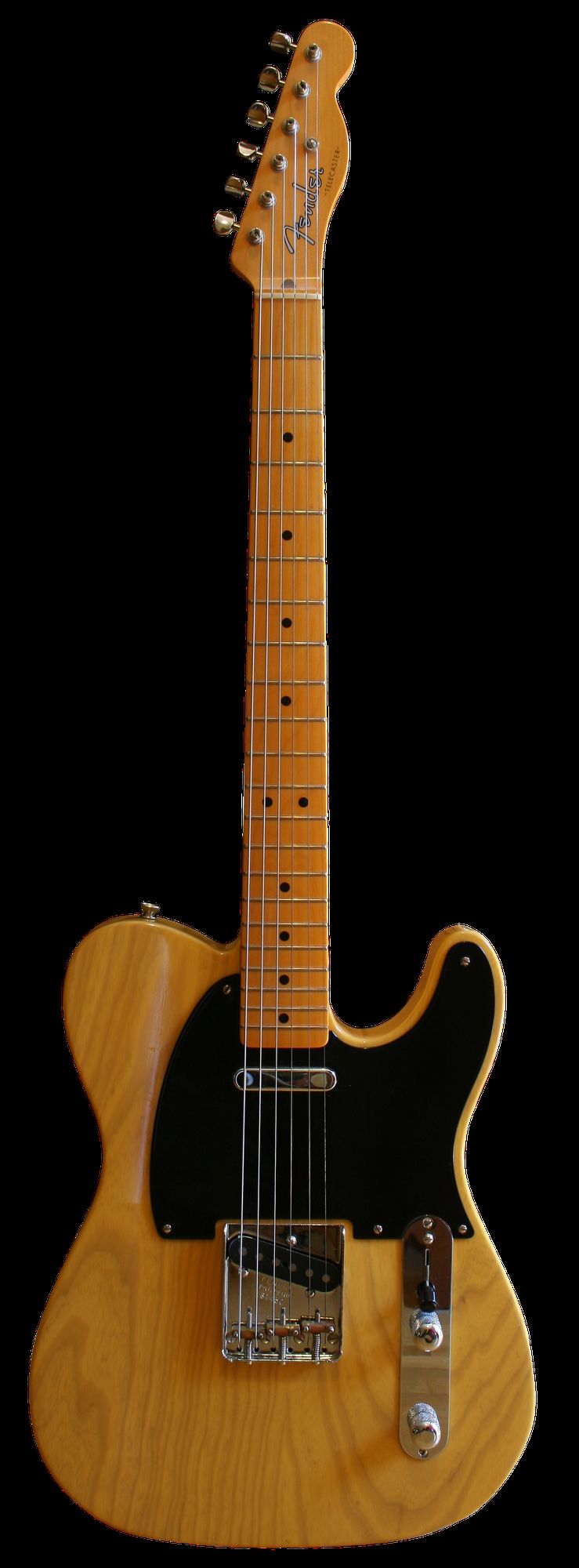
Fender Telecaster American Vintage 1952 with transparent background. Photo by Massimo Barbieri. Licensed under CC BY-SA 3.0. Via Wikimedia Commons. Fender
Telecaster
1950
Leo built it like a tool. The famous ones look like they just clocked off a double shift.
Photograph of a Fender Mustang of 1968. Photo by Alban Dericbourg. Licensed under CC BY-SA 3.0. Via Wikimedia Commons. Fender
Mustang
1964
Fender’s 1964 student guitar. It was built to be outgrown, and a lot of people never bothered.