Fender
Mustang Bass
Leo Fender’s last bass for Fender was a short, cheap student model. That was the whole idea.
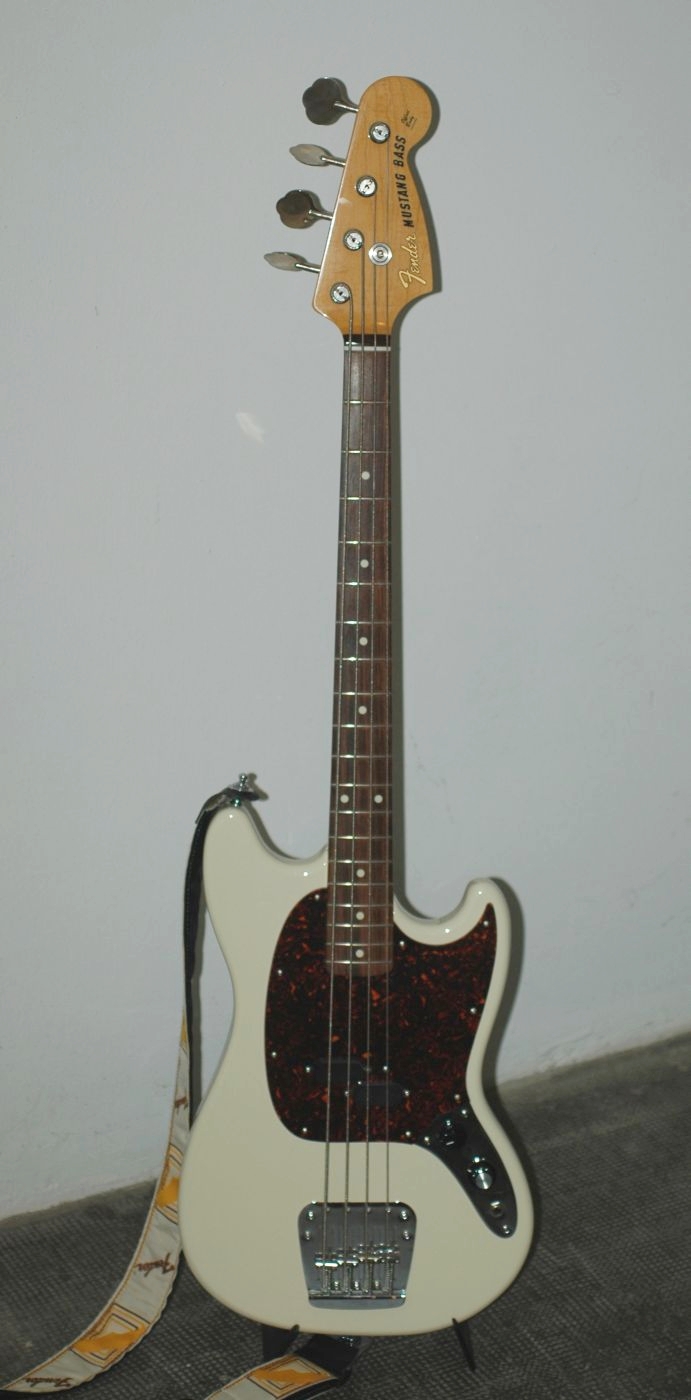
Fender’s July 1966 price list. The Jazz Bass is $271. The Precision is $223. Under them sits something new at $189.50: a stubby offset with a 30-inch neck and one little pickup, named after the student guitar. Leo Fender designed it. By the time it shipped, he’d already left.
- Introduced
- 1966
- Type
- Bass
- Class
- Production
The short version
1964
The guitar comes first
Fender’s Mustang six-string arrives. The bass is its companion, not the same instrument.
1965
Leo leaves
The Mustang Bass is the last original bass he designed before going.
1966
On the price list
$189.50 in July, in red, white, or blue. Left-handers pay ten percent more.
1976
Tina Weymouth switches
Early in the year she puts down her Precision and tries a Mustang Bass.
1981
The original run ends
Or 1983. The two counts don’t agree.
2017
A signature
Justin Meldal-Johnsen gets a Road Worn Mustang Bass with his name on it.
Side A
A1
A goodbye with a short neck
Leo Fender more or less invented the electric bass as you know it. The Precision in 1951, the Jazz Bass in 1960. Long 34-inch necks, big bodies, built for people who played for money.
Then CBS bought the company, and in 1965 Leo left. The last original bass he designed before he walked out the door went the other way from everything before it. Short, light, one pickup, priced under both of its big brothers. A student bass.
It’s a funny way to sign off. The man who put the bass guitar on the bandstand closed out his Fender years with one built for a kid who didn’t own a bass yet.
It shipped in 1966 as the Mustang Bass, the companion to the Mustang guitar Fender had launched two years earlier. Same family name. Different instrument, different job.
A2
Four inches shorter
The number that matters is 30. That’s the scale, the distance from the nut to the bridge, and it’s four inches shorter than a Precision or a Jazz.
You feel it right away. The frets are closer together, so your hand doesn’t have to stretch like it’s reaching for a top shelf. The strings sit a little slacker at the same pitch, so they press down easier, and the note comes out rounder and thumpier, less like a piano and more like a punch. A typical vintage neck has 19 frets, which is plenty.
The body isn’t a shrunken Precision, either. It’s a compact offset from the Musicmaster family, with a separate metal control plate for the volume and tone, more like a Jazz Bass. There’s one pickup, a smaller split single-coil made for this bass. The strings go through the body, and there’s a set of built-in string mutes for a short, dead thud. A lot of owners took the mutes off.
Four inches shorter than a Precision, one pickup, and cheaper than either of its big brothers.
A3
Red, white, and blue
The early ones came in red, white, or blue, which is about as subtle as the 1960s got. Later the Competition finishes showed up, with racing stripes. That’s a paint job, not a different bass.
What’s under the paint depends on who you ask. Poplar, ash, alder, basswood: all of them turn up in the literature, and nobody has settled it for the whole run. Lefties paid ten percent extra in 1966, which is its own small injustice. The ones collectors chase are clean early examples in the first colors, with the mutes and the original bridge still on.
The original run ended in either 1981 or 1983. The two counts don’t agree.
Flip the record · By the numbers
30"
Scale length. The Precision and the Jazz Bass were 34 inches.
$189.50
List price in July 1966. A Precision was $223 and a Jazz Bass $271.
19
Frets on a typical vintage neck. Enough to play almost anything a student would ask it to.
10%
Extra on the 1966 list for a left-handed one.
Side B
B1
Early 1976, in the West Village
Tina Weymouth had been playing a Precision in Talking Heads. She “stuck with the Precision until early 1976,” in her own words, and then she tried a Mustang Bass at Island Records’ townhouse in the West Village.
It’s one bass in a long list for her. She also played a Musicmaster early on, and later a Höfner, a Veillette-Citron, and a Steinberger. So don’t go pinning every Talking Heads bass line on this one. But it’s a good picture: a bass player already in a real band, picking up the student model.
B2
Somebody’s first
Fender brought the Mustang Bass back later, from Japan and then Mexico and the U.S. The current Mexican Player II has two pickups and a three-way switch, so electrically it isn’t a 1966 at all. If you want something closer to the old one-pickup sound, the American Professional Classic, with a ’70s-style split pickup, gets nearer. The Pawn Shop version from 2013 is a different animal. So is the Squier Bronco, whatever the price tag suggests. And the Musicmaster Bass that turned up in 1970 is a student sibling, not the same bass.
By late 2017 Justin Meldal-Johnsen, who spent decades playing bass for Beck and in sessions, got a Road Worn Mustang Bass with his name on it. Kim Gordon turns up on Fender’s list of players, too. None of them needed a beginner’s bass.
Leo’s last bass for Fender was built for somebody’s first. Sixty years later Fender is still making it, and it’s still the short one on the wall.
The cast
The people, and the specific guitars, that made the legend.
1965
Leo Fender
Designer
The Mustang Bass was the last original bass he designed before leaving Fender. It shipped the year after.
1976
Tina Weymouth
Mustang Bass
Switched from a Precision early in 1976. She played plenty of other basses in Talking Heads, so not every line you know is this one.
2017
Justin Meldal-Johnsen
Signature Road Worn Mustang Bass
Decades of work with Beck and in sessions, and a Fender signature short-scale to show for it.
Kim Gordon
Mustang Bass
On Fender’s own list of Mustang Bass players. That’s an acknowledgement, not a specific instrument.
Liner notes
Specs, construction, rarity, value, and every source we used.
Fender’s short-scale student bass — Mustang Bass, not a Precision, not a Jazz Bass, and not the Mustang guitar.
- Body
- Alder; Mustang Bass offset
- Neck
- Bolt-on maple, 4-bolt, Modern “C”; satin urethane back, gloss headstock
- Fingerboard
- Slab rosewood or maple, 9.5" radius, 19 medium jumbo frets
- Scale
- 30" (762 mm)
- Pickups
- Player Series Alnico 5 split-coil Precision (middle) + Alnico 5 Jazz Bass single-coil (bridge)
- Hardware
- 4-saddle bridge; open-gear tuners
- Electronics
- Master volume, master tone, 3-way toggle (PJ)
- Finish
- Gloss polyester body
- Nut
- Synthetic bone, 1.5" (38.1 mm)
Open the full research fileConstruction details, the complete player record, production numbers, dated value estimates, and sources
Current Mexican Player II Mustang Bass PJ. Fender list $849.99 (fetched 25 Aug 2026). Vintage 1966–83 is one smaller split-coil Mustang pickup, volume + tone, string-through, often mutes — electrically not this table. Vintera / American Professional Classic / JMJ Road Worn are labeled adjacent. Not a 34" Precision or Jazz Bass. Not the Mustang six-string.
Construction
Fender, Fullerton. July 1966 price list (vintageguitarandbass.com): $189.50 next to Precision $223 and Jazz Bass $271. Companion to the 1964 Mustang guitar, not the same instrument. Wikipedia: last original bass Leo designed before leaving in 1965, shipped 1966 — keep the lag; do not collapse design year into first list year.
Scale is 30" — not Fender’s 34" Precision/Jazz. vintageguitarandbass also lists Bass VI and Coronado bass at 30"; those are not this page. Typical vintage neck 19 frets. Body is a compact offset, Musicmaster-family, not a Precision slab and not a Jazz Bass offset.
Vintage pickup is a smaller split single-coil aimed at the Mustang Bass, not a full-size P-Bass split and not a Jazz pair. String-through bridge; vintageguitarandbass and Wikipedia flag a 7-bolt bridge and often string mutes (commonly removed). Guard and metal control plate are separate pieces (Jazz-like plate, not a P-Bass).
Woods are mixed in the literature. Player II: alder. vintageguitarandbass vintage: poplar or ash. Wikipedia: alder, poplar, ash, basswood. Do not flatten. Early colors (vintageguitarandbass / 1966 copy): red, white, blue.
Original U.S. run: vintageguitarandbass 1966–83; Reverb model notes 1966–1981. Keep both. Japanese and later Mexican/US returns from 1998 / 2002 (Wikipedia period line) are reissues, not 1966 Fullerton.
Competition finishes on the bass, as on the guitar, are a paint package, not a different model. Pawn Shop Mustang Bass (2013, Wide Range) is a different SKU family. Musicmaster Bass (1970) is adjacent student, not this guitar. Squier Bronco is not a Mustang Bass.
Player II PJ is electrically not 1966. Middle P-style split + bridge J single-coil and a 3-way. Vintage is one Mustang split. American Professional Classic (Coastline ’70s split) is closer to the old pickup story; it is not the Specs table.
Players
Tina Weymouth — Talking Heads, among other basses. Reverb interview (2018), via Mixdown: she “stuck with the Precision until early 1976,” then tried a Mustang Bass at Island’s West Village townhouse after Robert Palmer / Chris Blackwell. Far Out: early live identity also includes Musicmaster; later Höfner 500/2 Club, Veillette-Citron, Steinberger. Do not hang every Talking Heads bass line on this plate. The 500/2 lives on the Höfner plate as Club, not 500/1. Precision lines stay on the P-Bass plate.
Justin Meldal-Johnsen. MusicRadar, 21 November 2017: Fender Justin Meldal-Johnsen Road Worn Mustang Bass; decades with Beck and session work. Signature is a current named SKU, not a 1966 census.
Fender/GC marketing lists (Kim Gordon, etc.) are acknowledgement, not serials. Bill Wyman forum mentions were not sourced this pass. Mustang guitar players (Cobain, Gibbard) stay on fender-mustang.
Rarity
The Mustang Bass as a current Player II is not scarce. Official lifetime totals are unpublished. Serials date era, not a census.
Scarcity is clean original-finish 1966–early CBS, especially first-year colors and intact mutes/bridge hardware, plus Competition paint. Reissues, Player PJ, and the JMJ Road Worn are not 1966 Fullerton money. Left-handed vintage is a thinner sample; vintageguitarandbass notes a 10% list premium in 1966 — not a count.
Value
Informal estimate, 25 August 2026. Not an appraisal.
Asking prices are not sold prices. A PJ Player II is not a one-pickup 1966. Artist signatures are not comps for ordinary short-scales.
New street. Fender Player II Mustang Bass PJ $849.99 (25 Aug 2026). Sweetwater Coral Red / sunburst $839.99. American Professional Classic and JMJ Road Worn sit above Player II — label the SKU.
Used modern. Mexican Player / Player II short-scales typically sit under new street when they sell; no clean 2024–26 Reverb sold band captured this pass.
Vintage / collectible. 1966–69 Reverb category pages exist; a 2024–26 sold histogram was not extracted this pass. Do not invent a median. Expect original-finish CBS examples in the same general vintage-Fender student-bass neighborhood as contemporary Mustangs, not Precision/Jazz pre-CBS money. Competition and first-year colors sit above later standard finishes when original. JMJ and Custom Shop relics are not vintage.
See also
- Mustang — 1964 six-string offset; Dynamic Vibrato, not a bass
- Precision Bass — Leo’s 34-inch workhorse; Weymouth’s first Talking Heads bass
- Jazz Bass — 34-inch two-pickup offset; not 30"
- 500/1 — hollow 30" violin bass; Weymouth’s later 500/2 Club is labeled there as Club, not this Fender
Sources
- https://www.fender.com/products/player-ii-mustang-bass-pj
- https://www.sweetwater.com/store/detail/MustBsP2RCR--fender-player-ii-mustang-bass-pj-coral-red-with-rosewood-fingerboard
- https://www.vintageguitarandbass.com/fender/bass/Mustang.php
- https://en.wikipedia.org/wiki/Fender_Mustang_Bass
- https://reverb.com/p/fender-mustang-bass-1966-1969
- https://www.musicradar.com/news/justin-meldal-johnsen-on-his-fender-road-worn-mustang-bass-its-something-that-could-really-fill-a-void-for-people
- https://mixdownmag.com.au/features/eight-iconic-artists-who-play-a-fender-mustang-bass/
- https://www.faroutmagazine.co.uk/talking-heads-tina-weymouth-bassist/
- https://commons.wikimedia.org/wiki/File:Fender_Mustang_Bass_30.jpg

Keep digging
Guitars this one gets compared to, confused with, or descended from.
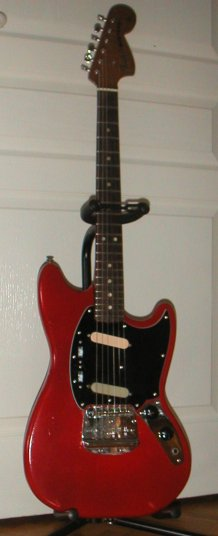
Photograph of a Fender Mustang of 1968. Photo by Alban Dericbourg. Licensed under CC BY-SA 3.0. Via Wikimedia Commons. Fender
Mustang
1964
Fender’s 1964 student guitar. It was built to be outgrown, and a lot of people never bothered.

Photo: Infrahertzz / Wikimedia Commons / CC BY-SA 3.0 Fender
Precision Bass
1951
Leo’s bass let the player at the back be heard. You know their lines by heart. You mostly don’t know their names.

Fender Jazz Bass from 1966 in Olympic white with the transition fingerboard (bindings and dot inlays). Photo by Th. Ott. Licensed under CC BY-SA 3.0. Via Wikimedia Commons. Fender
Jazz Bass
1960
Built for jazz players who mostly passed on it. Then bass players started using it to take the solo.