Fender
Coronado
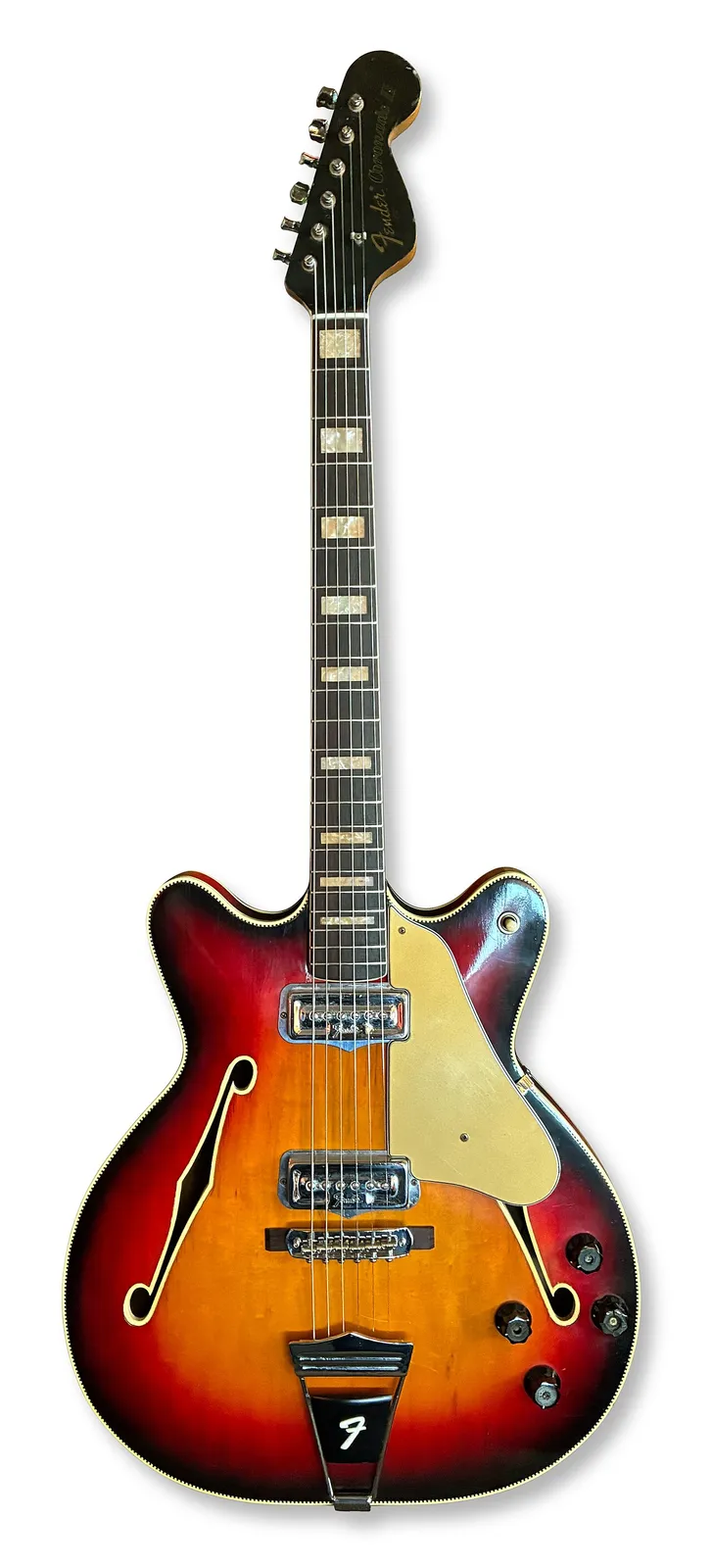
Fender built it to stand next to a 335. It became the guitar nobody else at the gig has.
1968, a film set. Elvis Presley is handed a sunburst Fender Coronado II for a solo with Nancy Sinatra, and Fender itself admits he isn’t really playing it. The model is two years old: a hollow Fender with a bolt-on neck and somebody else’s pickups.
- Introduced
- 1966
- Type
- Hollowbody electric
- Class
- Production
The short version
1962
Rossmeisl comes to Fender
The man behind Rickenbacker’s Capri line is hired to build Fender acoustics.
1965
CBS, then an announcement
CBS buys Fender on January 5. By November the Coronado is “in the final stages of production.”
1966
The first price list
July. Coronado I, II, and XII, in cherry or sunburst.
1967
Wildwood
Beech dyed while the trees were still growing. Gone by 1969 or 1970, depending who you ask.
1968
Antigua
A scorched batch, refinished in cream shading to brown, becomes a catalog color.
1972
The last list
February. No Coronados on the 1973 lists.
2013
The name comes back
A Modern Player from China, with humbuckers and a block down the middle. A different guitar. Gone by 2018.
2020
Back at the Ryman
Marty Stuart brings Charley Pride his old Coronado, and Pride plays it again.
Side A
A1
Elvis isn’t really playing it
1968, Speedway. Elvis Presley and Nancy Sinatra do “There Ain’t Nothing Like a Song,” and somebody hands Elvis a sunburst Fender Coronado II for the solo. It’s the only guitar he uses in the film. Fender puts it plainly: “we realize he’s not really playing it.”
If you’re picturing Elvis in black leather with a hollow double-cut that same year, that’s a different show and a different guitar. The comeback special is a Hagstrom Viking. People mix them up all the time.
So the Coronado’s big-screen moment was a prop. It was built to look like the guitars everybody else was buying. That isn’t how it ended up being remembered.
A2
A Fender that wasn’t a Strat
CBS bought Fender on January 5, 1965. Gibson owned the thinline business: the 335, the fully hollow ES-330, Epiphone’s Casino. CBS wanted a Fender to sit next to them on the wall.
The man for the job was Roger Rossmeisl. He had designed the Capri line at Rickenbacker and come to Fender in 1962 to build acoustics. The Coronado was his, and it was Fender’s first production thinline electric. A November 1965 Fender Facts said the line was “in the final stages of production.” It could have been called the Fantasy, or the Aztec.
The first price list, July 1966, had the one-pickup Coronado I at $229.50, the two-pickup II at $319.50, and a twelve-string XII at $449.50. Tremolo was $55 more. Cherry or sunburst, nothing else that year. (That list already prices the XII. Most other dates for it say 1967. Keep both.)
From across a shop it reads as a 335. It isn’t one. There’s no center block, just air, like a 330 or a Casino, in laminated maple, built at Fender’s separate acoustic plant. The neck bolts on, because it’s a Fender, which was not something set-neck buyers had asked for. And the pickups were DeArmonds, the first on a Fender guitar that Fender hadn’t designed.
A3
“The point of no return”
Put single-coils on a hollow box, turn it up, and it wants to howl. Bill Carson remembered pickup problems and a guitar prone to feedback, found only after production had passed “the point of no return.” He called the project a “fiasco.”
Building it wasn’t easy either. Fender knew how to cut a solid slab. This was assembly, and the binding gave them trouble. One batch came out with scorched tops. The fix was paint: cream shading to brown, with a name, Antigua. The catalog called it “rich, antique white with a halo mist shading,” and by 1968 it was listed. Some people love it. Plenty don’t.
One bad batch of binding became a Fender finish.
Wildwood was stranger. It isn’t maple. It’s beech, with dye injected into the trees while they were still growing. It arrived in 1967 and lasted until 1969 or 1970, depending who you ask. How many were made, nobody knows.
Flip the record · By the numbers
$319.50
The two-pickup Coronado II on Fender’s first price list, July 1966.
0
Center blocks. It’s all air inside, like a Casino, not a 335.
3
Names on the table before it shipped. Fantasy, Aztec, Coronado.
1966–72
The original run, by Fender’s count. Other accounts end it in 1970 or 1971.
Side B
B1
Gone by 1972, give or take
By 1969 you could order a maple fingerboard for 5 percent extra, or gold hardware for 15. The one-pickup I was falling off the lists around then. From 1970 the lists carried only Antigua IIs and XIIs. The last one with a Coronado on it is February 1972. There are none in 1973.
Fender says 1966 through 1972. Other accounts stop it in 1970 or 1971. The neck-plate serials were shared across models, so a late number can make a guitar look newer than the catalog. A serial dates a guitar. It doesn’t stretch the run.
The name came back in 2013, on a Modern Player built in China: humbuckers, and an alder block down the middle. That makes it a semi-hollow. The original’s whole point was that it wasn’t one. The Modern Player was gone by 2018.
B2
Nobody else has one
The Coronado never took the 335’s spot on the wall. It found other people instead.
Charley Pride played an Antigua Coronado early on. “He played a Fender Coronado guitar in his heyday when he was first starting,” Marty Stuart said. Stuart bought that guitar from a collector and brought it to the Ryman in January 2020, and Pride played it again. The statue of Pride on the Ryman’s Icon Walk holds an Antigua Coronado II.
Mike Doughty’s lime-green II, “Greeny,” was his main onstage guitar in Soul Coughing. Sergio Pizzorno played a red II on Later… with Jools Holland in 2009. The Flaming Lips put Coronados in the “Turn It On” video.
Jimmie Vaughan’s is a 1967 II with DeArmond pickups. (The Coronado on “Hold It” is a Japanese copy he bought on eBay, so don’t go looking there.) Put on his 2007 Austin City Limits “Jimmy Reed Highway” and listen to what a hollow Fender does when nobody asks it to be a Gibson.
It was supposed to be one more thinline on the wall. Vaughan had a better reason to want one:
“I’ve always liked the Coronado because you show up to a gig and no one else has one.”
Put this on
You’ve read about it. Now hear it. Here’s what this guitar sounds like, and what to listen for.
Jimmy Reed Highway
Austin City Limits, on his 1967 Coronado II. Two DeArmonds and a hollow maple box, in a room.
Watch it on YouTube (opens in a new tab)Circles
The televised performance. Mike Doughty is on “Greeny,” his lime-green Coronado II. He called it “ringing, gritty and nice.”
Watch it on YouTube (opens in a new tab)Underdog
Later… with Jools Holland. Sergio Pizzorno on a red Coronado II, reportedly a 1966.
Watch it on YouTube (opens in a new tab)
The cast
The people, and the specific guitars, that made the legend.
1968
Elvis Presley
Sunburst Coronado II, 1966 or 1967
The only guitar he uses in Speedway, for “There Ain’t Nothing Like a Song.” He isn’t really playing it. The guitar on the NBC special that year is a Hagstrom Viking.
Charley Pride
Antigua Coronado
His guitar when he was first starting. Marty Stuart bought it back from a collector, and in January 2020 Pride played it again at the Ryman.
2007
Jimmie Vaughan
1967 Coronado II
Played it at Austin City Limits in 2007. The Coronado on “Hold It” is a Japanese copy he bought on eBay, not this one.
1998
Mike Doughty
Lime-green Coronado II, “Greeny”
His main onstage guitar in Soul Coughing.
2009
Sergio Pizzorno
Red Coronado II, reportedly 1966
Kasabian. Played it on “Underdog” on Later… with Jools Holland.
1966
Roger Rossmeisl
Designer
Came to Fender from Rickenbacker in 1962. The Coronado was Fender’s first production thinline electric.
Liner notes
Specs, construction, rarity, value, and every source we used.
Fully hollow, bolt-on maple, DeArmond coils — Fender’s 1966 Coronado, not a 335, not a Casino, and not a Thinline Tele.
- Body
- Double-cut thinline hollow; laminated maple; no center block. Bound top and back. Bound f-holes on II. VG&B: 16" wide, 1 11/16" deep. ggjaguar measured 16 1/8" × 1 3/4". Fender Facts: 5 cm. Mix flagged. Wildwood: laminated beech.
- Neck
- Bolt-on maple. Bound on II.
- Fingerboard
- Rosewood, bound on II; pearloid blocks; 21 frets. Dots on I. Optional maple from 1969 (VG&B).
- Scale
- 25 1/2" (VG&B; ggjaguar). MusicRadar’s 2013 reissue prints 25.5" (648 mm). Mix flagged.
- Pickups
- Two DeArmond single-coils (II). I: one, neck. ggjaguar: first non-Fender pickups on a Fender guitar. VG&B: by 1970 described as Fender pickups.
- Hardware
- Floating tune-o-matic-style bridge; “F” trapeze. Optional tremolo. Chrome. Gold optional 1969.
- Electronics
- Volume and tone per pickup; 3-way (II). I: one volume, one tone.
- Finish
- Cherry and sunburst 1966. DuPont custom colors 1967–69. Wildwood 1967–70. Antigua 1968–72.
- Nut
- 1 5/8" (VG&B; ggjaguar)
Open the full research fileConstruction details, the complete player record, production numbers, dated value estimates, and sources
Classic living example = 1966–72 USA Coronado II (fully hollow, two DeArmonds). I is one pickup, dots; VG&B table 1966–70, 1969 text drops I from the lists. XII is the 12-string sister (hockey-stick headstock). Coronado basses are 30" and not this table. Not a Jazzmaster, Bass VI, Strat, Tele, or Tele Thinline. Current typical SKU: none. Modern Player Coronado (China, 2013–18) is a semi-hollow with an alder center block and Fideli’Tron humbuckers — not this table. No 2026 Fender or Custom Shop Coronado located this pass. Mixed inch/mm flagged on Fender Facts 5 cm against VG&B 1 11/16" and ggjaguar 1 3/4"; do not invent millimetres for the nut or the 25 1/2" scale.
Construction
The job was a CBS thinline Fender could put next to a 335 and a Casino. Hollow. Double-cut. Bolt-on maple. DeArmond coils. Not a Strat with f-holes. Not a Tele. Not an offset.
CBS bought Fender on 5 January 1965. Roger Rossmeisl — Rickenbacker Capri, then Fender’s 1962 acoustic hire — designed it as Fender’s first production thinline electric (Vintage Guitar, Michael Wright, April 2007). Fender Facts 10, November 1965, announced the line “in the final stages of production” (Vintage Guitar and Bass). VG&B: Fender had considered Fantasy and Aztec. The name that shipped was Coronado. First price list: July 1966. I $229.50, II $319.50, XII $449.50; optional tremolo $55. Cherry and sunburst only that year. Period money, not 2026 street. This plate starts in 1966.
XII is the split. VG&B’s July 1966 list already prices it. VG&B’s own table, Wikipedia, and Premier Guitar’s launch line date XII 1967 (Premier Guitar’s first pair is I and II only). Keep both.
It looks like the 335 from across a shop. It is not one. Fully hollow. No center block. Same air as a Gibson ES-330 or an Epiphone Casino — not the maple stick through a 335. Premier Guitar (Dave’s Guitar Shop, December 2009): built at Fender’s separate acoustic plant. Bolt-on is the Fender part the set-neck market did not ask for. Wright: assembly, not carving a solid, challenged the line; binding was a problem. One scorched-top batch was refinished as cream-and-brown Antigua — Wright’s origin for a finish Fender then cataloged. VG&B quotes the copy: “rich, antique white with a halo mist shading.” Antigua listed 1968 (Premier Guitar; VG&B March 1968). VG&B: tremolo standard on Antigua II.
The pickups were not Fender’s. ggjaguar: DeArmonds, first non-Fender designed pickups on a Fender guitar. Vintage Guitar (Willie G. Moseley, December 2004) cites Bill Carson’s autobiography: pickup problems, a propensity to feed back, “the point of no return” already passed in production; Carson called the project a “fiasco.” Wright: competing on Gibson’s set-neck home field. The hollow body feeds back at volume. That is the construction.
Wildwood is dyed beech, not a sunburst on maple. Wright: dye injected into growing beech. Premier Guitar: Wildwood I Rainbow Green, II Rainbow Blue, III Rainbow Gold, 1967. Wright: debuted 1967, lasted until 1969, “how many were made is unknown.” VG&B still lists Wildwood 1967–70. Keep both. Do not invent a census.
VG&B 1969: optional maple board (5% extra), optional gold hardware (15%). 1970–72 lists: Antigua II and XII only. Fender: produced 1966 through 1972. Fretboard Journal: discontinued 1970. Scottymoore: 1971. VG&B: no Coronado guitars in 1973 lists. Prefer the last lists (February 1972) and Fender’s 1966–72 span. Shared serials overlap years. A 1966 II listing notes out-of-sequence numbers that tempt a 1973–75 date. Serials date a guitar. They do not extend the catalog.
Not a Telecaster Thinline. Rossmeisl’s 1968 Tele with one f-hole is a rear-routed Tele slab, not this double-cut hollow (fender-telecaster-thinline). Not his later Montego / LTD jazz boxes. Not Starcaster. Not Electric XII — Coronado XII only borrows the hockey-stick. Not Bass VI. Not Jazzmaster.
2013–18. Fender put the name on a China Modern Player: laminated maple, alder center block, Fideli’Tron humbuckers, 21 frets, 9.5" radius (Fender; Premier Guitar, 8 September 2013). MusicRadar (6 March 2014): “unlike the original hollowbody Coronado”; MSRP $899. Wikipedia: 2013–2018. Semi-hollow with humbuckers. Not a 1966 II. No 2026 Fender SKU named Coronado located this pass.
Players
Do not hang a 335, a Casino, a Hagstrom Viking, or a Tele Thinline on this plate. Do not recruit the Coronado bass as if it were this guitar. Elvis’s 1968 Comeback Special is a Hagstrom Viking. Clambake is a Fender Wildwood acoustic and an Electric XII (Scottymoore) — not this hollow.
Elvis Presley — sunburst Coronado II, Speedway, 1968. Fender: “There Ain’t Nothing Like a Song,” handed the guitar for the solo with Nancy Sinatra; “we realize he’s not really playing it.” Scottymoore: 1966 or 1967 II; the only guitar he uses in that film; sometimes confused with the Viking from the NBC special.
Charley Pride — Antigua Coronado, early career. Marty Stuart, Rolling Stone, 14 December 2020: “He played a Fender Coronado guitar in his heyday when he was first starting.” Stuart bought that guitar from a collector, took it to the Ryman in January 2020, and Pride played it again. The Tennessean (12 April 2023): the Ryman Icon Walk statue holds a Coronado Antigua II. Named object. Not a session log for “Kiss an Angel Good Mornin’.”
Jimmie Vaughan — 1967 Coronado II. Fender: 2007 Austin City Limits, “Jimmy Reed Highway.” Fender quoting Guitar Player, 2010: “I’ve always liked the Coronado because you show up to a gig and no one else has one.” Guitar World (July 2010): “a Fender Coronado with DeArmond pickups, which is a real oddball and a lot of fun.” Trap: Premier Guitar (2019) — the guitar on “Hold It” from Baby, Please Come Home is a Japanese Coronado copy he bought on eBay, not the Fender.
Mike Doughty — lime-green Coronado II, “Greeny.” Fender: main onstage guitar with Soul Coughing; televised “Circles” (1998). His 2005 note, via Fender: “ringing, gritty and nice.”
Fender also files the Flaming Lips “Turn It On” video (1993) — Coyne, Drozd, and Jones on Coronados in the clip, not a tracking sheet; Ben Gibbard, Antigua II circa 1969–70, “You Are a Tourist” (2011); Ira Kaplan, red II, live “Stupid Things” (2013); Sergio Pizzorno, red II, reportedly 1966, Kasabian “Underdog,” Later… with Jools Holland (2009).
Also known to play stays short. Wright’s Byrds Wildwood endorsement is publicity, not a named track. Wikipedia’s user list is not a census. Thom Yorke, Colin Greenwood, Steve Kilbey, and the Lemon Pipers are Coronado bass stories. They are not this six-string.
Rarity
You cannot buy a new Coronado from Fender in 2026. The original run ends with the catalog. The Modern Player is a different factory on a different interior, and it is out of the line.
Fender did not publish Coronado unit totals. None invented. Neck-plate serials were shared across models and overlap years, so they date a guitar, they don’t count a year. That is why a first-year census is unknown, not the chapter.
What is actually thinner: Coronado I; Wildwood (Wright: unknown how many, “pretty rare”); original-finish DuPont custom colors; complete DeArmond examples that have not been rewound. Cherry and sunburst II is the common vintage Coronado. Antigua is polarizing, not automatically scarce. Pride’s guitar and the Speedway lot are unique objects. They are not a vintage Coronado.
Value
Informal estimate, 29 September 2026. Not an appraisal.
Ask ≠ sold. Do not average. Do not paste Strat, Tele, or ES-335 bands onto this hollow. July 1966 lists ($229.50 / $319.50 / $449.50) are 1960s money, not 2026 street. Artist lots sit outside these ranges: Gotta Have Rock and Roll (July 2019) sold a Speedway film-used II, Charlie Hodge provenance, $35,373 — one object, not a comp. Pride / Stuart unpublished.
New street. None under Coronado this pass. No current Fender or Custom Shop SKU located. Historical Modern Player list $899.99 (Fender archived spec; MusicRadar $899, 2014) — a 2013–18 China semi, not a 1966 II.
Used modern. Reverb Price Guide, Modern Player Coronado, Good–Mint, $604–$926 (247 orders). Named 2026 solds on that page: $653–$995. Not vintage.
Vintage / collectible. Reverb’s standard Coronado II product-page dollar widget was empty this pass. Flag: no order-counted II band on the model page. Listing widgets are not a census: one Good 1967 sunburst printed $1,535–$2,020; another II listing $1,920–$2,476. Do not average those widgets. Named asks, not hammers: 1967 sunburst $1,900; 1966 Candy Apple Red $3,450. Wildwood II is the one clean Reverb band this pass: Good–Mint $1,502–$2,741 (109 orders), with named 2026 solds $1,700–$2,650. Working ask on that page still runs higher (Wildwood I $3,650 ask). Do not fold Wildwood solds into cherry/sunburst II.
See also
- gibson-es-330 — fully hollow double-cut, dog-ear P-90s, set neck; the Kalamazoo job this bolt-on DeArmond hollow is not
- epiphone-casino — the Beatles’ fully hollow P-90 cousin; not a Coronado and not a 335
- fender-telecaster-thinline — Rossmeisl’s 1968 Tele with one f-hole; a Tele slab, not this double-cut platform
Sources
- Vintage Guitar and Bass, Fender Coronado — Fender Facts 10 November 1965; Fantasy/Aztec; July 1966 list $229.50 / $319.50 / $449.50, tremolo $55; 5 cm announcement; 16" × 1 11/16"; 25½"; nut 1 5/8"; I 1966–70 / II 1966–72 / XII 1967–72; Cherry/Sunburst 1966; DuPont 1967–69; Wildwood 1967–70; Antigua 1968–72; 1969 maple board 5% / gold 15% / I dropped from lists; 1970–72 Antigua only; no 1973 lists; bound f-holes on II; closer to ES-330/Casino than 335
- Vintage Guitar, Michael Wright, Fender Coronado XII Wildwood (April 2007) — Rossmeisl; Coronado designed 1966, first Fender thinline electric; DeArmonds a first; binding scorch → Antigua; Wildwood dye-injected beech, debut 1967, lasted until 1969, unknown how many; Byrds endorsement; Thinline Tele / Montego / LTD later
- Vintage Guitar, Willie G. Moseley, ’67 Fender Coronado II (December 2004) — introduced 1966 after CBS 1965; Rossmeisl; bolt-on; fully hollow; Bill Carson “fiasco” / feedback / “point of no return”; Wildwood and Antigua
- Premier Guitar, 1968 Fender Coronado II, Wildwood I Finish (17 December 2009) — released 1966; acoustic plant; De Armond; I and II, optional tremolo; Cherry/Sunburst then Wildwood I–III 1967; Antigua 1968; discontinued by 1972
- Premier Guitar, Fender reissues Coronado and Starcaster (8 September 2013) — Modern Player; semi-hollow maple, alder center-block; Fideli’Tron; 9.5"; 21 medium jumbo
- MusicRadar, Fender Modern Player Coronado review (6 March 2014) — $899; China; alder centre block; Fideli’Trons; 25.5" (648 mm); not a strict vintage reissue
- Fender, 9 Cool Coronado Moments — produced 1966 through 1972; I / II / XII / basses; original fully hollow, 2013 reissue has a center block; Elvis Speedway “There Ain’t Nothing Like a Song” (not really playing); Flaming Lips “Turn It On” video 1993; Doughty “Greeny” / “Circles”; Jimmie Vaughan ’67 II, ACL 2007, Guitar Player 2010 quote; Kasabian “Underdog” 2009; Gibbard Antigua II c. 1969–70, “You Are a Tourist” 2011; Kaplan red II, “Stupid Things” 2013; Lemon Pipers / Church are bass
- Fender, History of Fender's Acoustic Guitars — Rossmeisl arrives 1962; Rickenbacker Capri; King/Concert/Classic 1963
- Wikipedia, Fender Coronado — announced 1965; period appr. 1966–1972, 2013–2018; hollow original / semi-hollow reissue; 25.5"; maple, beech on Wildwood; DeArmond vs Fidelitron; I discontinued 1970; XII 1967; no center block vs ES-335. Jazzmaster-headstock claim on II not followed. User list not treated as a census
- GGJaguar, 1967 Fender Coronado II — late 1966–1972; DeArmonds first non-Fender pickups; fully hollow, feedback; 25 1/2"; nut 1 5/8"; 21 frets; 16 1/8" lower bout; 1 3/4" depth
- Fretboard Journal, Catch of the Day: 1966 Fender Coronado I (December 2013) — introduced 1966; I / II / XII; Wildwood and Antigua; Rossmeisl; aimed at Casino, ES-330, Gretsch, Rickenbacker; discontinued 1970
- Scottymoore, Fender Coronado II (Speedway) — 1966 or 1967 II in Speedway; discontinued 1971; mash warning vs Hagstrom Viking on the 1968 NBC special; Clambake Wildwood acoustic
- Guitar World, Jimmie Vaughan: Powerful Stuff (July 2010) — Fender Coronado with DeArmond pickups
- Premier Guitar, Jimmie Vaughan: Emperor of Tone (4 July 2019) — “Hold It” is a Japanese Coronado copy, not the Fender
- Rolling Stone, Marty Stuart Remembers Charley Pride (14 December 2020) — Pride’s early-career Fender Coronado; Stuart purchase; Ryman January 2020
- The Tennessean, Charley Pride statue on Ryman Icon Walk (12 April 2023) — statue holds Coronado Antigua II
- Gotta Have Rock and Roll, Elvis Speedway Coronado II (July 2019) — film-used II, Hodge letter; hammer $35,373; not a model comp
- Reverb, Fender Coronado II (1966–1972) — years 1966–1972; hollow; 25.5"; 21 frets; dollar widget empty this pass
- Reverb, Wildwood Coronado II (1968–1969) — Good–Mint $1,502–$2,741 (109 orders); named 2026 solds $1,700–$2,650
- Reverb, Fender Modern Player Coronado — 2014–2018 China; Good–Mint $604–$926 (247 orders)
- Reverb listing, 1967 Coronado II sunburst — ask $1,900; widget $1,535–$2,020
- Reverb listing, 1966 Coronado II Candy Apple Red — ask $3,450; intro list $319.50; widget $1,920–$2,476; serial-overlap dating note
- Fender archived, Modern Player Coronado Guitar — MSRP $899.99; semi-hollow maple, alder center-block; Fideli’Tron; 9.5"; 21 frets
Keep digging
Guitars this one gets compared to, confused with, or descended from.
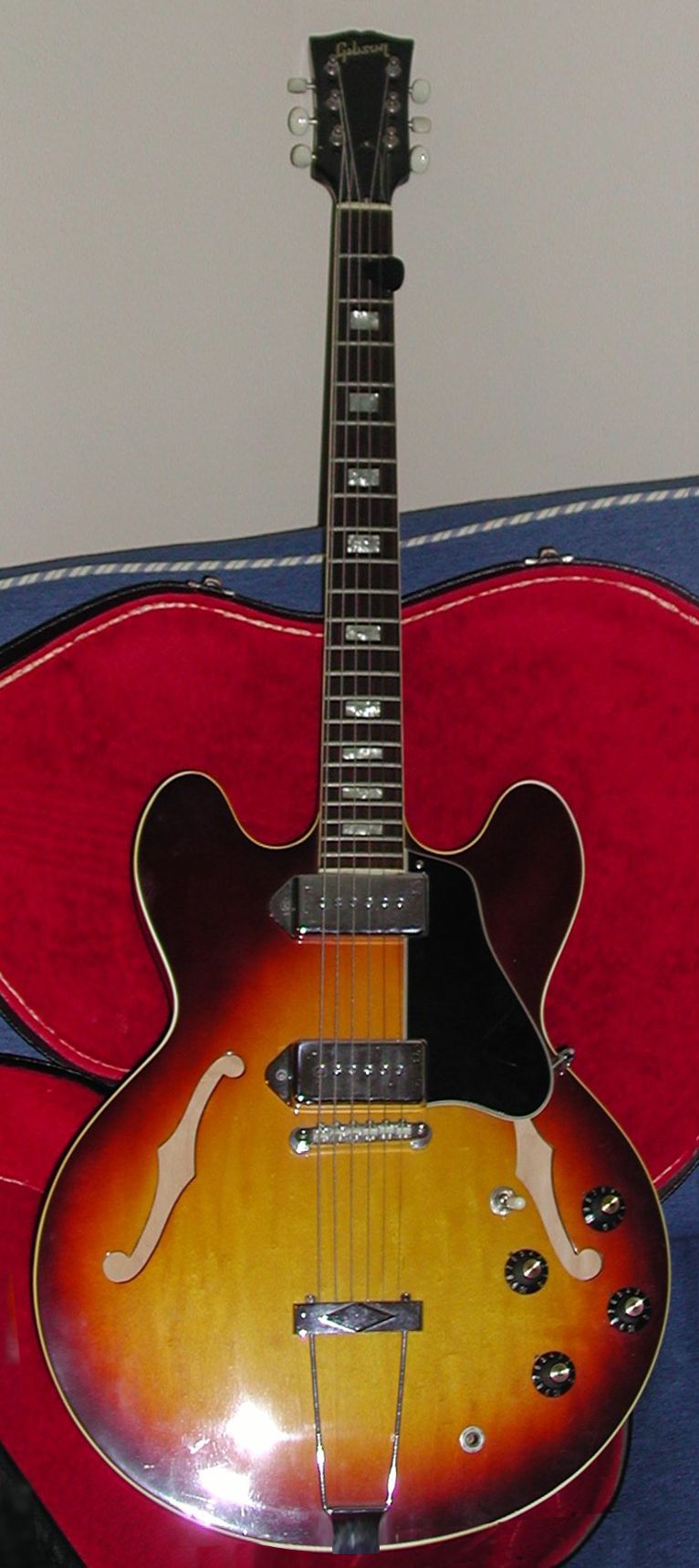
Gibson ES-330TD (front). Photo by Es330td; derivative by Clusternote. Licensed under CC BY-SA 3.0. Via Wikimedia Commons. Gibson
ES-330
1959
From across the room it looks like a 335. Inside, it’s all air, and the people who play one like it that way.
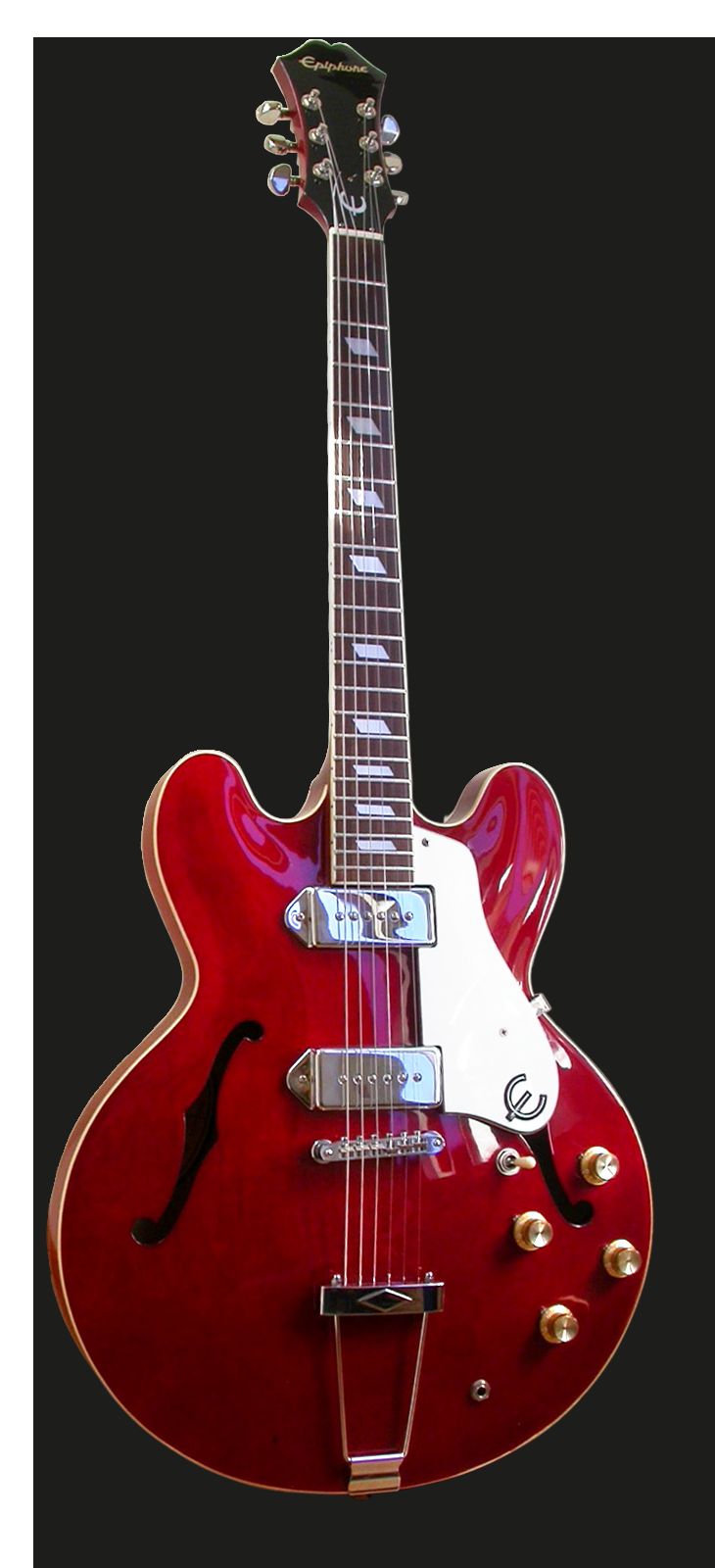
Epiphone Casino Cherry. Photo by Maxo; background removed by Auge=mit. Licensed under CC BY-SA 4.0. Via Wikimedia Commons. Epiphone
Casino
1961
Of all the Beatles’ famous guitars, the only one John, Paul, and George all had. Two sanded theirs bare.
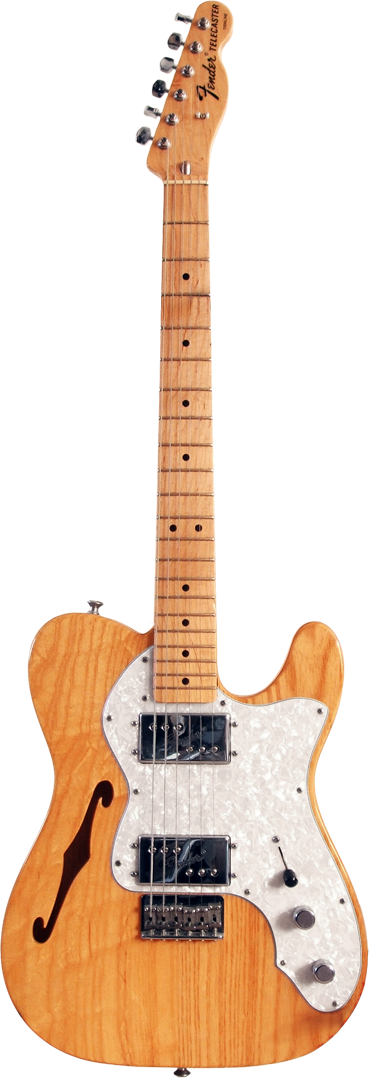
A Fender '72 Telecaster Thinline electric guitar. Photo by Matt Eason. Licensed under CC BY 3.0. Via Wikimedia Commons. Fender
Telecaster Thinline
1968
Fender hollowed out the Telecaster to take the weight off your shoulder. Tab Benoit has carried his since 1992.