G&L
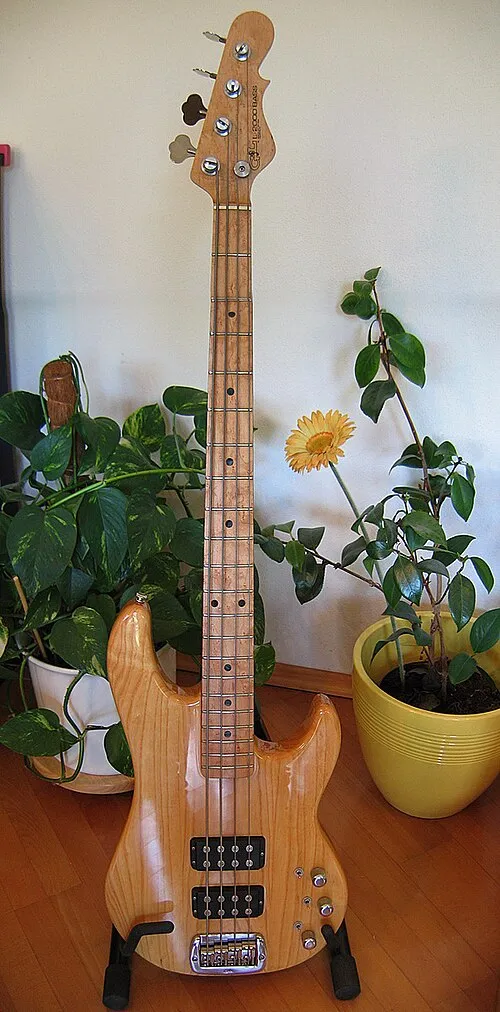
L-2000
Leo Fender had already built the Precision and the StingRay. In 1980 he built one more, with more switches.
Fullerton, California, 1980. Leo Fender has sold Fender, built the StingRay at Music Man, and moved on again, to a new company called G&L on a street called Fender Avenue. On the new price list there’s a two-pickup bass with a row of little toggle switches. He isn’t finished yet.
- Introduced
- 1980
- Type
- Solidbody bass
- Class
- Production
The short version
1980
G&L opens
Leo Fender, George Fullerton, and Dale Hyatt. One magazine dates the founding to 1979.
1980
On the price list
On 1 September, the L-2000 at $779 passive and the L-2000E at $849 active.
1981
Active only
By April the passive version is gone. Lesh’s bass is bought for the Dead in October.
1982
The hook headstock
A late-year face-lift gives it a new headstock, a deeper belly cut, and black hardware.
1990
The ASAT Bass
The same electronics go into a single-cut body under a different name.
2003
Tribute
A cheaper imported version arrives.
2020
Forty years
A Custom Shop anniversary run of 40 basses.
2025
The factory closes
Fullerton shuts in September. Staff are let go on 29 September.
Side A
A1
He wasn’t done
Most people who invent something get to retire on it. Leo Fender invented the Fender Precision Bass in 1951, sold the company, and then did it all again at Music Man with the StingRay in 1976.
Then he did it a third time. In 1980 he started G&L in Fullerton with his old partner George Fullerton and Dale Hyatt, on Fender Avenue, of all places. One of the first things on the price list was a two-pickup bass called the L-2000. As G&L’s own copy still put it decades later: “When Leo Fender launched the G&L L•2000 bass in 1980.”
Some people pick up a bass and never find a good reason to put it down. Leo was one of them, and he wasn’t even the one playing it.
A2
More switches than anybody asked for
The L-2000 is Leo improving on his own StingRay, one switch at a time.
Start with the pickups. G&L called them Magnetic Field Design humbuckers: a ceramic magnet under each coil and iron pole pieces you can raise or lower string by string. They put out about twice as much per turn of wire as an ordinary pickup, so they’re strong.
Then the switches. There are three little toggles. One picks the pickups. One wires them in series, for a fat, loud sound, or in parallel, for something thinner and more hi-fi. The third turns the preamp on, off, or on with a treble boost. You can switch the electronics off and play it completely passive, which the StingRay never let you do. That matters the night the battery dies.
The bridge, which G&L called the Saddle-Lock, clamps the saddles together with a small screw so the whole thing acts like one solid piece, sitting right in the end grain of the body. The idea is simple: more of the string’s energy goes into the wood instead of rattling around.
Leo built the Precision, then the StingRay, then this. He kept finding one more thing to fix.
A3
Passive for about seven months
On the 1 September 1980 price list, you could buy an L-2000 passive for $779 or an L-2000E with the preamp for $849. By April 1981 the passive one had disappeared. One collector reads that as a run of about seven months. G&L never said.
The earliest ones had chrome control plates, a chrome bridge, and a skunk-stripe maple neck. There’s even a 1980 catalog showing a prototype in a Music Man body shape, before the production bass settled down. Late in 1982 it got a face-lift: a hooked headstock, meant by one account to set it apart from CBS-era Fenders, plus a deeper belly cut and black hardware. Years later the neck went from three bolts to six, sometime between 1995 and 1998, depending who you ask.
Flip the record · By the numbers
$779
The passive L-2000 on the 1 September 1980 price list. The active L-2000E was $849, and a case $100 more.
3
Mini-toggles. Pickup select, series or parallel, and preamp on, off, or boosted.
~7
Months the passive version seems to have lasted, by one collector’s reading of the price lists.
61
Grateful Dead shows Phil Lesh played on his L-2000E, from December 1981 to November 1982.
Side B
B1
Sixty-one shows
In 1981 the Grateful Dead bought Phil Lesh an L-2000E. He played it at 61 shows, from 26 December 1981 to 26 November 1982. It was the last four-string bass he ever played on a Dead stage. After that he went to six strings.
It turned up in very different rooms, too. Mike Gordon played one as his regular bass in the early days of Phish; there’s a 1987 photo of him with it next to Trey Anastasio. Henry Bogdan of Helmet played a black L-2000 with a rosewood board through the Meantime and Betty tours, which is about as far from a Dead show as a bass can get.
B2
Borrowed, and kept
Leo Fender died in 1991. G&L kept going for more than thirty years after him, building the bass in Fullerton. A cheaper Tribute version started in 2003, and in 2020 the Custom Shop made 40 anniversary basses for the model’s fortieth.
Then, in September 2025, the Fullerton factory closed. The staff were let go on 29 September. Some leftover instruments and parts turned up for sale the next year, through a company in Tennessee, and one magazine was careful to call it “not a comeback.”
In 2001 Mark Mendoza of Twisted Sister borrowed a new L-2000, and he stayed. Leo spent forty years unable to leave the bass guitar alone. Fair enough that one of the last basses he built turned out to be hard to hand back.
Put this on
You’ve read about it. Now hear it. Here’s what this guitar sounds like, and what to listen for.
Grateful Dead live, 1982
Phil Lesh played his L-2000E at 61 shows, from 26 December 1981 to 26 November 1982. Pick one from that stretch. It was his last four-string on a Dead stage.
Find it on YouTube (opens in a new tab)
The cast
The people, and the specific guitars, that made the legend.
1980
Leo Fender
Designer
The man behind the Precision, the StingRay, and this. G&L was his last company.
1981
Phil Lesh
L-2000E
Bought for him on 28 October 1981. Sixty-one shows with the Grateful Dead, then he moved to six strings.
1992
Henry Bogdan
Black L-2000, rosewood board
Helmet’s bass player through the Meantime and Betty years.
1987
Mike Gordon
L-2000
His regular bass in early Phish, before the custom basses came along.
2001
Mark Mendoza
L-2000
Twisted Sister’s bassist borrowed a new one in 2001 and stayed with it. Not the Stay Hungry bass.
Liner notes
Specs, construction, rarity, value, and every source we used.
Two Magnetic Field Design humbuckers and a Saddle-Lock into the end-grain — Leo’s Fullerton bass, not the ASAT guitar, and not an ASAT Bass.
- Body
- Alder on Standard and solid finishes; swamp ash on Premier. Double-cut solid.
- Neck
- Bolt-on hard-rock maple, 1 5/8" Medium C, 9 1/2" radius
- Fingerboard
- Maple or rosewood, 21 Jescar 57110 medium-jumbo
- Scale
- 34"
- Pickups
- Two G&L Magnetic Field Design humbuckers, Fullerton-wound
- Hardware
- Saddle-Lock, chrome-plated brass saddles; Ultra-Lite tuners with aluminum tapered posts
- Electronics
- Tri-Tone: 3-way pickup, series/parallel, 3-way preamp mode; volume, treble, bass
- Finish
- Factory Standard or Premier; satin neck standard from 1992
- Nut
- Bone, 1 5/8"
Open the full research fileConstruction details, the complete player record, production numbers, dated value estimates, and sources
Last typical production = USA Build To Order L-2000 (Fullerton; glguitars.com). Factory closed September 2025. No new factory L-2000 this pass. Factory inches; millimetres unpublished. Musician’s Friend Fullerton Deluxe table prints 20 frets and a 1.77" nut against factory 21 / 1 5/8" — mix flagged, not averaged. Early measured examples (ggjaguar 1981, 1983): 1 11/16" plastic nut — not this table. Tribute Series L-2000 (Indonesia; Music Store Live $899.00) is the volume SKU, not this table. ASAT Bass is the same electronics in a single-cut body. L-1000 is one pickup. L-2500 is five strings. CLF Research L-2000 is the 2018 vintage-detail line. M-2000 is 18V. No Gibson SKU.
Construction
The job was a two-pickup bass Leo could put on Fender Avenue after Music Man. Ceramic-bar Magnetic Field Design humbuckers, iron poles you raise per string, a Saddle-Lock that clamps the saddles into the body end-grain, and more switching than a StingRay.
G&L opened 1980. Leo Fender, George Fullerton, Dale Hyatt. Wikipedia and the factory page date the company that year. Vintage Guitar (Ward Meeker, April 2026) prints 1979 for the founding. Keep both. The bass is 1980.
Factory copy still says it: “When Leo Fender launched the G&L L•2000 bass in 1980.” No Treble, February 2020, marked a 40th anniversary Custom Shop — 40 pieces worldwide. ggjaguar dates the model 1981, “the second bass model designed by Leo at G&L,” a two-pickup L-1000, sold passive (L-2000) or active (L-2000E). yowhatsshakin has the L-1000, L-2000, and L-2000E together on the 1 September 1980 price list. Keep 1980, 1981, and that list. This plate starts in 1980.
Not the ASAT guitar (g-l-asat). That is 1985, six strings, jumbo MFD soapbars. Not an ASAT Bass. G&L: “essentially an L•2000 packed into an ASAT body shape,” 1 1/2″ nut; Tom Hamilton’s signature lives there. yowhatsshakin puts the ASAT Bass on the 15 January 1990 list — same harness, different silhouette. The one-pickup L-1000 is the sibling workhorse (OMG bass-boost switch). The L-2500 is five strings, mid-1990s. The M-2000 is 18V. A Music Man StingRay (music-man-stingray) is one Alnico humbucker, 2-band, 1976. A Precision (fender-precision-bass) is the other Leo bass this is not. G&L is not associated with FMIC. No Gibson SKU.
The pickup is the argument. Ceramic magnet under each coil, adjustable soft-iron poles. Musician’s Friend: about twice the output per wind of a conventional pickup. Tri-Tone is three mini-toggles — pickup select, series/parallel, active/passive with treble boost — plus volume, treble, and bass. You can kill the preamp and play it dead passive. The StingRay could not.
Saddle-Lock, Locktight on the early badges: an Allen screw on the side locks the brass saddles so the bridge behaves more like one mass. String energy into the end-grain.
Early examples are 3-bolt, skunk-stripe one-piece maple, chrome control plate and chrome Locktight through late 1981 (ggjaguar). Scale 34". 21 frets. Nut 1 11/16" on the measured 1981 and 1983 instruments. Plastic nut. Schaller open tuners. No pickguard. Bodies ash, maple, mahogany. Nitro. yowhatsshakin: passive L-2000 $779 maple, L-2000E $849, original case $100 — 1980 money, not 2026 street. The 1 April 1981 list dropped to L-2000E only; the same page infers the passive run lasted about seven months. Collector inference, not a factory census.
The October 1980 catalog still shows a prototype in a Music Man Sabre-Bass contour with a banana plate. The 1981 catalog is the production bass: pickups closer together, plate tabs at the switches.
Late 1982 is the face-lift. Hook headstock — ggjaguar: to distinguish it from CBS-Fender. Bi-Cut two-piece maple, deeper belly contour, black crinkle hardware, more colors than natural and sunburst. The Series·E decal left with the hook. Rear-loaded controls by mid-1985. Satin neck standard 1992. 3-bolt gave way to 6-bolt around 1995–96 (ggjaguar); TalkBass common-knowledge puts the six-bolt nearer 1998. Keep both. Wikipedia: Bi-Cut phased out once CNC arrived.
Tribute 2003 (Wikipedia; Twelfth Fret). Import volume. USA-wound MFDs on many. Cort Indonesia later (Wikipedia). Not USA.
CLF Research L-2000, March 2018 (Premier Guitar): early CLF/G&L headstock, reproduced ’81 plate, color-coded switch tips. Street then about $1,700 Candy Apple Red or Jet Black, $1,800 Natural Ash or 3-Tone Sunburst. Vintage-detail SKU, not this table.
Custom Shop Ruby Anniversary 2020: Okoume, quilted maple, roasted maple neck. 40 pieces worldwide. Price TBD on announcement (No Treble).
Fullerton closed September 2025. Wikipedia, citing employees: production staff furloughed 15 September, terminated 29 September. Orange County Register: parent BBE dissolved 28 October. Guitar World (Phil Weller, 25 June 2026): leftover finished instruments and parts through Musical Instrument Reclamation Corp. in Franklin, Tennessee — “not a comeback.”
Classic vs last typical: 1980–82 chrome, 3-bolt, 1 11/16" plastic nut — against the last USA Build To Order: 6-bolt, 1 5/8" Medium C, 9 1/2", Jescar 57110, Ultra-Lite, bone nut, alder or swamp ash. Same two MFDs. Same Tri-Tone. Same slug. No new factory L-2000 this pass.
Players
Do not hang the ASAT guitar on this plate. Do not recruit Tom Hamilton’s ASAT Bass as if it were this four-string. Do not steal Jerry Cantrell (Rampage).
Phil Lesh (Grateful Dead). An L-2000E, completed May 1981, bought by the band 28 October 1981. Stage 26 December 1981–26 November 1982, 61 shows (Jason Scheuner; Equipboard). Last four-string he played on a Grateful Dead stage. Then six-string. Not the Alembic. Not the Guild Starfire.
Henry Bogdan (Helmet). TalkBass eyewitness on the Meantime and Betty tours: black, rosewood-board L-2000. Equipboard files the same bass on Strap It On (1990), Meantime (1992), Betty, Aftertaste. Conservative: the Helmet years. Not a serial.
Mike Gordon (Phish). Early-band bass. jam.buzz: the regular four-string in Phish 1.0; 1987 photo with Trey Anastasio. TalkBass: G and L L2000. Then Paul Languedoc. File the early years, not a career wipe.
Also known to play stays short. Mark Mendoza (Twisted Sister) told G&L he borrowed a new L-2000 in 2001 and stayed — not the Stay Hungry records. Liam Wilson in a 2007 G&L ad. None invented.
Rarity
You cannot order a new L-2000 from Fullerton. The factory run ended September 2025. MIRC leftover is warehouse stock, not a living line. Tribute imports are other factories on this silhouette.
G&L did not publish L-2000 unit totals. None invented. Early bass serials are B0 on a neck plate, then CL / CLF on the headstock (G&L FAQ). They date a guitar. They don’t count a year.
What is actually thinner: the short passive L-2000 window (yowhatsshakin’s seven-month inference from the April 1981 list); chrome-plate 1980–late 1981; first-year skunk-stripe 3-bolts; the 40 Ruby Anniversary Custom Shop pieces. Lesh’s Dead L-2000E is one object. It is not a vintage L-2000.
Value
Informal estimate, 4 September 2026. Not an appraisal.
Ask is not sold. No invented median. Period $779 / $849 (1 September 1980 list, yowhatsshakin) is 1980 money, not 2026 street. Celebrity lots are not-comps.
New street. None under a living factory SKU this pass. Leftover USA: Guitar Center Fullerton Deluxe Ruby Red Metallic $2,100.00, sold out. Musician’s Friend same Deluxe $2,100.00. TalkBass dealer table, 6 March 2024: BTO L-2000 $2,149, then TBD on that list. Premier Guitar 2018 CLF Research street about $1,700 / $1,800. Named leftover ask, not a 2026 hammer: Custom Shop Vintage Natural $2,493.54. Tribute new: Music Store Live $899.00; Musician’s Friend lefty $899.00. Sweetwater used-guide still prints Tribute Blueburst new $899.00. MIRC allocations are independent-dealer leftover, not a MAP.
Used modern. No clean Reverb Price Guide band isolated for USA L-2000 this pass. Flag: thin sold-comp access. Named asks, not hammers: 2014 sunburst $1,850; 2000s natural $1,356.43; Moore Guitars 2000 sunburst $1,500.00; 2021 Cherryburst Frost Excellent (listing ended) $1,699. Named sold: Basschat, January 2024, USA cherry sunburst £1,250. Tribute used sits under USA. Reverb Canada sold table (Gloss Black rosewood): Very Good C$713.72 (18 September 2025); Excellent C$929.70 (30 December 2024). Sweetwater used Tribute Blueburst $467.00–$692.00. Don’t average those asks.
Vintage / collectible. Named early-1980s USA asks, not hammers: 1982 transparent red $1,472.50 / $1,550; early-1980s with OHSC $1,795; 1982 with OHSC $2,850. Do not average those asks. Chrome 1980–81 and the inferred passive first run sit at the scarce end. A Tribute is not a 1981 L-2000E. Lesh’s Dead bass is one object. Not a comp.
See also
- g-l-asat — the 1985 guitar; jumbo MFDs on six strings, not this bass
- fender-precision-bass — Leo’s 1951 bass; split-coil after 1957, not two MFDs
- music-man-stingray — Leo’s 1976 one-humbucker active; not two MFDs and not Tri-Tone
Sources
- G&L, Build To Order L-2000 — 1980 launch copy; two MFD humbuckers; Tri-Tone; Saddle-Lock; 1 5/8" Medium C; 9 1/2"; 21 Jescar 57110; alder / swamp ash; Ultra-Lite; Fullerton
- G&L, Tribute Series L-2000 — 1980 launch copy; 34" scale; 1 5/8" nut; 12" radius; 21 frets; ash top over poplar; L-spec MFD; open-back tuners
- G&L, Build to Order ASAT Bass — ASAT Bass is an L-2000 in an ASAT body; 1 1/2" nut; Tom Hamilton signature
- G&L, bass options — 1 3/4" Medium C brought to Fender Avenue for the L-2000; 1 5/8" also offered in the 1980s; SCM option for L-2000 / L-2500 / ASAT Bass
- G&L FAQs — B0 bass serials; CL then CLF; heel and body dates
- ggjaguar, 1981 G&L L-2000E — model introduced 1981; two-pickup L-1000; passive L-2000 vs L-2000E; active-only by 1982; chrome 1980–late 1981; 34"; 1 11/16" nut; 21 frets; MFD humbuckers
- ggjaguar, 1983 G&L L-2000 — late-1982 face-lift; Bi-Cut; hook headstock; black crinkle; rear-loaded by mid-1985; satin neck 1992; 6-bolt around 1995–96
- ggjaguar, 1984 G&L L-2000 — ash and mahogany bodies; maple, ebony, rosewood boards; 34"; 1 11/16"; 1 5/8" body depth
- yowhatsshakin, The Real Ones — A history of G&L — 1 September 1980 price list (L-1000 / L-2000 / L-2000E); $779 / $849 / $100 case; April 1981 L-2000E-only list; ~7-month passive inference; ASAT Bass 15 January 1990; L-2500 mid-1990s; CLF Research 2018
- Premier Guitar, G&L Introduces the CLF Research L-2000 Bass, 5 March 2018 — 2018 CLF Research; ’81 plate; street about $1,700 / $1,800
- No Treble, G&L 40th Anniversary Custom Shop L-2000, 7 February 2020 — 40 pieces worldwide; 34"; MFD; Tri-Tone; Saddle-Lock
- No Treble, G&L Guitars Shuts Down, 4 November 2025 — Fullerton closed; Orange County Register confirmation
- No Treble, Former G&L employee Steve Araujo, 15 November 2025 — leftover instruments to MIRC Nashville
- Orange County Register, Peter Larsen, 31 October 2025 — closed end of September 2025; BBE dissolved 28 October
- Wikipedia, G&L Musical Instruments — founded 1980; MFD, Saddle-Lock, Bi-Cut; Tribute 2003 then Indonesia; furlough 15 September 2025 / terminated 29 September; BBE dissolved 28 October
- Vintage Guitar, Ward Meeker, April 2026 — “Storied Brand Closes After 45 Years”; founding printed 1979 (keep 1980 factory/Wikipedia for the bass); Fullerton closed late September 2025
- Guitar World, Phil Weller, 25 June 2026 — MIRC leftover stock, Franklin TN; not a comeback
- Musician’s Friend, Hands-On Review: G&L L-2000 & L-2500 — MFD ceramic-bar construction; ~twice the output per wind; Saddle-Lock set screw; 6-bolt USA; Tribute USA electronics
- Musician’s Friend, Fullerton Deluxe L-2000 Ruby Red Metallic — $2,100.00; table 20 frets / 1.77" nut (mix flagged)
- Guitar Center, Fullerton Deluxe L-2000 Ruby Red Metallic — $2,100.00 sold out
- Music Store Live, Tribute L-2000 3-Tone Sunburst — $899.00
- Sweetwater, used Tribute L-2000 Blueburst — new $899.00; used $467.00–$692.00
- The Twelfth Fret, L-2000 — introduced 1980; still in production as of those listings; Tribute 2003
- Jason Scheuner, 26 December 2021 — Lesh L-2000E; completed May 1981; purchased 28 October 1981; 61 shows 26 December 1981–26 November 1982
- Equipboard, G&L L2000 — Lesh 61 shows; Bogdan Helmet albums; Mendoza 2001 quote
- TalkBass, Henry Bogdan of Helmet — Meantime / Betty tours; black rosewood L-2000
- jam.buzz, Mike Gordon Tone and Sound — Phish 1.0 G&L L-2000; 1987 photo
- TalkBass, Mike Gordon Early Equipment — G and L L2000
- TalkBass, G&L Pricing, 6 March 2024 — BTO L-2000 $2,149 then TBD
- Moore Guitars, 2000 L-2000 sunburst — ask $1,500.00
- Basschat, G&L USA L-2000 sold — January 2024; £1,250
- Reverb Canada, Tribute L-2000 Gloss Black rosewood — sold Very Good C$713.72 (18 September 2025); Excellent C$929.70 (30 December 2024)
Keep digging
Guitars this one gets compared to, confused with, or descended from.
- Send a picture
G&L
ASAT
1985
Thirty-five years after his first Broadcaster, Leo Fender built another one. Gretsch objected again.

Photo: Infrahertzz / Wikimedia Commons / CC BY-SA 3.0 Fender
Precision Bass
1951
Leo’s bass let the player at the back be heard. You know their lines by heart. You mostly don’t know their names.
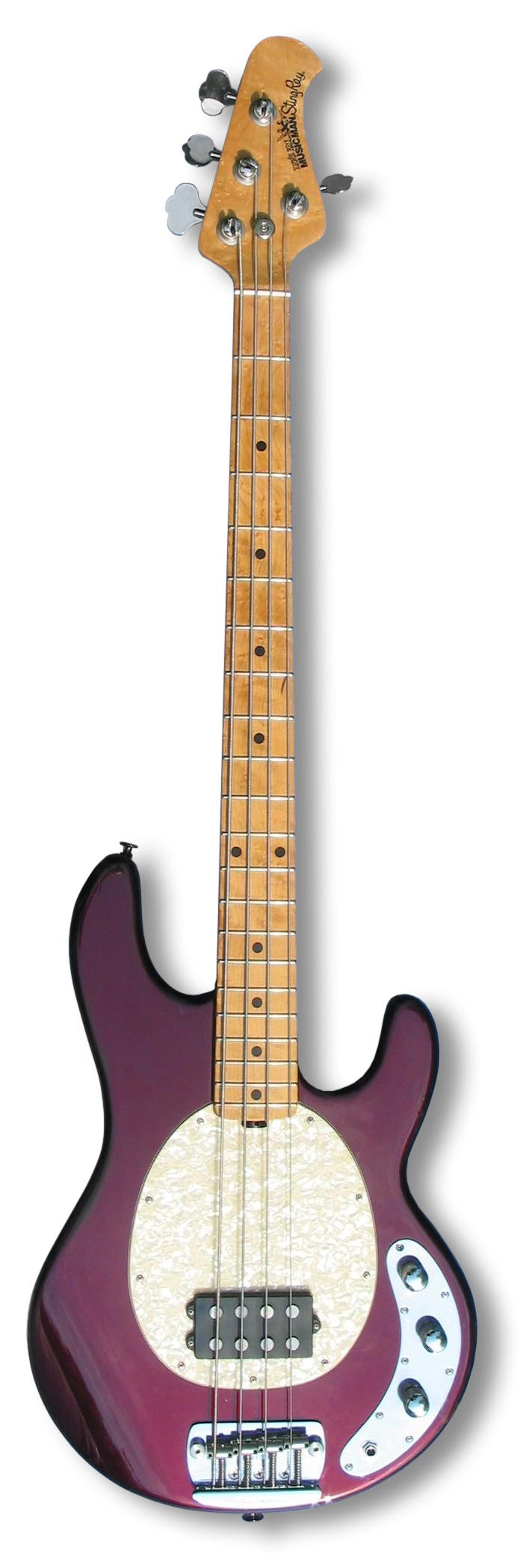
Photo: Th. Ott / Wikimedia Commons / CC BY-SA 3.0 Music Man
StingRay
1976
Leo Fender wanted a wide, bright bass. Louis Johnson hit it with his thumb, and funk had its sound.