Pedulla
Buzzard
A fusion bassist botched his homemade fretless. The builder who fixed it went on to build him a better one.
1977. Mark Egan, the bass player in the original Pat Metheny Group, has pulled the frets out of his ’64 Jazz Bass and brushed epoxy onto the rosewood, the way you did it back then. It went on uneven. The bass is unplayable. A friend knows a shop nearby.
- Introduced
- 1980
- Type
- Solidbody bass
- Class
- Closed run
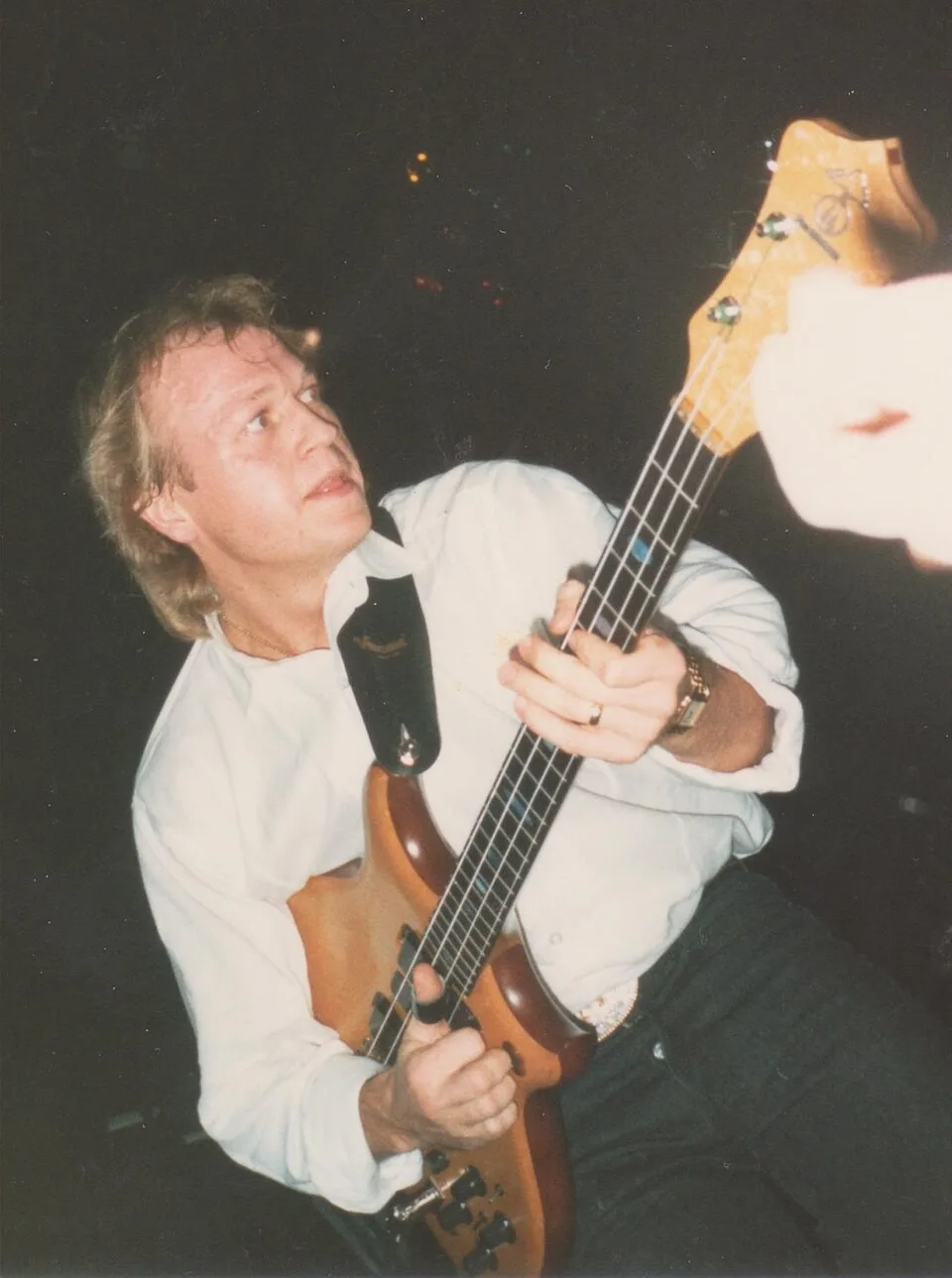
The short version
1975
The shop opens
M.V. Pedulla starts up in Massachusetts. The first bass comes a year later.
1977
The rescue
Pedulla sands off Mark Egan’s bad epoxy job and recoats his fretless Jazz.
1980
The Buzz
A fretless designed as a fretless, built in Brockton with Egan and Tim Landers in the room.
1981
Egan’s own
He buys a Buzz. It’s his go-to fretless for the next thirteen years.
1982
Diamondkote
The catalog’s name for the hard, clear board coat that lets roundwound strings sing.
1994
End of an era
Egan’s Buzz finally gives up its main-fretless job, and the Standard version is discontinued.
2019
Orders stop
In May, Michael Pedulla retires after nearly 45 years.
Side A
A1
An epoxy job gone wrong
In the mid-’70s, the usual way to get a fretless electric bass was to make one. You pulled the frets out of a Jazz Bass, filled the slots, and brushed epoxy over the fingerboard so the roundwound strings wouldn’t chew it up. Then you hoped it went on flat.
Mark Egan’s didn’t. He was playing in the original Pat Metheny Group, chasing Jaco Pastorius’s sound on a 1964 Jazz, and his epoxy went on uneven. The bass was unplayable. Tim Landers, another bassist, knew a shop nearby. The shop was Michael Pedulla’s.
Pedulla sanded it down and put on a fresh coat. Egan’s verdict:
The bass came to life.
He took that Jazz on the road with Metheny. There are two stories about where it came from. You’ll sometimes read that it was a gift from Jaco. Egan’s own account is a flea market in Miami, early ’70s, $100.
A2
A bass drawn by two bass players
A repair is one thing. What happened next was bigger. In 1980, in Brockton, Massachusetts, with Egan and Landers in the room, Pedulla built the Buzz: a fretless designed from the start to be a fretless, not a Fender with the frets yanked out.
Egan had a list. A neck thinner front to back than a Jazz. A flatter fingerboard. More sustain, and a growl “more like a bass sitar.” A deep cutaway so he could actually reach the top of the neck, and a longer upper horn.
Landers had his own reason. Playing with Al Di Meola, he had to double guitar riffs on the bass, and he needed the room. So the board went to 24 positions instead of what Pedulla called “the existing 21.” Two full octaves, no frets.
The rest is a maple neck that runs right through the body, flame-maple wings, and a lined ebony board, so you still know where the notes are.
A3
A finish almost as hard as glass
The real trick is the fingerboard coat. A fretless with no metal in the board needs something on top that steel roundwounds won’t grind through. Egan credits it for the growl.
It has had a few names, which is half the fun. The 1982 catalog called it Diamondkote, a “superhard clear finish,” and promised the “singing” fretless sound. Egan has called it acrylic. Pedulla himself said he tried epoxy, nitrocellulose, catalytic lacquer, and urethanes before a chemical engineer pointed him to polyester. It stays flexible, goes on thinner, and by his reckoning is about 80 percent as hard as glass. He ended up clear-coating the whole bass with it.
Pickups came two ways at first, active Bartolinis or passive DiMarzios. Egan went Bartolini, warmer and punchier with less hum, in a P/J layout. Some early Buzzes have the DiMarzios, so don’t assume.
Flip the record · By the numbers
24
Positions on the board. Tim Landers wanted 24 instead of “the existing 21.”
~80%
How hard the polyester board coat is, compared to glass, by Pedulla’s reckoning.
~750
Basses a year at the shop’s mid-’90s peak, every model counted.
~45
Years in business before the orders stopped in May 2019.
Side B
B1
Thirteen years of records
Egan left Metheny in 1980, and in 1981 he bought a Buzz of his own. It was his main fretless until 1994. By his count it’s on his work with Jim Hall, Bill Evans, Gil Evans, and Sophie B. Hawkins, on his solo records, and all over Elements, his band with the drummer Danny Gottlieb.
One careful split. Some of his best-known sessions, including Sting’s …Nothing Like the Sun, were on the old Jazz, not the Buzz. He keeps the two lists apart, so we will too.
Landers kept his Buzz busy for over thirty years of session work, “on hundreds of recordings from Al Stewart to Tori Amos to Vince Neil.”
And if someone tells you John Entwistle played a Buzzard: he did, but that one was a Warwick. Different bird entirely.
B2
One man and a rasp
Pedulla never really became a factory. The shop peaked in the mid-’90s at close to 750 basses a year, across every model, and then shrank back to one man again. No CNC machines. No imports. He carved necks with a rasp.
The experiments that didn’t work out, he destroyed. The two Buzz prototypes he didn’t. Egan and Landers still have them, never reworked.
In May 2019, after nearly 45 years, Pedulla stopped taking orders. Bartolini still winds replacement pickups for owners.
There are fancier basses. There are certainly louder ones. But the Buzz started with a bass player walking into a shop with a problem, and a builder who actually listened. The two prototypes are still with the two players who asked for them.
Put this on
You’ve read about it. Now hear it. Here’s what this guitar sounds like, and what to listen for.
Elements
Egan’s band with drummer Danny Gottlieb. He lists this album among the ones he made on his Buzz.
Find it on YouTube (opens in a new tab)Forward Motion
More Elements, and more of that growling, singing fretless on the Buzz.
Find it on YouTube (opens in a new tab)Mosaic
One of Egan’s own solo records, on the Buzz he bought in 1981.
Find it on YouTube (opens in a new tab)
The cast
The people, and the specific guitars, that made the legend.
1981
Mark Egan
1981 Buzz, fretless
Helped design it, bought one, and used it as his main fretless through 1994. His Metheny-era fretless was the Jazz.
1980
Tim Landers
Buzz prototype
Needed 24 frets’ worth of range to play guitar riffs with Al Di Meola. Still has his prototype.
1980
Michael Pedulla
Builder
Fixed the Jazz, built the Buzz, and was still carving necks by hand with a rasp decades later.
Liner notes
Specs, construction, rarity, value, and every source we used.
Neck-through maple, a hard-coated ebony board, and twenty-four positions — Pedulla’s fretless Buzz, not a Warwick Buzzard and not the fretted MVP.
- Body
- Offset double-cut flame maple on a neck-through stick. Egan: deep treble cutaway, longer upper horn.
- Neck
- “Capillary” neck-through, two or three pieces of maple. 1.55" at the nut (early-’80s literature).
- Fingerboard
- Lined ebony, white inlay, 24 positions, no frets. 1982 catalog coat: Diamondkote.
- Scale
- 34" (early literature).
- Pickups
- Bartolini active or DiMarzio passive. JL, JB, PJL, or PJB.
- Hardware
- 1987 PJB example: Schaller tuners, bridge/tailpiece, locking strap buttons. Standard: chrome, fixed bridge.
- Electronics
- Active. That 1987 PJB: volume per pickup, master tone, gain, 3-way toggle, mini-toggle with LED.
- Finish
- Standard list: Champagne, Black, Lime Green, Metallic Midnight Blue, Red, White.
- Nut
- 1.55" wide. Blue Book Standard: brass.
Open the full research fileConstruction details, the complete player record, production numbers, dated value estimates, and sources
Classic living example = early-1980s M.V. Pedulla Buzz, 4-string fretless (Brockton). No new one: orders stopped May 2019. Late sheet (No Treble, 18 October 2012): three-piece maple, bone nut, Bartolini PJ / JJ / soapbar, volume / pan / bass / treble / mid toggle, gloss polyester, Pedulla/Gotoh, 9–10 lb, bridge ABM. Listings print Hipshot. Blue Book AA still says brass nut, quartersawn maple, “current mfg.” The shop does not. MVP is fretted. Pentabuzz / Hexabuzz / Octabuzz are 5 / 6 / 8. Mark Egan Signature is not this table. Not a Warwick Buzzard. Mix flagged: late inlay 5 mm against 34" and 1.55". No millimetres invented for scale or nut. One 1988 listing measured 1.5" and 17 mm spacing. Do not average it with 1.55".
Construction
The job was a fretless designed as a fretless. In the mid-’70s you got one by pulling the wire out of a Jazz and hoping the epoxy went on flat. Mark Egan’s didn’t.
He was in the original Pat Metheny Group, chasing Jaco’s sound on a ’64 Jazz. Vintage Guitar (Willie G. Moseley, May 2018): he brushed epoxy on the rosewood, it went on uneven, and the bass was unplayable. Tim Landers knew a shop nearby. Pedulla sanded it and put down a fresh coat. Egan: “The bass came to life.” He took that Jazz on the road with Pat. His own site: frets out briefly in 1977, back in after the Austin City Limits show that year. FretlessBass’s interviewer frames the bass as a gift from Jaco. Egan’s page does not. Flea-market Jazz, Miami, early ’70s, $100. Pedulla, answering that question, put “Jaco” in quotes and said the repair showed him the opening. Keep his account and Egan’s. The Metheny-years fretless is the Jazz. Not this bass.
What he built next is the Buzz. Vintage Guitar: introduced in 1980, Brockton, Massachusetts, with those two locals in the room. Egan wanted a Jazz neck thinner front to back, less fingerboard radius, sustain, and a growl “more like a bass sitar,” a cutaway that reached the 24th fret, and a longer upper horn. Pedulla’s early-’80s literature calls the neck-through a “capillary” stick, two or three pieces of maple, 1.55" at the nut, 34" scale, lined ebony, white inlay, 24 positions. The obvious part is the board. A fretless with no metal in it needs a coat that roundwounds will not chew through.
The coat has four names. The Jazz repair was epoxy. The 1982 catalog, via Vintage Guitar, calls the board Diamondkote, a “superhard clear finish” under roundwounds, the “singing” fretless sound. Egan calls that coat a hard finish he credits for the growl, and on his own site he says acrylic. Pedulla, FretlessBass 2015: he tried epoxy, nitrocellulose through catalytic lacquer, and urethanes. A chemical engineer sent him to polyester. It stays flexible, goes on thinner, and he put the hardness at about 80% of glass. He clear-coated the whole bass with it. The 2012 sheet still says polyester on the board. Keep all four names.
Pickups split the same way. Vintage Guitar: Bartolini active or DiMarzio passive. JL is two Jazz-type DiMarzios. JB is two active Bartolini Jazz coils. PJL and PJB are the P/J versions, passive and active. The 1987 bass in that article is a PJB: split-P at the neck, Jazz at the bridge, Schaller tuners and bridge, a wooden lid over the controls so the battery is a screwdriver job. Egan preferred Bartolini — warmer, punchier, less hum — and a P/J, bridge pickup forward. Bass Musician (September 2016): he has used Bartolini since the 1978 Chicago NAMM, booth next to Bill Bartolini, and by then “exclusively.” The early Buzz still had a DiMarzio column. Don’t erase it.
Flame-maple wings, the long horn, offset double-cut. Blue Book Standard: chrome, brass nut, fixed bridge, P/J Bartolini, volume/tone/mix, Champagne, Black, Lime Green, Metallic Midnight Blue, Red, or White. Disc. 1994. Before that, Standard / Deluxe / Custom / Signature tracked chrome, black or gold, then AA and AAA flame. Later AA and AAA are the catalog and hardware color is just a choice. The open AA page still says “current mfg.”
He destroyed the experiments that weren’t right. The two prototypes, Egan’s and Landers’s, they still have, unreworked. Egan’s first bought Buzz is the next sentence: #236, 1981, after he left Metheny in 1980. Don’t merge it with the prototype.
Wikipedia: founded 1975, headquarters Boston. Bass Musician: first bass 1976. Vintage Guitar puts the design in Brockton. Keep both towns. No Treble: mid-’90s peak close to 750 basses a year, every model, then one man again because the job had become the company. Pedulla, 2015: no CNC, no imports, Christine on the business, necks still carved with a rasp. About 30% of sales fretless, the whole line, not a Buzz count.
May 2019 the orders stopped. Nearly 45 years. Leftover “Available basses,” then strings and parts. Bass Magazine ran it again in July. Bartolini dates the parts authorization June 2019 and still winds owner replacements. Wikipedia’s “10,000 basses” is not in the No Treble piece it cites. Omitted.
Not the MVP — same wings, frets in the board. Not a Pentabuzz, Hexabuzz, or Octabuzz. Not the Egan signature five-strings, and not the doubleneck Vintage Guitar calls the company’s first, 8-string fretted over 4-string fretless. Not a Thunderbass, Thunderbolt, Nuance, or Rapture. Wolstenholme’s Pedullas are Raptures. Not a Warwick Buzzard. Guitar-list: Entwistle, 1985, later personal instruments from Status.
Classic vs current: the 1980 Buzz against no order book. The last spec sheet is 2012. Then the door closed.
Players
The Metheny fretless is the ’64 Jazz. Egan, on FretlessBass: Pat kept it, and he thinks it was stolen in Chile. A Rapture, an MVP, and Entwistle’s Buzzard do not belong in this list.
Mark Egan. Met Pedulla in 1977. #236, 1981, is the Buzz, his go-to fretless through 1994. His page puts that bass on Arcadia, Sophie B. Hawkins, Marc Cohen, Jim Hall, Bill Evans, Gil Evans, the solos Mosaic, A Touch of Light, and Beyond Words, and on Elements with Danny Gottlieb: Elements, Forward Motion, Blown Away, Illumination, Liberal Arts, Spirit River. A wider sentence on the same page adds Sting, Joan Osborne, Michael Franks, and Richie Havens. The Jazz section names the albums: Nothing Like the Sun, Relish, So Red the Rose. Keep the split. Guitar World (13 April 2021): Electric Blue is the later signature five-strings, the 8-string fretless, and the doubleneck. Narrow neck, two octaves, low action. Not #236.
Tim Landers. The other half of the drawing. With Al Di Meola he had to play guitar riffs on the bass, so both MVP and Buzz go to 24 instead of what Pedulla called “the existing 21.” That is the brief, not a pinned Di Meola title. His own Buzz, Vintage Guitar: a session partner for over 30 years, “on hundreds of recordings from Al Stewart to Tori Amos to Vince Neil.” Later Pedulla models are other basses.
Rarity
You cannot order a new Buzz. Used is the market. Blue Book’s “current mfg” line was not revised for 2019.
No Buzz total was published. None invented. The 750 a year and the 30% fretless are shop figures, every model. #236 dates one bass. It does not count 1981.
What is actually thinner: the two prototypes; the experiments he says he destroyed; a DiMarzio-option Buzz with Diamondkote still the catalog name; a Standard from before 1994. The 2015 anniversary was one of each model, flag headstock, his name on the back — not a Buzz edition size. #236, those prototypes, and the doubleneck are single objects. They are not a vintage Buzz.
Value
Informal estimate, 22 September 2026. Not an appraisal.
Ask vs sold labeled. Celebrity instruments are not-comps. No invented medians or factory counts. No clean Reverb Price Guide band isolated this pass. Flag: thin sold-comp access. Blue Book’s open page prints an $800 step over AAA for AAAAA or quilt and still says current production. The AAA base is behind the login. Not a 2026 cart. Period list prices for a new Buzz were not on a living Pedulla page this pass.
New street. None. Orders stopped May 2019.
Used. The whole market is used. Named asks, not hammers, this pass: Reverb, 1985 flame-maple Buzz $5,000; 1986 blue-sparkle Buzz $3,599; a 1988 red triple-flame Buzz cut from $5,500 to $4,930, with the same title also showing $3,333 — do not average the two cards. Guitar Center, Marietta, used 1984 natural $2,999.99. A five-string Pentabuzz is a different model. Don’t borrow its ask.
Vintage / collectible. Early Buzzes are the same used market, not a separate hammer series. #236 and the prototypes are not comps. A refinish changes the object. Don’t treat a recut board as a clean early coat.
See also
- fender-jazz-bass — Egan’s defretted ’64, the bass this fretless was built after
- warwick-streamer — Entwistle’s Buzzard is the other bird; not this neck-through
- alembic-series-i — the other American active through-neck; not this silhouette
Sources
- Vintage Guitar, Willie G. Moseley, The Pedulla Buzz Bass (May 2018) — introduced 1980, Brockton; Egan’s botched epoxy on the ’64 Jazz; Landers; capillary neck, 1.55" nut, 34" scale, lined ebony, 24 positions; 1982 Diamondkote copy; Bartolini or DiMarzio, JL/JB/PJL/PJB; 1987 PJB and Schaller; Landers on Al Stewart, Tori Amos, Vince Neil; signature and first doubleneck
- Mark Egan, Basses — shop 1977; left Metheny 1980; Buzz #236 in 1981, go-to 1981–1994; album split against the ’64 Jazz (Nothing Like the Sun, Relish, So Red the Rose); acrylic board; flea-market Jazz, $100; frets out briefly 1977, back after Austin City Limits; signature five-strings, Octobuzz, doubleneck
- FretlessBass.com, Eric Larson, Pedulla 40th-anniversary interview (2015) — “Jaco” in quotes; Buzz designed as its own instrument; 24 vs “the existing 21” for Landers with Di Meola; prototypes still with Egan and Landers, earlier ones destroyed; polyester vs epoxy, ~80% the hardness of glass; ~30% of sales fretless; no CNC, no imports
- FretlessBass.com, Pedulla 40th anniversary (2015) — one of each model, flag headstock, signature on the back
- FretlessBass.com, Mark Egan — interviewer’s Jaco-gift frame; Pat kept the Jazz, thought stolen in Chile
- No Treble, Bass of the Week: Pedulla MVP/Buzz, 18 October 2012 — late factory options: three-piece capillary maple, 34", ebony, 24 markers, polyester board, bone nut, 5 mm dots, 9–10 lb, ABM bridge, Gotoh, Bartolini PJ/JJ/soapbar, volume/pan/bass/treble/mid
- No Treble, Michael Pedulla Announces Retirement, 7 May 2019 — orders stopped; nearly 45 years; mid-’90s peak close to 750 basses a year, whole shop; MVP, Buzz, Thunderbass, Thunderbolt, Nuance, Rapture
- Bass Magazine, retirement notice, 26 July 2019 — same closure, parts while supplies last
- Bartolini, Pedulla Basses, 17 April 2025 — June 2019 retirement; replacement pickups for verified owners only
- Bass Musician Magazine, Year of the Luthier: Michael Pedulla, 1 September 2016 — first bass 1976; Bartolini since NAMM 1978; only signature is Egan’s
- Wikipedia, M.V. Pedulla Guitars — founded 1975; Boston headquarters; MVP fretted, Buzz fretless; 4/5/6/8. The “10,000 basses” line is not in the No Treble citation. Omitted
- Blue Book of Guitar Values, Pedulla Buzz/MVP series — Standard disc. 1994; brass nut; AA/AAA “current mfg”; $800 AAAAA/quilt step, AAA base paywalled
- Guitar World, Mark Egan on Electric Blue, 13 April 2021 — Pedullas since 1981; signature five-string, two-octave neck; Electric Blue instrument list
- guitar-list, Warwick Buzzard — Entwistle/Warwick Buzzard introduced 1985; later personal instruments by Status
- Reverb, Pedulla bass listings — asks this pass, not hammers: 1985 flame $5,000; 1986 blue sparkle $3,599; 1988 red triple-flame $4,930 from $5,500, same title also $3,333
- Guitar Center, used 1984 Pedulla Buzz 4 — ask $2,999.99, Marietta
- Reverb, 1988 Buzz, Tone Wolf — one bass measured 1.5" nut, 34" scale, 17 mm spacing, 8 lb 7 oz. Not a factory table
Keep digging
Guitars this one gets compared to, confused with, or descended from.

Fender Jazz Bass from 1966 in Olympic white with the transition fingerboard (bindings and dot inlays). Photo by Th. Ott. Licensed under CC BY-SA 3.0. Via Wikimedia Commons. Fender
Jazz Bass
1960
Built for jazz players who mostly passed on it. Then bass players started using it to take the solo.
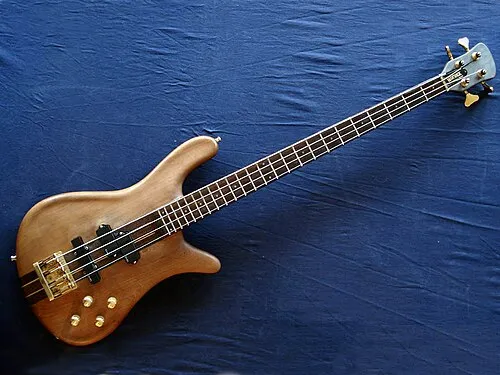
Photo: Jarlmos / Wikimedia Commons / CC BY-SA 3.0 Warwick
Streamer
1984
It started as a German copy of a bass Europe couldn’t get. By the time the lawyers came back, it wasn’t one.
- Send a picture
Alembic
Series I
1972
The sound wizards behind the Grateful Dead got tired of noisy pickups, so they built bass players a better one.