Warwick
Streamer
It started as a German copy of a bass Europe couldn’t get. By the time the lawyers came back, it wasn’t one.
Frankfurt, 1984. A young German builder named Hans-Peter Wilfer brings a bass to the big music fair. It has a curvy, carved body that a lot of American bassists would recognize, because it looks an awful lot like a Spector. That’s the point, and soon it’s going to be the problem.
- Introduced
- 1984
- Type
- Solidbody bass
- Class
- Production
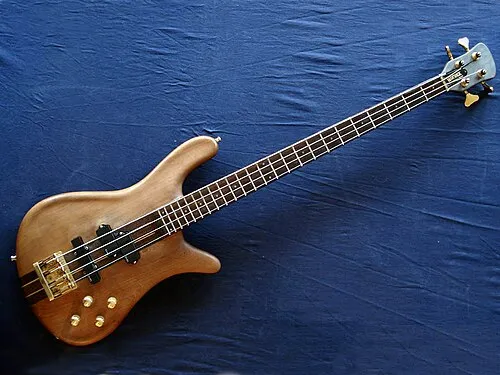
The short version
1977
Ned’s curve
Ned Steinberger designs the NS body for Stuart Spector.
1982
Warwick opens
Hans-Peter Wilfer starts his own workshop in Bavaria on 13 September.
1984
The Streamer
Wilfer shows his first Streamer at Frankfurt. Some accounts date it as early as 1982.
1985
The confrontation
Spector and Steinberger meet Wilfer at the Frankfurt fair. He agrees to pay a licensing fee.
1987
Stage I
A second Streamer arrives, so the original becomes the Stage I. It gets a new two-piece brass bridge.
1990
MEC pickups and Mike Inez
Warwick’s own pickups go in, and Ozzy Osbourne buys his bassist a Streamer.
1995
Markneukirchen
Warwick leaves Franconia for a new home in Saxony.
1997
The lawsuit that wasn’t
A threatened suit over the shape is dropped. The Streamer is no longer an exact copy.
Side A
A1
A bass nobody in Europe could get
In the mid-’80s, the Spector NS was catching on in America. It had a curved, carved body designed by Ned Steinberger in 1977. If you lived in Europe, good luck finding one.
Hans-Peter Wilfer had an idea about that. His father, Fred, had founded Framus back in 1946, so guitars were the family business. In September 1982 Hans-Peter opened his own small workshop in Bavaria and called it Warwick. He didn’t see any reason to build the Fender copies players could already get cheaply from Asia. So he built his own version of that curve instead.
That first year he sold guitars and basses out of the shop, and more basses went out the door than guitars, so he concentrated on basses. His first model of his own was a headless bass called the Nobby-Meidel. The one that stuck was the Streamer.
A2
Frankfurt, twice
“I made my first Streamer in nineteen eighty four,” Wilfer said. “I presented it in Frankfort 1984.” Other accounts push the date back to 1982 or 1983. Depends who you ask.
The early ones were close to the original: a paddle headstock, a one-piece bridge, cherry wings on a laminated wenge-and-maple neck that ran all the way through the body, and the same pickup layout, a split P-style pickup near the neck and a J at the bridge.
A year later, back at the Frankfurt fair, Stuart Spector and Ned Steinberger came to see him. Wilfer agreed to pay a licensing fee. Warwick paid for a while. Then Spector sold his company to Kramer, the payments stopped, and Kramer didn’t chase them.
It was a copy, and everybody knew it. Then it spent ten years quietly becoming something else.
A3
Becoming a Warwick
Here’s what happened next, one change at a time. The early ones were oiled and waxed, with EMG or Bartolini pickups in them, and the shop was turning out sixty or seventy instruments a month. Around 1985 or ’86, Wilfer gave it his own headstock. In 1987 Warwick brought out a second Streamer, the Stage II, with its through-neck hidden under the body wood and two J-style pickups. So the first one became the Stage I, and it got the two-piece solid brass bridge that’s still on it. Cherry wings gave way to flamed maple. In 1990, Warwick’s own MEC pickups went in.
None of those is a big deal on its own. Added up, the bass stopped being Ned’s and became Wilfer’s. What you get now is a through-neck of wenge, a hard, dark wood with a lot of grain, and an active preamp with a three-band EQ, all on that same curve.
In 1995 the company moved to Markneukirchen, in Saxony, where the German Streamers are still built.
Flip the record · By the numbers
1984
The year Wilfer says he made and showed his first Streamer.
60–70
Instruments a month out of the whole Warwick shop in 1984. By 1990, about 100–120.
24
Frets on a 34-inch through-neck.
1997
The year it stopped counting as a copy.
Side B
B1
The kid with the loan
Stuart Zender’s mother took out a loan to buy him his first Streamer. He played it on Jamiroquai’s first three albums. On “Virtual Insanity,” he said, “I used a Warwick Streamer Stage I with MEC pickups,” straight into the desk and through a miked Mesa/Boogie cabinet. On “Revolution 1993” it was a five-string Streamer with a Minimoog underneath.
In 1990 Ozzy Osbourne bought his bassist, Mike Inez, a Streamer with old EMG pickups. Inez kept it long after it was beaten half to death, and he played most of Alice in Chains’ Rainier Fog on it in 2018. Robert Trujillo has mostly played Streamers in Metallica, and in 2010 Warwick built him a signature one. He didn’t use a Warwick on Death Magnetic, but for Hardwired… to Self-Destruct his signature five-string “crushed” the blindfold test.
B2
No longer a copy
In 1997, after Stuart Spector had won his name back, there was talk of a lawsuit over the shape. It got dropped. By then the Streamer wasn’t an exact copy anymore. The headstock was Warwick’s, the bridge was Warwick’s, the pickups were Warwick’s, and so was the list of players.
Every builder starts out copying someone. Plenty of them stay there. Wilfer copied Ned Steinberger’s curve, paid for it, and then spent a decade changing the thing a piece at a time, until the bass that started as somebody else’s was plainly his own.
Put this on
You’ve read about it. Now hear it. Here’s what this guitar sounds like, and what to listen for.
Virtual Insanity
Stuart Zender has said he played a Streamer Stage I with MEC pickups on this, direct and through a miked Mesa cabinet. Another account says it was a five-string, so we won’t swear to the string count. Listen for the woody tone.
Find it on YouTube (opens in a new tab)Revolution 1993
Zender on a five-string Streamer with a Minimoog underneath.
Find it on YouTube (opens in a new tab)Rainier Fog
Mike Inez played most of this album on the beat-up Streamer Ozzy Osbourne bought him in 1990.
Find it on YouTube (opens in a new tab)
The cast
The people, and the specific guitars, that made the legend.
1984
Hans-Peter Wilfer
Designer
Son of Framus founder Fred Wilfer. Didn’t see the point of building Fender copies Asia could make cheaper.
1977
Ned Steinberger & Stuart Spector
The NS curve
Designed and built the shape the Streamer started from, and came to Frankfurt in 1985 to talk about it.
1990
Mike Inez
A 1990 Streamer from Ozzy
Old EMGs, a battered burst finish, and most of Alice in Chains’ Rainier Fog.
1993
Stuart Zender
Streamer Stage I
His mother took out a loan for his first one. He used it on Jamiroquai’s first three albums.
2010
Robert Trujillo
Streamers, and a signature one
Has mostly played Streamers, four- and five-string, in Metallica.
Liner notes
Specs, construction, rarity, value, and every source we used.
Wenge through-neck, a reverse-P and a J, and the German take on Ned Steinberger’s NS curve — Warwick’s Streamer Stage I, not a Spector, and not the bolt-on LX.
- Body
- AAA flamed maple wings; curved NS-style silhouette; neck-through
- Neck
- Wenge with ekanga veneer stripes, 3 laminations; through-neck
- Fingerboard
- Wenge (fretted); tigerstripe ebony (fretless). 20" (508 mm) radius, 24 jumbo bronze frets, IFT. Mix flagged.
- Scale
- 34" (864 mm)
- Pickups
- Active MEC P/J, brushed metal covers. Reverse-P at the neck, J at the bridge.
- Hardware
- Warwick 2-piece solid brass bridge; Graph Tech Ratio tuners with wooden pegs; Warwick security locks
- Electronics
- Active Warwick 3-band with rechargeable lithium battery; volume (push/pull), balance, mids, stacked bass/treble
- Finish
- Natural oil, transparent satin, or high polish
- Nut
- Just-A-Nut III brass, 38.5 mm / 1.5"
Open the full research fileConstruction details, the complete player record, production numbers, dated value estimates, and sources
Current typical = Masterbuilt Streamer Stage I 4-string (Markneukirchen; shop.warwick.de, fetched 4 September 2026). Factory prints mixed inch/mm; no millimetres invented. Factory cart €7,790 oil / €8,530 high polish for the 4-string; 5-string €10,370. Teambuilt / GPS is the German production Stage I, not this table. RockBass Streamer is China. Streamer Stage II is hidden-neck, afzelia, J/J — not this table. Streamer LX is bolt-on. Streamer Standard is the RockBass / bolt-on line, not Stage I. Robert Trujillo Signature and Stuart Zender Signature are Streamer-family SKUs, not this table. Not a Spector NS-2. No Gibson SKU.
Construction
The job was a bass Europe could not buy. In the mid-1980s the Spector NS was tracking in the United States and hard to find on this side of the ocean. Hans-Peter Wilfer, Bass Player (Rod Taylor, May 2012, via Wikipedia): he saw no reason to build Fender copycats players could get cheaply from Asia. He designed his own version of that curve. The bass that stuck is the Streamer — Stage I once Stage II existed.
Warwick itself starts 13 September 1982. Vintage Guitar (Willie G. Moseley, July 2017): Wilfer’s father, Fred, had founded Framus in 1946; Hans-Peter started Warwick that September in a tiny Bavarian workshop — Pretzfeld on German Wikipedia, Erlangen on English Wikipedia. Keep both towns. First year: guitars and basses sold out of the shop; more basses than guitars, so he concentrated on them. First own model was the headless Nobby-Meidel, not this bass. German Wikipedia: Nobby-Meidel first. MusicRadar (Roger Newell, 28 October 2011): first production models were the Nobby-Meidel and the Streamer.
When the Streamer itself arrived is split. Wilfer, Chicago Music Exchange: “I made my first Streamer in nineteen eighty four. I presented it in Frankfort 1984.” Still the old headstock. Spector’s PJ Rubal, TalkBass (23 December 2004): “Warwick came on to the scene in 1984 with their Streamer bass.” Wikipedia’s Streamer page prints 1982–present and “launched in 1982,” citing the company founding, and captions a photograph “Streamer from 1983.” Andertons repeats 1982. Keep 1982, 1983, and 1984. This plate starts in 1984.
The curve is Ned’s. Steinberger designed the NS body for Stuart Spector in March 1977 (spector-ns-2). Early Streamers were near copies: paddle headstock, one-piece bridge, cherry wings, five-piece wenge/maple through-neck, reverse-P and J. Wikipedia: at Frankfurt Musikmesse 1985, Spector and Steinberger confronted Wilfer; he agreed to pay a licensing fee. Rubal: Warwick paid royalties for a while; Stuart sold Spector to Kramer; Warwick stopped; Kramer did not pursue. Wikipedia: 1997, after Spector won the name back, a threatened suit was dropped because the Streamer was no longer an exact copy. Keep both sides.
Then the instrument became a Warwick. Wikipedia: headstock changed around 1985. Wilfer: own headstock in 86. Bass Center’s translation of the megabass.it chronology (12 July 2016): Warwick headstock 1985, tuners angled shortly after. 1987 is the split year. Stage II arrived, so the living bass took the name Stage I. The one-piece bridge became the two-piece brass still on the spec sheet. Cherry wings gave way to flamed maple. Early examples are oil and beeswax on cherry and wenge, EMG or Bartolini in the routes. MEC pickups, 1990. Bass Center: Stage I five- and six-strings were already in the line by then, still on Bartolini when MEC arrived. Shimamura dates Stage I itself 1983 — a dealer year, not this plate’s start.
Not Stage II. Same year, hidden neck-through like the Thumb, afzelia, J/J, yin-yang inlays. Rarer. Not this table. Not the bolt-on. Streamer bolt-on 1993–97 (Blue Book disc. 1996; Bass Center 1993–97). Streamer LX: Wikipedia 1996, Bass Center 1997 from the bolt-on’s ashes, Blue Book’s living LX 2009–present. Keep 1996, 1997, and 2009. LX is P/J bolt-on, not through-neck Stage I. Not Streamer $$, CV, or NT. Not Thumb (1985, small body, 26 frets). Not Buzzard (Entwistle, 1985–86). Not Corvette. No Gibson SKU.
1995, the shop left Franconia for Markneukirchen. German Wikipedia: Custom Shop is Masterbuilt, handcrafted in Germany; Pro Series is Teambuilt, also Germany; RockBass is “Standard,” made in China. Same silhouette at three prices. The table is Masterbuilt Stage I 4-string: flamed maple, wenge/ekanga, MEC P/J, 3-band lithium, two-piece brass, Just-A-Nut III. Classic vs current: 1984 cherry/wenge/EMG/one-piece/paddle — against that living Markneukirchen 4-string. Same curve. Same reverse-P. Same slug.
Players
Do not hang a Spector NS-2 on this plate. Do not recruit Jack Bruce’s Thumb or Entwistle’s Buzzard as if they were Streamers. Do not flatten Dirt onto Inez.
Mike Inez (Alice in Chains / Ozzy Osbourne). MusicRadar (Joel McIver, 6 November 2018): Ozzy bought him a Streamer in 1990, old EMGs, Moonburst or Silverburst, “completely beat to shit,” fifth headstock. Warwick endorser since 1990. Most of Rainier Fog (2018) on that bass. Bass Player, via Wikipedia: two Streamer Stage I four-strings plus a Streamer 5. Jar of Flies (1994) is Inez. Dirt is Mike Starr. Do not mash them.
Stuart Zender (Jamiroquai). Warwick player since 1993. Warwick’s own “Meet the Players” clip: his mother got a loan for the first Streamer; he used it on the first three Jamiroquai albums. Guitar World (Chris Jisi, 9 May 2024), on “Virtual Insanity”: “I used a Warwick Streamer Stage I with MEC pickups.” Direct plus a miked Mesa/Boogie 4x10. Same writer’s earlier framing calls the woody tone a 5-string; keep both. Guitar World (28 December 2025): “Revolution 1993” on a 5-string Streamer with a Minimoog underneath. The later Stuart Zender signature “features a body shape new to Warwick basses” (Wikipedia) — not this table.
Robert Trujillo (Metallica). Wikipedia: with Metallica he has primarily been playing Warwick Streamer basses, 4- and 5-string. Signature Streamer, March 2010 (Premier Guitar): neck-through, maple, tigerstripe ebony, EMG J/J, Bartolini 3-band, Chrometone. Bass Player, via Ultimate Guitar (4 January 2017): a signature 5-string “crushed” the Hardwired… to Self-Destruct blindfold test; he used no Warwick on Death Magnetic. The signature is a Streamer-family SKU with a special neck. It is not this table. Pre-Metallica Tobias / ESP / Music Man stay off.
Also known to play stays short. P-Nut’s signatures are Streamer Stage II (German Wikipedia). T.M. Stevens had a 2009 Stage I signature. Those are adjacent SKUs. Do not recruit Chancellor, Shavo, or Wolstenholme from Wikipedia’s unsorted Streamer list.
Rarity
You can order a new Stage I from Markneukirchen. Masterbuilt, Teambuilt, and RockBass all coexist on this silhouette. RockBass is not a German Stage I. Custom Shop is the limited current line. It is not vintage rare.
Warwick does not publish Streamer unit totals. None invented. Serials date a bass; they don’t count a model. Bass Center’s megabass chronology: about 60–70 instruments a month in 1984, about 100–120 a month by 1990 — company-wide, not a Streamer census. German Wikipedia: about 4,000 electric basses and guitars in 2009, company-wide. Same caveat. Andy’s Vintage, on paddle-headstock serial 103, remembers about 300 early paddle examples; that is a dealer memory, not a factory total.
What is actually thinner: paddle-headstock Streamers before the 1985–86 headstock; cherry-wing Stage I before flamed maple; complete EMG-era instruments before MEC (1990); 1980s Stage II, especially 5-string (Bass Center). Inez’s Moonburst, Zender’s first Streamer, Trujillo’s Hardwired 5-string are unique objects. They are not a vintage Streamer.
Value
Informal estimate, 4 September 2026. Not an appraisal.
Ask vs sold labeled. Celebrity lots are not-comps. No invented medians or factory counts. US Reverb Price Guide dollar widget did not print a clean Stage I band this pass. Flag: thin sold-comp access.
New street. Factory Masterbuilt Stage I 4-string €7,790 oil / €8,530 high polish; 5-string €10,370 (shop.warwick.de, fetched 4 September 2026). Named US dealer carts, not a midpoint: Teambuilt/GPS Stage I 4-string $5,380; 5-string $5,570. Named Masterbuilt/Custom Shop asks: 2023 Champagne Gold Metallic Satin $4,543.52 (was $5,345.31); Burgundy Red 4-string $7,445.57. RockBass Streamer NT dealer $1,375 — China, labeled adjacent.
Used modern. Named asks this pass, not hammers: 1991 flame-maple Stage I $2,300 (was $2,750); 1995 Natural $2,300; 1996 Mahogany Red $2,425.81. Do not average those asks with new GPS.
Vintage / collectible. Named older solds, not a series: 1994 Natural oil $1,913.26; 2004 flame-maple $1,970.30. Named paddle-headstock ask, not a hammer: serial 103 (listed 1983 and 1984) €3,718.22 (was €4,134.66). Do not average 1990s solds with a first-run paddle. Inez’s Moonburst and Zender’s first Streamer are unique. Not comps.
See also
- spector-ns-2 — Ned’s 1977 curve this German through-neck is not
- music-man-stingray — 1976 active four-string, bolt-on slab; not a Streamer
- alembic-series-i — through-neck active, California sandwich; not the NS curve
Sources
- Warwick, Masterbuilt Streamer Stage I — 4-string flamed maple; wenge/ekanga 3-lam; 34"/864 mm; nut 38.5 mm/1.5"; MEC P/J; 3-band lithium; 2-piece brass; €7,790 oil / €8,530 high polish; 5-string €10,370
- Wikipedia, Streamer bass — launched 1982; photo 1983; headstock ~1985; two-piece bridge later; MEC 1990s; LX 1996; Bass Player May 2012 Wilfer on NS copies / Stage I; Musikmesse 1985 license; 1997 threat dropped
- Wikipedia, Warwick (guitar manufacturer) — founded 1982 Erlangen; Markneukirchen 1995; Streamer among original German models; P-Nut Streamer signatures; Zender signature new body; Trujillo signature
- Wikipedia (de), Warwick (Unternehmen) — Pretzfeld 1982; Buzzard 1985; Markneukirchen 1995; ~4,000 basses and guitars 2009; Masterbuilt / Teambuilt / RockBass Standard (China); Streamer among best-known; P-Nut Stage II signatures; Trujillo Streamer 2010; T.M. Stevens Stage I 2009
- Chicago Music Exchange, Q&A with Hans-Peter Wilfer — first Streamer 1984; Frankfurt 1984; own headstock 1986; Thumb 1985
- Bass Musician Magazine, Luthier Spotlight: Hans-Peter Wilfer (4 September 2017) — workshop 13 September 1982; first basses Fender copies then TV Bass then Nobby-Meidel; first artists Jack Bruce, Entwistle, Zender, Buchholz
- Vintage Guitar, Willie G. Moseley, Warwick Thumb Bass (July 2017) — Warwick September 1982; Framus 1946; wenge/bubinga/afzelia; Thumb 1985; Just-A-Nut; Markneukirchen 1995
- MusicRadar, Roger Newell, Bass manufacturer profile: Warwick (28 October 2011) — Warwick 1982 Erlangen; Nobby-Meidel and Streamer first production; Streamer similar to Spector NS, licensed until Kramer sale; two-piece bridge; Thumb 1985; Markneukirchen 1995
- Bass Center, L’histoire des Warwick (12 July 2016) — megabass.it chronology; Streamer 1984–85; ~60–70/month 1984; headstock 1985; Stage I name 1987; two-piece bridge 1987; Stage II 1987; MEC pickups 1990; ~100–120/month 1990; bolt-on Streamer 1993–97; LX 1997
- TalkBass, Spector NS body shape and Warwick (23 December 2004) — PJ Rubal: Ned March 1977; Warwick Streamer 1984; royalties for a while; Kramer did not pursue
- Blue Book of Guitar Values, Warwick Streamer series — Stage I current mfg.; bolt-on disc. 1996; LX 2009–present; Stage II current
- MusicRadar, Mike Inez (6 November 2018) — Ozzy Streamer 1990, EMGs, Moonburst/Silverburst; Rainier Fog; Warwick endorser since 1990
- Wikipedia, Mike Inez — Bass Player: Streamer Stage I ×2; Streamer 5; Jar of Flies 1994; Dirt is Starr
- Warwick, Meet the Players: Stuart Zender — Warwick player since 1993; mother bought first Streamer; first three Jamiroquai albums
- Guitar World, Chris Jisi, Stuart Zender on Virtual Insanity (9 May 2024) — Streamer Stage I, MEC; direct + Mesa 4x10
- Guitar World, Stuart Zender on Stevie Wonder / Jamiroquai (28 December 2025) — 5-string Streamer on “Revolution 1993”
- Premier Guitar, Warwick Debuts Robert Trujillo Signature Bass (1 March 2010) — Streamer signature; neck-through; maple; EMG J/J; Bartolini 3-band
- Wikipedia, Robert Trujillo — Metallica primarily Warwick Streamer 4- and 5-string; signature March 2010
- Ultimate Guitar, Trujillo Hardwired bass (4 January 2017) — Bass Player: signature 5-string on Hardwired; no Warwick on Death Magnetic
- Shimamura, Warwick model comparison (17 March 2018) — dealer copy: Stage I 1983; Stage II 1986; LX 1993 bolt-on
- Andertons, Warwick Streamer Basses — introduced 1982; LX / CV / NT as other versions
- Reverb, Warwick Streamer Stage I listings — GPS 5-string dealer $5,570; 4-string $5,380; Price Guide widget thin this pass
Keep digging
Guitars this one gets compared to, confused with, or descended from.
- Send a picture
Spector
NS-2
1979
It started with a man looking for a belt sander. Sting found his lying on the stage before soundcheck.
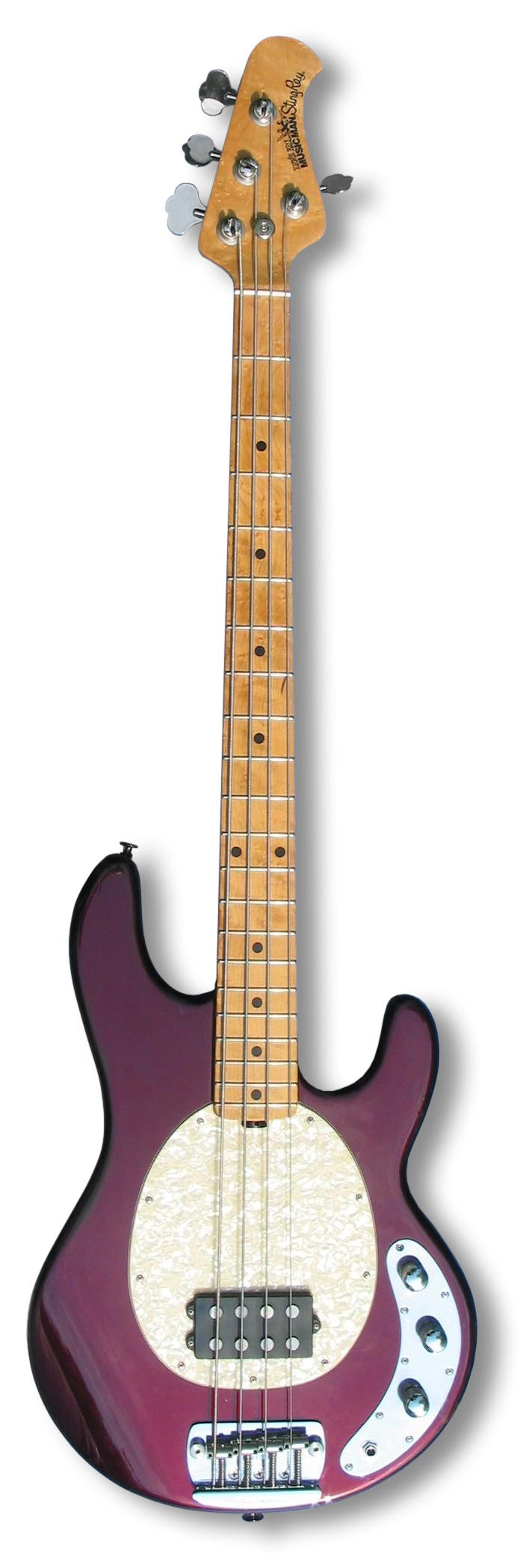
Photo: Th. Ott / Wikimedia Commons / CC BY-SA 3.0 Music Man
StingRay
1976
Leo Fender wanted a wide, bright bass. Louis Johnson hit it with his thumb, and funk had its sound.
- Send a picture
Alembic
Series I
1972
The sound wizards behind the Grateful Dead got tired of noisy pickups, so they built bass players a better one.