 Guitaripedia
Gallotone
Champion
The sticker said guaranteed not to split. John Lennon had it in his hands the day Paul McCartney first saw him.
Woolton, 6 July 1957. A church fete, a stage in a field, a sixteen-year-old with banjo chords on a cheap three-quarter flat-top. The guitar came from South Africa by mail order, and the label inside promised it would not split.
- Introduced
- 1955
- Type
- Acoustic flat-top
- Class
- Production

The short version
1926
Brunswick Gramophone House
Eric Gallo opens a record shop in Johannesburg. Guitars come later.
c. 1946
Jacobs
The instrument factory moves to a bigger plant near Durban, and the brand becomes Gallotone.
c. 1955
The cheap end
The Champion is offered wholesale in Britain at £2/10/-.
1957
Sent for 20/-
A mail-order ad in Reveille on 7 March. Lennon's Champion arrives that spring.
1957
Woolton
On 6 July, Lennon plays it at the St Peter's Church fete. Paul McCartney is in the crowd.
1958
Smashed in half
By the autumn, in Lennon's telling, the Champion is finished.
c. 1969
The factory shuts
Gallo stops making instruments and carries on as a record company.
1999
Sotheby's
Lennon's restored Champion is sold in London on 14 September.
Side A
A1
Making up the words
Woolton, the afternoon of 6 July 1957. There's a garden fete at St Peter's Church, and on a stage in a field behind it a skiffle group called the Quarrymen is playing. Drums, washboard, a tea-chest bass, a banjo, and two guitars.
The kid singing is John Lennon. He's playing banjo chords on a little brownish-red flat-top, and he doesn't know all the words to the Dell-Vikings' "Come Go with Me," so he's making them up. They get through "Railroad Bill," "Cumberland Gap," "Maggie Mae," and "Be-Bop-A-Lula," with a few verses stumbled over along the way.
A fifteen-year-old called Paul McCartney is watching. Later he'll play Lennon Eddie Cochran's "Twenty Flight Rock."
The guitar in Lennon's hands was shipped from Durban. It cost about as little as a guitar could, and it was mostly a promise printed on a sticker.
A2
Guaranteed not to split
Look through the soundhole of a Champion and there it is, in English and in Afrikaans: GUARANTEED NOT TO SPLIT. GEWAARBORG OM NIE TE BARS NIE. Some labels went further and said it was specially made to withstand all climatic conditions.
That's the whole sales pitch of a student guitar. Laminated woods, not a solid top. Three-quarter size. The strings didn't anchor at the bridge; they ran over it to a tailpiece at the end of the body. A treble clef on the headstock, between the tuners.
It came from a record man. Eric Gallo opened the Brunswick Gramophone House in Johannesburg in 1926 to sell American records, then a studio, then, in the late 1930s, a small instrument factory next door turning out guitars, banjos, ukuleles, and mandolins under the Singer name. Around 1946 the factory moved to a bigger plant in Jacobs, an industrial suburb of Durban. The Singer sewing-machine company complained, and the guitars became Gallotones.
The Champion was the cheap end. Around 1955 it went to the British trade at two pounds ten shillings, which probably meant about six pounds in a shop.
A3
On the never-never
How Lennon got his is a small mystery with too many answers.
In March 1957 a mail-order firm in south London ran an ad in Reveille: "Rock 'n Roll Guitars, Real Professional, Sent for 20/-." Twenty shillings was only the deposit. After that came twenty-one fortnightly payments of 20s 3d, £22 5s in all. Lennon remembered it more kindly:
"I was about 14 when I got my first guitar. It was a beat-up old Spanish model which cost about ten quid. It was advertised in Reveille magazine as 'guaranteed not to split'."
He was sixteen, and the arithmetic says it was more than ten quid. He did say it was bought "on the never-never," which means somebody was paying a little over a pound every two weeks into 1958.
Who that somebody was depends who you ask. In one version his mother, Julia, bought it for him. In another, Aunt Mimi refused, worried about his schoolwork, so John ordered it himself and had it sent to Julia's house. A newspaper in 2000 had Mimi lending him thirty dollars. The famous story about Mimi spending £17 on a guitar is true, but that was a later guitar, his first electric. Not this one.
Flip the record · By the numbers
£2/10/-
Wholesale for a Champion around 1955. About £6 in a British shop.
£10
What Lennon always remembered paying
£22 5s
The mail-order total, at 20s 3d a fortnight
3/4
Size, against a regular flat-top
Side B
B1
Blood in the soundhole
Julia played banjo, so that's what she taught him. Lennon said he played the guitar like a banjo for a while, "with the sixth string hanging loose." George and Paul taught him other things later.
Rod Davis, the Quarrymen's banjo player, remembered John and Eric Griffiths turning up with almost identical mail-order guitars. Eric's was lighter wood. John's was more brownish-red. When John broke strings, which was often, Davis put on Cathedral roundwound banjo strings, because they were the cheapest thing going.
"He would play it so furiously that he'd take the skin off his index finger and spray blood into his guitar."
Lennon admitted "it was a bit crummy," and he never put it down. Then, somewhere around a year in, he broke it. By the autumn of 1958 it was retired, "smashed in half," in his words. The sticker had been talking about the weather.
No Beatles record is this guitar. It was gone before there were any.
B2
You'll never earn your living by it
It ended up with Mimi. Years later, in the 1980s, a Liverpool charity asked for things John had owned, and she sent the Champion, in a trunk, with a typed note:
"The poor old guitar was in such a state when I found it I had it professionally repaired."
It had new paint, black and red now, over a well-worn fretboard. What happened after that is told two ways: through the charity, or, in another account, through a family friend with a disabled son and then another friend, whose stepfather sold it. Either way, on 14 September 1999 it came up at Sotheby's in London and went to a buyer on the telephone. Before the sale, a few papers called it Dutch. It was made in South Africa. In the winter of 2000 it was on show in Boston, in a museum exhibition on the art of the guitar.
The factory in Jacobs stopped making instruments around 1969. Gallo went on selling records.
And when the restored Champion reached the sale room, it had a little plaque on its headstock, looking back at what Mimi is supposed to have told a boy who practised instead of studying: "Remember You'll Never Earn Your Living By It."
The cast
The people, and the specific guitars, that made the legend.
1957–58
John Lennon
Gallotone Champion, his first guitar of his own
Played it at Woolton the day he met Paul McCartney. No Beatles record is this guitar.
1957
Julia Lennon
Banjo teacher, and maybe the buyer
Taught him banjo chords. In one telling she bought the guitar; in another it only came to her address.
1957
Eric Griffiths
An almost identical guitar
The Quarrymen's other guitarist. His was lighter wood, John's more brownish-red.
1957
Rod Davis
Banjo, and string-changer
Restrung Lennon's Champion with cheap banjo strings when he broke them, which was often.
1957
Paul McCartney
In the audience
Fifteen, at the Woolton fete. Saw Lennon making up the words to "Come Go with Me."
1980s
Aunt Mimi
Keeper
Had the wreck professionally repaired and gave it away in the 1980s.
Liner notes
Specs, construction, rarity, value, and every source we used.
Three-quarter laminate, a tailpiece, and a label that promised it would not split — John Lennon’s first guitar.
- Body
- Three-quarter-size steel-string flat-top, laminated woods (Andy Babiuk, Beatles Gear; Wikipedia). Heritage Auctions, one 1950s example: about 36½" long and 13¼" wide at the bottom.
- Neck
- No factory construction has been published. Rod Davis, via Babiuk: a treble clef on the headstock, between the machines.
- Fingerboard
- No factory wood and no fret count have been published. The Herald (15 September 1999), on Lennon’s restored guitar: a well-worn fretboard.
- Scale
- No factory figure has been published.
- Pickups
- None
- Hardware
- Strings over a separate bridge to a tailpiece (Davis, via Babiuk). A 1950s Reverb example: pressed-steel tailpiece stamped Gallotone.
- Electronics
- None
- Finish
- Sunburst on surviving Champions. Lennon’s: black and red (Chicago Tribune; The Herald), cherry-coloured (BBC, 24 August 1999).
- Nut
- No factory width has been published.
Open the full research fileConstruction details, the complete player record, production numbers, dated value estimates, and sources
The specs above are a 1950s Champion; no current model carries the name. Ace, Wonder, and Special Champion are other Gallotone models. Heritage prints inches on one guitar; no millimetre factory sheet has been published.
Construction
The job was a first guitar a kid could get. Three-quarter size. Laminate, not a carved top. Strings over a bridge to a tailpiece. Inside the soundhole, a sticker that said the box would not split.
Eric Gallo opened the Brunswick Gramophone House in Johannesburg in 1926, to distribute American Brunswick records (Wikipedia, Gallo Record Company; Babiuk). He opened a recording studio in 1932. In 1946 the firm became Gallo (Africa) Ltd. Wikipedia’s company page is Johannesburg, and it dates Gallotone guitar production to the 1950s without naming a plant.
Where the guitars were built is not one address. Babiuk: in the late 1930s Gallo set up a small factory next to the Johannesburg premises and built Singer-brand guitars, banjos, ukuleles, and mandolins. Around 1946 the instrument factory moved to a larger plant in Jacobs, an industrial suburb of Durban. At about the same time the record imprint became Gallotone, and after a complaint from the Singer sewing-machine company the instrument brand changed too. Mark Lewisohn, Tune In: Lennon’s guitar was shipped from Durban. Sources differ: Babiuk and Lewisohn put a 1950s Champion on the Jacobs line; Wikipedia’s Gallo page never names that plant.
The Champion was the cheap end. Babiuk: around 1955 it was offered wholesale at £2/10/-, and would probably have retailed in Britain at around £6. Wikipedia’s Champion page puts the model in the 1950s and ’60s. No factory catalogue has been published that states a first year. 1955 is Babiuk’s dated wholesale, not a named launch ad. Ace, Wonder, and Special Champion are other Gallotone models. A childhood photograph of Jimmy Page is a Wonder (Wikipedia), not this guitar.
What you get is the student recipe. Laminated woods, unlike the solid timber on better instruments (Babiuk). Three-quarter size against a regular flat-top; Lewisohn calls the shape Spanish-style. A sticker visible through the soundhole: GUARANTEED NOT TO SPLIT, and in Afrikaans GEWAARBORG OM NIE TE BARS NIE (Lewisohn). Some versions added “Specially manufactured to withstand all climatic conditions” (Babiuk). Davis: the strings were not attached to the bridge; they ran over it to a tailpiece. Headstock badges read Champion, with the treble clef he remembered. No pickup.
Gallo published no Champion total. Babiuk: for more than two decades the company built stringed instruments for the South African market and ran a large export business; the operation shut down in about 1969. Gallo itself went on as a record company. Robert van der Linde, via John Ellis (15 February 2021): a Friday-afternoon fire around 1965, staff throwing almost-finished guitars over the fence, and the Jacobs factory later demolished. He places it on Voortrekker Street. His memory, not a ledger.
Players
John Lennon — the first guitar he owned, and not a Beatles record. Lewisohn: he had already borrowed a cheap acoustic, possibly an Egmond. The guitar he called his first arrived in March or April 1957, a few months before 6 July. It came from a south-London mail-order firm advertising in Reveille, issue of 7 March 1957: “Rock ’n Roll Guitars, Real Professional, Sent for 20/-.” The small print was £1 down and twenty-one fortnightly payments of 20s 3d, total £22 5s, or one payment of 19 guineas plus 5s carriage, £20 4s. Lennon always remembered £10. He later said it was bought “on the never-never,” which Lewisohn reads as Julia committing a little over a pound from Bobby Dykins’s wage packet every two weeks into 1958.
Who paid is not one story. Lewisohn: Julia bought it for him. Babiuk, following Ray Coleman: Lennon ordered it and had it sent to Julia’s address after Aunt Mimi refused, thinking it would affect his studies. Lennon, 1964, via Babiuk: “I was about 14 when I got my first guitar. It was a beat-up old Spanish model which cost about ten quid. It was advertised in Reveille magazine as ‘guaranteed not to split’.” And: “My first guitar cost me £10, advertised in the paper.” Babiuk: the much-repeated story that Mimi bought his first guitar for £17 is not this instrument. Mimi did later part with £17 on a guitar; Julien’s puts that deposit on his first electric, a Höfner Club 40. The BBC and Sotheby’s said Lennon bought the Champion for £10. Cape Cod Times, covering the Boston show in 2000, printed $30 borrowed from Mimi. Sources differ on the buyer and on the price.
Rod Davis, then on banjo in the Quarrymen, via Babiuk: the first guitars he remembered John and Eric Griffiths having were almost identical, and he did not think they would have cost more than £5. Eric’s was lighter wood, John’s more brownish-red. Mail-order, from one of the newspapers. Treble clef on the headstock. Tailpiece. Cathedral-brand roundwound banjo strings, because they were at the bottom of the market. Lennon thrashed it and broke strings; Davis restrung it. “He would play it so furiously that he’d take the skin off his index finger and spray blood into his guitar.”
Lennon, via Babiuk: “When I was young I played the guitar like a banjo, with the sixth string hanging loose.” Banjo chords from Julia. “I got some banjo things off OK, [and later] George and Paul came along and taught me other things.” Lewisohn: he conceded “it was a bit crummy” and played it constantly.
6 July 1957, St Peter’s Church garden fete, Woolton. Beatles Bible: afternoon on a stage in a field behind the church — Lennon vocals and guitar, Eric Griffiths guitar, Colin Hanton drums, Rod Davies banjo, Pete Shotton washboard, Len Garry tea-chest bass — then an evening set at the Grand Dance in the church hall. Babiuk prints the banjo player as Rod Davis; Beatles Bible prints Davies. Liverpool Echo (6 July 2015): Railroad Bill, Cumberland Gap, Maggie Mae, Be-Bop-A-Lula; Lennon stumbled over verses and improvised. Lewisohn: banjo chords, making up the words to the Dell-Vikings’ Come Go with Me, when fifteen-year-old Paul McCartney first saw him. Chicago Tribune: McCartney later played Eddie Cochran’s “Twenty Flight Rock.” The Höfner Club 40 and the Rickenbacker 325 came after. No Beatles studio track is this guitar.
The BBC’s 24 August 1999 preview called the Champion Dutch-made. The Irish Times, 25 August, printed the same. The Hartford Courant, on the Boston exhibition, said the Netherlands. Babiuk, Lewisohn, and Wikipedia put the factory in South Africa. Dutch-made is a published error, not a second origin.
Beatles Bible, citing Lennon: by the TV Star Search audition in Manchester, likely a Saturday in October 1958, the Champion had been retired — “smashed in half.” Far Out (12 June 2023) says it broke about a year after he got it.
What happened to his guitar is the restored object that went to auction. Babiuk, from the Sotheby’s catalogue: in the 1980s Mimi donated a restored Champion, in a trunk, after a Liverpool charity asked for things Lennon had owned. A typed letter signed “Mimi”: “The poor old guitar was in such a state when I found it I had it professionally repaired.” New paint. A plaque on the headstock, “Remember You’ll Never Earn Your Living By It,” looking back at a remark she is reported to have made about the hours he spent practising rather than studying. Far Out, quoting The Times: after his murder she gave it to a family friend with a disabled son; when the boy died it passed to another disabled friend; that friend’s stepfather sold it.
Sotheby’s, 14 September 1999, Hard Rock Cafe, London. BBC: starting £42,000; final selling price with tax and premiums £155,500. The Herald: hammer £140,000, then the same £155,500 with tax and premiums. Chicago Tribune: $224,000. Wikipedia: £155,500 ($251,700). An unnamed New York investment-fund manager, by telephone. Estimate beforehand £80,000–£100,000 (BBC; Irish Times). Museum of Fine Arts, Boston, Dangerous Curves: Art of the Guitar, 5 November 2000–25 February 2001 (MFA). One object. Not a price for the others.
Wikipedia notes a childhood photograph of Jimmy Page with a Gallotone Wonder. That is a different model.
Rarity
You cannot buy a new Champion. Babiuk ends the instrument factory in about 1969. Gallo’s living business is records. Wikipedia dates the model to the 1950s and ’60s.
Gallo never published a Champion total. They were the cheap export guitar, which is why a few still turn up. Thinner: original sunburst, original tailpiece, the bilingual label still in the soundhole, and a finish that has not been stripped. Lennon’s restored guitar is one object at auction in 1999. It is not a market for the rest.
Value
Informal estimate, 30 October 2026. Not an appraisal.
Ask is not sold. Lennon’s lot is not a comparable sale. £2/10/- wholesale around 1955 (Babiuk), around £6 retail (Babiuk), Lennon’s remembered £10, Davis’s not more than £5, and Lewisohn’s mail-order £20 4s / £22 5s are 1950s money, and they are not one price.
New street. None. No maker lists a Champion.
Used. Player and Beatles-collector money, when the box is still together. Named sold listings, not a series. Lodge & Thomas, 5 September 2025, a circa-1957 Champion with the soundhole label and a period bag: hammer £200. Reverb, a 1950s Champion, page marked sold at $618.37, listing about a year old. Named asks, not hammers, on 30 October 2026: a 1957-badged Champion at $1,328.30. Ended asks, not sales: $1,470.24 (listed about five months earlier); £1,195 (UK listing); $2,792.42 (Denmark Street Guitars, listed twelve years earlier). The £200 hammer and the four-figure asks are different kinds of price. Reverb showed no separate price-guide band for the Champion.
Vintage / collectible. A plain Champion is the used market above. Lennon’s is the other market. Sotheby’s, 14 September 1999: £155,500 with tax and premiums. That is one guitar.
See also
- hofner-club-40 — the hollow electric Aunt Mimi put money down on; Lennon’s first electric, not this parlor
- egmond-toledo — Harrison’s first guitar, a Dutch bolt-neck parlor; a different maker
- rickenbacker-325 — the Capri Lennon bought in Hamburg when the Club 40 came off
Sources
- Andy Babiuk, *Beatles Gear*, excerpt, Gadfly Online — Gallo 1926 Johannesburg; Singer factory late 1930s; Jacobs move around 1946; Champion cheapest, wholesale £2/10/- around 1955, retail around £6; laminate, three-quarter; “GUARANTEED NOT TO SPLIT”; climatic-conditions line; Lennon Reveille quotes; Coleman/Julia address; Mimi £17 is not the first guitar; Davis on mail-order, treble clef, tailpiece, £5, blood; Sotheby’s Mimi letter and restoration
- Mark Lewisohn, *Tune In*, excerpt, Delanceyplace, 1 July 2014 — borrowed guitar first; Julia; Reveille 7 March 1957; £22 5s / £20 4s; remembered £10; shipped from Durban; three-quarter laminate; English and Afrikaans sticker; “a bit crummy”
- Wikipedia, Gallotone Champion Guitar — Gallo Africa, 1950s–60s; 3/4 laminated flat-top; “guaranteed not to split”; Sotheby’s £155,500 ($251,700); Page photograph is a Wonder
- Wikipedia, Gallo Record Company — Brunswick Gramophone House 1926, Johannesburg; studio 1932; Gallotone guitar in the 1950s
- John Ellis, 15 February 2021 — Babiuk factory history; Lewisohn mail-order; Afrikaans sticker; van der Linde fire around 1965, Voortrekker Street, Jacobs
- BBC, 24 August 1999 — Sotheby’s announcement; Dutch-made (disagrees with Babiuk); cherry-coloured; estimate up to £100,000; £10; plaque
- BBC, 14 September 1999 — £155,500 with tax and premiums; start £42,000; unnamed New York buyer; Woolton; plaque; Olive Mount
- *The Herald*, 15 September 1999 — hammer £140,000; £155,500 with tax and premiums; black and red; well-worn fretboard
- *Chicago Tribune*, 15 September 1999 — $224,000; black-and-red; mail order; 6 July 1957
- Irish Times, 25 August 1999 — Dutch-made (disagrees with Babiuk); estimate £80,000–£100,000
- The Beatles Bible, 6 July 1957 — Woolton fete lineup; afternoon field, evening church hall
- The Beatles Bible, October 1958 — Champion retired, “smashed in half”
- Liverpool Echo, 6 July 2015 — Gallotone at Woolton; Railroad Bill, Cumberland Gap, Maggie Mae, Be-Bop-A-Lula
- Tony Bacon, Guitar World, 23 July 2020 — Gallotone Champion flat-top, then Club 40
- Far Out, 12 June 2023 — Julia; broke about a year later; Times provenance; £155,000; MFA 2000–2001
- Museum of Fine Arts, Boston, *Dangerous Curves* — 5 November 2000–25 February 2001; Lennon among the owners
- Cape Cod Times, 12 November 2000 — MFA display; $30 from Mimi (disagrees with Lewisohn/Babiuk on who paid)
- Hartford Courant, 26 January 2001 — MFA; “made in the Netherlands” (disagrees with Babiuk)
- Heritage Auctions, lot 86008 — not Lennon’s; 36½" × 13¼"; bilingual sticker; sold 24 September 2022
- Lodge & Thomas, 5 September 2025, lot 31 — circa 1957; hammer £200
- Reverb, 1950s Champion, sold — marked sold, $618.37; pressed-steel Gallotone tailpiece
- Reverb, 1957 Champion ask — ask $1,328.30 on 30 October 2026
- Reverb, 1950s Champion, ended ask — ended ask $1,470.24, listed about five months earlier
- Reverb UK, 1950s Champion — ended ask £1,195; white pin striping on body and headstock
- Reverb, Denmark Street Guitars — ended ask $2,792.42, listed twelve years earlier
- Julien’s Auctions, Harrison Club 40, lot 550 — Mimi, 28 August 1959, £17 down on Lennon’s first electric; not this parlor
Keep digging
Guitars this one gets compared to, confused with, or descended from.
- Send a picture
Höfner
Club 40
1955
John Lennon and George Harrison both saw a Club 40, and in John’s words, both “thought it was the end.”
- Send a picture
Egmond
Toledo
1954
George Harrison unscrewed one bolt and the whole neck fell off. It was still the guitar that started him.
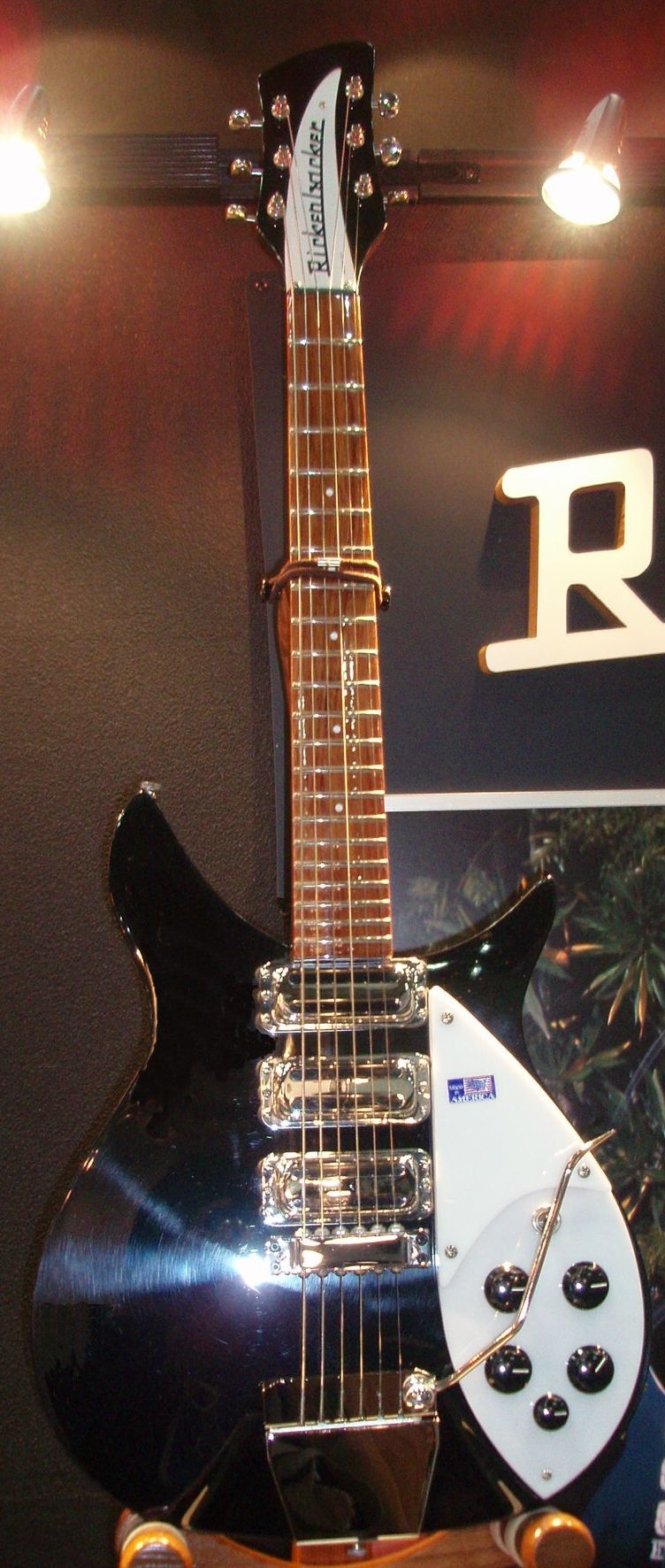
Rickenbacker 325C64. Photo by CasinoKat. Licensed under CC BY-SA 3.0. Via Wikimedia Commons. Rickenbacker
325
1958
Lennon bought it natural in Hamburg and had it painted black. The reissues copy the ends of that story, not the middle.