 Guitaripedia
Egmond
Toledo
George Harrison unscrewed one bolt and the whole neck fell off. It was still the guitar that started him.
Liverpool, the mid-1950s. A schoolboy gets a small second-hand steel-string for a few pounds. It's a Dutch Egmond, the kind Britain often sold under the Rosetti name. A couple of years earlier, a boy called Brian May got one for his seventh birthday.
- Introduced
- 1954
- Type
- Acoustic flat-top
- Class
- Production
Have a photograph of this guitar? Send a picture
The short version
1932
Musica
Uilke Egmond, a retired stationmaster, opens a music school and shop in Valkenswaard. It moves to Eindhoven in 1935.
Early–mid 1950s
The G 105 series
The cheap end is the 105/0. In Britain it's the Rosetti 276.
c. 1954
Brian May turns seven
An Egmond acoustic, "or so," for his birthday.
1957
His first guitar
George Harrison is photographed with Arthur Kelly and his first guitar, an Egmond 105/0.
1960
Best
A new factory opens in Best, in May or in November depending who tells it.
1969
Toledo
The catalog calls the 105/0 the Toledo P1, or Student.
1974
The end of the series
The Toledo line stops.
2003
Two homecomings
Harrison's goes on show at The Beatles Story in Liverpool. Andrew Guyton returns May's, restored.
Side A
A1
A kid with a guitar for £3 10s
Liverpool, the mid-1950s. George Harrison is 13, and somewhere around a stay in Alder Hey hospital with a kidney complaint, he decides he wants a guitar. A boy from Dovedale Primary has one to sell.
"I heard about this kid who had a guitar, and it was £3.10. It was just a little acoustic round, hall-type guitar, and I got the £3.10 off my mother."
That's his version in one place. In another, his father bought it, for 50 bob. Either way, it wasn't much. Harrison himself called it a "cheapo, horrible little guitar," and then wrote the line that matters more than the price:
"It's funny how little things can change your whole life."
The cheapo guitar was a Dutch Egmond.
A2
A bolt in the back of the neck
The first thing he did with it was take it apart.
"I saw that it had a bolt in the back of the neck. Being inquisitive, I got a screwdriver and unscrewed it and the whole neck fell off." It went in a cupboard. His brother Peter put it back together, and not quite right: "Now it had a concave neck, so the most you could get out of it was a couple of chords."
A couple of chords, buzzing frets, and weekly lessons from Len Houghton, a friend of his father's. The next year he made his debut with a skiffle group, the Rebels, at the Speke British Legion Club. By 1958, by one account, he'd moved up to a Höfner President. The Club 40 and the Futurama came later. No Beatles record is the Egmond.
A3
The stationmaster's guitars
Uilke Egmond was a retired stationmaster. In 1932 he opened Musica, a music school and shop, in Valkenswaard, and moved it to Eindhoven in 1935. The war cut off imports, so his sons started making the instruments themselves.
By the early '50s there were 20 people making 50 guitars a week, and the cheapest of them cost about a tenth of a comparable Gibson or Fender. That was the whole idea. This was a first guitar a European kid could actually get: a small steel-string parlor, laminate rather than a carved top, a tailpiece and a separate bridge, and the neck on a bolt.
The names are a mess, so here they are once. The cheap guitar was the 105/0 in Egmond's G 105 series. By the 1969 catalog the same guitar was the Toledo P1, or Student. In Britain the label often didn't say Egmond at all. Rosetti, the British firm that sold Egmonds under its own name, called it the Rosetti 276. Harrison's estate calls his an Egmond 105/0, Rosetti 276 in the UK, and doesn't say Toledo. Other people do.
The factory everyone pictures, in Best, opened in 1960. Business was booming by then: 2,000 guitars a week, by the family's count, most of them exported. A mid-'50s 105/0 wasn't built there. It didn't exist yet.
Flip the record · By the numbers
£3 10s
What Harrison's cost, in one telling. Another says 50 bob, and his father paid.
1/10
Early-'50s cheapest Egmonds, against a comparable Gibson or Fender
2,000
Egmond guitars a week by 1960, the family says
7
Brian May's age when he got his, around 1954
Side B
B1
Brian May's seventh birthday
Around 1954, give or take, a boy in England got the same kind of little Egmond from his mum and dad. He and his father had wanted an electric. They "had no money."
The boy was Brian May. Here's how he put it at the launch of his Red Special book in 2014:
"The inspiration for the Red Special came from this little guitar."
He swapped it later to Dave Dilloway, bass player in his band 1984, for a Hairfred, and at some point built a pickup for it and mounted it behind the soundhole. In 2002 it went to the luthier Andrew Guyton, who stripped it, filled the holes, and refinished everything except the fingerboard. He returned it in June 2003.
No Queen record is this guitar either. The Red Special is the one Brian and his father built next.
B2
Back on show
Harrison's Egmond turned up at auction in London in the mid-1980s, already missing its machine heads. From 1995 to 2002 it was on loan to the Rock and Roll Hall of Fame in Cleveland. On 25 February 2003, what would have been his 60th birthday, it went on show at The Beatles Story in Liverpool, the first time it had been displayed in Britain. That November it was auctioned again.
It's at The Beatles Story now. On the tours, you can touch it.
Two cheap Dutch parlors, the kind you bought because there was no money for anything better. One, with a concave neck, good for a couple of chords, got a kid from Liverpool onto a stage with the Rebels. The other got Brian May and his dad building the Red Special.
The cast
The people, and the specific guitars, that made the legend.
c. 1956–57
George Harrison
Egmond 105/0, sold in Britain as the Rosetti 276
His first guitar, bought second-hand from a school friend. No Beatles record is this guitar.
c. 1954
Brian May
An Egmond acoustic, his first guitar
A seventh-birthday present. He calls it the inspiration for the Red Special.
Mid-1950s
Raymond Hughes
Seller
The Dovedale Primary boy who sold Harrison the guitar for £3 10s, in the version that names him.
Mid-1950s
Peter Harrison
Repairman
Put the neck back on after his little brother took it off. It came back concave.
Dave Dilloway
Trade partner
Bass player in May's band 1984. Took the Egmond in a swap for a Hairfred.
2002–03
Andrew Guyton
Restorer
Stripped and refinished May's Egmond, all except the fingerboard, and gave it back in June 2003.
Liner notes
Specs, construction, rarity, value, and every source we used.
A small steel-string parlor with a neck on a bolt — the Dutch beginner Britain sold as a Rosetti, and George Harrison’s first guitar.
- Body
- Small parlor flat-top, steel-string. Auction reports call it Spanish style. Egmond.se, one Toledo S1: birch ply, sunburst, 440 × 320 × 75 mm (that page also prints 17¼" × 12½" × 3"). One sold 105/0: lower bout 13".
- Neck
- Bolt-on. Harrison, as the Liverpool Echo quotes him: a bolt in the back of the neck. He unscrewed it and the neck came off.
- Fingerboard
- No factory wood and no fret count have been published. Andrew Guyton left the finish on Brian May’s fingerboard as it was.
- Scale
- No factory figure. Sources differ. A sold 105/0: 23". A seller’s Toledo P1: 62.5 cm, and that listing also prints 24 5/8". A Toledo S1 listing: 62.5 cm.
- Pickups
- None on the plain acoustic. Ground Guitar: May later built a pickup and mounted it behind the soundhole of his.
- Hardware
- Tailpiece and a separate bridge. Steel strings (Guitar Player; The Times). Harrison’s own guitar later lacked its machine heads (The Times, 2017).
- Electronics
- None
- Finish
- Sunburst on the S1 (Egmond.se). The 2003 auction reports do not name a colour.
- Nut
- No factory width. A seller’s Toledo P1: 45.5 mm (that listing also prints 1 25/32"). Hendrix Guitars prints 43 mm on one 1950s sunburst Egmond it compares with Harrison’s.
Open the full research fileConstruction details, the complete player record, production numbers, dated value estimates, and sources
The specs above are the original Dutch parlor, the cheap end of the G 105 series, later called Toledo. No current model carries the name. Egmond.se maps G 105/0 to the Toledo P1 or Student in the 1969 catalog, and to Rosetti 276 in Britain. The Toledo S1 is the birch-ply sibling he thinks was the most numerous. G 105/4 is the expensive end, the Toledo M2 in 1969. The Rosetti Solid 7 is a different guitar, an Egmond electric. The body is in millimetres, with the inches that same page prints. Scales are in the units each seller printed. They do not agree: 23" is not 62.5 cm.
Construction
The job was a first guitar a European kid could get. A small steel-string box. A neck on a bolt, so the action could be tilted and, as Harrison found, the neck could come off. Laminate, not a carved top. In Britain the label often read Rosetti.
Uilke Egmond (1878–1959), a retired stationmaster, opened the Musica school and shop in Valkenswaard in 1932 and moved it to Eindhoven in 1935 (Egmond.se). Imports died in the war and his sons started building. Egmond.se: early 1950s, 20 people and 50 guitars a week, and the cheapest models at about a tenth of a comparable Gibson or Fender.
Best is later than this model. Sources differ on the opening. Hetty van Rooij, FRITS, quoting Joep Egmond: the official opening of N.V. Muziekinstrumentenfabriek Egmond, formerly Musica, on the Randweg in Best, 2 November 1960, a year after Uilke died. Omroep Brabant, citing Loekie from the family: the Frankrijkstraat works in Eindhoven burned a few months before the move, and the Randweg doors opened in May 1960. Egmond.se captions a photograph “the new factory in Best, 1961.” Lydia Notz, Groeiend Best (10 October 2023), puts the 1960 building on the Stationsweg, not the Randweg. A mid-1950s 105/0 was not built in Best. That factory was not open.
The counts are the whole company, not this model, and they do not match. Joep Egmond, in FRITS: in 1960, more than 80 people and 2,000 guitars a week, 80 percent exported, mostly to the United States, and Egmond “the largest.” The same piece sets a Gibson at ten times an Egmond. Omroep Brabant: about 100,000 a year once the guitars carried the Egmond name; 1967 peak, 200 people, turnover 4.1 million guilders; a guitar of that period about 25 guilders. Notz: 57 employees up to 80, 500 a day, more than 60 models, 90 percent exported; by 1970, 200,000 a year, 150 people, second-largest guitar factory in Europe. A Brabants Heem note on Siert van den Berg’s film says 200,000 a year at the 1960 plant and calls Egmond the largest in Europe. None of those is a Toledo total.
The name moved, and no catalog states a first year. Egmond.se: on the market in the early or the mid-1950s, made until 1974. The earliest year a player dates one is May’s, around 1954. First the G 105 series. The cheap guitar was the 105/0, equated there with the 1969 Toledo P1, or Student. The 105/4 equates with the Toledo M2. The S1 is birch ply and sunburst, and “probably” the one made in the largest numbers. His word, not a ledger. In Britain the 105/0 was the Rosetti 276. Vintage Guitar and Bass: Rosetti, run in this period by Michael Hunka, sold Egmond and Hoyer under its own name. A caption on the same Egmond.se history page prints Harrison’s guitar as an Egmond 105/G. The site disagrees with itself. FRITS captions a photograph “Egmond Toledo 105/0.” Guitar Player (17 September 2025) says “an Egmond 105/0 Toledo.” The estate’s post of 10 September 2015 says “an Egmond 105/0 (Rosetti 276 in the UK)” and does not say Toledo. Sellers add Stadium, Model 30, and S1 on guitars they also call a 105/0. Listing names, not the 1969 equation.
The Rosetti Solid 7 is not this parlor. Egmond.se files it with the Lucky 7 and the Bass 7. Vintage Guitar and Bass: Paul McCartney bought a Solid 7 in 1960. A Rosetti label in a soundhole can be this flat-top. A Solid 7 is the electric.
What is still on a survivor is the student recipe. Birch ply and sunburst, on the S1. The bolt. A tailpiece and a bridge that is not part of the top. No pickup unless someone added one. May did. Guyton, in 2002–03, stripped May’s finish, filled the holes, and refinished everything except the fingerboard.
The company outlasted the name, then stopped. Sources differ on the end. Egmond.se: the American importer turned to Korean guitars; a 1972 deal with C.F. Martin to build Vega instruments; Martin ended it in 1979; bankruptcy in 1983. Notz: layoffs in 1972, Tolchin Instruments took a large share, the family left, and Martin came in through Tolchin four years later. Van den Berg’s account, via Brabants Heem: Tolchin in 1972, then Vega, complaints from U.S. dealers, the collaboration over in 1979, and the Best factory had to close. The Dutch Wikipedia company page says Best closed in 1970 and the firm went bankrupt in 1976, and it marks that sentence as needing a source. Egmond.se also puts later guitars in a Boxtel shop under the Roderich Paesold name, and says AudioOne in Canada owned the brand and halted a relaunch in 2011, when the designer died.
Players
George Harrison — the first guitar, and not a Beatles record. The estate, 10 September 2015: a 1957 photograph with Arthur Kelly, “his 1st guitar,” an Egmond 105/0, Rosetti 276 in Britain. Guitar Player, 17 September 2025: an Egmond 105/0 Toledo, Dutch, steel-string, bought second-hand from a school friend at 13 or 14. The magazine’s inflation line uses 1957. The Höfner President, the Club 40, and the Futurama came later. No Beatles track is this guitar.
Who paid is not one story. Harrison, in Guitar Player: “I heard about this kid who had a guitar, and it was £3.10. It was just a little acoustic round, hall-type guitar, and I got the £3.10 off my mother. That was a lot of money in those days.” The Liverpool Echo, 25 February 2003: he was 13, the seller was Raymond Hughes from Dovedale Primary, the price £3 10s (£3.50), the money his mother’s, and a kidney stay at Alder Hey is when he decided he wanted one. The Belfast Telegraph, 30 November 2001, has the same Hughes sale at £3 10s, and does not print a maker’s name in that passage. The Times, 22 November 2003, citing the Anthology: his father bought it for 50 bob (£2 10s). Harrison there called it a “cheapo, horrible little guitar,” and wrote, “It’s funny how little things can change your whole life. Don’t ask me why he chose a guitar instead of a mouth organ or something. They certainly weren’t popular at the time.” The BBC, 21 November 2003: his father, about £3.50, “a real cheapo, horrible little guitar but it was OK at the time.” Vintage Guitar and Bass says he got a new Rosetti acoustic in 1958, and does not say 105/0, Toledo, or 276. A new guitar in 1958 and a second-hand guitar at 13 are different accounts.
The bolt is his, via the Echo: “I saw that it had a bolt in the back of the neck. Being inquisitive, I got a screwdriver and unscrewed it and the whole neck fell off.” It sat in a cupboard. His brother put it back. “Now it had a concave neck, so the most you could get out of it was a couple of chords.” The Telegraph names the brother Pete. The BBC names him Peter, adds weekly lessons from Len Houghton, his father’s friend, and says the frets buzzed. The Echo: the following year, a debut with the skiffle group the Rebels at the Speke British Legion Club.
Then the guitar left the house. The Times, 24 May 2017: auctioned in London in the mid-1980s, minus its machine heads, then on loan to the Rock and Roll Hall of Fame in Cleveland, 1995–2002. The Echo, 25 February 2003, his 60th birthday: the owner, who had bought it from the Hall of Fame, lent it to The Beatles Story, the first British showing. The paper that day printed £500,000, and £45 if he had never played it. Not hammers. Cooper Owen sold it at the Hard Rock Cafe in London for £276,000. The Times of 22 November 2003 says the sale was the day before, £76,000 over the estimate. The BBC’s report is dated 21 November 2003. A Kyiv Post brief dates the same sale to 20 November. Deseret News converted the hammer to more than $469,200. Omroep Brabant prints €397,000. One sale. A photograph at The Beatles Story is dated 28 October 2009. The Times in 2017 still places it at the Liverpool museum and prints “around £800,000.” Spencer Leigh, Liverpool Echo, 6 December 2025: on the Beatles Story tours, you can touch it.
The unmarked beginner’s guitar Louise Harrison gave neighbour George Rawlinson in 1965, leaving 174 Mackets Lane, is a different instrument. The Times says it may or may not be earlier, and that it has no maker’s name. The Futurama is not this guitar either. Liverpool Echo, 21 November 2024: about £58 in 1959 at Hessy’s, his mother’s hire-purchase, sold at Julien’s for $1.27 million (£1.03 million). Guitar Player dates the next guitar, a Höfner President, to 1958, at £30. The 2003 Echo had guessed a 1958 Rushworth and Dreapers Futurama at £55.
Brian May — an Egmond acoustic, around his seventh birthday. May, at the 2014 Red Special book launch, via Ground Guitar: “The inspiration for the Red Special came from this little guitar. It was a present to me from my mom and dad for me 7 birthday – or so (around 1954).” He does not say Toledo there. He and his father wanted an electric and “had no money.” Egmond.se calls it a Toledo. Ground Guitar files it as the Student. Guyton calls it his first guitar, an Egmond acoustic, from his seventh birthday. May was born 19 July 1947, so that birthday is 19 July 1954. “Or so” is his.
Ground Guitar: he traded it to Dave Dilloway, bass in the band 1984 (1964–68), for a Hairfred, and later put his own pickup behind the soundhole. Mark Hodkinson, quoted there: Brian “strummed his very first guitar, an Egmond, which he had swapped with Dave Dilloway many years before.” Guyton wrote to Pete Malandrone in October 2002, met May that December, and returned the guitar in June 2003. No Queen record is this instrument. The Red Special is the one they built next.
Vintage Guitar and Bass also gives Keith Richards a new Rosetti acoustic in 1958, and does not name the model. That is not a Toledo credit.
Rarity
You cannot buy a new Toledo. Egmond.se ends the series in 1974. The Best factory’s later years are the Vega work above, not this parlor. The 2011 relaunch stopped with the designer.
Egmond never published a Toledo total. The weekly and yearly figures above are the whole works, and they already disagree. “Probably the largest numbers” is Egmond.se on the S1 alone. A bolt-neck parlor from the series still turns up, because that was the point. Thinner: one that still has its neck, bridge, and finish, and a 105/0 rather than a later S1 if the number you want is Harrison’s. His guitar is one object at The Beatles Story. It is not a price for the others.
Value
Informal estimate, 29 October 2026. Not an appraisal.
Ask and sold prices are labeled below. Harrison’s auction is not a comparable sale. £3.10 (Harrison, via Guitar Player), £3 10s / £3.50 (Liverpool Echo, 2003), 50 bob / £2 10s (The Times, citing the Anthology), and the BBC’s about £3.50 are 1950s money, and they are not one price. Loekie’s 25 guilders is a period Egmond guitar, not a Toledo list. The Times (2017) says an advertisement called his the cheapest model in the range, and prints no price for that line.
New street. None. No maker lists a Toledo.
Used. Player money, when the bolt-neck is still worth having. Reverb’s Egmond acoustic listings on 29 October 2026, asks, not sales: a 1960s 105/0 Toledo at $500; a 1957 Toledo at $297.32; a 105/G parlor, fair, at $125. Named sold listings, not a series. A 105/0, Music Plays On, marked sold, last price $55 on the U.S. page and £42.64 excluding VAT on the U.K. page; the listing was about eight years old when read. A Toledo S1, marked sold at €100, ask €175, listing about two years old. A guitar the seller badges Stadium and calls a 105/0, marked sold at €307.79, listing about three years old. The $55 result and the $500 ask are different kinds of price. Reverb showed no separate price-guide band for the Toledo.
Vintage / collectible. A plain one is the used market above. Harrison’s is the other market. Cooper Owen, November 2003: £276,000, The Times putting it £76,000 over the estimate. The Echo’s £500,000 (25 February 2003) and The Times’s around £800,000 (24 May 2017) are printed valuations, not hammers. The Futurama at $1.27 million is not this guitar.
See also
- hofner-club-40 — the hollow electric Harrison took in trade for his President; his first electric, not this parlor
- eko-ranger-6 — Recanati’s later laminate dreadnought, another guitar Europe could buy; not an Egmond
- harmony-sovereign — Chicago’s catalog jumbo of the same years; a different body and a different job
Sources
- Egmond.se, The Egmond story — Musica 1932, Eindhoven 1935, early-1950s output; 105/0 as Toledo and as Rosetti 276; caption also prints 105/G; Solid 7; Best photo dated 1961; bankruptcy 1983; AudioOne stopped 2011
- Egmond.se, Toledo S1 — early or mid-1950s through 1974; 105/0 = Toledo P1 or Student (1969); 105/4 = Toledo M2; S1 birch ply; body 440 × 320 × 75 mm (17¼" × 12½" × 3")
- Hetty van Rooij, “In de beste families – Egmond,” *FRITS* — official opening 2 November 1960, Randweg; Joep Egmond: more than 80 people, 2,000 a week; Gibson at ten times an Egmond; caption Toledo 105/0
- Omroep Brabant, 11 October 2025 — May 1960 opening; about 100,000 a year; 1967 peak, 200 people, 4.1 million guilders; about 25 guilders; 2003 sale as €397,000
- Lydia Notz, *Groeiend Best*, 10 October 2023 — Stationsweg; 500 a day; 1970 at 200,000, second-largest; Tolchin 1972
- Brabants Heem, on Siert van den Berg — 200,000 a year; largest in Europe; Tolchin 1972; Martin ended 1979
- Vintage Guitar and Bass, Rosetti — Harrison and Keith Richards, new Rosetti acoustics, 1958; McCartney’s Solid 7, 1960
- Guitar Player, 17 September 2025 — 105/0 Toledo; second-hand; 13 or 14; £3.10 from his mother; President by 1958 at £30
- The Times, Adam Sherwin, 22 November 2003 — father, 50 bob; £276,000, £76,000 over estimate
- BBC, 21 November 2003 — father, about £3.50; Len Houghton; Peter; frets buzzed
- Liverpool Echo, 25 February 2003 — age 13; Raymond Hughes; £3 10s (£3.50); the bolt; the Rebels; Beatles Story; £500,000 and £45
- Belfast Telegraph, 30 November 2001 — Hughes, £3 10s; the bolt; brother Pete; Len Houghton
- George Harrison estate, 10 September 2015 — 1957 with Arthur Kelly; Egmond 105/0 (Rosetti 276)
- The Times, 24 May 2017 — mid-1980s auction; Hall of Fame 1995–2002; around £800,000; Rawlinson guitar, 1965
- Wikimedia Commons, Beatles Story, 28 October 2009 — on display
- Spencer Leigh, Liverpool Echo, 6 December 2025 — Beatles Story tours; the Egmond can be touched
- Liverpool Echo, 21 November 2024 — Futurama, about £58 in 1959; Julien’s, $1.27 million (£1.03 million)
- Deseret News, 22 November 2003 — more than $469,200
- Kyiv Post, 27 November 2003 — dates the Cooper Owen sale to 20 November
- Dutch Wikipedia, Egmond (gitaarbouwer) — Best closed 1970 and bankruptcy 1976, marked on that page as needing a source
- Ground Guitar, May’s Egmond Student — around 1954, in May’s words; Hairfred trade; Hodkinson
- Andrew Guyton — October 2002 to June 2003; fingerboard left
- Reverb, 105/0 Toledo, Music Plays On — marked sold, $55; scale 23"; lower bout 13"
- Reverb, Egmond acoustics — asks on 29 October 2026: $500; $297.32; 105/G $125
- Reverb, Toledo S1 — marked sold, €100; scale 62.5 cm
- Reverb, seller’s Toledo P1 — 62.5 cm / 24 5/8"; nut 45.5 mm / 1 25/32"
- Reverb, Stadium-badged 105/0 — marked sold, €307.79
- Hendrix Guitars, AC750 — 43 mm nut on one 1950s sunburst Egmond

Keep digging
Guitars this one gets compared to, confused with, or descended from.
- Send a picture
Höfner
Club 40
1955
John Lennon and George Harrison both saw a Club 40, and in John’s words, both “thought it was the end.”
- Send a picture
Eko
Ranger 6
1967
Not the dreadnought anybody dreamed about. The one Europe could actually get.
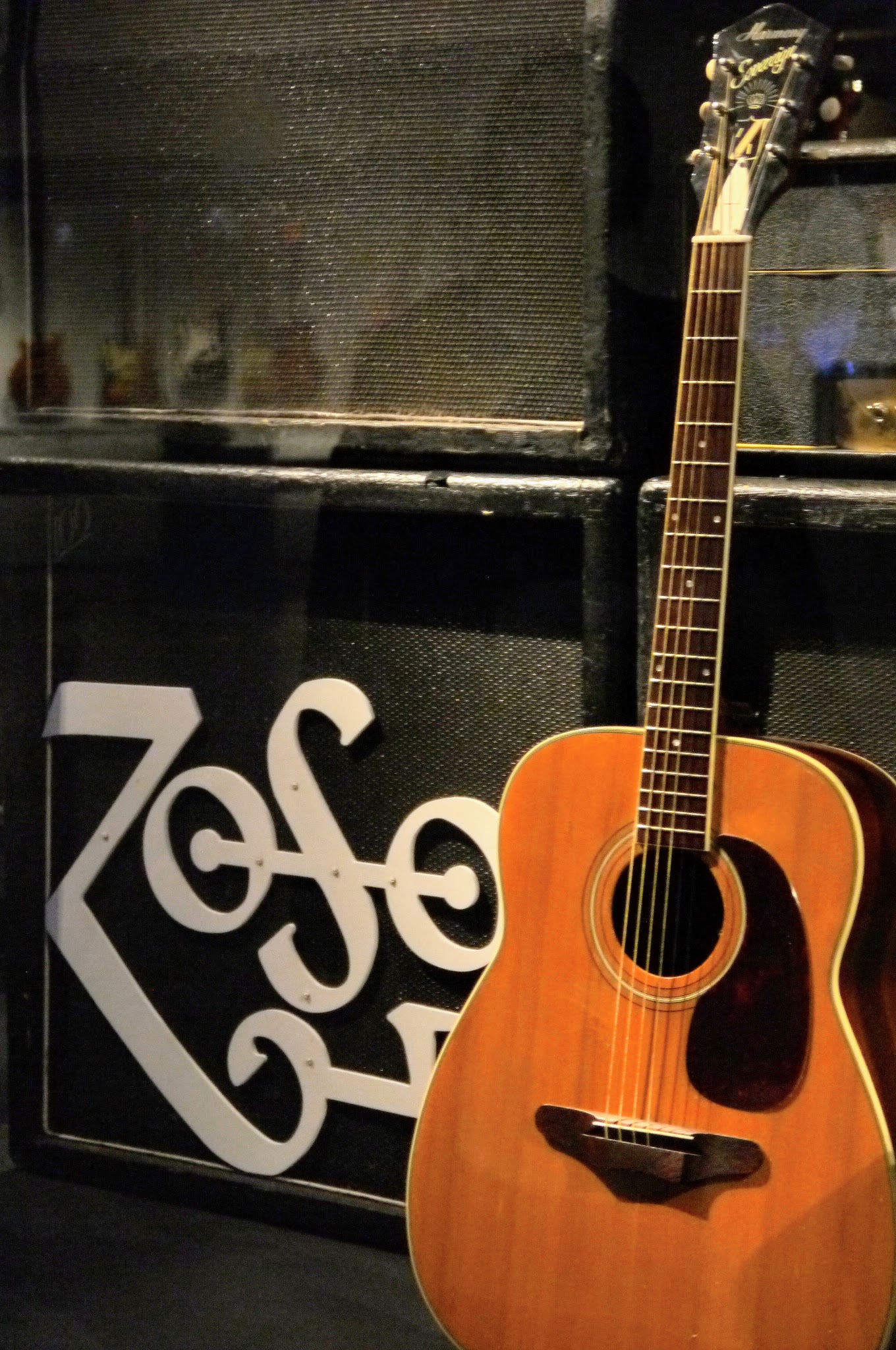
Photo: Eden, Janine and Jim / Wikimedia Commons / CC BY 2.0 Harmony
Sovereign
1958
An $85 jumbo out of a Chicago catalog, and the guitar Jimmy Page wrote four Led Zeppelin albums on.