 Guitaripedia
Levin
Goliath
Pete Townshend's first stage guitar may have been a big Swedish flat-top. Then somebody stole it.
Gothenburg, around 1958. Levin starts building its largest flat-top: spruce over flame maple, a neck on bolts, 400 millimetres across. Britain sells it as the Goliath. America often gets it with Goya on the headstock.
- Introduced
- 1958
- Type
- Acoustic flat-top
- Class
- Closed run
Have a photograph of this guitar? Send a picture
The short version
1900
Norra Larmgatan 4
Herman Carlson Levin opens his Gothenburg factory on 27 July, with two men.
1954
Goya
Talks with a New York distributor that began in 1952 turn into a brand name.
c. 1958
The Goliath size
The first big steel-strings, the LM 26 and its siblings. In America, the M-26.
c. 1962–63
The Detours
Photographs show Pete Townshend on a sunburst LM-26 with a soundhole pickup.
1967–68
120,000
An order for 120,000 more Goya guitars, a thousand a month for ten years. It's cancelled a year later.
1971
Still a Goliath
Rosetti's British catalog still prints the name. The Goliath Super Jumbo is £97.95.
1973
Martin
C.F. Martin buys the company in June. Gothenburg becomes its European base.
2019
Just like it
Gordon Giltrap gives Townshend a 1966 Levin on 22 January.
Side A
A1
A photograph from the Detours
Around 1962 or 1963, somebody photographs a band called the Detours. John Entwistle is holding a Fender Precision. Roger Daltrey has an Epiphone Wilshire he'll later give to Pete Townshend. And Townshend is playing a big sunburst flat-top with a pickup stuck in the soundhole.
It's a Levin Goliath, an LM-26, from Gothenburg, Sweden. It may be his first stage guitar. No colour photo has turned up, so even the sunburst is a reading of black and white.
Then it disappeared. The way Gordon Giltrap tells it, Townshend lent the guitar to Entwistle, it was stolen, and Entwistle's mother gave Pete three pounds for the loss.
That's the whole famous chapter of the Goliath: a borrowed photograph and a stolen guitar. It was the big flat-top you could get when the American one was hard to find, and it was there at the start.
A2
Two men and 70 square metres
Herman Carlson was born in Åsaka in 1864 and added the name Levin after his journeyman's exam. From 1887 he polished guitars in New York. He ran his own business, went into partnership, and in 1897 patented a combined guitar and mandolin.
On 27 July 1900 he opened a factory at Norra Larmgatan 4 in Gothenburg: two men, 70 square metres, 4,000 kronor of capital. How many instruments came out that first stretch depends who's counting, but within a few years they were into four figures, and by 1965 the factory had finished more than 450,000. He died in 1948.
A3
A size, not a model
Goliath isn't one guitar. It's a size. Levin's catalogs had three: Concert, Grand Concert, and Goliath, the big one, 400 millimetres across and 505 long. Around 1958 the first steel-strings in that body arrived: the sunburst LM 26, the natural LS 18 with its ebony board, the LM 28, and the LM 50.
The recipe was a spruce top, X-braced, over flame maple back and sides, with a mahogany neck that bolted on and had an adjustable truss rod. A bolt-on flat-top sounds cheap. Here it meant the neck could come off.
Britain named them like wrestlers. The LM 26 was the Goliath, the LS 18 the Super Goliath, and with a DeArmond pickup and controls the later sunburst became the Goliath Electric. Around 1963 the LM 26 and LS 18 became the LN 26 and LT 18. Around 1965 they got a belly bridge with a little plastic saddle for every string, though the old bridge was still being fitted in early 1967. There were twelve-strings in the same outline too, ladder-braced, with a wider board.
The one to look for is the LM 50: six-ply top, cloud inlays, gold machines. There's no catalog photograph of it, and only two known examples.
Flip the record · By the numbers
400 mm
Across the lower bout. Levin's biggest body.
120,000
Goya guitars ordered in 1967. The order was cancelled in 1968.
£97.95
The Goliath Super Jumbo in Britain's 1971 catalog
£3
What John Entwistle's mother paid Townshend for the stolen one, the story goes
Side B
B1
Goya on the headstock
In America most of these guitars wore another name. A New York distributor named Hershman opened talks with Levin in 1952, and by 1954 the brand was Goya. Many of the flat-tops were drawn for him first and turned up in Levin catalogs later with small changes. The M-26 is the LM 26. The T-18 is the LT 18. Same factory.
Not every Goya is a Goliath. The one Julie Andrews carries in The Sound of Music is a Goya classical, a smaller nylon-string guitar.
America nearly swallowed the place. By 1965, 70 percent of what Levin made was exported. In 1967 came an order for 120,000 more Goyas, a thousand a month for ten years. It was cancelled in 1968. A rented factory in Lessebo shut, and half the workforce went.
B2
After the Goliath
Around 1969 the LT 18 became Model 174, same body, same scale, and later a set neck. The sunburst became Model 163. In Britain, Rosetti's 1971 catalog still printed the old name: Goliath Super Jumbo, £97.95. By around 1973 the steel-strings were the W models, and nobody called those Goliaths.
C.F. Martin bought Levin in June 1973 and made Gothenburg its European headquarters. The shop built about 200 guitars labeled "LD-18 — Made In Gothenburg, Sweden." Those are Martins, not Goliaths. When the factory finally closed is not one year either: 1978, 1979, or 1981, depending who you ask.
B3
A 1966, just like it
On 22 January 2019, Gordon Giltrap handed Pete Townshend a 1966 Levin acoustic, "just like" the one in the Detours photographs. Townshend reportedly used it on that year's Who recordings.
Nobody has said which track. The Detours guitar has never resurfaced. But one of the biggest guitarists in rock started on a Swedish flat-top he couldn't keep, and more than fifty years later another one turned up in his hands.
The cast
The people, and the specific guitars, that made the legend.
c. 1962–63
Pete Townshend
A sunburst Levin Goliath LM-26 with a soundhole pickup
In photographs with the Detours, perhaps his first stage guitar. Not a Tommy guitar, and not a Rickenbacker.
1960s
John Entwistle
Borrower
Townshend lent him the Levin, and it was stolen. His mother made good with three pounds.
2019
Gordon Giltrap
A 1966 Levin acoustic
Told the theft story, then gave Townshend a 1966 Levin "just like" the old one.
1900
Herman Carlson Levin
Founder
Born Herman Carlson in Åsaka in 1864. Polished guitars in New York before opening his own factory in Gothenburg.
1952–54
Hershman
Goya, the U.S. name
The New York distributor. Many Levin flat-tops were drawn for him first.
Liner notes
Specs, construction, rarity, value, and every source we used.
Spruce over flame maple, 400 millimetres across — Levin’s largest flat-top, the one Britain called a Goliath and America often got with Goya on the headstock.
- Body
- Non-cutaway. Vintage Guitars Sweden, Goliath size: width 400 mm, length 505 mm, depth 95/120 mm. Spruce top, X-braced on the six-strings; flame maple back and sides. Elderly, on one 1966 LT-18, serial 466104: a square-shoulder dreadnought, lower bout 15-3/4", depth at the end block 4-7/8". The catalog does not use the word dreadnought.
- Neck
- Mahogany, bolt-on, adjustable truss rod, on the 1958–1960s cards. Elderly’s 1966: a 14-fret neck. Model 174 went to a set neck circa 1972. The 12-string LTS 5 went to a set neck circa 1970.
- Fingerboard
- Six-string width 43 mm. Rosewood and pearl dots on the LM 26 and the LN 26. Ebony and pearloid blocks on the LS 18, the LT 18, and Model 174. The 12-string LTS 5 is 51 mm, rosewood, dots.
- Scale
- 630 mm on the Goliath-size cards. Elderly’s 1966 card prints 24-3/4". The two figures are not the same unit, and they are not the same number.
- Pickups
- None on the plain acoustic. Rose-Morris’s Goliath Electric Model 1890 is an LN 26 with a DeArmond and controls.
- Hardware
- Rosewood or ebony bridge, by model and by year. Strip tuners early; nickel-plated individual Van Gent machines later (Vintage Guitars Sweden’s spelling). A belly bridge with separate plastic saddles from circa 1965 on the LT 18 and the LN 26. The old bridge was still being fitted in early 1967.
- Electronics
- None on the acoustic
- Finish
- Sunburst on the LM 26 and the LN 26. Natural on the LS 18, the LT 18, and Model 174. The LM 50 is natural, with gold-plated machines.
- Nut
- No separate nut width on the catalog cards. They print a 43 mm fingerboard on the six-string. Elderly’s 1966 card: nut 1-21/32".
Open the full research fileConstruction details, the complete player record, production numbers, dated value estimates, and sources
Specs are the Gothenburg Goliath-size six-string Vintage Guitars Sweden dates from circa 1958. No current guitar from that factory carries the name. The 2014 Indonesian LT18 in Akustik Gitarre (scale 64.7 cm, nut 42 mm) is a different guitar, and so are Grand Concert (380 mm), Concert (360 mm), and the Italian Rangemaster.
Construction
The job was a large flat-top Gothenburg could ship when an American dreadnought was hard to get. Solid spruce over flame maple. A mahogany neck on bolts, with a truss rod, so the neck could come off. Britain called it a Goliath. America often got Goya on the headstock.
It is a size, not one number. Vintage Guitars Sweden: circa 1955–1967 for Levin, 1954–1972 for Goya, the catalogs used three names. Goliath, Goliat, is 400 mm wide, 505 mm long, 95/120 mm deep. Grand Concert, Stor Spansk, is 380 × 480 × 98 mm. Concert, Spansk, is 360 × 465 × 98 mm. The first Goliath-size steel-strings are circa 1958: Levin LM 26, LS 18, LM 28, and LM 50, and Goya M-26, S-18, M-28, and M-50. Earliest LM 26: serial 377647, 1958. The 1955 date is the size-name window. Model 111, a Grand Concert nylon-string, is circa 1955 and 380 mm. It is not this body. Wikipedia’s company page has no inline citations. It puts bolted-neck steel-strings in the late 1950s and does not say Goliath.
Sunburst six-string: LM 26, circa 1958, then LN 26, circa 1963. Britain: Goliath 1795, and with a DeArmond, Goliath Electric 1890. America: M-26, then N-26. Natural: LS 18, circa 1958, ebony board, then LT 18, circa 1963. Britain: Super Goliath 1855. America: S-18, then T-18. The LM 50 is the scarce one: six-ply top, cloud inlays, ebony bridge, gold machines, no catalog photo, both known examples undated inside 1958–1962. The six-string cards are spruce, X-braced, flame maple, a mahogany bolt-on, fingerboard 43 mm, scale 630 mm. Four-ply binding on the ordinary guitars, six-ply on the LM 50 and the LM 28. Early truss-rod covers carry a star and “1900”, already missing on some 1958 guitars and still on others until circa 1962. Ten-year warranty on the LN 26 and the LT 18. The LS 18 card prints none. A 1957 redesign had put DeArmonds on archtops. Those are f-hole guitars.
Circa 1965 the LT 18 and the LN 26 took a belly bridge with a plastic saddle per string. The old bridge was still fitted in early 1967. Circa 1969 the LT 18 became Model 174: same 400 × 505 mm, same 630 mm, ebony, natural, bolt-on until a set neck circa 1972. Latest on that card: 528386, 1973. The LN 26 became Model 163 about 1970, sunburst, rosewood board. Rosetti’s 1971 book still says Goliath: Super Jumbo L.163, Sunburst Jumbo 163, 12-string LTS.4. Alp spruce, flamed darkened maple, an adjustable mahogany neck, ebony on the Super Jumbo, a rosewood bridge with individual string height. By circa 1973 the steel-string list is the W models. Vintage Guitars Sweden does not call a W a Goliath.
The 12-string is the same outline and a different top. LTS 5, circa 1963, Goya TS-5, Rose-Morris 1844: ladder-braced spruce, fingerboard 51 mm, a one-year warranty, the body meeting the neck at the 14th fret circa 1969, a set neck circa 1970. LTS 4, circa 1967, is plainer: maple rather than flame maple, single binding, bracing undetermined.
Goya is the New York distributor’s name, not a second factory. Hershman opened talks in 1952. The brand became Goya in 1954. Many of the guitars were drawn for him first, then turned up in Levin catalogs with small changes. The M-26 is the LM 26. The T-18 is the LT 18. A Goya classical is a smaller nylon guitar. Julie Andrews’ in The Sound of Music is one of those, on Wikipedia’s Levin page. Hagström’s late-1950s Goya electrics are another shop. The Rangemaster is an Italian hollow.
Herman Carlson was born in Åsaka on 25 September 1864 (Vintage Guitars Sweden; Acoustic Music). He added Levin after his journeyman’s exam, polished guitars in New York from 1887, ran his own business from 1891, joined Robert H. Benary in the Metropolis Musical Instrument Co. circa 1895, patented a combined guitar and mandolin in 1897, and on 27 July 1900 opened the factory at Norra Larmgatan 4, Göteborg. Two men. 70 square metres. Capital 4,000 kronor, on Wikipedia and Acoustic Music. Sources differ on year one. Vintage Guitars Sweden: 90 instruments, then five men and 1,648 by the end of 1903. Wikipedia: 473 by the end of 1901, and the 1,000th in 1903. He died 26 March 1948.
By 1965 Vintage Guitars Sweden counts more than 450,000 instruments, 70 percent exported, an order for 13,000 Goya guitars, and a rented factory in Lessebo. In 1967: 120,000 more, 1,000 a month for ten years. Wikipedia at that contract: production over 30,000, Goya about 70 percent, “no fewer than 120,000.” Cancelled in 1968. Lessebo shut. Half the workforce went. Göteborgs stadsmuseum, 11 December 2025, agrees. Kustom of Chanute held the Goya rights from 1970 and failed in 1972. Dude took what was left. Wikipedia: it is unclear Levin ever shipped Dude anything. The owner table runs Hershman to 9 December 1963, Goya Music to 17 July 1967, Avnet to 21 September 1970, Kustom to 6 September 1972, Dude to 3 November 1976.
Martin bought the company in June 1973. Talks had started in 1972. Gothenburg became Martin’s European headquarters, Japanese Martin and Sigma imports passed through it, and the shop built about 200 guitars labeled “LD-18 — Made In Gothenburg, Sweden” (Wikipedia; Acoustic Music). Göran Levin, quoted on 24 March 2019, calls them about 200 Sigmas with that label. Some LD-28 labels have surfaced. An LD-18 is a Martin, not a Goliath. Dude sold the Goya name to Martin on 3 November 1976. Wikipedia says Martin stopped selling Goya guitars during the 1990s. Acoustic Music dates a sale of the name to Goya Foods in 1999.
The close is not one year. Vintage Guitars Sweden: the factory shut in 1979, with Landola nylon-strings from Finland circa 1977 and some Japanese steel- and nylon-strings circa 1979. Wikipedia’s infobox ends the company in 1978 and the last Gothenburg guitar in 1981. Acoustic Music agrees on 1981, and on more than 500,000 instruments from 1900 to 1978. guitar-list stops production in 1979 and operations in 1982. Svensk Musik bought the brand and leftover stock in 1982 and, in early 1983, restarted with classicals: LG 8 and LG 17, bodies from Hans Persson in Lugnås, necks from Landola. After 2004 Svenska Levin imported Asian westerns. Not a Goliath. The 2014 student guitar in the specs above is the other reuse of the name. Akustik Gitarre’s spec block says Indonesia and the review text says China; 20 frets, 54 mm at the 12th, list €335, street under €200. No Kirstein page for it on 29 October 2026.
Players
One photograph is the famous claim, and it is early.
Pete Townshend. Whotabs: pictures from about 1962 or 1963, with the Detours, show him on a sunburst Levin Goliath LM-26 with a pickup in the soundhole. John Entwistle is on a Fender Precision. Roger Daltrey is on the Epiphone Wilshire he later gave Townshend. Whotabs calls the Levin perhaps Townshend’s first stage guitar. No colour photo has surfaced; the page reads the finish as a dark sunburst, and double-bound. Gordon Giltrap, quoted there from his own site: the guitar was stolen after Townshend lent it to Entwistle, and Entwistle’s mother gave Pete three pounds for the loss. On 22 January 2019 Giltrap gave him a 1966 Levin acoustic, “just like” that one. Whotabs says Townshend then used the 2019 guitar on that year’s Who recordings. It does not name a track. The Detours guitar is a photograph. It is not a credit for Tommy, and it is not a Rickenbacker.
Also known to play: no one else has been tied to this body by a named source.
Rarity
You cannot order a Gothenburg Goliath. The size runs in the catalogs from circa 1958 into the early 1970s, Model 174 and Model 163 last, and Rosetti was still printing the word in 1971. After that the steel-string list is the W line. Levin never published a Goliath total. The big numbers are every instrument the factory finished: more than 450,000 by 1965, more than 500,000 by 1970 (Vintage Guitars Sweden), “over half a million” from 1900 to 1978 (Wikipedia). A neck number dates a guitar. It does not count a year, and a year of serials covers classicals, archtops, and mandolins as well as this body.
Inside that ordinary pile, a few things are thinner. An LM 50, which the catalog site can barely find. A 12-string whose ladder brace and 51 mm board are still the ones it left with. A six-string that still has the pre-1965 bridge, not the plastic saddles. An LN 26 that was not later blocked or routed around a DeArmond. Townshend’s Detours guitar, if Giltrap’s theft story holds, is gone. The 2019 gift is one 1966 Levin. Whotabs does not print its model.
Value
Informal estimate, 29 October 2026. Not an appraisal.
Asking prices are not sold prices. The 1971 Rosetti lists are 1971 money: Goliath Super Jumbo £97.95, Goliath Sunburst Jumbo £89.35, Goliath 12-string £79.55 (vintageguitarandbass’s reading of that catalog). Giltrap’s three pounds is what he says Entwistle’s mother paid for a stolen guitar. It is not a comparable sale.
New street. None from Gothenburg. No Levin Goliath product page turned up at Kirstein on 29 October 2026. The €335 list, and street under €200, are the 2014 Akustik Gitarre review of the Indonesian student guitar. Not a 2026 price, and not this maple body.
Used modern. No separate market. There is no later Gothenburg run to trade. A used Indonesian LT18 would be a different guitar, and no 2026 sale of one turned up.
Vintage / collectible. No Reverb Price Guide band turned up for the Gothenburg Goliath. Named hammers, not a series. Gardiner Houlgate, 3 September 2024, lot 171: a 1962 LS-18 Super Goliath, fair, maple, a hairline in the top, hammer £580 (estimate £500–£800). Gardiner Houlgate, 4 December 2024, lot 864: a 1968 LT-18, fair, a later transducer and later tuners, hammer £500 (estimate £500–£700). A Reverb sold-filter card read 28 October 2026 showed a 1962 Model 1795, Excellent, with £950 and £795 both printed on the card. That is one listing’s pair of figures, not a median.
Named asks, not hammers, read in the same weeks. A 1965 LT-18 on Reverb, Frankfurt, $3,213.41, down from $3,565.33, the listing about two months old. Guitar Village asked £1,399 for a 1965 sunburst it calls an LM-26, serial 450373; Vintage Guitars Sweden files 450373 as an LN 26. Oscar Guitars asked €519.84 including tax for a 1966 LTS 5 12-string. A Reverb 12-string, mid-1960s, sat at £595, local pickup only. A Reverb 1963 LM-26 sat at £895. Elderly’s page for the 1966 LT-18, serial 466104, showed a $450 tag and a sold-out line on 29 October 2026. Not a dated hammer. A fair auction guitar with a later pickup, a $3,213.41 ask, and a €519.84 12-string are three different objects. Townshend’s Detours guitar has not come up for sale. The 2019 gift is not a hammer.
See also
- D-28 — the American dreadnought a Goliath was often bought instead of
- D-18 — Martin’s later Gothenburg run, the LD-18, is this factory and a different guitar
- Rangemaster — Goya on the headstock, but an Italian hollow electric, not this flat-top
Sources
- Vintage Guitars Sweden, Levin sizes — Goliath 400 × 505 mm, depth 95/120 mm; Grand Concert 380 mm; Concert 360 mm; size names circa 1955–1967 (Goya 1954–1972)
- Vintage Guitars Sweden, LM 26 — circa 1958; Goliath Model 1795; earliest 377647 (1958); replaced by LN 26 circa 1963
- Vintage Guitars Sweden, LS 18 — circa 1958; Super Goliath 1855; ebony board; replaced by LT 18 circa 1963
- Vintage Guitars Sweden, LT 18 — circa 1963; Super Goliath 1855; Goya T-18; belly bridge circa 1965; replaced by Model 174 circa 1969
- Vintage Guitars Sweden, LN 26 — Goliath 1795 and Goliath Electric 1890; replaced by Model 163 circa 1970
- Vintage Guitars Sweden, LM 50 — circa 1958; six-ply top; gold machines; no catalog photo
- Vintage Guitars Sweden, LTS 5 — 12-string, ladder bracing, 51 mm, Model 1844; set neck circa 1970
- Vintage Guitars Sweden, LTS 4 — plainer 12-string, circa 1967
- Vintage Guitars Sweden, Model 174 — circa 1969; set neck circa 1972; latest 528386 (1973)
- Vintage Guitars Sweden, Goya M-26 — US name for the LM 26, circa 1958
- Vintage Guitars Sweden, history — 27 July 1900; 90 the first year; 1,648 by the end of 1903; death 26 March 1948; Lessebo; 120,000 order cancelled 1968; Martin purchase June 1973; factory closed 1979; Svensk Musik 1982
- Vintage Guitars Sweden, Goya brand owners — Hershman through Martin, with the handover dates
- Wikipedia, Levin — 4,000 kronor; 473 by the end of 1901; 1,000th in 1903; late-1950s steel-strings; 1967 contract, 120,000 / 70 percent / over 30,000; broken 1968; about 200 LD-18s; last Gothenburg guitar 1981; Sound of Music classical. No inline citations
- Acoustic Music, Herman Carlson Levin — 25 September 1864; 27 July 1900; 4,000 kronor; about 200 LD-18s; some LD-28 labels; last guitar 1981; Goya Foods 1999
- guitar-list, Levin — Gothenburg production stopped 1979; operations ceased 1982
- Göteborgs stadsmuseum, 11 December 2025 — Norra Larmgatan 4, two employees; 1965 Lessebo; 1967 order of 120,000; contract broken a year later; sold to Martin 1973; Martin buys Goya 1976
- vintageguitarandbass, Rosetti 1971, page 10 — Goliath Super Jumbo £97.95; Sunburst Jumbo £89.35; 12-string £79.55; Alp spruce, flamed maple
- Whotabs, Pete’s Gear: Levin Goliath LM-26 — Detours, circa 1962 or 1963; soundhole pickup; Giltrap on the theft and the three pounds; 1966 Levin given 22 January 2019
- *Akustik Gitarre* 2/2014, David Rebel, via Kirstein — Indonesian LT18 Goliath; the review text also says China; 64.7 cm; 42 mm; €335 list; street under €200
- The Unique Guitar Blog, 24 March 2019 — Göran Levin on about 200 Sigma guitars labeled LD-18
- Elderly Instruments, 1966 LT-18, serial 466104 — 15-3/4", 4-7/8" at the end block, 1-21/32" nut, 24-3/4" scale, 14-fret; $450 tag, sold out when read 29 October 2026
- Gardiner Houlgate, 3 September 2024, lot 171 — 1962 LS-18, hammer £580, estimate £500–£800
- Gardiner Houlgate, 4 December 2024, lot 864 — 1968 LT-18, hammer £500, estimate £500–£700
- Guitar Village, 1965 sunburst, serial 450373 — ask £1,399; the shop calls it an LM-26
- Oscar Guitars, 1966 LTS 5 — ask €519.84 including tax
- Reverb, 1965 LT-18, Frankfurt — ask $3,213.41, down from $3,565.33; read late October 2026
- Reverb sold filter, 28 October 2026 — 1962 Model 1795 card printing £950 and £795
Keep digging
Guitars this one gets compared to, confused with, or descended from.
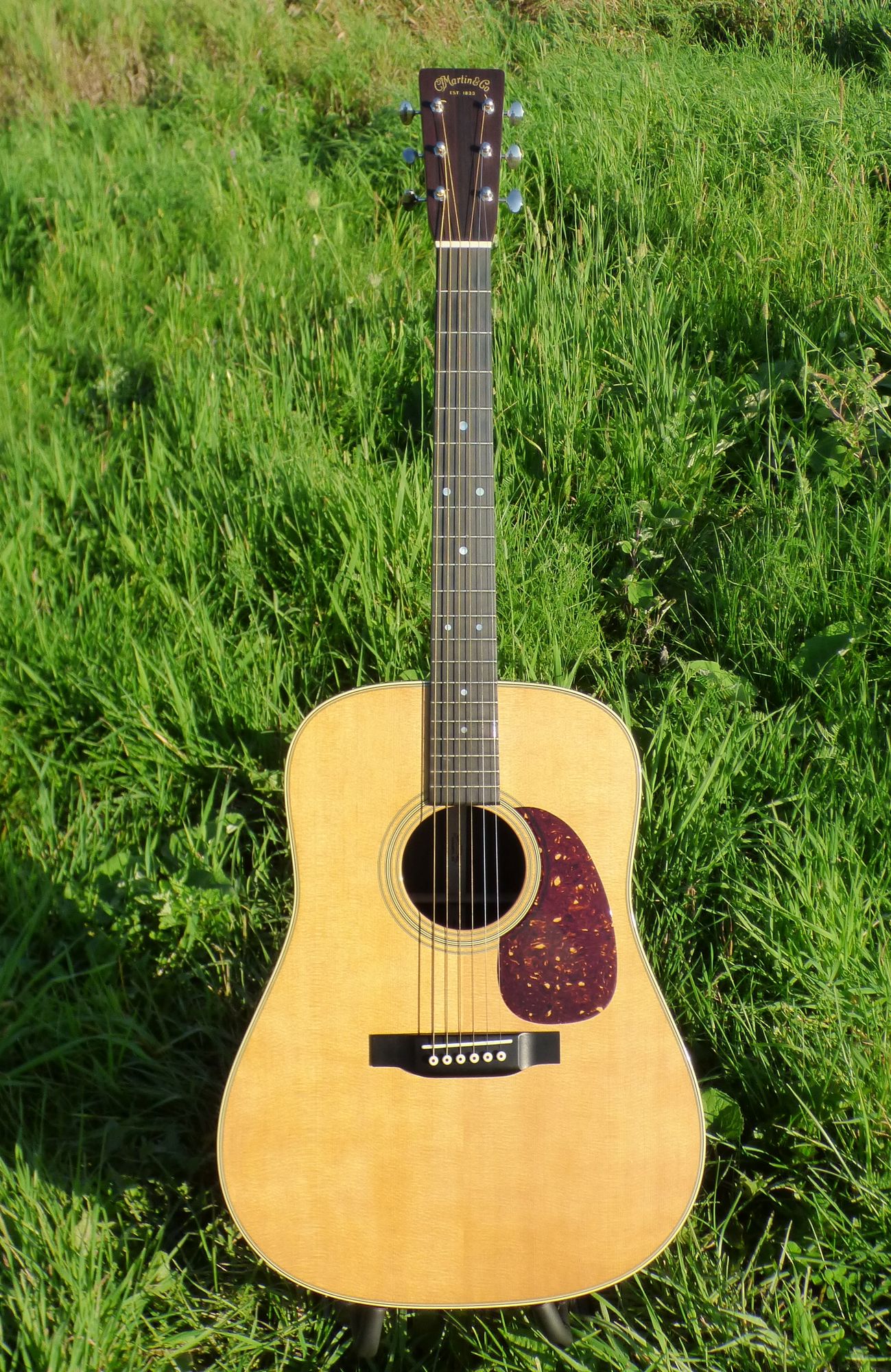
Martin D-28 Acoustic Guitar. Photo by Niranjan Arminius. Licensed under CC BY-SA 4.0. Via Wikimedia Commons. Martin
D-28
1931
You’ve heard a D-28 your whole life. It just never asked for the credit.
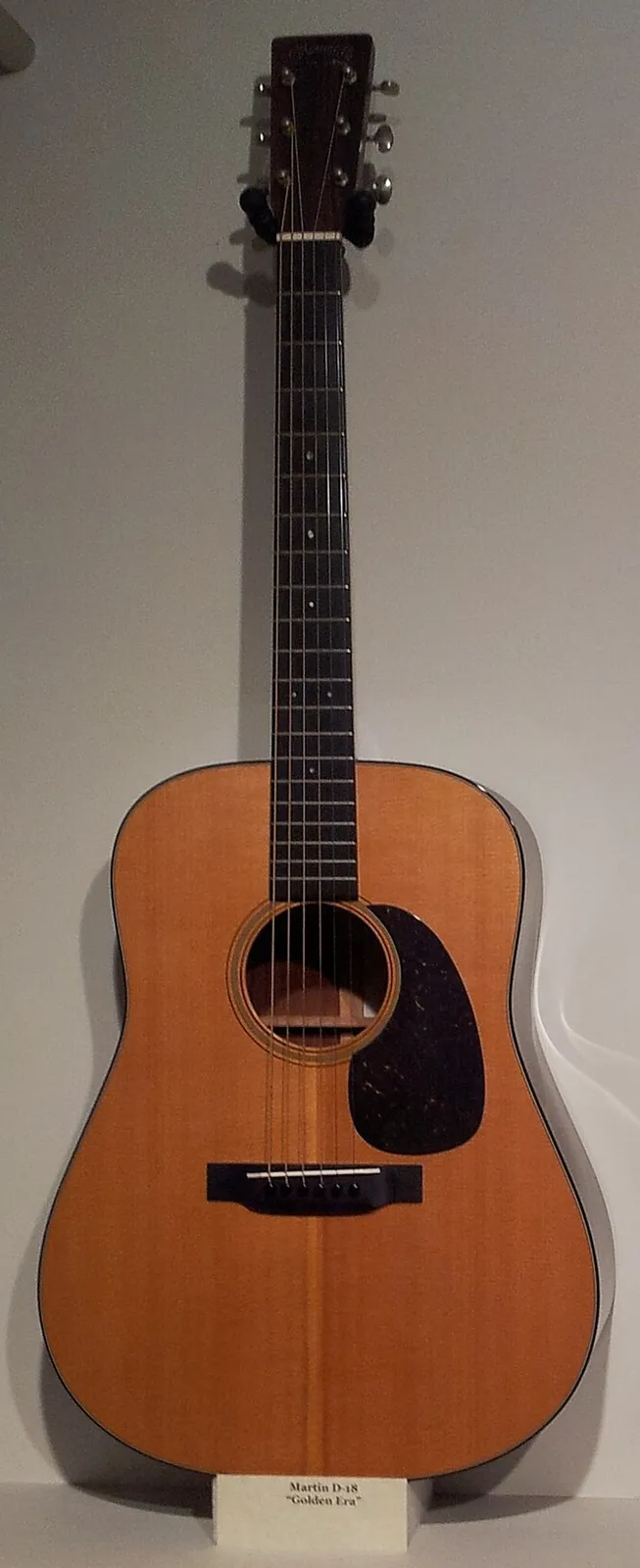
Photo: doryfour / Wikimedia Commons / CC BY-SA 2.0 Martin
D-18
1931
Elvis traded his D-18 up for a leather-covered D-28. The plain one had already been there for the Sun records.
- Send a picture
Goya
Rangemaster
1966
It has nine buttons where one switch would do, and more than half a century later they still work.