Gibson
Corvus
Gibson named it after a crow. Everybody else called it the can-opener.
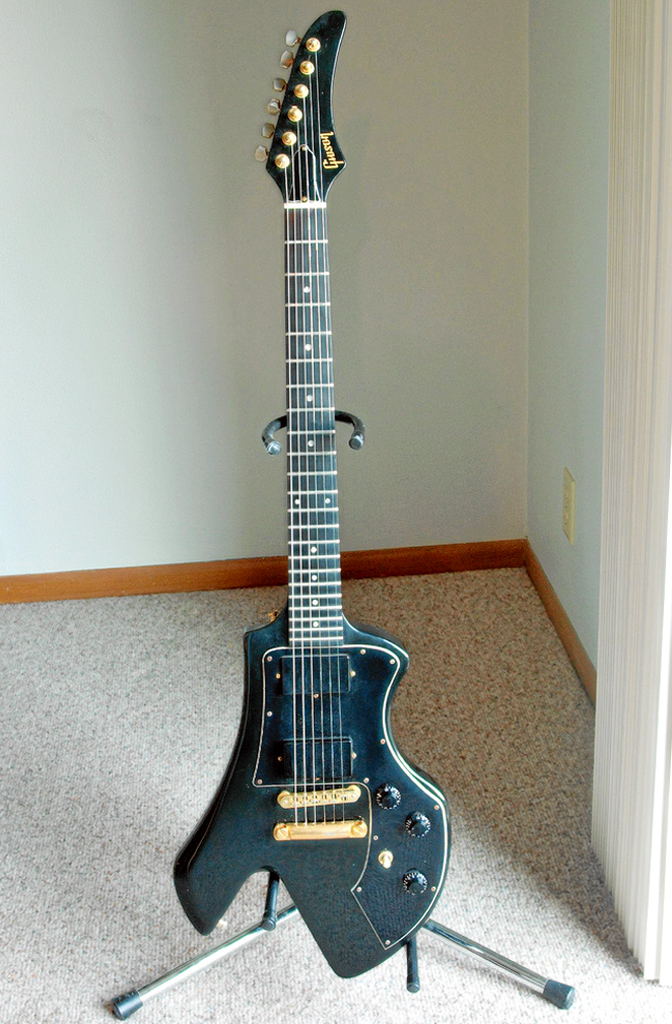
No horns, a bite out of the tail, a bolt-on maple neck, and six tuners in a row. The Corvus came in three flavors for Gibson's 1982 American Series and was gone by 1984. It's not a Les Paul, not the Sonex or the Marauder, and not the set-neck Futura that shares its outline.
- Introduced
- 1982
- Type
- Solidbody electric
- Class
- Production
The short version
1981
No headstock
Gibson's Kalamazoo R&D team builds a headless prototype and sends it to marketing in Nashville, which asks for headstocks.
1982
American Series
The Corvus I, II, and III appear in Gibson's American Series catalog.
1983
Seven colors
A British ad lists silver, antique natural, fire red, yellow mist, electric blue, tangerine, and ebony.
1984
Gone
The Corvus run ends after two years, or 1982 to 1984, depending how you count.
2015
The Ryman
Mike Cooley has a Corvus I with a P-90 in his Drive-By Truckers rig and calls it "a bad idea from the '80s."
2016
Ever South
Cooley overdubs a song on American Band with a one-P-90 Corvus.
2023
Out of the vault
Gibson puts the 1981 headless prototype up for sale, more than forty years after marketing turned it down.
Side A
A1
Marketing wanted a headstock
Kalamazoo, 1981. Gibson's research and development team has built a solid with no headstock at all, the tuners at the far end of the body. Headless was the fashion. They send it to marketing in Nashville.
Marketing turned it down, as Gibson's own page puts it, "in favor of Futura and Corvus models with traditional headstocks." One account credits the design to Chuck Burge, from that R&D team, and says Bruce Bolen had approved the headless version first. Gibson's page doesn't name anyone.
So the body drawn for a guitar with its tuners at the tail got a six-in-a-row headstock bolted to the other end. Hold on to that. It matters later.
A2
The crow and the can-opener
The 1982 American Series catalog called the Corvus "an instrument with a look as daring as it sounds." It has no horns. Instead there's a big offset V cut into the tail, with a black guard on top.
Corvus is Latin for crow, and the idea, supposedly, was that if you turned it sideways it looked like a crow in flight. Other people saw a can-opener. Some people saw an executioner's axe, and later on, Pac-Man. The crow was the pitch. The can-opener stuck.
Under the shape it's simple. A bolt-on maple neck, rosewood board, dots, 22 frets, a 24¾-inch scale, usually an alder body. There were three versions. The Corvus I had one covered humbucker with a volume and a tone. The II had two covered humbuckers and a three-way switch. The III had three exposed single-coils and a five-way.
Even the bridge is an argument. Some say every Corvus has a wraparound; the guide books say tune-o-matic and stop tailpiece. One well-documented two-humbucker 1983 has a Schaller wraparound. And there's at least one 1983 Corvus I with a mahogany body and an ebony board, when most specs say alder and rosewood. Corvuses don't sit still.
A3
Not the Futura
The Corvus had a sister with the same outline, the Futura, and that's where people get mixed up. The Futura was the upmarket one: set or through neck depending on who's describing it, ebony board, a separate bridge and tailpiece, gold hardware. Same can-opener. Different guitar.
And it's not the 1950s Explorer prototype collectors also call the Futura. That's a third guitar.
Its American Series siblings were the Challenger, a bolt-on with a vaguely Les Paul shape, and the Invader. A 1983 British ad feature in a magazine had its writer take a Corvus I off the wall and call it the sharpest thing he'd seen, then mention, a little later, that he'd "later found out" its pickup was an Alnico 5. It was an ad. The prices, it said, started around £300 for the new models as a group.
Flip the record · By the numbers
3
Versions: one humbucker, two humbuckers, or three single-coils
24¾"
Scale, the same as a Les Paul's, on a guitar that doesn't look anything like one
22
Frets on a rosewood board with dots
7
Colors in one 1983 ad. Silver is the one every list agrees on.
Side B
B1
Why it leans
Back to that headstock. The theory, from the same historian who named Burge, is that the Corvus is balanced for a body designed with the tuners at its tail. Put six tuners on a long neck at the other end and the neck dives. Look at the man in the old ads, he says, and he's leaning back to hold it up.
That's his reading of a photograph, not a factory spec. It's a good one, though.
The Corvus lasted from 1982 to 1984, about two years. No reissue, no count of how many were made. The headless prototype sat in Gibson's vault until 2023, when Gibson finally offered it for sale. The Corvus also turned up in all three of the first Guitar Hero games, so plenty of people have seen one who have never held one.
B2
A bad idea from the '80s
The Ryman, Nashville, 2015. Mike Cooley of the Drive-By Truckers is walking someone through his rig before a show. One of the guitars is his Gibson Corvus I. He calls it "a bad idea from the '80s." He's retrofitted it with a P-90.
The next year the band made American Band. On "Ever South," the basic tracks are acoustic guitars. The overdub, in the studio notes, is "his mid-'80s Gibson Corvus—the model with one P-90 pickup in the bridge position," through the same Silvertone amp and 2×12 cabinet he'd used for the acoustic, with different settings.
The studio notes don't say it's the same guitar that was at the Ryman. It's described the same way: a Corvus I, one P-90 in the bridge, a long way from how Gibson shipped it.
Gibson built it and dropped it within a couple of years. Cooley calls his a bad idea, and then he puts it on the record.
Put this on
You’ve read about it. Now hear it. Here’s what this guitar sounds like, and what to listen for.
Ever South
The basic tracks are acoustics. The electric overdub is Mike Cooley's mid-'80s Corvus with a single P-90 in the bridge, through a Silvertone amp.
Find it on YouTube (opens in a new tab)
The cast
The people, and the specific guitars, that made the legend.
2015
Mike Cooley
Corvus I, retrofitted with a P-90
In his Ryman rig, and on the "Ever South" overdub. He calls it "a bad idea from the '80s."
Tim Kasher
A silver Corvus II
Named as an early-Cursive guitar. No song has been tied to it.
1981
Chuck Burge
Designer, in one account
Credited with the design by one Gibson historian. Gibson's own prototype page doesn't name him.
1981
Bruce Bolen
Approved the prototype, in the same account
Said to have signed off on a headless prototype before Nashville put a headstock on it.
Liner notes
Specs, construction, rarity, value, and every source we used.
An offset V in the tail of a bolt-on solid — Gibson’s Corvus, the can-opener, not a Les Paul and not the set-neck Futura.
- Body
- Solid, no horns. Offset V-cut at the tail — the can-opener, the crow, the Pac-Man, depending on who is looking. Species is not one answer. Wikipedia, Reverb’s family spec, and Trogly: alder. Blue Book: hardwood. One 1983 Corvus I (Chicago Music Exchange): solid mahogany. Not a carved cap. No factory body millimetres.
- Neck
- Bolt-on maple. Six-on-a-side. Not a set neck. CRAVE’s March 1983 II: Nashville.
- Fingerboard
- Rosewood, dot inlays, 22 frets, in the published specs and on CRAVE’s II. One CME 1983 I: unbound ebony, dots, “C” profile, 12" radius. One guitar. Not the row.
- Scale
- 24¾" (CRAVE, on that 1983; CME, on the 1983 I). Reverb’s family spec prints 24.75". CRAVE also prints (629 mm), the same scale in metric. The 628.65 mm / 24.75 in figure belongs to the 1981 headless prototype, a different guitar.
- Pickups
- Three catalog guitars, not one. I: one covered humbucker. Wikipedia: Alnico V. A September 1983 advertisement says the reviewer later found the I was an Alnico 5. II: two covered humbuckers. CRAVE’s 1983: fully covered, no visible poles. III: three exposed single-coils. CME’s one I measured 8.9k. One guitar.
- Hardware
- Chrome. The bridge is the argument. CRAVE’s 1983 II: Schaller 455 integrated wraparound. Trogly: an intonatable wrap on all three. Reverb’s family spec: wrap-around. Blue Book and guitar-list: a tune-o-matic and, on Blue Book, a stop tailpiece.
- Electronics
- Passive. I: volume and tone. II: CRAVE’s guitar, and Trogly, two volumes, one tone, 3-way. Guitar-list prints two volumes and two tones. The accounts differ. III: one volume, one tone, 5-way. Front jack, per Trogly. CRAVE lists the jack with the guard hardware. Not the Futura’s side jack.
- Finish
- Silver is the color every list names. A September 1983 ad, same range as the Challenger: silver, antique natural, fire red, yellow mist, electric blue, tangerine, ebony. Wikipedia: silver, yellow, orange, others. Trogly adds yellow metallic and says he could not find a photo. Reverb’s family spec: black, blue, natural, red, silver, violet. The lists differ. CRAVE’s silver is nitrocellulose. One guitar.
- Nut
- Factory width unpublished. One 1983 I (CME): 1-5/8". The 42.86 mm / 1.69 in nut is the prototype’s, a different guitar.
Open the full research fileConstruction details, the complete player record, production numbers, dated value estimates, and sources
The spec above is a 1982–84 Corvus II (bolt-on maple, offset-V body, two covered humbuckers, rosewood dots). The I is the one-humbucker. The III is the three-single-coil. Gibson had no current Corvus on 27 October 2026. The Futura is the upscale sister: same silhouette, set or through neck, not this bolt-on, and not the 1950s Explorer prototype later called Futura (see the 1958 Korina Explorer). The Challenger and the Invader are the other American Series solids. Not a Les Paul, not an SG, not an ES, not the Sonex, not the Marauder, not the Moderne. CRAVE’s 629 mm is the 24¾" scale in metric. Significant in its own right as a Gibson — not an LP/SG/ES cousin.
Construction
The job was a Gibson a shop could put under a Les Paul, and not mistake for one. The Marauder and the Sonex were already the budget solids behind it. This one is a different drawing. Wikipedia, citing Terry Burrows’s 1001 Guitars (2013, p. 560), puts the Corvus in Gibson’s 1982 American Series catalog, “an instrument with a look as daring as it sounds.” 1982 is that catalog's date. It is not the prototype.
The prototype is a year earlier, and it is not this guitar. Gibson’s own page for the Certified Vintage object: a headless Futura, made by the R&D team while it was still in Kalamazoo, sent to marketing in Nashville. Headless was the fashion. Marketing rejected the compact design “in favor of Futura and Corvus models with traditional headstocks.” The prototype stayed in the Gibson Vault until it was offered for pickup or US shipment starting 27 July 2023. Gibson prints the body as alder, the neck as a glued-in maple, 22 frets, Indian rosewood, dots, scale 628.65 mm / 24.75 in, a Corian nut at 42.86 mm / 1.69 in, one Alnico 5 humbucker. The page also prints “887k DC Resistance,” which is not a usable humbucker figure. Gibson’s shape line says “Futura/Corvis.” Their spelling. Trogly’s Guitar Show (19 November 2020) names the designer as Chuck Burge, of that R&D team, and says Bruce Bolen approved one headless prototype before Nashville put a head on it. vintageguitarandbass.com already has Burge building Gibson’s 1977 ES Artist prototype, so the man is real. The design credit is Trogly’s. Gibson’s page does not name him. Trogly’s reason the neck dives: the headstock is on a body drawn for tuners at the tail, and the man in the ads is leaned back to hold it up. That is his account of the picture. Not a factory playing position.
What shipped is the can-opener. Offset V at the tail, no horns, bolt-on maple, six-on-a-side, a black single-ply guard. Corvus is Latin for crow. Wikipedia: turned sideways, it supposedly looks like a crow in flight. CRAVE: that was the designer’s intention, and other people call the notch a can-opener, or an executioner’s axe. Trogly and later sellers add Pac-Man. The crow is the pitch. The can-opener is what stuck. Neither nickname is the Moderne. That guitar’s hooked treble bout is a different drawing, from 1957–58, and a different guitar.
It is not a Les Paul. No carved cap, no set neck, no open-book headstock. A September 1983 Music UK advertisement feature by Dave Lacey — an ad, not a road test — has him take a Corvus I off the wall and call that model the sharpest thing he had seen. Same piece: a Corvus II with twin humbuckers, a Corvus III with three single-coils and a 5-way, and, in the same shop, a Challenger, a Spirit, a Special, and a Futura, all of them called Gibson. The prices, he writes, started at around £300 for these new models as a group. That is the ad’s floor. It is not a printed Corvus list, and no dollar conversion is given. The Challenger, in that ad, is the vaguely Les Paul-shaped sister, bolt-on, 24¾", 22 frets, rosewood, Alnico 5 on the I. Same colors as the Corvus, the ad says: silver, antique natural, fire red, yellow mist, electric blue, tangerine, ebony. The Invader is the other American Series solid. Trogly’s Challenger film (17 June 2023) puts Challenger, Corvus, and Invader in one series, and the Invader at the top of it. Not this body.
The Futura is the trap inside the name. Same can-opener silhouette, a different guitar. CRAVE: set neck, dual humbuckers, the upmarket one. Blue Book: through-body maple neck, tune-o-matic and stop, ebony board, ebony, ultraviolet, or white, 1983–85. Reverb’s Corvus overview also says through-neck, and a stopbar or a vibrato. Trogly: separate bridge and tailpiece, gold hardware, five-ply guard, ebony, side jack, and a rumor of one-piece maple body-and-neck that “Mr. Leonard,” who built some, told him was false. They are set necks. Sources differ: set neck (CRAVE, Trogly) or through-neck (Blue Book, Reverb). The Music UK ad says a fitted neck, concealed-magnet humbuckers, ebony, and an optional new tremolo with gold hardware. The 1957–58 Explorer prototype that collectors also call Futura is a third guitar. Three Futuras. None of them is a bolt-on Corvus.
The three Corvus numbers are the pickup row, and they are sourced. I: one covered humbucker, volume, tone. II: two covered humbuckers. CRAVE’s March 1983 silver, Nashville: two volumes, one tone, 3-way, Schaller 455 wraparound, nitrocellulose, original tuners, original case. Guitar-list gives the II four knobs. CRAVE’s guitar has three. III: three exposed single-coils, one volume, one tone, 5-way. Wikipedia’s Alnico V is on the humbuckers. The ad’s “I later found out” is how the Alnico 5 got onto the I. Not a pickup sheet.
Wood does not sit still, and neither does the board. Alder is Wikipedia, Reverb’s family spec, Trogly, and CRAVE’s one II. Blue Book will only say hardwood, and silver only, which is not the finish story. Chicago Music Exchange’s 1983 silver I, serial 82083552, is the dissenting guitar: the technician calls the body solid mahogany, the board unbound ebony, nut 1-5/8", radius 12", scale 24 3/4", neck .81" at the 1st and .98" at the 12th, weight 6 lb 8 oz, one humbucker at 8.9k. Pots may not be original. The name “Mike” is written in the cavity. One guitar. A Guitar Center listing for a 1982 silver with two humbuckers also says mahogany. A seller’s line. CRAVE’s II is alder, and the ebony board is one guitar’s, not the model’s.
No US list price for a Corvus has turned up. No reissue turned up. Gibson’s site, on 27 October 2026, still has the 1981 prototype page, marked no longer available. That is a vault object. It is not a 2026 Corvus.
Players
A player’s Les Paul, SG, Sonex, Marauder, or Futura is a separate guitar. The one Corvus a player has talked about no longer has the stock humbucker. That one has a P-90 in it.
Mike Cooley — a Corvus I he calls a bad idea, and a P-90 on one overdub. Premier Guitar’s rig rundown (John Bohlinger, 14 January 2015), before a Ryman show: Cooley describes his Gibson Corvus I as a “bad idea from the ’80s,” and he has retrofitted it with a P-90. It was in the Ryman rig. The stock pickup on a I is the covered humbucker. This is not that pickup. Premier Guitar again (Jack Silverman, 10 November 2016), DeWitt Burton’s studio notes for American Band: on “Ever South,” the basic tracks are acoustics, Cooley’s on a Baxendale. The overdub is “his mid-’80s Gibson Corvus—the model with one P-90 pickup in the bridge position,” D’Addario EXL115s, a gray .88 mm Dunlop, through the same Silvertone 1483 and A Brown Soun 2×12 he had used for the acoustic, different settings. Burton says he cannot be sure of every song, and some overdubs are missing from the notes. This one is written down. The Ryman guitar and the “Ever South” guitar match on the page: a mid-’80s I, one bridge P-90. The notes do not say they are the same piece of wood. Patterson Hood’s aside in that sidebar — the band’s guitars, for the most part, tuned down a whole step to D–G–C–F–A–D — is the record, not a Corvus spec. CRAVE’s artist line names Cooley and does not name a song.
Also known to play, briefly. Wikipedia names Tim Kasher of Cursive and Jet Piston of Rifle, with no photo credit and no session log. UberProAudio calls a silver Corvus II an early-Cursive guitar. Equipboard repeats a damage-and-repair story, Ground Floor Guitar in Omaha, and does not date it. Not an album credit. A Corvus in Guitar Hero, Guitar Hero II, and Guitar Hero III is Burrows, via Wikipedia, and CRAVE’s “the series.” A game model. Not a Nashville guitar, and not a player.
Rarity
You cannot buy a new Corvus. You can buy a used one without pretending Gibson published a census. No shipment total turned up. “Two years” is Wikipedia and CRAVE. The same pages, and Blue Book, print 1982–1984. A span and a count of years. They are not a factory total. A Challenger is not a Corvus. An Invader is not a Corvus. A Futura is not a Corvus, even when the body matches.
What is actually thinner, where a source will say so: a yellow metallic, if Trogly is right that he could not find a photograph. That is one person’s search, not a ledger. Silver is the color every list names. CRAVE, in 2014: relatively scarce on the used market, and when one appears it sits in “affordable” vintage. No reissue. No source splits I, II, and III into counts. The 1981 headless prototype is one object. It left the vault in 2023. It is not a vintage Corvus.
Cooley’s P-90 guitar is one modified object. It is not a stock I.
Value
Informal estimate, 27 October 2026. Not an appraisal.
Asking prices are not sold prices. A Futura is not a comp. A Challenger is not a comp. A Kahler and a locking nut take a II out of the stock row. One such 1983 listing prints 8 lb 2 oz. That weight includes the tremolo. Not a model weight. Celebrity instruments are not comps. No US catalog list for the Corvus has turned up. The September 1983 ad’s “around £300” is the new models as a group, in a UK shop, in an advertisement. Not a Corvus MSRP. Not converted.
New street. None. No Corvus on a current Gibson cart (27 October 2026). The prototype page is a sold reference.
Used modern. No reissue, so no modern used band.
Vintage / collectible. Reverb’s guide on the Corvus II 1982–1984 page, 27 October 2026: $823–$1,698, Good to Mint, 36 orders, the page’s own label “All Models.” Named finals on that page, not a new median: $1,150 (Good, 16 September 2026), $1,444.15 (Very Good, 24 June 2026), $1,100 (Excellent, 22 June 2026), $1,000 (Good, 27 February 2026), $1,609.41 (Very Good, 22 January 2026), $700 (Very Good, 22 November 2025). The $700 sits under the printed floor.
The Corvus I page, and the Corvus III page, did not print a dollar band on that date. Few sold prices are public beyond the II.
Named asks, not hammers, the same date: a 1983 tangerine II, Very Good, serial 82913719, the seller’s alder, $2,499 (Reverb); Guitar Center Kalamazoo, a 1982 silver in Good condition, the seller’s dual humbuckers and the seller’s mahogany, $1,499.99; Guitar Center Hallandale, via Musician’s Friend, a 1983 black Corvus in Good condition, model number not in the title, $2,299.99; an orange III in Very Good condition, $2,150 (guitar-list’s Reverb line). That III listing’s own text says the electronics were replaced, and it misdates the model to 1992–94. The ask can stand. The seller’s decade cannot. CME’s 1983 silver I is sold through, and no price was on the page. No hammer for Cooley’s Corvus is in these sources.
See also
- gibson-sonex — the Multi-phonic budget solid the American Series followed; a single-cut shell, not this offset V
- gibson-marauder — the earlier bolt-on, already off the list by 1980; a pointed headstock and a different body
- gibson-les-paul-standard — the carved set-neck the outline is not; open-book headstock, not six-on-a-side
Sources
- Wikipedia, Gibson Corvus — 1982–1984; bolt-on; alder, maple, rosewood; I / II / III pickup and control split; Alnico V on the humbuckers; can-opener; crow; 1982 American Series catalog line, via Burrows; Futura as the set-neck upscale, not the Explorer prototype. The player names are not a session log
- Terry Burrows, ed., *1001 Guitars to Dream of Playing Before You Die* (Cassell Illustrated, 2013), p. 560 — cited by Wikipedia for the catalog line and for Guitar Hero, Guitar Hero II, and Guitar Hero III. The citation is Wikipedia’s
- Gibson, Certified Vintage 1981 Futura Prototype — headless; Kalamazoo R&D; rejected for Futura and Corvus with traditional headstocks; vault until a 27 July 2023 availability; alder; set maple neck; 22 frets; 628.65 mm / 24.75 in; nut 42.86 mm / 1.69 in; one Alnico 5. The page’s “887k” is not used as a coil reading. Not a production Corvus
- CRAVE Guitars, 1983 Corvus II — 1982–1984; I / II / III; Futura set-neck; can-opener and executioner’s axe; one Nashville guitar, March 1983; alder; silver nitro; bolt-on maple; rosewood; 22 frets; 24¾" (629 mm); two covered humbuckers; 2 volume, 1 tone, 3-way; Schaller 455; scarce, affordable vintage; no reissue; Cooley named, no song
- Blue Book of Guitar Values, Corvus / Futura series — Corvus I 1982–84: hardwood, bolt-on maple, 22-fret rosewood dots, tune-o-matic and stop, six-on-a-side, black guard, covered humbucker, volume and tone, silver. II: second humbucker and a three-way. III: three exposed single-coils and a five-way. Futura: through-body maple, 1983–85. Dollars are behind the login. None used
- *Music UK*, Dave Lacey, “Why Settle for Second Best?” (September 1983) — advertisement feature; Corvus I in a shop; Alnico 5 “later found out”; II and III described; bolt-on maple, rosewood; colors shared with the Challenger; group prices starting around £300. Not a Corvus MSRP
- Trogly’s Guitar Show, Corvus / Futura (19 November 2020) — introduced 1982 through 1984; Burge; Bolen; one headless prototype; wrap tailpiece on all three; I one humbucker, volume and tone; II adds a pickup, a selector, and a volume; III three single-coils; alder; bolt-on; front jack; black single-ply guard; Futura is the set-neck, and Leonard rejects the one-piece-maple rumor. A YouTube narration, not a catalog
- Chicago Music Exchange, 1983 Corvus I silver — one guitar: serial 82083552; mahogany; ebony; 1-5/8"; 12" radius; 24 3/4"; 6 lb 8 oz; 8.9k; pots may not be original. Sold through. No price on the page
- Premier Guitar, Rig Rundown: Drive-By Truckers (14 January 2015) — Cooley’s Corvus I, “a bad idea from the ’80s,” retrofitted with a P-90
- Premier Guitar, Drive-By Truckers: Sing Out! (10 November 2016) — Burton’s notes: “Ever South” overdub on a mid-’80s Corvus with one bridge P-90; the acoustic basic is a Baxendale; whole-step tuning is Hood on the band, not a Corvus spec
- Reverb, Corvus II 1982–1984 price guide — $823–$1,698, 36 orders, Good to Mint, “All Models”; finals through 16 September 2026. The featured 1983 listing on that page is a Kahler conversion at 8 lb 2 oz. Fetched 27 October 2026
- Reverb, 1983 Corvus II tangerine — ask $2,499; serial 82913719; seller says alder. An ask
- Reverb, Corvus I 1982–1984 — family spec: alder, bolt-on maple, rosewood, 22 frets, wrap-around, 24.75", one humbucker. No dollar band shown (27 October 2026)
- Reverb, Corvus III 1982–1984 — family spec: three single-coils. No dollar band shown (27 October 2026). The overview’s “through neck” line is about the Futura
- Guitar Center, used 1982 Corvus silver — ask $1,499.99, Good, Kalamazoo; seller says mahogany and two humbuckers. An ask
- Musician’s Friend, 1983 Corvus black — ask $2,299.99, Good, Hallandale. Model I / II / III not in the title
- guitar-list, Corvus series — 1982–1984; I and II copy, including a four-knob II that conflicts with CRAVE
- guitar-list, Corvus III US offers — orange III ask $2,150, Very Good. The listing’s own 1992–94 line, and its replaced electronics, are the seller’s text. Not a model year
- Trogly’s Guitar Show, 1984 Challenger (17 June 2023) — American Series as Challenger, Corvus, and Invader; Invader at the top of that series. Not a Corvus spec sheet
- UberProAudio, Tim Kasher — a silver Corvus II, “early years of Cursive.” No recording identified
- Equipboard, Gibson Corvus II — Kasher; a damage-and-repair story via Ground Floor Guitar, Omaha, undated. Not a session log
- vintageguitarandbass.com, 1977 ES Artist prototype — Burge built that prototype. Context for the name. Not a Corvus spec
Keep digging
Guitars this one gets compared to, confused with, or descended from.
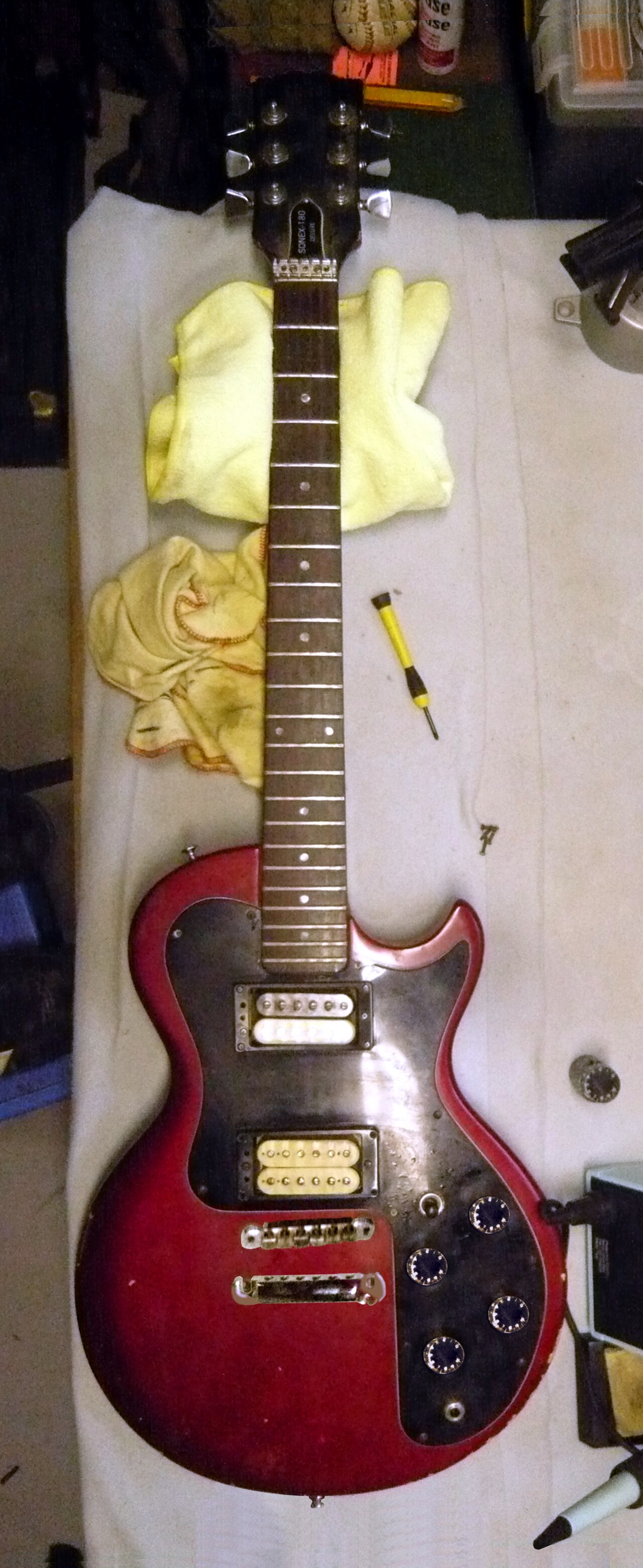
Photo: Roadside Guitars / Wikimedia Commons / CC BY-SA 2.0 Gibson
Sonex
1980
Gibson built the Sonex for the shops that weren't allowed to sell a Les Paul. Some people never put it down.
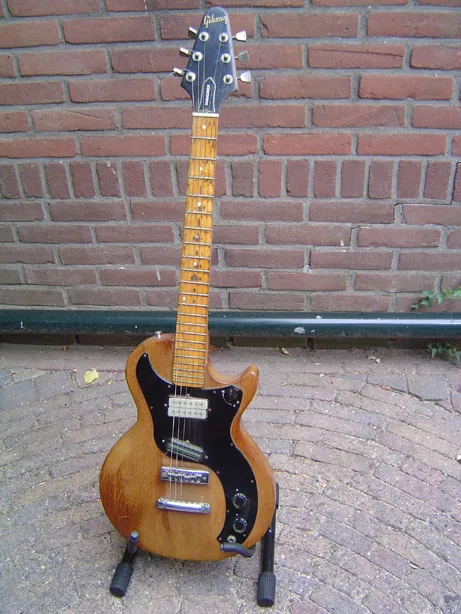
Photo: Wikideviking / Wikimedia Commons / Public domain Gibson
Marauder
1974
Gibson built it to take on the cheap copies. Kiss paid $65 apiece to break it.
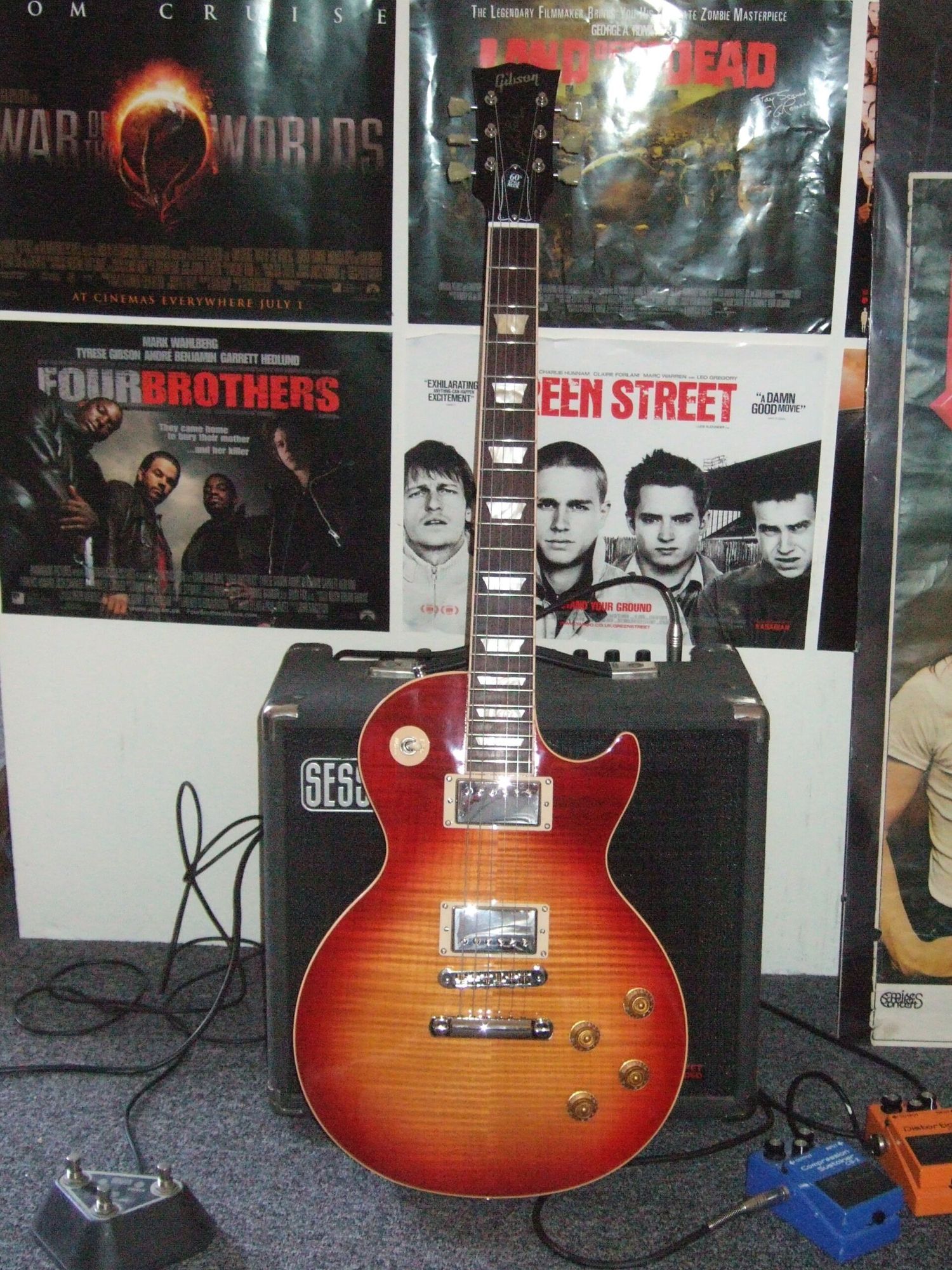
2006 Gibson Les Paul Standard (SN 000660573). Photo by wetwebwork. Licensed under CC BY-SA 2.0. Via Wikimedia Commons. Gibson
Les Paul Standard
1952
Gibson made about 1,500 sunburst Les Pauls, decided nobody wanted them, and stopped. Then the British blues boom happened.