Gibson
Marauder
Gibson built it to take on the cheap copies. Kiss paid $65 apiece to break it.
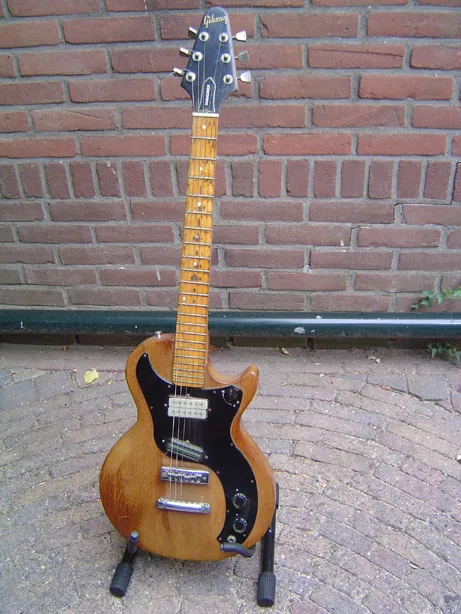
In the mid-1970s Gibson needed a guitar a shop could price against a Fender. The Marauder had a bolt-on neck, a Flying V headstock, and pickups by Bill Lawrence. Paul Stanley remembers it as the guitar he broke every night.
- Introduced
- 1974
- Type
- Solidbody electric
- Class
- Production
The short version
1974
One guitar
Gibson calls it introduced. The shipping ledger shows exactly one, a natural.
1975
Into production
Natural satin lists at $349 on 1 January, and 2,906 ship. By June it’s the M-1, and there’s a Custom.
1976
Cobo Hall
Marauders become Paul Stanley’s breakaway guitars. Late in the year a blend knob replaces the toggle.
1977
Eighty guitars
The quietest full year in the ledger.
1978
The peak
3,178 ship, most of them natural satin, with Kalamazoo and Nashville both building.
1980
Segmented out
Gibson announces it’s discontinued, replaced by the Firebrand and the Sonex. A few closeouts trickle out into 1981.
1986
The Expressway guitar
Thurston Moore’s Marauder is stolen before a New York show, and later comes back to the band.
2019
Fear Inoculum
Adam Jones brings one to the sessions, and the producer can’t get over the pickups.
Side A
A1
Plugged in, for one song
Cobo Hall, Detroit, January 1976. Paul Stanley is playing “Let Me Go, Rock ’n’ Roll” on a Gibson Marauder, and the photos and the film show it plugged in. Then it comes unplugged, because it has another job to do before the night is over.
Stanley tells it shorter. “Truly, the Marauder was the guitar that I broke on stage every night, I never played one live! They were horrible,” he said in 1997. That’s the legend, and it’s his. The Detroit tape says he played one first.
It wasn’t even the first guitar he smashed. That was in April 1975, and it was a different Gibson. Marauders took over the job in January 1976, on a deal struck late in 1974. Bill Aucoin, Kiss’s manager, explained the economics: “It cost us $65 a piece… they would agree to take broken parts or whatever they had and make bodies. There were no real guts to it.”
“Then we would saw the back of it [the neck] so it would break easy, because Paul couldn’t break them.”
A sawed neck with no guts is a prop. The guitar Gibson actually sold had a better reason to exist.
A2
A Gibson to hang next to a Fender
Think about a guitar shop wall in 1974. The oil crisis, the recessions after it, and Japanese copies hanging right beside the Gibsons. Gibson needed an entry-level electric a dealer could price against a Fender.
So they borrowed a few Fender habits. A bolt-on maple neck, four screws and a plate. An alder body, Fender’s wood, instead of the mahogany Gibson usually reached for. Pickups and knobs mounted on the guard, so the factory could skip a rout. Still a Gibson. Still not cheap: on 1 January 1975 a natural satin one listed at $349, and wine red at $399.
Gibson’s own promo called it “a body shape rather like a Les Paul, but has a bolt-on neck.” No arch, no binding. The headstock is a Flying V in outline. The guitar it was really lined up against was the Telecaster Custom: humbucker at the neck, an angled pickup at the bridge.
It starts in two places. Gibson said 1974, and the ledger shows exactly one guitar shipped that year. Then 2,906 in 1975. Michael Wright put it neatly: “technically introduced in ’74 but really entering production in ’75.”
A3
One coil or two
Bill Lawrence did the pickups. He’d come to Gibson after designing the L-6S, and he potted these in epoxy, the way he had for Dan Armstrong. The neck pickup is a cousin of Gibson’s Super Humbucker.
The bridge pickup is where the arguing starts. Gibson’s 1978 copy calls it “a single, iron-cored coil.” Wright, looking at a 1978 guitar, says the opposite: “There’s not even a single-coil pickup, but rather a narrow humbucker at the bridge.” Others call it a blade single-coil that people mistake for a humbucker. Depends who you ask, and nobody has settled it.
What Gibson wanted you to hear is on record. Gibson pressed a 7-inch demo record in 1974 or ’75, and the narrator calls the bridge “piercing blues” and the neck “mellow jazz.” The catalog sold the lead pickup on its “accented treble frequencies.”
Early guitars had a three-way toggle. From late 1976 a blend knob took its place, so you could dial the two pickups together instead of flipping between them.
Flip the record · By the numbers
$349
A natural satin Marauder on Gibson’s 1 January 1975 price list.
$65
What Kiss paid Gibson for each breakaway prop, on their manager’s account.
80
Marauders shipped in all of 1977.
7,112
Shipped 1974–79 by the ledger. Leave out the lone 1974 guitar and you get the 7,111 you’ll also see.
Side B
B1
Eighty guitars in 1977
The ledger tells a strange little story. 2,906 in 1975. 745 in 1976. Then 80 in 1977, the whole year. Then 3,178 in 1978, most of them natural satin, with Kalamazoo and Nashville both building. Then 202.
In June 1980 Gibson announced it was done, “in order to effectively segment our mid-priced product line.” The Firebrand and the Sonex took its place. A few more trickled out of Nashville into 1981, some of them in an opaque Devil Red with a painted neck.
Gibson never reissued it. A 2025 Les Paul pays homage, with two humbuckers and a Les Paul name. It isn’t a Marauder.
B2
The Expressway guitar
Thurston Moore had one. Sonic Youth called a Gibson Marauder the original “Expressway” guitar, after “Expressway to Yr. Skull,” on EVOL in 1986. It was stolen before a New York show that November, and later found its way back to the band.
Nobody wrote down which guitar is on the album take. The nickname is the credit.
In 1999, at Irvine, after another theft, Mac McCaughan of Superchunk lent Moore a sunburst Marauder. On the tape, Lee Ranaldo mentions that Thurston wrote “Expressway” on the same kind of guitar. Same kind. Not the same one.
B3
The ugliest guitar in the room
In 2019 Tool’s producer, Joe Barresi, described the Fear Inoculum sessions. The starting point was Adam Jones’s Les Paul Custom. Then:
“Adam brought in a Gibson Marauder — which I thought was the ugliest guitar I’d ever seen — but it has the pickups Bill Lawrence designed for Gibson, and it blew my mind how much clarity those pickups had.”
He also remembered a five-way varitone. The Marauder never had one: a three-way, then a blend. Memory does that. And no song on the album is pinned to the guitar.
But the pickups are the part he got right. Paul Stanley swore he never played one. Forty-odd years after Kiss sawed the necks so they’d break, the man who called it the ugliest guitar he’d ever seen heard Bill Lawrence’s pickups, and it blew his mind.
Put this on
You’ve read about it. Now hear it. Here’s what this guitar sounds like, and what to listen for.
Let Me Go, Rock ’n’ Roll (Cobo Hall, January 1976)
Paul Stanley said he never played a Marauder live. Photos and video from Detroit show one plugged in for this song, before it’s unplugged to be broken.
Watch it on YouTube (opens in a new tab)Expressway to Yr. Skull
The band called a Gibson Marauder its original “Expressway” guitar, after this song. No take sheet says which guitar is on the EVOL recording, so treat the nickname as the link.
Find it on YouTube (opens in a new tab)
The cast
The people, and the specific guitars, that made the legend.
1976
Paul Stanley
Marauder breakaway props
Of Kiss. Broke them on stage from January 1976, after a different Gibson took the first smash in 1975. Endorsed the model in a 1976 ad.
1986
Thurston Moore
The original “Expressway” Marauder
Of Sonic Youth. Stolen before a New York show in November 1986, and later back with the band. In 1999 Superchunk’s Mac McCaughan lent him a sunburst one after another theft. That was a different guitar.
2019
Adam Jones
Gibson Marauder
Of Tool. Brought one to the Fear Inoculum sessions. The album started from his Les Paul Custom, and no song is pinned to the Marauder.
Bill Lawrence
Pickup designer
Came to Gibson after the L-6S. Potted the Marauder’s pickups in epoxy, and nobody has agreed on what the bridge one is since.
Mike Bloomfield
Marauder Custom
Photographed with one for Gibson’s own magazine. A photo, not a record credit.
Liner notes
Specs, construction, rarity, value, and every source we used.
A Flying V headstock and a bolt-on neck on a single-cut slab — Gibson’s Marauder, not a Les Paul, and not Fender’s aborted one.
- Body
- Solid single-cut, contoured, no arch, no binding. Venetian cutaway. Alder on the early run; maple or mahogany later. Poplar is named in 1978 literature. Not one wood.
- Neck
- Bolt-on laminated Canadian maple, four screws and a plate. Pointed headstock: Gibson’s “V-series,” a Flying V in outline. A 1979 catalog line mentions mahogany necks. Unconfirmed.
- Fingerboard
- Rosewood, 1974–77; maple from mid-1978. Dots, 22 frets. Custom: rosewood, blocks. A few 1981 closeouts go back to rosewood. Trapezoids are a “some may have,” not this row.
- Scale
- 24¾" (vintageguitarandbass.com). Wikipedia prints 24.75 in (629 mm). Crave’s one 1978 prints 24¾" (629 mm). Mix flagged. Not a second scale.
- Pickups
- Neck humbucker, part 13670, epoxy-potted, kin to the Super Humbucker. Bridge part 13671, angled blade. Gibson’s 1978 copy: a single iron-cored coil. Vintage Guitar (2009): a narrow twin-blade humbucker. Not settled.
- Hardware
- Wide-travel Tune-o-matic — the harmonica bridge — and a stopbar. Enclosed Gibson Deluxe tuners. Custom: gold tuners.
- Electronics
- Passive. Master volume and tone. Early: 3-way, both pots 300k. From late 1976: a blend pot. 1981 list: volume 300k (70031), tone 100k (70033), blend 75k linear (70009), cap .02 mfd. The 1977 blend is 50k (70036).
- Finish
- Natural satin is the volume finish. Wine red, ebony, tobacco sunburst, plus walnut, white, maple gloss, and natural mahogany. Devil Red on some 1981 closeouts.
- Nut
- Factory width unpublished. One 1978 (Crave): 1 11/16" (43 mm). One 1975 (Carter): 1.663". Mix flagged. Do not average.
Open the full research fileConstruction details, the complete player record, production numbers, dated value estimates, and sources
Classic living example = 1975–79 Marauder / M-1 (bolt-on, V-series headstock, neck humbucker, angled bridge blade). No current Gibson Marauder (19 October 2026). The 2025 Les Paul Music City Special is a homage with two 70s Tribute humbuckers. Not this table. The Marauder Custom is sunburst, blocks, gold tuners: 83 in the cells. The S-1 is the three-single-coil sister. The Grabber is the bass. The Fender Marauder is Fender’s aborted 1960s model, the ill-fated 1966 one. Not a Les Paul, not an SG, not an ES. No body millimetres invented. Do not average the nut widths, or treat 629 mm as another scale.
Construction
The job was a Gibson a shop could price against a Fender. vintageguitarandbass.com: the 1973 oil crisis, the recessions after it, Japanese copies on the same wall. The entry-level electric got cheaper to build. Still a Gibson. Still not cheap. Pickups and knobs on the guard, so the factory skipped a rout. Bolt-on maple. Alder, the wood that page associates with Fender, instead of the mahogany Gibson usually reached for.
Not a Les Paul. Not an SG. Not an ES. Not the L-6S. Not the Grabber. Not the Fender Marauder. Gibson’s 1978 promo, quoted on that site: “a body shape rather like a Les Paul, but has a bolt-on neck.” Vintage Guitar (Michael Wright, November 2009): Les-Paul-shaped, “a contour along the upper edge – no binding, no arch.” The spec page calls the cutaway Venetian. That is what the sources say about the outline. It is not a Les Paul (gibson-les-paul-standard): no carved cap, no set neck, no open-book headstock. The peghead is the promo’s “V-series.” Wright: a Flying-V-style taper. Wikipedia: similar to the Flying V’s. The Grabber (gibson-grabber) is the bass from the same moment. The site says the two shared guard-mounted electronics, the bolt-on maple, and alder or poplar. The Grabber’s headstock is the same pointed idea. It is a bass. The L-6S (gibson-l-6s) is Lawrence’s previous solid: flat maple, 24 frets, a six-way, a set neck. The S-1 is the sister six-string, aimed at a Stratocaster. This one is the guitar they compared to a Telecaster Custom (fender-telecaster-custom): humbucker at the neck, angled coil at the bridge. The other Marauder is Fender’s. Fender’s Starcaster history calls it the aborted ’60s Marauder, and the ill-fated 1966 one Fields drew a headstock for. Not this guitar.
The start is two dates. The 1978 promo: “introduced in 1974.” Shipping, Larry Meiners’s Gibson Shipment Totals via vintageguitarandbass.com: 1 natural in 1974, then 2,906 in 1975. First price list: 1 January 1975, natural satin $349, wine red $399. Wright: “technically introduced in ’74 but really entering production in ’75.” Wikipedia’s current opening says 1975–1979 and “only 7,111” sold; the history section still says introduced in 1974. An older wording calls the 1974 guitar a prototype and starts the 7,111 in 1975. The ledger calls it one shipped guitar. This plate starts at 1974. It does not pretend 1975 was the introduction, and it does not pretend one guitar was a production year. By 20 June 1975 the price list is calling it the M-1, and announcing the Custom, sunburst only, $449.
Lawrence did the pickups. Wright: Gibson hired him after the L-6S, designed 1972, introduced 1973. He had potted Dan Armstrong coils in epoxy. These are potted too. Neck part 13670. The 1978 promo: “similar to the Super Humbucker with small additional magnets.” Crave, on one 1978: like the L-6S Super Humbucker, no adjustable poles. The L-6S parts are 13682 and 13683. Similar. Not the same number.
The bridge is the argument. Same promo: “a single, iron-cored coil, with a magnet below and iron strips from the lower magnet pole.” The spec page: “Back pickup is single coil.” Part 13671. Catalog copy: a new lead pickup “with accented treble frequencies,” the neck “Super Humbucking.” Wright, on a 1978: “There’s not even a single-coil pickup, but rather a narrow humbucker at the bridge,” a slanted twin-blade with green insulation. Crave sees one bobbin and calls it a noiseless single-coil, and notes the split among commentators. Wikipedia: a blade single-coil, often mistaken for a humbucker. Do not file it as two humbuckers, and do not file the bridge as a Tele single-coil, without saying who said which.
The control dates a guitar. The 1975 schematic is a three-way, both pots 300k, toggle on the treble horn, opposite a Les Paul. Witch-hat knobs that year. By late 1976 the toggle is a blend pot, at first in the same hole. 1977 parts: 50k linear (70036). The 1981 list: 75k (70009), volume 300k, tone 100k, cap .02 mfd. The sheet mislabels the tone pot as volume. Mid-1978 the guard goes single-ply black, then matches the S-1, and the blend sits between volume and tone under a chicken-head. Speed knobs are on the 1977 photo. Boards are maple from here. Rosewood was 1974–77.
Wood does not sit still. Spec page: alder 1974–77; poplar “mentioned in some 1978 literature”; maple or mahogany 1978–79. The promo says “body and neck are made from poplar and hard maple,” clear satin lacquer, rosewood dots, Canadian maple neck. It does not say which piece is poplar. A 1979 line says the neck may be mahogany. The spec page prints “could this be an error?” Mahogany bodies, that page says, only in 1978/79, and they have no row. Crave’s August 1978 Kalamazoo guitar is one: two-piece mahogany, maple board, three-piece neck, volute, no scarf, 8 lb 7 oz (3.93 kg). Carter’s 1975 natural is alder, 7.2 lb. One guitar each. Not a model weight.
The Custom leaves the 15 May 1978 list. New finish names that year: ebony, walnut, tobacco sunburst, natural mahogany, and white. 30 September 1979 is $399 and walnut only. Last list: 7 January 1980, still $399. Not on the July 1980 list. The dollar steps between those dates are in Value. They are 1970s money.
Kalamazoo first. Both plants in 1978. Nashville only toward the end of that year. The closeouts are Nashville.
Gibson News, June 1980: discontinued “in order to effectively segment our mid-priced product line,” replaced by Firebrand and Sonex, and they would ship until the inventory was gone. Wright: cancelled in ’79, a few more until ’81 or ’82. The 1981 page: last ones made in 1981, some in opaque red read as Devil Red (code DR, not translucent cherry). Painted neck. Rosewood board again. Black covers. A February 1982 special-sale list still names the model, dealer price $259.50, retail not printed. A sale list is not a cell. The shipping page guesses tens after 1979, not hundreds. A guess.
Gibson did not reissue it. The 2025 Les Paul Music City Special marks fifty years in Nashville. Gazette, 7 July 2025: “rooted in the design DNA” of the Marauder. DeCola: it “pays homage.” Premier Guitar, 14 July 2025: the Marauder, plus a touch of the Music City Junior. Poplar, SlimTaper maple, striped ebony, 12" radius, two 70s Tribute humbuckers, 650 per finish. Steve’s Music prints 500. Prefer Gibson. Musicstore’s line says the neck is glued. List $1,799 (Guitar World, 8 July 2025). Guitar World’s “in all but name” is the magazine, not a Marauder SKU. This table stays the bolt-on.
A 1974/75 vinyl 7-inch, not a flexi, demos the early three-way. Steve Baron narrates: country, the bridge as “piercing blues,” the neck as “mellow jazz,” both pickups. Side two is Bruce Bolen on a Marauder, with a Ripper, keys, and Larry Londin. A demonstration. Not a hit.
Players
Do not hang a Les Paul, an SG, or an L-6S on this plate. The guitar Paul Stanley broke is this one. The guitar in his hands on 1 April 1975 is not.
Paul Stanley — the ad, the denial, and one plugged-in encore. The 1976 ad is “KISS Knows looks Aren’t Everything.” Wright says Ace Frehley and Stanley endorsed the model. An endorsement is not a Kiss album. Stanley, Vintage Guitar, March 1997, via the Kiss Timeline and Axeology: “Truly, the Marauder was the guitar that I broke on stage every night, I never played one live! They were horrible.” Axeology has him in Metal Edge (1996) on seeing Pete Townshend and wanting to do that; Gibson gave him guitars and every night he broke one. The Timeline’s first smash is 1 April 1975, “Black Diamond,” and that guitar is the white Midnight Special, which lives on the L-6S plate. Marauders become the breakaway in January 1976, from a late-1974 deal at $65. Bill Aucoin, Warman’s Field Guide to Kiss Collectibles, p. 499, via that timeline: “It cost us $65 a piece… they would agree to take broken parts or whatever they had and make bodies. There were no real guts to it. Then we would saw the back of it [the neck] so it would break easy, because Paul couldn’t break them.” A sawed neck with no guts is a prop. It is not a stock M-1.
The denial is not the whole month. Axeology: Cobo Hall, Detroit, 25–27 January 1976, “Let Me Go, Rock ’n’ Roll.” Photos and video show it plugged in. He plays it, then it has to come unplugged to break. No smashing on the European tour in May and June. By the Spirit of ’76 tour a stagehand hands him an unplugged one. Keep the quote and the Detroit tape.
Thurston Moore — two Marauders, years apart. sonicyouth.com calls a Gibson Marauder the original “Expressway” guitar. Stolen before the 22 November 1986 New York gig, and later back with the band. “Expressway to Yr. Skull” is on EVOL (1986). The page does not print a studio-take sheet. The nickname is the credit. A second one is not that guitar. At Irvine in 1999, after a theft, Mac McCaughan of Superchunk lent a sunburst: maple board, black guard, a toggle, four knobs. On the tape Lee Ranaldo says Thurston wrote “Expressway” on the same kind of guitar. A comment about the old one. Not the old one.
Adam Jones — one was in the room for Fear Inoculum. Not the album’s guitar. Joe Barresi, Guitar World (David Von Bader, 2 October 2019): the starting point was “his Les Paul Custom” into a Diezel VH4 and a Marshall Superbass. Then: “Adam brought in a Gibson Marauder — which I thought was the ugliest guitar I’d ever seen — but it has the pickups Bill Lawrence designed for Gibson, and it blew my mind how much clarity those pickups had; with that five-way varitone switch, you can dial in almost any sound.” The Lawrence pickups are the fact. The five-way is his memory. This guitar’s third control is a three-way, then a blend pot. No song on Fear Inoculum is pinned to it. Gibson’s 2025 Gazette names Jones beside Stanley. That is marketing. The producer’s sentence is the session.
Mike Bloomfield posed with a Custom. vintageguitarandbass.com: a Backstage Pass photo, Bloomfield on a Marauder Custom. A Gibson magazine. Not a Super Session credit.
Also known stays short. Wright adds Ace Frehley, no guitar and no year. The ad in hand is Stanley. Wikipedia’s crowd — Whibley, Gotoh, Homme, Shelley, Kooymans — is not repeated as fact. Johnny Ramone does not move here from a dealer list.
Rarity
You cannot buy a new Marauder. The 2025 Les Paul is another name. Fender’s aborted Marauder is not this guitar. Meiners, through vintageguitarandbass.com, stops at 1979. Later Nashville guitars are real and uncounted. The page guesses tens, not hundreds. Wikipedia’s 7,111 is this table without the 1974 guitar, or “sold” against “shipped.” 7,112 is the cells. Keep both.
| 1974 | 1975 | 1976 | 1977 | 1978 | 1979 | Total | |
|---|---|---|---|---|---|---|---|
| Marauder (finish unsplit) | 9 | 12 | 5 | 161 | 15 | 202 | |
| Ebony | 435 | 25 | 460 | ||||
| Natural | 1 | 1 | |||||
| Natural satin | 1,819 | 408 | 4 | 2,422 | 105 | 4,758 | |
| Tobacco sunburst | 227 | 13 | 240 | ||||
| Wine red | 851 | 259 | 66 | 148 | 44 | 1,368 | |
| Custom, tobacco sunburst | 66 | 5 | 12 | 83 | |||
| Year sum | 1 | 2,906 | 745 | 80 | 3,178 | 202 | 7,112 |
1978 is the peak, mostly natural satin. 1975 is the other big year. 1977 is 80 guitars. Wright’s “a little over 1,368” wine reds, 148 of them in ’78, is the wine-red row plus the uncounted closeouts. Not the model total. Tobacco’s cells are 1975 and 1979, not the 1978 “new finish” the chronology names. Walnut, white, maple gloss, and natural mahogany have no rows. They may sit in the unsplit 202. Don’t invent the split. Serials date a guitar. They don’t count 1980–82. That is why the addendum is unknown.
What is thinner: the 1974 natural; the Custom, 83; ebony, 460, a 1978–79 color; a Devil Red closeout with the painted neck. Natural satin is the ordinary one, 4,758 of 7,112. Stanley’s props, if Aucoin is right, may never have been in the table. Moore’s Expressway guitar is one object. It is not a vintage Marauder.
Value
Informal estimate, 19 October 2026. Not an appraisal.
Asking prices are not sold prices. Celebrity instruments are not comps. A Music City Special is not a 1975 M-1. A Custom is not a dot-inlay natural. A sawed Kiss prop is not either. Period list, vintageguitarandbass.com: 1 January 1975, natural satin $349, wine red $399; 20 June 1975, Custom $449; 1 March 1976, Custom $499, M-1 unchanged; the second 1976 list, satin $359, maple gloss $399; 1 January 1977, satin $399, wine red or maple gloss $449, Custom $539; 15 January 1978, satin $419, wine red or maple gloss $469, Custom $559; 30 September 1979 and 7 January 1980, $399. The February 1982 sheet is a dealer price, $259.50. 1970s money.
New street. None under Marauder. The homage is still on carts, and it is not this table. Sweetwater’s wine red, page dated 30 June 2026, $1,799, in stock. Music & Arts and Musician’s Friend, ebony, $1,799. One markdown, not a series: Haggerty’s ebony at $1,499 from $1,799. Do not average them. 650 per finish is Gibson’s cap, not a count of what is left.
Used modern. No clean sold band for the 2025 Les Paul this pass. Don’t invent one from the $1,799.
Vintage / collectible. Reverb’s US dollar widget did not render (19 October 2026). Flag: thin dollar sold-comp access. The Netherlands mirror of the 1975–1980 guide printed €992–€1,559, 32 orders, Good to Mint, “All Models.” Euros are not a dollar band. Do not convert them. Named hammers on that page, not a series, and not dollars: €1,390 (Good, 12 October 2025), €1,400 (Very Good, 19 August 2025), €1,229.49 (Very Good, 1 July 2025), €1,199 (Good, 29 April 2025), €1,150 (Good, 22 August 2025), €970 (Good, 31 July 2025), €809.10 (Excellent, 9 April 2025).
Named US asks, not hammers, the same pass: a 1976 maple-board in Very Good condition, $1,200; a 1976 wine red in Good condition, $1,695 from $1,795; a 1975 natural, $1,450 from $1,655; a 1979 walnut in Very Good condition, $2,227.50 from $2,475; a 1975 wine red in Excellent condition, $1,940.64. A “Freebird Custom” ask is not the factory Custom unless the guitar is. A listing title that says Paul Stanley owned one is a title. Not provenance. Do not average the asks. No hammer for the Expressway guitar, or for a Cobo Hall Marauder, is in these sources.
See also
- gibson-grabber — the bass from the same bolt-on, guard-mounted program; a pointed headstock; not this six-string
- gibson-l-6s — Lawrence’s previous solid, and the Midnight Special Stanley played in April 1975; the guitar he broke is not that one
- fender-telecaster-custom — the neck-humbucker, angled-bridge layout this was aimed at; different scale, different factory
Sources
- vintageguitarandbass.com, Gibson Marauder — introduced 1974; 1 shipped that year; Kalamazoo then Nashville, both plants in 1978; 1978 promo (Les Paul-like body, bolt-on, poplar and hard maple, satin lacquer, Super Humbucker-like neck pickup, single iron-cored bridge coil, V-series peghead); Grabber cost cuts; Telecaster Custom comparison; S-1 as the Strat-aimed sister; price lists 1 January 1975 through the February 1982 dealer sheet; Gibson News, June 1980; Sonex and Firebrand; Devil Red
- vintageguitarandbass.com, specifications and shipping — alder 1974–77, poplar in some 1978 literature, maple or mahogany 1978–79; Venetian cutaway; laminated Canadian maple; 1979 mahogany-neck line, flagged as possibly an error; rosewood then maple; dots, 22 frets, 24¾"; Custom blocks and gold tuners; Meiners cells totaling 7,112; tens after 1979, their guess; mahogany bodies uncounted; Bloomfield with a Custom in Backstage Pass
- vintageguitarandbass.com, schematic and parts — 1975 three-way, both pots 300k; blend from 1976/77; 70031, 70033, 70009, 70036; cap .02 mfd; pickups 13670 and 13671; bridge 80040; tailpiece 81509
- vintageguitarandbass.com, publicity — 1976 Kiss ad; 1979 “$399 and Up”; catalog copy on the two pickups; 1974/75 promo 7-inch, Steve Baron, Bruce Bolen, a Ripper, Johnny Propst, Larry Londin
- vintageguitarandbass.com, 1981 Marauder — deleted 1980; Firebrand and Sonex; 18 March 1981 Nashville example; Devil Red versus cherry; last list 7 January 1980 at $399; Les Paul-like shape, Flying V headstock, Super Humbucker neck, single-coil bridge
- vintageguitarandbass.com, 1978 catalog — 3,178 shipped in 1978; list $419–$469; natural mahogany pictured
- *Vintage Guitar*, Michael Wright, Marauder M-1 (November 2009) — introduced ’74, production ’75; contour, no binding, no arch; Flying-V headstock; Lawrence after the L-6S; epoxy; twin-blade bridge humbucker, which disagrees with Gibson’s single-coil copy; blend from late 1976; Frehley and Stanley endorsements; wine red a little over 1,368, 148 in ’78; a few to ’81 or ’82
- Wikipedia, Gibson Marauder — infobox 1974–1979; prose 1975–1979 and 7,111 sold; 24.75 in (629 mm), mix flagged; Flying V-style headstock; blade often mistaken for a humbucker; finish splits matching the ledger. The player list is not a credit. The infobox Short Lyre Vibrola is not in the catalog copy used here
- CRAVE Guitars, 1978 Marauder — one Kalamazoo guitar: mahogany, 1 11/16" (43 mm), 12" (304.8 mm), 24¾" (629 mm), 8 lb 7 oz (3.93 kg); bridge as a noiseless single-coil. Rounded totals on that page are this ledger, loose
- Carter Vintage, 1975 natural — one guitar: alder, 24.75", nut 1.663", 12" radius, 7.2 lb
- Gibson Gazette, Les Paul Music City Special (7 July 2025) — homage, not a reissue; DeCola; 650 per finish; dual 70s Tribute humbuckers; names Jones and Stanley, which is not a session log
- Premier Guitar, Music City Special (14 July 2025) — Marauder plus a touch of the Music City Junior; poplar; SlimTaper; striped ebony; 12" radius
- *Guitar World*, Music City Special (8 July 2025) — $1,799; 650 per color; dual humbuckers against the original layout; “in all but name” is the magazine
- Steve’s Music, Music City Special — prints 500 per color. Conflicts with Gibson’s 650. Not used as the count
- Sweetwater, Music City Special wine red — $1,799, in stock, page dated 30 June 2026. Not this table
- Music & Arts, Music City Special ebony — $1,799
- Musician’s Friend, Music City Special ebony — $1,799
- Haggerty’s, Music City Special ebony — one markdown, $1,499 from $1,799
- Musicstore, Music City Special wine red — this retailer’s spec line says glued maple neck. Not the 1970s bolt-on
- Fender, the Starcaster — “aborted ’60s version of the Marauder”; Fields’s headstock for the “ill-fated 1966 Marauder.” Not this guitar
- Kiss Timeline, 1 April 1975 — Midnight Special that night; Vintage Guitar, March 1997; $65; Aucoin in Warman’s, p. 499
- Axeology, Stanley’s 1976 Marauder — Cobo Hall, 25–27 January 1976, plugged in on “Let Me Go, Rock ’n’ Roll”; the 1997 denial; Metal Edge 1996
- sonicyouth.com, gear notes — original Expressway guitar is a Marauder; stolen before 22 November 1986; later back with the band
- sonicyouth.com, 1999 Marauder — Mac McCaughan’s sunburst at Irvine; Lee on the tape. Not the 1986 guitar
- *Guitar World*, Joe Barresi on Adam Jones (2 October 2019) — Les Paul Custom is the album’s starting point; a Marauder was brought in; his “five-way” is not on the schematic
- Reverb, Gibson Marauder — US asks, not hammers, this pass
- Reverb Netherlands, 1975–1980 price guide — €992–€1,559, 32 orders. Not converted. US dollar widget did not render
Keep digging
Guitars this one gets compared to, confused with, or descended from.
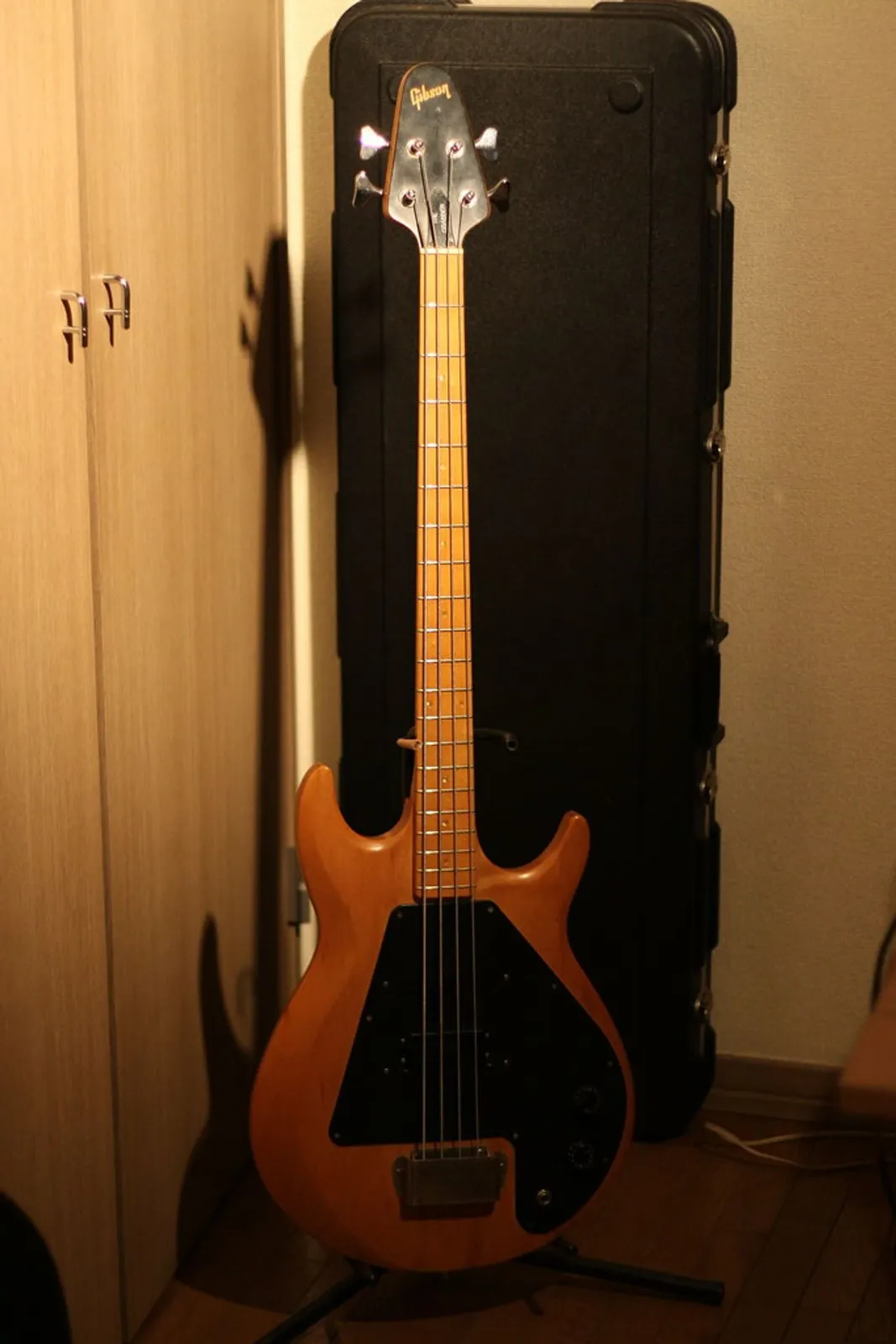
Photo: zenmai461 / Flickr / CC BY 2.0 Gibson
Grabber
1973
Gibson named its cheapest bass after what your hand did to the pickup: grab it and slide it.
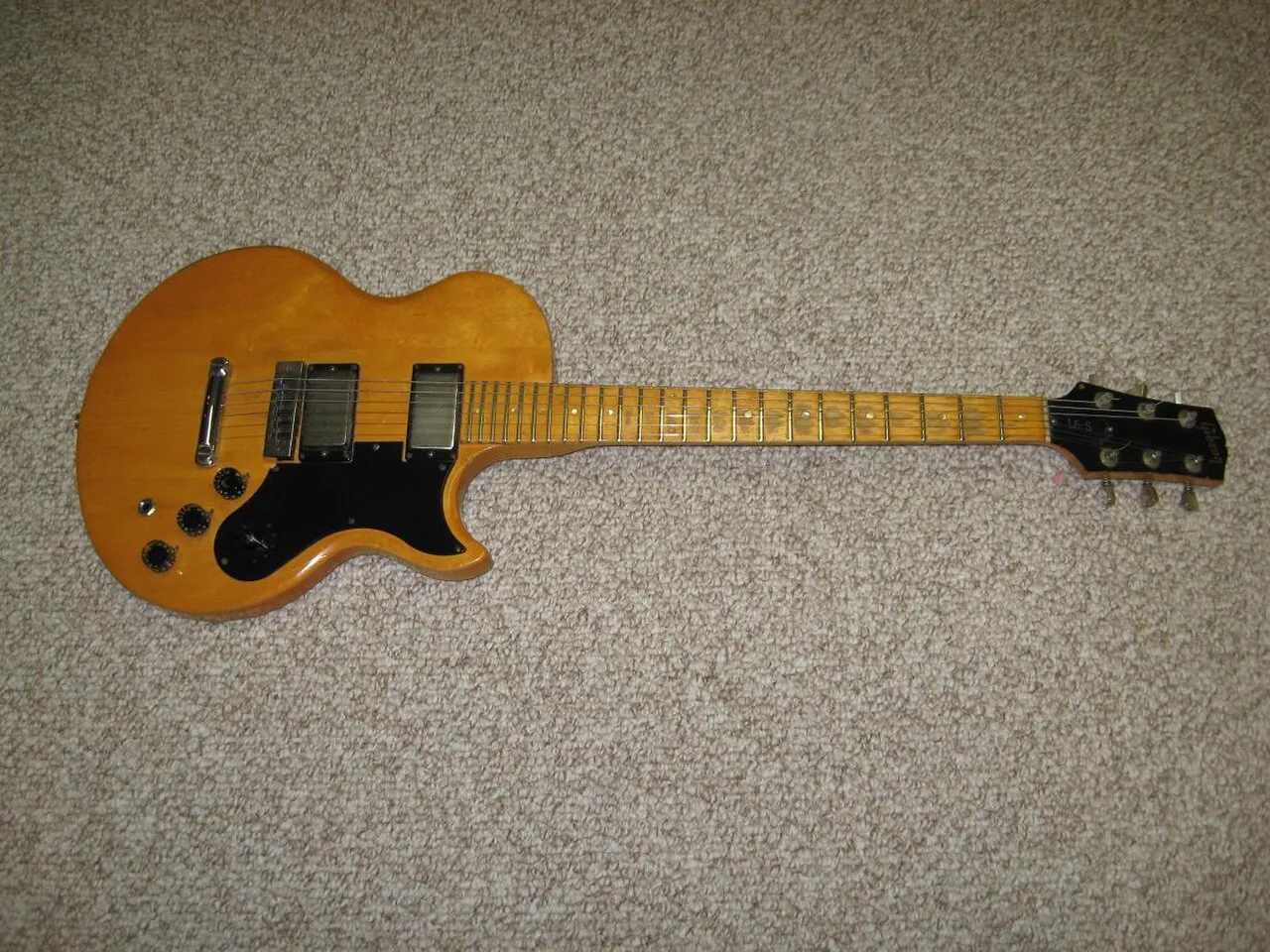
Photo: Glamafez / Wikimedia Commons / Public domain Gibson
L-6S
1973
Bill Lawrence drew a guitar with nine sounds. The budget cut it to six. Santana called it his rainbow.
1976 Fender Telecaster Custom. Photo by GEisenhut. Public domain. Via Wikimedia Commons. Fender
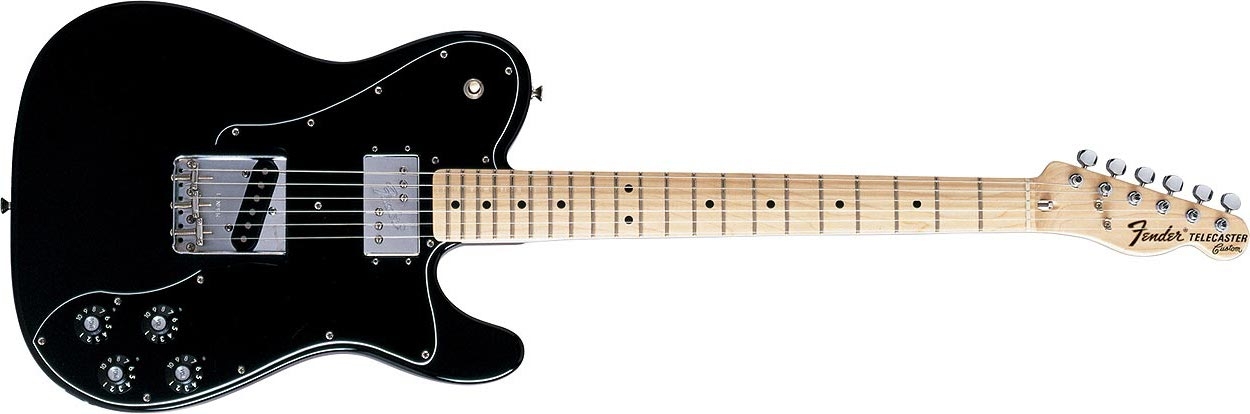
Telecaster Custom
1972
A borrowed name, a copied hot-rod, modest sales. Keith Richards still sent it onstage in Micawber’s place.