Gibson
Sonex
Gibson built the Sonex for the shops that weren't allowed to sell a Les Paul. Some people never put it down.
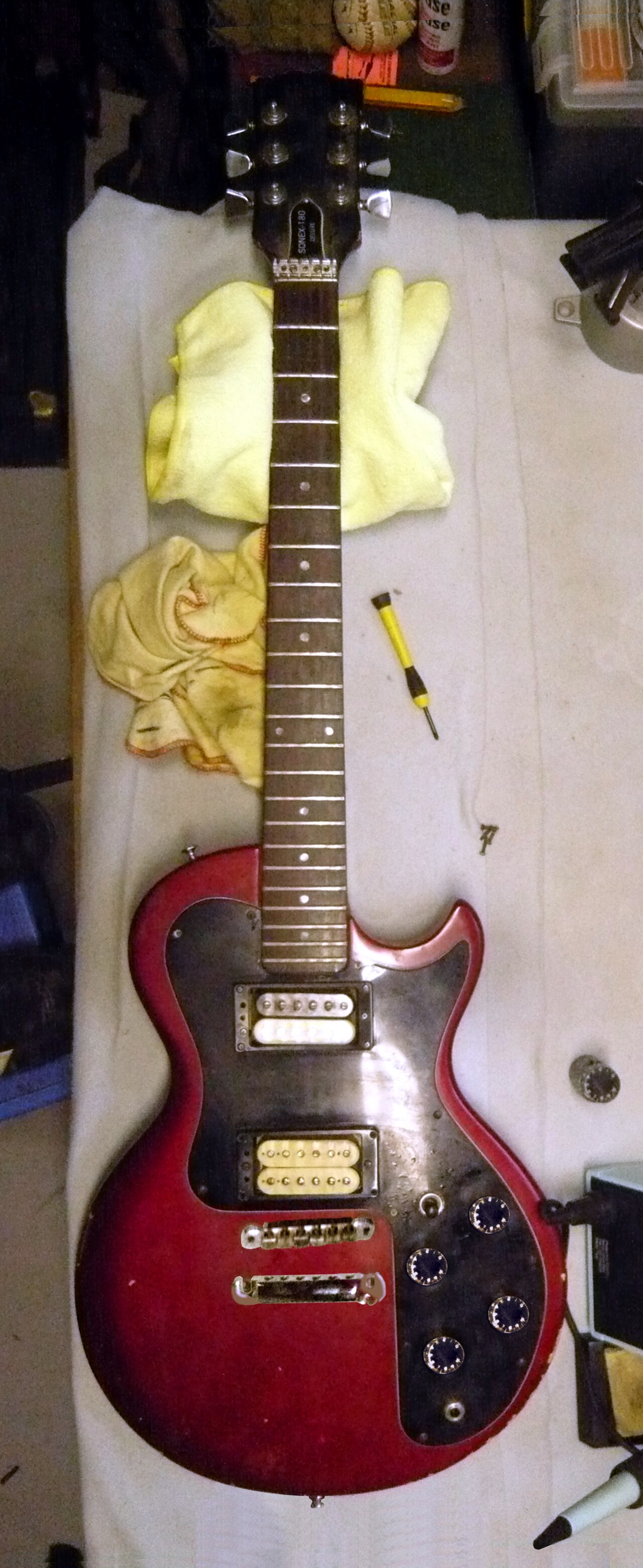
A single cutaway, two humbuckers, a Tune-o-matic, and a bolt-on neck in a body made of a wood composite called Resonwood. The Sonex-180 was the cheapest Gibson of 1980, and it only lasted until 1984. It isn't a Les Paul, and it isn't the Marauder it replaced.
- Introduced
- 1980
- Type
- Solidbody electric
- Class
- Production
The short version
1980
Chicago, June
Gibson shows the Sonex at the summer NAMM fair in Chicago, as the bottom tier of a line split three ways.
1980
$299
The 1 July price list has the Sonex-180 Deluxe in semi-gloss ebony, the only color, for $299.
1981
The Standard goes
The coil-tap Standard is gone after a year, and the active Artist joins the series.
1982
Gloss
Candy apple red, silverburst, and antique fireburst join the June list, and for a while the decal reads "Sonex by Gibson."
1984
Last list
The 23 June list is the last one with a Sonex on it. By January 1985 it's gone.
1999
The Drifter is stolen
Sonic Youth's gear is stolen in July, and with it the Conn Drifter that "Eric's Trip" was written for.
2002
The New Drifter
A refit Sonex brings "Eric's Trip" back into the set on the Murray Street tour.
Side A
A1
Not cleared for a Les Paul
Chicago, June 1980. Gibson is at the summer NAMM fair with a new way of deciding who gets to sell what.
The company had split its line, and its dealers, three ways. Professional was the high-gloss peghead and anything listed over $650. Firebrand was the middle. And Sonex was the bottom: a guitar for the shops that weren't cleared for the expensive stuff, priced under $450, with "Gibson Guitar Co." on the headstock instead of the Professional peghead.
It took the place of the Marauder, which Gibson dropped, in its own newsletter's words, "in order to effectively segment our mid-priced product line."
The 1 July list put the Sonex-180 Deluxe at $299, in semi-gloss ebony, the only color you could get. That was a hundred dollars under the Marauder's last price and two hundred under the next cheapest Gibson electric. A Les Paul Standard was $849.
It was the cheapest way into a new Gibson, and it was priced like something you'd trade up from.
A2
What's in the Resonwood
From across the shop it reads as a Les Paul. Single cutaway, Tune-o-matic and stopbar, two humbuckers, a three-way switch, speed knobs. Up close there's no carved top, and the neck is bolted on.
The body is the point, and Gibson wanted you to know it. The leaflet:
"The Sonex Multi-phonic body is composed of Resonwood surrounding an inner tone wood core."
The core anchors the neck. The Resonwood, the leaflet says, has "the weight of mahogany and the density of maple," and the body survived testing from 40 below to 180°F. Gibson was selling the material as hard as the guitar.
What the core actually is depends on which guitar you open up. One Deluxe photographed at the neck pocket shows Resonwood over solid maple. Another, a 1981 in silver, has a mahogany core under a moulded resin-and-wood shell. Gibson had tried cheaper materials before, with pressed-wood guitars in Kalamazoo about fifteen years earlier, but those weren't trying to pass for a Les Paul.
A3
The pickups everybody gets wrong
The Deluxe has two exposed humbuckers with one black coil and one cream coil, the zebra look. The 1980 manual just calls them high-output humbuckers. A 1984 parts list names them "Pickup assembly Sonex Japan."
Sellers and plenty of writers call them Velvet Bricks. One of the people who has catalogued Gibson's parts most closely says they're not, and not Dirty Fingers either. Dirty Fingers went on the two pricier Sonexes, the Standard at $375 and the Custom at $449, which also got a coil tap to turn either pickup into a single-coil.
The Deluxe kept it simple: a volume and a tone for each pickup and a three-way switch. It's the plain one, and judging by what turns up used, it's the one that sold.
Flip the record · By the numbers
$299
The Deluxe in 1980. The next cheapest Gibson electric was $499, and a Les Paul Standard was $849.
$450
The price ceiling Gibson set for its bottom series that year.
−40° to 180°F
The temperatures Gibson's leaflet says the Sonex body survived in testing.
35
Years Jimmy Bower says he played his Sonex.
Side B
B1
A shorter list every year
The Standard was gone by 1981. What replaced it depends on who you ask: the active Artist, with a circuit borrowed from the RD Artist, or a mahogany set-neck called the GGC 700 that only shows up on one list. Even the Artist's first price comes in two versions, $749 and $799, either way well over the series' own $450 ceiling.
By June 1982 the Custom was gone too, and the Deluxe had picked up gloss candy apple red, silverburst, and antique fireburst. For a short stretch that summer the decal read "Sonex by Gibson." Electric blue followed in 1983.
The list on 23 June 1984 was the last one with a Sonex on it: ebony or red, $419. On 15 January 1985 it wasn't there.
B2
Eric's Trip, again
In July 1999 Sonic Youth's gear was stolen. In it was the Conn Drifter, a guitar with the frets torn out and four bass strings, played with drumsticks on "Eric's Trip." It's the guitar on Daydream Nation. For a while it looked as if the song couldn't be played again.
Their tech, Eric Baecht, had a Gibson Sonex he'd kept for years. He took the frets out, took the bridge off, put on four heavy strings, and left one humbucker. On 15 June, in Salzburg, on the Murray Street tour, "Eric's Trip" was back in the set. The set lists just called the guitar "drifter."
Thurston Moore used it from 2002 to 2011, for that one song and nothing else.
B3
Thirty-five years
Jimmy Bower has played a Sonex for a long time. One of his main Eyehategod stage guitars in recent years is a 1983 Deluxe in silverburst, covered in stickers, with four strings tuned to C. The original neck pickup is still in it, dead.
In October 2026, talking through his gear, he said he'd played that Sonex for 35 years, and that it hadn't changed. When a builder made him a new guitar, the brief was to get close to the Sonex without copying it.
Gibson made it for the dealers who couldn't have a Les Paul, and dropped it after four years. Bower is still playing his.
Put this on
You’ve read about it. Now hear it. Here’s what this guitar sounds like, and what to listen for.
Eric's Trip (live, 2002–2011)
Live, in those years, this is Thurston Moore's New Drifter, a gutted Sonex with four strings and one humbucker. The Daydream Nation studio take is the original Conn.
Watch it on YouTube (opens in a new tab)
The cast
The people, and the specific guitars, that made the legend.
2002
Thurston Moore
The New Drifter, a heavily modified early-'80s Sonex-180 Deluxe
Used from 2002 to 2011, only for "Eric's Trip," after the original Conn Drifter was stolen.
2002
Eric Baecht
The Sonex he'd kept for years
Sonic Youth's tech. Pulled the frets, took off the bridge, and strung it with four heavy strings so the song could come back.
2024
Jimmy Bower
A 1983 silverburst Sonex-180 Deluxe
One of his main Eyehategod stage guitars, four strings, tuned to C, stickers and all. He says he's played a Sonex for 35 years.
Liner notes
Specs, construction, rarity, value, and every source we used.
Resonwood around a wood core, and a bolt-on neck on a single-cut slab — Gibson’s Sonex, not a Les Paul, and not the Marauder it replaced.
- Body
- Multi-phonic solid, single cutaway. Resonwood composite surrounding an inner tone-wood core. 1980 manual, Deluxe / Standard / Custom: length 17¼", width 13", depth 1¾". Core species is not one answer. Not a carved cap.
- Neck
- Bolt-on. 1980 Deluxe and Standard literature: one-piece select hardwood. 1982 Rock Hard brochure, Deluxe: three-piece maple. Custom: three-piece maple. The Artist’s sheet says fixed heel. Not this row.
- Fingerboard
- Rosewood, dot inlays, 22 frets (Deluxe and Standard). Custom: ebony, dots. Artist sheet: rosewood, pearl dots. Blue Book prints ebony on the Artist.
- Scale
- 24¾" (1980 manual). Wikipedia prints 24.75 in (629 mm). CRAVE, on one 1981: 24¾" (629 mm). Mix flagged. Not a second scale. Not 25½".
- Pickups
- Deluxe: two exposed zebra humbuckers, three-point mount, black coil and cream coil. Parts 13248 (neck) and 13249 (bridge), “Pickup assembly Sonex Japan” on a September 1984 parts list. Standard and Custom: Dirty Fingers, same zebra look, plus a coil tap. The Deluxe name is disputed.
- Hardware
- Chrome Tune-o-matic and stopbar. Enclosed tuners, three-a-side. Black speed knobs. Double-sided fingerrest, white edge. Artist: TP-6, not this row.
- Electronics
- Passive. Volume and tone for each pickup, three-way (1982 Deluxe page). Standard and Custom add a coil tap. The Artist is active. Not this row.
- Finish
- Launch: semi-gloss ebony only. Later white, silver, and gloss candy apple red, silverburst, antique fireburst, electric blue. 1984 lists: ebony and red.
- Nut
- Deluxe, Standard, Custom, and Artist sheets: 1 11/16". CRAVE’s 1981: 1 11/16" (43 mm). One 1980, Chicago Music Exchange: 1 5/8". Mix flagged. Do not average.
Open the full research fileConstruction details, the complete player record, production numbers, dated value estimates, and sources
Classic living example = 1980–84 Sonex-180 Deluxe (Multi-phonic body, bolt-on, two exposed humbuckers, rosewood dots). No current Gibson Sonex this pass (26 October 2026). Standard is the 1980 coil-tap sister, ebony only. Custom is Dirty Fingers, ebony board, three-piece maple, gone from the June 1982 list. Artist is the active one, different body size, not this table. The GGC 700 sat in the Sonex series on one list and is a mahogany set-neck, not this body. Not a Les Paul, not an SG, not an ES, not the Marauder, not the RD Artist. Mixed inch/mm flagged on Wikipedia’s and CRAVE’s 629 mm, and on CRAVE’s 43 mm. Do not invent millimetres for 17¼", 13", 1¾", or 1 11/16". Standalone card. Do not nest under live families. Significant Gibson gap — not an LP/SG/ES cousin.
Construction
The job was a Gibson for the dealers who were not cleared to sell a Les Paul. June 1980, Gibson News, via vintageguitarandbass.com: the company split the line into three authorizations. Professional was the high-gloss peghead and anything listed over $650. Firebrand was the middle, under $650. Sonex was the bottom series: Multi-phonic body, a Gibson Guitar Co. logo, priced below $450. The Sonex-180 is the guitar in that series. The series is not only this guitar.
It replaced the Marauder (gibson-marauder) and the S-1. The same site’s Sonex page: by the late 1970s those entry solids, and the Melody Maker, were barely shipping, and in 1980 two new ranges took the wall, Firebrand in the middle and Sonex at the bottom. Gibson News that June, on vintageguitarandbass.com’s Marauder page, says the Marauder was dropped “in order to effectively segment our mid-priced product line,” replaced by Firebrand and Sonex. This plate starts at the Sonex, not at the Marauder’s last closeouts.
The “Revolutionary” series was first demonstrated at the Chicago NAMM fair, June 1980. Three models that summer: Sonex-180 Deluxe $299, Standard $375, Custom $449. The next cheapest Gibson electric that year, on that page, was the 335-S Standard at $499. A Les Paul Standard was $849. The Deluxe chronology prints its lists day-first — 15/6/1983, 23/6/1984 — so 1/7/1980 is 1 July 1980, not 7 January. That list: semi-gloss ebony only, $299, the 180 case $65, a protector case $119.50. A hundred dollars under the Marauder’s last $399. No earlier prototype year turned up in these sources. YAML introduced: 1980 is the NAMM demonstration and that July list.
It reads as a Les Paul from across the shop. It is not one (gibson-les-paul-standard). Single cutaway, Tune-o-matic, stopbar, two humbuckers, a three-way, speed knobs. No carved top in any of the sheets. Bolt-on neck, not a set neck, on the Deluxe, the Standard, and the Custom. The peghead had to say Gibson Guitar Co., not the Professional script. vintageguitarandbass.com: they were not branded simply “Gibson,” but “Gibson Guitar Company USA,” and briefly “Sonex by Gibson” in mid-1982. Blue Book: a “Sonex by Gibson” decal in June 1982, and in July 1982 “The Gibson Guitar Co.” logo replaced the earlier one. Keep both wordings. A 1982 Deluxe page still sees an early-eighties script on the headstock. Script is not the Professional peghead.
The body is the point, and the sources do not describe it the same way. Gibson’s own leaflet, quoted on the Sonex page: “The Sonex Multi-phonic body is composed of Resonwood surrounding an inner tone wood core.” The core “acts as the anchor point for the neck” and, in the ad’s words, adds resonance. The same leaflet: structural properties “survived extreme testing in temperatures ranging from 40° below to 180°F.” Wikipedia’s note prints −40 °F to 180 °F. Same test. The model is the Sonex-180. These pages do not say the number is the temperature. Don’t make that leap.
What Resonwood is stays split. vintageguitarandbass.com: an inner solid tone-wood core “sandwiched between slices of a composite wood material named Resonwood,” and a photo of a Deluxe neck pocket where the unpainted joint shows Resonwood over a solid maple core. The leaflet’s pitch line — Resonwood “has the weight of mahogany and the density of maple” — is about the composite, not a species call. CRAVE, on a 1981 silver Deluxe: a moulded resin-and-wood outer layer over a solid mahogany core. Wikipedia’s infobox says “Epoxy resin with a wooden core, marketed as Resonwood,” then quotes the leaflet and concludes the Resonwood was a coating on a solid, “usually mahogany,” body. Ultimate Guitar (20 April 2024): usually mahogany, “allegedly some were maple.” Keep the maple in the photograph and the mahogany on CRAVE’s guitar. Do not average them into one blank. CRAVE’s guitar, and the pickup page, put the Deluxe in Nashville.
Gibson had been here before, in a cheaper way. The same site points at the Kalamazoo KG and KB, pressed wood, about fifteen years earlier, built so the main plant’s skilled hands didn’t have to do it. Those are not Sonexes. Neither is a Firebrand “Paul,” which is wood, in the other series.
The Deluxe pickups are the other argument. The 1980 manual does not give them a name: “two high output Humbucking 3-point adjustable exposed pickups,” one black coil and one cream coil. The Deluxe page: parts 13248 front and 13249 back, “Pickup assembly Sonex Japan” in a September 1984 parts list, later also used on the Invader. A 1982 candy-apple guitar on that site: six adjustable poles in the black coil, three screws setting height against the scratchplate, and a plain statement that they are not the Velvet Bricks they get called, and not Dirty Fingers. Dirty Fingers, that page says, went on the Standard and the Custom. The site’s Velvet Brick entry is a different part: Tim Shaw, bridge position on the 1980 Firebrand SG, neck position on the Victory MV2. Wikipedia, CRAVE, and Ultimate Guitar still call the Deluxe pickups Velvet Bricks, and the first two name Bill Lawrence. Wikipedia also contradicts itself and once says the Deluxe had Dirty Fingers. Blue Book prints Dirty Fingers on the Deluxe. Prefer the manual and the parts list for what was fitted. Keep the nickname, and say who is using it. One pair on the parts page measured 7.6kΩ and 7.7kΩ. One Chicago Music Exchange 1980 measured 7.0k and 7.1k. One guitar each. Not a model spec.
Controls on the Deluxe are the ordinary Gibson set. The 1982 page: volume and tone for each pickup, three-way, neck / both / bridge. The knobs are speed knobs with their own, cheaper part number. Standard and Custom add the manual’s coil tap, “to place either humbucking pickup into a single point non-humbucking mode.” CRAVE says “coil split.” The sheet says coil tap. Custom neck: three-piece maple, ebony board, dots, not blocks. Finishes on the Custom sheet: ebony or white, later candy apple red. Standard sheet: ebony only, one-piece hardwood neck, rosewood, same Dirty Fingers and the tap.
The neck did not stay one piece. 1980 literature: one-piece select hardwood. The 1982 Rock Hard brochure: three-piece maple. A 1980 at Chicago Music Exchange is already described as three-piece maple, nut 1 5/8", 9 lb 15.3 oz. Another 1980 on that site is 1 11/16" at the nut and 9 lb 5 oz. CRAVE’s 1981 silver is 8 lb (3.6 kg), nut 1 11/16" (43 mm). A 1981 silver at Mike & Mike’s is 9 lb 1 oz. A 1982 silverburst at Chicago Music Exchange is 9 lb 6 oz, with the electronics replaced, so the weight is the guitar and the circuit is not. The ad’s “weight and feel of even the most expensive guitars” sits on top of an 8 lb guitar and a guitar just under 10 lb. One each. Not a model weight. Radius is unpublished. Don’t invent one.
The line shrank. By 1981 the Standard was gone. vintageguitarandbass.com says what replaced it in the series was the GGC 700, not the Artist: mahogany instead of Resonwood, a set neck, otherwise like a Standard, including the headstock brand, the pickups, and the circuit, and present on the one list that names it, January 1982. Dropped by the June 1982 list, with the Custom. It is not this body. Wikipedia and Ultimate Guitar tell the cut differently: the Standard dropped in 1981 and the Artist replaced it, at $749. The price-list site says the Artist was added by the end of 1981, first priced on the January 1982 list at $799, over the series cap of $450, and that both the Artist and the GGC 700 break the newsletter’s own rules. Keep $749 and $799. Keep “replaced the Standard” and “the GGC 700 took the Standard’s slot.”
The Artist is still a Sonex, and it is not a Deluxe. The 1981 pre-owners sheet, quoted on the Sonex page: fixed heel, three-piece laminated maple, rosewood with pearl dots, nut 1 11/16", 22 frets, 24¾", body 17⅜" by 12¾" by 1¾". Those dimensions are not the 180’s. TP-6 fine-tuner. Two humbuckers the sheet does not name. Master volume, cut and boost for bass and for treble, three mini switches for compression, expansion, and bright. Finishes on that sheet: candy apple red, silverburst, ivory. An “Artist” truss-rod cover. vintageguitarandbass.com: the circuit is the Moog expansion and compression first built for the RD Artist (gibson-rd-artist), not a new invention and not an RD. Blue Book prints a bolt-on neck and an ebony board, and runs the model 1981–85. The sheet says fixed heel and rosewood. By 1984 the only Sonex on a US price list, on that site, is the Deluxe. A passive Deluxe is not this circuit. Blue Book’s bolt-on is not the sheet.
Deluxe prices moved. 1 April 1981: ebony and white, $349. 1 June 1982: gloss arrives. Ebony $349, candy apple red $399, silverburst and antique fireburst $434, left-hand in every color but ebony $449. The 1983 catalog skips the Sonex, and skips other models too. The lists do not. 1 January 1983: silver and ebony $369; silverburst, candy apple red, antique fireburst, and electric blue $469, cut to $439 on 15 June 1983. Left-hand premium $100, then $70. 15 January 1984 and 23 June 1984: ebony and red, $419, left- and right-hand the same. That June list is the last one with a Sonex on it. 15 January 1985: gone. Wikipedia’s span is 1980–1984. The 1985 date is an absence.
No reissue turned up. No Sonex model page on gibson.com this pass. The Invader inherited the Deluxe pickups and is not this guitar. Epiphone USA’s Spirit, Challenger, and Corvus, from 1982–83, were the next cheap American electrics in the same company’s book. Not a Multi-phonic body.
Players
Do not hang a Les Paul, an SG, a Marauder, or an RD Artist on this plate. Do not hang the Conn Drifter on it either. Moore’s Sonex is a substitute, built because the Drifter was gone. Bower’s is a guitar he played.
Thurston Moore — the New Drifter, from 2002, and not the guitar on the record. sonicyouth.com’s gear card: used 2002–2011, and only for “Eric’s Trip,” tuning BBxxF#F#. The original is a Conn Drifter, with the band from the early 1980s, frets torn out in the mid-1980s, four bass strings, two drumsticks for that song. It is the guitar on Daydream Nation (1988). Stolen in the July 1999 theft. The song page: for a while it looked as if “Eric’s Trip” could not be played again. Tech Eric Baecht had a Gibson Sonex he had kept for years. He refit it — the song page says bass strings and the frets removed; the gear card says the bridge off, four strings, one humbucker, gauges .052 .052 .042 .042 — and the song came back on the Murray Street tour, 15 June, Salzburg. The gear index calls it a Sonex-180 Deluxe, early ’80s, and flags that those gauges “may have been for the original Drifter.” Keep the caveat. CRAVE’s note is “very heavily modified.” Listed as “drifter” on 2002 set lists. The studio part stays on the Conn. The Expressway guitar is a Marauder. Not this one.
Jimmy Bower — a Sonex for 35 years, and one 1983 Deluxe that is not the only one. Does It Doom gear breakdown, 17 October 2026: he says he played “that Sonex” 35 years, and that it didn’t change. The Woodrite Seer he helped spec was built to sit close to the Gibson Sonex without copying it, a little over 9 lb, with the Seymour Duncan Super Distortions he had been using in the Sonex. Those are his pickups. Not the factory zebras. The Seer is not a Gibson and not this plate. A separate Does It Doom short, 15 November 2024, Steve Reis: a 1983 Sonex-180 Deluxe in silverburst, stickers and all, “Relic of God,” one of his main Eyehategod stage guitars over the previous five or six years, four strings, C standard, the neck pickup described as an original Sonex Deluxe that is dead. The bridge pickup on that guitar is not the stock Sonex coil. The clip does not name the replacement clearly enough to repeat. He also says, in the same 2026 conversation, that he played an SG for a very short time. That SG is not this plate. No album take is pinned to either Sonex here.
Also known stays short. Wikipedia’s player paragraph names Bower, Allan Harper of the Limitations, Lee Ving with Fear on the 31 October 1981 Saturday Night Live broadcast, and Moore. The article is flagged for missing citations, and it does not attach a photo credit or a session log. Bower and Moore are above, from the videos and the gear guide. Harper and Ving are not repeated as Sonex credits.
Rarity
You cannot buy a new Sonex. You can buy a used Deluxe without pretending it is scarce. vintageguitarandbass.com: shipping figures are not available. The page’s judgment, from what shows up used, is that the Deluxe outsold the Standard and the Custom. A judgment. Not a count. None invented.
What is actually thinner: the Standard, one catalog year, ebony, the coil tap. The Custom, off the list by June 1982. The Artist, which CRAVE calls “a very small number,” with no factory figure attached. A solid silver Deluxe, which sellers and Wikipedia call the rare finish. Wikipedia’s “less than 100 (by factory record)” does not name the record. CRAVE repeats it. Mike & Mike’s listing says “purportedly” limited to 100. Purportedly is not a ledger. The number stays off this plate. A mid-1982 “Sonex by Gibson” decal is a short branding window, not a separate model. A GGC 700 is not a Sonex body and not a Sonex count.
Moore’s New Drifter is one modified object. Bower’s silverburst is one object. Neither is a vintage Sonex in stock condition.
Value
Informal estimate, 26 October 2026. Not an appraisal.
Asking prices are not sold prices. A Woodrite Seer is not a Sonex. A Les Paul is not a comp. A modified Custom is not a stock one. Celebrity instruments are not comps. Period list, vintageguitarandbass.com, 1980s money, not a 2026 cart: Deluxe $299 (1 July 1980, ebony), case $65, protector $119.50; Standard $375; Custom $449. Deluxe ebony and white $349 (1 April 1981). Artist $799 on the January 1982 list; Wikipedia’s launch figure is $749. Keep both. Deluxe, 1 June 1982: ebony $349, candy apple red $399, silverburst and antique fireburst $434, left-hand except ebony $449. 1 January 1983: silver and ebony $369, the premium colors $469, then $439 on 15 June, left-hand premium $100 then $70. 15 January 1984 and 23 June 1984: ebony and red $419, either hand. The 1980 Les Paul Standard at $849 and the 335-S at $499 are the neighbors in that book. Not Sonex prices.
New street. None. No Sonex on a current Gibson cart this pass (26 October 2026).
Used modern. No reissue, so no modern used band. Don’t invent one from the 1984 list.
Vintage / collectible. Reverb’s guide on the Sonex-180 Deluxe 1980–1981 page, this pass, transactions through 21 October 2026: $582–$1,013, Good to Mint, 278 orders, the page’s own label “All Models.” Named finals on that page, not a new median: $999 and $679.15 (Very Good, 21 October 2026), $450 (Very Good, 18 October 2026), $625 (Good, 15 September 2026), $637.75 (Excellent, 29 August 2026). The $450 sits under the printed floor. Don’t “correct” the guide. Don’t average the five.
Named asks, not hammers, the same pass: a 1981 silver Deluxe in Excellent condition, the seller’s title calling the pickups Velvet Brick, $1,899.99; a 1982 Deluxe in Very Good condition, $680 from $1,000; a 1982 silverburst Deluxe in Very Good condition, $1,650; Orphan Guitars, a 1981 ebony Deluxe, $1,299. Custom asks, same caution: ebony, Very Good, $1,150 from $1,295; a 1981 candy apple red, Very Good, $1,452.73 from $1,997.51; a white Custom in Excellent condition $2,104.96, and a white in Good condition $1,421.89. One Standard ask on the Deluxe page’s similar-products line: $1,402.94. Guitar-list’s Guitar Center line has a used black Standard at $999.99. Do not average asks with the guide, or a Custom with a Deluxe. No dollar price-guide band for the Custom, the Standard, or the Artist rendered this pass. A Brazil mirror of the Custom guide prints reais. Not converted. Flag: thin sold-comp access off the Deluxe. No hammer for the New Drifter, or for Bower’s silverburst, is in these sources.
See also
- gibson-marauder — the bolt-on single-cut this replaced in 1980; wood, not a Resonwood shell
- gibson-rd-artist — maple, and the Moog expansion and compression the Sonex Artist extends; not this body, and not this price
- gibson-les-paul-standard — the single-cut the outline quotes; a carved top and a set neck, not a Multi-phonic shell
Sources
- vintageguitarandbass.com, Gibson Marauder — Gibson News, June 1980: Marauder discontinued to segment the mid-priced line, replaced by Firebrand and Sonex
- vintageguitarandbass.com, Gibson Sonex — Chicago NAMM June 1980; Deluxe $299, Standard $375, Custom $449; 335-S $499 and Les Paul Standard $849 that year; Resonwood over a maple core in a Deluxe neck-pocket photo; 1980 manual specs for Deluxe, Standard, and Custom; Artist sheet (fixed heel, rosewood, 17⅜" × 12¾" × 1¾", TP-6, compression / expansion / bright); leaflet, including −40°F to 180°F; Artist first priced January 1982 at $799; GGC 700; Custom and GGC 700 dropped by June 1982; Deluxe the last model on a list, at $419 in 1984; Moog circuit from the RD Artist
- vintageguitarandbass.com, Sonex-180 Deluxe — price lists 1/7/1980 through 15/1/1985, day-first; one-piece hardwood, then the 1982 three-piece maple brochure; parts 13248 and 13249, Japan, September 1984; shipping figures not available; Deluxe judged to have outsold Standard and Custom
- vintageguitarandbass.com, 1982 Deluxe, candy apple red — volume and tone per pickup; pickups are not Velvet Bricks and not Dirty Fingers; six poles in the black coil; height against the scratchplate
- vintageguitarandbass.com, product alignment — Gibson News, June 1980; Professional / Firebrand / Sonex rules; Gibson Guitar Co. logo; “Sonex by Gibson” in mid-1982; Artist at $799 breaks the $450 cap; GGC 700 is mahogany
- vintageguitarandbass.com, Gibson pickups — Deluxe coils often miscalled Velvet Brick or Dirty Fingers; Dirty Fingers on Standard and Custom; one pair 7.6kΩ and 7.7kΩ; same Deluxe parts later on the Invader; Velvet Brick entry is Tim Shaw, Firebrand SG and Victory, not these part numbers
- Wikipedia, Gibson Sonex — 1980–1984; 24.75 in (629 mm), mix flagged; infobox “epoxy resin” against the leaflet quote and a “usually mahogany” coating; Deluxe Velvet Brick / Bill Lawrence, and a contradictory Dirty Fingers line; Standard and Custom coil tap; Custom ebony; Artist $749 in 1981; player paragraph not used as a credit
- CRAVE Guitars, 1981 Sonex-180 Deluxe — one Nashville guitar; mahogany core; Velvet Brick / Bill Lawrence claim; 1 11/16" (43 mm); 24¾" (629 mm); 8 lb (3.6 kg); two volumes, two tones; Artist “a very small number,” set neck; Moore “very heavily modified”
- Ultimate Guitar, Justin Beckner (20 April 2024) — repeats the 1980 launch, the $299 / $375 / $449 book, and the Artist-at-$749 account; usually mahogany, allegedly some maple
- Blue Book of Guitar Values, Sonex series — decimal body sizes matching the sheets; Dirty Fingers printed on the Deluxe, which the manual does not say; Artist as bolt-on with an ebony board, 1981–85, against the fixed-heel rosewood sheet; June 1982 “Sonex by Gibson,” July 1982 “The Gibson Guitar Co.”
- Chicago Music Exchange, 1980 Deluxe — one guitar: three-piece maple, nut 1 5/8", 9 lb 15.3 oz, 7.0k and 7.1k
- Chicago Music Exchange, 1980 Sonex — one guitar: nut 1 11/16", 9 lb 5 oz; the listing’s “Japanese-made” neck is the seller’s line, not the parts list
- Chicago Music Exchange, 1982 silverburst — 9 lb 6 oz; electronics replaced, so not a stock circuit
- Mike & Mike’s Guitar Bar, 1981 silver — 9 lb 1 oz; seller calls the finish purportedly limited to 100 and the pickups Velvet Brick. Not a factory census
- Orphan Guitars, 1981 Deluxe — ask $1,299; seller describes a mahogany neck and a wood core with a resin outer layer
- sonicyouth.com, New Drifter — Sonex used 2002–2011 for “Eric’s Trip,” BBxxF#F#; Eric Baecht; bridge removed, four strings, one humbucker; gauges .052 .052 .042 .042
- sonicyouth.com, gear index — Sonex-180 Deluxe, early ’80s; gauges “may have been for the original Drifter”
- sonicyouth.com, “Eric’s Trip” — Conn stolen 1999; Sonex refit with bass strings, frets removed; back in the set 15 June, Salzburg, on the Murray Street tour
- sonicyouth.com, Conn Drifter — the Daydream Nation guitar; frets out; four bass strings; drumsticks; not the Sonex
- Does It Doom, Jimmy Bower gear breakdown (17 October 2026) — “that Sonex” for 35 years; Woodrite Seer built close to it; Super Distortions were the pickups in the Sonex; an SG only briefly
- Does It Doom, “Relic of God” (15 November 2024) — 1983 silverburst Deluxe; Eyehategod stage guitar; four strings, C standard; neck pickup a dead Sonex Deluxe
- Reverb, Sonex-180 Deluxe 1980–1981 price guide — $582–$1,013, 278 orders, Good to Mint, “All Models”; dated finals through 21 October 2026. One Standard ask, $1,402.94, on the similar-products line
- Reverb, Sonex-180 Custom — white Custom asks this pass, $2,104.96 (Excellent) and $1,421.89 (Good). Asks, not hammers
- Reverb listing cards, this pass (no single stable item URL) — 1981 silver Deluxe ask $1,899.99; 1982 Deluxe $680 from $1,000; 1982 silverburst Deluxe $1,650; Custom ebony $1,150 from $1,295; 1981 candy apple red Custom $1,452.73 from $1,997.51. Asks, not hammers
- guitar-list, Sonex-180 Custom offers — Guitar Center used black Standard at $999.99. An ask
Keep digging
Guitars this one gets compared to, confused with, or descended from.
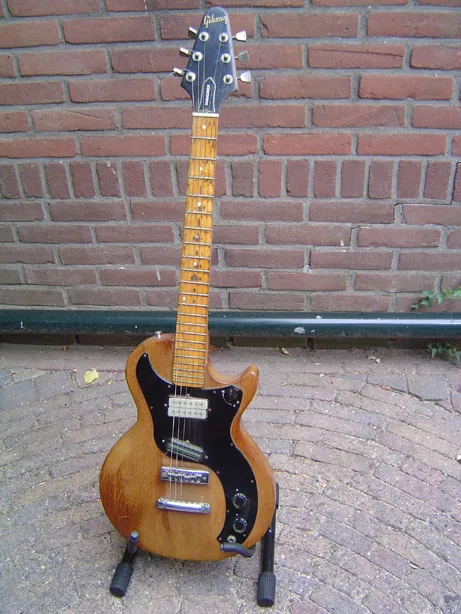
Photo: Wikideviking / Wikimedia Commons / Public domain Gibson
Marauder
1974
Gibson built it to take on the cheap copies. Kiss paid $65 apiece to break it.
- Send a picture
Gibson
RD Artist
1977
Gibson put a Moog inside it, then blamed the outside. The outside is the part that lasted.
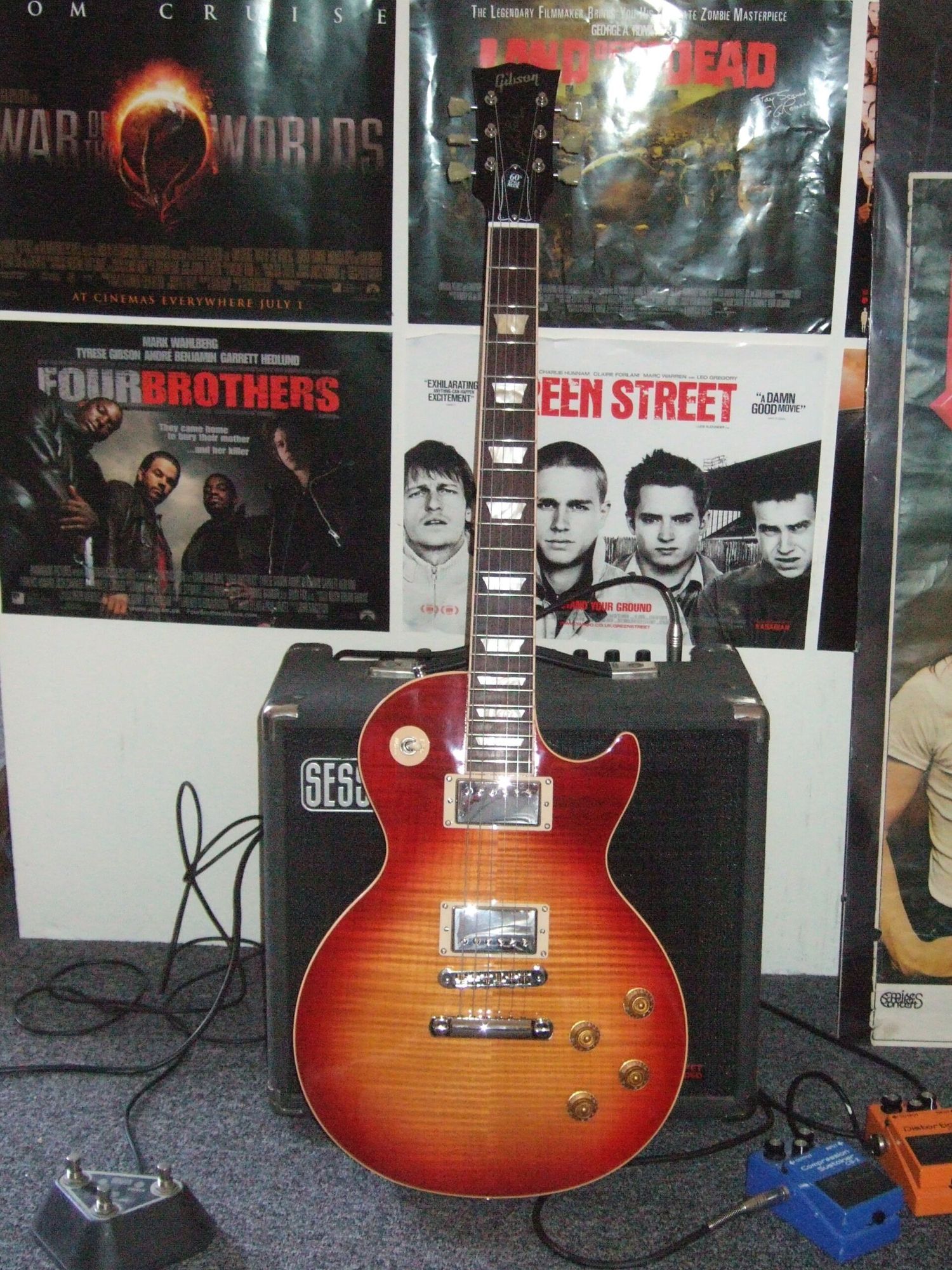
2006 Gibson Les Paul Standard (SN 000660573). Photo by wetwebwork. Licensed under CC BY-SA 2.0. Via Wikimedia Commons. Gibson
Les Paul Standard
1952
Gibson made about 1,500 sunburst Les Pauls, decided nobody wanted them, and stopped. Then the British blues boom happened.