Gibson
ES-330
From across the room it looks like a 335. Inside, it’s all air, and the people who play one like it that way.
21 December 1962. Grant Green records *Feelin’ the Spirit* for Blue Note, and when the album comes out, there he is on the cover holding a Gibson double-cutaway. Everybody who picks up the record calls it a 335. Look at the pickups. It isn’t.
- Introduced
- 1959
- Type
- Thinline hollowbody electric
- Class
- Production
The short version
1959
Not a cheaper 335
The ES-330 replaces the single-cut ES-225. One pickup or two, P-90s, and nothing inside.
1960
Beats its brothers
Gibson ships 2,408 of them, more than the 335, 345, and 355 put together.
1962
Blocks and Blue Note
Small block inlays replace the dots. Grant Green cuts Feelin’ the Spirit.
1963
One pickup is out
The single-pickup 330T is dropped. The two-pickup 330TD carries on.
1968
A longer neck
A version with the neck joined at the 19th fret appears, more of the board clear of the body.
1969
Hyde Park
Keith Richards plays a sunburst 330 in open G at the Stones’ free concert, 5 July.
1972
Discontinued
Gibson stops making it.
2024
Back in the catalog
The ES-330 returns in Gibson’s USA Original Collection.
Side A
A1
The one on the album cover
The ES-330 has spent its whole life being mistaken for somebody else. It shows up on album covers and in old concert photos, and the caption says ES-335, and the caption is wrong. It doesn’t seem to bother the people who actually play one.
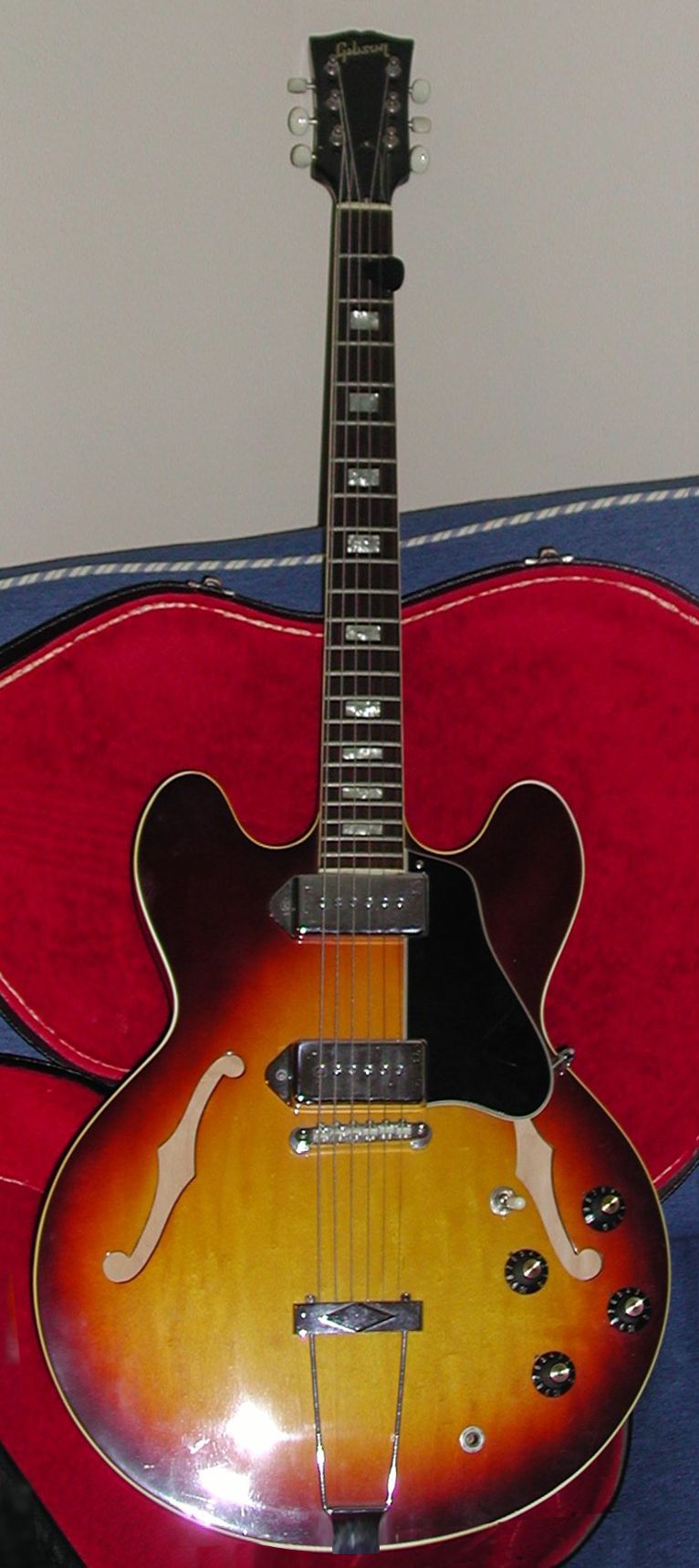
Grant Green is the classic case. On the cover of Feelin’ the Spirit he’s holding a thin double-cutaway Gibson with f-holes, and at a glance, sure, it’s a 335. Then you look at the pickups. They’re P-90s, the single-coils with the little pointed “ears” on the covers. A 335 has humbuckers. Then look up at the headstock: just the logo and the model name, no crown inlay. That’s a 330.
Same 16-inch outline, same horns, same f-holes. Completely different guitar.
A2
Nothing in the middle
The difference is inside. The 335 has a solid block of maple running down the middle of its body, and it’s what lets that guitar get loud without howling. The 330 doesn’t have one. It’s fully hollow, all air, closer to Gibson’s thin hollowbodies from the mid-’50s than to a 335.
You can see the consequence from across the room. With nothing solid in the middle to bolt a stop tailpiece to, the strings anchor to a trapeze tailpiece hanging off the end. The neck meets the body at the 16th fret, so there’s less room up high than on a 335. And the P-90s, bright and a little raw, sit on a body that wants to ring along with them.
So it’s lighter and more open. It sounds more like an acoustic guitar that happens to be plugged in. Turn it up too far and it’ll feed back on you, which, for some people, is exactly the point.
Same outline as a 335, same horns, same f-holes. Look in through the f-holes: nothing.
A3
The year it beat its brothers
Gibson introduced it in 1959 to replace the ES-225, an older single-cut. It was never meant as a cheaper 335. It was its own thing, a light, hollow working guitar with one pickup (the 330T) or two (the 330TD).
And it sold. In 1960 Gibson shipped 2,408 ES-330s. The 335, 345, and 355 managed 1,352, all three combined. It kept selling through the decade, with a peak of 4,898 in 1967. Somehow the 335 still became the one everybody remembers.
The first ones came in sunburst or natural. Natural only lasted through 1960, which is why just 464 of them shipped. Cherry turned up around then too, though nobody agrees on exactly when.
It kept changing quietly. Small block inlays replaced the dots around 1962. The one-pickup model was dropped after 1963. In 1968 a version with the neck joined at the 19th fret appeared. That doesn’t turn it into a 335. It’s still hollow, still P-90s. Gibson stopped making it in 1972, and brought it back in 2024.
Flip the record · By the numbers
2,408
ES-330s shipped in 1960, when the 335, 345, and 355 managed 1,352 between them.
0
Center blocks. From the outside it matches a 335. Inside, it’s hollow.
23,222
Shipped from 1959 through 1969. Not a rare guitar, just an overlooked one.
464
Natural-finish 330s, all of them from 1959 and 1960.
Side B
B1
Wrong guitar, wrong caption
Because it looks like its famous brothers, the 330 gets credit it didn’t earn and misses credit it did. The Beatles played Epiphone Casinos, a hollow P-90 cousin made in the same factory, not 330s. Alvin Lee’s “Big Red” is a 335. B.B. King’s Lucille is a 355.
What it did do is plenty. Keith Richards played a sunburst 330 in open G at Hyde Park on 5 July 1969, in front of a huge crowd. It was a short window, but it’s on film. Slim Harpo is nearly always pictured with one. William Reid of the Jesus and Mary Chain used one as his feedback guitar, which is about the most honest use of a hollow body I can think of.
B2
Her brother’s guitar
Emily Remler’s 330 was cherry, and it wasn’t even hers to start with. It was her brother’s. She made it her main professional guitar anyway, and kept it there through the years she recorded for Concord.
That’s the 330 all over. Nobody walks into a shop dreaming of one. It turns up, it’s hollow and light and a little louder than it should be, and somebody picks it up and doesn’t put it down.
The captions will keep calling it a 335. Grant Green knew what he was holding, and so did Emily Remler. Neither of them needed it to be anything else.
Put this on
You’ve read about it. Now hear it. Here’s what this guitar sounds like, and what to listen for.
The Stones in the Park
Hyde Park, 5 July 1969. Keith is on a sunburst 330 in open G for part of the show. The Flying V he also played that day is a different guitar.
Watch it on YouTube (opens in a new tab)
The cast
The people, and the specific guitars, that made the legend.
1962
Grant Green
Early-1960s ES-330
On the cover of Feelin’ the Spirit. Later moved to an L-7, then a D’Aquisto.
Concord years
Emily Remler
Cherry ES-330
Her brother’s guitar, and her main professional guitar through the Concord years.
1969
Keith Richards
Sunburst ES-330
Hyde Park, open G. A short window. His black 1960 guitar is a 355, not this.
1960s
Slim Harpo
ES-330
Nearly always pictured with one.
2007
William Reid
ES-330
The Jesus and Mary Chain’s feedback guitar, still on stage with him in 2007. Nobody’s tied a specific one to Psychocandy.
Liner notes
Specs, construction, rarity, value, and every source we used.
Fully hollow, dogear P-90s, no center block — not a 335, not a cheap 335, and not the Casino the Beatles played.
- Body
- Double-cut thinline. Laminated maple. Fully hollow — no center block. 16 in × 19 in × 1 3/4 in. Single-bound top and back. F-holes.
- Neck
- Set mahogany. Join 16th fret (1959–67 class). Unbound logo-only headstock, no crown.
- Fingerboard
- Bound rosewood; 22 frets; dots then small blocks (mid/late 1962).
- Scale
- 24.75 in / 628.65 mm
- Pickups
- Dogear P-90s, one (330T) or two (330TD).
- Hardware
- Nickel (chrome ~1965). ABR-1 Tune-o-matic; trapeze. Bigsby optional.
- Electronics
- 330T: single P-90, 1959–63 then dropped. 330TD: 2 volume, 2 tone, 3-way, mono. No Varitone.
- Finish
- Nitro. Sunburst or natural 1959. Natural TDN 1959–60 only. Cherry start contested.
Open the full research fileConstruction details, the complete player record, production numbers, dated value estimates, and sources
Vintage Kalamazoo 1959–62 class. Current USA Original Collection is small-block / ’60s, list $3,499 — not the table default.
Construction
Kalamazoo, 1959. Joe’s: a handful of 1958 FON examples exist; not listed until 1959. Do not call it a 1958 335. Discontinued 1972 (guitarhq; wiki lead). It replaced the single-cut ES-225 — “not meant as a cheaper ES-335” (guitarhq).
Fully hollow. No center block. Same 16" double-cut outline as 335/345/355 from across a shop. Interior is air — closer to the 1955 thinlines (ES-225 / ES-350T) than to a 335 (Premier Guitar). Retailer “semi-hollow” is taxonomy, not spec. Trapeze is the construction consequence: nothing in the middle to bolt a stop-bar to. Bigsby optional (guitarhq). Do not describe vintage from a modern 330 with a 19th-fret joint or stopbar conversion.
Neck join: factory language 16th fret 1959–67 class. guitarhq and es-335.com say 15th — count convention, not a second census. 1968: guitarhq “19th-fret option” vs es-335.com change; True Vintage “offered beginning 1968.” Mix year — not a 1 January cut. “330L” as a 1968 factory code is not verified. Long-neck 330s are still hollow P-90s, not 335s.
Headstock: unbound, logo + model designation, no crown (Joe’s; Premier Guitar 1959). guitarhq 1959 “crown” is 335 copy-paste. Edgewater crown + bound headstock = 335/345 language on the wrong model.
Pickups: dogear P-90s. Not soapbar — soapbar on a 330 is a swap. Never catalog mini-humbuckers (Joe’s). Humbucker conversions exist; they are not 335s. Covers: black plastic at intro. Nickel onset: guitarhq mid-1962 / Joe’s late 1962 vs es-335.com 1963 — attribute, do not pick. Chrome ~1965 (guitarhq).
T vs TD. Single 330T 1959–63, then dropped. Dual 330TD is the survivor. Do not describe all 330s from the T. Inlays: dots 1959–mid/late 1962; small blocks from mid-1962 (guitarhq) / late 1962 at earliest (Joe’s).
Finish: guitarhq 1959 sunburst or natural. Natural TDN 1959–60 only. Cherry: guitarhq 1962 vs True Vintage 1961 — conflict. TDC ships from 1960 (Meiners: 98). Sparkling Burgundy 1967; walnut 1968 (guitarhq).
Casino (1961) is the Kalamazoo cousin — same fully hollow P-90 recipe. Not this guitar.
Current 2026: USA Original Collection yes (2024 revival). List $3,499. Visual is small-block / ’60s, not 1959 dots. USA sheet lists Centerblock: None; does not print width, depth, or join-fret. Custom Shop Historic 1959 (dots, 16th) and 1962 (small blocks, 16th) VOS $5,999. The 1962 Historic table Inlays: Dot is wrong — prefer body copy (small-block). Reissues ≠ Kalamazoo.
Players
Carlton, Big Red, and Clapton’s 1964 cherry stay on the 335. Lucille, Marr, Lifeson Whitey, Gallagher, and Richards’s black 1960 355 stay on the 355. The Beatles played Casinos, not 330s. Do not follow dealer blogs putting Alvin Lee on a 330.
Grant Green — early-1960s Blue Note 330. Feelin’ the Spirit cover (recorded 21 December 1962, released 1963) shows Green on a 330 — P-90s, mistaken for a 335. Later: L-7 with McCarty pickup, then D’Aquisto. Idle Moments as a specific 330 track is secondary — 330-era Blue Note, not a proven track credit unless a session photo.
Emily Remler — cherry 330. Brother’s guitar; main professional guitar through the Concord years. Later Borys is a different guitar.
Keith Richards — sunburst 330, Hyde Park, 5 July 1969. Open G, plus a Flying V. Short window. Not Micawber. Not the 1963 SG Custom (1973 Exile tour). Not the black 1960 ES-355.
Also known to play. Slim Harpo — nearly always pictured with one (RetroFret). B.B. King spotted; Lucille / “The Thrill Is Gone” live on the 355. Chuck Berry spotting; hits = ES-350T; Hail! Hail! Rock ’n’ Roll = 355. William Reid / Jesus and Mary Chain — feedback guitar; Psychocandy not pinned to a serial. His ES-125T on 1989 TV is not a 330.
Rarity
Factory shipping (Meiners), not production counts. 1959–69: 23,222. First year 780 (Premier Guitar: 270 sunburst TDs). 1960: 2,408 vs 1,352 for 335+345+355 combined — one strong year, then fade. Single-pickup ends 1963 in published cells. Peak 1967: 4,898 — not scarce. Natural is the scarce finish: 464 published (TN 170 + TDN 294), 1959–60 only. VG&B: 403 shipped 1970. 1971–72 unpublished.
Value
Informal estimate, 25 August 2026. Not an appraisal.
Asks ≠ solds. Reverb 1959–61 medians did not return numbers. Casino solds are not 330 comps. Do not use 335 dot-neck money ($45k–$80k). Edgewater: 330s price 50–75% below comparable 335s — order-of-magnitude, not a formula.
New / reissue. Original Collection $3,499. Historic VOS $5,999 — reissue.
Late-60s player. Working ask ~$5,500–$8,000. Omega 25 Jun 2024 sold £3,800 1964 TD — auction floor.
1963–67 small-block 16th-fret. Working ask ~$7,000–$12,000. Edgewater buyer “near $6,500” for 1962–65 is an offer, not street ask. Rudy’s 1964 TD $11,900 ask.
1968–69 long-neck. VGAB ask $8,000.
1959–61 dots. Edgewater buyer (not retail): paid $12,200 clean 1959; 1960 near $9,000; 1961 near $8,500. ATB 1959 TD £13,995 ask. Singles below dual (Jimmy’s 1960 T $6,999 ask). Working sold-direction clean 1959–61 TD dots: high $8ks to mid-teens.
Humbucker conversion −30–50%. Period Bigsby is not automatically a 335-style deduction.
See also
- epiphone-casino — the Kalamazoo cousin; Beatles Casinos live there, not here
- gibson-es-335 — center block, humbuckers, 19th-fret from day one; Carlton, Big Red, and Clapton’s 1964 cherry live there
- gibson-es-355 — Lucille, Marr, Whitey, Gallagher, and Richards’s black 1960 355 live there
Sources
- guitarhq: thinline family / ES-330
- guitarhq: hollowbody shipping 1955–69
- True Vintage: Gibson’s ES-330 from 1959 to 1969
- Joe’s Vintage Guitars: Complete Dot Neck ES-330 guide (1959–1962)
- Joe’s Vintage Guitars: Gibson shipping totals 1948–1979
- Premier Guitar: Vintage Vault 1959 ES-330TD
- Vintage Guitar and Bass: ES-330TD
- Vintage Guitar and Bass: 1960 catalog p.8
- Vintage Guitar and Bass: 1970 thinline catalog p.7
- es-335.com: The Neglected Stepchild
- Gibson ES-330 (USA Original Collection)
- Gibson Gazette: Custom 1959 & 1962 ES-330 Reissues
- Gibson Custom 1959 ES-330 Reissue VOS Vintage Burst
- Gibson Custom 1962 ES-330 Reissue VOS Sixties Cherry
- Gibson ES collection (Original Collection: 335 / 345 / 330)
- Vintage Guitar: 2021 Hall of Fame — Gibson ES-330 (Meeker / Carter)
- Vintage Guitar: Epiphone Riviera (Casino cousin)
- Vintage Guitar: ’66 Epiphone Casino
- Guitar World: Rod Brakes, history of the ES-330 (28 May 2020)
- Guitar World: Bob Wootton, the ES-330T (16 Sep 2024)
- Premier Guitar: Forgotten Heroes — Emily Remler
- Jazz Guitar Life: *Feelin’ the Spirit* cover as 330
- RetroFret: ES-330TD notes
- Ground Guitar: Keith Richards’ 1960s ES-330
- Wikipedia: The Stones in the Park (lead only)
- Wikipedia: Grant Green (lead only)
- Wikipedia: Emily Remler (lead only)
- Wikipedia: Gibson ES-330 (lead only)
- Guitar Player: Jesus and Mary Chain live, William Reid ES-330 (2007)
- April Skies: William Reid interview
- Edgewater: ES-330 value guide (June 2026)
- Edgewater: ES-330 unsung-hero essay (Apr 2026)
- Sweetwater: ES-330 Sixties Cherry ($3,499)
- Carter Vintage: 2026 ES-330 Antique Natural ($3,499)
- ATB Guitars: 1959 ES-330TD sunburst ask £13,995
- Rudy’s Music: 1964 ES-330TD sunburst ask $11,900
- Omega Auctions: 1964 ES-330TD sold £3,800 (25 Jun 2024)
Keep digging
Guitars this one gets compared to, confused with, or descended from.
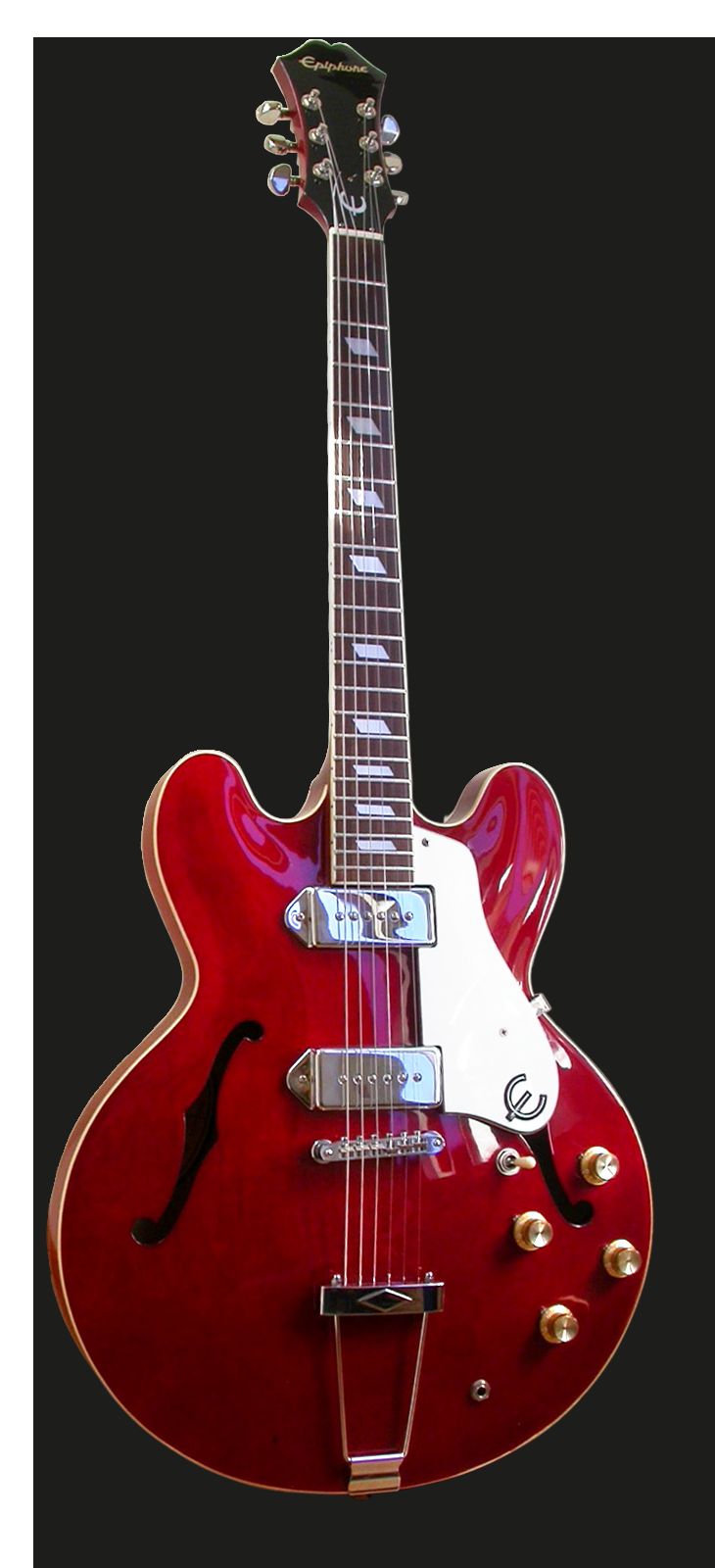
Epiphone Casino Cherry. Photo by Maxo; background removed by Auge=mit. Licensed under CC BY-SA 4.0. Via Wikimedia Commons. Epiphone
Casino
1961
Of all the Beatles’ famous guitars, the only one John, Paul, and George all had. Two sanded theirs bare.

Photograph of a vintage 1960 Gibson ES-335TD. Photo by Lightburst. Licensed under CC BY-SA 4.0. Via Wikimedia Commons. Gibson
ES-335
1958
Larry Carlton played three 335s off a shop wall, unplugged, paid $850 for one, and became Mr. 335.
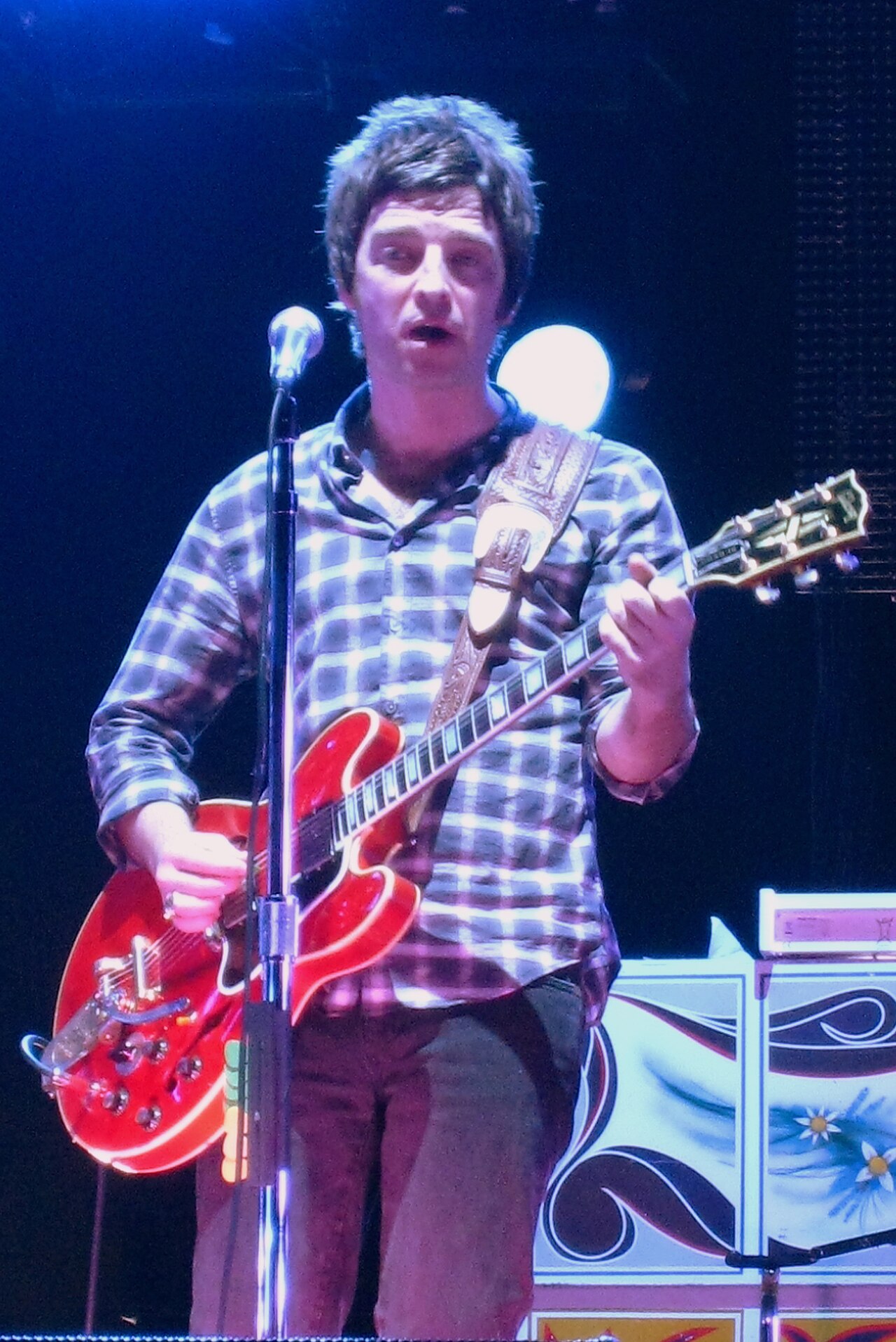
Photo: Anirudh Koul / Wikimedia Commons / CC BY 2.0 Gibson
ES-355
1958
B.B. King ran into a burning dance hall to save a guitar. Every Gibson after it was Lucille too.