Gibson
ES-295
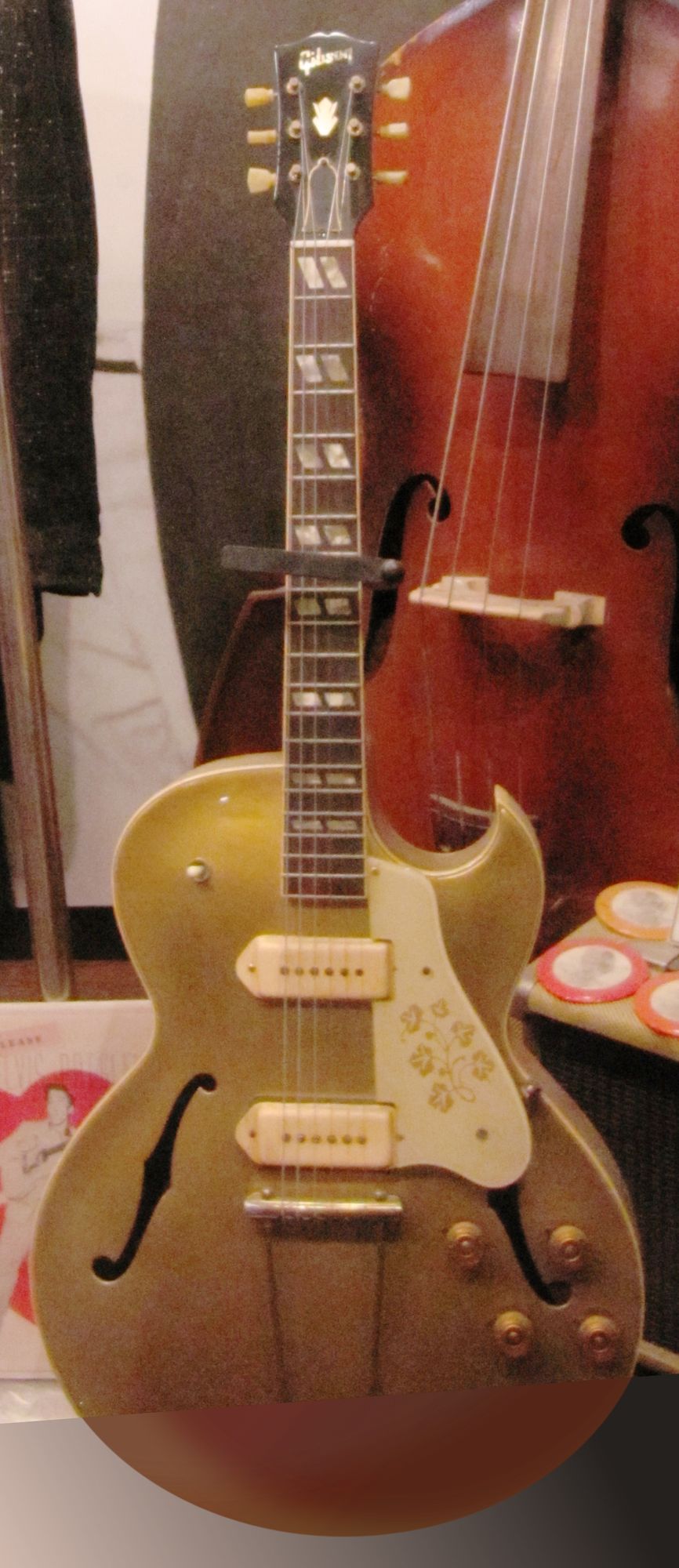
Scotty Moore traded a Fender for the gold guitar in the window. Four Elvis singles later, he traded it away.
Memphis, 1953. In the window at O.K. Houck’s music store there’s a guitar that’s gold all over, body and neck, with flowers painted on the back of the pickguard. Scotty Moore, a working guitar player with a 1952 Fender Esquire, trades the Fender for it. He has no idea what he’s about to do with it.
- Introduced
- 1952
- Type
- Hollowbody electric
- Class
- Production
The short version
1951
A gift for a veteran
Les Paul has Gibson spray an ES-175 gold for a veteran named Dean Davis. It’s logged 4 December.
1952
In production
The first production ES-295s are listed on 14 May, two months after the goldtop Les Paul.
1953
The window at Houck’s
Scotty Moore trades his ’52 Esquire for the gold 295 in the window.
1954
That’s All Right
“That’s All Right” and “Blue Moon of Kentucky.” The first of four Elvis singles on this guitar.
1955
Traded up
On 7 July, Moore trades the 295 back at Houck’s for an L-5 CES.
1957
Humbuckers
The P-90s give way to humbuckers for the last couple of years.
1958
The end
Last regular production, with a few more in 1959. Sources split on which year to call the last.
2007
Reunited
Moore and his old 295 meet again on George Klein’s Memphis Sound.
Side A
A1
The gold one in the window
Working guitar players don’t marry their guitars. They trade them. You walk into the shop with what you’ve got, you walk out with what you need next, and you don’t get sentimental about it until years later.
In 1953 Scotty Moore walked into O.K. Houck’s in Memphis with a 1952 Fender Esquire, and he walked out with the gold Gibson that had been sitting in the window. An ES-295. It was about as subtle as a Cadillac.
A year or so later, he was in a little studio on Union Avenue with a kid named Elvis Presley and a bass player named Bill Black. You know what happened next. What you might not know is that the guitar on those first records was that gold Gibson from the shop window, and that Scotty didn’t keep it very long.
A2
A present for a soldier
The gold guitar started as a gift. In 1951 Les Paul asked Gibson to spray an ES-175 gold for a World War II veteran named Dean Davis. The factory logged it on 4 December 1951. Davis died before it arrived.
That one guitar was a one-off. But in March 1952 Gibson launched the goldtop Les Paul solidbody, and two months later, on 14 May, it listed the first production ES-295s. Gold, like the Les Paul. Priced at $295, which is where the name came from. Somebody in the naming department took a long lunch.
A3
A 175 in a gold suit
Underneath, it’s an ES-175: a fully hollow body of laminated maple with a pointed cutaway. Gibson took that body and dressed it up. Gold lacquer on the body and the neck. Two cream-colored P-90 pickups, where the 1952 175 usually had one. (Depending who you ask, the very first ones may have had just one; most say two from the start.) A pickguard with flowers painted on the back of it.
And Les Paul’s tailpiece, a bar bridge on a long trapeze with the strings wrapped over the top. It was supposed to give that big hollow body the sustain Les wanted. (The early goldtop Les Pauls ran the strings under the bar instead.) Scotty took it off anyway. He put on a Melita Synchro-Sonic bridge and a plain Kluson trapeze.
It’s an ES-175 that went to a party and never came home.
Two P-90s in a hollow body sound bright, a little raw, with plenty of wood in them. That gold finish is the weak spot. It doesn’t wear well.
Flip the record · By the numbers
$295
The list price. Gibson named the guitar after it.
4
Elvis Presley singles on Sun with Scotty Moore playing this guitar.
637
Shipped in 1953, the best year. By 1958 it was down to 49.
1,770
Total shipped from 1952 to 1958.
Side B
B1
Four singles
Here’s the run. “That’s All Right” backed with “Blue Moon of Kentucky.” “Good Rockin’ Tonight” with “I Don’t Care If the Sun Don’t Shine.” “Milkcow Blues Boogie” with “You’re a Heartbreaker.” “Baby Let’s Play House” with “I’m Left, You’re Right, She’s Gone.”
That’s Elvis’s first four singles, and every one is Scotty on the gold 295.
Then, on 7 July 1955, he did what working players do. He went back to Houck’s and traded the 295 for a natural-finish L-5 CES, a much more serious guitar. “Mystery Train,” the next Sun single, is the L-5. People mix that up all the time.
B2
Ultimate rockabilly guitar
Gibson shipped 297 of them in 1952 and 637 in 1953, the best year it ever had. Then the numbers slid, all the way down to 49 in 1958. Humbuckers replaced the P-90s in 1957. Regular production ended in 1958, with a few more built in 1959 for a summer show. From 1952 to 1958, the total is 1,770.
It came back as reissues in the 1990s, as a Scotty Moore signature in 1999, and again around 2013. Brian Setzer called it the “ultimate rockabilly guitar.” Danny Gatton loved them and got a young Joe Bonamassa hooked too.
Scotty kept trading up. The L-5 gave way to a Super 400 in January 1957, and his Super 400 is the guitar on the 1968 Comeback Special. Esquire, 295, L-5, Super 400: a working player’s résumé, one trade at a time. But in 2007, on George Klein’s Memphis Sound, he got to hold that gold 295 again, more than fifty years after he’d handed it back across the counter at Houck’s. He had played fancier guitars since. None of them was on “That’s All Right.”
Put this on
You’ve read about it. Now hear it. Here’s what this guitar sounds like, and what to listen for.
That’s All Right
The first Elvis single, with Scotty Moore on his gold ES-295. Two P-90s in a hollow body, a little raw and very awake.
Find it on YouTube (opens in a new tab)Good Rockin’ Tonight
The second single. Same guitar, same three guys, a lot more swagger.
Find it on YouTube (opens in a new tab)Baby Let’s Play House
The last of the four Sun singles on the 295. The next one, “Mystery Train,” is the L-5 CES.
Find it on YouTube (opens in a new tab)
The cast
The people, and the specific guitars, that made the legend.
1953
Scotty Moore
1952 gold ES-295
Traded a Fender Esquire for it at O.K. Houck’s. Played it on Elvis’s first four Sun singles, then traded it for an L-5 CES.
1951
Les Paul
The idea
Had Gibson spray an ES-175 gold as a gift. The production 295 wears his wraparound trapeze tailpiece.
1951
Dean Davis
The gold ES-175
The World War II veteran the first gold guitar was made for. He died before it arrived.
—
Brian Setzer
ES-295
Called it the “ultimate rockabilly guitar.”
—
Danny Gatton
ES-295
Partial to the 295, and the man who turned a young Joe Bonamassa on to them.
Liner notes
Specs, construction, rarity, value, and every source we used.
Scotty Moore’s first Elvis guitar — gold ES-295, not an ES-175, and not an L-5.
- Body
- Fully hollow laminated maple; Florentine (pointed) cutaway; two f-holes; 16¼" class lower bout (guitarhq); gold lacquer on body and neck; triple-bound top, single-bound back
- Neck
- Set mahogany; 175-platform; crown peghead
- Fingerboard
- Bound rosewood; pearloid double-parallelograms; 19 frets at intro (guitarhq); 20 from 1955 (guitarhq). Duchossoir / scottymoore.net: some boards already 20 from c. 1953 — keep as a range
- Scale
- 24 3/4"
- Pickups
- Two cream/ivory-cover P-90s (guitarhq; Vintage Guitar). Wikipedia lead: first 295s one pickup, two from 1953 — keep; prefer guitarhq / VG
- Hardware
- Gold-plated Les Paul Model wraparound trapeze — bar bridge on a long trapeze, strings over the bar (VG; guitarhq). Not a stud wraparound. Not the 175 diamond/parallelogram trapeze. Floral back-painted pickguard
- Electronics
- 2 volume, 2 tone; 3-way toggle
- Finish
- Nitrocellulose gold on body and neck. Wikipedia: some later sunburst / Argentine Grey / cherry — not the table
- Nut
- No factory 295 width sourced. Gibson Certified Vintage 1953 A-13899 lists 1.71" after a Repair & Restoration refret and new bone nut — one restored guitar, not a factory ticket
Open the full research fileConstruction details, the complete player record, production numbers, dated value estimates, and sources
This table is the 1952 gold dual-P-90 wraparound-trapeze recipe. No current Custom / Original catalog SKU on gibson.com this pass (25 August 2026). Last USA / Historic chapters (1990s Historic, 1999 Scotty Moore signature, 2013–15 Memphis ’52) are Construction, not the table. A goldtop Les Paul is a different guitar.
Construction
Kalamazoo. ES-175 platform, fully hollow laminated maple, Florentine cutaway, 16¼", double parallelograms — then gold, two cream P-90s, floral guard, and Les Paul’s wraparound trapeze. Not an ES-175 (1952 175 is typically one P-90 and a separate trapeze). Not an L-5 CES (carved 17" spruce). Not an ES-335 (thinline, center block). Not Lucille / ES-355.
1951 vs 1952. Vintage Guitar: Les Paul had Gibson gold-spray an ES-175 for WWII vet Dean Davis; serial A-9196, logs 4 December 1951. Davis died before it arrived. That one-off is the gold-175 origin story, not a production ES-295. The Les Paul Model solidbody entered the line March 1952. First production 295s — serials A-10554 and A-10555 — listed 14 May 1952 (VG). YAML introduced: 1952. Keep the 1951 gift as the prototype year, not the catalog year.
Wraparound vs trapeze. Stock 1950s 295: combination wraparound trapeze, strings over the bar (VG: the 175-sized hollow got the sustain Les wanted; early goldtops routed strings under). Scotty Moore swapped that unit for a Melita Synchro-Sonic plus a Kluson trapeze (as on an ES-125). 1990s Historic / many reissues wear a Bigsby. 2013 Memphis ’52 used a bail trapeze (legacy gibson.com). Do not flatten wraparound, Melita+trapeze, Bigsby, and bail into one hardware era.
P-90 vs humbucker. guitarhq: two white-cover P-90s at intro; humbuckers replace P-90s in 1957. Wikipedia lead: one pickup in 1952, two from 1953; humbuckers “by 1957.” Prefer two-P-90 intro (VG: 175 was single-P-90 in 1952; the 295 had two). Late gold humbucker 295s are still this model, not a 175D and not a Les Paul.
Frets. guitarhq: 19 at intro, 20 in 1955. scottymoore.net citing Duchossoir: transition listed 1955, with examples from c. 1953. Keep both.
List $295 (Wikipedia lead; model name). guitarhq: discontinued 1959; shipping table has no 1959 cell. scottymoore.net: last regular production 1958, with several 1959 for a summer show. Keep 1958/59.
Reissues, labeled. guitarhq: re-introduced 1994. Wikipedia: 1990, again 1999 Scotty Moore signature, 2013 ’52. Memphis 1952 ES-295 (legacy 2015 page) is a later USA / Historic, often Bigsby or bail, not a 1952 original. No live Custom Shop or Original SKU on the ES collection this pass. Epiphone ES-295 copies are not this guitar.
Gold lacquer does not wear well (guitarhq collectibility note) — that is finish chemistry, not a different model.
Players
Scotty Moore’s first Elvis guitar is this plate. Not the later L-5 CES, not a Super 400 CES, not a goldtop Les Paul.
Scotty Moore — 1952 ES-295 serial A-12290. Vintage Guitar (March 2015): traded a ’52 Esquire at O.K. Houck, Memphis, 1953, for the gold 295 in the window. Melita + Kluson trapeze. First four Sun singles: #209 “That’s All Right” / “Blue Moon of Kentucky”; #210 “I Don’t Care If the Sun Don’t Shine” / “Good Rockin’ Tonight”; #215 “Milkcow Blues Boogie” / “You’re a Heartbreaker”; #217 “I’m Left, You’re Right, She’s Gone” / “Baby Let’s Play House.” 7 July 1955: traded the 295 at Houck for L-5 CESN A-18195. “Mystery Train” / “I Forgot to Remember to Forget” (Sun 223) is the L-5, not this guitar. Super 400 CESN A-24672 replaces the L-5 in January 1957. The 1968 Comeback Special guitar is the Super 400, on the L-5 CES plate. Reunited with A-12290 on George Klein’s Memphis Sound, 2007 (VG; then in Larry Moss’s collection).
Brian Setzer (Guitar.com Hitmakers / vintage review): called the ES-295 the “ultimate rockabilly guitar” — a quote about the model, not a freeze of his touring main.
Danny Gatton / Joe Bonamassa. Guitar.com: Gatton was partial to an ES-295 and turned a young Bonamassa onto them. Known-to-play. Do not file Gatton as owner of Moore’s A-12290 (VG places that serial with Moss as of 2015).
Do not steal Wes Montgomery (L-5 CES), Herb Ellis / Jim Hall / Joe Pass / Metheny (ES-175), B.B. King Lucille (ES-355-based), or Chuck Berry (ES-350T / later 335 family).
Rarity
Not a current gibson.com catalog model (25 August 2026). Possible Custom Shop special order is not a live SKU this pass.
Factory shipping 1952–1958 (GuitarHQ / Meiners — shipping totals, not a census): 1,770. Same yearly cells in Duchossoir as cited by scottymoore.net. 1952: 297. Peak 1953: 637. Then 357 / 166 / 193 / 71 / 1958: 49. No GuitarHQ 1959 cell; Wikipedia discontinue 1959. 1970–present reissue shipping unpublished in that table.
P-90 gold wraparound-trapeze 1952–56 is the identity run. 1957–58 humbucker golds are the short late cell, not a 175. Clean original gold (guitarhq: the finish does not wear well) is the condition peak, not a second model. 1990s Historic, 1999 signature, and 2013–15 Memphis are later USA, not 1950s Kalamazoo. Artist-owned A-12290 is a separate market.
Value
Informal estimate, 25 August 2026. Not an appraisal.
No current Gibson 295 SKU. Ask vs sold. Public 2024–26 solds are thin. Moore’s A-12290, and other named instruments, are not comps. Historic / Memphis reissues and Epiphone copies are not vintage 295s. Gibson Certified Vintage one-offs (e.g. 1952 A-12067, 1953 A-13899) are authenticated vintage sales, not a catalog list price.
Used modern (1990s Historic / 2013–15 Memphis). Dealer asks this pass: Guitar Center 1991 gold $5,999.99; guitar-list / Reverb Historic Bigsby examples ~$8,000–$12,500. Reverb Custom Shop Historic ’52 page had a 1997 Bigsby ask $8,850 (was $10,824). Asks, not a sold median. A 2013 VOS is not a 1952.
Vintage. Reverb product-page transaction history for “ES-295 1952–1959” (used, not a clean-original filter): 27 Jan 2022 Excellent $5,850; 3 Feb 2022 Excellent $11,500; 24 Mar 2022 Very Good $8,399.47; 24 Jan 2023 Good $7,000; 1 Sep 2023 Very Good $9,700; 10 Dec 2023 Very Good $6,995; 30 May 2024 Very Good $7,600. That strip is mixed condition / possible refin and parts — not a 100% original gold ladder. Current dealer asks (not sold): Johnny’s Guitars 1952 “100% original” $19,995; other Reverb/guitar-list gold asks ~$11,955–$25,260. Kansas City Vintage 1952 all-gold $14,500 (listed sold-out — not a confirmed hammer). Carter Vintage 1952 Nathaniel Rateliff example ask $10,000 — relic refin, replacement tuners/P-90s/pots/tailpiece; player-grade, not a comp. Gold-finish wear is the usual discount vs a clean 175 of the same years; do not price a 295 as a 175 or as a goldtop Les Paul.
See also
- gibson-es-175 — same laminated Florentine platform without the gold / floral / wraparound-trapeze recipe — not Scotty’s first Elvis guitar
- gibson-l-5-ces — Moore’s July 1955 trade and the Mystery Train guitar; carved 17" CES, not a 295
- gibson-es-335 — laminated too, but a thinline with a maple center block — not this guitar
Sources
- guitarhq: ES-295
- guitarhq: hollowbody shipping 1948–69
- Vintage Guitar: Scotty Moore’s Gibson ES-295 (March 2015)
- scottymoore.net: 1952 ES-295 A-12290
- scottymoore.net: Melita Synchro-Sonic
- Guitar.com: Hitmakers — Scotty Moore 1952 ES-295
- Guitar.com: 1953 ES-295 vintage review (Setzer / Gatton / Bonamassa)
- Wikipedia: Gibson ES-295 — lead only; 1952–59; $295; one-pickup claim; reissue years
- Gibson ES collection (no 295, 25 Aug 2026)
- Gibson Certified Vintage 1952 ES-295 A-12067
- Gibson Certified Vintage 1953 ES-295 A-13899
- legacy.gibson.com: Memphis 1952 ES-295 (2015)
- Reverb: ES-295 1952–1959 (asks + transaction history)
- Reverb: Custom Shop Historic ’52 ES-295 1994–2000
- Carter Vintage: 1952 ES-295, Rateliff, ask $10,000
- Kansas City Vintage: 1952 ES-295 ask $14,500
- guitarhq: ES-175 (1952 single P-90 vs 295 dual)
Keep digging
Guitars this one gets compared to, confused with, or descended from.
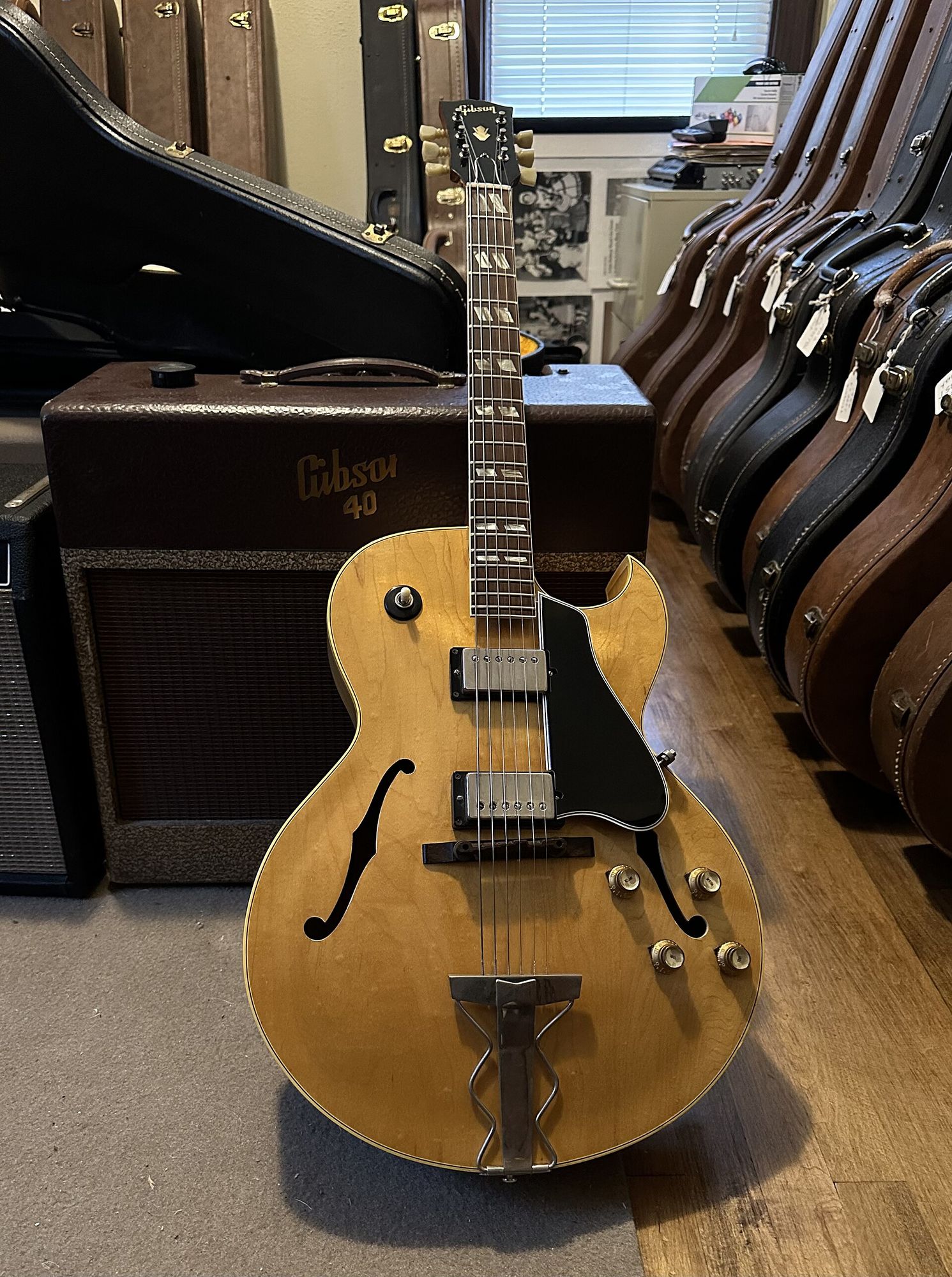
1963 Gibson ES-175DN. Photo by Lightburst. Licensed under CC BY-SA 4.0. Via Wikimedia Commons. Gibson
ES-175
1949
A laminated jazz box that kept changing hands: bought used, given as a gift, borrowed for a hit.
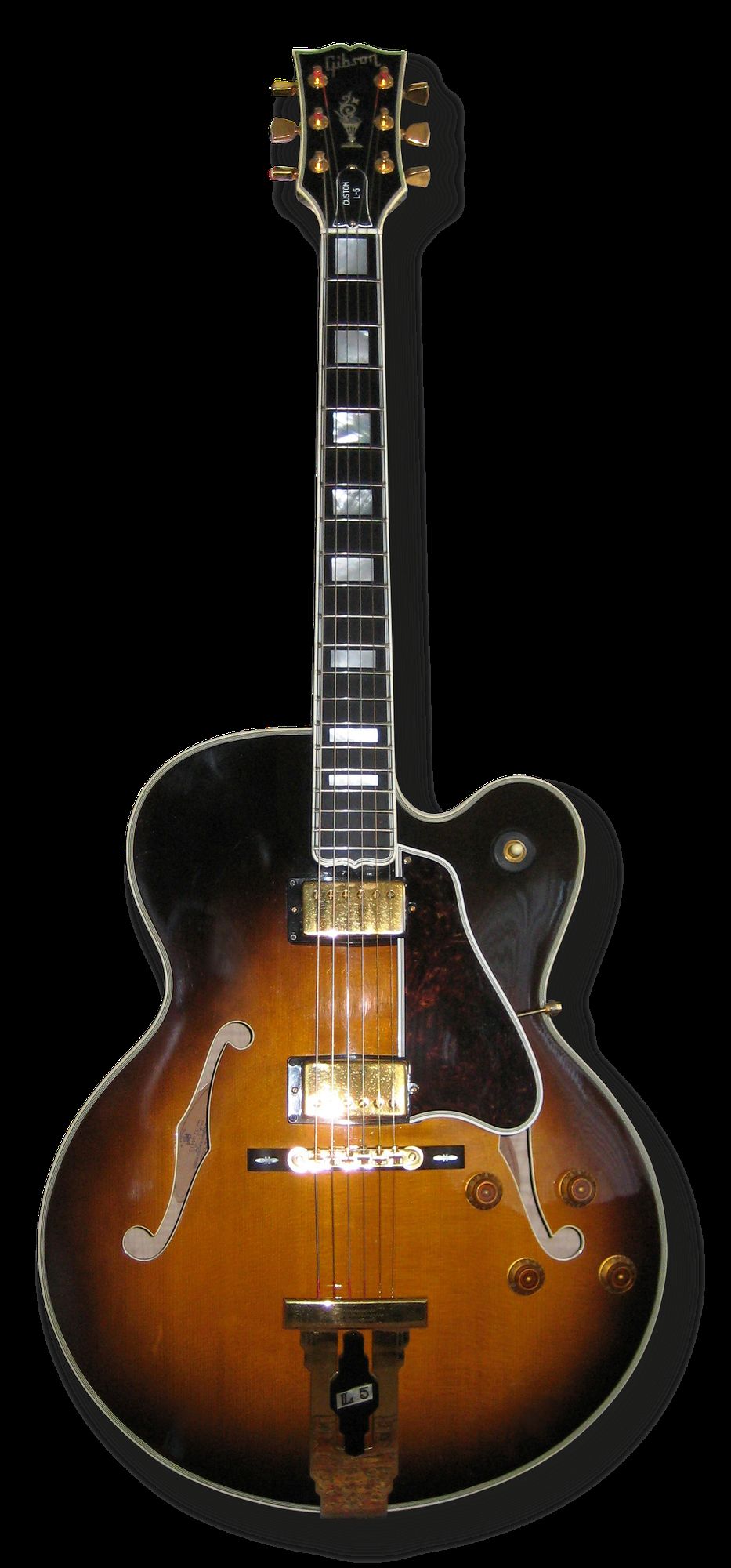
Gibson L-5 CES Tobacco Burst. Photo by Cruciniacus; isolated background by Auge=mit. Licensed under CC BY-SA 3.0. Via Wikimedia Commons. Gibson
L-5 CES
1951
In the ’50s Gibson shipped a few dozen a year. Wes Montgomery and Scotty Moore made them count.

Photograph of a vintage 1960 Gibson ES-335TD. Photo by Lightburst. Licensed under CC BY-SA 4.0. Via Wikimedia Commons. Gibson
ES-335
1958
Larry Carlton played three 335s off a shop wall, unplugged, paid $850 for one, and became Mr. 335.