Gibson
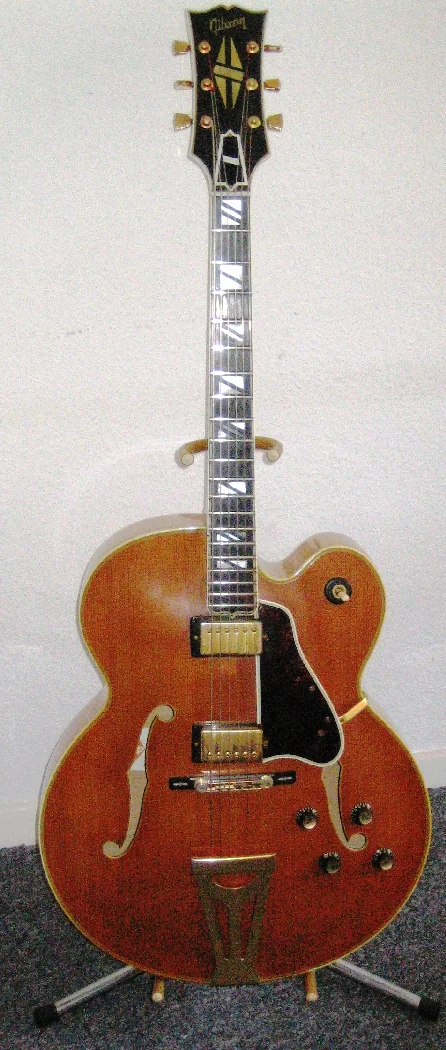
Super 400
Gibson priced it at $400 in the middle of the Depression and put the price right in the name.
Kalamazoo, 1934, or 1935, depending on whose records you trust. Epiphone has been building bigger archtops than Gibson, and Gibson has had enough. The answer is eighteen inches of carved spruce, gold on everything, and a price tag of $400 with the case. It is the middle of the Depression.
- Introduced
- 1934
- Type
- Archtop acoustic / electric
- Class
- Production
The short version
1934–35
Four hundred dollars
Gibson’s biggest guitar yet, 18 inches across, $83 more than an L-5. Sources split on the year.
1936–37
Wider and longer
The upper bout grows and the scale stretches to 25½ inches.
1939
The Premier
A cutaway version arrives, and natural finish becomes an option.
1951
CES
“Cutaway Electric Spanish.” Pickups set right into the carved spruce top.
1957
Scotty’s blonde
Scotty Moore’s natural Super 400 CES replaces his L-5 in January.
1960–61
The pointed cutaway
The Florentine cutaway replaces the rounded one, with Kenny Burrell pushing for it.
1968
The sit-down show
Elvis plays Scotty’s sunburst 1963 Super 400 on NBC’s Comeback Special.
1969
Off the wall
Reggie Young takes Scotty’s old blonde down from the wall at American Sound for “Suspicious Minds.”
Side A
A1
Built to win an argument
In the early ’30s, Gibson had a problem in New York. Epiphone’s Masterbilt archtops came in more models than Gibson’s, and Epiphone’s top guitars were three-eighths of an inch wider than the L-5. Gibson didn’t like losing a measuring contest.
So it went big. The L-5 grew to 17 inches. And a new top-of-the-line guitar went all the way to 18, the biggest thing Gibson had ever built. It listed at $400 with the case, $83 more than an L-5, and Gibson put the price right in the name: Super 400.
That was 1934, if you ask Gibson and several histories. Others say 1935, and one close study of the early guitars puts the official introduction in June 1935. We’ll keep both years.
Gibson built it to show off. The funny thing is how much of its life it spent doing a day job.
A2
Every inch of it is showing off
Just look at the thing. Carved spruce top, figured maple back and sides. Pearl split-block inlays on an ebony board with a pointed end. A five-piece split-diamond inlay on the headstock. Seven layers of binding on the top, a marbled pickguard, gold hardware, and a Y-shaped tailpiece with “Super 400” engraved on it, in case you missed the point. The earliest truss rod covers said “L-5 Super.”
Gibson’s own literature didn’t apologize for the price. It leaned on it.
Its price is a criterion of its quality.
The first players were working pros. Muzzy Marcellino swapped his L-5 for one while playing with Ted Fio Rito. Alvino Rey got one that turned out to be Gibson’s first blonde archtop. And Gibson’s catalogs showed a young radio player called Rhubarb Red holding one. Later he went by Les Paul.
The guitar kept changing. By 1936 or ’37 the upper body was wider and the scale was longer. In 1939 came a cutaway version, the Premier, so you could reach the high frets, and natural finish became an option.
A3
Plugging in the big one
The war stopped production. By the end of the ’40s the Super 400 was back. Then, in 1951, Gibson made it electric. CES stands for Cutaway Electric Spanish.
How they did it is the interesting part. They didn’t make a cheaper laminated body and stick pickups on it. They routed the pickups into a solid carved spruce top, made the top a little thicker to take it, and left the body fully hollow. So you get the size and air of an 18-inch carved archtop, with pickups. P-90s at first, Alnico V pickups from 1954, and humbuckers by 1957 or ’58.
Nobody bought many. Gibson shipped two Super 400 CES guitars in 1951, and 769 in the whole run from 1951 to 1969. The ES-175 outsold it by miles.
Flip the record · By the numbers
$400
List price with the case, 1934–35. That’s where the name comes from.
18"
Width of the lower bout. Gibson’s largest guitar at the time.
769
Super 400 CES electrics shipped from 1951 to 1969, both finishes together.
2
CES guitars Gibson shipped in 1951, the first year.
Side B
B1
Scotty’s guitar
In January 1957, Scotty Moore, the guitar player standing next to Elvis Presley, switched from his L-5 to a blonde Super 400 CES. It was an endorsement guitar. It went with him through Jailhouse Rock and King Creole, to the first sessions after Elvis got out of the Army, and he was still playing it in Hawaii in 1961.
In 1963 Scotty got a newer one, a sunburst with the pointed Florentine cutaway, which Gibson had switched to around 1960 or ’61. Kenny Burrell was the main push behind that change. Scotty’s ’63 went on his 1964 album The Guitar That Changed the World.
Jazz players loved the Florentines too. George Benson played a sunburst one on The New Boss Guitar of George Benson in 1964. Burrell made his main guitar a Florentine from 1976.
B2
Off the wall at American Sound
Picture the 1968 NBC special. Elvis, in black leather, sitting in a little square with his old band, passing guitars around. The big sunburst archtop he’s playing is Scotty’s 1963 Super 400. Elvis had borrowed it for “One Night With You.” His own famous acoustic was a J-200. The guitar in his hands that night belonged to the guy sitting next to him.
And the blonde? Scotty had traded it to the producer Chips Moman. In 1969 it was hanging on the wall at Moman’s American Sound studio in Memphis, when session guitarist Reggie Young took it down and played it on Elvis’s “Suspicious Minds.” Then “Kentucky Rain.”
Gibson built the Super 400 in the mid-’30s to be the fanciest, most expensive guitar it made. About thirty-five years later, one was hanging on a studio wall, the guitar somebody grabbed when there was work to do.
Put this on
You’ve read about it. Now hear it. Here’s what this guitar sounds like, and what to listen for.
Suspicious Minds
Reggie Young pulled Scotty’s old blonde Super 400 off the studio wall at American Sound for this one, and for “Kentucky Rain.”
Find it on YouTube (opens in a new tab)’68 Comeback Special, the sit-down shows
That big sunburst in Elvis’s lap is Scotty Moore’s 1963 Super 400 CES, borrowed. Not a J-200.
Watch it on YouTube (opens in a new tab)The New Boss Guitar of George Benson
Young Benson on a sunburst Florentine Super 400.
Find it on YouTube (opens in a new tab)
The cast
The people, and the specific guitars, that made the legend.
1957
Scotty Moore
1956 blonde Super 400 CESN, and a 1963 Florentine
Elvis’s guitarist. The blonde was his endorsement guitar from January 1957. The ’63 was on his 1964 solo album and in Elvis’s lap in 1968.
1968
Elvis Presley
Scotty’s 1963 Super 400, borrowed
Played it at the NBC sit-down shows. His own stage acoustic was a J-200.
1969
Reggie Young
Scotty’s old blonde, off the wall
Played it on “Suspicious Minds” and “Kentucky Rain” after Scotty had traded it to Chips Moman.
1935
Alvino Rey
An early natural Super 400
One of the first three owners. His was Gibson’s first blonde archtop, the only first-generation Super 400 shipped in natural.
1976
Kenny Burrell
Florentine Super 400 CES
Pushed Gibson toward the pointed cutaway, and made a Florentine his main guitar from 1976.
1964
George Benson
Sunburst Florentine Super 400
On his early records, starting with The New Boss Guitar of George Benson.
Liner notes
Specs, construction, rarity, value, and every source we used.
Eighteen inches of carved spruce and a split-diamond peghead — Gibson’s Super 400, acoustic then CES, not the 17-inch L-5 and not a laminated ES.
- Body
- 18" × 21¾" × 3⅜". Fully hollow. Carved spruce top; figured maple back and sides. Venetian cutaway on typical later Custom Shop. Bound f-holes.
- Neck
- Set. Later Custom Shop often five-piece maple/walnut. Bound headstock; five-piece split-diamond inlay.
- Fingerboard
- Ebony; pointed end; pearl split-blocks; 20 frets
- Scale
- 25½". Not 24¾". First Super 400s were 24¾" class.
- Pickups
- Two humbuckers set into the carved top on typical later CES. Not a floating McCarty unit.
- Hardware
- Gold-plated. ABR-1 on an ebony base; Super 400 / L-5-style tailpiece.
- Electronics
- Volume and tone per pickup; 3-way toggle.
- Finish
- Nitrocellulose. Sunburst or natural.
- Nut
- Typical later Custom / vintage 1 11/16". 1965–69 often 1 9/16" (Van Hoose; VG Florentines). Do not average.
Open the full research fileConstruction details, the complete player record, production numbers, dated value estimates, and sources
Typical later Custom Shop CES. Not a live 2026 gibson.com SKU this pass (16 September 2026). A Custom Shop CES is not a 1934 acoustic. Inches as catalog. Mix flagged: Gibson Certified Vintage 1977 Super 400CES (one guitar) prints scale 647.7 mm / 25.5 in, nut 42.9 mm / 1.69 in, radius 304.8 mm / 12.0 in. Millimetres otherwise unpublished here.
Construction
The job was size. Epiphone’s Masterbilt line had more archtop models than Gibson, and Epi’s top boxes were 3/8" wider than the L-5 (Vintage Guitar, George Gruhn and Walter Carter). Gibson did not stop at seventeen. The L-5 went Advanced to 17". The Super 400 went to 18".
guitarhq, Gibson Custom, and Gruhn/Carter date the model 1934. prewargibsonl-5.com: official introduction June 1935, $400 with case and cover, $83 over the L-5; earliest surviving serial 91809 entered the ledgers in April 1935, first two delivered. VG’s 1939 Premier plate: debuted 1935. MusicRadar: unveiled 1935. Keep 1934 and 1935. This plate starts in 1934.
What Kalamazoo carved is the recipe that stuck. Carved spruce top. Figured maple back and sides. 18" lower bout — Gibson’s largest guitar then, and still the width on later CES. Split-block pearl on a pointed ebony board. Five-piece split-diamond on the peghead, three-piece diamond on the back. Model name on the heel cap. Gold. Seven-ply top binding. Marbleized guard. Y-shaped tailpiece engraved Super 400. Early truss covers read L-5 Super, then Super 400 (guitarhq; Wikipedia lead). Gibson literature, via Gruhn/Carter: “Its price is a criterion of its quality.” Historical list $400 with case. Not 2026 street.
Then the instrument changed. guitarhq: upper bout to 13 5/8" in 1936. VG’s 1939 Premier plate and prewargibsonl-5: that wider bout and 25½" scale from 1937; first version 24¾" (prewargibsonl-5 measured 24-7/8" on 91809). Keep 1936/1937. 1939: Premier cutaway (Super 400P, later Super 400C), parallel bracing in place of X, improved tailpiece, natural optional. VG Super 400 PN: first sample August 1939.
WWII stopped the line. Gibson Custom: discontinued mid-1940s, back in 1949. Name change Super 400P → Super 400C: VG 1948, guitarhq 1949. Keep both. guitarhq: rosewood 1949, ebony 1953. Non-cutaway acoustic dropped 1955. Cutaway acoustic Super 400C: VG 1982; guitarhq 1983, re-introduced 1994. Historic Collection acoustics 1993–97 (VG). Those are not a 1934 non-cutaway.
CES = Cutaway Electric Spanish. Same year as the L-5 CES: 1951. Factory-electric of the carved 18" Super 400C. Pickups routed into a solid spruce top. Fully hollow. Thicker top and wider-set parallel braces than the acoustic, with cross braces at the pickup holes (Thomas Van Hoose, Guitar Player). Not a laminated ES-175. Not an ES-335 with a center block. Not the 17" L-5 CES.
Pickup eras do not flatten. guitarhq: 1951 two P-90s; 1954 Alnico V; 1957 humbuckers. Gibson Custom: humbuckers “in earnest” November 1957. Premier Guitar and MusicRadar: 1958. Keep 1957/1958; prefer guitarhq plus Gibson’s November date. Tune-o-matic: Gibson Gazette first ABR-1 on a Super 400 in 1953; MusicRadar / Premier Guitar 1955. Keep both.
Florentine vs Venetian: MusicRadar and VG Florentines start the pointed cut 1960. guitarhq: 1961. Keep 1960/1961. VG: five-piece necks late 1961; laminated backs mid-decade; solid two-piece briefly 1968; Venetian returns 1969 (guitarhq: rounded cutaway, solid 2-piece back). Van Hoose, to McCarty: Burrell was the main push to Florentine in mid-1960. Nut 1 11/16" typical; 1 9/16" from 1965, back late 1969.
Not these guitars. Super 300 / 300C is the plain 18" (guitarhq 1948–58). Super V CES is an L-5 body with a Super 400 neck, 1978–93 (VG). Johnny Smith borrows the split-diamond; 17", other model. None of those is this plate.
Typical later Custom Shop, when offered: 18" Venetian CES, carved spruce, figured maple, ebony/split-block/split-diamond, ’57 Classics, gold. Reverb files Custom Shop Super 400 CES 1986–2016. Not on gibson.com as a live SKU this pass (16 September 2026). Possible Custom Shop special order. Not a 1934 acoustic.
Players
Wes Montgomery’s public electric is the L-5 CES, not this guitar. Elvis’s own stage acoustic is a J-200. The 1968 NBC guitar is Scotty Moore’s Super 400 CES, borrowed.
Muzzy Marcellino / Alvino Rey / Rhubarb Red. Gruhn/Carter: Marcellino put down an L-5 for a Super 400 with Ted Fio Rito in time for 1934’s “My Little Grass Shack…” and “I’ll String Along with You.” Gibson catalogs showed a young WJJD player billed as Rhubarb Red — later Les Paul — on a Super 400. Catalog association, not a Les Paul Model. prewargibsonl-5: Rey, Tony Romano, and Marcellino among the first three owners, 1935; Rey’s serial 92096, Gibson’s first blonde archtop and the only first-generation Super 400 shipped Natural. Serial 91809 (April 1935 ledger) is the earliest surviving example known there; later Romano’s, on Taylor/Grisman Tone Poems II.
Scotty Moore — Super 400 CESN serial A-24672. Vintage Guitar: replaces L-5 CESN A-18195 in January 1957. scottymoore.net: blonde 1956, logged 14 December 1956, consignment 8 January 1957; endorsement guitar. Jailhouse Rock, King Creole, first post-Army sessions; still on it in Hawaii, 1961. Traded to Chips Moman; Reggie Young took it off the American Sound wall for Elvis’s “Suspicious Minds” and “Kentucky Rain” (1969). Christie's London, 27 April 2000, lot 191, £58,000 / ~$98,652 — celebrity lot, not a 1956 CESN comp.
Scotty Moore — 1963 Florentine Super 400 CES. VG Florentines: he settled on a ’63. scottymoore.net: acquired 1963; on The Guitar That Changed the World (1964); the sunburst on NBC’s 1968 Comeback Special. Gruhn/Carter: Elvis borrowed that Super 400 for “One Night With You.” The sit-down shows are this guitar in Elvis’s hands, not a J-200 and not the 1956 blonde.
Kenny Burrell — Florentine Super 400 CES, not one serial here. Van Hoose: late 1960s, after a D’Angelico New Yorker the same 18" class; prefers two humbuckers and a Florentine. VG Florentines: after a Venetian Super 400C, in 1976 the Florentine becomes the mainstay — sunburst ’68, then the ’64 with PAFs, laminated back, factory teardrop refinish; Special Requests; archetype for Heritage Super KB. Heritage Super KB is Kalamazoo Heritage, other guitar.
George Benson — sunburst Florentine Super 400. VG Florentines: The New Boss Guitar of George Benson (1964); It’s Uptown; The George Benson Cookbook; likely Miles Davis “Paraphernalia” (Miles in the Sky, 1968). Later career is other instruments.
Larry Coryell — sunburst 1967 Super 400. VG: Gary Burton band into fusion; pictured on Barefoot Boy and Offering. Robben Ford — 1967 sunburst Super 400 with Jimmy Witherspoon; 1973 Guitar Explosion at the Hollywood Bowl, Super Reverb.
Also known to play stays short. VG: Merle Travis, Hank Thompson. Wikipedia’s extra names are unsourced here. Chuck Berry is not listed — early hits were ES-350T.
Rarity
Not a current gibson.com catalog model (16 September 2026). Possible Custom Shop special order. Reverb’s Custom Shop CES window is 1986–2016. Later CES is not a 1934 acoustic, and it is not a 1950s CES.
Factory shipping is tiny. GuitarHQ / Meiners, Super 400 CES 1951–69: 769 shipped (520 sunburst, 249 natural). Factory shipping totals, not a survival census. 1951: 2 (sunburst only). 1951–59 combined: 229. Several 1950s years under 40. 1969 jump — 120 sunburst, 45 natural — is still small next to an ES-175. 1970–present CES shipping: unknown.
Acoustic Super 400 is a different supply. GuitarHQ pre-war 1935–41: Super 400 401, Super 400n 7, Super 400P 29, Super 400PN 18. 1934 is not in that table. Belson (VG): Premier sunburst 6 / 10 / 13 (1939–41); PN 13 / 5 (1940–41) — matches guitarhq. Postwar acoustic through 1969: non-cutaway 234 (1948–55); cutaway Super 400C / 400CN 407 (1950–69). Non-cutaway last year 1955: 2 sunburst, 1 natural. 1970–82 Super 400C unpublished here.
Collector split: 1934–36 small-bout / short-scale acoustic; 1937–38 wide-bout 25½"; 1939–41 Premier; 1951–53/54 P-90 CES; 1954–56 Alnico V; 1957–60 PAF Venetian; c. 1961–69 Florentine. Late Custom Shop carved examples are not vintage Super 400. Moore’s A-24672 and the 1963 Florentine are unique objects. They are not a vintage Super 400.
Value
Informal estimate, 16 September 2026. Not an appraisal.
Public 2024–26 solds for vintage 1950s Super 400 CES were not found in a usable series. Label ask vs sold. Reissues are not vintage Super 400. Artist-owned lots (Moore A-24672, the 1963 Florentine Elvis borrowed, Burrell’s ’64) are a separate market, not a comp.
New street. No current Gibson catalog SKU and no public 2026 list price. Legacy Gibson Custom Super 400 CES sat at $16,099 starting — historical dealer list, not 2026 street. Period $400 (1934/35, VG / prewargibsonl-5) and 1956 $650 sunburst / $675 natural + $60 case (Fretted Americana, citing shipping records) are 1930s–50s money.
Used modern (Custom Shop / later CES). Reverb Custom Shop Super 400 CES (years 1986–2016) sold strip retrieved: 2024–25 hammers $8,995–$10,995 typical (Excellent/Mint/Very Good); one Good $4,500 (12 April 2024) sits off that cluster. Do not average the outlier in. Named ask, not a hammer: 1997 sunburst $17,500. VG January 2026 price-guide band for a 1970 Super 400 CESN: $9,500–$12,500 — 1970, not 1950s.
Vintage / collectible. Distinguish ask vs sold. Named asks (not sold): Willie’s American Guitars 1955 sunburst CES $26,250; 1969 natural CES $12,599.99; 1957 sunburst CES (Canada) C$33,890. Older ended asks, not 2026 hammers: 1958 CESN (Chinery) $49,999; 1962 sunburst Florentine $34,799. Clean all-original 1957–60 PAF Venetian, especially blonde, sits at or above these asks. No 2024–26 auction sold ladder was retrieved. Gibson Certified Vintage 1977 Super 400CES Natural listed $12,499 (sold out) — a 1977 object on gibson.com, not a new SKU.
Moore A-24672: Christie's 2000 £58,000. Celebrity lot, not a typical 1956 CESN.
See also
- gibson-l-5-ces — carved 17-inch CES; not this 18-inch Super 400, and not Wes’s guitar
- dangelico-new-yorker — 18-inch Kenmare after the Super 400 prompt; not Kalamazoo
- gibson-es-175 — laminated 16¼-inch workhorse; not this carved flagship
Sources
- GuitarHQ Super 400 / Super 400CES — 1934 Super 400 18" X-braced, split-block, split-diamond; 1936 upper bout 13 5/8"; 1939 Premier + parallel bracing; 1949 Super 400C; 1955 non-cutaway dropped; 1951 CES 18" Venetian, carved spruce, two P-90s; 1954 Alnico V; 1957 humbuckers; 1961 Florentine + laminated back; 1969 Venetian + solid 2-piece back; Super 300 contrast.
- GuitarHQ hollowbody shipping — Super 400 CES / CESN factory shipping 1951–69.
- GuitarHQ acoustic archtop shipping — Super 400 / 400n / 400P / 400PN 1935–41; Super 400 / 400C postwar 1948–69.
- Vintage Guitar: Gibson Super 400 (Gruhn and Carter) — 1934 vs L-5; $400 / $302; Epiphone width war; 1937 upper bout; 1939 Premier, parallel bracing; CES 1951; Moore 1956 then 1963/1968 special; Super 300; Historic acoustics 1993–97.
- Vintage Guitar: 1939 Super 400 Premier — 1935 debut vs 1934; first version 24¾" / small upper bout; 1937 25½" / 13 5/8"; Premier August 1939.
- Vintage Guitar: Super 400 PN — Belson Premier counts; Super 400C name 1948; non-cutaway to 1955; cutaway acoustic to 1982.
- Vintage Guitar: Gibson’s Fabulous Florentines — CES as Cutaway Electric Spanish; Florentine 1960; laminated backs; five-piece necks; 1 9/16" nut 1965–69; Venetian 1969; Burrell ’68 then ’64; Benson 1964–68; Coryell ’67; Ford ’67; Moore ’63 / 1968 special.
- Vintage Guitar: Scotty Moore’s Gibson ES-295 — Super 400 CESN A-24672 January 1957.
- Guitar Player: The History of the Gibson Super 400CES (Van Hoose) — 1934 acoustic; CES 1951; thicker CES tops; P-90 then Alnico 1954–57 then PAF; Burrell Florentine; 1 11/16" vs 1 9/16"; McCarty on Burrell and the 1960 cutaway.
- MusicRadar: Classic gear, Super 400CES — 1935 unveiling vs 1934; CES 1951; Alnico 1954; TOM 1955; PAF 1958; Florentine 1960; nut 1965/1969.
- Premier Guitar: 1959 Super 400 CES — Super 400 1934 acoustic; CES 1951; Venetian until 1960; two-piece maple/mahogany neck until 1961; TOM from 1955; humbuckers from 1958.
- prewargibsonl-5.com: Gibson Super 400 — June 1935 official introduction $400; serial 91809 April 1935; 24¾" / 24-7/8"; Alvino Rey 92096 first blonde; 1937 25½" / 13 5/8"; Premier from 1939.
- Gibson Custom Super 400 CES (legacy) — 1934 acoustic, 18"; 1939 changes; WWII halt / 1949 return; CES 1951 first dual-pickup production; November 1957 humbuckers; 18" × 21¾" × 3⅜"; five-piece maple/walnut; ’57 Classics; $16,099 starting.
- Gibson Custom Super 400 CES Features (legacy) — late-1950s CES as the Custom recreation; bound f-holes; ABR-1 on ebony; L-5 tailpiece; 20-fret ebony; split-diamond; Schaller M6; Vintage Sunburst / Natural.
- Gibson Certified Vintage 1977 Super 400CES — one 1977: 647.7 mm / 25.5 in scale; 42.9 mm / 1.69 in nut; 304.8 mm / 12.0 in radius; split-block; $12,499 sold out.
- scottymoore.net: 56 Super 400 CESN — A-24672; 8 January 1957; Jailhouse Rock; Moman; Young “Suspicious Minds” / “Kentucky Rain”; Christie's 27 April 2000 £58,000.
- scottymoore.net: The Gibson Guitars of Scotty Moore — 1963 Florentine; 1964 album; 1968 NBC sit-down; Elvis on the Super 400.
- Joe’s Vintage: Gibson shipping totals 1948–1979 — Super 400CES 1951–69 table (Meiners).
- Reverb: Gibson Custom Shop Super 400 CES — years 1986–2016; 2024–25 sold strip.
- Vintage Guitar magazine, January 2026 price survey — 1970 Super 400 CESN $9,500–$12,500.
- Fretted Americana: 1956 Super 400 CES — 18"; 25½"; Alnico V; 1956 list $650 / $675 + $60 case; dealer figure 126 Alnico CES 1954–mid-1958.
- Gibson Gazette: 1955 NAMM Les Pauls — ABR-1 first on Super 400 in 1953.
- Wikipedia: Gibson Super 400 — lead only: first sold 1934, named for $400; 1939 Premier; CES 1950s; Moore 1963 / 1968 special. Prefer guitarhq / VG on years.
- Gibson Custom collection — no Super 400 listed as of fetch (16 September 2026).
- Willie’s American Guitars: 1955 Super 400 CES ask $26,250
- Reverb: 1969 Super 400 CES natural ask $12,599.99
- Reverb: 1958 Super 400 CESN Chinery ended ask $49,999
Keep digging
Guitars this one gets compared to, confused with, or descended from.
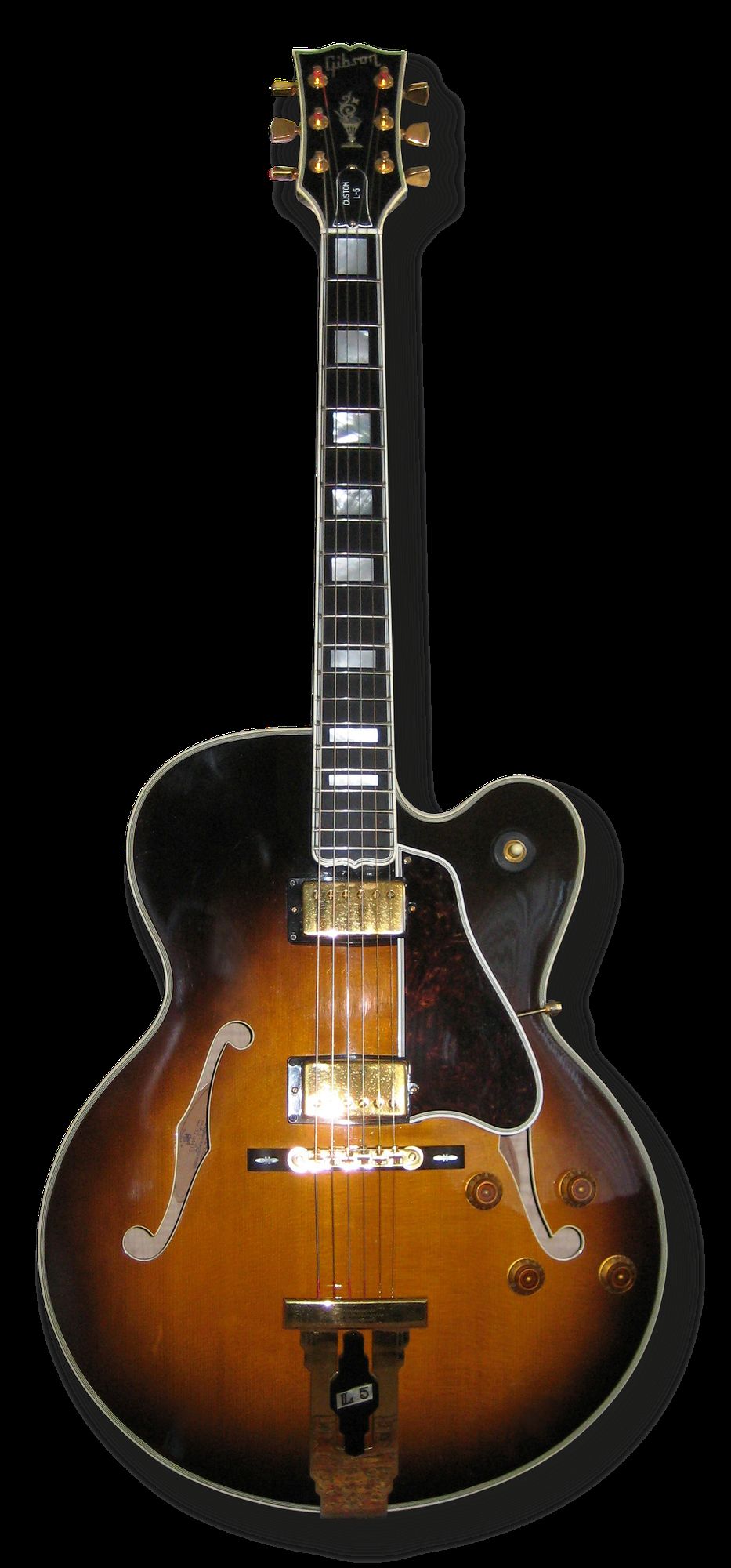
Gibson L-5 CES Tobacco Burst. Photo by Cruciniacus; isolated background by Auge=mit. Licensed under CC BY-SA 3.0. Via Wikimedia Commons. Gibson
L-5 CES
1951
In the ’50s Gibson shipped a few dozen a year. Wes Montgomery and Scotty Moore made them count.
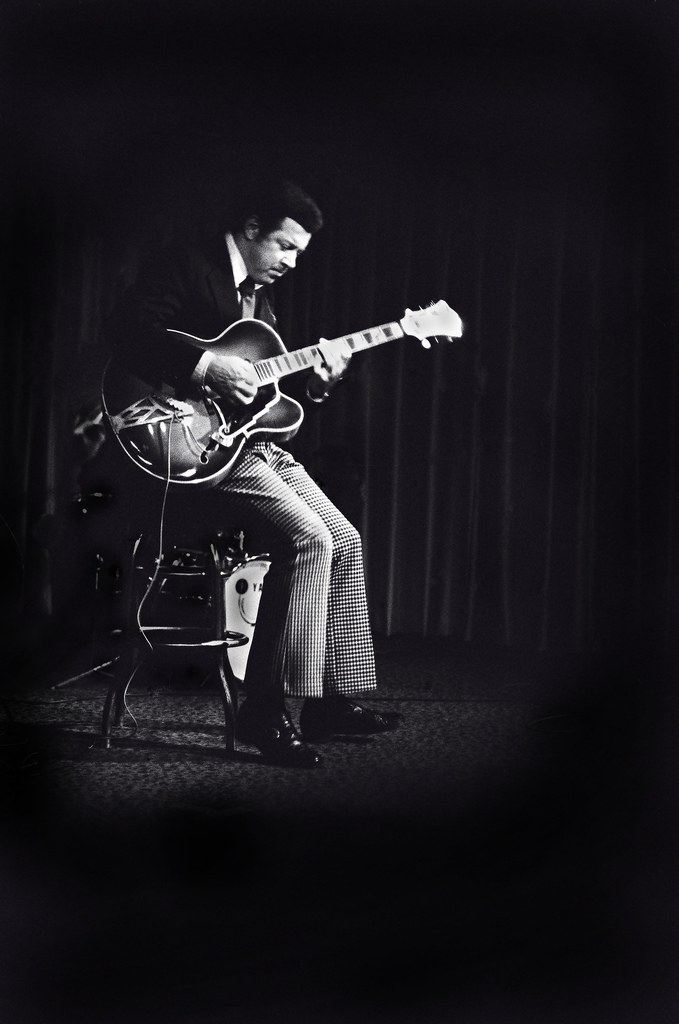
Photo: Tom Marcello / Wikimedia Commons / CC BY-SA 2.0 D'Angelico
New Yorker
1936
One man carved them by hand on Kenmare Street. When he died in 1964, the name kept going. The guitar didn’t.
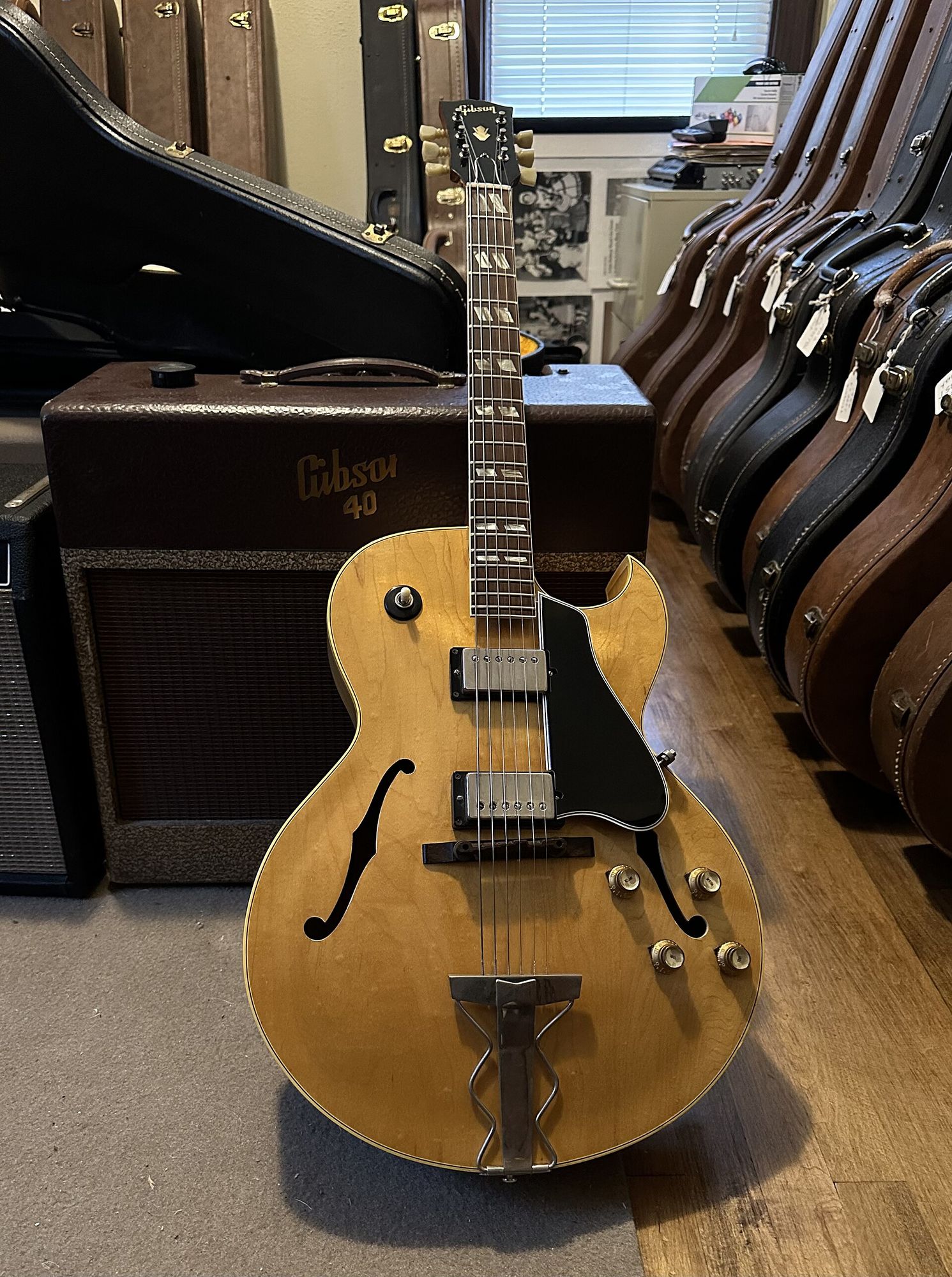
1963 Gibson ES-175DN. Photo by Lightburst. Licensed under CC BY-SA 4.0. Via Wikimedia Commons. Gibson
ES-175
1949
A laminated jazz box that kept changing hands: bought used, given as a gift, borrowed for a hit.