Gibson
Grabber
Gibson named its cheapest bass after what your hand did to the pickup: grab it and slide it.
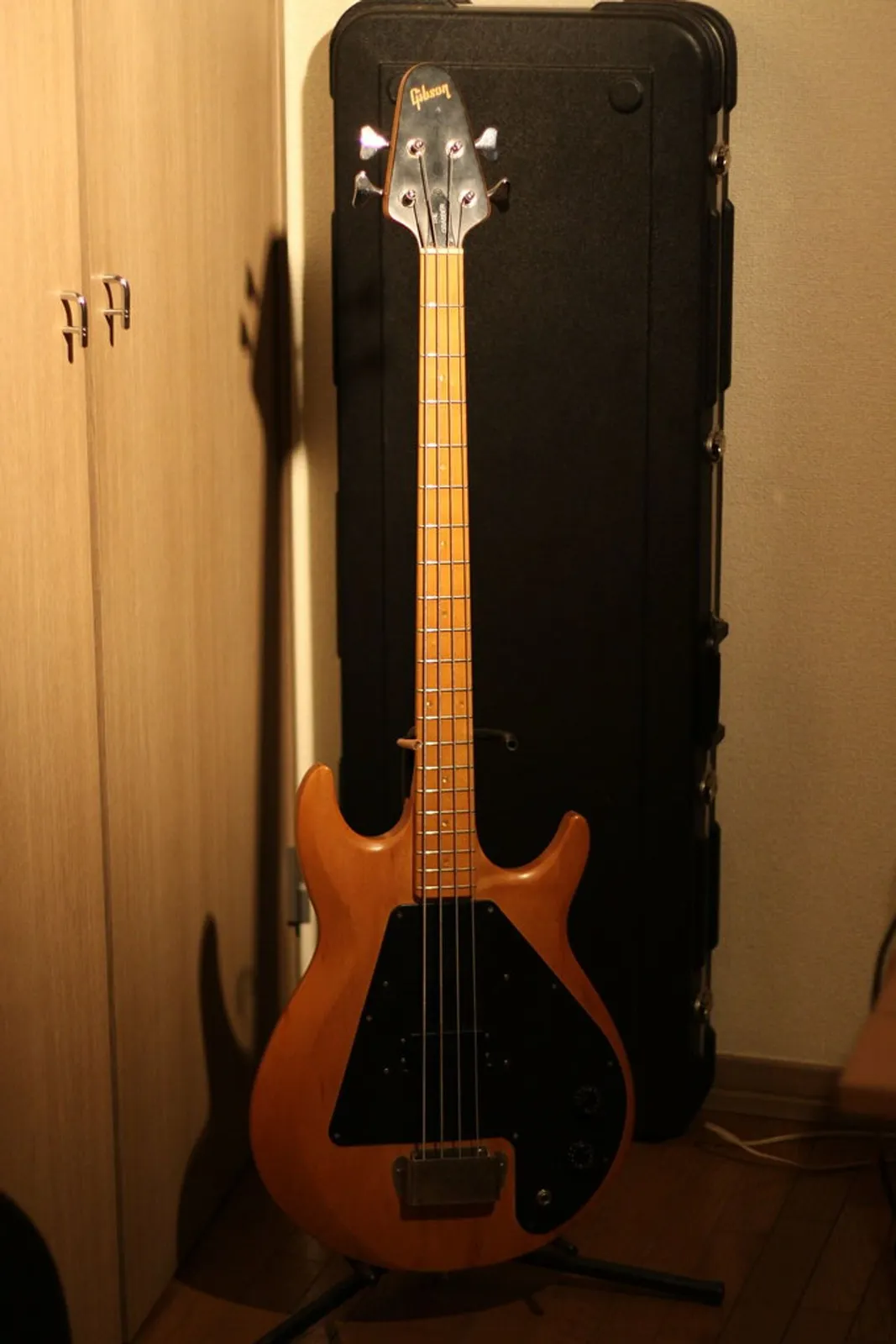
September 1975. On the cover of Kiss’s Alive!, Gene Simmons has a Gibson bass with a pointed, natural-finish headstock. That year Kalamazoo ships 2,637 Grabbers, more than in any other year. The bass is cheap, it bolts together, and its one pickup rides on a rail.
- Introduced
- 1973
- Type
- Solidbody electric bass
- Class
- Production
The short version
1969
Norlin
December. Norlin takes over Gibson. Then come recessions, Japanese copies, and players buying Fenders.
1973
One bass
The shipping table’s first Grabber. One account says late ’74, a dealer letter says January 1975.
1974
The patent
August 22. Bruce Bolen and Edward Klein file for the outline. The sliding pickup isn’t in it.
1975
The peak
$319 in natural satin, the cheapest Gibson in the book. 2,637 ship. Simmons is on the Alive! cover.
1975
The G-3
A second Grabber with three fixed pickups and a switch. A different bass.
1982
Discontinued
Or 1984, when the last small batch shipped. Both dates are on the record.
2009
Grabber II
A run of 350. The accounts don’t agree on what pickup it had.
2024
Epiphone
The shape comes back with a fixed, coil-split humbucker. It doesn’t slide.
Side A
A1
The cover of Alive!
September 1975. Kiss put out Alive!, and on the cover Gene Simmons is holding a Gibson with a pointed headstock. It’s a Grabber. He gigged a Ripper too, and nobody has said which bass is on which song. For the cover, it’s the Grabber.
That was the biggest year the Grabber ever had. Kalamazoo shipped 2,637 of them in 1975. One account puts that down to Simmons. The shipping table only says how many went out the door.
The name tells you what’s different about it. There’s one pickup, on a rail, and you move it with your hand.
A2
Cheaper than a Precision
The Grabber was built to fight on price. Norlin had taken over Gibson in December 1969. There were recessions in 1970 and again from 1973 to ’75. Copies of the old Gibson shapes were coming in from Japan, and bass players were buying Fenders.
So Gibson built a bass it could sell next to a Precision: one pickup, two knobs, a plate bridge, the controls routed from the front, and a neck held on with four screws. On one account it was Gibson’s first bolt-on bass. Most of those necks are scarfed, with the headstock angle made from a separate piece, which saves wood.
In January 1975 a natural-satin Grabber listed at $319 and the other finishes at $369. It was the cheapest bass in Gibson’s book, and the cheapest guitar of any kind. Beside it, a Precision was $325.
A3
Three dates, three designers
When it started depends on which paper you pick up. The shipping table has exactly one Grabber in 1973 and 219 in 1974. Another history says late ’74. A Gibson dealer letter from late 1975 talks about “the successful introduction of the Grabber Bass in January of 1975.” All three stay.
Who drew it splits three ways too. The design patent, filed August 22, 1974, names Bruce Bolen and Edward Klein. One account says Bill Lawrence designed the Grabber and the Ripper. Another says Lawrence designed the pickups. The patent covers the outline. It doesn’t mention the slide.
That headstock looks like a Flying V. The resemblance stops at the outline.
Flip the record · By the numbers
$319
January 1975 list, natural satin. The cheapest bass and the cheapest guitar in Gibson’s book.
1
Grabber shipped in 1973.
2,637
Shipped in 1975, the peak year.
6,800
Shipped 1973–79, the years with counts. Probably under 7,000 in all.
Side B
B1
Slide it forward
The pickup is the whole idea. It’s a single-coil, brighter than a Gibson humbucker, on a rail under the strings. Push it toward the neck for more bass. Pull it back toward the bridge for more treble. Stop anywhere in between. There’s no switch, only volume and tone. The 1975 catalog put it this way:
Slide it forward for a deep rhythm roar, backward for a full treble punch, or slide it anywhere in between.
Gibson didn’t invent the rail. Alembic and Dan Armstrong already had pickups you could move. But on a cheap bolt-on Gibson, the one knob that wasn’t a knob was the selling point.
Not everyone bought it. Suzi Quatro had played a Ripper for about three years before she got a Grabber, and she didn’t like it. It had none of the Ripper’s tone or feel, she said. It was “just big and not nice to play.” The pickup was “some marketing guys mistake.”
B2
Natural satin, and a long goodbye
Most Grabbers were natural satin, 4,043 of them through 1979, on alder bodies. Wine red came next, then ebony. Walnut and white were rare. There were candy apple red and metallic blue ones in the early ’80s, and nobody counted those.
In 1975 Gibson also put out the G-3, a Grabber with three fixed single-coils and a three-way switch. That’s the one Mike Dirnt played on Dookie. It’s a different bass. So is the Ripper, the one Krist Novoselic used on Nevermind.
The ending is as blurry as the beginning. One history has it discontinued in ’82. The last small batch shipped in 1984. The counted years, 1973 to ’79, add up to 6,800, and the people who keep the table think the total was probably under 7,000.
B3
Two of them, and a Marshall missing tubes
The Grabber kept turning up after that. In 2021 Lou Barlow of Dinosaur Jr. used a pair of them on part of Sweep It Into Space, through a Marshall JCM 800 “with a bunch of tubes taken out of it” and an old SVT. That’s “I Ain’t,” “Hide Another Round,” and “N Say.” Nobody said whether those were sliders or G-3s.
Gibson made a Grabber II in 2009, 350 of them. Ask what pickup it had and you get three answers.
In 2024 Epiphone brought the shape back, with a fixed humbucker and a coil-split switch. It’s a 34-inch bass on a three-piece alder body, and it has the outline right. You just can’t grab anything.
Put this on
You’ve read about it. Now hear it. Here’s what this guitar sounds like, and what to listen for.
I Ain’t
From Sweep It Into Space. Lou Barlow played a pair of Gibson Grabbers through a JCM 800 with some tubes pulled and an old SVT. The interview doesn’t say whether they were sliders or G-3s.
Find it on YouTube (opens in a new tab)Hide Another Round
Same album, same pair of Grabbers, same Marshall. Not “Garden” or “Wonder Why,” which are a ’65 Precision.
Find it on YouTube (opens in a new tab)
The cast
The people, and the specific guitars, that made the legend.
1975
Gene Simmons
Grabber, natural headstock
Kiss. Holding one on the cover of Alive! He gigged a Ripper too, and nobody has said which bass is on which song.
Suzi Quatro
Grabber, after three years on a Ripper
Didn’t like it. “Big and not nice to play,” and the sliding pickup was “some marketing guys mistake.”
2021
Lou Barlow
A pair of Grabbers
Dinosaur Jr. Used both on part of Sweep It Into Space. The first Dinosaur Jr. album was a Ripper.
Bill Lawrence
Designer, depending who you ask
One account credits him with the whole bass. Another says the pickups. The patent names Bolen and Klein.
1994
Mike Dirnt
G-3, not the slider
Green Day. His G-3 is on Dookie. Three fixed pickups. Don’t move it onto this bass.
1991
Krist Novoselic
Ripper, not a Grabber
Nirvana. “I played a blonde Ripper on Nevermind.”
Liner notes
Specs, construction, rarity, value, and every source we used.
One single-coil you grab and slide — Gibson's bolt-on Grabber, not the Ripper, and not the three-pickup G-3.
- Body
- Solid double-cut. Maple on the early run; alder on 1975 natural satin, maple still offered later. FlyGuitars technical table: 21½" long, 14½" wide, 1¼" deep; 45¾" overall. Vintage Guitar matches width and depth. Weights there: maple 4 kg, alder 3.5 kg. Inches and kilograms are not one drawing.
- Neck
- Bolt-on maple, four screws and a plate. Most are scarfed. Earliest: one piece, skunk stripe, headstock not kicked back. Late 1982: three-piece maple, no volute. Pointed headstock. A Flying V in outline only.
- Fingerboard
- Unbound maple, dot inlays, 20 frets
- Scale
- 34½" (FlyGuitars spec line; Vintage Guitar). FlyGuitars technical table 34⅜". Wikipedia 34½" (876 mm). Mix flagged. Do not average.
- Pickups
- One Grabber sliding single-coil
- Hardware
- String-through plate bridge with cover (part 81554). Not a top-loader. Schaller BM; some late examples Schaller M4. Extra-long strings.
- Electronics
- Volume and tone. No switch. Passive. 1973 schematic: .047 mfd cap (70057). 1977 list: both pots 250k audio (70023). 1981 list: volume 300k (70031), tone 100k (70033).
- Finish
- Wine red, ebony, natural satin, maple gloss, walnut, white. Candy apple red and metallic blue in the early 1980s, uncounted.
- Nut
- 1⅝" (FlyGuitars). Millimetres unpublished on the vintage sources.
Open the full research fileConstruction details, the complete player record, production numbers, dated value estimates, and sources
Classic living example = 1970s Kalamazoo Grabber (sliding single-coil; FlyGuitars also calls it the G1). No current Gibson USA Grabber SKU (fetched 25 September 2026). The living cart is the Epiphone Grabber, and it is not this table: 3-piece alder, bolt-on 3-piece maple, fixed bass humbucker, coil-split mini switch, no slide. Natural EIGRBNANH1, $999. Scale 863.6 mm / 34.0 in. Nut 41.0 mm / 1.61 in. Radius 320.0 mm / 12.6 in. Mix flagged. Ebony is the other finish (Guitar Center $999). The G-3 is three fixed single-coils. The Ripper is the other body. The 2009 Grabber II is a limited run. The EB-3 is the short-scale set-neck. The Thunderbird is the bird.
Construction
The job was a Gibson bass a shop could price next to a Precision. FlyGuitars: Norlin took the company in December 1969; recessions in 1970 and again 1973–75; copies of the old shapes coming in from Japan; players buying Fenders. So: one pickup, two knobs, a plate bridge, a bolt-on neck, a front-routed body.
Not a Ripper. Not a G-3. Not an EB-3. Not a Thunderbird. Vintage Guitar (Willie G. Moseley, January 2015) gives the whole mid-'70s trio the same new body: 14½" wide, 1¼" deep, maple neck, 20 frets, 34½" scale. The Ripper is the other instrument on that outline. FlyGuitars: set neck, two Super Humbuckers, the Q-system. Andy Baxter (Bass Guitar Magazine): "set-neck (through-body)." Keep both joint words. The G-3, below, is three fixed coils. The EB-3 (gibson-eb-3) stays 30½". The Thunderbird (gibson-thunderbird) is the bird. This plate is the coil you slide.
The start is three dates. FlyGuitars shipping: 1 bass in 1973, 219 in 1974. Baxter titles the introduction as 1973, with the Ripper. Vintage Guitar: "In late '74." A Gibson dealer letter, late 1975, via FlyGuitars: "the successful introduction of the Grabber Bass in January of 1975." Design patent Des. 239,052 was filed 22 August 1974 by Bruce Bolen and Edward Klein, assigners to Norlin, and granted March 1976. It covers the outline. It does not mention the sliding pickup. This plate starts at 1973, the first shipping cell. It does not bury the other two dates.
Who drew it splits the same way. The patent, and FlyGuitars, name Bolen and Klein. Wikipedia says Bill Lawrence designed the Grabber and the Ripper. Baxter says Lawrence designed the pickups. FlyGuitars thinks the scarf was probably his influence — he was at Gibson, and Framus had scarfed necks for years. Three jobs. Not one designer.
The name is the pickup. Grab it, slide it. Neckward for bass, bridgeward for treble, or anywhere on the rail. The 1975 catalog, via FlyGuitars: "Slide it forward for a deep rhythm roar, backward for a full treble punch, or slide it anywhere in between." Not a new idea. FlyGuitars: Alembic and Dan Armstrong already had pickups on rails. This one is a single-coil, brighter than a Gibson humbucker (Wikipedia), on the guard with two knobs and no switch. Early guards red or brown tortoiseshell. Most of them plain black (FlyGuitars).
January 1975 list: natural satin $319, other finishes $369. Cheapest Gibson bass in that book, and the cheapest guitar — the Marauder six-string was $349, the Ripper $449. FlyGuitars sets a Precision at $325 and a Telecaster bass at $330 beside it. Historical list, not 2026 street.
The neck is the other departure, and it changed. Earliest: one piece, skunk stripe, headstock not kicked back. FlyGuitars: at least one of Gene Simmons's is that neck, and the patent drawing shows the flat angle. The run that matters is scarfed, so the angle costs less wood. Gibson's first bolt-on bass, on FlyGuitars's account. From late 1982, three-piece maple, typically highly figured, no volute. String-through only. The Ripper can be top-loaded. This bridge cannot.
Wood and color move with the sales. 1973–74: FlyGuitars's chronology says maple, wine red or ebony only. Those two years are not split by finish in the shipping rows. Vintage Guitar starts the model in wine red or black, moves the body to alder in '75, and puts natural in '76. The table has 2,138 natural-satin Grabbers in 1975, and FlyGuitars ties that finish to alder. 1977 adds walnut, and maple gloss — clear over a maple body — so maple did not leave. 1982: candy apple red and metallic blue. No cells. FlyGuitars guesses tens, not hundreds. A guess.
The parts lists change the pots and not the job. 1977: both 250k. 1981: 300k volume, 100k tone. Still no switch.
G-3 is the other Grabber, from 1975. Vintage Guitar: alder, bolt-on, same headstock, three single-coils, volume and tone, a three-way — neck-and-middle, all three, or middle-and-bridge. Wikipedia calls all three a "buck and a half." FlyGuitars: 4,287 shipped 1975–79. Not this table.
The end is a pile of dates. Vintage Guitar: the trio discontinued in '82. FlyGuitars: small numbers finished in 1982 and 1984; the chronology says the last Grabber shipped in 1984. Wikipedia's infobox is 1973–1983; the prose says discontinued 1982, a few as late as 1984. Counted Kalamazoo cells stop at 1979. Last price-list line: January 1980 on FlyGuitars's main page ($499 / $549), July 1980 on the shipping page.
2009. A Grabber II, 350 of them, and the sources do not agree what it was. FlyGuitars: three-point bridge, a T-bird+ humbucker, not the old slide. Wikipedia: the sliding pickup, all black. Reverb's Grabber II page: maple, rosewood board, 34" scale, a movable Grabber II pickup, and a set neck. Keep all three.
The bass you can order does not slide. Epiphone, 2024, still $999 on Gibson.com (Natural, 25 September 2026). Guitar World (4 December 2024): the Simmons bass had a pickup you moved; the Epiphone has a coil-split humbucker. 34" against 34½" / 34⅜". Different factory.
Players
A catalog that says "Grabber" is not a credit. Epiphone's 2024 page names Gene Simmons, Krist Novoselic, Mike Dirnt, and Lou Barlow. One of those is cleanly this bass.
Krist Novoselic played a blonde Ripper on Nevermind. Guitar World: "I played a blonde Ripper on Nevermind." His signature is an RD. Vintage Guitar only says the '70s trio turned up later with him and with Dirnt. It does not say which. Mike Dirnt played a G-3. Gibson Gazette (18 November 2025): his original G-3 on Dookie (1994), notably "Longview." The Epiphone Mike Dirnt Grabber G-3 is that instrument. Not a sliding coil.
Gene Simmons — Kiss, the Alive! cover. Vintage Guitar: a Grabber in the early heyday, natural headstock, on the cover of Alive!, September 1975. He also gigged a Ripper. Which songs on the record are which bass is unpublished here. Wikipedia's "Eggplant Sparkle" for that shoot is not in Vintage Guitar, and it is not a FlyGuitars finish cell. Do not make it a catalog color. Artist-owned. Not a comp.
Suzi Quatro played one and did not want it. FlyGuitars, after the EB-2, the Les Paul bass, and about three years on a Ripper: "Ripper, Grabber.. it had none of the tone or feel of the Ripper.. just big and not nice to play.. and the sliding pickup.. some marketing guys mistake." Vintage Guitar lists her with the Ripper endorsers. Both stand. No album is pinned on the Grabber here.
Lou Barlow — a pair of them, on part of one record. Guitar World (Gregory Adams, 20 September 2021): Sweep It Into Space, a pair of Gibson Grabbers, a Marshall JCM 800 2205 "with a bunch of tubes taken out of it," and an old SVT. The piece ties that sound to "I Ain't," "Hide Another Round," and "N Say." It does not say sliding G1 or G-3. "Garden" and "Wonder Why," on the same album, are Mascis on a '65 Precision and Barlow on guitar. His Reverb interview: the first Dinosaur Jr. album, and half the second, were a Ripper.
Also known to play stays short. FlyGuitars captions Louis Johnson with a Grabber, George beside him on a one-off left-handed S-1. Guitar World (Chris Jisi, 1 December 2023): "Stomp!" is a Music Man StingRay. The hits do not move onto the photograph. None invented.
Rarity
You cannot buy a new Gibson Grabber. Epiphone's humbucker is another factory on the silhouette. The 2009 Grabber II is 350 basses and a disputed spec. Neither is a 1975 sliding pickup.
No lifetime factory census in the sources in hand. FlyGuitars's table, 1973–79, is 6,800. After that the cells stop. The same site: small numbers in 1982 and 1984, and "highly unlikely" the total exceeded 7,000. That ceiling is their estimate. Serials date a guitar. They do not count a year.
| 1973 | 1974 | 1975 | 1976 | 1977 | 1978 | 1979 | Total |
|---|---|---|---|---|---|---|---|
| 1 | 219 | 2,637 | 1,630 | 1,109 | 808 | 396 | 6,800 |
1975 is the peak cell. Wikipedia says those 2,637 were "sold" and "due largely" to Simmons. The table says shipped. Keep the number. The cause is Wikipedia's.
Finish, same table, through 1979. Natural satin 4,043. Wine red 1,276. Ebony 810. Maple gloss 181. Walnut 76 (1977–79). White 58 (1976–77). An unsplit "Grabber G1" row totals 356: the 1973 and 1974 basses live there, and so do later ones Gibson did not file under a color (63 in 1975, 1 in 1976, 2 in 1978, 70 in 1979). Candy apple and metallic blue have no cells. The G-3's 4,287 is not this total.
A 1973 Grabber is one bass. White and walnut are the thin catalog finishes. Simmons's cover bass is one object. It is not a vintage Grabber.
Value
Informal estimate, 25 September 2026. Not an appraisal.
Asking prices are not sold prices. Celebrity instruments are not comps. An Epiphone is not Kalamazoo money. A G-3 is not a sliding Grabber. A 2009 Grabber II is not a 1975. Period $319 / $369 (January 1975, natural satin / other) is 1970s money. The same FlyGuitars page steps the list to $499 / $549 in January 1980. The 1978 catalog: $399 natural satin, $449 other.
New street. None under Gibson USA. Epiphone Grabber Natural $999 (Gibson.com, EIGRBNANH1, 25 September 2026). Guitar World, December 2024, had $999 / £929. Ebony $999 at Guitar Center. Coil-split humbucker, not this table. The Dirnt G-3 is $1,299 (Premier Guitar, 18 November 2025). No 2009 list price captured. Do not invent one.
Used modern. No clean Reverb sold band for the 2024 Epiphone this pass. Don't invent a midpoint.
Vintage / collectible. A Reverb price-guide extract printed $1,443–$2,887 (216 Good-to-Mint orders, "All Models" — year and finish mixed). Named hammers in that extract, not a series to average: $1,700 (Good, 11 December 2025), $1,700 (Very Good, 19 September 2025), $2,450 (Very Good, 26 October 2025), $2,355 (Very Good, 26 December 2025). A later Reverb Norway page counted 222 orders off US sales and printed kroner, not a new dollar band. Do not convert it. Named ask, not a hammer: a 1980 natural in Good condition, $2,299.99 (Musician's Friend / Guitar Center). Reverb News (24 April 2023): the 1973–83 Grabber's average sale price rose 149% from 2015 to 2022. A trend. Not a 2026 price. The article does not give the dollar endpoints. No hammer for Simmons's cover bass is in these sources.
See also
- gibson-eb-3 — the short-scale set-neck this bolt-on was priced under; not a sliding pickup
- gibson-thunderbird — Gibson's other long-scale bass; not this body, not this coil
- fender-precision-bass — the bolt-on Gibson was pricing the 1975 Grabber against
Sources
- FlyGuitars, Gibson Grabber — Bolen and Klein; 6,800 shipped 1973–79; unlikely over 7,000; January 1980 last price list on this page; first bolt-on Gibson bass; 34½"; nut 1⅝"; maple or alder; scarf vs earliest one-piece; late-1982 three-piece; 1975 catalog line; Jan 1975 $319 / $369; Precision $325 and Tele bass $330; Marauder $349; Alembic and Dan Armstrong rails; dealer letter, January 1975 "introduction"; white 58; walnut 76; 2009 Grabber II as a T-bird+ humbucker, 350; Simmons's early neck
- FlyGuitars, Grabber shipping totals — year and finish cells; 1973 = 1; 1975 = 2,637; total 6,800; unsplit G1 row 356; July 1980 as the last price-list line on this page
- FlyGuitars, Grabber technical information — 21½" × 14½" × 1¼"; overall 45¾"; scale 34⅜"; nut 1⅝"; 20 frets; maple 4 kg, alder 3.5 kg; string-through; .047 mfd / 70057; 1977 pots 250k (70023); 1981 volume 300k (70031), tone 100k (70033); Schaller BM, some late M4; single-coil
- FlyGuitars, Grabber pricing and publicity — list pairs 1975–80, through $499 / $549; March 1976 Grabber $329–$379 against G-3, Ripper, EB-3
- FlyGuitars, 1975 Grabber — alder wine red; unbound maple; scarf; bridge 81554; not top-loadable; wine red common, white and walnut rare
- FlyGuitars, design patent Des. 239,052 — filed 22 August 1974 by Bolen and Klein, assigners to Norlin; granted March 1976; outline only; sliding pickup not in the patent
- FlyGuitars, Gibson G-3 — from 1975; 4,287 shipped 1975–79; not the sliding Grabber
- FlyGuitars, Suzi Quatro interview — Grabber after the Ripper; she rejected the sliding pickup
- *Vintage Guitar*, Willie G. Moseley, Gibson Basses in the '70s (January 2015) — late '74; 14½" × 1¼"; 34½"; 20 frets; wine red or black, alder in '75, natural in '76; Simmons on the Alive! cover, September 1975, plus a Ripper on gigs; G-3 in '75; trio discontinued '82; Novoselic and Dirnt only as later players of the trio
- vintageguitarandbass.com, 1978 catalog page — 1978 list $399 natural satin, $449 other
- Andy Baxter, 1973: Grabber and Ripper (*Bass Guitar Magazine*) — 1973 intro framing; Lawrence designed the pickups; maple, then alder in 1975; Grabber bolt-on, Ripper "set-neck (through-body)"
- Wikipedia, Gibson Grabber — 1973; 34½" (876 mm), mix flagged; Lawrence as designer of both basses (the page asks for citations); 2,637 "sold," pinned on Simmons; discontinued 1982 with examples into 1984; infobox 1973–1983; 2009 reissue as 350 black sliding-pickup basses. The player list is not a credit
- *Guitar World*, Gregory Adams, Lou Barlow (20 September 2021) — pair of Grabbers on Sweep It Into Space; "I Ain't," "Hide Another Round," "N Say"; JCM 800 2205 and an SVT; "Garden" and "Wonder Why" are a '65 Precision
- *Guitar World*, Krist Novoselic — blonde Ripper on Nevermind; not this bass
- Gibson Gazette, Epiphone Mike Dirnt Grabber G-3 (18 November 2025) — original G-3 on Dookie, "Longview"; three pickups; not the sliding Grabber
- *Premier Guitar*, Mike Dirnt Grabber G-3 (18 November 2025) — street $1,299; a G-3, not this table
- *Guitar World*, Chris Jisi, Louis Johnson on "Stomp!" (1 December 2023) — Music Man StingRay; not the Grabber in the FlyGuitars photo
- *Guitar World*, Epiphone Grabber review (4 December 2024) — $999 / £929; no sliding pickup; coil-split humbucker; 34" scale
- Epiphone Grabber Bass, Natural (Gibson.com) — EIGRBNANH1, $999; 3-piece alder; 863.6 mm / 34.0 in; nut 41.0 mm / 1.61 in; radius 320.0 mm / 12.6 in; coil-split; fetched 25 September 2026. The page names Novoselic and Dirnt; the interviews do not
- Guitar Center, Epiphone Grabber Bass Ebony — Ebony $999
- Reverb, Gibson Grabber — years 1973–1983; dollar widget did not render on a direct fetch this pass
- Reverb price-guide extract, Gibson Grabber — $1,443–$2,887 (216 Good-to-Mint orders); named 2025 hammers in that extract
- Reverb Norway, Gibson Grabber — 222 orders, US-sales estimate, printed in kroner; not a dollar band
- Reverb News, Norlin Gibsons (24 April 2023) — Grabber 1973–83 average sale price +149%, 2015 to 2022; no dollar endpoints in the piece
- Reverb, Gibson Grabber II — 2009 limited run, 350; movable pickup, rosewood, 34", and a set neck on this page. Conflicts with FlyGuitars and Wikipedia
- Musician's Friend, 1980 Grabber natural — ask $2,299.99, Good; not a hammer
- Reverb, Lou Barlow on the Ripper — first Dinosaur Jr. album and half the second on a Ripper
Keep digging
Guitars this one gets compared to, confused with, or descended from.
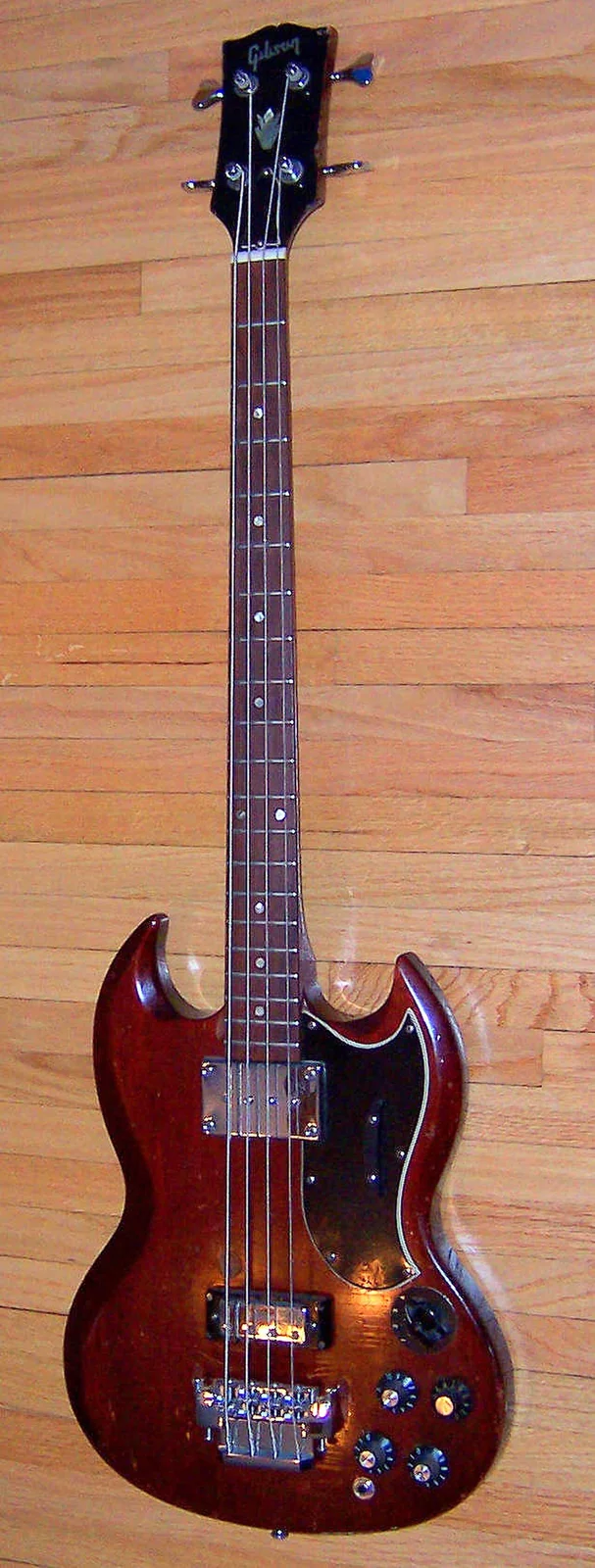
Photo: Jpkotta / Wikimedia Commons / CC BY-SA 3.0 Gibson
EB-3
1961
Jack Bruce wanted to bend bass notes like a guitarist. At thirty and a half inches, the EB-3 let him.
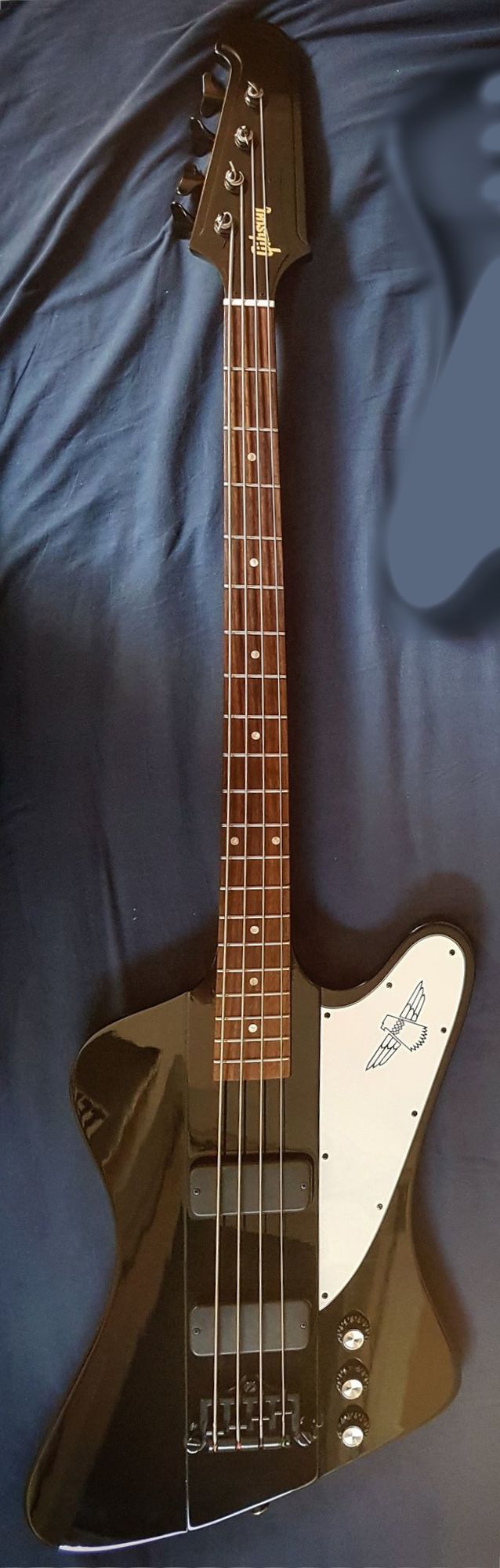
2013 Gibson Thunderbird ebony, clipped from a two-bass photograph. Original photo by MaxVaudous; derivative by Clusternote. Licensed under CC BY-SA 4.0. Via Wikimedia Commons. Gibson
Thunderbird
1963
John Entwistle thought the neck was too thin. So he kept the body and changed the neck.

Photo: Infrahertzz / Wikimedia Commons / CC BY-SA 3.0 Fender
Precision Bass
1951
Leo’s bass let the player at the back be heard. You know their lines by heart. You mostly don’t know their names.