Gretsch
Bo Diddley
A teenager built a square guitar with a Victrola part for a pickup. Somebody stole it. Gretsch still makes it.
Bo Diddley had the rectangle before Gretsch did. In 1958 the Brooklyn company built him one with DeArmond pickups, and forty years later it gave him a copy for his birthday. The G6138 is that copy, still in the catalog, and it was never anybody’s idea but his.
- Introduced
- 1999
- Type
- Semi-hollow electric
- Class
- Production
Have a photograph of this guitar? Send a picture
The short version
1958
The custom
Gretsch builds Bo a rectangular guitar with DeArmond pickups. He called it the one authorized square.
1997
Not a Gretsch
The squares he’s photographed with are often Japanese or French. Some nights he plays something else, and someone asks where the square is.
1998
Seventy
Fred Gretsch brings Bo the first reissue of the 1958 guitar, copied from the one at the Hard Rock Cafe. One reading of the dates puts it a year later.
1999
Signature
Gretsch introduces the Bo Diddley rectangular guitar to the public. Some guides say 2000.
2000
The shape is registered
The rectangular body is registered as Gretsch trade dress on 13 June.
2005
Into the museum
A G6138 made in Japan this year, owned by Bo, later goes to the Smithsonian.
2007
Last stage
He plays a 1999 square at his last public show, in Council Bluffs, Iowa, in May.
2026
Still in the catalog
Japan puts the same G6138 on sale again in September.
Side A
A1
The Victrola part
When Bo Diddley was a teenager, he built a square guitar.
For a pickup he took the part of a Victrola where the needle went in and clamped it to the metal tailpiece. “They worked pretty good,” he said, years later. Then somebody stole it.
That’s where the shape starts: a teenager, a box, and a phonograph part. Everything Gretsch did with it came after.
A2
The one authorized square
Before the Gretsch square, Bo played a Gretsch Jet Firebird. In an old black-and-white clip, Bo singing “Bo Diddley” with Jerome Green on maracas, one interviewer guessed the guitar was a Harmony. Bo corrected him.
That’s a Gretsch Jet Firebird.
“Not long after that,” he said, “Gretsch built that square guitar.” In his words: “in 1958 Gretsch made me one with DeArmond pickups. They only made one authorized square guitar.” He’d seen others, and figured they had something to do with the times the company was closed up.
His band tells it bigger. Charlie Tona, who joined in the 1990s, says that after the Jet was stolen, Bo built a cigar-box square himself, and then Giuliano Balestra at the Brooklyn factory built three more refined ones. Bo said one. Tona’s story says three. Nobody published a count, so keep both.
There’s a trap here too. Gretsch also built him a guitar of a different shape, which he called the Jupiter Thunderbird. Fans call it the Cadillac. That one went on to Billy Gibbons and a model of its own. It isn’t the box.
A3
A piece of wood and some strings
What he wanted, Tona says, was a guitar reduced to the strings and a piece of wood. Simple, and out of his way on stage.
That’s the G6138 you can buy today. A rectangle, two inches deep, no waist and no horns, finished in Firebird Red, with gold hardware and no pickguard. The 1958 guitar had DeArmond pickups; today’s has two Filter’Trons, Gretsch’s own humbuckers. It’s built in Japan.
The headstock is Jet-style. The body is not a Jet.
Flip the record · By the numbers
1
Authorized square Gretsch made him, in Bo’s words. Other accounts say two, or three.
40
Years between the custom and the first reissue, by Fred Gretsch’s count.
2"
Body depth of today’s G6138. No waist, no horn, just a box.
15 or 16
Bo’s age when the beat came to him, banging on a guitar because he wanted a drum.
Side B
B1
Forty years later
For Bo’s 70th birthday, Fred Gretsch and Dinah Gretsch went to Gainesville and gave him, in Fred’s words, “his first re-issue model of the custom guitar we made for him in 1958, 40 years earlier.” The original was in the Hard Rock Cafe on 57th Street in New York. They copied that guitar’s specs.
Read the dates one way and the gift lands at the end of 1998. Read them another and it’s a year later. Bo was born in 1928, so his 70th falls in 1998.
Gretsch put the signature model on sale to everyone in 1999, though some guides say 2000. In June 2000 the rectangular body itself was registered as Gretsch’s trade dress. The shape a kid had built for himself was now, legally, a brand.
That first reissue is the one called Big B, though people hang the nickname on the 1950s guitar too. Bo played it, then gave it to Tona. The story that comes with it says that on the day of the gift, backstage at a Rolling Stones show, Keith Richards and Ron Wood each played it.
B2
Where’s the square?
By 1997 the square guitars Bo carried weren’t always Gretsches. One, with an “Unleaded Fuel Only” sticker and humbuckers, was made in Japan by Kid Guitars. Another came from Roadrunner, in France. Some nights he played something else entirely, and someone in the crowd would ask where the square was.
He kept playing one to the end. His last public show, in May 2007 at a casino in Council Bluffs, Iowa, was on a red 1999 catalog model, wearing sparkle stickers and a Roland synth pickup added along the way. He died the next year, at home in Florida, at 79.
Another G6138 he owned, made in Japan in 2005, is in the Smithsonian now. Its label says it’s based on the 1958 custom. It’s a catalog guitar behind glass. The idea in it belongs to a teenager who built one, lost it, and kept the shape anyway.
The cast
The people, and the specific guitars, that made the legend.
1958
Bo Diddley
The 1958 Gretsch custom; later a 1999 G6138 on stage
Built his first square as a teenager. Played a 1999 catalog square at his last shows in 2007.
1998
Fred Gretsch
Gave Bo the first reissue
Went to Gainesville with Dinah for Bo’s 70th birthday and handed him a copy of the 1958 guitar.
1990s
Charlie Tona
The reissue called Big B
Joined Bo’s band in the 1990s. Bo gave him the reissue he had played.
1958
Giuliano Balestra
Builder at the Brooklyn factory
In one telling, he built the refined squares after Bo’s homemade one. Bo himself said Gretsch made one.
1998
Keith Richards and Ron Wood
Played Big B backstage
The story that travels with Big B says each played it backstage with the Stones the day it was given. No Stones track is tied to it.
Liner notes
Specs, construction, rarity, value, and every source we used.
One 1958 square with DeArmonds, built for Bo, and a Japan G6138 that wears the rectangle in Filter'Trons — not the Jet in the old clip, and not the Jupiter.
- Body
- Rectangle, no cutaway. Gretsch's prose calls it semi-hollow; the same sheet labels the build "Solid Body." Laminated maple top, mahogany back, maple. Depth 2" (50.8 mm). Length and width are not on that sheet.
- Neck
- Set, three-piece rock maple, gloss urethane. Headstock spec says Jet style; the product sentence says 1957-style. That is a headstock. It is not a Jet.
- Fingerboard
- Ebony, 12" (305 mm), white pearloid dots, 22 vintage small
- Scale
- 25.5" (648 mm)
- Pickups
- Two High Sensitive Filter'Trons
- Hardware
- Adjusto-Matic on a rosewood base; G-cutout tailpiece; gold; Grover Rotomatic; no pickguard; G-arrow knobs
- Electronics
- Neck volume, bridge volume, one tone; 3-way toggle (bridge / both / neck)
- Finish
- Firebird Red, gloss urethane
- Nut
- Synthetic bone, 1.6875" (42.86 mm)
Open the full research fileConstruction details, the complete player record, production numbers, dated value estimates, and sources
Classic living example = current G6138, model 2410102815, Professional Collection, Japan. The table is that sheet (Gretsch page, fetched 23 October 2026), $2,999.99 EST. U.S. street on the same page. The 1958 custom is the earlier guitar, not this table. Blue Book's 241-0102 (mfg. 2000–present in that guide) is an older published recipe: alder, five-ply maple top, ebonized rosewood, bone nut, 17.75" × 9.25" × 2", and a master volume besides the two volumes and tone. Guitar-list prints nut 1.69" and a bone nut for that recipe. Do not average those with the table. Do not invent millimetres for 17.75", 9.25", or 1.69". G5810 is the Electromatic rectangle. 6138LH is the left-hand. G6199 Billy-Bo is the Jupiter. G1850 Mini Diddley, on guitar-list, is a three-quarter Synchromatic number. Not this table. Standalone. No Gibson SKUs. Mixed inch/mm flagged. Factory pairs above are printed conversions. Smithsonian's centimetres are a different object (overall size). Do not convert 7.48 lb or 3519 g.
Construction
The job was a guitar that would stay out of his way. Charles Tona, who joined the band in the 1990s, told Chris Gill that Bo wanted the body reduced to the strings and a piece of wood — simple, and clear of him on stage. Gretsch's blog (27 February 2018) is summarizing that Guitar Aficionado conversation, and it puts the rectangular shape in brackets as the G6138. The shape is a box. No waist. No horn.
He had built the idea before Gretsch did. Vintage Guitar, June 1997, Willie G. Moseley: as a teenager he made a square guitar. The pickup was the part of a Victrola where the needle went in, clamped to the metal tailpiece. "They worked pretty good." Somebody stole it. Then, his words: "in 1958 Gretsch made me one with DeArmond pickups. They only made one authorized square guitar." He had seen other unauthorized models and guessed it had to do with the times the company was closed up. That 1958 DeArmond guitar is the custom. Gretsch's current G6138 page calls the catalog model a faithful reproduction of "the famous rectangular guitar Gretsch built especially for him in 1958." Fred Gretsch, in the line the Summer 1999 Gretsch House Telegram is cited for, says the same year: the custom "we made for him in 1958."
Julien's, describing a 1999 stage guitar, says only "the late 1950's." Keep 1958 and "late 1950s." Do not promote the teenager's Victrola box into a Gretsch, and do not give it a year he did not give. He said teenager.
How many squares Gretsch actually built is not one number. Bo: one authorized. The Gretsch blog, via Tona and Gill: after a '57 G6131 Jet Firebird was stolen, Bo built the cigar-box guitar himself, then had Giuliano Balestra at the Brooklyn factory build three more refined squares. The same paragraph has Tona saying Fred Gretsch personally gave Bo that guitar. Fred's own telegram puts a personal gift in the reissue years, not in 1958 Brooklyn. Keep the blog's three and Bo's one. Blue Book sorts the old customs as Jupiter (rectangle, red, two Filter'Trons), Thunderbird (curved, red), and Cadillac (tail-fin, orange), "reportedly" two of each from 1958 to 1962. Bo sorts them the other way. The square came first. The guitar fans call the Cadillac is the one he called the Jupiter Thunderbird, and "Gretsch made two of those." The blog: Balestra also built a Cadillac with the horns cut blunt, and that one became the Jupiter Thunderbird. Blue Book's rectangle-named Jupiter is not Bo's Jupiter. No factory total. None invented.
The Jet is the other trap, and it is the earlier professional guitar. Moseley showed him a black-and-white clip he thought was a Harmony Stratotone, Bo singing "Bo Diddley," Jerome Green on maracas. Bo: "That's a Gretsch Jet Firebird." He had owned a Harmony and did not remember playing it on stage. "Not long after that, Gretsch built that square guitar." So that clip is a Firebird, model family of the Duo Jet (gretsch-duo-jet), and the square comes after it. Guernsey's (15 July 2021) sold a 1957 6131 Jet Firebird, red top, black back and sides, and wrote that Stan Jay of Mandolin Brothers bought it from Bo sometime between 1970 and 1972, and that the first three LP covers are "strongly believed" to be that guitar. Hammer not published. Do not invent one. Do not move those covers onto the square. A 6120, a White Falcon, and a White Penguin are other Gretsch bodies. This plate is none of them. The G6138's headstock is Jet-style. The body is not.
The catalog guitar is a later object. Fred, telegram as cited by the 2024 auction lot and by guitar-list: for Bo's 70th birthday he and Dinah went to Gainesville and gave Bo "his first re-issue model of the custom guitar we made for him in 1958, 40 years earlier." The original, he said, was in the Hard Rock Cafe on 57th Street in New York, and they duplicated that guitar's specs. The auction traces the quote to Gretsch House Telegram, volume 6, issue 2, Summer 1999, so "last December 28th" is 28 December 1998, and forty years back from that gift is 1958, the year in the sentence. Guitar-list heads the same sentences "interviewed in 2000," which would make "last December" 1999, and forty years back from that is 1959. Keep both readings. He was born in 1928 (Vintage Guitar's page dates him 1928–2008), so the 70th birthday is 1998, which fits the telegram and not the 2000 interview heading.
YAML introduced: 1999 is the public signature, not the custom and not the birthday gift. Fred Gretsch, 14 March 2024: "25 years ago, 1999, #gretsch introduced the bo diddley rectangular-shaped signature guitar." Gretsch's complaint against Loog, as Lexology reported the 24 October 2012 filing: beginning in 1958 the company supplied him a rectangular guitar; "In 1999, Gretsch reintroduced the classic Gretsch rectangular guitar, which has been continuously sold to the public since that time." Julien's calls the last stage guitar a 1999 model, serial 999138-54, "made in accordance with the design and specs personally approved by Bo in 1999." Blue Book and guitar-list say the 6138 was introduced in 2000 and is still in manufacture in that guide. U.S. trademark registration 2,357,459, the rectangular body as trade dress, issued 13 June 2000 (Lexology's account of the complaint). Registration is not the first sale. Keep 1998, 1999, and 2000.
What that reissue is made of depends on which sheet you read. Bo said the 1958 guitar had DeArmonds. The G6138 page specs two High Sensitive Filter'Trons. The Smithsonian's 2005 example, serial JT05096044, "MADE IN JAPAN," has pickups etched U.S. PAT. 2892371. The label dates it 2005, "based on the 1958 custom." It is a catalog guitar he owned. It is not the Hard Rock guitar Fred copied, and it is not the DeArmond custom in Bo's sentence.
Blue Book's 241-0102 recipe is alder, a five-ply maple top, ebonized rosewood, a bone nut, 17.75 by 9.25 by 2 inches, and four knobs: two volumes and a tone on the lower treble bout, a master volume on the upper bout, switch on the upper bass bout. Guitar-list's series page says the same wood and an ebonized rosewood board, and calls the reissue "Big B." The current 2410102815 sheet is maple, a mahogany back, a laminated maple top, an ebony board, a synthetic-bone nut, and three controls — no master volume. A German new listing that has ended (Reverb 34643715) prints four controls again, and weight 3519 g. Wildwood's serial JT23031153 is listed at 7.48 lb, and that page's neck wood says mahogany against the factory's rock maple. One guitar's sheet, not a second factory spec. Mix flagged. Do not average 7.48 lb with 3519 g. Do not invent a factory weight. The current page prints no weight at all.
Smithsonian overall size, same 2005 guitar: 40 3/4 × 9 1/4 × 3 1/8 in. (103.5 × 23.5 × 7.9 cm). That is the whole instrument. Width 9 1/4 inches matches Blue Book's 9.25-inch body width. Depth 3 1/8 inches does not match the factory's 2-inch body depth. Different dimension. Do not average them.
Strings on the current sheet: nickel-plated steel, .010–.046. Country on the Smithsonian guitar and on Fuller's listing of 2410102815: Japan. The 1958 custom, if you follow the blog, was Balestra in Brooklyn. Fred said the reissue duplicated the Hard Rock guitar and did not publish those measurements. The 25.5" scale is the G6138's. It is not a measured 1958 number.
The other rectangles are not this table. G5810 is the Electromatic: bolt-on maple, rosewood, chrome humbuckers, a wraparound bridge, luan on the retailer sheets (zZounds; Musician's Friend). Guitar-list: Korea, from 2003. Reverb's span: 2005–2013, Korea. An Ishibashi 2010 example, serial CYG10050591, is marked China. The Lexology account of the complaint says the registered shape is embodied in at least the G5810. Same outline. Different guitar. 6138LH, Blue Book: the left-hand 6138, 2000–08. G6199 Billy-Bo, Blue Book from summer 2005: the Jupiter Thunderbird shape, not the box. Guitar-list's G1850 Mini Diddley is a three-quarter Synchromatic number. Not checked against a current Gretsch page. Off this plate.
By 1997 the squares he was photographed with were often not Gretsch. Moseley: the one with the "Unleaded Fuel Only" sticker and humbuckers was Kid Guitars, Japan. Another was Roadrunner, in France. Sometimes he took a different guitar out, and someone in the crowd asked where the square was.
Japanese trade press in 2026 dated a release of this same G6138: Digimart, on sale 19 September 2026, ¥429,000 tax included; Guitar Magazine (14 October 2026) the same yen figure, and a note that it was not the first time the rectangle had been reissued. The spec block matches the U.S. sheet. Not a new design. The U.S. page still lists 2410102815. Reverb's product taxonomy prints "2000–2020" and files the body as mahogany. That is a category. It is not a factory end date, and it is not the laminated-maple-top sheet.
Players
Bo Diddley. Name the guitar or you will hang the wrong one on him.
The clip Moseley thought was a Harmony Stratotone — Bo singing "Bo Diddley," Jerome Green on maracas — is a Jet Firebird, his correction. He owned a Harmony and did not remember it on a stage. Guernsey's 1957 6131, red top, black back, bought from him by Stan Jay of Mandolin Brothers between 1970 and 1972 on that lot's account, is that model. The lot says the first three LP covers are "strongly believed" to be it. Hammer not published. Not this plate. The teenage Victrola square is not this plate either.
The 1958 DeArmond square is the custom. Fred put it at the Hard Rock Cafe on 57th Street when the reissue was copied. Where it is now is not in these sources. The Smithsonian's guitar is the 2005 G6138 JT05096044, red, semi-hollow, hardware the label calls brass, owned by Bo, "based on the 1958 custom."
The Jupiter Thunderbird is the other Gretsch he drew: two of them, his name, the fans' Cadillac. Tom Holmes made more, about fifteen years before the 1997 interview. The blog follows that blunt-horn guitar to Billy Gibbons and then to the G6199. Gibbons is on the Jupiter. He is not on this rectangle.
What he played on a catalog square, late: Julien's lot 280, serial 999138-54, the 1999 model, Roland GK-2A and sparkle stickers added later, specs he approved in 1999. Last public stage, Horseshoe Casino, Council Bluffs, Iowa, May 2007. Also Byron Bay, New South Wales, April 2007. The Ledger calls that red square the guitar he used to create the beat. He told Moseley the beat was him at about 15 or 16, beating on a guitar because he wanted to hear a drum. A 1999 replica did not do that.
Big B, on the lot that closed 8 June 2024, is the reissue he played and then gave to Charlie Tona. Guitar-list hangs the same nickname on the 1950s rectangle. In the 1997 interview he only says "the square guitar." Same lot: the day of the gift, backstage with the Rolling Stones, Keith Richards and Ron Wood each played it. The lot sources that night to Bo, the telegram, and Sylvia Piaz McDaniel. No Stones track is pinned here.
Also known to play, and not Gretsch: the 1997 Kid Guitars square with the "Unleaded Fuel Only" sticker, and the Roadrunner from France. That interview is June 1997, before the signature. They stay off the G6138.
Rarity
You can order a new G6138. Gretsch still lists 2410102815. Japan priced the same model again in September 2026. That is a catalog guitar. It is not scarce.
The 1958 custom is the scarce one, and the count is why it stays scarce in the telling. Bo said one authorized square. The blog says three, from Balestra. Blue Book says two rectangles and then sorts the Jupiter onto the rectangle, which contradicts Bo. No shipping total was published. Do not average one, two, and three into a run. Do not treat the Hard Rock guitar and the Smithsonian 2005 as the same object.
G5810s turn up used. Reverb closes that Electromatic span at 2013; guitar-list opens it at 2003. Either way it is a finished cheaper model, not a 1958. Left-hand 6138s stop at 2008 on Blue Book's line. No yearly G6138 totals. None invented. A Japan serial does not date a Brooklyn custom.
Value
Informal estimate, 23 October 2026. Not an appraisal.
Ask and sold stay apart. The 2009 stage guitar and the 2024 Big B lot are celebrity instruments. They are not a price for a stock red G6138. A Jet Firebird is not a comparable. A Jupiter is not a comparable. A G5810 is not a comparable. No factory count, so no "divided by the run."
New street. Gretsch's page: $2,999.99 EST. U.S. street, model 2410102815. The Guitar Factory lists the same number, in stock. Reverb's new pick from Andy Babiuk's Fab Gear is the same $2,999.99. Fuller's had serial JT24041181 at $2,699.99, sold out. Those are dealer tags against an estimate. Do not average them. Japan, not a converted dollar: Guitar Magazine and Digimart, ¥429,000 tax included, the Digimart date 19 September 2026. Ultimate Guitar (4 October 2026) prints "around $3,025 (list)" against the $2,999.99 estimate. Keep both. Do not average.
Used modern. Sold comps for an ordinary G6138 are thin on this pass. Flag: thin sold-comp access. Named asks, not hammers: MusicStoreLive on eBay, listing updated 9 January 2026, open-box with a headstock ding, $2,419.99, crossed-out list $2,839.99. Pitbull Audio's open-box special, $2,186.99 (was $2,699.99), out of stock. A Custom Shop rectangle with Round-Up trim is a different order. It is not this band.
Vintage / collectible. There is no 1950s production rectangle to price. The 1958 custom has no published sale in these sources. Fred's Hard Rock guitar is not a listing.
Artist-owned, not a comps tape. Julien's, 21 November 2009, lot 280, serial 999138-54, the 1999 guitar with the added Roland and the sparkle stickers: sold US$60,000, estimate $10,000–$20,000. Paul Fraser Collectibles, 24 November 2009, prints the same $60,000. The Ledger the day after the sale: "more than $50,000." The Bo Diddley Facebook page, on that guitar: $50,000. Keep all three. Do not average. Gotta Have Rock and Roll, bidding ended 8 June 2024, the Big B reissue the lot says Keith and Ron played: reserve not met, final bid $30,000, estimate $80,000–$120,000, two bids. Not a sale. Guernsey's 1957 Jet Firebird hammer was not published. It would be the wrong guitar if it had been.
See also
- gretsch-duo-jet — the Jet family; Bo's Firebird, the guitar in the early clip, lives here and not on the rectangle
- gretsch-6120 — the 16-inch Chet hollow. A Gretsch people name when they do not mean a square
- gretsch-white-falcon — the Cadillac hollow. Not the Jupiter he nicknamed against the fans' "Cadillac," and not this box
Sources
- Vintage Guitar, Willie G. Moseley, Bo Diddley (June 1997; obituary header 1928–2008) — teenage Victrola square, stolen; 1958 Gretsch, DeArmond pickups, one authorized square; Jet Firebird in the clip, not a Harmony; Jupiter Thunderbird, two from Gretsch, fans' "Cadillac"; Tom Holmes about fifteen years before the interview; Kid Guitars and Roadrunner squares in 1997; the beat at 15 or 16; died 2 June, age 79, home in Florida
- Gretsch, G6138 Bo Diddley, model 2410102815 — 1958 custom as the guitar being reproduced; semi-hollow prose and "Solid Body" build label; maple / mahogany back / laminated maple top; depth 2" (50.8 mm); rock maple; ebony 12" (305 mm); 22 vintage small; 25.5" (648 mm); synthetic bone 1.6875" (42.86 mm); two High Sensitive Filter'Trons; two volumes and one tone; G-cutout; gold; Firebird Red; $2,999.99 EST. U.S. street; Jet-style headstock; .010–.046
- Fred Gretsch, 14 March 2024 — "25 years ago, 1999, Gretsch introduced the Bo Diddley rectangular-shaped signature guitar"
- Gotta Have Rock and Roll, lot closed 8 June 2024 — cites Gretsch House Telegram vol. 6 no. 2, Summer 1999: first reissue given for the 70th birthday, "last December 28th," custom of 1958, original then at Hard Rock Cafe, 57th Street, specs duplicated; lot calls that reissue Big B; Keith Richards and Ron Wood backstage; reserve not met, bid $30,000, estimate $80,000–$120,000
- Guitar-list, Bo Diddley series and G6138 — same Fred quote headed "interviewed in 2000"; "Big B" reissued 2000 as the G6138; alder, five-ply maple, 17.75" × 9.25" × 2"; ebonized rosewood; G1850 Mini Diddley as a different number; G6138 introduced 2000
- Lexology, report of Gretsch v. Loog (filed 24 October 2012) — complaint: rectangular guitar supplied beginning 1958; reintroduced 1999 and sold since; trade dress registration 2,357,459 issued 13 June 2000; shape embodied at least in the G5810
- Smithsonian, NMAAHC 2013.177.3.1a — 2005 G6138, JT05096044, Made in Japan, based on the 1958 custom; semi-hollow red rectangle; pickups etched U.S. PAT. 2892371; overall 40 3/4 × 9 1/4 × 3 1/8 in. (103.5 × 23.5 × 7.9 cm); owned by Bo Diddley
- Blue Book, Gretsch Electric: Bo Diddley series — no vintage production model; Jupiter / Thunderbird / Cadillac, two of each, 1958–1962, Jupiter called the rectangle; 6138 no. 241-0102, alder, ebonized rosewood, bone, four knobs, 17.75 × 9.25 × 2 in., 25.5 in., mfg. 2000–present; 6138LH 2000–08; G6199 from summer 2005
- Gretsch blog, Guitar Aficionado / Tona (27 February 2018) — Tona via Gill: cigar box after the stolen '57 Jet Firebird; three squares by Giuliano Balestra, Brooklyn; "strings and a piece of wood"; Jupiter as a blunt Cadillac; Gibbons, then the G6199
- Julien's Auctions, 21 November 2009, lot 280 — 1999 model, serial 999138-54; Roland GK-2A and sparkle stickers added; specs approved 1999; Council Bluffs, May 2007; Byron Bay, April 2007; sold US$60,000; estimate $10,000–$20,000; "late 1950's" for the original
- The Ledger, Dante Lima, 22 November 2009 — red square "more than $50,000"; the beat claim is this piece's, and the dates disagree
- Paul Fraser Collectibles, 24 November 2009 — same Julien's sale, $60,000
- Bo Diddley Facebook page, on the 21 November 2009 guitar — "fetched $50,000"
- Guitar Magazine (Japan), 14 October 2026 — 1958 custom as the guitar reproduced; spec block matches the U.S. sheet; ¥429,000 tax included; not the first reissue
- Digimart, 24 September 2026 — on sale 19 September 2026; ¥429,000 tax included; same spec pairs, including 1.6875" (42.86 mm) and 25.5" (648 mm)
- Reverb, G6138 product — new Fab Gear listing $2,999.99; taxonomy year 2000–2020, body filed as mahogany, made in Japan
- Reverb, item 34643715, German new listing, ended — weight 3519 g; four controls (two volumes, master volume, master tone); nut written 1,6875"
- Wildwood, serial JT23031153 — one guitar, 7.48 lb; listing's neck wood mahogany against the factory rock-maple line
- The Guitar Factory, G6138 — $2,999.99, in stock, model 2410102815
- Fuller's Guitar, serial JT24041181 — $2,699.99, sold out; country JP; model 2410102815
- eBay, MusicStoreLive item 326949293456, updated 9 January 2026 — open-box ask $2,419.99; list $2,839.99; headstock ding
- Pitbull Audio, open-box G6138 — $2,186.99, was $2,699.99, out of stock
- Ultimate Guitar, 4 October 2026 — "around $3,025 (list)"; cites the 1997 Vintage Guitar Victrola line
- Invaluable / Guernsey's, 15 July 2021, 1957 Jet Firebird — 6131, Stan Jay purchase from Bo between 1970 and 1972; LP-cover claim hedged "strongly believed"; hammer not published
- zZounds, G5810 — Electromatic rectangle; luan; bolt-on; chrome humbuckers; wraparound; 25.5" (648 mm) on that sheet
- Musician's Friend, G5810 — rosewood board; Gretsch Special Design humbuckers; four controls; nut 1.6875" (42.8 mm) on that page
- Guitar-list, G5810 — Electromatic, Korea, dates of manufacture 2003; bolt-on; rosewood
- Reverb, G5810 Electromatic — year span 2005–2013; Korea
- Ishibashi, G5810 serial CYG10050591 — 2010 example marked China; a different rectangle
Keep digging
Guitars this one gets compared to, confused with, or descended from.

Photo: Raph_PH / Wikimedia Commons / CC BY 2.0 Gretsch
Duo Jet
1953
George Harrison bought his used in Liverpool as a teenager. In 1987 he put it on an album cover.
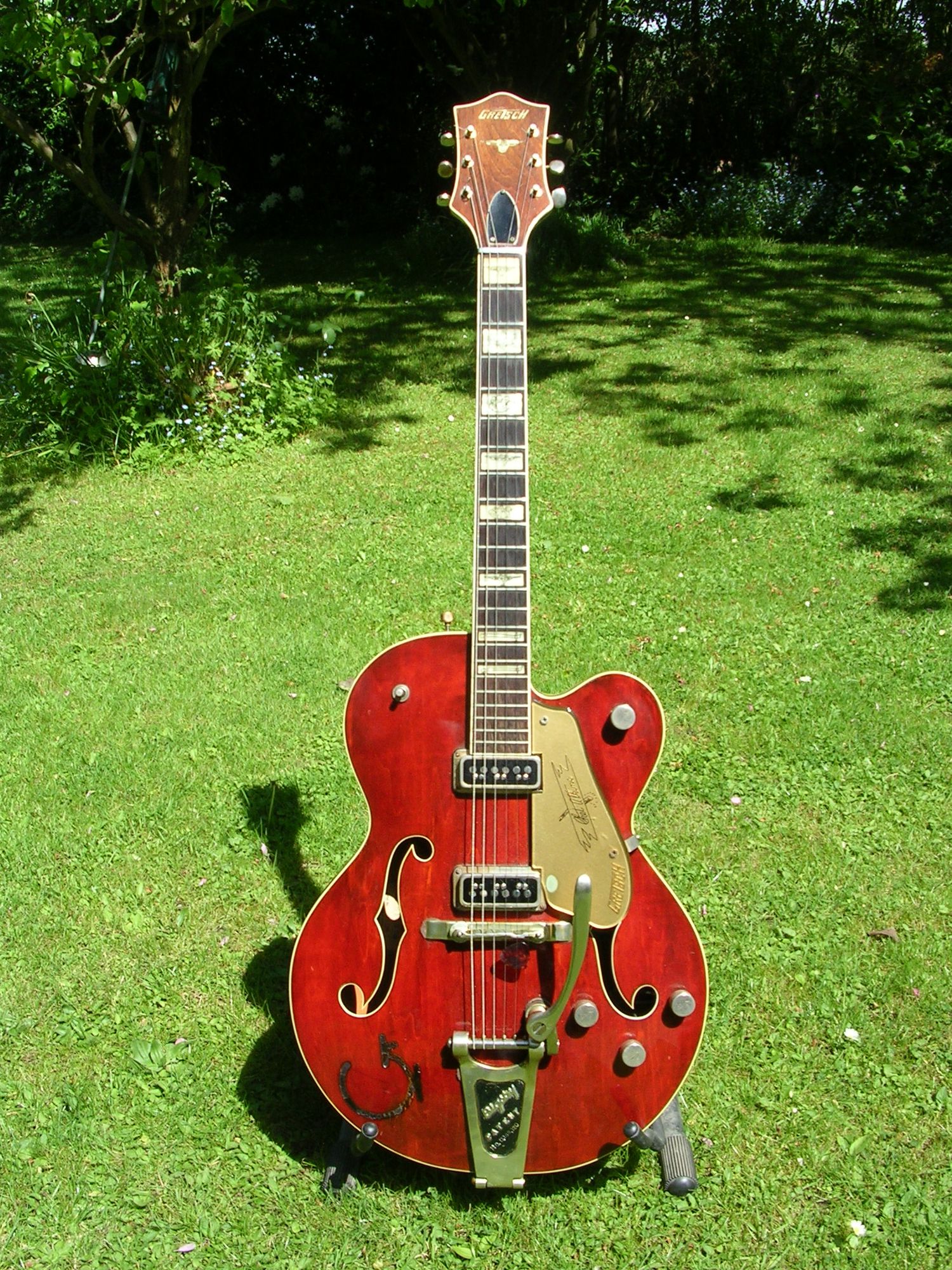
Gretsch 6120 G-Brand 1955. Photo by Francis pullen. Public domain (PD-self). Via Wikimedia Commons. Gretsch
6120
1955
Joe Walsh gave Pete Townshend one. Steve Miller gave Brian Setzer one. Chet Atkins just lent it his name.
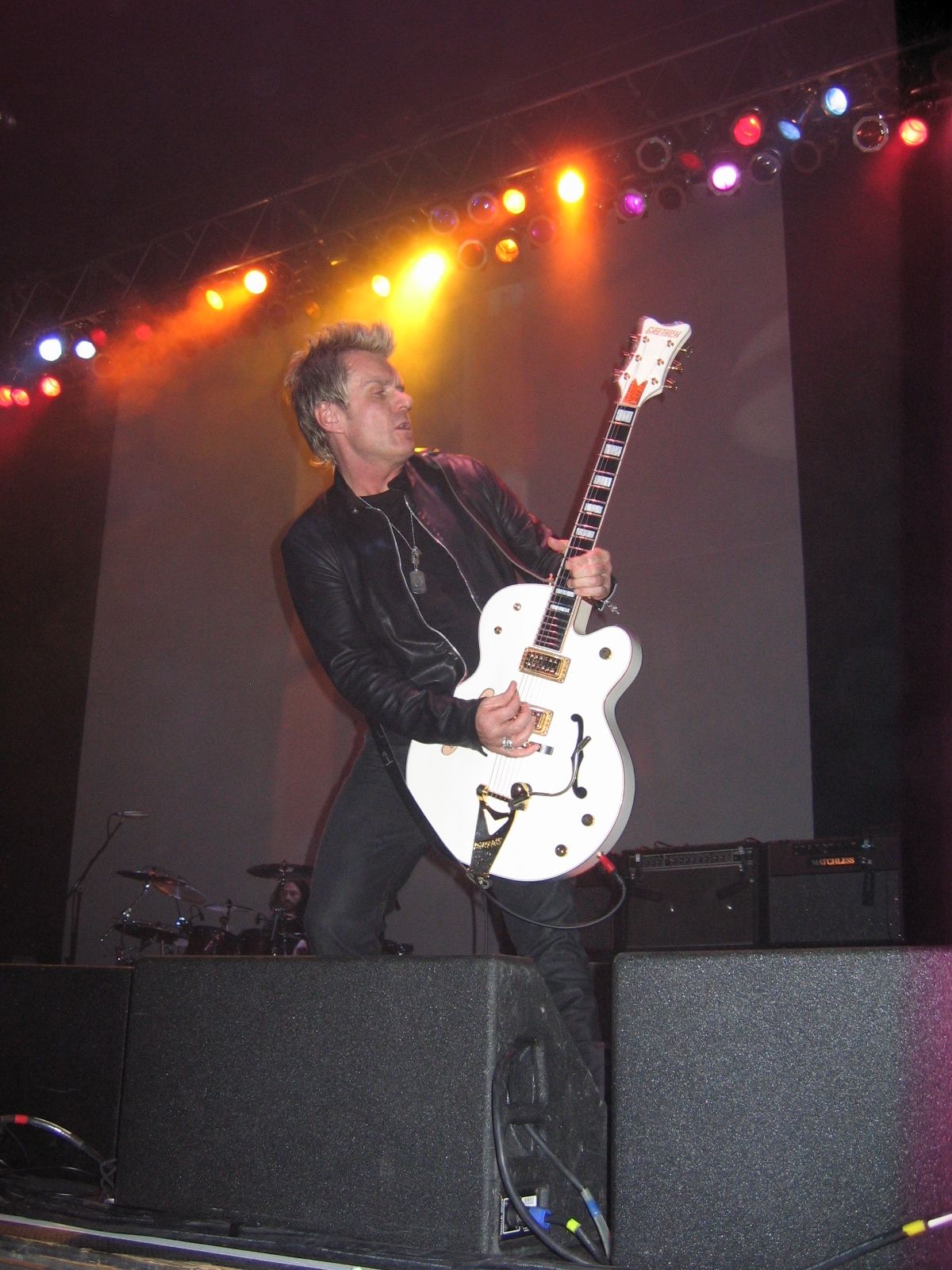
Photo: Veronica Perina / Wikimedia Commons / CC BY 3.0 Gretsch
White Falcon
1955
Gretsch built it to stop people in the aisle of a trade show. It never stopped doing that.