Gretsch
White Penguin
Gretsch barely bothered to sell it. So every White Penguin anybody knows about had to be found.
Nashville, 1972. Dan Fogelberg walks into GTR, George Gruhn’s first shop, and comes out with a white-and-gold Gretsch solidbody with a penguin standing on its pickguard. It’s a 1958, wired for stereo, and at that shop’s prices he wouldn’t have paid more than $1,000 for it.
- Introduced
- 1955
- Type
- Chambered solidbody electric
- Class
- Production
The short version
1955
A Falcon on a Jet
The White Penguin arrives, in 1955 or 1956 depending who you ask.
1959
One price list
$490, and nearly the only time Gretsch put it in print.
1961
Double-cut
A second cutaway and a gold Burns vibrato, in 1961 or 1962. The rarest Penguin of all.
1962
Gone
Discontinued in 1962 or 1964. Its model number went to a cheap slab called the Corvette.
1972
Fogelberg finds one
A 1958 stereo Penguin, bought at GTR in Nashville.
1980
Gilmour finds one
A tip reaches his camp, and a circa-1958 Penguin joins his collection.
2003
Back for good
After a brief return in 1993–94, Gretsch makes the Penguin again.
Side A
A1
The guitar nobody was selling
Most guitars that matter got a push. An ad, a catalog page, a star holding one on the cover. The White Penguin got almost none of that, and that’s the reason its story is all about the people who went and found one.
Gretsch, the Brooklyn company that had just made a splash with the White Falcon, left the Penguin out of its catalogs. It shows up on a 1958 flyer and a 1959 price list, and that’s about it. Nobody has turned up a photo of it at a trade show. Some people think the few that were made were custom orders placed through dealers. Nobody knows for sure.
So nobody was ever talked into a White Penguin. If you have one, you went looking.
A2
An old man in an overcoat
The idea was simple. Take the Falcon’s white paint, gold hardware, and gold sparkle, and put them on the smaller Duo Jet, a chambered mahogany “solidbody” Gretsch already knew how to build. One Gretsch expert calls them “essentially Jet model guitars.” The neck and headstock came from the Falcon, which is why the headstock looks too wide for the body and why the early ones needed a special case.
The sparkle came from the drum department. The headstock is covered in white plastic that stays bright while the painted body slowly turns the color of old piano keys, so an old Penguin can wear two shades of white at once.
And then there’s the pickguard. The Falcon’s bird is landing, wings out, talons first. The Penguin just stands there, as one description of Fogelberg’s guitar put it,
looking very much like an old man in an overcoat.
When did it arrive? 1955 or 1956, depending who you ask. One year map lists “introduction specs” for 1954, which isn’t the same as a year you could buy one. In June 1956 it listed at $475, when the Falcon was $650.
A3
Counting penguins
The early Penguins had DeArmond single-coils. By 1958 they had Filter’Trons, Gretsch’s humbuckers, and thumbnail-shaped inlays, and you could order one in stereo. In 1959 it listed at $490. A sunburst Les Paul that year was $265. This was not a guitar for beginners.
Around 1961 or 1962 it went double-cut, with a gold-plated Burns vibrato instead of a Bigsby. Those are the rarest Penguins of all. Then it was gone, in 1962 or 1964, and Gretsch handed the model number to a cheap slab-bodied guitar called the Corvette. Some penguin.
How many were made? Here’s where it gets good. Ask around and nobody agrees: “a few dozen,” fewer than 50 single-cuts, 12 to 15 single-cuts and eight to 10 double-cuts, or under 100 with 19 publicly accounted for. Gretsch never published totals, so nobody gets to average them into a fact. What everybody agrees on is that you will probably never see one outside a photograph.
Flip the record · By the numbers
$490
List price in 1959. The Falcon was $675, and a sunburst Les Paul was $265.
19
Vintage Penguins publicly accounted for, by one count. Estimates of how many were made run from a couple of dozen to under 100.
$1,000
About the most Fogelberg could have paid in 1972. A year later, GTR had sunburst Les Pauls at $1,200.
Side B
B1
Found in Nashville
In 1972, Dan Fogelberg found one at George Gruhn’s first shop. It was a 1958 in the middle of all the changes: early Filter’Trons, thumbnail inlays, the last of the vertical logos, and the stereo wiring. On his guitar the neck pickup only has poles for the three bass strings and the bridge pickup only for the three treble strings, so in stereo the low strings come out of one amp and the high ones come out of the other.
Fogelberg was a player, not a curator. He added a Bigsby, a Gibson-style bridge, and new tuners, “to make it more playable.” Collectors wince. I don’t. That’s a man who wanted to use the thing.
He did. The solo on “As the Raven Flies,” from Souvenirs in 1974, is the Penguin, and the guitar turns up again in his video for “The Language of Love.”
B2
Found again
In July 1980, David Gilmour got one the same way. His guitar tech, Phil Taylor, got a tip from Grover Jackson and a dealer named Tut Campbell, and a circa-1958 Penguin joined Gilmour’s collection. It was a home and studio guitar. Don’t go hunting for it on a Pink Floyd record; nobody’s tied it to one.
Gretsch brought the Penguin back briefly in 1993 and 1994, and for good in 2003. Stephen Stern of the Custom Shop has called it the shop’s most popular model, and Rival Sons’ Scott Holiday ordered a blue one with three pickups. You can walk into a store today and order a White Penguin, new, in a box. For most of forty years you couldn’t. You had to hear about one first, and then go.
Put this on
You’ve read about it. Now hear it. Here’s what this guitar sounds like, and what to listen for.
As the Raven Flies
From Souvenirs. The solo is Fogelberg on his 1958 Penguin, the one he found in Nashville.
Find it on YouTube (opens in a new tab)The Language of Love (video)
From Windows and Walls. The Penguin is the guitar in the video. Look for the white guitar with the gold trim.
Watch it on YouTube (opens in a new tab)
The cast
The people, and the specific guitars, that made the legend.
1956
Jimmie Webster
Namer and dresser
Gretsch’s designer-demonstrator. One history puts him in the planning meeting with Fred Gretsch and Duke Kramer.
1972
Dan Fogelberg
1958 stereo Penguin
Bought it at GTR in Nashville and played the solo on “As the Raven Flies” with it.
1972
George Gruhn
The shop
GTR was his first shop, and the place Fogelberg found his.
1980
David Gilmour
Circa-1958 Penguin
Bought for his collection after a tip. A home and studio guitar, not one tied to a Pink Floyd record.
Scott Holiday
Custom Shop triple-pickup Blue Penguin
The Rival Sons guitarist’s modern custom order. A new Penguin, not a Brooklyn original.
Liner notes
Specs, construction, rarity, value, and every source we used.
Falcon white and gold on a Jet-sized chambered body: a standing penguin on the guard, not a landing falcon, and not a 17-inch hollow.
- Body
- Chambered mahogany, arched laminated maple top, 2" (51 mm) deep. Official VS table omits width. Mix flagged.
- Neck
- Set mahogany “U”
- Fingerboard
- 12" (305 mm) ebony, 22 medium-jumbo, neo-classic thumbnails
- Scale
- 24.6" (625 mm)
- Pickups
- TV Jones Filter’Tron Classic
- Hardware
- Space Control on pinned ebony; Bigsby B3GB; Grover Imperial; gold; banjo armrest
- Electronics
- Two volumes, master volume, 3-way toggle, 3-position tone switch
- Finish
- Gloss nitrocellulose, Vintage White
- Nut
- Bone, 1.6875" (42.86 mm)
Open the full research fileConstruction details, the complete player record, production numbers, dated value estimates, and sources
Current typical player spec: G6134T-58 Vintage Select ’58 Penguin. A year-clone of the Filter’Tron single-cut, not the DeArmond first guitar. Limiteds, Custom Shop, the parlor G5021E Rancher Penguin, and the discontinued Japan G6134 ’56-clone are not this table. Mixed inch/mm flagged. Vintage width and scale live in Construction. Do not convert.
Construction
Gretsch White Penguin, vintage 6134: Duo Jet-class chambered mahogany, arched laminated maple top, Falcon white and gold, and a V-top peghead the Jet never wore. Not a 17-inch hollow. Not a Duo Jet with a paint job.
Keep the neighbors straight. 6136 White Falcon is the 17"-class hollow — same white/gold language, falcon on the guard with wings out, 25.5" scale. 6128 Duo Jet is this size class without Falcon trim. 6120 is the 16" Chet hollow. 6121 is the chambered Chet solid, Penguin’s analog as matching pair. Later 6134 Corvette reuses the number on a cheap slab. Not a Penguin. No Gibson SKU.
The job was Falcon cosmetics on a Jet body Gretsch already knew how to route. Vintage Guitar (Gruhn): Duo Jet structure except the peghead; shared ornament — white, gold-sparkle edge, Cadillac “G,” jeweled knobs. Guitar Player / David Davidson: “essentially Jet model guitars,” Falcon neck on a Jet body, which is why the headstock is wide and early examples needed a special case. Reverb News: sparkle from the drum department; white Nitron on the headstock stays bright while the painted body yellows. Fogelberg’s Vintage Guitar plate is the pickguard trap: Falcon landing, talons out; Penguin upright, “looking very much like an old man in an overcoat.”
Year of birth is split. Vintage Guitar: introduction 1955, through 1964. Davidson: 1955, same year as the Falcon, not on a price list until 1959. guitarhq’s “1954 White Penguin Introduction specs” is intro-spec language, not a proven 1954 retail year — same trap as the Falcon card. Tony Bacon (Guitar.com): planned for 1956 after the Falcon/6120 year; June 1956 list $475, Falcon $650. Reverb prints that list and follows Ed Ball 1956–1962. This plate starts in 1955. Keep 1954, 1955, and 1956.
It barely advertised itself. Gruhn: no catalog other than a 1959 price list ($490, Falcon $675) and a 1958 flyer (Project-O-Sonic, Filter’Trons, Space Control, thumbprints). Fogelberg’s plate: missing from 1955 Guitars for Moderns and every catalog after. Reverb: no trade-show photo in hand; speculation the few were dealer custom orders. Attribute; don’t certify.
Width: guitarhq 13 1/4"; Bacon, Reverb, Christie's Duo Jet template 13.5" / 13 ½". Range it. Official VS omits width. Scale: guitarhq vintage 24 3/4"; current VS 24.6" (625 mm). Do not convert. VS depth 2" (51 mm); early FMIC G6134 dealer sheets 1.75".
guitarhq intro: DeArmond single-coils, Cadillac “G,” gold Melita, pearl block inlays with engraved birds, vertical peghead. Banjo armrest typical; Gruhn notes some lack it. 1957: humptops replace blocks. Fogelberg / Reverb treat first-generation boards as feather-engraved hump-blocks — keep that against guitarhq’s block-then-humptop map.
Filter’Tron follows the Falcon/Jet split, not a unique Penguin date. guitarhq 1958. Fogelberg: late 1957. Reverb second generation ’58–’61: Filter’Trons, Space Control, thumbnails, tone switch, horizontal T-roof. guitarhq 1959: horizontal logo and zero fret. Gruhn: late ’58 the vertical logo ends; a metal model/serial plate lands on the peghead, Country Gentleman-style. Project-O-Sonic stereo optional 1958; Gruhn has found a couple, almost undoubtedly custom. Some wear stereo pickup spacing and are still wired mono.
Double-cut: guitarhq 1961 (standby switch). Gruhn: by ’62 single-cut is dropped. Reverb ’61–’62: lowest quantity, gold-plated Burns, not Bigsby. Gruhn: DC is the rarest Penguin; rarity and price are not the same thing. Discontinued is split: guitarhq and Gruhn 1964; Fogelberg some time in ’62; Reverb / Ed Ball 1962, number reassigned to Corvette. guitarhq’s Corvette 6134 is a 1963 slab. Keep 1962 and 1964.
Brooklyn originals are not Japan. Reverb: brief return 1993–1994, regular from 2003. The table is Japan Vintage Select: nitro, TV Jones Classics, Space Control, factory Bigsby B3GB. Vintage ’58 often still means Cadillac; Davidson: many Cadillac, his has a factory Bigsby, and a Bigsby’s aluminum will not be gold-plated. VS ’58 is a ’58 clone with a Bigsby. It is not a 1955 DeArmond Penguin. Custom Shop Penguins (Stephen Stern to Guitar.com: the Shop’s most popular model) are USA one-offs. The Rancher Penguin parlor is an acoustic. Neither is this table.
Players
Jimmie Webster named and dressed it. Bacon puts Webster, Fred Gretsch, and Duke Kramer in the 1956-model meeting. Endorser-inventor. Not a hit-record player on a 6134.
Dan Fogelberg — 1958 stereo 6134. Bought 1972 at GTR (Gruhn’s first shop), Nashville. Vintage Guitar: he would not have paid more than $1,000 then (1973 GTR lists: sunburst Les Pauls $1,200; a ’58 Explorer $1,000). Transitional ’58: Filter’Trons with “PAT APPLIED FOR” on the center tab, thumbprints, last vertical logo, early Project-O-Sonic pickup split (three bass poles on the neck unit, three treble on the bridge). He later added a Bigsby, a Gibson-style tune-o-matic, and Yamaha Rotomatic-style tuners “to make it more playable.” Vintage Guitar puts the Penguin solo on “As the Raven Flies” (Souvenirs, 1974) and the guitar in the video for “The Language of Love” (Windows and Walls). Named guitar, named sides. Not a price for ordinary 6134s.
David Gilmour — circa-1958 6134. Christie's / Reverb: bought July 1980 for the collection after Phil Taylor got a tip from Grover Jackson and dealer Tut Campbell. Home and studio. A 2001 snapshot exists. Not sourced here as a Pink Floyd master take. Christie's New York, 20 June 2019: $447,000. Artist lot. Not a comp.
Also known to play stays short. Scott Holiday (Rival Sons) ordered a triple-pickup Blue Penguin from Stern’s Custom Shop — Guitar.com photograph, USA custom, not a Brooklyn 6134. Scott Chinery owned a ’56-style example (Bacon); collector, not a session credit.
Do not dump 6120 or White Falcon players here. Eddie Cochran, Duane Eddy, Setzer’s Stray Cats guitar, Townshend Who’s Next — 6120s. Billy Duffy, Stephen Stills, Neil Young’s stereo single-cut — Falcons. Harrison is Country Gentleman / Tennessean / Duo Jet. Malcolm Young’s official Gretsch is the 1963 Jet Firebird.
Rarity
Japan Vintage Select / Professional Penguins are regular production. Not rare. Custom Shop and limited colors are limited current runs. They are not vintage rare.
Vintage factory yearly 6134 totals are unpublished. Serials are shared across Gretsch models. Do not treat serial ranges as Penguin counts.
Attributed non-factory estimates (label them): Vintage Guitar — no more than a few dozen, 1955–1964. Ed Ball via Reverb and Guitar.com — fewer than 50 single-cuts, 1956–1962, even fewer double-cuts; Christie's lot text, same researcher, at the very most 50. Guitar Player / Davidson — 12 to 15 single-cut and eight to 10 double-cut. Blue Book — less than 100 manufactured, nineteen publicly accounted. Keep all five. Do not average them into a factory total.
1955–57 DeArmond single-cuts are the scarce first object. 1958–61 Filter’Tron single-cuts are the finished-design single-cut, still tiny. Double-cut 1961/62 is the rarest shape (Gruhn). Stereo Project-O-Sonic examples are a handful. Original wide-peghead cases are scarce on their own. Artist-owned pieces are a separate market. Binding shrink and white-paint flake are the condition traps; Davidson: original gold sparkle should look octagonal under magnification — replacement binding is a tell.
Value
Informal estimate, 16 September 2026. Not an appraisal.
Factory yearly totals unpublished. Public 2024–26 solds for original White Penguins are thin. Prefer labeled asks over invented medians. Japan reissues are not 1950s 6134s. A Falcon is not a Penguin comparable. Gilmour’s hammer is not a price for ordinary 6134s.
Historical lists, not 2026 street: June 1956 $475 (Bacon); 1959 $490 vs Falcon $675 (Vintage Guitar) and vs a sunburst Les Paul $265 (VG; Reverb).
New street. G6134T-58 Vintage Select about $3,500 (manufacturer est. U.S. street $3,499.99; Sweetwater $3,499.99, was $3,799.99). Japan Professional, not a Brooklyn original. Limiteds and Custom Shop sit above that cart; don’t invent a midpoint.
Used modern. Reverb Price Guide on G6134T-58: estimated used $1,876–$2,938 (Good to Mint widget). Named 2026 solds on that page: 2 September Excellent $2,699; 13 July Excellent $2,550; 26 June Very Good $2,349; 22 May Mint $2,999. Used G6134 ’56-clones are Japan money, not 1955. Ask ≠ sold unless labeled.
Vintage / collectible. No 2024–26 Heritage/Carter/Dave’s/Bill’s hammer for a non-celebrity 1950s 6134 was captured. Named older marks, not a 2026 series: VG (2005) some more than $80,000; Davidson (2021) dealer talk $125,000–$150,000; a 1986 Gruhn appraisal on his ’58 at $88,000; Gitarre & Bass (2023) one clean example offered $180,000 — offer, not a hammer; vintagegretsch.com 1957 with 1960s white overspray $114,500 / sale $94,500 — refin ask. Do not average those into a median.
Christie's June 2019 Gilmour $447,000 is one artist lot. Not a comp. Fogelberg’s stereo 6134 is a market factor. Not a price for ordinary 6134s.
Filters: Brooklyn vs Japan vs Custom Shop; single-cut vs double-cut; DeArmond vs Filter’Tron vs replaced; Cadillac vs Bigsby vs Burns; original white vs overspray vs binding replacement; stereo vs mono-with-stereo-spacing; 6134-number Corvette trap.
See also
- gretsch-white-falcon — the 17" hollow this Jet-sized white/gold guitar is not
- gretsch-duo-jet — the chambered sibling without Falcon trim
- gretsch-6120 — the 16" Chet hollow this is also not
Sources
- guitarhq, Gretsch 6134 year map — 1954 intro-spec block; 13 1/4"; 24 3/4"; DeArmond / Cadillac / Melita; 1957 humptops; 1958 Filter’Tron / thumbprints / bar bridge; 1959 horizontal logo + zero fret; 1961 double-cut; discontinued 1964; later 6134 Corvette
- Vintage Guitar, Gruhn, Gretsch 6134 White Penguin — 1955–1964; few dozen; 1959 list $490 / Falcon $675; 1958 flyer; Jet structure + Falcon ornament; armrest; 1958 wiring; late-’58 horizontal logo + peghead plate; DC by ’62 rarest; some >$80,000 (2005)
- Vintage Guitar, Gruhn, Dan Fogelberg’s White Penguin — solidbody Falcon companion; 1955 catalog absence; 1958 flyer / 1959 $490; late-1957 Filter’Trons; 1972 GTR purchase; Souvenirs / “As the Raven Flies”; “The Language of Love” video; stereo pole split
- Reverb News, The Story of the Gretsch White Penguin — Jet 13.5" chambered maple/mahogany; Falcon companion; Ed Ball <50 (1956–1962); 1956 list $475; 1959 $490; three generations; Burns not Bigsby on DC; 1993–94 / 2003 return; VS ’58 current; Gilmour $447,000
- Guitar.com, Tony Bacon, Rare Bird — 1956 launch; June ’56 $475; 13.5"; Webster meeting; Ed Ball <50 SC; Stern Custom Shop popularity; Chinery; Gilmour $447,000
- Guitar Player / David Davidson, Well Strung — 1955; 12–15 SC / 8–10 DC; 2021 $125–150k talk; 1986 Gruhn $88k; Jet body + Falcon neck; sparkle-octagon tell
- Christie's, Gilmour 6134 lot — circa 1958; Duo Jet 13 ½" template; Ed Ball at most 50; July 1980 purchase
- G6134T-58 Vintage Select ’58 Penguin — current Japan VS spec; $3,499.99 est. U.S. street; 2" (51 mm); 24.6" (625 mm); TV Jones Classic; Space Control; Bigsby B3GB
- Gretsch Penguin family — VS ’58 plus limiteds, Hendroff signature, Rancher parlor; not a single SKU
- Sweetwater, G6134T-58 — $3,499.99 street; banjo armrest; TV Jones Classic
- Reverb Price Guide, G6134T-58 — used $1,876–$2,938 widget; named 2026 solds
- Gitarre & Bass, 1956 White Penguin — one clean offered $180,000 (2023); Gilmour $447,000
- vintagegretsch.com, 1950s White Penguin — 1957 overspray ask $114,500 / $94,500; Mandolin Brothers 1992 $70,000; Chinery $80,000
- Blue Book, White Penguin series — 1956 trade show; <100 / 19 accounted; mfg 1955–1964
- Gretsch blog, VG features 6134 — VG few-dozen / 1955–1964 restatement
Keep digging
Guitars this one gets compared to, confused with, or descended from.
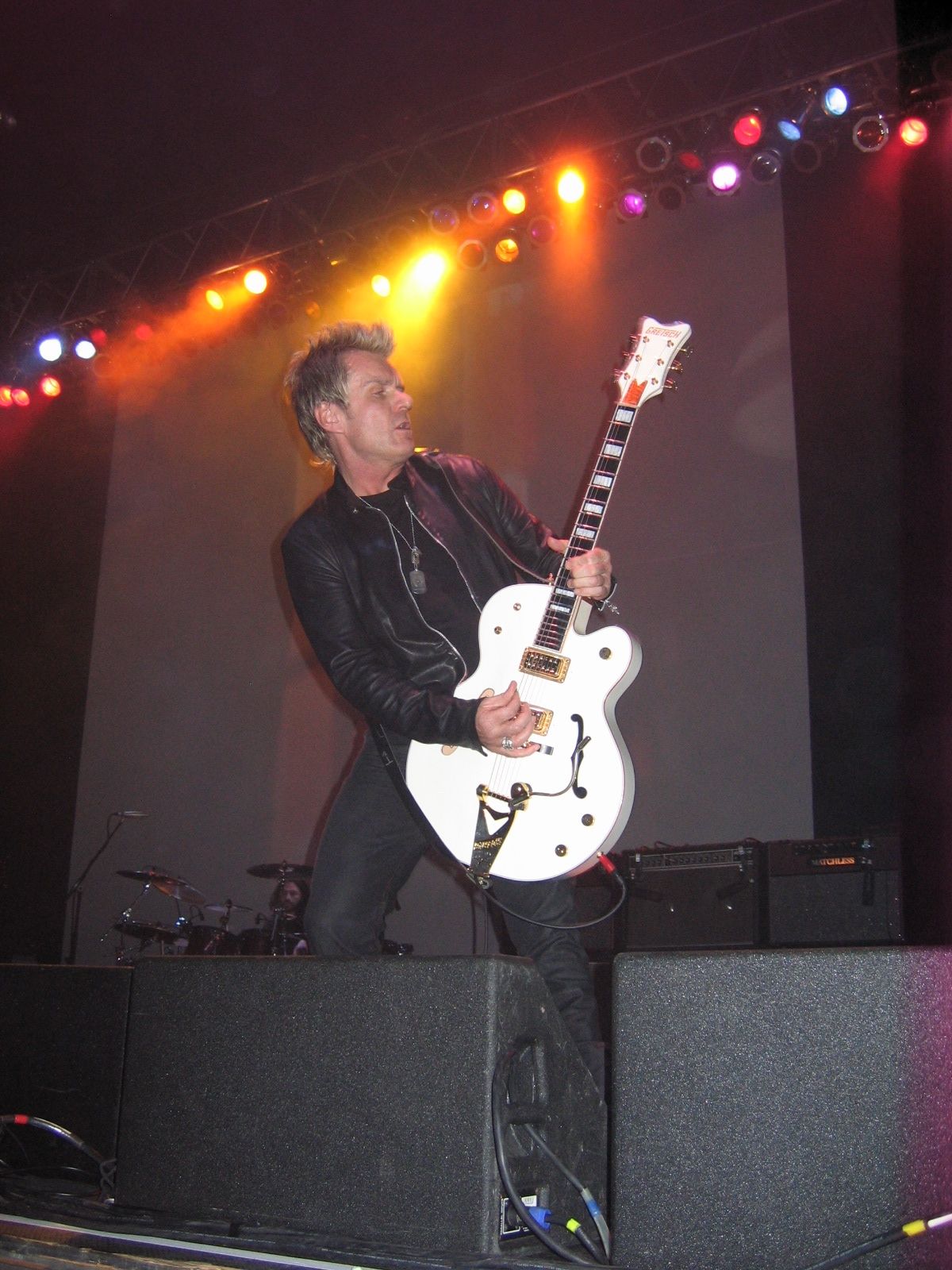
Photo: Veronica Perina / Wikimedia Commons / CC BY 3.0 Gretsch
White Falcon
1955
Gretsch built it to stop people in the aisle of a trade show. It never stopped doing that.

Photo: Raph_PH / Wikimedia Commons / CC BY 2.0 Gretsch
Duo Jet
1953
George Harrison bought his used in Liverpool as a teenager. In 1987 he put it on an album cover.
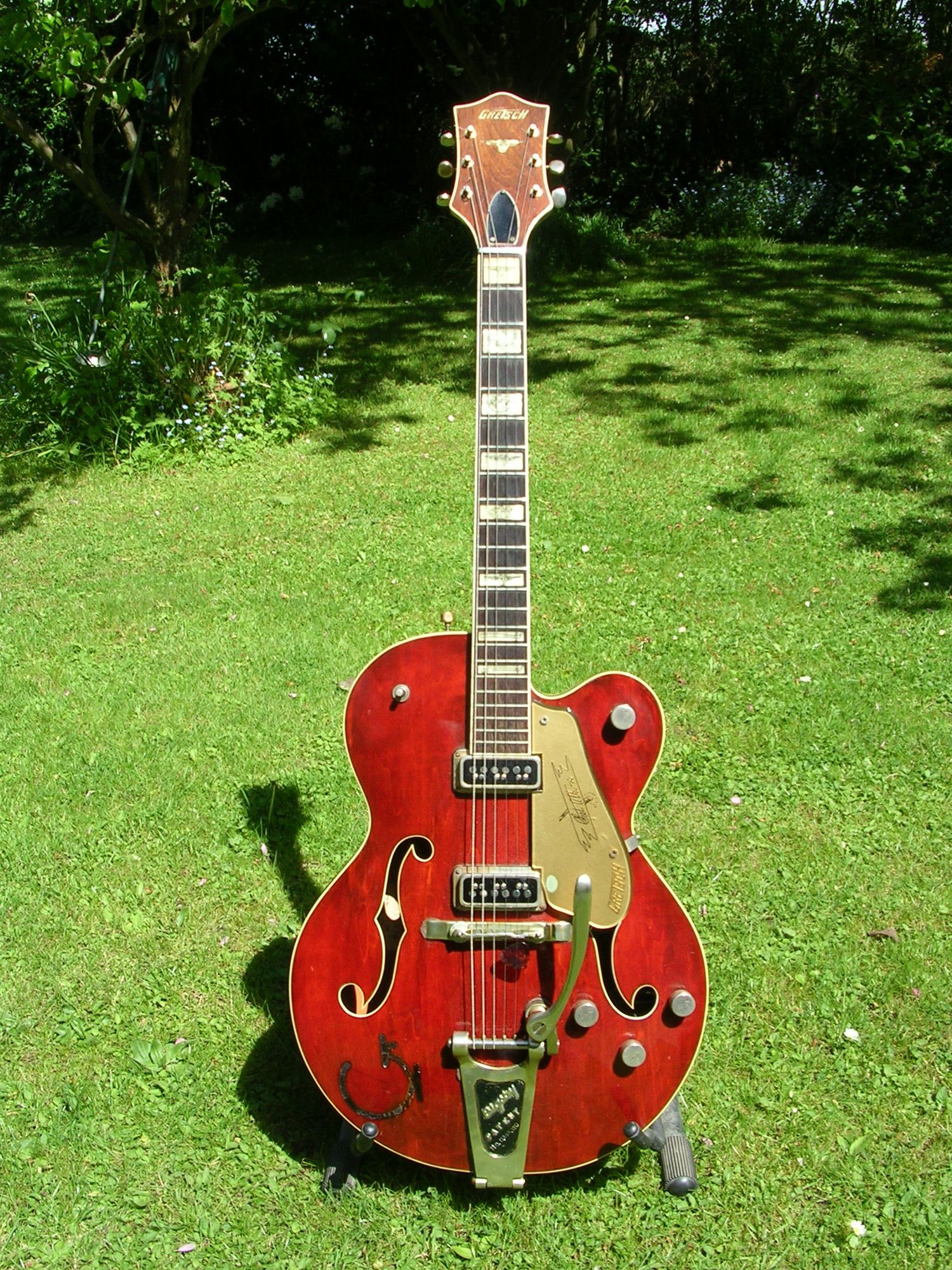
Gretsch 6120 G-Brand 1955. Photo by Francis pullen. Public domain (PD-self). Via Wikimedia Commons. Gretsch
6120
1955
Joe Walsh gave Pete Townshend one. Steve Miller gave Brian Setzer one. Chet Atkins just lent it his name.