Coral
Electric Sitar
Built so a session player could fake a sitar before lunch. Some of those afternoons are still on the radio.
New York, the late ’60s. George Harrison has put a real sitar on “Norwegian Wood,” Brian Jones has put one on “Paint It, Black,” and now every producer wants that buzz on a record by Tuesday. Vinnie Bell, the guitarist those producers call first, doesn’t have a lifetime to learn raga. So he and Nathan Daniel of Danelectro build a shortcut.
- Introduced
- 1967
- Type
- Solidbody electric
- Class
- Production
The short version
1966
MCA buys Danelectro
The new owner wants a prestige badge. It borrows the name of a record label, Coral.
1967
Launch
Corals premiere at the June NAMM show. The Electric Sitar lists at $295.
1969
Patent and shutdown
The buzz-bridge patent finally issues. The Neptune plant closes the same year.
1972
“Do It Again”
Denny Dias plays a borrowed Coral on the Steely Dan solo.
1974
Drury Lane
Steve Hackett is photographed with one onstage with Genesis in London.
2011
The copies stop
Jerry Jones ends its run of replicas. Danelectro’s own reissue carries on.
Side A
A1
A sitar by Tuesday
Most guitars are bought to last a lifetime. You pick one, you grow into it, it gets your sweat in the finish. The Coral Electric Sitar was built for something much smaller than a lifetime: an afternoon.
Here was the problem in the late ’60s. The Beatles and the Stones had put real sitars on hit records, and everybody wanted the sound. But a real sitar takes years to learn, and a session player has one date and a producer tapping his foot. Vinnie Bell was New York’s first-call guy for exactly those dates. He worked it out with Nathan Daniel at Danelectro: an electric guitar that tuned like a guitar and slapped like a sitar.
No raga required. Just plug in and buzz.
A2
Thirteen strings nobody plays
MCA had bought Danelectro in 1966 and wanted something a little fancier than the masonite student guitars the company was known for. It named the new line Coral, after one of its record labels. Corals premiered at the June 1967 NAMM show, and the Electric Sitar launched, in one writer’s phrase, “in a blaze of publicity in mid ’67.” List price: $295.
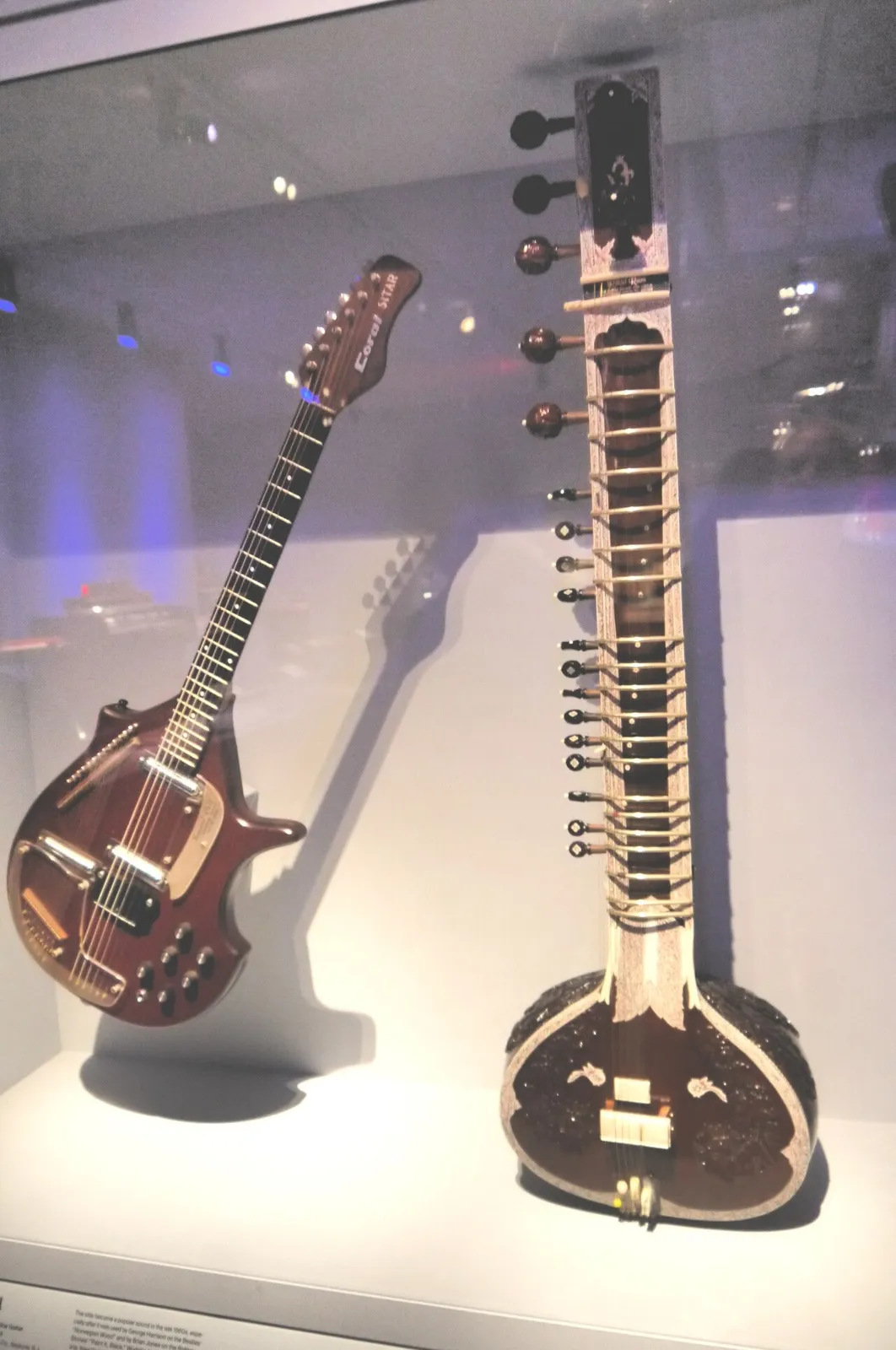
It looks like nothing else. A teardrop body with a horn on the treble side, a floating pickguard with Bell’s signature on it, and usually a crinkly red finish called Bombay Red. The body is masonite over a pine frame, or poplar, depending who you ask. Take your pick.
Then there are the extra strings. Thirteen of them, on their own tuning pegs, with their own lipstick pickup. The owner’s manual promised they would “respond to the vibrations of the main strings transmitted through the sitar body.” Chris Gill of Guitar World put it more kindly than I would: the thirteen sympathetic strings “seemed like a good idea but never really resonated effectively.”
So players strum them. The patent even suggests it: you may “strum across the series of non-fingered strings.” Honestly, it’s more fun that way.
A3
The bridge is the whole trick
The real sitar sound comes from the bridge. Bell and Daniel called theirs the Sitarmatic, and their patent describes a wide, gently curved surface that the strings slap against as they vibrate, something “far different from the function of conventional guitar bridges.” That slap is the buzz. It’s the whole instrument.
It’s also why the thing is notoriously hard to play in tune. A nearly flat plastic bridge doesn’t care much about intonation. Three volume knobs, three tone knobs, no pickup selector. You didn’t dial in a Coral. You turned it up and let it buzz.
Flip the record · By the numbers
$295
List price at launch in 1967. More than twice the later Baby Sitar’s $139.
13
Sympathetic drone strings, tuned with a harp wrench. Players end up strumming them by hand.
3
Lipstick pickups. Two for the six playing strings, one just for the drones. No selector switch.
$50
What Pip Williams paid for the pawn-shop Coral that Steely Dan borrowed.
Side B
B1
“The thing would not drone”
My favorite Coral story is Steely Dan’s. They wanted a drone like a Beatles sitar for the solo on “Do It Again,” from Can’t Buy a Thrill in 1972. Denny Dias got the job.
I only saw the Coral for a few hours, on the day we recorded that solo.
“The thing would not drone,” he said. So he played licks on it instead, and that’s the solo. The guitar itself came from Pip Williams, who had picked up a Coral in a pawn shop across from the Village Recorder for $50. Steely Dan borrowed it.
Bell, meanwhile, made a whole Decca album called Pop Goes the Electric Sitar. The Lemon Pipers’ “Green Tambourine” turns up on lists of Bell’s electric-sitar records. “Band of Gold” by Freda Payne is either Bell or Dennis Coffey, depending who you ask.
B2
Borrowed, overdubbed, and bought for the road
Once rock guys found it, they mostly used it the way it was built to be used: for a part, a color, a few bars. Eddie Van Halen tucked one in the background under the solos of “Ain’t Talkin’ ’Bout Love.” Twenty years later he brought it back for “Primary,” from Van Halen III, with the sympathetic strings tuned to the melody. Steve Howe used one for chordal rhythm on Yes’s Close to the Edge. Steve Hackett had one onstage with Genesis at Drury Lane in January 1974.
Rory Gallagher went further. He hired a 1968 Coral for the road, then bought it in New York for $1,500. It’s on “Philby.”
And one more, for the trivia file. Nat Daniel said that in twenty-plus years Danelectro built exactly one left-handed instrument. It was a Coral Electric Sitar, for Jimi Hendrix.
B3
Still on the radio
The Coral didn’t last long. The Neptune plant closed in 1969, and the brand went with it. The patent issued the same year, which is a very Danelectro bit of timing. Nobody published how many were made. Danelectro sells a replica today, Jerry Jones made copies until 2011, and none of them has Coral on the headstock.
That’s fine. It was never meant to be anyone’s one guitar. It was meant to walk into a session, buzz for a few bars, and go back in the case. Denny Dias had his for an afternoon. The afternoon is still on the radio.
Put this on
You’ve read about it. Now hear it. Here’s what this guitar sounds like, and what to listen for.
Do It Again
The solo is Denny Dias on a Coral he had for a few hours. The drone never showed up. Listen for the slap of the strings on that flat bridge instead.
Find it on YouTube (opens in a new tab)Ain’t Talkin’ ’Bout Love
Eddie Van Halen overdubbed the Coral in the background under the solos. It’s the reedy, buzzing shadow behind the lead.
Find it on YouTube (opens in a new tab)Philby
Gallagher’s 1968 Coral, a guitar he hired for the road and then bought in New York.
Find it on YouTube (opens in a new tab)
The cast
The people, and the specific guitars, that made the legend.
1967
Vinnie Bell
Designer
The New York session player who co-designed it with Nathan Daniel, then made a whole Decca album of it, Pop Goes the Electric Sitar.
1972
Denny Dias
A borrowed Coral
Played the “Do It Again” solo on it. By his account he had the guitar for a few hours.
1978
Eddie Van Halen
Coral Electric Sitar
A background overdub on “Ain’t Talkin’ ’Bout Love,” and later “Primary” from Van Halen III.
1972
Steve Howe
Coral Electric Sitar
Chordal rhythm parts on Yes’s Close to the Edge.
1979
Rory Gallagher
1968 Coral Electric Sitar
Hired it for touring, then bought it in New York for $1,500. It’s on “Philby.”
Liner notes
Specs, construction, rarity, value, and every source we used.
A Sitarmatic buzz bridge, thirteen drone strings, and three lipsticks — Coral’s Electric Sitar, not Danelectro’s two-lipstick ’59.
- Body
- Teardrop with treble horn; semi-hollow masonite over pine (RetroFret; Vintage Guitar). guitarhq: semi-hollow poplar. Mix flagged.
- Neck
- Bolt-on poplar, Brazilian rosewood board (guitarhq 1956–69 method; RetroFret). Mix flagged.
- Fingerboard
- Rosewood, 21 frets, dots (Gruhn / Vintage Guitar; Blue Book)
- Scale
- 25" (635 mm) on RetroFret’s 1967, serial 8017. Mix flagged.
- Pickups
- Three lipstick-tube single-coils: two for the six play strings, one for the drones
- Hardware
- Sitarmatic buzz bridge; six-on-a-side Kluson Deluxe; 13 drone strings on metal friction pegs, harp wrench; floating lucite Bell Signature Design guard
- Electronics
- Three volumes, three tones; no pickup selector (Premier Guitar)
- Finish
- Textured Bombay Red / red crackle typical
- Nut
- 1¾" (44 mm) RetroFret. Mix flagged.
Open the full research fileConstruction details, the complete player record, production numbers, dated value estimates, and sources
Classic living example = 1967–69 Coral Vincent Bell Electric Sitar (Neptune, N.J.; 3S18 / 3S19 in the literature). No current Coral SKU this pass. Evets’ living Danelectro Sitar (danelectro.com, fetched 3 September 2026) is a later replica — Danelectro on the headstock, Gotoh bridge — not this table. Baby Sitar is the 1968 Danelectro one-pickup gourd without drones. danelectro-59 is the two-lipstick shorthorn 3021. No Gibson SKU. Mixed inch/mm flagged on RetroFret’s measured guitar (overall 39⅜" (100 cm), lower bout 13¾" (34.9 cm), depth 1½" (3.8 cm), scale 25" (635 mm), nut 1¾" (44 mm)).
Construction
The job was a sitar a guitarist could play. George Harrison had put a real one on “Norwegian Wood.” Brian Jones put one on “Paint It, Black.” Session players needed the buzz on a Tuesday date without a lifetime of raga. Vinnie Bell, New York first-call, and Nathan Daniel at Danelectro built an electric that tuned like a guitar and slapped like a sitar.
MCA bought Danelectro in 1966 (guitarhq; Vintage Guitar). Coral is MCA’s prestige badge, named for a record label, not a second factory. Vintage Guitar (Peter Stuart Kohman, Part 1): Corals premiered at the June 1967 NAMM show. Tony Bacon (Reverb News, 20 July 2020): the Coral Sitar launched in 1967, list $295. Chris Gill (Guitar World, 3 February 2023): the Coral Vincent Bell Electric Sitar, introduced 1967. Kohman’s Part 2 caption dates the 3S19 to ’68; the same article says the Electric Sitar “was launched in a blaze of publicity in mid ’67.” Keep both. RetroFret’s example has an internal 1967 date code on the neck heel and a Patent Pending sticker. This plate starts in 1967.
What they built is Danelectro method on a new silhouette. Kohman: semi-hollow masonite/pine, evolved from Bell’s Bellzouki. RetroFret: masonite and pine, poplar neck, rosewood board, Neptune. guitarhq: “Body is made entirely from Poplar, with a semi-hollow construction,” three-point body, crinkle burgundy. Keep both woods. Gruhn (Vintage Guitar, June 2015): teardrop with treble horn, Sitarmatic, Kluson Deluxe, floating Bell Signature Design guard, Textured Bombay Red, Patent Pending on the headstock back. The owner’s manual, quoted by Gruhn: the drones “respond to the vibrations of the main strings transmitted through the sitar body.”
The sound is the bridge. Bell and Daniel’s patent, filed 1967, issued 1969 as US 3,422,715 (Gambella / Daniel): a wide, convexly arcuate surface the strings slap, “far different from the function of conventional guitar bridges.” Bacon: the almost-flat plastic bridge did create the buzz and made the guitar notoriously hard to intonate. Gill: the 13 sympathetic strings “seemed like a good idea but never really resonated effectively.” Players harp them instead. Premier Guitar (Dan Orkin, 25 August 2019): no selector; six knobs; the patent notes you may “strum across the series of non-fingered strings.”
Not Danelectro’s ’59 (danelectro-59). That plate is the two-lipstick shorthorn 3021 family. Same lipstick tubes, same Neptune plant, different job. Not the Baby Sitar. Kohman: 1968 Danelectro-brand cut-down — solid gourd, one bridge pickup, no drones, list $139, “less than half of the $295 Coral model,” in production less than a year. “Only a hundred or so may ever have been made” is that guitar, not this one. Not the living Danelectro Sitar. danelectro.com (3 September 2026): “Reissue of the famous Danelectro® big Sitar of the 1960’s.” Sweetwater Red Crackle $849, backordered, estimated November 2026. zZounds: Coral shape, composite/plywood hollow, maple/pau ferro, 24.75" scale, Gotoh sitar bridge, three Lipstick tubes. Gill calls it an affordable replica of the original Coral Vincent Bell model. Later object. Jerry Jones copies ran until 2011 (Bacon). Italia Modena is Wilkinson’s Coral-style drone bout. None of those is a 1967 Neptune Coral.
Classic vs current: 1967–69 Coral — masonite, Sitarmatic, 13 drones, Bombay Red — against no new Coral you can order in 2026. The Danelectro Sitar on the Evets cart is the living cousin.
Players
Do not recruit Jimmy Page’s Met 1961 3021. That lives on danelectro-59. Do not hang Harrison’s “Norwegian Wood” or Jones’s “Paint It, Black” on this guitar; those are real sitars. Do not flatten every electric-sitar credit onto a Coral without a named instrument.
Vinnie Bell. Designer. Gruhn: Pop Goes the Electric Sitar on Decca, MCA cross-promotion. Bacon’s ten: Lemon Pipers “Green Tambourine”; Freda Payne “Band of Gold” is Bell or Dennis Coffey — keep both.
Denny Dias (Steely Dan). Bacon, quoting Dias: Coral on the “Do It Again” solo, Can't Buy a Thrill (1972). “I only saw the Coral for a few hours, on the day we recorded that solo.” They wanted a drone like a Beatles sitar. “The thing would not drone.” Then the licks. Pip Williams, same article: pawn-shop Coral for $50 across from Village Recorder; Steely Dan borrowed it. Serial 820015 is Williams’s later guitar, not a census.
Eddie Van Halen. Gill: background overdub on the solos of “Ain’t Talkin’ ’Bout Love.” Gruhn same. Primary on Van Halen III: Gill, quoting Van Halen in 2013, tuned the sympathetic strings to the melody, sitar against Auratone monitors, MXR Dyna Comp.
Steve Howe (Yes). Gill: chordal rhythm on Close to the Edge and other Yes. Gruhn: Yes.
Steve Hackett (Genesis). Gill photo: Coral, Theatre Royal, Drury Lane, January 1974.
Rory Gallagher. Guitar World (Jamie Dickson, 27 September 2024), Donal Gallagher: 1968 Coral 3S19 on “Philby.” Hired for the road, then bought in New York for $1,500. “Reputedly only around 50 were ever made” is that article’s touring-rarity claim, not a factory total.
Also known to play stays short. Gill: Metallica “Wherever I May Roam”; Steve Vai “For the Love of God.” Bacon names Eddie Willis on Stevie Wonder “Signed, Sealed, Delivered I’m Yours,” Joe South “Games People Play,” Reggie Young on the Box Tops’ “Cry Like a Baby.” Album-to-guitar credits beyond those named interviews are unpublished here. None invented. Nat Daniel, to Gruhn in the ’80s: Danelectro built one left-handed instrument in twenty-plus years — a lefty Coral electric sitar for Hendrix. One object. Not a vintage Coral.
Rarity
You cannot buy a new Coral. The brand died with the Neptune plant in 1969 (guitarhq; Kohman). Living Danelectro Sitar and Baby Sitar reissues are other factories on related silhouettes. They are not a 1967 Vincent Bell Coral.
Danelectro and MCA do not publish Electric Sitar totals. None invented. guitarhq: Coral serials are often a silver-foil sticker, six digits starting 7, 8, or 9, likely year for ’67–’69; some peeled off. They date a guitar. They don’t count a year. That is why a census is unknown, not the chapter.
What is actually thinner: first-year 1967 Patent Pending examples (RetroFret); complete outfits with the original case and harp wrench; the 1968 Baby Sitar Kohman puts at “a hundred or so.” Guitar World’s “around 50” is reputedly, attributed, not a ledger. Hendrix’s lefty, if it survives, is a unique object. Dias’s session guitar and Gallagher’s 3S19 are unique objects. They are not a vintage Coral.
Value
Informal estimate, 3 September 2026. Not an appraisal.
Ask vs sold labeled. Celebrity lots are not-comps. No invented medians or factory counts. Period list $295 (Bacon; Kohman) is 1967 money, not 2026 street. Williams’s $50 pawn and Gallagher’s $1,500 New York buy are what two people paid for two guitars.
New street. None under Coral. Living typical of the replica is Danelectro Sitar. Sweetwater Red Crackle $849, backordered, estimated November 2026. zZounds Black / Red / White Crackle $849. That cart is not this table.
Used modern. Jerry Jones stopped in 2011. Later Italia / Agile copies are other guitars. No modern Coral production to make a used-modern band.
Vintage / collectible. Reverb Price Guide on Coral Vincent Bell Electric Sitar did not print a clean Good-to-Mint band this pass. Don’t invent a midpoint. Named asks, not hammers: David’s Gear Locker mint-looking 1960s $1,800 (missing a string); Lyon listing $3,565.16; Premier Guitar, 2019, “around $3,000” on a Music Zoo red crackle. Premier Guitar’s “New, our instrument listed at $139” is the Baby Sitar mash with the Coral — Kohman has Baby $139, Coral $295. Do not average those asks. Gallagher’s 3S19 and a Hendrix lefty, if they surface, are not comps.
See also
- danelectro-59 — the two-lipstick shorthorn 3021; same lipstick idea, not the thirteen-drone Coral
- silvertone-1448 — Sears’ one-lipstick amp-in-case; Danelectro-for-Sears, not Coral
- ampeg-dan-armstrong — Dan Armstrong bought leftover Neptune parts after 1969; not this sitar
Sources
- Vintage Guitar, George Gruhn, Coral Electric Sitar (June 2015) — Bell/Daniel; six play + 13 drones; Sitarmatic; Bombay Red; Hendrix lefty; Van Halen, Howe, Gallagher, Metallica, Guy
- Vintage Guitar, Peter Stuart Kohman, The Last Days of Danelectro, Part 1 — MCA 1966; Coral at June 1967 NAMM; Bell Electric Sitar promoted 1967–68; Pop Goes the Electric Sitar
- Vintage Guitar, Peter Stuart Kohman, The Last Days of Danelectro, Part 2 — mid-’67 launch; two years; masonite/pine; Bombay Red; $295; Baby Sitar 1968 $139 / ~100; 3S19 caption ’68
- Reverb News, Tony Bacon, Electric Sitars of the Psychedelic Era (20 July 2020) — 1967 launch $295; patent; drones theoretical; Dias “Do It Again”; Williams $50 / serial 820015; Jerry Jones to 2011
- Guitar World, Chris Gill, 3 February 2023 — introduced 1967; buzz bridge; 13 strings ineffective as drones; three lipsticks; Dias, EVH, Howe, Hackett 1974, Metallica, Vai; living Danelectro replica
- Guitar World, Jamie Dickson, 27 September 2024 — Gallagher 1968 3S19; “Philby”; reputedly ~50; $1,500 NY
- Premier Guitar, Dan Orkin, Vintage Vault, 25 August 2019 — Sitarmatic; 13 drones; no selector; ~$3,000 ask; EVH “Ain’t Talkin’ ’Bout Love”
- guitarhq, Danelectro / Silvertone / Coral — MCA 1966; Coral 1967; plant 1969; Vinnie Bell Coral Sitar 1967–69; poplar semi-hollow; 13 drones; three pickups; Danelectro Sitar 1967–69 no drones
- RetroFret, 1967 Coral Sitar #8017 — Neptune; 1967 heel code; masonite/pine; poplar/rosewood; 39⅜" / 13¾" / 1½"; scale 25" (635 mm); nut 1¾" (44 mm)
- Danelectro, Sitar & Resonator — living Sitar as “Reissue of the famous Danelectro® big Sitar of the 1960’s”
- Sweetwater, Danelectro Sitar Red Crackle — $849; backordered, estimated November 2026; 24.75" scale; Gotoh; three lipsticks
- zZounds, Danelectro Electric Sitar — $849; Coral shape; 24.75"; pau ferro; Gotoh; three Lipstick tubes
- Wikipedia, Electric sitar — Coral 1967; US 3,422,715; lead only
- Reverb, Coral Vincent Bell Electric Sitar — 1967–1969; Price Guide widget unpublished this pass; named ask $1,800
Keep digging
Guitars this one gets compared to, confused with, or descended from.
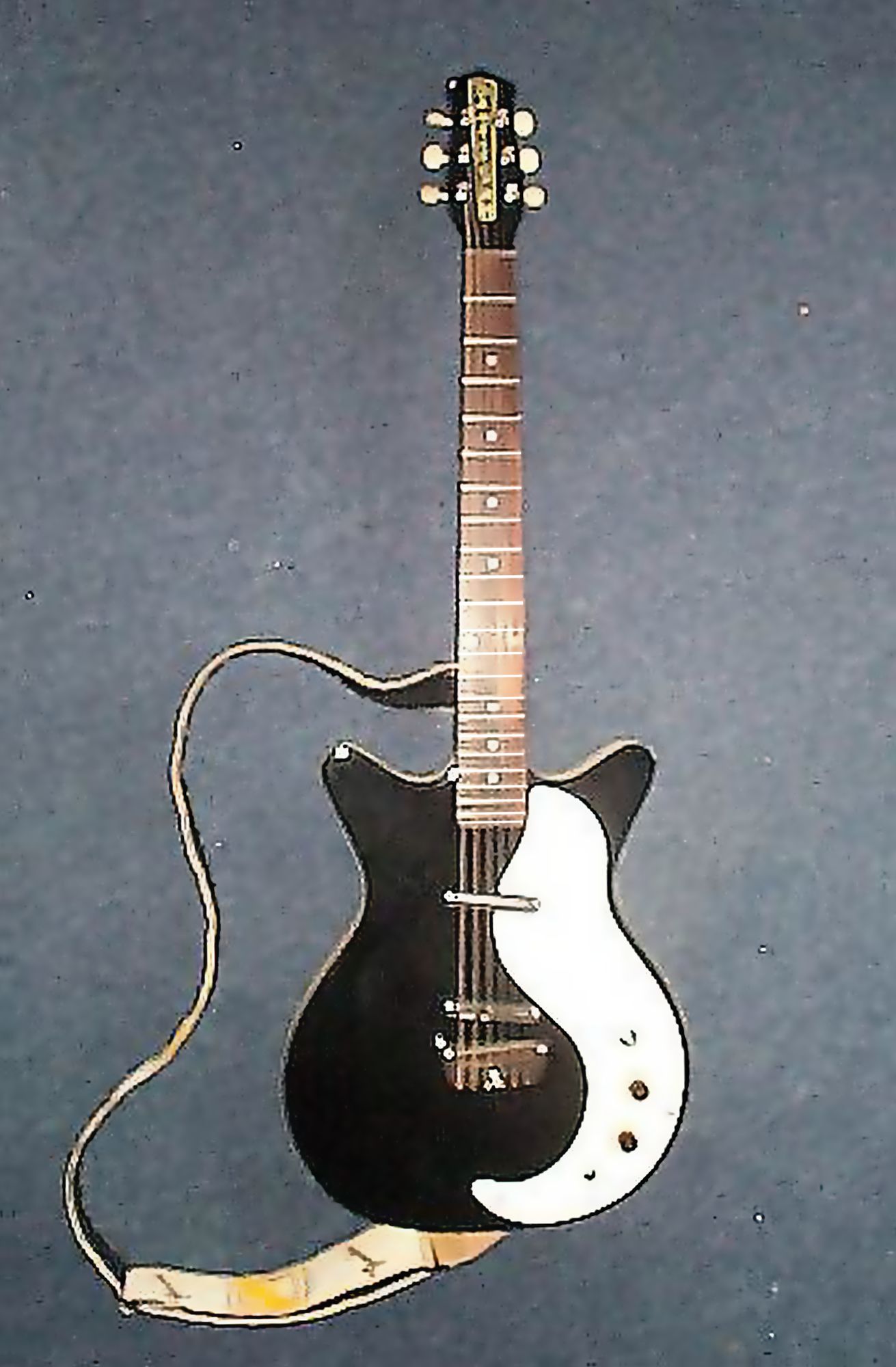
Danelectro 59-DC. Photo by Sander van Malssen. Licensed under CC BY-SA 2.0. Via Wikimedia Commons. Danelectro
59
1958
Jimmy Page’s has been shown at the Met. The same two lipsticks and coke-bottle head are hanging on a shop wall near you.
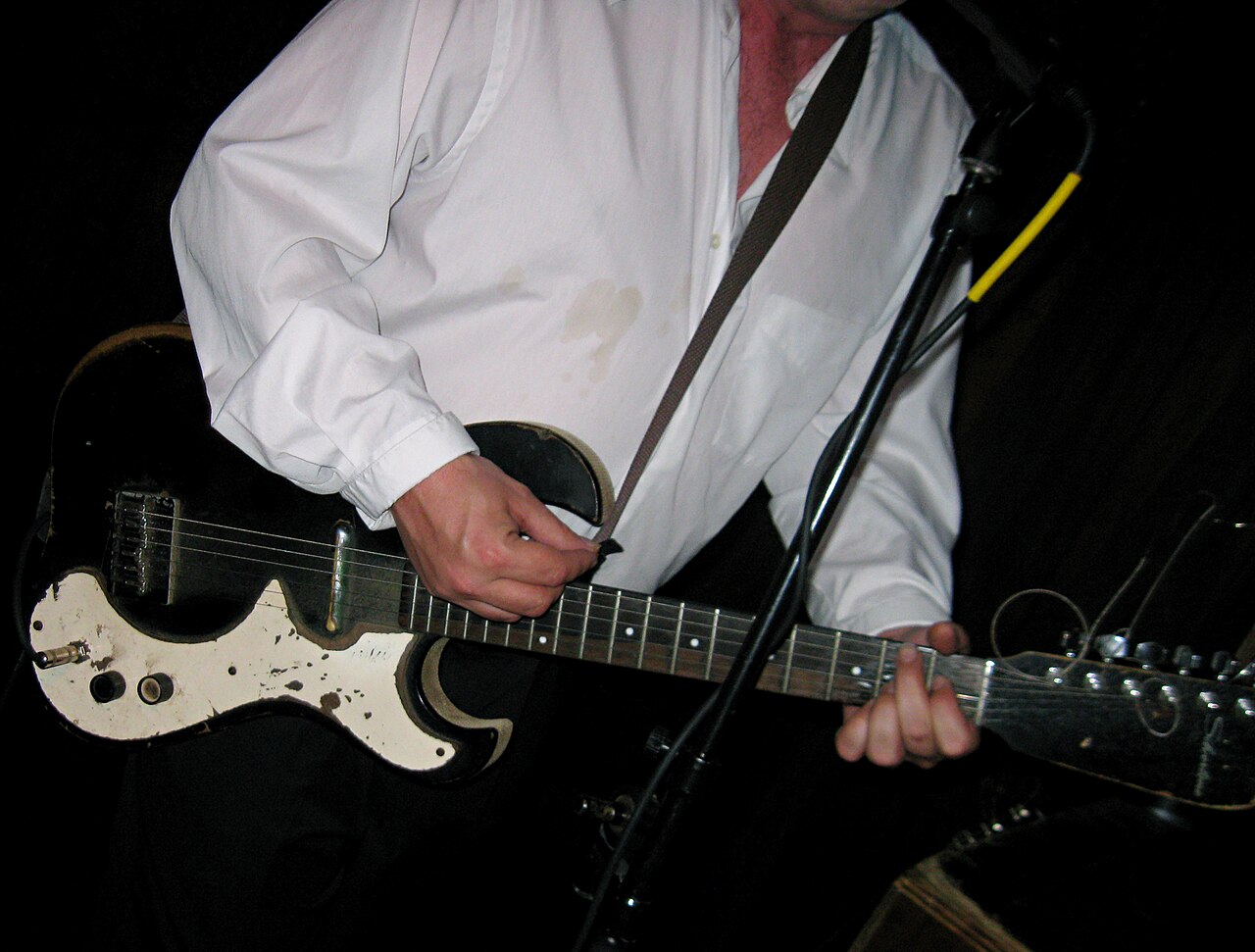
Photo: Rick Hall / Wikimedia Commons / CC BY 2.0 Silvertone
1448
1962
A beginner’s electric from the Sears catalog, with the amp in the case. Beck has played one his whole career.
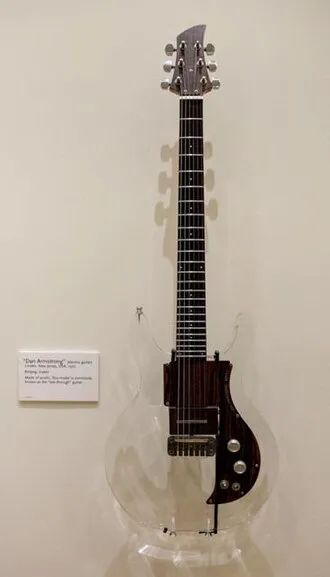
Photo: Frank Kovalchek / Wikimedia Commons / CC BY 2.0 Ampeg
Dan Armstrong
1969
A repairman who spent his days inside other people’s guitars designed one you could see straight through.