Danelectro
Convertible
Danelectro sold it with a pickup or without. The cheap one came with plugs in the knob holes, for later.
Neptune, New Jersey, the end of the 1950s. The cheapest guitar in the Danelectro catalog is a hollow shorthorn with a round soundhole. You can buy it as a plain acoustic. You can buy it with a pickup. Or you can buy the plain one now, and the pickup when you’ve saved up.
- Introduced
- 1959
- Type
- Hollowbody electric
- Class
- Production
Have a photograph of this guitar? Send a picture
The short version
1956
The Danelectro method
From the fall, a stapled wooden frame, masonite top and back, vinyl round the sides.
1958–59
The Convertible appears
Sources split on the first year. Either way, it’s the cheapest guitar in the line.
1966
MCA buys Danelectro
A lot of models get cut. The Convertible survives.
1967
$45 or $65
The list price without a pickup, and with one.
1969
Neptune closes
The Convertible is still in the catalog when the plant shuts.
1999
Back, in color
A reissue with one lipstick pickup, in finishes like Nifty Aqua and Malt Shop Creme.
2002
J.J. Cale plugs in
He starts playing a Korean-made Convertible, then adds a second pickup of his own.
2015
Both at once
The current version ships with a lipstick pickup and a piezo, and a knob to blend them.
Side A
A1
Buy it now, finish it later
Every guitar in a catalog is a finished thing. You pick the color, you pay, it’s done. The Danelectro Convertible was the one guitar in the book that left the last decision to you.
It was the cheapest guitar Nathan Daniel made, a student acoustic with a round soundhole. You could buy it plain. You could buy it with a pickup already fitted. Or you could buy it plain, play it for a while, and buy the pickup kit when the money turned up. The unwired version had little chrome plugs sitting in the control holes, waiting. The pickup was a separate upgrade, and that’s where the name comes from.
Either it’s a 1958 guitar or a 1959 guitar, depending who you ask. Either way, a 1959 Danelectro catalog already has it.
A2
Masonite, staples, and lipstick tubes
To understand the Convertible you need to understand Danelectro, and to understand Danelectro you need to understand that Nathan Daniel was a genius at not spending money.
He started the company in 1947. By the fall of 1956 he’d worked out a way of building guitars that sounds like a dare. A frame of poplar or pine, stapled together. A top and back of masonite, three-eighths of an inch thick, the pressed hardboard you’d find on the back of a cheap cabinet. Vinyl wrapped around the unpainted sides. And the pickups went into surplus chrome lipstick tubes, which is why every Danelectro fan calls them lipsticks. Daniel built guitars for Sears to sell as Silvertones, too. The factory was in Neptune, New Jersey.
In 1958 he drew the shorthorn, a little double-cutaway body about thirteen and a quarter inches wide. The standard shorthorns have a block of wood down the middle. The Convertible took that outline, left the middle out, and cut a round hole in the top.
A3
A decent acoustic, considering
It works better than it has any right to. With nothing in the middle, the top moves more than on any other Daniel design, and it sounds like a real, if small, acoustic guitar. One dealer’s description sums it up:
A fairly functional acoustic guitar — considering they are made of the finest Masonite.
Some of them had Formica on the top and back, like a kitchen table. The bridge is a loose piece of rosewood with a metal riser that was never notched, so if you bend a string hard it wanders off across the saddle. And after sixty-odd years under string tension, plenty of the tops have sunk a little around that bridge. Call it character.
Flip the record · By the numbers
$45
List price in 1967 without a pickup. The acoustic version.
$65
List price in 1967 with the lipstick pickup installed.
⅜″
Thickness of the masonite top and back. The same stuff as a cheap cabinet door.
0 or 1
Pickups on an original. The customer decided.
Side B
B1
Forty-five dollars, or sixty-five
In 1966 MCA bought Danelectro and started trimming the line. The Convertible made it through. In 1967 it listed at $65 with a pickup and $45 without. Even wired, it was the cheapest Danelectro. Around then the head changed from the old coke-bottle shape to a single-sided one with a chrome logo, and the rest of the guitar stayed the same.
It was still in the catalog, next to the Longhorns and the Baby Sitar, when the Neptune plant closed in 1969. The cheap one lasted right to the end.
B2
J.J. Cale finishes the job
When the Danelectro name came back in the late ’90s, so did the Convertible. The first reissues had one lipstick pickup and candy colors with names like Nifty Aqua and Beatnik Burgundy. They were made in Korea.
In 2002 J.J. Cale picked one up. He told the story himself:
In 2002 I started playing a Danelectro Convertible because it’s light and has acoustic properties. It’s one of the newer ones made in Korea.
Then he did what the 1959 catalog had in mind. He decided what kind of guitar it was going to be. He put a piezo pickup under the bridge and ran the guitar in stereo, the lipstick into a Fender Blues Junior and the piezo into a Crate Limo. The Convertible is on “These Blues.”
The Convertible you can buy today comes with both pickups and a knob to blend them, already decided at the factory. It’s a nice guitar. But the original idea was a plain box with a couple of chrome plugs in the top, and the person who bought it got to finish it. Forty-odd years later, J.J. Cale was still finishing his.
Put this on
You’ve read about it. Now hear it. Here’s what this guitar sounds like, and what to listen for.
These Blues
From To Tulsa and Back. Cale named this as the cut with the Convertible on it, the Korean-made one he started playing in 2002.
Find it on YouTube (opens in a new tab)
The cast
The people, and the specific guitars, that made the legend.
1959
Nathan Daniel
Designer
Founded Danelectro and built its guitars out of masonite, staples, and chrome lipstick tubes. This was the cheapest of them.
2002
J.J. Cale
Korean-made Convertible
Picked it because it was light and sounded acoustic, then put a piezo in it and ran it in stereo.
1965
Vinnie Bell
1965 Convertible, no pickup
One turned up in the New York session player’s estate, alongside a 1966 version with the pickup. The dealer who sold it guessed he didn’t play it much.
1961
Jimmy Page
Not this one
Page’s famous Danelectro is a 1961 two-pickup shorthorn, a different model. People mix them up.
Liner notes
Specs, construction, rarity, value, and every source we used.
Masonite with a round hole, sold with or without the lipstick — Danelectro’s Convertible, not the two-lipstick ’59, and not a U2.
- Body
- Shorthorn dual-cut, fully hollow; round soundhole. Living SKU: hardboard/plywood (Sweetwater). Original family: masonite over pine, Formica top and back, vinyl sides (RetroFret)
- Neck
- Bolt-on maple, “C,” clear satin (living). Original: poplar, Brazilian rosewood board (guitarhq 1956–69 method; RetroFret)
- Fingerboard
- Pau ferro on living examples (Sweetwater; Ish Guitars). Original: rosewood, 21 frets, dots
- Scale
- 25" (635 mm) RetroFret vintage; 25" on living dealer tables. Mix flagged.
- Pickups
- Living: ’56 lipstick-tube single-coil in the soundhole plus piezo under the bridge. Original 5015: one lipstick across the hole. Original 5005: none
- Hardware
- Living: pau ferro floating bridge, metal saddle, separate tailpiece (Sweetwater). Original: rosewood floating bridge, metal riser, trapeze tailpiece
- Electronics
- Living: master volume, master tone, blend pot (lipstick / piezo / both). Original 5015: volume and tone on the top, jack on the top
- Finish
- Living: black, cream, tobacco sunburst typical. Original: blonde, red, or blue (Blue Book); Formica woodgrain also exists
- Nut
- 1.650" on Ish Guitars’ 2021. RetroFret vintage: 1 5/8" (41 mm) typical; 1 11/16" (43 mm) on a 1960. Mix flagged.
Open the full research fileConstruction details, the complete player record, production numbers, dated value estimates, and sources
Current production typical = living Convertible (danelectro.com 1959 Guitars; Sweetwater, fetched 17 September 2026). Factory cart unpublished on the Convertible tile; Sweetwater routes the buy. Classic living example of the original object = 1959–69 5005 / 5015 (Neptune, N.J.). ’59M NOS+ (danelectro-59) is the two-lipstick shorthorn, not this table. U2 is a single-cut. Longhorn is a different silhouette. No Gibson SKU. Mixed inch/mm flagged on RetroFret’s measured guitars (overall 38½" (97.8 cm), lower bout 13¼" (33.7 cm) typical / 13 1/16" (33.2 cm) on a 1960, depth 2" (5.1 cm) / 2⅛" (5.4 cm), scale 25" (635 mm)). Do not average the nuts or the depths.
Construction
The job was the cheapest guitar in Nathan Daniel’s line: a student acoustic you could later turn into an electric. Buy the hollow shorthorn. If you wanted a lipstick, you bought the kit — or you bought the wired one. RetroFret: the electronics package was a separate upgrade, “hence the name.” Control holes on a 5005 got chrome inserts that pop out. That is the Convertible. This plate starts in 1959.
guitarhq lists Convertible models 1959–1969: 5005 no pickup, blond; 5015 one pickup, blond. A photo on that page is captioned “1959 Dano Convertible.” Sweetwater and MusicRadar (Simon Bradley, 29 July 2015) both date the first appearance 1959. Blue Book, citing Bechtoldt and Tulloch’s Guitars From Neptune, prints introduced 1958 through 1969. Wikimedia’s model list the same 1958–1969 span, with catalog cites from 1961 on. A 1959 Danelectro catalog (WorthPoint listing) already shows the Convertible next to Standards, Companion, Guitarlin, Longhorn. Keep 1958 and 1959. Do not pick a winner.
What you get is Danelectro method with the middle left out. guitarhq: from fall 1956, poplar or pine frame, stapled, ⅜" masonite top and back, vinyl on the unpainted sides, lipstick tubes in surplus chrome cosmetics housings. Shorthorn dual-cut from 1958, 13.25" wide. The Convertible is that outline with a round hole and no solid center block. RetroFret: more body response than any other Nathan Daniel design; “a fairly functional acoustic guitar — considering they are made of the finest Masonite.” Formica like a kitchen table. Vinyl siding. Floating rosewood bridge, metal riser, separate tailpiece. Wikipedia’s Shorthorn page: the riser was not notched, so bent strings walk. Coke-bottle head and decal logo through 1967; then a six-in-line head with a raised chrome script logo through 1969 (Blue Book; guitarhq). guitarhq: in 1968 the Convertible took the new Dane peghead and the newer three-digit serial system. Kohman (Vintage Guitar, Part 2): in ’67–’68 a single-sided head and chrome plastic logo, “the rest of the instrument is unchanged.”
Not the ’59 (danelectro-59). That plate is the two-lipstick shorthorn 3021 family — masonite, seal guard, concentric stacks, a center block in the standard models. Same plant, same lipstick idea, different job. This one is fully hollow, one hole, one lipstick or none. Not a U2. U1 / U2 are 1956–58 single-cuts (guitarhq). Not a Longhorn, not a Guitarlin, not a Bellzouki. Not the Companion. RetroFret: two-pickup deluxe of this guitar, 1959–60 only. Wikipedia files the Convertible as a Shorthorn subsection. This plate stays standalone.
MCA bought Danelectro in 1966 (guitarhq; Kohman, Part 1). The Convertible survived the cull. Kohman: cheapest Danelectro still the 5015, a holdover from the pre-MCA line, offered until the end; 1967 list $65 with pickup, $45 without. Same dollars on RetroFret. Kohman Part 1: back-page Convertible $45 to $65 in the Dane Line catalog; still in the 1969–’70 book with the Longhorns, the Doubleneck, and the Baby Sitar. Neptune closed 1969 (guitarhq). Historical list, not 2026 street.
1998–2003. Evets revived the badge. Blue Book: Convertible Reissue 1999 — one lipstick, stacked volume/tone, Nifty Aqua / Limo Black / Beatnik Burgundy / Malt Shop Creme / Blue Burst / Copper Burst. Convertible Pro 2000–03, Gotoh tuners, metalflake and pearl. Wikipedia: first reissues 1998–2001; pickup mounted diagonally; one concentric knob; jack in the strap button. Keep the range. Those are lipstick-only Koreans, not a 1959 5015.
The living guitar adds a piezo. danelectro.com (1959 Guitars tile): “Combining our 56 Lipstick® with Piezo.” Sweetwater: hardboard/plywood, maple “C,” pau ferro, ’56 lipstick (Alnico VI, tape wrap) in the hole, piezo under the bridge, blend control. MusicRadar on the 2015 DCV56CR: volume, tone, notched blend; lipstick height screws in the back; three micro-screws in the bridge. Wikimedia dates that piezo Convertible on danelectro.com 2015 / 2017. Classic vs current: 1959 5005/5015 — masonite, Formica, optional lipstick, two knobs or none — against a living Convertible that ships wired, lipstick plus piezo, three pots.
Players
Do not recruit Jimmy Page. The Met guitar is a 1961 3021, two lipsticks, on danelectro-59. Do not recruit Mark Knopfler’s DC, Clapton’s painted Standard, or Syd Barrett’s 59-DC. Those are other Danelectros. Do not flatten Elvis Costello’s late-1990s Evets ads, or When I Was Cruel, onto this silhouette without a named Convertible.
J.J. Cale. Vintage Guitar (Dan Forte, December 2003), on To Tulsa and Back: “In 2002 I started playing a Danelectro Convertible because it’s light and has acoustic properties. It’s one of the newer ones made in Korea.” Convertible on one cut, “These Blues.” He put a piezo in it and stereo’d it out — lipstick to a Blues Junior, piezo to a Crate Limo. Named guitar, named year, named track. Not a 1959 Neptune 5015. RetroFret’s vintage copy repeats that Cale was seen using a Convertible extensively. The interview is the fact.
Vinnie Bell. RetroFret: a 1965 5005, serial 1055, from Bell’s estate; pictured in Doug Tulloch’s Neptune Bound, not credited there as his. Also a 1966 5015, serial 4046, from the same basement. Not Bell designs. RetroFret guesses he did not use the acoustic much. Named objects. Not a session log.
Also known to play stays short. Wikipedia’s Shorthorn page nests this guitar under the DC line; it does not hand it a player list of its own. None invented.
Rarity
You can buy a new Convertible. The living piezo guitar is regular production, backordered at Sweetwater this pass, not scarce. Original Neptune 5005 / 5015 examples are finite. Danelectro did not publish Convertible totals. None invented. Neck-pocket serials date a guitar (guitarhq: week / unknown digit / year). They don’t count a year. That is why a first-year census is unknown, not the chapter.
What is actually thinner: unwired 5005s with the chrome hole plugs still in; coke-bottle heads before the 1967–68 six-in-line change; tops that have not sunk under the floating bridge (RetroFret treats sag as typical). Bell’s 5005 is one object. Cale’s Korean is one object. They are not a vintage Convertible.
Value
Informal estimate, 17 September 2026. Not an appraisal.
Ask vs sold labeled. Celebrity lots are not-comps. No invented medians or factory counts. Period $65 with pickup / $45 without (Kohman 1967; RetroFret) is 1960s money, not 2026 street.
New street. Living typical. Sweetwater Black $599 (was $639); Tobacco Sunburst $639, estimated January 2027 (fetched 17 September 2026). Authorized-dealer asks at $599 (Z String Music; Mass Musik; House of Musical Traditions). Factory MAP unpublished on the danelectro.com tile.
Used modern. 1998–2001 lipstick reissues, Convertible Pros, and later piezo Convertibles trade used. Reverb Price Guide on Danelectro Convertible did not print a clean Good-to-Mint band this pass. Don’t invent a midpoint. Named asks, not hammers: 1998–99 Blue Burst $914; Burgundy $349 (Blue Book for-sale rail). Those are two listings. Do not average them.
Vintage / collectible. Flag: thin sold-comp access. Named asks, not hammers, on the 1959–69 rail: c. 1959 acoustic $695; 1960 blond $1,000; 1960s hollowbody $750; clean 1960s with modern case $1,399.95; 1960s blonde with gig bag $999.99. Do not average those asks. Bell’s estate 5005 and Cale’s Korean are not comps.
See also
- danelectro-59 — the two-lipstick shorthorn 3021; same lipstick idea, not this fully hollow Convertible
- silvertone-1448 — Sears’ one-lipstick amp-in-case; Danelectro-for-Sears, not this acoustic-electric
- coral-electric-sitar — Coral’s thirteen-drone Electric Sitar; same lipstick idea, not this Convertible
Sources
- Danelectro, 1959 Guitars — living Convertible tile; ’56 Lipstick plus piezo; Sweetwater buy link
- Sweetwater, Convertible Tobacco Sunburst — first appeared 1959; hardboard/plywood; maple C; pau ferro; piezo plus ’56 lipstick (Alnico VI); $639; estimated January 2027
- Sweetwater, Convertible Black — $599 (was $639); estimated February 2027; same living spec
- guitarhq, Danelectro / Silvertone / Coral — Daniel 1947; masonite/poplar from fall 1956; shorthorn 1958 13.25"; Convertible 1959–1969 5005/5015; 1959 Convertible photo caption; 1968 new peghead and 3-digit serials; MCA 1966; plant 1969
- Vintage Guitar, Peter Stuart Kohman, The Last Days of Danelectro, Part 1 — MCA 1966; Convertible $45 to $65 on the Dane Line back page; veteran Convertible with new single-sided headstock; still in the 1969–’70 catalog
- Vintage Guitar, Peter Stuart Kohman, The Last Days of Danelectro, Part 2 — cheapest Danelectro still 5015; round-hole fully hollow Formica masonite; 1967 list $65 / $45; ’67–’68 chrome plastic logo
- Vintage Guitar, Dan Forte, J.J. Cale (December 2003) — Korean Convertible from 2002; “These Blues”; piezo added; Blues Junior / Crate Limo
- RetroFret, 1967 Convertible 5015 — Neptune; no center block; $65 list; 38½" / 13¼" / 2"; scale 25" (635 mm); nut 1 5/8" (41 mm); 1967 single-sided head
- RetroFret, 1960 Convertible — 38½" / 13 1/16" (33.2 cm) / 2⅛" (5.4 cm); scale 25" (635 mm); nut 1 11/16" (43 mm); typical top sink
- RetroFret, 1965 Convertible 5005 (Vinnie Bell) — 5005 no pickup; $45 list; kit conversion; serial 1055; Neptune Bound; 38½" / 13¼" / 2"; scale 25" (635 mm); nut 1 5/8" (41 mm)
- RetroFret, 1966 Convertible 5015 (Vinnie Bell) — serial 4046; lipstick 5015 from the same estate
- RetroFret, 1960 Companion — two-pickup deluxe of the Convertible; 1959–60 only; not this table
- Blue Book, Danelectro Convertible — introduced 1958 through 1969; masonite, vinyl, round hole; with or without electronics; coke-bottle through 1967, 6-in-line through 1969; blonde/red/blue
- Blue Book, Convertible Reissue / Convertible Pro — reissue 1999 stacked knob; Pro 2000–03 Gotoh
- Wikipedia, Danelectro Shorthorn — Convertible subsection; 1960s originals; 1998–2001 reissue; currently reissued; diagonal pickup / concentric knob / strap-jack on reissues; un-notched bridge. Lead only; this plate is standalone
- Wikimedia Commons, List of Danelectro models — Convertible 1958–1969 #5005/#5015; 1999 reissue / Pro; piezo Convertible on danelectro.com 2015 / 2017
- MusicRadar, Simon Bradley, DCV56CR Convertible review (29 July 2015) — original 1959; hollow shorthorn; ’56 lipstick plus piezo; volume / tone / blend; £599
- Reverb, Danelectro Convertible — living listings $599; Price Guide widget unpublished this pass
- Ish Guitars, 2021 Convertible Tobacco Sunburst — $599; pau ferro; nut 1.650"; 14" radius; 5.6 lb
- Mass Musik, Danelectro CONVERTIBLE — factory copy; 25" / 21 frets; ’56 lipstick plus piezo; volume / tone / blend; $599
- Z String Music, Convertible Black — $599; same living spec
- House of Musical Traditions, Convertible — $599; same living spec
- guitar-list, Danelectro Convertible — dates of manufacture 1958 to 1969
- guitar-list, Convertible listings (USA) — named asks, not hammers: c. 1959 acoustic $695; 1960 blond $1,000; 1960s $750; clean 1960s $1,399.95; 1960s blonde $999.99
- WorthPoint, 1959 Danelectro catalog — Convertible listed in a 1959 catalog
Keep digging
Guitars this one gets compared to, confused with, or descended from.
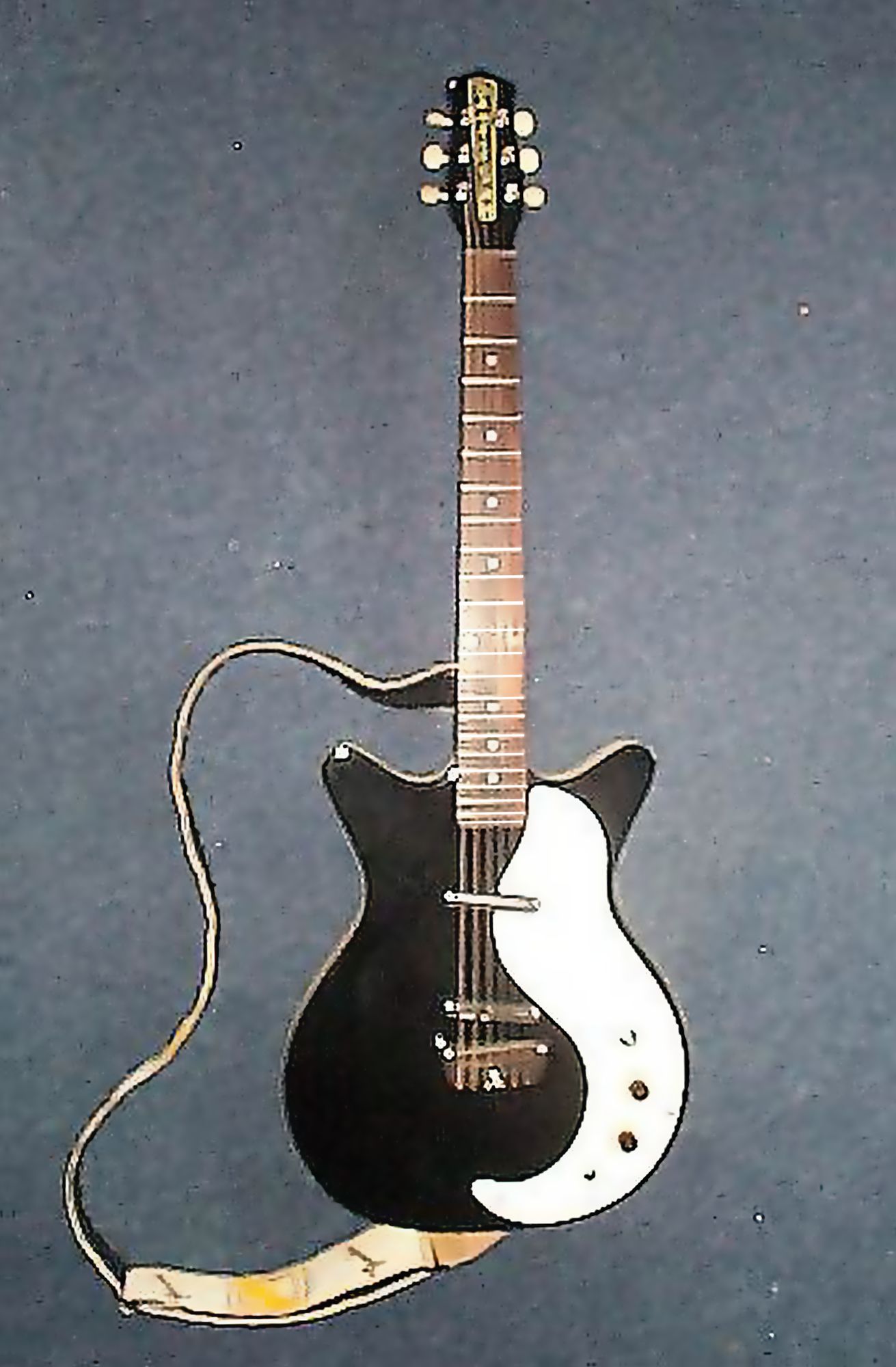
Danelectro 59-DC. Photo by Sander van Malssen. Licensed under CC BY-SA 2.0. Via Wikimedia Commons. Danelectro
59
1958
Jimmy Page’s has been shown at the Met. The same two lipsticks and coke-bottle head are hanging on a shop wall near you.
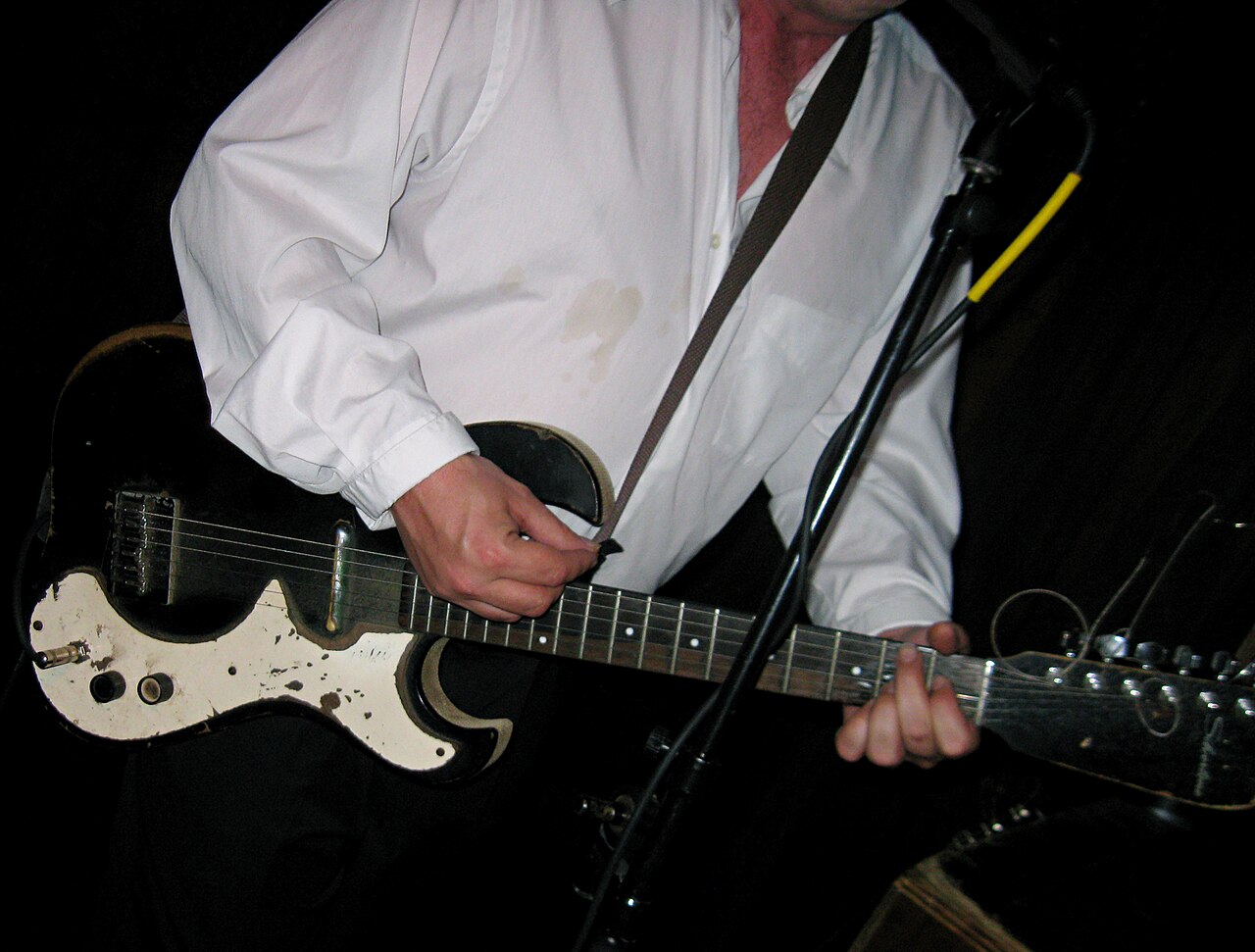
Photo: Rick Hall / Wikimedia Commons / CC BY 2.0 Silvertone
1448
1962
A beginner’s electric from the Sears catalog, with the amp in the case. Beck has played one his whole career.
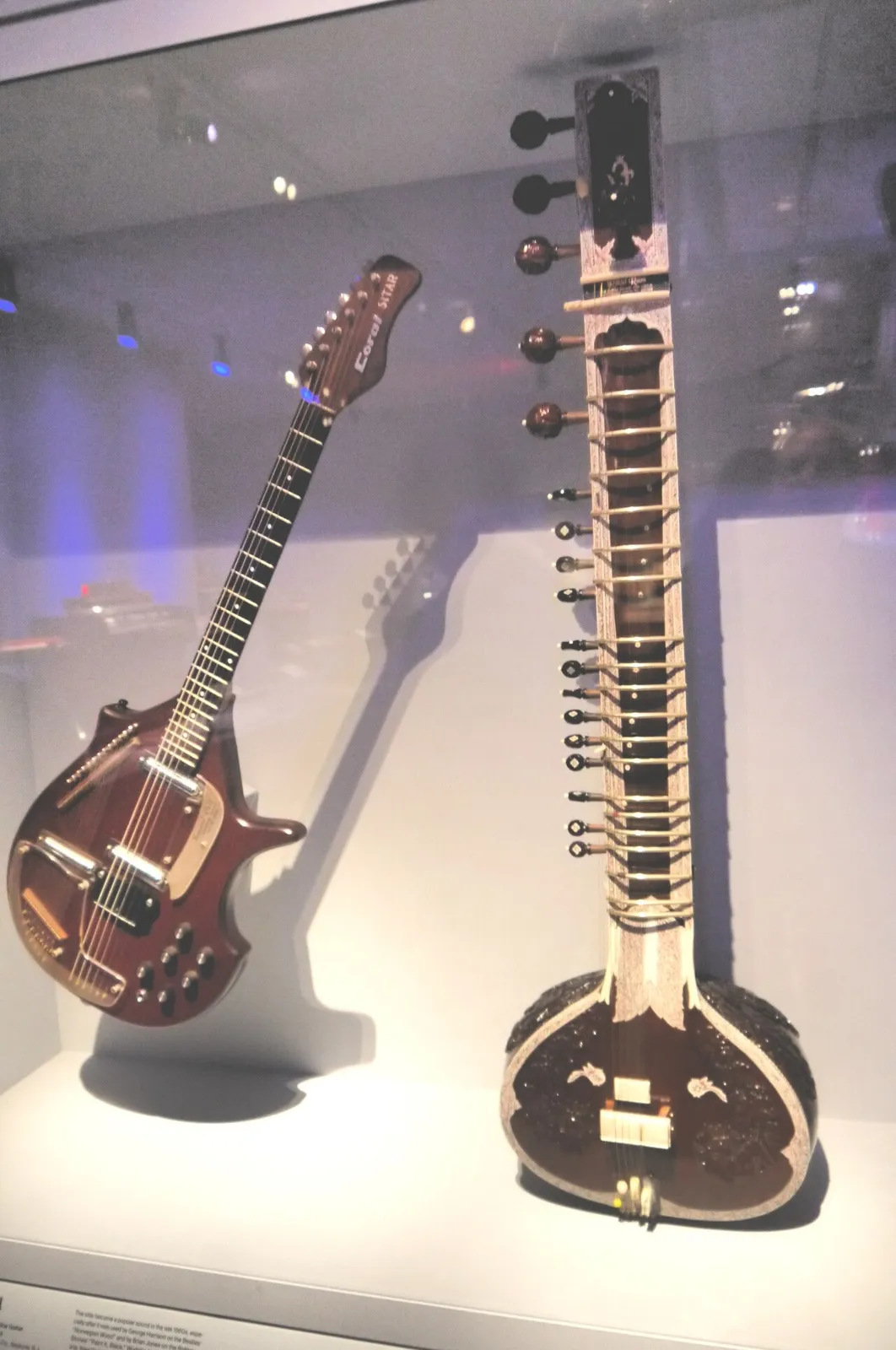
Photo: Eden, Janine and Jim / Wikimedia Commons / CC BY 2.0 Coral
Electric Sitar
1967
Built so a session player could fake a sitar before lunch. Some of those afternoons are still on the radio.