Watkins
Rapier 33
The Strat was the guitar everybody knew. The Rapier was the one a British kid could take home.
In 1960 a Stratocaster was an import. A family firm in Chertsey built the guitar they could actually buy: three pickups, the middle one leaning, a vibrato with a knife edge, and red paint that cracks in sheets.
- Introduced
- 1960
- Type
- Solidbody electric
- Class
- Production
Have a photograph of this guitar? Send a picture
The short version
1949
Tooting Market
Charlie and Reg Watkins open a shop. Balham follows in 1951.
1957
Chertsey, and the Vibra
The guitar factory opens, beaten to the first British solid by a week or two, on Charlie’s telling. Another account says 1958.
1960
The outline
The Strat-ish shape arrives, and a Rapier 33 is bought new in April. Other dates for the start are 1959 and about 1961.
1964
WEM
The guitars wear the WEM logo until 1968.
1965
Tower Music, Blackpool
Alan Entwistle buys his Rapier 33.
1968
Wilson
The guitars take the brothers’ mother’s maiden name, in 1968 or in the 1970s.
1982
The end, maybe
The Chertsey run stops in 1970, the late 1970s, or 1982. Depends who you ask.
2021
The new one
Entwistle and JHS put a new Rapier 33 in the shops. It doesn’t say Watkins.
Side A
A1
The guitar in the shop
If you were a British kid with a guitar around 1960, you probably didn’t have a Stratocaster.
A Strat was an import. Hank Marvin had a red one, the one Cliff Richard ordered, and everybody knew it. But the guitar actually in a British player’s hands was much more likely a Dallas Tuxedo, a Höfner, or a Watkins Rapier.
The Rapier came from a family. Charlie and Reg Watkins opened a shop in Tooting Market in 1949 and moved to Balham in 1951. The amplifiers were Charlie’s. The guitar factory, at Chertsey, was Reg’s.
A2
Second by a week
Who made the first British solid is a race the Watkinses say they lost, narrowly. Charlie dated the factory to 1957 and called the guitar “2nd British made solid,” beaten “by a week or two” by the Dallas Tuxedo. In a letter he remembered it differently: “Just missed being the first Brit solid by about a week. I think it was 1958.” That one, partly “nicked” from an American National by his own account, is usually filed as the Deluxe: almost symmetrical, three tuners a side, a different guitar.
The Rapier 33 outline turns up around 1960. One was bought new in April that year. Other lists start it in 1959, or around 1961. Keep them all.
Reg designed them, Charlie said. Sid, back from Hong Kong, built them, and one writer calls Sid the creator. Keep both. It stayed in the family either way.
A3
The knife edge
Look at one and you’ll see the Strat in it, roughly. Double cutaway, a squared guard, three pickups, the middle one raked forward. Then look closer.
There’s no synchronized tremolo. The Watkins vibrato sat on a knife edge, and Charlie said it “would return itself to correct tuning under almost any conditions.” It started out in 1957 as the Vibra and became the Hi-Lo after Jim Burns objected to the name. The arm is a push fit, and a Strat arm won’t go in. The bridge is held on by nothing but string pressure, with no screws to set the intonation. A few very early ones are wood.
The body is jelutong, light enough to split, often in two pieces. The neck is usually sycamore, which in Britain counts as a maple. Early necks were set, with a metal bar under a thick mahogany board and no truss rod.
The bridge is held on by nothing but string pressure.
Flip the record · By the numbers
£20–£30
A Rapier 22, 33, or 44 in the early 1960s.
10 a month
What one shop in Surbiton took. One dealer, not the whole count.
5
Magnets in an early pickup, one of them turned the other way.
£36
A Rapier 33 in 1969.
Side B
B1
Around a Hornby train set
They wound the pickups themselves, and they sound like it: warm, and noisy. Charlie remembered a bar magnet and a coil “designed around a Hornby train set,” then a second pole piece because the B and E were weak.
Under the mesh cover of an early one are five magnets, the small one turned around. Alan Entwistle measured his and found the same, and heard what that does: nasal on the top strings, loud on the bass. That isn’t a Strat sound. It’s a Rapier sound, and it’s what the kids heard.
The ordinary 33 has a Rhythm/Solo toggle by the neck pickup, though the wiring changed often. The paint is red polyester, the first guitars on that spray, and it cracks in sheets. Early necks were red too, and then they were stripped.
B2
Made by the thousand
The prices were the point. Early in the 1960s a Rapier 22, 33, or 44 cost £20 to £30. In 1969 a 33 was £36. Charlie said they were “made by the 1000 and sold all over the world.” Bell’s of Surbiton alone took ten a month.
The name on the guitar moved around. WEM from 1964 to 1968. Then Wilson, the brothers’ mother’s maiden name, from 1968 or the 1970s depending on who’s counting. When the guitars stopped is the same kind of argument: 1970, the late 1970s, or 1982. Nobody published how many 33s there were.
In 1971, at Apple Studios, George Harrison was photographed with a heavily modified Rapier 33. It belonged to Del Mandel. A Beatle held one. That’s as far as it goes.
B3
Next to the Strats
Alan Entwistle bought his Rapier 33 at Tower Music in Blackpool in 1965. In 2021, with JHS, he put a new one in the shops. It isn’t a copy, it’s built in China, it has mini-humbuckers because the five-magnet coils wouldn’t balance, and the headstock doesn’t say Watkins.
In 2000, a friend gave Mark Knopfler a Rapier 33 from about 1965. He tried it to get an idea of the sound and where it might fit in a song. It never made it onto a record.
But it stood beside his vintage Strats, for Strat Masters in 2007 and again in the photo shoot for Kill to Get Crimson. Decades after British kids bought one because they couldn’t get a Strat, it finally got to stand next to a few.
The cast
The people, and the specific guitars, that made the legend.
2000
Mark Knopfler
Rapier 33, circa 1965
A gift from a friend. He tried it to hear where it might fit in a song. It didn’t make a record, but it stood next to his vintage Strats in the photographs.
1971
George Harrison
Del Mandel’s highly modified Rapier 33
Photographed with it at Apple Studios while producing the Radha Krishna Temple album. Mandel’s guitar, not a Beatles instrument.
1965
Alan Entwistle
Rapier 33, bought at Tower Music, Blackpool
Measured the pickups on his own. In 2021 he and JHS put out a new Rapier 33.
1960
Reg and Sid Watkins
Designer and builder
Reg designed the Rapiers, by his brother Charlie’s account. Sid built them, or created them, depending on who’s telling it.
Liner notes
Specs, construction, rarity, value, and every source we used.
Three single-coils, the middle one slanted, and a knife-edge Hi-Lo — Watkins’ Rapier 33, the solid you could buy when a Strat was an import.
- Body
- Solid double-cut. Godwin: jelutong through most of the run, often two pieces. Christie's Knopfler guitar: length of back 15 9/16" (39.5 cm). Mix flagged.
- Neck
- Sycamore most often (Godwin). Early: set, no truss, a metal bar under a thick mahogany board. Carleton's 1961: he calls it maple, with a truss rod. Mix flagged.
- Fingerboard
- Early mahogany (Godwin). Rosewood on Carleton's 1961, Absolute Music's circa-1960, and Gardiner Houlgate's 2025 lot. Carleton: 22 frets plus a zero fret. Absolute Music prints 22 and does not mention a zero.
- Scale
- 25" on Absolute Music's circa-1960 set-neck, serial 408. No factory scale. JHS reissue: 25.5" (648 mm). Mix flagged.
- Pickups
- Three in-house single-coils; middle slanted forward. Early: five magnets, one of them reversed (Godwin; Entwistle via Guitar.com).
- Hardware
- Hi-Lo knife-edge vibrato; push-fit arm (Godwin). Bridge held by string pressure, not intonatable.
- Electronics
- Rhythm/Solo toggle by the neck pickup (Godwin). Watkins changed the scheme. One 33 variant: a four-position selector.
- Finish
- Red polyester on most. Neck painted early, then natural. White, ice blue, natural, and special-order sunburst exist.
- Nut
- No factory width on the 1960s guitar. JHS reissue: 42.5 mm measured (Guitar.com) and 43 mm in the JHS copy. Mix flagged.
Open the full research fileConstruction details, the complete player record, production numbers, dated value estimates, and sources
Classic living example = early-1960s Watkins Rapier 33 (Chertsey): three single-coils, slanted middle, Hi-Lo. The guitar you can order now is not that. JHS and Alan Entwistle’s Rapier 33 (China, from 2021) is okoume, bolt-on Canadian maple, rosewood, three EWR64 mini-humbuckers. It does not wear Watkins. Rapier 22 is two pickups. Rapier 44 is four. Circuit 4 is the dressed-up 44. Rapier Deluxe Series 1 is the 1958–59 symmetrical solid, not this outline. Rapier bass is a bass. Wilson, from 1968, is this line under the brothers’ mother’s maiden name. No Gibson SKUs. Mixed inch/mm flagged on Christie's 15 9/16" (39.5 cm) and on the reissue’s 25.5" (648 mm) against a shop’s 25" and a nut printed only in millimetres. Do not average 25" / 25.5", or 42.5 mm / 43 mm.
Construction
The job was a solid a British teenager could take home. A Strat was an import. Hank Marvin’s 1959 Fiesta Red, serial 34346, is the one Cliff Richard ordered. That object is on the Strat plate. Huw Price (Guitar.com, 23 December 2021): the guitar in a British player’s hands was much more likely a Dallas Tuxedo, a Höfner, or a Watkins Rapier.
Charlie and Reg’s shop: Tooting Market, 1949, then Balham, 1951 (Charlie’s history; Wright). Amps were Charlie’s. Chertsey was Reg’s.
1957, on Charlie’s history: Reg’s “2nd British made solid,” beaten “by a week or two” by the Dallas Tuxedo, Syd joining as the Rapiers developed. Sound on Sound calls that the Strat-like 22 / 33 / 44, Reg designing, Syd building at Chertsey. Wright, chronology “in flux”: the 1957 factory “probably” the Rapiers, the Tuxedo ahead “perhaps by a week,” a Rapier Deluxe on its own in 1958.
Charlie’s letter to Godwin is a different guitar. “Partly nicked” from a U.S. National, his bar-magnet coil, Reg’s spliced neck. “Just missed being the first Brit solid by about a week. I think it was 1958.” Godwin files that as the Series 1 Deluxe, 1958–59 — almost symmetrical, three-a-side, pearloid — Deluxe from 1959 on the renovation page, this outline from 1960, Strat shape by serial 425. A 33 bought new in April 1960 is serial 1731. Carleton starts the line in 1959. Blue Book says around 1961. This plate starts in 1960. Keep 1957, 1958, 1959, and 1961. Reg designed them (Charlie; Sound on Sound). Godwin: Sid, back from Hong Kong, was the luthier, Charlie still the amp man. Blue Book: Sid on guitars and cabinets, Charlie on the amp electronics. Carleton calls Sid the creator. Syd and Sid are the same brother. Don’t pick a winner.
Double-cut. Squared guard. Three coils, the middle raked forward. Not a Stratocaster (fender-stratocaster): no synchronized tremolo. Charlie’s knife-edge “would return itself to correct tuning under almost any conditions.” Wright: Watkins Vibra, 1957, recast Hi-Lo after Jim Burns objected to the name. Push-fit arm. A Strat spare does not drop in (Godwin). The bridge hangs on the strings. A few very early bridges are wood. No intonation screws.
Jelutong, often two pieces, light enough to split (Godwin). Not his idea of a tonewood. Wilson went to a heavier hardwood in the 1970s. Absolute Music’s 408 is 2.55 kg. Gardiner Houlgate’s 2025 lot is 2.67 kg. Don’t average them. The neck is sycamore most often. UK sycamore is a maple; Carleton still writes maple for his 1961. Early necks are set, a metal bar under a thick mahogany board, no truss. Godwin puts rods in the early ’60s. An untrussed set neck under serial 5000 is only a 1960–64 possibility. The numbers are a mess. Price, off the reissue: rods around 1966. Carleton’s 1961 already has one, a zero fret, and 22 frets on rosewood. 408 prints 22 frets, 25", rosewood, no zero. Don’t average the scales. Don’t make the zero the rule.
Wound in the shop. Warm, and noisy (Godwin). Charlie, about 1957: a bar magnet, a coil “designed around a Hornby train set,” then a second pole because the B and E were weak. The mesh cover has five magnets, the small one reversed. Entwistle measured the same — Tri-Sonic-like baseplate, second from the top reversed, top strings nasal, bass loud (Price). Wright’s slotted toasters start in 1964. Godwin already calls the mesh a toaster. Two covers, one nickname. Wilson coils sit deeper. Wright thinks Japanese, or a copy. Some later Wilsons have Schaller humbuckers.
An ordinary 33 is a Rhythm/Solo toggle by the neck pickup and gold script in the guard (Godwin). One variant takes the 44’s four-position selector. They changed the wiring often (Price). Carleton’s 1961 “Rapier 3” — his name for three pickups — is a four-stop rotary, one volume, one tone, and a toggle that solos the middle, bypasses the tone, or kills the output.
Red polyester. Charlie: the first guitars on that spray. It cracks in sheets (Godwin). Necks started red and were stripped. White, ice blue, natural, special-order sunburst. WEM on the guitar is 1964–1968 (Godwin). Total Production dates the company name to 1963. Wilson, their mother’s maiden name, is the guitar brand once it split from the amps: 1968 (Godwin), the 1970s (Blue Book). Keep both. Wilson adds white, royal blue, yellow, gold. Sixties lists, not 2026 street: £20–£30 for the 22 / 33 / 44 (Charlie; Sound on Sound); about 29 guineas (Entwistle) and $85 (Carleton); £36 for a 33 in 1969 (Godwin). The Circuit 4, the dressed-up 44, was 47 guineas.
A 22, a 44, the Deluxe, the Vibra, and the bass are other instruments. So is an España: Wright’s correction, the EL-31 is an Emerald export. Pompeii, the Isle of Wight, and Hyde Park 1969 are the P.A. The Copicat is a tape echo. When the factory stopped is in Rarity. It is not one year.
The cart now is another factory. Entwistle’s own came from Tower Music, Blackpool, 1965. With JHS he shipped a new 33 in 2021: not a copy, and the head does not say Watkins (Price). China, okoume about 5 mm thicker, bolt-on Canadian maple, roller saddles, EWR64 mini-humbuckers where the five-magnet coils would not balance, a zero fret. Guitar.com counts 22 frets plus that zero. JHS counts 23, on a 12" rosewood board. 25.5" (648 mm). £429 in that review, right-hand only. JHS RRP £479 this pass. Left-hand Fiesta Red is the same money. Gearnews credits Entwistle with the names. Godwin’s account is a different man: in 2009 Charlie gave the designs, and the registered name Watkins Rapier, to Reg Godwin. Two claims. Neither guitar is the Chertsey one.
Players
Do not hang a WEM P.A., the Copicat, a 22, a 44, a Circuit 4, a Deluxe, an España, or the bass on this plate. Knopfler’s other Watkins is a bass, serial 8339, bought at Sound Stage Studio, Nashville, October 2004. Tweedy’s RetroFret is a 1967 bass. Hank’s Strat and his Burns are other plates. Burns objected to a name. He is not a Rapier player here.
Mark Knopfler. The documented 33. Christie's, 31 January 2024. Catalogued circa 1965, neck plate 16238, “RAPIER 33” in the guard, a Wilson logo on the tailpiece. Godwin puts Wilson at 1968. Christie's still says circa 1965. Keep both. A friend gave it to him in 2000. He tried it “to get an idea of the sound and where it might fit in a particular song, but did not make it onto a record.” It stood next to his vintage Strats for Strat Masters (British Grove, 2007) and in the Kill to Get Crimson shoot, Fabio Lovino. Realised £32,760, against an estimate of £1,000–£1,500. Celebrity. Not a comp.
George Harrison. Carleton: photos of him with a highly modified Rapier 33 that belonged to Del Mandel, at Apple Studios in 1971, while producing the Radha Krishna Temple album. The post he cites is AbbeyRoadTribute. Mandel’s guitar. Modified. Not a Beatles instrument, and not a session log for that record. A Beatle held one.
Danny Kirwan. Wikipedia’s equipment list — the page says the section cites nothing — has a red Rapier 33, “chambered,” with Boilerhouse and early Fleetwood Mac, including Hyde Park, 1968. Godwin’s bodies are solid jelutong. No citation. Not a session log. Don’t put that concert on this plate.
Alan Entwistle. Tower Music, Blackpool, 1965. Why a new Rapier 33 is in the JHS book. Not a record.
Also known to play stays short. Christie's says young UK players used them, and names nobody. Sound on Sound calls the 22, 33, and 44 the staple of the early 1960s. A reputation. Not a discography. None invented.
Rarity
You can buy a new Rapier 33. JHS and Entwistle, China, not Chertsey. The Watkins run ends at 1970 (Carleton), the late 1970s (Wright), or 1982 (Godwin; Blue Book, circa 1961–1982). Keep all three.
No 33 total was published. Charlie: “made by the 1000 and sold all over the world” — the Rapiers, not a ledger. Wright: the most plentiful WEM guitar, “thousands,” survivors unknown. Godwin: serials just over 20,000 by 1982, “all over the place,” some models restarted at zero. Serials date a guitar. They don’t count a year. Charlie, on Godwin’s history page: Bell’s of Surbiton took ten a month. One dealer. Godwin’s other figure, about 10% left-handed, is all the guitars, his estimate.
Thinner than a red 33: set-neck, neck still red, mesh covers still on; ice blue, or a white that has not creamed; the push-fit arm still in the drawer. Dealers see fewer 44s. A counter, not a census. 16238, and Mandel’s if the photo is that guitar, are single objects. Not a vintage 33.
Value
Informal estimate, 15 October 2026. Not an appraisal.
Ask vs sold labeled. Celebrity lots are not-comps. No invented medians. The sixties lists — £20–£30, about 29 guineas or $85, £36 in 1969, Circuit 4 at 47 guineas — are sixties money, not 2026 street.
New street. JHS Rapier 33, RRP £479 (Fiesta Red, sunburst, Arctic White, Daphne Blue, left-hand Fiesta Red). The 2021 review was £429. Not Watkins. The 22 is £449 and the 44 £499 on the same page.
Used modern. The China guitar trades used. No Reverb Price Guide band this pass. Don’t invent a midpoint.
Vintage / collectible. No Price Guide widget this pass. Flag: thin sold-comp access. Gardiner Houlgate, 2 December 2025, fair, 2.67 kg, hammer £220 (fees extra). Barnebys’ $293 is that lot. Piers Motley, 12 January 2026, £70, “in need of restoration” — a project. Gardiner Houlgate, 25 June 2020, £340, is not a 2026 comp. Asks, not hammers: Rock Stock 5367 at £810; Absolute Music 408 at £249, their circa-1967 bolt-on £399; Reidys, cut from £595 to £335. guitar-list, 29 September 2026, Reverb asks only: $331.70 / $1,100.30 / $1,120.91. Do not average them.
Christie's, 31 January 2024: 16238 made £32,760 against £1,000–£1,500. The estimate is the guitar. The hammer is the name. Not a comp.
See also
- fender-stratocaster — Hank’s 1959 Fiesta Red, serial 34346; the import this guitar was built instead of
- burns-marvin — 1964 Romford solid for Hank; Jim Burns is why the vibrato says Hi-Lo, and the Marvin is not this
- vox-phantom — 1962 British solid, five-sided; not Chertsey, and not this outline
Sources
- Charlie Watkins, Watkins Electric Music history — 1949 Tooting; 1951 Balham; 1957 Chertsey, second British solid, beaten by the Dallas Tuxedo by a week or two; Syd joined later; “made by the 1000”; Rapier 22 / 33 / 44 designed by Reg, £20–£30; first guitars on the new polyester spray
- Vintage Guitar, Michael Wright, Watkins Rapier 33 (May 2013) — chronology “in flux”; factory 1957; Deluxe 1958; 22 / 33 / 44; slanted middle; Vibra 1957, later Hi-Lo after Jim Burns; red necks then natural; slotted toasters 1964; Wilson from 1968; late-’70s end; most plentiful, thousands, survivors unknown; España is an Emerald, not a 33
- Watkins Guitar World, Rapiers (Reg Godwin) — Series 1 Deluxe 1958–59; Charlie’s National letter, “I think it was 1958”; Strat shape by serial 425; Rhythm/Solo; slanted middle; 1969 Rapier 33 £36; Wilson colors from 1968; four-position 33; Circuit 4 at 47 guineas; about 10% left-handed; 2009 gift of the Rapier rights
- Watkins Guitar World, Renovation (Reg Godwin) — no dating archive; Deluxe from 1959, Strat shape appears 1960; Rapier 33 bought new April 1960, serial 1731; numbers unreliable; WEM logo 1964–68; jelutong, often two-piece; sycamore; set necks, metal bar, mahogany board; truss in the early ’60s; polyester; five-magnet pickup; Charlie’s 1957 Hornby-coil story; knife-edge vibrato; wooden bridges on very early examples; closed 1982, serials just over 20,000
- Watkins Guitar World, home — Charlie the amp man; Sid and Reg the guitars; Sid after Hong Kong; Wilson, the mother’s maiden name, after 1968; factory closed 1982
- Watkins Guitar World, history — Charlie: Bell’s of Surbiton, ten a month; Circuit 4 as the deluxe 44
- Sound on Sound, Charlie Watkins — second UK solid after the Dallas Tuxedo; Reg designed, Syd built at Chertsey; Strat-like 22 / 33 / 44; £20–£30; early-1960s staple
- Total Production, via the Internet Archive (29 October 2008) — WEM rebrand 1963; Rapier as the cheaper alternative to a Strat; Floyd, the Who, and Hyde Park 1969 are the P.A.
- Guitar Player, Terry Carleton, 18 May 2026 — line 1959–1970; 1961 “Rapier 3,” 22 frets plus zero, truss, rosewood, Hi-Lo; four-stop rotary; 29 guineas or $85; Harrison with Del Mandel’s modified 33, Apple, 1971; Sid-as-creator is his line
- Guitar.com, Huw Price, 23 December 2021 — Dallas / Höfner / Rapier against the imported Strat; Entwistle, Tower Music, 1965; five magnets, reversed pole; truss rods around 1966; sycamore vs maple; +5 mm; China; £429; 25.5" / 648 mm; nut 42.5 mm; not Watkins-badged
- Guitar.com, 1 October 2021 — JHS / Entwistle; okoume; Canadian maple; 22 frets plus a zero fret; EWR64
- JHS, Rapier 33 — RRP £479 this pass; okoume; 4-bolt maple; 12" rosewood; 23 frets including the zero
- JHS electric guitars — left-hand Fiesta Red £479; Rapier 22 £449; Rapier 44 £499
- JHS, Entwistle interview — “around 29 guineas”; EWR64 to fix the five-magnet balance
- Christie's, Rapier 33, serial 16238 — circa 1965; Wilson on the tailpiece; back 15 9/16" (39.5 cm); gifted 2000; tried, not recorded; realised £32,760 on 31 January 2024; estimate £1,000–£1,500
- oneverybootleg, Knopfler / Watkins — 16238 did not make a record; Strat Masters; Lovino shoot; bass 8339 is the other instrument
- Blue Book, Watkins electrics — around 1961; circa 1961–1982; Sid on guitars, Charlie on amp electronics; WEM late 1960s, Wilson in the 1970s
- Wikipedia, Danny Kirwan, equipment — unsourced: red Rapier 33, “chambered,” Boilerhouse and Hyde Park 1968. Not used as a credit
- Absolute Music, circa-1960 Rapier 33, serial 408 — set neck; rosewood; 22 frets; 25"; 2.55 kg; ask £249; circa-1967 bolt-on £399
- Gardiner Houlgate, 2 December 2025 — fair; maple; rosewood; 2.67 kg; hammer £220
- Piers Motley, 12 January 2026 — restoration project; hammer £70
- Gardiner Houlgate, 25 June 2020 — good; sold £340; not a 2026 comp
- Rock Stock / Reverb UK, serial 5367 — ask £810
- Reidys, 1960s Rapier 33 — cut from £595 to £335
- guitar-list, 29 September 2026 — Reverb asks, not solds: $331.70 / $1,100.30 / $1,120.91
- Gearnews, 1 October 2021 — 43 mm nut in the reissue copy; Entwistle credited with the Rapier names
- RetroFret, Tweedy Rapier bass — a 1967 bass, not this table
Keep digging
Guitars this one gets compared to, confused with, or descended from.

Photo: Lightburst / Wikimedia Commons / CC BY-SA 4.0 Fender
Stratocaster
1954
The guitar most people mean when they say “electric guitar.” Designed by a man who didn’t play one.
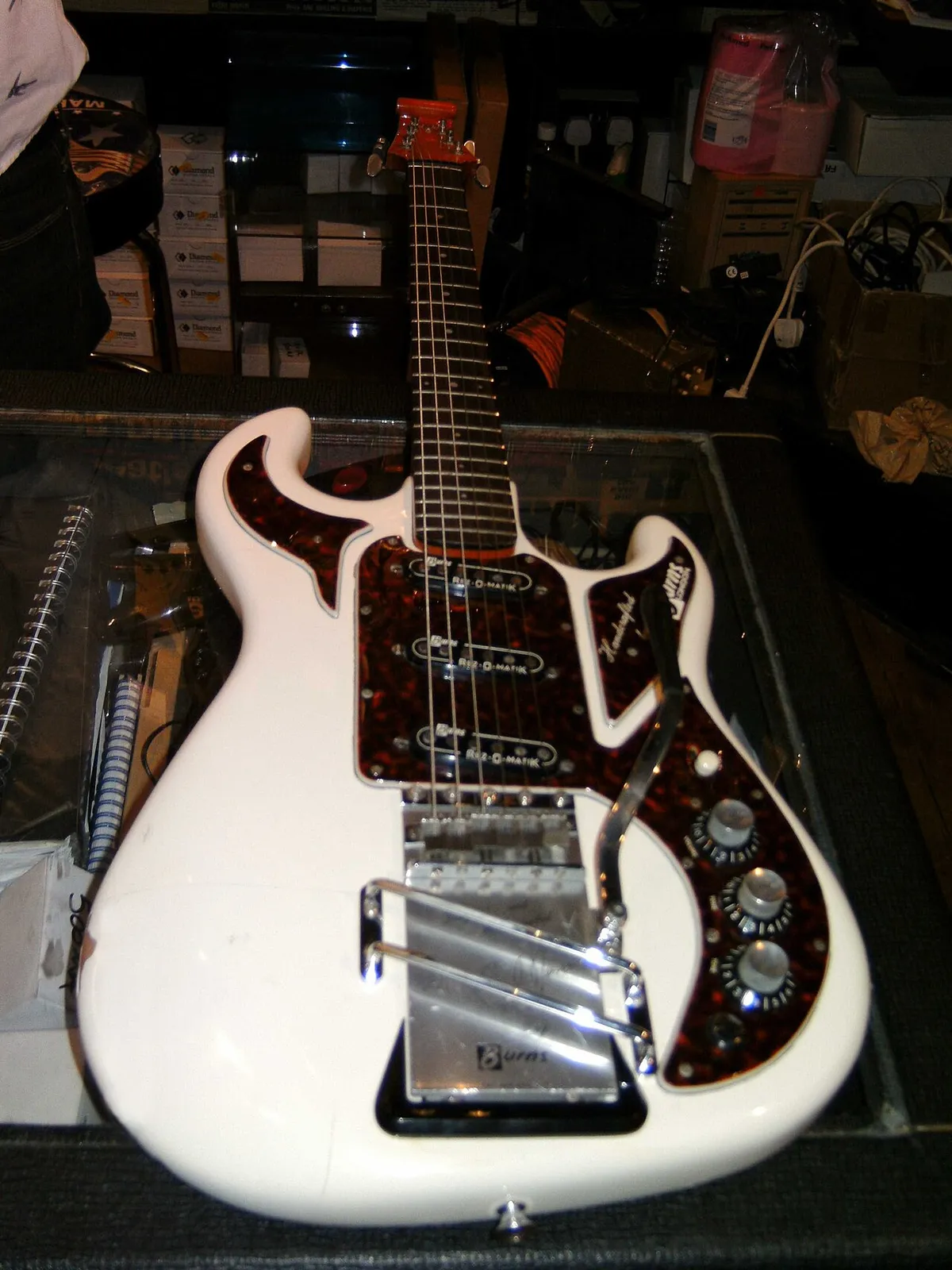
Photo: Bruce Marvin / Wikimedia Commons / Public domain Burns
Marvin
1964
Burns built Hank Marvin more than 30 prototypes to keep him in tune. Then somebody checked his jacket.
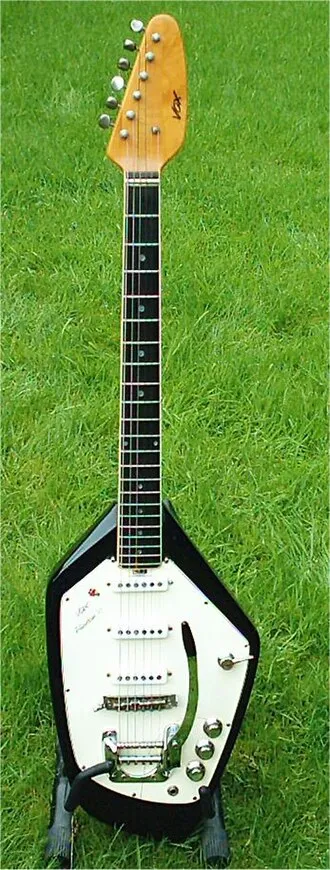
Photo: LittleRoughRhinestone / Wikimedia Commons / Public domain Vox
Phantom
1962
No Fenders in Britain, so Vox built a Strat in a five-sided coat you could spot from the back of the hall.