 Guitaripedia
Hopf
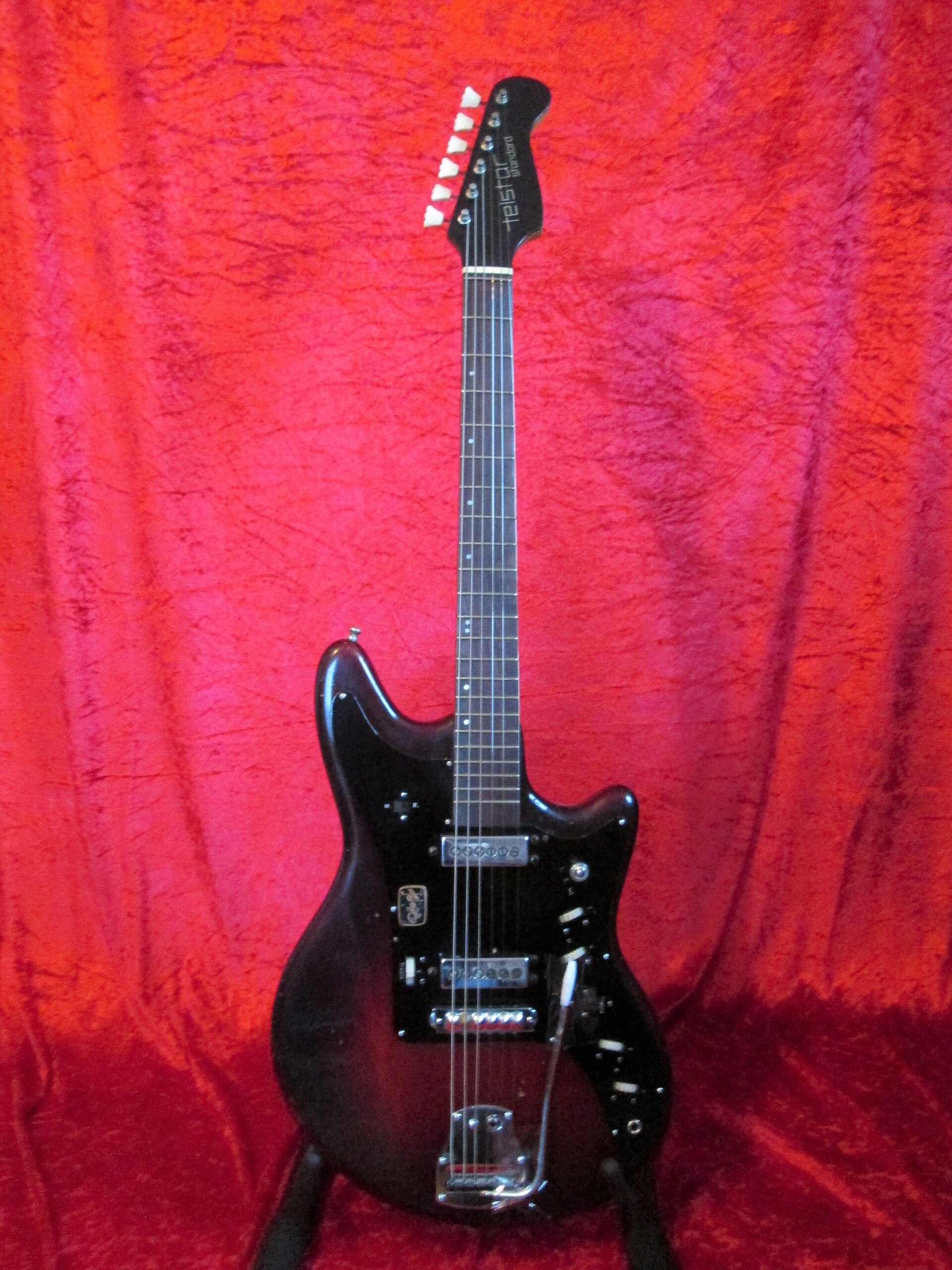
Telstar
Named for a satellite, switched like a mixing desk, and its best notes are on the wrong side of the bridge.
Telstar went up in 1962. Within a year or so, a family shop in Wehen, West Germany, had a solid offset guitar with the satellite's name and more switches than anybody needed. Half a century later Nels Cline took one on tour with Wilco and played the part behind the bridge.
- Introduced
- 1963
- Type
- Solidbody electric
- Class
- Closed run
The short version
1948
Out of Saxony
The Hopf family leaves the Klingenthal district for Wehen, in Hesse, before its workshop can be nationalized.
1962
The satellite
Telstar, the communications satellite, goes up. The guitar takes its name.
1963–66
Standard and International
The run dealers give for the Telstar, in two versions. No Hopf catalog page has turned up to confirm it.
1970
The imports win
Hopf's own electric production ends, by one account, under Japanese competition.
1996
Not from Wehen
A shop in Salem, Oregon, builds Lee Ranaldo a red offset called a "Hopf Telstar."
2011–12
Out with Wilco
Nels Cline tours a green Telstar Standard and names "Art of Almost" for it.
2026
Dieter Hopf dies
The man the family credits with Hopf's 1950s and '60s electrics dies in Taunusstein on 13 January.
Side A
A1
Named for the future
In 1962 a satellite called Telstar went up. Within a year or so, a guitar maker in Wehen, in Hesse, West Germany, had put its name on a solid offset electric.
That's the dealers' account, anyway: named for the satellite, built from 1963 to 1966, in two versions. No Hopf catalog page with the launch year has ever surfaced. Listings date guitars 1963, 1964, 1965, and "about 1963," and one in Vancouver came with a German receipt from 1968.
The Hopf family had been making instruments since the 1600s, in Saxony, near Klingenthal. In 1948 they left for Wehen, ahead of the GDR, before the workshop could be nationalized. The firm sold strings, woodwinds, and fretted instruments. The electrics came later, and the company's history credits Willy Hopf's son Dieter with them.
The Telstar was the future, as seen from West Germany in 1963.
A2
M, R, and Treble
Pick one up and the first thing you notice is that it's busy.
On one Standard, there's a preset marked M for full volume, another marked R for reduced volume, and a Treble preset that jumps straight to the bridge pickup. Then a pickup selector on top of that. Open the cavity and one shop found the selector wired in the opposite order to a Gibson, the M setting with its own volume and tone, the R setting with a second pair, and then a treble switch with yet another volume. Fiber board, screws, rivets. Nels Cline says his has roller controls instead of knobs, "typical of German guitars of the period."
The rest is short and light. One measured Standard has a 620 mm scale and weighs about three kilos. There's a vibrato, a floating bridge, and a long bare stretch of string behind the bridge. Remember that string.
The neck has no adjustable truss rod on one guitar. Another seller calls it Hopf's patented "ever straight" neck. Those might be the same idea, described from opposite ends.
A3
Standard and International
There were two Telstars. The Standard had two pickups. The International, by the dealers' account, had three and gold hardware, and it was the scarcer one. Then one listing titled International turns up with two pickups, and nobody can say whether it's a relabeled Standard.
Who made the pickups is the other argument. One dealer says Dynacord. Another says Schaller. A third calls them handmade. Hopf never said.
Not everyone loved it. A reader named Andreas got a worn 1960s Standard as a first electric: too many pickups, switches and pots, a neck that had already warped, and neck bolts set so close together the neck felt loose. Andreas rebuilt it, and what's left isn't a Telstar anymore.
It's also not the Saturn, the Hopf thinline with teardrop sound holes that the company ties to the Star-Club sign in Hamburg. Nor a Jazzmaster or Jaguar, though that's the offset family people compare it to. Different country, different scale, different switch count.
By one account Hopf stopped making its own electrics in 1970, beaten by Japanese imports. The firm went bankrupt in 1985.
Flip the record · By the numbers
3
Presets on one Standard: M for full volume, R for reduced, and Treble
620 mm
Scale on one measured Standard. Short.
2 or 3
Pickups, depending on which version, and which listing, you believe
1963–66
The run the dealers give. Hopf never published one.
Side B
B1
Behind the bridge
In 2012 Nels Cline showed his Wilco rig to a camera, and in the middle of it was a 1960s Hopf Telstar Standard.
Cline likes to play behind the bridge, picking that stretch of bare string. His Jazzmasters have it too. But the run on the Telstar is long enough to give him different pitches back there. "Art of Almost" was the point. He named "Capitol City" off the then-new record as well, and "Country Disappeared" from Wilco (The Album). He thinks he may have bought it at Mike's Music in Cincinnati, but he isn't sure. Years later, a post from the Loft in Chicago described his as electric green, and named the same three songs live.
He'd been recording with guitars like this for the odd tones, and leaving them at home when he toured.
B2
Same name, different guitar
There's another "Hopf Telstar" with a famous player. Lee Ranaldo of Sonic Youth used one on "Junkie's Promise," in DAADDA tuning. But that guitar was built in 1996 by Tim Knight at Guitar Castle in Salem, Oregon, the first guitar that shop built for the band. A red offset, and the band's own pages don't agree on its controls. It borrowed the name. It didn't come from Wehen.
The real ones stopped decades ago. Dieter Hopf died in Taunusstein on 13 January 2026. A new Hopf company, started by Christopher, Daniel, and Patrick Hopf, builds Saturns and a Skyrocket. There's no Telstar on the list.
That leaves the old ones, with all their switches, and a few players who want exactly the strange things that got them rebuilt into something else. In the rig video, Cline explains that he hadn't been taking them on tour.
"But now of course with Wilco I'm completely enabled."
Put this on
You’ve read about it. Now hear it. Here’s what this guitar sounds like, and what to listen for.
Art of Almost
The song Nels Cline names first for his Hopf. Listen for the notes behind the bridge. The string run is long enough there to give him different pitches.
Find it on YouTube (opens in a new tab)Capitol City
Another song Cline names for the Telstar, from The Whole Love, the record Wilco was touring when he showed it off.
Find it on YouTube (opens in a new tab)Country Disappeared
The third song Cline ties to this guitar, from Wilco (The Album). He played all three on it live.
Find it on YouTube (opens in a new tab)
The cast
The people, and the specific guitars, that made the legend.
2012
Nels Cline
1960s Hopf Telstar Standard, electric green
Took it on tour with Wilco for the behind-the-bridge notes. Isn't sure he bought it at Mike's Music in Cincinnati.
1996
Lee Ranaldo
1996 Guitar Castle "Hopf Telstar," not a Wehen guitar
Built for Sonic Youth by Tim Knight in Salem, Oregon. Used on "Junkie's Promise." Same name, different guitar.
1948
Willy Hopf
Ran the firm
Took over the family business in 1932 and moved it west to Wehen as Willy Hopf & Co.
1950s–60s
Dieter Hopf
Credited with the electrics
The company's history credits him with Hopf's electric guitars of the period. It names the Saturn 63, not the Telstar.
Andreas
A worn 1960s Telstar Standard
A first electric. Too many pickups, switches and pots, and a warped neck. Later rebuilt into something else.
Liner notes
Specs, construction, rarity, value, and every source we used.
A Wehen offset solid named for the 1962 satellite — preset switches, and a long run of string behind the bridge.
- Body
- Solid offset. Wood species unpublished. The Old Europe, on one green Standard: solid, "likely birch or poplar." Nels Cline, on his: it looks laminated, and it is not.
- Neck
- Bolt-on. The Old Europe's Standard: a slim, wide D, and no adjustable truss rod. Vintage & Rare's 1964 Standard: Hopf's patented "ever straight" neck. One reader's 1960s Standard (Premier Guitar, 27 January 2026): neck bolts set close together.
- Fingerboard
- Rosewood on the Standard The Old Europe measured, 12" radius, medium-jumbo frets. Fret count is not one figure. eric's Gear Depot prints 22 frets on a listing titled 1963 International.
- Scale
- 620 mm on The Old Europe's Standard. That listing prints no inches. No second measured Telstar scale has been published.
- Pickups
- Sources differ on the count and the maker. VintageFans, and a Dresden shop, give the International three pickups and the Standard two. eric's Gear Depot titles a 1963 guitar International and describes two single-coils. On the Standard's pair, VintageFans says Dynacord model GTA 3; The Old Europe says original Schaller, 4.89k at the neck and 4.3k at the bridge, on that one green guitar.
- Hardware
- Vibrato and a floating bridge on the International eric's Gear Depot listed. A string damper on The Old Europe's Standard. Gold hardware on the International, per VintageFans. Willie's American Guitars (3 August 2026): a steel pickguard and a small brass plate, on one Standard.
- Electronics
- Passive, and busy. The Old Europe: an M preset at full volume, an R preset at reduced volume, and a Treble preset that jumps to the bridge pickup. Willie's video describes the same M / R split, then a separate treble switch and another volume.
- Finish
- No factory color card has been published. Examples are offered in sunburst, white, green, and red.
- Nut
- 43 mm on The Old Europe's Standard. That listing prints no inches.
Open the full research fileConstruction details, the complete player record, production numbers, dated value estimates, and sources
The specs above are the 1960s Wehen Telstar, mostly one measured Standard. No current model carries the name. In the Detmold and Dresden shop copy, the International is the three-pickup version with gold hardware; one listing titled International describes two. A four-string Telstar Standard is a bass. The Guitar Castle instrument Lee Ranaldo used is a 1996 build from Salem, Oregon, not a Wehen Telstar.
Construction
The job was a West German solid with a space-age name and a mixer’s worth of switches. Offset in the hand. Short. Light. A vibrato, and a long bare string behind the bridge.
The shop that built it had already moved once. German Wikipedia: the Hopf name is in the instrument-making record from 1669, with Caspar Hopf (1655–1716) in Klingenthal. The Allgemeine Zeitung (15 January 2026) dates the family tradition to 1655. The two dates are the birth year and the first guild record, not two foundings. Ernst Max Hopf founded E. Max Hopf in Zwota, near Klingenthal, in 1906, as a string maker. His son Willy (1906–1990) took the firm in 1932 and, with his brother Wolfgang, added an instrument workshop. Until 1948 the family was still in the Klingenthal / Markneukirchen district of Saxony. They left for Wehen, in Hesse, before the GDR and before the workshop could be nationalized. The new firm was Willy Hopf & Co., on Platter Straße: strings, fretted instruments, and woodwinds. Wehen is now part of Taunusstein. Hopf Electric Guitars’ own history puts Dieter Hopf (1936–2026) and a Wolfgang Hopf (1930–2013) in the shop in the early 1950s, calls them Willy’s sons, and credits Dieter with the electrics of the 1950s and 1960s, naming the Saturn 63. It does not name the Telstar. German Wikipedia’s Wolfgang is the brother who joined in 1932, not a son born in 1930. The two accounts are not the same man.
The name is the satellite. Telstar, the communications satellite, went up in 1962. VintageFans, the Detmold shop whose paragraph is copied onto other Telstar listings, says the guitar was named for that satellite and built from 1963 to 1966, in two versions. No Hopf catalog page with the launch year has been published. Listings still date individual guitars 1963, 1964, 1965, and “about 1963.” A Vancouver Craigslist ad, updated 12 October 2026, includes a German purchase receipt dated 1968. That is one guitar changing hands. It is not a factory end date. 1963 is the start those dealer accounts give. Nothing earlier has turned up.
Two guitars share the name. VintageFans: the Standard, and the International. In that copy, and in a Dresden shop’s listing, the International has gold hardware and three pickups, and is the scarcer of the two. VintageFans also says the International used “higher quality wood.” That is the shop’s sentence, not a wood list. eric's Gear Depot titles a 1963 guitar International and then describes two single-coils, a bolt-on neck, and 22 frets. A mislabeled Standard would explain the two pickups. The listing does not say. The Standard, everywhere else, is the two-pickup guitar.
The numbers in the specs are sellers’ tapes, not a factory sheet. Weights on named guitars, not one average: The Old Europe 3.06 kg on its green Standard; Beyers Music 2.6 kg (the listing also prints 91.7 oz) on a white Standard; a Romanian seller 3.7 kg on a 1964 International, with a neck he calls mahogany and “forever straight.” Vintage & Rare’s 1964 red-sunburst Standard calls the neck Hopf’s patented “ever straight” neck. The Old Europe’s “no adjustable truss rod” and those two “straight neck” claims may be the same idea. They are three guitars. Amazona (27 August 2022) gives the Saturn 63 a 620 mm scale as well. The Saturn is a different instrument. The shared number is not a Telstar factory scale.
The pickups are the other fight. VintageFans: Dynacord, model GTA 3, made in Germany. The Old Europe, on its green Standard: Schaller, 4.89k neck and 4.3k bridge. Willie’s American Guitars, in a 3 August 2026 video of one Standard, calls the pickups handmade. Three accounts. No Hopf page picks one.
The circuit is why players either love it or rip it out. The Old Europe: three presets — M at full volume, R reduced, Treble straight to the bridge pickup — plus a pickup selector. Willie’s video walks the same idea from the cavity: a selector for neck, bridge, or both, wired in an order the shop calls backwards from Gibson; an M setting with its own volume and tone; an R setting with a second pair; then a treble switch and yet another volume. Fiber board, screws, rivets. Cline, on his Standard, describes roller controls rather than knobs, “typical of German guitars of the period.” A string damper survives on The Old Europe’s Standard. One red example, sold as a Sid Kleiner Telstar, has a mechanical mute and a mirror pickguard; the seller says Sid Kleiner had a store and studio in New Jersey, and that this headstock wears his name. One labeled guitar. Not a catalog model with a published count.
Andreas, in Premier Guitar (27 January 2026), remembers a worn 1960s Standard as his first electric: too many pickups, switches, and pots, a neck that had already warped, and neck bolts spaced narrowly enough that the neck felt loose, which he calls typical of German guitars of that era. He later rebuilt it. The rebuilt guitar is not a Telstar anymore.
Not the Saturn. The Saturn 63 is the thinline, with teardrop sound holes, the one Hopf Electric Guitars ties to the Hamburg Star-Club sign. Amazona groups the solid, space-named Hopfs — Jupiter, Cosmos, Telstar, Satellite, Galaxie — as the Stratocaster side of that catalog. Sellers, and Cline, describe the Telstar as an offset, Jaguar and Jazzmaster territory, with a rhythm circuit and a long behind-bridge string. Both comparisons are in print. The body you buy is the offset. Not a Jazzmaster, and not a Jaguar: different country, different scale, different switch count. Not Lemmy Kilmister’s Hopf. The company’s history gives him a Studio bass. Not the four-string. Amazona’s Telstar Standard bass is a solidbody four-string with a sieve pickup. Not the 2023 electrics. Hopf Electric Guitars, the company Christopher, Daniel, and Patrick Hopf started — Wikipedia says 2022, the company’s own page says 2023 — lists a Saturn 23, a Saturn SB, and a Skyrocket. No Telstar.
Willy Hopf & Co. filed for bankruptcy in 1985 (German Wikipedia). The guitar department in Taunusstein went to Dieter Hopf, whose own atelier, opened in 1981, built concert guitars, not this solid. Amazona dates the end of Hopf’s own electric production to 1970, under Japanese imports, with the firm then selling Aztec copies. Dieter Hopf died in Taunusstein on 13 January 2026. The Telstar was already long out of the book.
Players
Nels Cline — a 1960s Telstar Standard, with Wilco. Premier Guitar’s rig rundown (Rebecca Dirks, 26 January 2012) lists a ’60s Hopf among the guitars he had out with Wilco, and notes that he likes to play behind the bridge. In the video of that rig he calls the guitar a Hopf Telstar Standard. The behind-bridge notes on “Art of Almost” are the point: his Jazzmasters have that string too, but this run is long enough to give different pitches. He also names “Capitol City” on the then-new record, and “Country Disappeared” on Wilco (The Album). “Art of Almost” and “Capitol City” are on The Whole Love (2011). “Country Disappeared” is on Wilco (The Album) (2009). His line, in that video: it is luxurious to play guitars like this live; he records them often for the odd tones and had not been taking them on tour, “but now of course with Wilco I’m completely enabled.” He is not sure he bought it at Mike’s Music in Cincinnati. The Loft, Chicago (5 January 2021), describes his mid-1960s Telstar Standard as electric green and names the same three songs live. The 1959 Jazzmaster is a different guitar. So is the Jaguar.
Lee Ranaldo — a Guitar Castle instrument, not a Wehen Telstar. The Sonic Youth gear guide titles one 1996 guitar “Hopf Telstar” and says it was used on “Junkie’s Promise,” tuning DAADDA, from Washing Machine. The same note says the guitar was manufactured for him by Tim Knight of Guitar Castle in Salem, Oregon. The sold-gear page calls it a Guitar Castle Hopf Telstar, serial 001, the first guitar that shop built for the band, a red offset, electronics cut back to a volume knob, auctioned on Reverb in October 2018. The gear-guide note on the same instrument also lists two single-coils, a rosewood board, two switches per pickup, two knobs, and a silver pickguard. The two pages on one site do not describe the same control layout. The tab archive is plain about the builder: Tim Knight, Salem, built it for the band. A later shop, listing a red mirror-guard guitar it calls a Sid Kleiner Telstar, guessed that Ranaldo’s was a German import with a different headstock logo. That is the shop’s guess. The band’s gear guide says Knight built it. “Junkie’s Promise” on that guitar is not a 1963 Wehen Telstar.
No other player has a named source on a Wehen Telstar.
Rarity
You cannot buy a new Telstar. Hopf Electric Guitars’ living models are the Saturn and the Skyrocket (the company’s site, read 29 October 2026). Dieter Hopf’s concert guitars are a different bench. No reissue of this solid turned up.
Hopf never published a Telstar total. A neck date, or “about 1963” on a listing, dates a guitar. It is not a census. Dealer copy puts the run at 1963–1966 and calls the International rarer than the Standard. That is a shop’s ranking. The 1968 receipt on the Vancouver Craigslist guitar is a purchase, not a production figure.
What is actually thinner: an International that still has three pickups and the gold hardware; a Standard whose M / R / treble switching has not been pulled; a string damper that is still on the guitar. A Telstar bass is a different instrument. A Saturn is a different instrument. Andreas’s rebuilt Standard is one guitar that used to be this one. Ranaldo’s red offset is a 1996 Oregon build. Cline’s green Standard is one object, and it has not been a public sale.
Value
Informal estimate, 29 October 2026. Not an appraisal.
Prices below are asking prices unless marked sold. No celebrity Telstar sale has turned up. Cline’s guitar is not a comparable. Ranaldo’s Guitar Castle instrument is not a Wehen Telstar, and the 2018 auction price was not printed on the gear guide. No period list price for the Telstar has been published. Amazona’s “about 430 Deutschmarks” in 1963 is the Saturn, a different guitar.
New street. None. The Hopf Electric Guitars site listed no Telstar on 29 October 2026. A new Saturn SB is a different model: one Reverb ask, the same week, showed €4,900 (was €5,600). That number is not a Telstar.
Used modern. No current or reissue Telstar turned up, so there is no separate modern used market.
Vintage / collectible. No sold median has been published. Asks, checked 29 October 2026, and not sales: VintageFans, Detmold, a 1960s Standard in sunburst, $1,077.13 plus $85.55 shipping on the US listing, and €919 on Reverb’s euro pages — one guitar, two currencies. wurst.guitars, Neustrelitz, a 1960s International: €790 on the shop’s own page (was €840), and €875 on that shop’s Reverb listing after a drop from €925, shipping free. Same seller, so the two figures are not two guitars. A Vancouver listing updated 12 October 2026 asked $1,450 for a Standard, with the 1968 German receipt in the lot. Older pages, not 2026 results: Beyers Music, a white Standard, marked sold, the price on the page €590 plus €10 shipping, listed four years ago. Germany’s Vintage Guitar Shop, an International, last price on the page $915.68, seller away, listed seven years ago. Vlad’s Gear Locker, a 1964 International, listing ended at €990 plus €70, listed three years ago. The Old Europe’s green Standard and Vintage & Rare’s 1964 red-sunburst Standard are both marked sold, and neither page printed a price. An ask and a hammer are different kinds of number, and here the hammers are mostly missing.
See also
- fender-jazzmaster — the offset sellers, and Cline, set the Telstar beside; a different scale, and the behind-the-bridge idea he already had
- fender-jaguar — the other Fender offset in that comparison; not this Wehen solid, and not Cline’s Hopf
- hofner-club-40 — the other West German electric of the same years; fully hollow, one pickup, Bubenreuth, not a Taunusstein solid
Sources
- German Wikipedia, Hopf (Gitarrenbauer) — 1669; Caspar Hopf 1655–1716; E. Max Hopf, Zwota, 1906; Willy from 1932; Saxony until 1948, then Wehen, Platter Straße; Dieter’s atelier 1981; Willy Hopf & Co. bankrupt 1985; Dieter died 13 January 2026; electric revival dated 2022
- Hopf Electric Guitars, history — Wehen / Wiesbaden workshop; Dieter and the 1950s–60s electrics, Saturn 63 and the Star-Club; Lemmy on a Studio bass; 2023 revival, Saturn 23, no Telstar (read 29 October 2026)
- Amazona, Hopf Saturn 63 and Saturn 67, 27 August 2022 — Jupiter, Cosmos, Telstar, Satellite, Galaxie as the solid, space-named models; Saturn is the thinline; Saturn guitar scale 620 mm; Telstar Standard bass, four strings, sieve pickup; own production to 1970
- VintageFans, Telstar Standard, Reverb — named for the 1962 satellite; produced 1963–1966; Standard and International; Dynacord GTA 3; International has gold hardware, three pickups, “higher quality wood”
- The Old Europe, Telstar Standard, Reverb — 620 mm; nut 43 mm; 3.06 kg; 12" radius; rosewood; no adjustable truss rod; Schaller single-coils, 4.89k and 4.3k; M / R / Treble presets; string damper; marked sold, price not printed
- Beyers Music, white Standard, Reverb — 2.6 kg / 91.7 oz; marked sold at the page price €590; listed four years ago
- Vintage & Rare, 1964 Telstar Standard — “ever straight” neck, patented by Hopf; marked sold, no price
- Willie’s American Guitars, video, 3 August 2026 — steel pickguard, brass plate; M / R plus a treble switch; pickups called handmade
- eric’s Gear Depot, 1963 International, Reverb — solid body, bolt-on, 22-fret board, two single-coils in that listing’s text, floating bridge, vibrato
- Germany’s Vintage Guitar Shop, International, Reverb — three pickups, gold hardware; last price on the page $915.68; listed seven years ago
- Vlad’s Gear Locker, 1964 International, Reverb — 3.7 kg; mahogany neck in the seller’s text; “forever straight”; listing ended at €990
- Premier Guitar, Rebecca Dirks, Rig Rundown, 26 January 2012 — a ’60s Hopf in the Wilco rig; behind-the-bridge playing
- Nels Cline, rundown video — he calls it a Hopf Telstar Standard; “Art of Almost,” “Capital City,” “Country Disappeared”; roller controls; solid, not laminate
- The Loft, Chicago, 5 January 2021 — his mid-1960s Standard described as electric green; the same three songs live
- Premier Guitar, Anne Erickson, 15 April 2010 — “oddities like Hopf and Magnatone,” not named as a Telstar
- Premier Guitar, reader guitar, 27 January 2026 — a worn Standard as a first electric; narrow neck-bolt spacing; later rebuilt
- Sonic Youth gear guide, Hopf Telstar — Lee, 1996, “Junkie’s Promise,” DAADDA; Tim Knight, Guitar Castle, Salem, Oregon; auctioned October 2018
- Sonic Youth, sold gear — Guitar Castle Hopf Telstar, serial 001; red offset; volume only
- Sonic Youth tab archive, “Junkie’s Promise” — the Guitar Castle “Hopf Telstar” was built for the band by Tim Knight
- VintageFans, 1960s Standard, Reverb, still listed — ask $1,077.13 + $85.55; €919 on euro pages (29 October 2026)
- wurst.guitars, Telstar International — €790, was €840
- wurst.guitars on Reverb — €875 after a drop from €925; same shop
- Allgemeine Zeitung, 15 January 2026 — Dieter Hopf died at 89; atelier on Platter Straße in Wehen; the paper dates the tradition to 1655, where Wikipedia uses 1669 for the name in the record
- Craigslist Vancouver, Telstar Standard — ask $1,450; German purchase receipt dated 1968; posted 31 August 2026, updated 12 October 2026
Keep digging
Guitars this one gets compared to, confused with, or descended from.
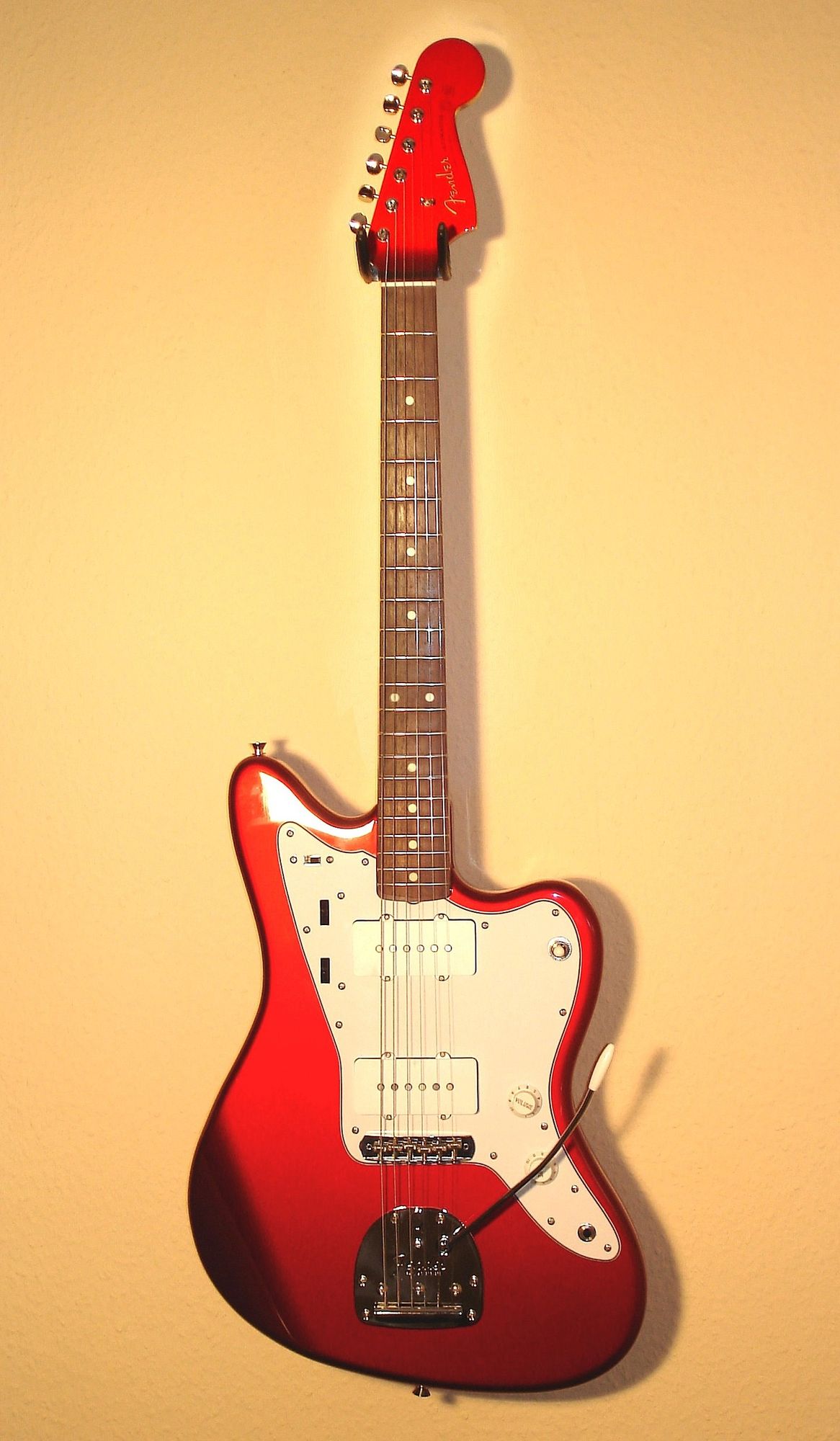
Photo: Dirk-X / Wikimedia Commons / CC BY-SA 4.0 Fender
Jazzmaster
1958
Fender built it for jazz players. Jazz players said no thanks. Surfers, punks, and noise bands said yes.
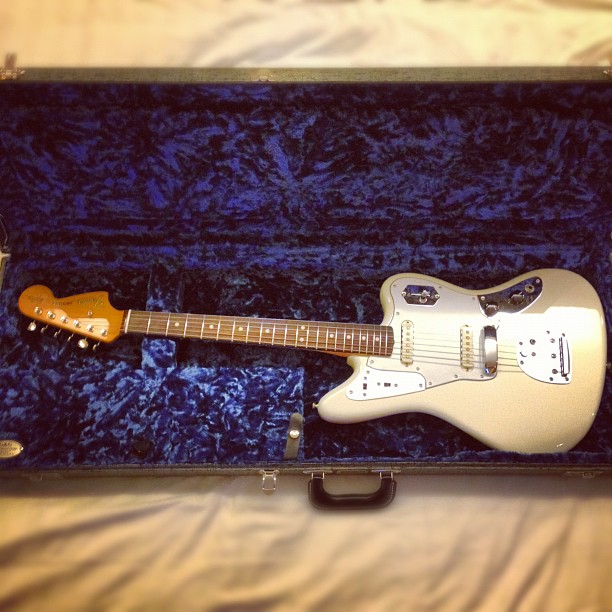
Fender Jaguar Johnny Marr signature. Photo by ToGa Wanderings. Licensed under CC BY 2.0. Via Wikimedia Commons. Fender
Jaguar
1962
It was the top of Fender’s catalog in 1962. By the late ’70s it was a pawn-shop guitar, and somebody’s only one.
- Send a picture
Höfner
Club 40
1955
John Lennon and George Harrison both saw a Club 40, and in John’s words, both “thought it was the end.”