Ibanez
JS
A Les Paul dug into Joe Satriani’s forearm. Ibanez built him a guitar that didn’t.
October 1987. *Surfing with the Alien* comes out, and the guitars on it are a bolted-together parts guitar and a $500 Kramer. The white Ibanez in the “Satch Boogie” video? A promo shot. The guitar with his initials on it is still a couple of years away.
- Introduced
- 1990
- Type
- Solidbody electric
- Class
- Production
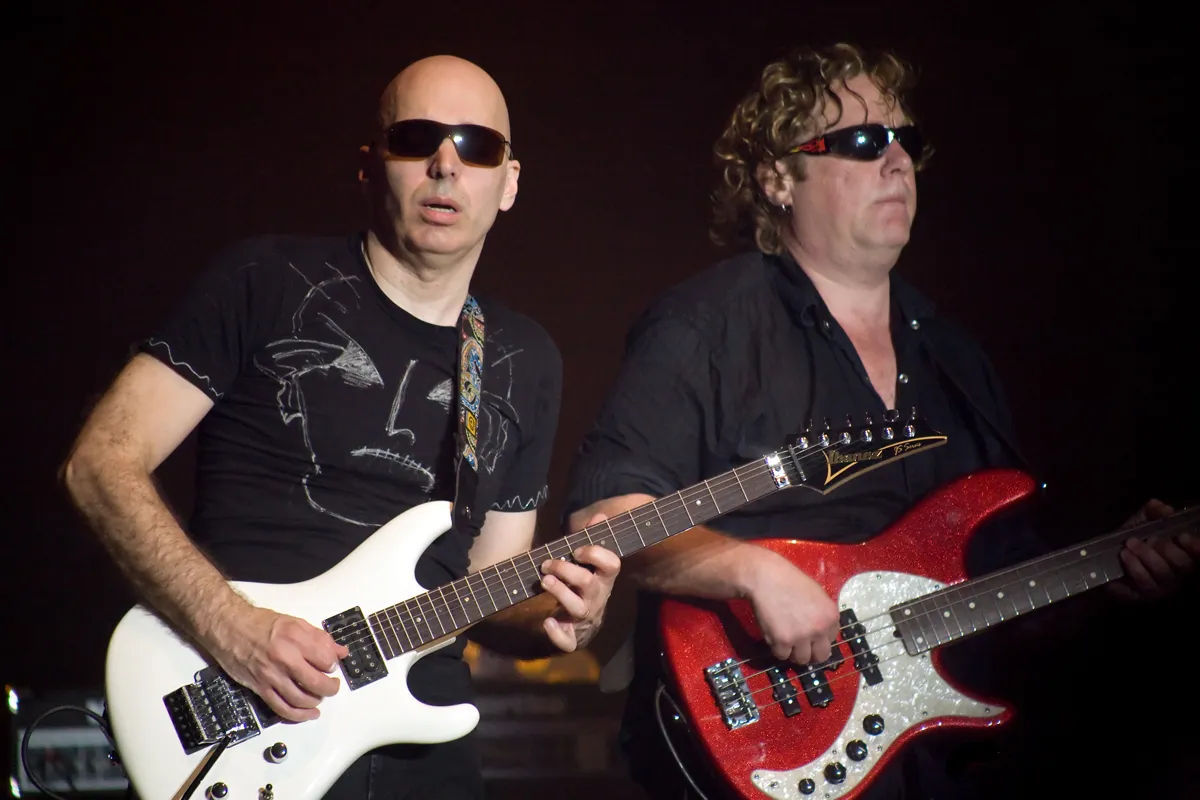
The short version
1987
Surfing, without a JS
The album is a parts guitar and Kramer Pacers. The white Ibanez in the video was never used.
1988
The partnership
Satriani starts endorsing Ibanez. The anniversaries count from here.
1990
JS1, JS2, JS3
The signature line reaches the catalog. One fan history says the JS1 came in 1989.
1994
JS1000
The JS1 becomes the JS1000, basswood and made in Japan. It runs to 2013 or 2014.
1998
Ten years in chrome
The JS10th, luthite under chrome. 506 of them, or 507.
2002
Pearly goes missing
His prototype chrome JS is reported stolen in August. A 2000 chat already mentions guitars gone.
2014
Twenty-four frets
The alder JS2450, after 24-fret prototypes and a JS2410 in 2013.
2017
Sustainiac
The JS2480 puts a Sustainiac in the neck position.
Side A
A1
Not on *Surfing*
October 1987. Joe Satriani’s Surfing with the Alien comes out. If you’re picturing an Ibanez on it, you’re picturing the wrong guitar.
The record is a 1978 parts guitar, a Boogie Bodies body on an ESP neck, and a Kramer Pacer bought at a midnight sale for $500. That one did the whammy work. A second Pacer played “Ice 9.”
There is an Ibanez in the story: a white 540, in the “Satch Boogie” video and on the cover of Not of This Earth. Years later somebody asked him about it.
“I never used it, it was just a promo shot.”
A2
Knuckles, forearm, horn
What Satriani wanted wasn’t a look. He wanted to stop fighting the guitar.
He told Guitar Player that Les Pauls, Teles, and Strats all restricted him. On a 335 his knuckles hit the horn. A Tele or a Les Paul dug into his forearm. The Strat was kinder to his arm, and its vibrato was not kind at all. So he’d been bolting Boogie Bodies to ESP necks, building his own.
Then Ibanez sent him a 540R. It was a Radius, a curvy double-cut with a body that reads a little like an airfoil.
“Hey, this doesn’t look like a ’50s guitar, and it produces a whole other sound,” he said. The JS, as he told it, is that comfort plus a neck he actually liked.
It isn’t a JEM. The JEM is Steve Vai’s, from 1987, with the monkey grip and the flat Wizard neck. Satriani’s board has a curve to it. Vai was once his student. Different guitar.
A3
Three birthdays
When the JS starts depends on what you’re counting. Satriani starts endorsing Ibanez in 1988, and the anniversary guitars count from there. The catalog guitar arrives in 1990: the JS1, the JS2 “Chromeboy,” and the JS3. One fan history says the JS1 came in 1989. Keep all three.
The JS1 is basswood with a one-piece maple neck, 22 frets, and an Edge tremolo. Satriani laid out the pickups himself in 2000: “paf pro in the neck, fred in the bridge.” A push/pull on the volume added a high-pass, and one on the tone split the coils. Steve Blucher at DiMarzio worked the pickups so a melody and a chord didn’t need two guitars. Gary Brawer and the Los Angeles Custom Shop spent years taking mass out of the tremolo arm so it wouldn’t go “boingy.”
In 1992 the JS1 picked up a third pickup in the middle and a Lo-Pro Edge. In 1994 it became the JS1000, which ran until 2013 or 2014, depending who you ask. He told fans in 2000 that he still liked the original Edge better.
Flip the record · By the numbers
3
Years the JS story can start in, depending who’s counting. 1988, 1989, 1990.
$500
The Kramer on Surfing with the Alien, bought at a midnight sale. Not a JS.
506 or 507
Chrome JS10th guitars. The counts don’t agree.
50
JS25ART guitars, each one drawn on and signed by Satriani.
Side B
B1
Chrome cracks
The JS2 was the chrome one. One account says it was advertised and never put into production, just a few prototypes. Another says there was a 1990 run, very few, because the chrome cracked. Nobody has settled it.
His own prototype chrome JS2CH, Pearly, carried a Seymour Duncan Pearly Gates. It was reported stolen in August 2002 and never recovered. In a December 2000 chat he’d already said guitars had gone missing from San Rafael, with “no word yet.” Two dates, and nobody has joined them up.
The ten-year guitar in 1998, the JS10th, was chrome over luthite: 506 of them, or 507, depending on who counted. Asked which chrome guitars he liked best, he said the Japanese basswood ones.
The JS3 was painted by Donnie Hunt. In 1991 Satriani gave Spinal Tap two guitars and a bass Hunt had painted, plus a JS he’d painted himself, which later turned up with Nigel Tufnel.
B2
Twenty-four frets and a Sustainiac
Today’s main JS is the Japan-made JS2450, and it has changed under the paint. Alder instead of basswood. A maple and bubinga neck. Twenty-four frets. Ibanez calls it the first 24-fret JS, but 24-fret prototypes and a JS2410 were already around in 2013.
By 2014 his main guitars were JS2410s in Muscle Car Orange. The neck pickup changed names too, from Pro Track on the prototypes to Satch Track now, with a Mo’ Joe at the bridge. In 2017 the JS2480 put a Sustainiac in the neck, a pickup that keeps a note ringing as long as you hold it.
B3
Most of the record
Ask what he used on What Happens Next and the answer is three JS guitars: “my MCO, my MCP, and my JS25ART.” For Shapeshifting, he said he couldn’t have made it without his JS1CR.
On The Sea of Emotion, it’s JS guitars on most of the record: the JS1CR, a GD, a Paisley, an MCR, with a 1958 Esquire and some acoustics for the rest. Steve Vai is on it too, playing JEMs.
Nearly forty years after a Les Paul dug into his forearm, he’s still playing the guitar that doesn’t.
Put this on
You’ve read about it. Now hear it. Here’s what this guitar sounds like, and what to listen for.
What Happens Next
His own gear list for the record, all JS guitars. “My MCO, my MCP, and my JS25ART.”
Find it on YouTube (opens in a new tab)Shapeshifting
He says he couldn’t have made this one without his JS1CR.
Find it on YouTube (opens in a new tab)
The cast
The people, and the specific guitars, that made the legend.
Joe Satriani
Pearly, a prototype chrome JS2CH
It carried a Seymour Duncan Pearly Gates, which a stock JS doesn’t. Reported stolen in August 2002 and never recovered.
Steve Blucher
The DiMarzio pickups
Worked the pickups so a melody and a chord didn’t need two different guitars.
Gary Brawer
The tremolo arm
Spent years with the Los Angeles Custom Shop taking mass out of the arm so it wouldn’t go “boingy.”
Donnie Hunt
Painted JS3, 1990–93
Painted the production JS3, and two guitars and a bass Satriani gave Spinal Tap in 1991.
1991
Spinal Tap
A JS Satriani painted himself
Part of the 1991 gift, alongside Hunt’s three. Later seen with Nigel Tufnel.
Steve Vai
JEMs, not a JS
His own Ibanez signature, from 1987. On The Sea of Emotion he plays JEMs while Satriani plays JSs.
Liner notes
Specs, construction, rarity, value, and every source we used.
Satriani wanted a guitar a Les Paul horn wouldn’t dig into — a Radius body and his neck, not a JEM, and not the Kramer on *Surfing with the Alien*.
- Body
- Alder; curvy double-cut, Radius-derived. Japan.
- Neck
- Bolt-on 3-piece maple/bubinga, JS profile. Ibanez Wiki: tilt joint.
- Fingerboard
- Rosewood, mother-of-pearl dots, 24 medium frets, Prestige edge treatment. Radius 250 mm (Ibanez). A shop prints 9.8". Mix flagged.
- Scale
- 648 mm / 25.5". Ibanez prints both. Mix flagged.
- Pickups
- DiMarzio Satch Track (ceramic) neck; DiMarzio Mo' Joe (alnico) bridge. HH.
- Hardware
- Edge tremolo, 10.8 mm spacing, chrome; Gotoh machines; Ultralite arm; hardshell case
- Electronics
- Volume with push/pull high-pass; tone with push/pull coil-tap; 3-way
- Finish
- Muscle Car Purple on the USA page. Sweetwater: gloss polyurethane.
- Nut
- Locking. Width 42.8 mm (Ibanez). A shop prints 1.685". Mix flagged.
Open the full research fileConstruction details, the complete player record, production numbers, dated value estimates, and sources
Current production typical = Japan JS2450 (ibanez.com/usa; Ibanez Wiki: 2014–2026). Classic catalog guitar is the Japan JS1 (1990–1993): American basswood, 22 frets, Edge then Lo-Pro Edge. Indonesia JS140M is the affordable current JS — American basswood, maple board, Ibanez pickups, Edge-Zero II — not this table. JSA acoustics are another signature. Not a JEM. Not an RG550.
Construction
The job was comfort. Joe Satriani told Guitar Player that Les Pauls, Teles, and Strats restricted him. Knuckles hit the horn on an ES-335. A Tele or a Les Paul dug into his forearm. The Strat was kinder. Its vibrato was not. He had been bolting Boogie Bodies to ESP necks. Then Ibanez sent a 540R. “Hey, this doesn’t look like a ’50s guitar, and it produces a whole other sound.” The JS, he said, was that comfort, plus a neck he actually liked. Steve Blucher at DiMarzio worked the pickups so a melody and a chord didn’t need two guitars. Gary Brawer and the Los Angeles Custom Shop spent years taking mass out of the arm so it wouldn’t go “boingy.”
The 540R is a Radius. Not an RG. Not a JEM. Ibanez Wiki calls the body a curvy double-cut, airfoil-like. The JEM (ibanez-jem) is Vai’s 1987 guitar: monkey grip, Wizard neck, usually a middle single. The RG550 (ibanez-rg550) is the mass HSH from the same year. This plate is Satriani’s. Current radius 250 mm, not the Wizard’s flat board.
When you could buy one is three dates. Keep them. Wikipedia: 1988–present, and he starts endorsing in 1988. The 1998 JS10th is a ten-year plate. Ibanez’s “30 Year Partnership” page was archived January 2018. Wikipedia calls the 2018 JS1CR a 30th. That count starts in 1988. The catalog guitar is later. Ibanez Wiki: launched 1990 as JS1, JS2 (“Chromeboy”), and JS3. The JS1 page cites the 1990 Europe catalog, years 1990–1993. One sentence there says “1999” and links the 1990 portal — a typo, not another year. Blue Book: debuted 1990. Guitar World (2 March 2015) frames the JS25ART as 25 years after the signature’s birth, which points at about 1990. Joe Satriani Universe says the JS1 arrived in 1989, then lists finishes from 1990. This plate starts in 1990, the catalog year. The partnership is counted from 1988. The fan site says 1989.
A JS1 is American basswood, one-piece maple, 22-fret rosewood, pearl dots, tilt joint, Gotoh, .009–.042 (Ibanez Wiki). Scale 648 mm / 25½" — the same dual print as today’s 648 mm / 25.5". Mix flagged. Joe Satriani Universe’s JS1 nut is 42 mm. The JS2450’s is 42.8 mm. Don’t average them. Music Store Live’s 9.8" and 1.685" are shop conversions of Ibanez millimetres, not a second spec.
Pickups, first JS1: Ibanez Wiki says DiMarzio PAF Pro neck, FRED bridge, HH, 3-way, high-pass on the volume, coil-split on the tone, Edge, 1990–91. Satriani, 5 December 2000: “paf pro in the neck, fred in the bridge.” Joe Satriani Universe’s table says PAF Joe at the neck; its opening paragraph swaps the two. Use Joe and the wiki. In 1992 the JS1 gained a middle HS-2, a 5-way, and a Lo-Pro Edge. Those years are HSH. The wiki’s other middle-pickup JS is the later JS2GD (2022–2025). The rest of the line is two humbuckers.
1994, the JS1 becomes the JS1000 (wiki; Wikipedia says “mid 90s”). Basswood, Japan, 22 frets. Wiki: 1994–2014. Joe Satriani Universe ends it in 2013. He told the 2000 chat he still liked the original Edge over the Lo-Pro. The JS100 is the cheaper sibling. Wikipedia gives it Ibanez Axis pickups, not DiMarzios.
Wood moves. A 1997 satriani.com shop note: mostly basswood, except the JS6 — mahogany, no tremolo. The guitar in the table is alder. The JS140M (Indonesia, 2020–2026) is American basswood again, Infinity RD and Quantum, Edge-Zero II, nut 42 mm. Same outline. Not this spec.
24 frets are current, not 1990. Ibanez’s JS2450 page calls itself the first 24-fret JS. The wiki dates JS24P and JS2410 to 2013, the JS2450 to mid-2014. Don’t hand it the “first.” Premier Guitar (2013) already has JS2410 prototypes: alder, maple/bubinga, 25.5", DiMarzio Pro Track neck and Mo’ Joe bridge. The 2026 page says Satch Track and Mo’ Joe. Both neck names stay.
Sustainiac is later, at the neck. Ibanez: factory units since the JS2480 (2017). Premier Guitar (December 2017) puts it in the neck of a JS2480 and mentions a bridge unit as a next step — a caption’s plan, not the 2026 catalog. Sweetwater’s JS240PS and JS2480 still show Sustainiac neck, Satchur8 bridge. Guitar World (2 September 2026) describes a new JS2470 the same way. Not the table. JSA acoustics, from 2010, are the other signature.
Chrome doesn’t have one census. Blue Book: the JS2 was advertised and “never put into production”; a few prototypes. Wikipedia: a 1990 JS2CH, basswood, “very few,” because chrome cracked. The wiki lists a 1990 chrome JS2. Keep the split. The JS10th (1998) is luthite under chrome. Wikipedia and Eddie’s: 506. Joe Satriani Universe: 507, Joe’s is #370, plus an unserialized spare some call #508. Don’t average. Asked which chrome he preferred, he said the Japanese basswood ones. JS2PRM (2005): 60 guitars, 35 for the USA (Joe Satriani Universe); Wikipedia’s 60 includes a first 20 with finish trouble and the rest in 2006. Aluminum plate (Wikipedia) or a few microns of stainless (Joe Satriani Universe). JS25ART (Guitar World, 2015): 50 guitars, 25 for the U.S., each drawn and signed by him. Not a JS2450.
Players
Surfing with the Alien is not this guitar. October 1987 (satriani.com). Vintage Guitar: a 1978 Boogie-body, ESP-neck parts guitar, and a Kramer Pacer from a midnight sale, $500, the whammy parts on that record. A second Pacer did “Ice 9.” Guitar World (2019) names the same set. The white 540 in the “Satch Boogie” video and on the Not of This Earth cover? His 2000 answer: “I never used it, it was just a promo shot.”
The line is his. Premier Guitar (2014): primary guitars were JS2410 Muscle Car Orange; Chickenfoot went to Eb and .010–.046. Premier Guitar (2017), What Happens Next: “my MCO, my MCP, and my JS25ART.” On Ibanez’s page he says he couldn’t have made Shapeshifting without the JS1CR. Premier Guitar (28 September 2026), The Sea of Emotion: JS models on most of the record — JS1CR, GD, Paisley, MCR — plus a 1958 Esquire and acoustics. Vai’s guitars on that record are JEMs, FLO and REVO. Not this plate.
Pearly, his prototype chrome JS2CH, carried a Seymour Duncan Pearly Gates. Wikipedia: stolen August 2002, never recovered. The December 2000 chat already has guitars gone from San Rafael, “no word yet.” Two dates. Don’t merge them, and don’t put that Duncan on a stock JS.
Spinal Tap is a 1991 gift. Guitar World (12 September 2025): “two guitars and a bass painted by Donnie Hunt,” plus a JS Satriani painted himself, later seen with Nigel Tufnel. Hunt also painted the production JS3 (Blue Book, 1990–93). Gifts. Not a reason to call every JS in a photo a JS3.
Also known to play stays empty. Vai, Hammett, and the other students are not JS players in these sources. Vai’s guitar is the JEM.
Rarity
A new one is ordinary. JS2450 is still on the USA page. JS140M is the Indonesian rack guitar. JS240PS and JS2480 are the Sustainiac production models. JS2470 showed up in September 2026. None of that is rare.
No factory total for the JS1, the JS1000, or the JS2450. A serial dates one guitar. It doesn’t count a year.
The thin ones are the counted runs. JS10th: 506 or 507. JS2PRM: 60. JS25ART: 50. The 1990 chrome JS2 is either a few prototypes or a short run that cracked. Pearly is one missing guitar, not a market.
Value
Informal estimate, 29 September 2026. Not an appraisal.
Asks and solds stay labeled. His prototypes, Pearly, and the Tap gifts are not comps. The $500 Kramer is Vintage Guitar’s midnight-sale figure, not a JS.
New street. JS2450 Muscle Car Purple: $3,399.99 (Sweetwater, Musician’s Friend, Music & Arts). JS140M, other spec: wiki SMAP $999.99 for 2025–2026, and Klarna shows the same at Sweetwater, Guitar Center, and Musician’s Friend. JS240PS: $1,899.99 (those U.S. shops, plus zZounds). JS2480: Guitar Center and Musician’s Friend $3,599.99; Sweetwater’s reviews page prints $3,599.99, a Klarna snapshot $3,419.99. Don’t average them. No JS2470 street price this pass.
Used modern. Reverb, Japan JS1000: $759–$1,276 estimated, 234 orders, Good to Mint. Named 2025 solds: $900 very good (9 September), $1,749 mint (16 October), $1,195 very good (28 November). JS100: $315–$602, 182 orders. JS2480: $1,712–$2,352, 47 orders, including a $2,300 mint on 20 December 2025 and a $1,350 very good on 11 October 2025. Sweetwater’s advisor on a used JS240PS says $1,235–$1,463. Advisor, not a hammer. One mint JS2450 was asking $2,700 on Reverb. Roadhouse tagged one excellent example Sold at $2,399. One tag.
Vintage / collectible. JS1 sold comps are thin. One UK excellent 1990–91 black HH: £1,100. Don’t convert it into a U.S. band. Eddie’s asks $8,995 for a signed JS10th, #11 of 506. An ask. No JS2PRM hammer here. No invented chrome market.
See also
- ibanez-jem — Vai’s 1987 signature; monkey grip and a Wizard neck, not this Radius
- fender-stratocaster — the vibrato and the horn he said restricted him; Surfing’s parts guitar is Strat-shaped, not a JS
- ibanez-rg550 — the 1987 mass superstrat; HSH, no Satriani neck
Sources
- Ibanez USA, JS2450 — alder; maple/bubinga; rosewood; 24 frets; 250 mm radius; 648 mm / 25.5"; nut 42.8 mm; Satch Track / Mo' Joe; Edge, 10.8 mm; high-pass and coil-tap; “first 24-fret” line
- Ibanez USA, JS140M — American basswood; maple board; Edge-Zero II; Infinity RD / Quantum; nut 42 mm; 648 mm / 25.5"
- Ibanez, Shapeshifting / JS signatures — Shapeshifting on a JS1CR; Sustainiac from the JS2480 (2017)
- Ibanez Wiki, Joe Satriani series — 1990 launch, JS1 / JS2 / JS3; Radius body; JSA from 2010; 30-year page archived January 2018
- Ibanez Wiki, JS1 — 1990–1993; 1990 Europe catalog; basswood; 22 frets; 648 mm / 25½"; PAF Pro / FRED; 1992 HSH. The “1999” sentence points at the 1990 portal
- Ibanez Wiki, series portal — JS1000 1994–2014; JS24P and JS2410 from 2013; JS2450 2014–2026; JS2GD 2022–2025; JS140M, JS240PS, JS2480, JS2470
- Ibanez Wiki, JS2450 — Japan; tilt joint; 2026 SMAP $3,399.99
- Ibanez Wiki, JS140M — Indonesia; SMAP $999.99 (2025–2026)
- Guitar Player, Les Pauls, Teles, and Strats — forearm, 540R, Blucher, Brawer
- MusicToyz chat, 5 December 2000 — PAF Pro neck, FRED bridge; prefers basswood chrome; still likes the Edge; promo 540 never played; San Rafael theft, no word
- Satriani.com, body wood (1997) — mostly basswood; JS6 mahogany, no tremolo
- Satriani.com biography — Surfing with the Alien, October 1987
- Wikipedia, Ibanez JS Series — 1988–present; JS2CH very few; JS10th 506, luthite; JS2PRM 60, aluminum; Pearly stolen August 2002; JS100 Axis pickups. Article carries a single-source warning
- Joe Satriani Universe, JS1 — 1989 introduction; nut 42 mm; PAF Joe in the table; swapped pickups in the story
- Joe Satriani Universe, JS10th — 507; #370; unserialized spare
- Joe Satriani Universe, JS2PRM — 60, 35 for the USA; stainless
- Joe Satriani Universe, JS1000 — run ended 2013
- Blue Book, Ibanez JS — debut 1990; JS2 never produced; JS3 by Donnie Hunt, 1990–93
- Vintage Guitar, Pop ’n Hiss — 1978 parts guitar; $500 Kramer; “Ice 9”
- Guitar World, Surfing tone (2019) — Pacers and the Boogie Bodies guitar
- Guitar World, JS25ART, 2 March 2015 — 50, 25 for the U.S.
- Guitar World, Spinal Tap, 12 September 2025 — 1991 Hunt gifts; one JS he painted
- Guitar World, 2 September 2026 — JS2470
- Premier Guitar, 15 April 2014 — JS2410 as primary; Chickenfoot Eb, .010–.046
- Premier Guitar, 23 April 2013 — JS2410 prototypes, Pro Track and Mo’ Joe
- Premier Guitar, 21 December 2017 — What Happens Next: MCO, MCP, JS25ART; Sustainiac at the neck
- Premier Guitar, 28 September 2026 — The Sea of Emotion; Vai on JEMs
- Sweetwater, JS2450 — $3,399.99; gloss polyurethane
- Musician’s Friend, JS2450 — $3,399.99
- Music & Arts, JS2450 — $3,399.99
- Music Store Live, JS2450 — 9.8" and 1.685" conversions
- Sweetwater, JS240PS — $1,899.99; Sustainiac neck, Satchur8 bridge
- Sweetwater Gear Exchange, JS240PS — advisor $1,235–$1,463
- Reverb, JS1000 — $759–$1,276, 234 orders; named 2025 solds
- Reverb, JS100 — $315–$602, 182 orders
- Reverb, JS2480 — $1,712–$2,352, 47 orders
- Reverb, JS2450 ask — asking $2,700
- Roadhouse, JS2450 — Sold at $2,399
- Eddie’s, signed JS10th — ask $8,995; #11 of 506
- Klarna snapshots — JS140M $999.99; JS2480 Sweetwater snapshot $3,419.99
Keep digging
Guitars this one gets compared to, confused with, or descended from.
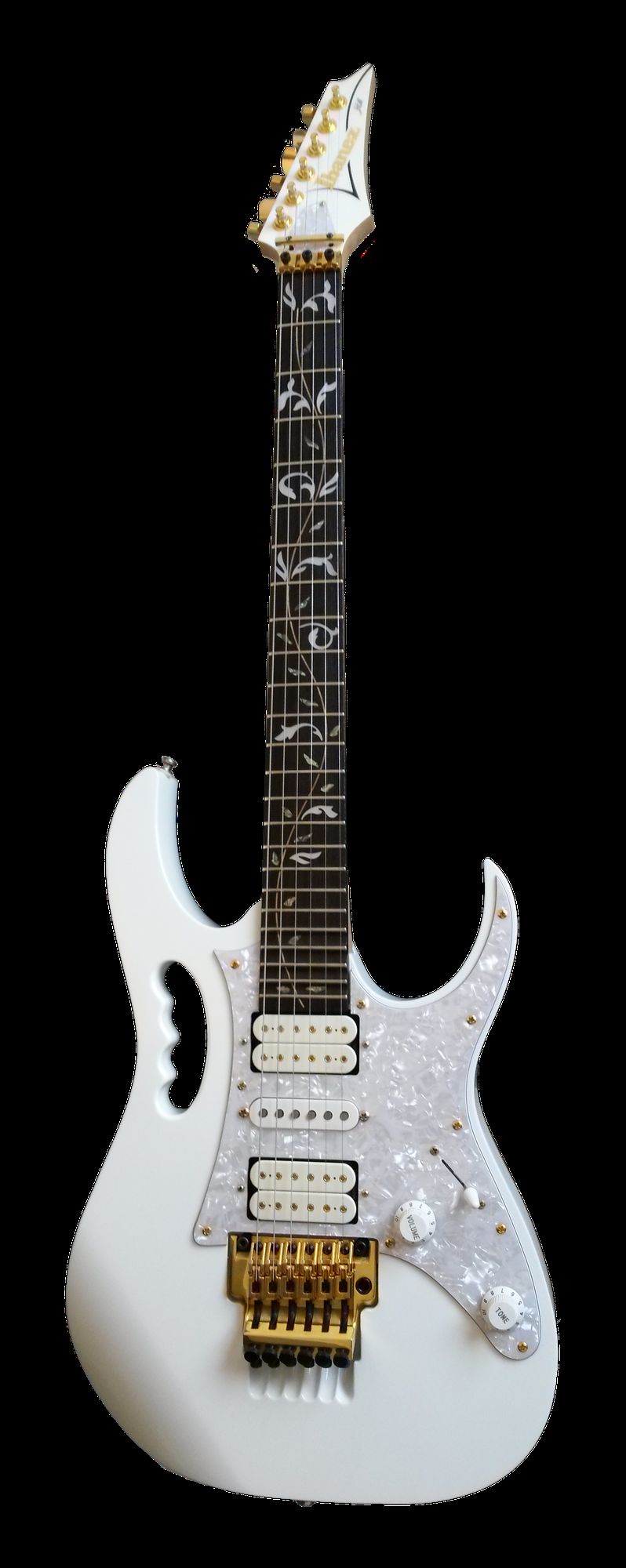
Ibanez Jem 7VWH vertical. Photo by Rachmaninoff; upright derivative by GreyCat. Licensed under CC BY-SA 4.0. Via Wikimedia Commons. Ibanez
JEM
1987
Steve Vai wanted a handle through the body and a finish that matched his curtains. Ibanez put it in the catalog.

Photo: Lightburst / Wikimedia Commons / CC BY-SA 4.0 Fender
Stratocaster
1954
The guitar most people mean when they say “electric guitar.” Designed by a man who didn’t play one.
- Send a picture
Ibanez
RG550
1987
Nobody’s name on it. Just a thin neck, 24 frets, and a locking trem, and it keeps coming back.