Ibanez
Musician
Ibanez chased sustain with a wooden sandwich, brass, and a three-band EQ. Everything it added, you carried.
The late 1970s. Alembic and B.C. Rich have made the case that a guitar should ring forever: a neck that runs straight through the body, layers of hardwood, brass under the strings. Ibanez builds its answer at FujiGen in Japan and calls it the Musician.
- Introduced
- 1978
- Type
- Solidbody electric
- Class
- Production
Have a photograph of this guitar? Send a picture
The short version
1977
First look
The Musician is shown at the end of the year. Production of the MC100 and MC500 starts late in 1977.
1978
Five models
The 1978 catalog lists five Musicians, from the bolt-on MC100 to the carved MC500.
1978
The Garcia prototype
Per Bob Weir’s letter, a Tree of Life MC500/SP is presented at that year’s NAMM show.
1979
Running changes
Around August, a nine-piece neck, a master tone knob, and an LED.
1980
No heel
Mid-year, the neck heel disappears.
1981–82
Last round
The MC150, MC350, and MC550 take over. The six-strings end after 1982.
1996
Same letters, different guitar
A Japan-only MC300 reissue arrives with 22 frets and no EQ. It runs to 1998.
Side A
A1
Sustain, at any cost
In the late ’70s, one idea was running through high-end electric guitars: sustain. Alembic and B.C. Rich had made the case. Travis Bean and Kramer were chasing it with aluminum. The recipe was a neck that didn’t stop at the body but ran all the way through it, a sandwich of hardwoods, and brass under the strings.
Ibanez wanted in. Its answer, built at FujiGen, was shown at the end of 1977 and went into the 1978 catalog as five models called the Musician. The top of the line was the MC500.
Nearly everything on the MC500 was there to make a note last longer. The catch is that every one of those things weighs something.
A2
A neck that never stops
On the MC500, the neck is a laminate of maple and walnut that runs from the strap button at the bottom of the body to the top of the headstock. The wings are glued on either side, and the top is carved, the only carved top in the first series. There are 24 frets on a 24¾-inch scale.
Exactly what wood is in those wings depends on who you read. The Ibanez wiki says ash, maple, and ash. Michael Wright, writing in Vintage Guitar with one in his hands, reads walnut or dark-stained ash around a maple center. A German magazine’s 1980 guitar has nine strips of maple and mahogany with ash wings and a walnut top and back. The Blue Book just says maple. They can’t all be right about every guitar, and I’m not going to pick one.
The hardware is gold. The bridge is a Gibraltar set on a sustain block let into the neck, and the tailpiece has a little cloud ornament on it. The nut is half bone, half brass. The pickups are two Super 88 humbuckers.
A3
A studio on the front of the guitar
Then there are the knobs. Ibanez called it the EQ Tone System: a preamp with a boost and cut, bass, mid, and treble controls, and an on/off switch for the whole thing, plus a master volume and a pickup selector up on the top horn. It’s an active circuit, on a guitar, in 1978.
There were also two mini-toggles called Tri-sounds. The Ibanez wiki says they switch the humbuckers between series, single-coil, and parallel. Wright calls the same switches a coil tap and a phase reverse. Both descriptions are out there.
In practice, it meant you could shape the tone at the guitar instead of at the amp: more mids to cut through, less bass to clean up, and a boost for the solo, without touching a pedal.
Flip the record · By the numbers
$975
MC500 list on one of the 1978 U.S. price lists. The other says $970.
24
Frets, on a neck that runs from the endpin to the top of the headstock.
~4.6 kg
One 1980 MC500 on the strap. About ten pounds.
~1,180
MC500s out of the factory by the end of 1980, per Michael Wright. A collector’s table says 1,421. Neither is official.
Side B
B1
Heavier every year
The Musician changed nearly every year. In 1978 the horns got smaller. Around August 1979 the neck went to nine pieces and picked up a master tone control and an LED. In mid-1980 the heel disappeared. Dark Stain was the finish most people bought.
And it was never light. A German magazine put a 1980 MC500 on a strap and got nearly 4.6 kilograms, about ten pounds. Wright complains about the same thing. The sustain they wanted made a heavy guitar.
That was the price of the ’70s idea. More wood, more brass, more electronics, more guitar.
B2
Jerry’s guitar, maybe
The story everyone wants attached to the Musician is Jerry Garcia’s. It’s a real story. It’s also a tangle.
A letter from Bob Weir says he and Jeff Hasselberger designed a special version in the late ’70s: the MC500/SP, with a Tree of Life inlay in mother-of-pearl leaves. The letter calls it the prototype for the series and says it was shown at the 1978 NAMM show. It also says Garcia found it too heavy to use onstage.
Hasselberger tells it another way. He remembers Garcia playing one for a couple of gigs, and liking it, just not enough. He remembers a custom MC5000 too, and he has a test for it: the real Garcia guitar had an effects loop, the pickups running out to his pedals and back before the volume control.
If it doesn’t have the loop, it’s not a Jerry Special.
The letter and the quote might describe the same guitar, or they might not. Nobody has settled it. What’s clear is that a plain catalog MC500 is not Garcia’s guitar, no matter what the listing says.
B3
Built to last
After 1980 the line changed. Wright says the original series was gone, replaced briefly by a bolt-on with passive electronics. The 1981 catalog has new models, the MC150, MC350, and MC550. Either way, the six-string Musicians were over after 1982. A 1990s reissue borrowed the name, with 22 frets and no EQ.
Wright counts about 1,180 MC500s out of the factory by the end of 1980. A collector’s table prints 1,421. Neither is an official number, but both say the same thing: they sold. They aren’t rare. There are plenty of them out there, still ringing, still heavy.
The Musician was built around one idea, a note that wouldn’t stop. If you believe Weir’s letter, the one built for Jerry Garcia stayed off the stage because it weighed too much. Hasselberger remembers Garcia getting a couple of gigs out of one. Either way, the sustain was all there. You just had to carry it.
The cast
The people, and the specific guitars, that made the legend.
1978
Jerry Garcia
MC500/SP “Tree of Life” prototype
Weir’s letter says Garcia found it too heavy to use onstage. Jeff Hasselberger remembers him playing a couple of gigs on one.
1978
Bob Weir
Co-designer, per his letter
Wrote that he and Hasselberger designed the MC500/SP, and that it was the prototype for the series.
1978
Jeff Hasselberger
Co-designer
“If it doesn’t have the loop, it’s not a Jerry Special.”
Liner notes
Specs, construction, rarity, value, and every source we used.
A neck that runs through a carved sandwich, two Super 88s, and a three-band EQ — Ibanez’s 1978 solid for sustain, not an Iceman and not an RG.
- Body
- Solid double-cut, neck-through. Wiki: ash/maple/ash wings, carved top. Only the MC500 is carved.
- Neck
- 7-piece rock maple/black walnut (1978, and again later 1980). 9-piece 1979–early 1980. Smooth heel, then heelless mid-1980.
- Fingerboard
- Ebony, abalone dots, 24 VelveTouch. Radius unpublished on the wiki spec. Ibanez Vintage’s series sheet: 300R.
- Scale
- 628mm / 24¾". Mix flagged.
- Pickups
- Two Super 88 humbuckers, integrated covers
- Hardware
- Gold. Gibraltar on a sustain block; Gibraltar tail with the cloud ornament; VelveTune II, pearloid buttons
- Electronics
- EQ Tone System: master volume, 3-way on the upper horn, preamp boost/cut, 3-band EQ, two Tri-sounds, EQ on/off. Master tone and an LED from about August 1979.
- Finish
- Dark Stain typical. Natural, Antique Violin (1979–80), and a very limited 1978 Black exist.
- Nut
- Half bone/half brass. Wiki: 1 ²³⁄₃₂" / 43.7mm. Ibanez Vintage sheet: 43mm. Mix flagged.
Open the full research fileConstruction details, the complete player record, production numbers, dated value estimates, and sources
Classic living example = 1978–1980 Japan MC500 (FujiGen). Carved top and the active EQ are the identity guitar. No current Musician six-string this pass: none on ibanez.com, 23 September 2026. MC100 is the bolt-on. MC200 / MC300 are the flat through-necks. MC400 is the flat-top with the EQ. MC150 / MC350 / MC550 are 1981–82. 1996–1998 MC300 is a Terada reissue. MC500/SP and MC5000 are the Garcia-adjacent one-offs, not this table. MC940 and the other four-strings are basses. AS200, JEM, RG550, Destroyer, and Iceman stay on their plates. No Gibson SKU. Mixed inch/mm flagged. Do not average 43 mm / 43.7 mm, or a shop card that prints 1 ¹¹⁄₁₆" and 44 mm for the same nut.
Construction
The job was sustain. A neck that doesn’t stop at the body. A sandwich of wood. Brass under the strings. An EQ if you paid for the top. Alembic and B.C. Rich had already made that case. Travis Bean and Kramer were chasing it with aluminum. Vintage Guitar (Michael Wright, October 2006) puts the Musician there, and calls the Studios the set-neck cousins. FujiGen’s version got the MC name.
This plate starts in 1978. Ibanez wiki: introduced for 1978, with MC100 and MC500 production starting in late 1977. Gitarre & Bass (Franz Hotlmann, 7 August 2018): shown at the end of 1977; five models named Musician first listed in a 1978 catalog. guitar-letter dates the name to 1977 and traces the outline to that year’s Artist 2700 — neck-through, Super 88s, Artist body, not this double-cut. Keep late 1977. The catalog object is 1978.
The top of it is the MC500. Maple and walnut, laminated, run from the endpin to the top of the head. That line is the catalog blurb on the wiki, typos and all. Wings glue on either side. Wiki: ash/maple/ash, carved top — the only carved top in the first series. The MC400 is the same job with a mahogany core and a flat top. Wright, on the guitar in his hands: carved walnut or dark-stained ash, maple center, walnut or ash back, around maple and mahogany. Hotlmann’s 1980: nine strips of maple and mahogany, ash wings, figured walnut top and back. Ibanez Vintage: an ash/mahogany sandwich except the 500, which has a maple center and a maple/walnut neck — and, on the same page, one MC500 as walnut/ash/walnut. Blue Book drops the ash and prints maple, maple back, carved maple top. Keep them. Don’t pick a wood.
Two Super 88s in integrated covers. Gold. Gibraltar on a sustain block let into the neck. Cloud tail. Half bone, half brass. Wiki: 1 ²³⁄₃₂" / 43.7mm. Ibanez Vintage: 43mm, and 300R. A Mike & Mike’s card for an August 1979 (H79) prints 1 ¹¹⁄₁₆" (44 mm) — fraction and millimetre on that card don’t agree. Mix flagged. Do not average.
Ibanez called the circuit the EQ Tone System. Master volume, 3-way on the upper horn, preamp boost and cut, bass/mid/treble, EQ on/off, two Tri-sounds. The wiki’s Tri-sound page, and Ibanez Vintage, say series, one coil, or parallel. Wright, and one sentence on the MC500 page, call the same toggles a coil tap and a phase reversal. Keep both.
It moved inside three years. Mid-1978: smaller horns, a symmetric waist, blocks under the pickups. Around August 1979: nine-piece neck, a master tone, an LED, jack off the face and onto the side. Mid-1980: no heel, neck back to seven pieces, tail slots on an angle. Dark Stain is the finish people mean. Natural is the other regular one. Antique Violin is 1979–80. Black is 1978, and the wiki’s table won’t count it.
Under the flagship the silhouette gets simpler. MC100 (1978–79) is the only bolt-on: three-piece maple, ebonized rosewood, Super 77s, chrome, no EQ. MC200 and MC300 are five-piece through-necks with Super 88s; the 300 is gold and gets Tri-sound, then a master tone and, on the wiki, a six-position varitone. MC400 adds the EQ on a flat top. MC500 is the carved one. Two 1978 USA lists, via the wiki: MC100 $480 and $490, up to MC500 $970 and $975. 1979 Japan: MC500 ¥125,000. January 1979 USA: $1,000 Natural / $1,010 Dark Stain. September 1979 through 1980: $950. 1979 German list: DM 1,615. Seventies money.
It is not an Iceman (ibanez-iceman), not a Destroyer, not an AS200 (ibanez-as200), not a JEM, not an RG550. Those are other outlines and other years. This is the MC solid. Standalone.
1981–82. The numbers jump to MC150, MC350, MC550. Blue Book: a slightly different body, Super 58s by the end. Wiki: MC550 still neck-through, still the EQ, koa/ash/koa, Super 88 then Super 58, gone after 1982 with the six-string series. Wright says the original line was gone after 1980, replaced briefly by a bolt-neck with passive electronics. Keep his ending and the 1981 catalog. They are not the same sentence.
1996–1998. Japan-only MC300, Terada, “80’s Custom Legend.” Wiki: 22 frets, not 24, passive Tri-sound, Quik Change. Same letters. Not this guitar.
Hotlmann’s 1980, on the strap: nearly 4.6 kg. Wright’s complaint is the same fact. The sustain they wanted made a heavy guitar. Classic vs current: 1978–1980 FujiGen MC500 — carved sandwich, maple/walnut through-neck, Super 88s, three-band EQ — against no new Musician you can order in 2026.
Players
JEM, RG, Destroyer, Iceman, AS200: other plates. Vai, Gilbert, Eddie’s Shark, Stanley, Scofield. Miller’s “Jet Airliner” Iceman, and the Artists Ibanez built him, stay off this one (Vintage Guitar). So does Weir’s stage guitar. The ’77 catalog shot in Vintage Guitar’s Hasselberger piece is Miller on an Artist, informally the Bob Weir model. Weir’s part here is the prototype.
Jerry Garcia. The name people paste onto every MC500. Bonhams lot 3096, 8 May 2012, with a letter from Weir witnessed by Jeb Scherb: he and Jeff Hasselberger designed it in the late 1970s; it is the MC500/SP with the Tree of Life; it was the prototype for the series; it was presented at the 1978 NAMM show. The letter: Garcia found it too heavy to use onstage. Wiki, from that lot: koa/ash/koa, nine-piece neck, mother-of-pearl leaves, a “Limited Edition” plate at the 21st fret. Not a catalog MC500.
Classic2Vintage quotes Hasselberger the other way. Played a couple of gigs. Liked it, not enough. The tell, in that telling, is an effects loop — pickups out to the pedals and back before the volume. He is sure of one guitar, not sure of two, and he remembers a custom MC5000. “If it doesn’t have the loop, it’s not a Jerry Special.” Keep the letter and the quote. Don’t decide they are one object. Wolf and Tiger are Doug Irwin. Alligator is a Strat.
Wright’s 2006 guitar is a third tree. A customer ordered a mother-of-pearl tree-of-life board on a 1978, plus an aluminum case. He does not name Garcia. Don’t lend him the prototype to tidy the paragraph.
Also known to play stays short. No second player pinned to a production MC serial here. A listing that says Garcia played “this model” is the mash. None invented.
Rarity
You cannot buy a new Musician. Six-strings end after 1982. The 1996–98 MC300 ended too. MC940 and the later basses kept the letters. They are not this guitar. Ibanez published no totals. None invented. A collector’s table and a magazine don’t match. That is why a first-year census is unknown.
Ibanez wiki, citing thetom on Ibanez Collectors World: MC500 Dark Stain 291 / 513 / 340 (1978 / 1979 / 1980), row 1,144. Natural 104 / 138 / 25, row 267. Year lines 395* / 651* / 365*, printed grand total 1,421*, plus an unknown handful of Antique Violin and Black. The finish rows sum to 1,411. Keep 1,421* and the sum. Wright: only 164 in 1978, and some 1,180 had left Fuji by the end of 1980. Keep both. Neither is a factory total. Same forum, on the MC550 page: believed 465 in two years. A belief.
Wright’s other point matches the market. The run sold. Not rare birds. The carved MC500 is the thinner regular guitar. Thinner than that: 1978 Black, Antique Violin, the early larger horns, a nine-piece 1979 with the jack still on the face. guitar-letter puts a 1979 MC300 limited edition at 150, Europe. ibanez-vintage.net repeats 150 and adds Meinl. Not a factory total. The MC500/SP is one guitar. guitar-letter, reporting Jim Donahue: 1979 samples were two MC3000s and one MC5000; 1980 was 18 MC5000 Dark Stain, 4 Antique Violin, and 30 MC3000. His count. Not a vintage MC500.
Value
Informal estimate, 23 September 2026. Not an appraisal.
Ask vs sold labeled. Celebrity lots are not-comps. No invented medians or factory counts. Period $970 and $975 (1978 USA), ¥125,000 (1979 Japan), and $950 (September 1979–1980) are seventies money, not 2026 street.
New street. None. No six-string MC on the Ibanez site this pass.
Used modern. No clean 1996–98 reissue band this pass. Don’t invent one. The FujiGen guitar is the market.
Vintage / collectible. Don’t average a flat-top MC300 into a carved MC500.
Reverb’s MC500 Price Guide, Good to Mint, 38 orders, did not hold one edge this pass: $1,148–$2,494 on one read, $1,208–$2,481 on another. Named solds on that tape: $2,999 (10 October 2025, Excellent); $1,699.15 (30 September 2025, Excellent); $2,415 (29 March 2025, Very Good); $1,950 (6 January 2025, Very Good); $1,800 (9 November 2024, Very Good); $1,300 (15 August 2024, Very Good); $2,999.99 (14 July 2024, Excellent). Named ask, not a hammer: 1978–80 Natural, Very Good, $2,377.20.
MC300 guide, one read: $988–$1,842 on 107 orders. Named solds: $1,325 (1 November 2025, Very Good); $1,999 (1 October 2025, Excellent); $2,250 (28 September 2025, Good); $1,350 (3 April 2025, Excellent). Named asks the same day: 1978 Natural $2,200 and $1,673.10; Dark Stain $2,092.46 and $1,482.95; 1980 Antique Violin $1,560.04. One 1978 MC400 Natural, $2,360.75. Don’t average those with the MC500 tape.
Gardiner Houlgate, 10 March 2026: a 1979 with replacement Schallers, sold £900, catalogued at 4.80 kg. One hammer, not a clean original, not dollars. Wright’s “prime examples can easily sell today for $1,500” is October 2006.
The Bonhams MC500/SP was estimated $50,000–$60,000 (Premier Guitar, 16 April 2012; lot 3096). The hammer was not on the lot page this pass. One prototype with a Weir letter. Not a comp.
See also
- ibanez-iceman — 1975 angular original; Miller’s Iceman lives there, not on this sandwich
- ibanez-as200 — 1979 semi-hollow; maple block and a set neck, not this solid
- yamaha-sg-2000 — the other late-’70s Japanese through-neck flagship; different factory, not this EQ
Sources
- Ibanez wiki, Musician series — introduced for 1978; six-string run discontinued after 1982; mid-1990s reissue
- Ibanez wiki, MC500 — late 1977 production; ash/maple/ash carved top; 7- and 9-piece maple/walnut; 628mm / 24¾"; nut 1 ²³⁄₃₂" / 43.7mm; Super 88; EQ Tone System; running changes; thetom table (DS 291/513/340, NT 104/138/25, printed total 1,421*); prices including ¥125,000 and $950
- Ibanez wiki, 1978 catalogs — MC100 $480 and $490; MC500 $970 and $975 on the two 1978 lists
- Ibanez wiki, MC100 — only bolt-on; Super 77; 1978–79
- Ibanez wiki, MC300 — 1978–80; five-piece; Tri-sound; varitone 1979–80
- Ibanez wiki, MC400 — flat top; mahogany core; active EQ
- Ibanez wiki, MC550 — 1981–82; neck-through; Super 88 then Super 58; believed 465
- Ibanez wiki, MC300 (1996–1998) — Terada; 22 frets; passive Tri-sound
- Ibanez wiki, Tri-sound switch — series / single-coil / parallel
- Ibanez wiki, MC500/SP — Garcia prototype; koa/ash/koa; Tree of Life; 1978 NAMM
- Ibanez Vintage, Musician series (archived July 2003) — 1978; ash/mahogany except the 500’s maple center; walnut/ash/walnut also listed; nut 43mm; 300R; Tri-sound as series/parallel/coil tap; models through 1982
- Vintage Guitar, Michael Wright, Ibanez MC500 Musician (October 2006) — Studios vs Musicians; carved top only on the MC500; his wood reading; phase reversal; gone after 1980 in his account; 164 and about 1,180; $1,500 as a 2006 line
- Gitarre & Bass, Franz Hotlmann, 7 August 2018 (archived) — end of 1977; five models catalogued 1978; 1980 maple/mahogany neck and walnut/ash; about 4.6 kg; series/tap/parallel
- guitar-letter, Die Ibanez Musician-Serie — 2700 to the MC; name from 1977 in that account; MC300 limited edition 150; Jim Donahue’s MC3000/MC5000 counts
- Blue Book, Ibanez Electric Musician (MC) series — 1978–80, then 1981–82; MC500 woods as maple in that entry
- Vintage Guitar, Vintage Visionary (Hasselberger) — ’77 catalog shot is Miller on an Artist, informally the Bob Weir model
- Vintage Guitar, Steve Miller — “Jet Airliner” on an Iceman; Artists beside it
- Bonhams, lot 3096, 8 May 2012 — Weir letter: MC500/SP, prototype, too heavy onstage; estimate $50,000–$60,000; hammer not printed this pass
- Premier Guitar, 16 April 2012 — same estimate
- Classic2Vintage, Ibanez MC 5000 — Hasselberger: a couple of gigs; effects loop; remembered as a custom MC5000
- Reverb, Ibanez MC500 Musician — 38 orders; band edges $1,148–$2,494 and $1,208–$2,481; named 2024–25 solds
- Reverb, Ibanez MC300 Musician — one read, $988–$1,842 on 107 orders; named 2025 solds
- Reverb listings, 23 September 2026 — MC500 Natural ask $2,377.20; MC300 asks $2,200, $1,673.10, $2,092.46, $1,482.95, $1,560.04; MC400 ask $2,360.75
- Mike & Mike’s, 1979 MC500 (Reverb) — H79; nut printed 1 ¹¹⁄₁₆" (44 mm)
- Gardiner Houlgate, 10 March 2026, lot 308 — sold £900; 4.80 kg; replacement Schallers
- ibanez-vintage.net, MC300 Limited Edition — 150, Europe / Meinl, as that page has it
Keep digging
Guitars this one gets compared to, confused with, or descended from.
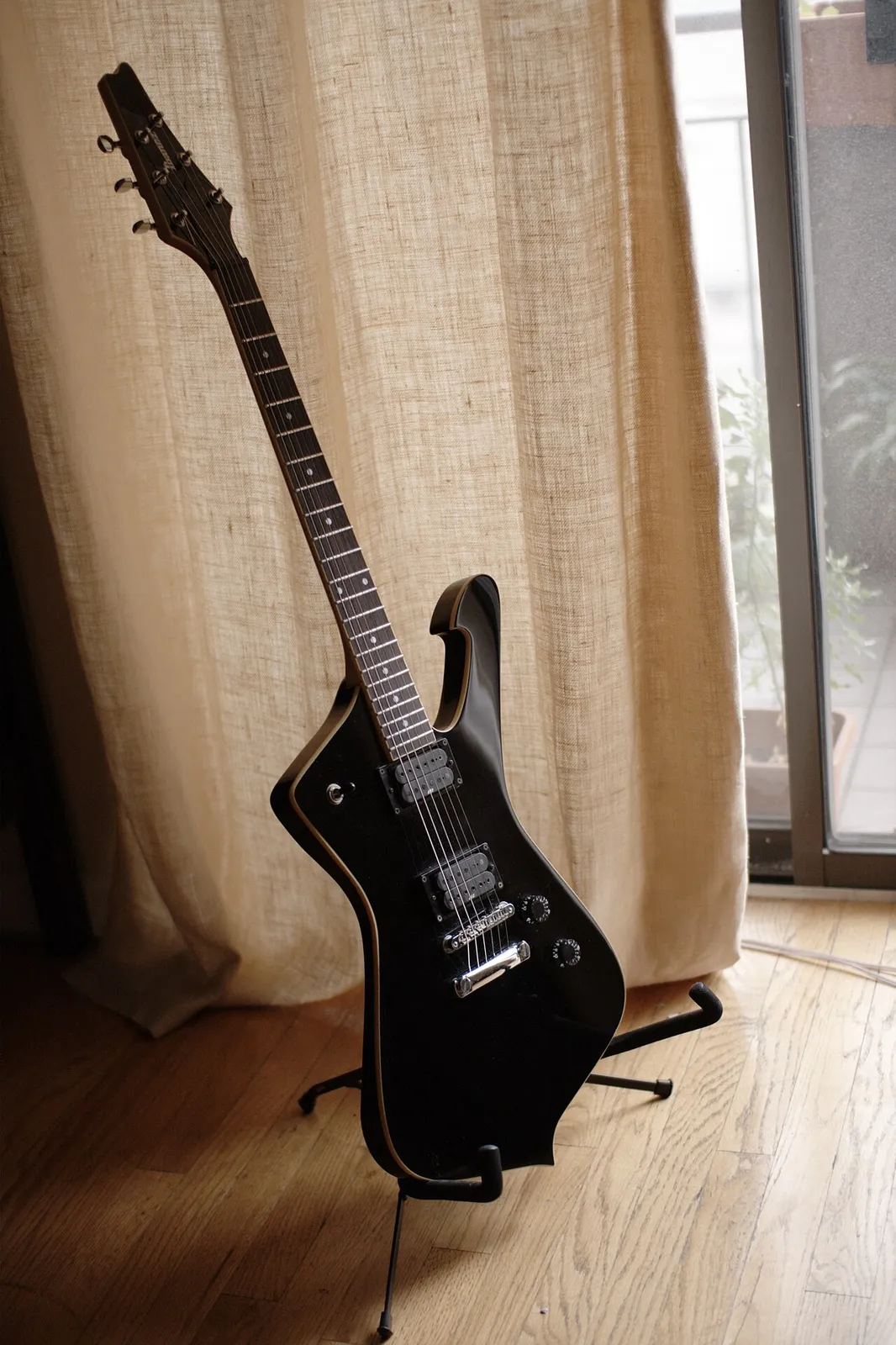
Photo: anders pearson / Wikimedia Commons / CC BY-SA 2.0 Ibanez
Iceman
1975
Ibanez drew this one itself in 1975. When the lawyers made the copies go away, it got to stay.
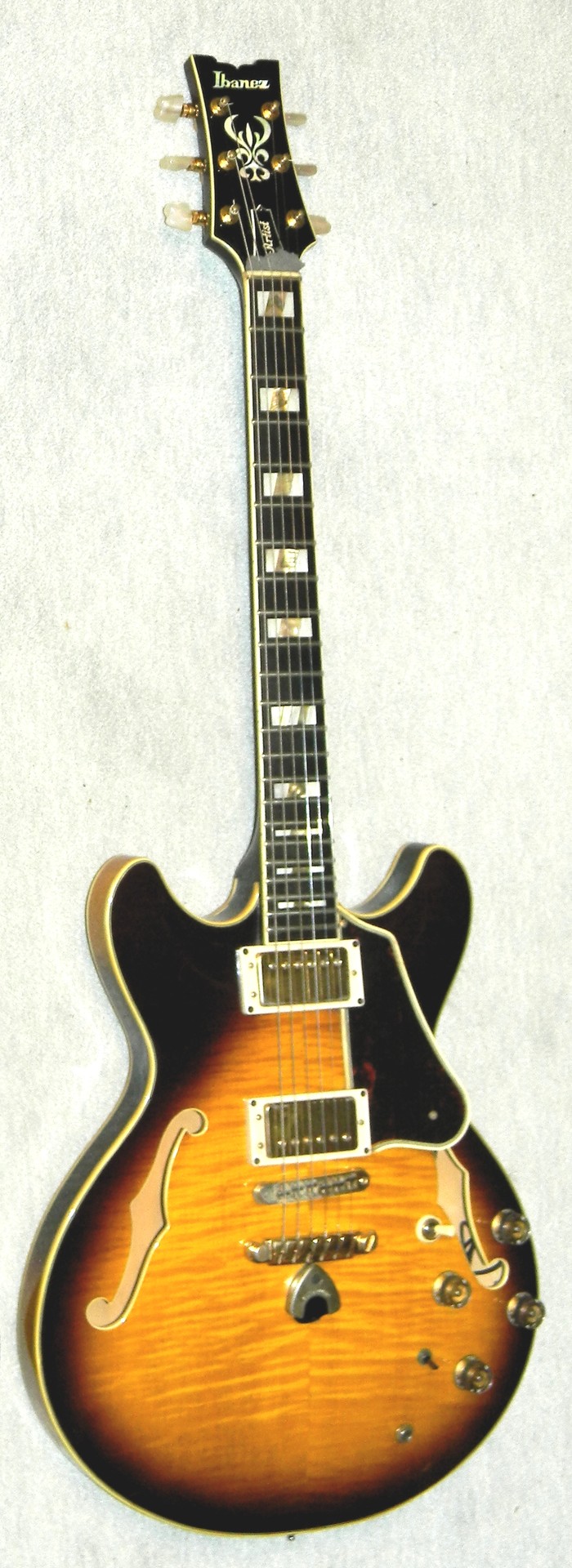
Photo: NSX-Racer / Wikimedia Commons / CC BY 3.0 Ibanez
AS200
1979
Ibanez handed John Scofield one in 1981. Twenty years later, they had to scan his to remember how it was made.
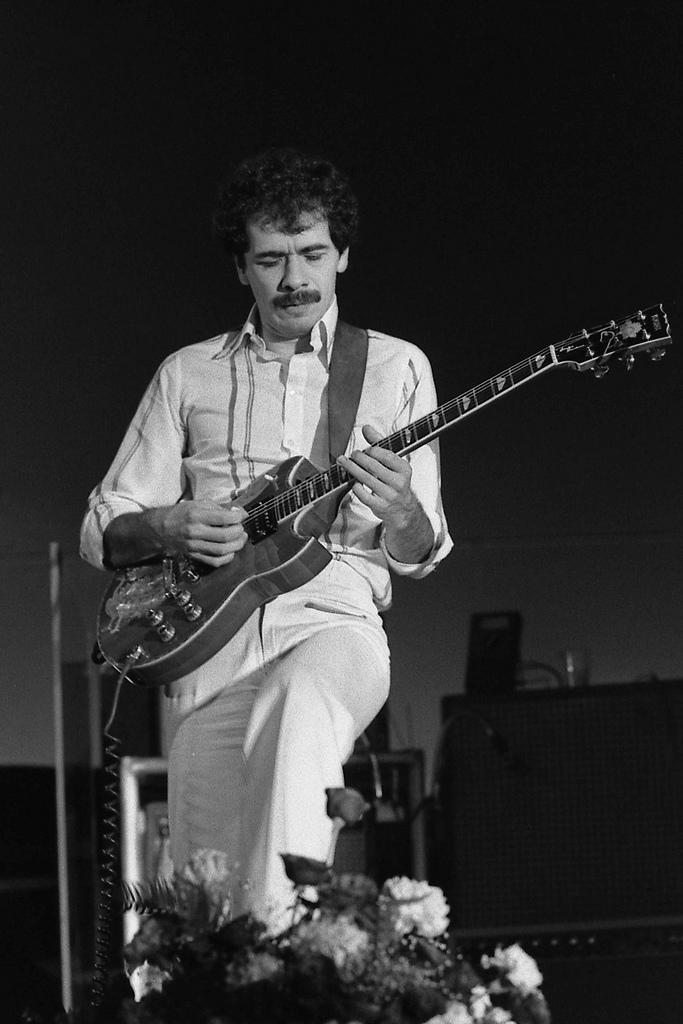
Photo: Chris Hakkens / Wikimedia Commons / CC BY-SA 2.0 Yamaha
SG-2000
1976
Santana told Yamaha to put a chunk of metal under the strings. They listened, and the notes stopped dying.