 Guitaripedia
Jolana
Star
Nobody in Czechoslovakia could buy a Fender. So a crew in Hradec Králové built the Star instead.
Czechoslovakia, 1959. The country's Stratocaster stand-in stops in Blatná, and its builders move to a new works at Hradec Králové. What they build next is a short-scale solid with two pickups. It ends up in British shops, a Warsaw surf band, and Viktor Tsoi's hands.
- Introduced
- 1959
- Type
- Solidbody electric
- Class
- Production
Have a photograph of this guitar? Send a picture
The short version
1959
Blatná to Hradec
The Grazioso line stops, its builders move to Hradec Králové, and the Star replaces it.
1959–60
Futurama II
Selmer sells the two-pickup Star in Britain for 25 guineas. The three-pickup Star III is 45.
1963
Star V
Red, contoured, a pointed head, Brilliant Deluxe pickups, and a rotary switch by the neck pickup.
May 1963
The name moves to Sweden
Selmer puts the Futurama badge on Hagström guitars. The Czech Star carries on.
1965–74
Star VII
The later short-scale solid. Its start date depends on who you ask, 1965 or 1970.
c. 1985
Luxury of those times
A concert photograph of Viktor Tsoi with a Jolana Star.
1989–91
The state brand ends
Production stops around the Velvet Revolution. The sources differ on the year.
Side A
A1
A Stratocaster you couldn't import
Blatná, 1959. The management changes at the cooperative, and the guitar line stops.
That line was the Resonet Grazioso, Czechoslovakia's answer to a Stratocaster nobody there was allowed to import. Three pickups, a tremolo, sold in London as the Futurama. Josef Růžička had run the place since 1953. When the line stopped he moved to a new state works at Hradec Králové, and his designer, Vladimír Vlček, and his production manager, Josef Rika, came with him.
The new factory was called Neoton, and soon it was called Jolana, probably after Růžička's daughter. Which guitar first wore the Jolana name on its head, a 1959 semi-acoustic or something from 1960, depends on who you ask. Even the man who wrote the story down says it may not be totally reliable.
What the crew built first was a simpler solid. They called it the Star.
A2
Twenty-five guineas
The first Star had two single-coil pickups with adjustable poles, two volumes and a master tone, a maple neck, and a simplified tremolo. The catalogue's best line about it: "the bridge is exposed for damping." The earliest ones had three tuners a side and a light-colored board. Around late 1960 the heads went six-a-side.
Selmer took it to Britain. The two-pickup Star was the Futurama II, at 25 guineas. The three-pickup Star III was the Futurama III, at 45.
Which brings up the guitar everyone wants this to be. George Harrison's Futurama, and the Jimmy Page and Eric Clapton stories that tag along with it, are the Grazioso, the older Blatná guitar from the other maker. It's an easy mix-up. Same builders, same British badge. It's still not this guitar.
A3
Red, with a rotary switch
By 1962 the Czech solids in British shops had gone red. The guard shrank, the head went pointed, the pickups got chromed covers, and the body had comfort contours you could actually feel.
That's the Star V, from 1963. Brilliant Deluxe pickups, and a new rotary selector sitting next to the neck pickup. Owners reported a drop from the old Futuramas, and the counts don't agree on what Selmer even called it in the catalogue. In May 1963 Selmer moved the Futurama name onto Hagström guitars from Sweden.
The Star didn't stop. It just stopped being the guitar on the British counter.
It's a short guitar. Put a tape on one 1963 Star V and the high E vibrates over 585 millimetres. Other Stars measure 580, 590, or more. No factory drawing has turned up to settle it.
Flip the record · By the numbers
25 guineas
The two-pickup Star in British shops, as the Futurama II
45 guineas
The three-pickup Star III, as the Futurama III
585 mm
Vibrating string on the high E of one 1963 Star V. A short scale.
3,550
Star VIIs built, by one collector's count. Nobody published a factory total.
Side B
B1
Surf music in Warsaw
One red Star V from Hradec Králové, made around 1963, now sits in the National Music Museum. Jolana on the upper bout, Star on the head, a tremolo tailpiece whose bar went missing somewhere along the way.
It belonged to the Tajfuny, the Typhoons, a surf band from Warsaw. They played early-1960s southern California guitar music to young audiences in the eastern bloc, on a guitar that existed because the California guitars couldn't get in. The museum calls the Star Jolana's answer to Fender electrics you couldn't get in Communist Czechoslovakia. The Tajfuny made the answer sound like the question.
B2
Luxury of those times
The name kept going after the guitar changed. The Star VII was a short-scale solid built into the 1970s. One collector counts 3,550 of them. The Star IX had a rhomboid body people call the screwdriver. The Star X had a fuzz built in. None of them is the 1959 Star.
Production spread out to Hořovice and Krnov, and nobody agrees on the years. The state brand ended around the Velvet Revolution, in 1989 or around 1991. Today NBE builds Jolanas in Hořovice, but they're Grazioso IIs and Tornados and Diamants. There's no new Star to order.
Once Western guitars arrived, the Stars went in the skip. One collector remembers finding them there in the 1980s and '90s. Plenty more ended up in Czech attics.
Around 1985, there's a concert photograph of Viktor Tsoi holding one. The caption reads:
"Luxury of those times — Czechoslovakian Jolana Star."
The cast
The people, and the specific guitars, that made the legend.
1959
Josef Růžička
Ran the Hradec works
Had run Resonet in Blatná from 1953. Moved to Hradec Králové in 1959, and the brand may be named for his daughter, Jolana. People call him the "Czech Leo Fender."
1959
Vladimír Vlček
Designer
Moved from Blatná to Hradec with Růžička and production manager Josef Rika.
1960s
The Tajfuny
A red Star V, circa 1963
The Warsaw surf band played early-1960s California guitar to eastern bloc crowds. Their Star V is now in the National Music Museum.
c. 1985
Viktor Tsoi
A Jolana Star
In a concert photograph captioned "Luxury of those times." The caption doesn't say which Star.
Břetislav Zachoval
Collector
Remembers Jolanas thrown in skips once Western guitars arrived. Later opened Retro Jolana, about 250 guitars and basses.
Liner notes
Specs, construction, rarity, value, and every source we used.
Two pickups, a rotary switch, and a short Czechoslovak scale — the Hradec solid that followed Resonet’s Grazioso.
- Body
- Solid double-cut, contoured. National Music Museum, serial 50 934, a Star V, circa 1963, Hradec Králové: hardwood, two cutaways. Upper bout 242 mm, waist 199 mm, lower bout 290 mm, body 363 mm long and 29 mm thick, guitar 906 mm overall. Blue Book: alder on the 1959 Star; poplar on the later Star VII. A sovietguitars owner on a mid-1960s Star V: alder, 30 mm thick.
- Neck
- Maple. The museum guitar: maple with a mahogany truss-rod strip, head integral, neck 338 mm from nut to the end of the tenon, 41 mm wide at the nut and 49 mm at the tenon. Blue Book: the 1959 Star is glued-in, non-adjustable rod; Star V is bolt-on with an adjustable rod. Cheesy Guitars prints both joints. Six-on-a-side machines under a white plastic cover on 50 934; Blue Book’s first Star is still three-a-side.
- Fingerboard
- Museum: brown hardwood, possibly mahogany, 21 nickel-silver frets including a zero fret, imitation-pearl dots. Cheesy Guitars: stained beech sold as rosewood. Blue Book: rosewood on Star V; European walnut, 20 frets plus zero, on Star VII. A sovietguitars Star V: walnut, 20 frets plus a brass zero. Terbe, on a Star VII: 21 frets, 40 mm at the zero, 50 mm at the 12th.
- Scale
- Museum, 50 934: vibrating string 585 mm (high E) and 591 mm (low E); nut to 12th 296 mm. Sovietguitars: 580 mm on a mid-1960s Star V. One Reverb Star / Futurama II: 590 mm. Blue Book: Star VII at 23.5 in. Terbe’s Star VII: 630 mm. Sources differ. No factory drawing has been published.
- Pickups
- Two, neck and bridge, white covers on 50 934. Sources differ on the coil: the museum calls that pair double-coil; Cheesy Guitars and the Blue Book treat Star V pickups as two Brilliant Deluxe singles; sovietguitars, on one mid-1960s guitar, calls the Brilant pickups singles with screw cores you can slide along the string. Star I: two singles with adjustable poles (Cheesy Guitars). Star III: three singles (Blue Book; Russell).
- Hardware
- Museum: beech bridge, nickel-plated brass height screws, four nickel-silver compensated saddles; tailpiece built for a tremolo bar, now missing; six-on-a-side machines, white plastic cover, ivory-plastic buttons. Cheesy Guitars: a plastic tuner cover on Stars I through VII. Blue Book’s 1959 Star: a primitive vibrato and a wooden floating bridge with metal saddles.
- Electronics
- Museum: steel volume and tone, a nickel-plated three-way with an ivory-plastic knob. Blue Book’s Star V: four-position rotary. Cheesy Guitars: a rotary selector next to the neck pickup is the new part on Star V. Sovietguitars, original circuit on one guitar: neck, both, bridge. Side jack on the 1959 Star (Blue Book); top jack on Star V.
- Finish
- Museum: red lacquer on the body, clear on the neck. Blue Book: red or black on the first Star; red or purple on Star V; red, black, silver, or blue on Star VII. Russell: the cheap Futurama II in sombre solids, mauve and black; the 1963 guitar went red.
- Nut
- Bone, 41 mm neck width at the nut on 50 934. Not a factory width. Terbe’s Star VII: 40 mm at the zero fret.
Open the full research fileConstruction details, the complete player record, production numbers, dated value estimates, and sources
The specs above are a circa-1963 Jolana Star V, National Music Museum object 14764, serial 50 934, Hradec Králové. No current model carries the name. Star / Star I is the two-pickup guitar of 1959, Selmer’s Futurama II. Star III is the three-pickup guitar, Selmer’s Futurama III. Star VII is the later short-scale solid. Star IX is the rhomboid body. Star X is the late-1960s guitar with a built-in fuzz. Basso V is the bass. A Resonet Grazioso is the earlier Blatná solid. A Hagström Futurama, from May 1963, is Swedish. NBE’s Grazioso II, Tornado II, and Diamant II are later Hořovice guitars.
Construction
The job was a solid the new state works at Hradec Králové could actually ship. Resonet’s Grazioso had been the Czechoslovak answer to a Stratocaster you could not import. In 1959 that line stopped in Blatná, and the Star is what the same crew built next.
Josef Růžička had run Resonet at the Dřevokov cooperative in Blatná from 1953. The Grazioso, from late 1955, is a different guitar: three singles, rocker switches, a two-post tremolo, top jack, three-a-side head. Selmer London sold it as Futurama. Russell, and he says the whole account is maybe not totally reliable: in 1959 Grazioso production halted when the management changed. Růžička, production manager Josef Rika, and designer Vladimír Vlček — Russell prints “Vlek” — moved to ČSHN, Czechoslovak Musical Instruments, at Hradec Králové. English Wikipedia: a new factory, Neoton, opened there in 1959, managed by Růžička, and was soon renamed Jolana, likely after his daughter. The first Jolana guitar, on that page, is 1960. Czech Wikipedia puts Star I–III under the Neoton name, and a 1959 semi-acoustic as the first guitar to carry Jolana on the instrument. German Wikipedia: in 1959–60 the Grazioso was replaced by the simplified Star and Star III. The 1959 date is the Hradec launch of this solid. It is not the Grazioso’s 1955, and it is not a claim that every head already said Jolana.
What you get at the start is two guitars. Russell: the two-pickup Jolana Star I is Selmer’s Futurama II, 25 guineas; the three-pickup Neoton Star II or Star III is the Futurama III, 45 guineas. Cheesy Guitars: two singles with adjustable poles, two volumes and a master tone, maple neck, six-on-a-side, a simplified tremolo whose catalogue line is “the bridge is exposed for damping,” light maple or beech board. Blue Book (Edward Pitt): offset double-cut alder, glued maple neck, non-adjustable rod, 20-fret beech or maple board, black dots, zero fret, three-a-side, white guard, side jack, red or black, 1959–1960. Around late 1960, Russell, the III’s head went six-on-a-side; the II followed, and kept the light board a little longer.
Then the 1963 guitar. Russell: from 1962 the Futurama IIIs in the shops went red, the guard shrank, the head went pointed, the pickups took chromed plates, and the body felt different, comfort-contouring now very apparent. ČSHN had started another Star, the Star V, with Brilliant Deluxe pickups. Cheesy Guitars: Star V is an upgrade of the two-pickup Star, introduced 1963, stained-beech “rosewood” board, rotary selector next to the neck pickup; owners reported a drop from the old Futuramas, and soon Selmer switched the Futurama name to Hagström. Blue Book: Star V 1963–66, bolt-on, adjustable rod, rosewood board, rounder body, upgraded vibrato, four-position rotary, top jack, red or purple. Sources differ on the British catalogue word. Russell: the 1963 red Futurama III is this Star V, and the two-pickup guitar continued as Futurama Duo until about 1965. Blue Book lists Star V as the Duo. Cheesy Guitars, citing Russell, still calls the Star V export a Futurama III. In May 1963 Selmer put Futurama on Hagström guitars from Sweden. The Czech Star did not stop. It just stopped being the guitar on the British counter.
50 934 is the museum’s Star V: object 14764, gift of Michael Cwach, 2013, Hradec Králové, circa 1963. Jolana on the upper bass bout, Star on the head, serial branded at the joint. The tremolo bar is gone. The museum’s sentence: Jolana’s answer to Fender electrics that were not accessible in Communist Czechoslovakia.
Later Stars keep the name and change the guitar. Blue Book: Star VII, 1970–74, poplar body, bolt-on maple, 20-fret European walnut, pearl dots, zero fret, six-on-a-side, two singles, volume, tone, four-position rotary, short 23.5 in. scale, red, black, silver, or blue. Terbe’s Hungarian collection: Star VII from 1965 to 1974, 3,550 guitars, body the Alfa outline at 32 mm, scale 630 mm, 21 frets, 2.9 kg. Those years, that count, and that scale are Terbe’s. They are not a factory book, and they do not match Pitt’s 1970 start or his 23.5 in. Star IX is the rhomboid “screwdriver” body, Blue Book 1970–74. Star X, Premier Guitar (Frank Meyers, 6 September 2020): late 1960s, offset, triangular head, built-in fuzz, among the rarest old Jolanas; Blue Book 1972–73. None of those is the 1959 Star, and none is a Grazioso.
Where they were built is a split. Everyone puts the first Stars at Hradec. The museum puts 50 934 there. German Wikipedia: Harmonika Hořovice from 1962, Varhany Krnov from 1965. Cheesy Guitars, dating models by Jiří Tutter: Krnov 1963, Hořovice 1965. English Wikipedia: Jolana production at Harmonika Hořovice from 1975. Czech Wikipedia: in May 1974 it was decided that from 1 January 1975 development at Hradec would close and continue only in Hořovice. Růžička’s daughter Jolana, quoted there, remembered the Hradec shop being turned into a piano-repair works. A Harmonika timeline on arres.cz gives 1979 for Jolana electric-guitar development at that plant. Extrafit.cz (July 2026): Blatná first, then Hradec from 1959, then Krnov and Hořovice; Krnov ended in 1991. Serials, Cheesy Guitars: stamped on the neck, head or heel; Czech collectors say the numbers relate to necks and have no meaning. They date a guitar. They do not count a year.
The state brand stopped with the Velvet Revolution. German Wikipedia: production ended 1989. Blue Book: Czechoslovakia 1959 to circa 1991. NBE Corp. bought the Jolana name — English Wikipedia, 2003 from Delicia; German Wikipedia, the brand again from 2001, production from 2006 on the old Harmonika site in Hořovice. What NBE builds is Grazioso II, Tornado II, Diamant II. Vintage Guitar, on the Diamant I: upscale versions of earlier designs, a lifetime away from the Cold War guitar. Alexim’s Jolana II Grazioso, fetched 29 October 2026, is alder and a Seymour Duncan HSS set, 35,640 Kč, on request. That is not a Star.
Players
Harrison’s Futurama, Page’s Grazioso, and the Clapton picture that follows them around are the Resonet Grazioso from Blatná. Serial 1126, Hessy’s, 20 November 1959, is that guitar. They are not this Star. English Wikipedia lists them among Jolana users; Premier Guitar and Extrafit.cz repeat the mash. The Grazioso is a different maker’s solid.
Tajfuny. The National Music Museum: serial 50 934 belonged to the Warsaw surf band the Tajfuny (Typhoons), who brought early-1960s southern California guitar to young audiences in the eastern bloc. One object. No song is named on the card.
Viktor Tsoi. Equipboard files a concert photograph around 1985: “Luxury of those times — Czechoslovakian Jolana Star.” No track is named, and the caption does not say Star V or Star VII. Later Tsoi guitars on that page are other instruments.
Also known to play: no other Star is confirmed. Radim Hladík and Miki Volek appear in a 2021 Czech Radio piece as Jolana players; the piece does not say Star. Andrzej Ziółkowski and Romuald Lipko of Budka Suflera sit on Wikipedia’s Jolana list the same way. A Basso V is the bass. A Tornado is the semi-acoustic.
Rarity
You cannot order a new Star from Hořovice. NBE’s current names are Grazioso II, Tornado II, and Diamant II. The Czechoslovak Star was ordinary production for schools, clubs, and export, which is why they still turn up from the Baltics to Czech attics. Extrafit.cz: collector Břetislav Zachoval remembered them in skips in the 1980s and 1990s, once Western guitars arrived; he later opened Retro Jolana at Vápenný Podol, about 250 guitars and basses.
Nobody published a Star total. Terbe’s 3,550 is a Star VII figure, 1965–74, from one collection site. A Reverb Star X listing printed “less than 1,000.” Dealer copy. Not a ledger. Cheesy Guitars: serials relate to necks. Extrafit.cz: a serial does not give the year.
What is actually thinner: a 1959 Star still three-a-side, light board, side jack, glued neck; a Star V with Brilliant covers, pointed head, and the tremolo bar still in the tailpiece, as on 50 934 before it went missing; a Futurama Duo that is this two-pickup guitar with a Selmer badge. Star IX is the other body. Star X is the fuzz guitar Meyers rarely sees two alike. A Hagström Futurama is Swedish. A Grazioso is Blatná.
Value
Informal estimate, 29 October 2026. Not an appraisal.
Prices below are asking prices unless marked sold. No median is given. Celebrity lots are not comps. A Grazioso, a Futurama III from Blatná, a Hagström Futurama, a Star IX, a Star X, a Basso V, and NBE’s Grazioso II are different guitars. Period money: 25 guineas (Futurama II) and 45 guineas (Futurama III), Russell. Historical list, not 2026 street.
New street. None under Jolana Star. NBE does not list one. Alexim’s 35,640 Kč Grazioso II, fetched 29 October 2026, is a different guitar.
Used modern. There is no modern Star, so there is no used-modern band. A new “Star IX Style” on Reverb is somebody else’s build.
Vintage / collectible. Reverb’s Price Guide shows no separate band for the Jolana Star. Few sold prices are public. Named asks, 29 October 2026 snapshot and recent listings: Star VII gray, circa 1973, $351; a 1960s red Star VII $319; another Star VII $350; a restored Star VII $329; a Star V project $129. Star IX asks on the same scrape: $300, $490, $635. Extrafit.cz, July 2026: foreign offers on Star VII–IX about 270–460 euros (about 6,500–11,100 Kč at the 17 July 2026 CNB rate it prints). Named hammers, not a series: Gardiner Houlgate, 9 September 2025, a 1970s Star, red metallic, 2.89 kg, sold £160 (the catalogue line “made in USSR” is the auctioneer’s; the guitar is Czechoslovak). A Star VII dated 1965 on Reverb, marked sold at $229. A Star / Futurama II with case, listed six years ago, marked sold at $363. A pair of those asks is not a 1959 Star I. 50 934 has no published price. Tsoi’s concert guitar has none either.
See also
- resonet-futurama — the earlier Blatná Grazioso Selmer sold as Futurama; Harrison’s 1126 is that guitar, not a Star
- fender-stratocaster — the import the embargo kept out; this is the short-scale Hradec solid that followed
- ural-650 — Sverdlovsk’s later solid; the paper there says restaurant bands wanted a Jolana
Sources
- National Music Museum, Jolana Star V, object 14764 — circa 1963, Hradec Králové, serial 50 934; Tajfuny provenance; hardwood body; maple neck with mahogany strip; brown hardwood board, 21 frets including zero; bone nut; two pickups called double-coil; volume, tone, three-way; red lacquer; millimetre card including 585 / 591 mm vibrating string, 41 mm at the nut, 29 mm body
- Steve Russell, The Futurama Guitar Story — 1959 move from Blatná to ČSHN Hradec; Neoton Star then Jolana; Star I = Futurama II at 25 guineas, Star II/III = Futurama III at 45; late-1960 six-a-side; 1963 Star V / red Futurama III, Brilliant Deluxe, pointed head; Futurama Duo to about 1965; Hagström from May 1963; account “maybe not totally reliable”
- Russell, Futurama visitors’ gallery — second-phase Czech solids from 1959 as Neoton/Jolana Star I, II, III; third phase from 1963 as Star V
- Cheesy Guitars, Star (Futurama II) — 1959 transfer to Hradec; Star I as a new two-pickup solid, Futurama II; 25 guineas against 45; two singles, six-on-a-side, simplified tremolo
- Cheesy Guitars, Star V — Star V 1963, Brilliant Deluxe, stained-beech board, rotary selector; quality drop; Selmer to Hagström from 1964; plastic tuner cover on Stars I–VII
- Cheesy Guitars, Czech electric guitar production — Růžička at Resonet 1953; move 1959–60; Neoton renamed Jolana; Star and Star III 1959; Star V 1963; NBE 2003, Grazioso / Tornado / Diamant revived, not Star
- Cheesy Guitars, Jolana chronology — serials on necks, “numbers relate to necks”; Tutter dating; Krnov 1963, Hořovice 1965 on that page; all dates approximate
- Blue Book of Guitar Values, Jolana — Czechoslovakia 1959–c. 1991; Pitt/Murray; Star 1959–60 as Futurama II; Star V 1963–66 as Futurama Duo; Star VII 1970–74, 23.5 in.; Star IX 1970–74; Star X 1972–73; Basso V 1963–70
- Wikipedia, Jolana (guitar brand) — Neoton 1959; first Jolana guitar 1960; daughter’s name; Harmonika Hořovice 1975; NBE 2003, Grazioso / Tornado / Diamant; Harrison, Page, Clapton listed (Grazioso mash)
- Wikipedia, Jolana (German) — 1959–60 Star and Star III replace Grazioso, Futurama II/III to 1963; Hořovice from 1962, Krnov from 1965; production ends 1989; current Grazioso II, Tornado II, Diamant II; Růžička 1928–2004
- Wikipedia, Jolana (Czech) — Resonet 1953–59 Blatná; Neoton then Jolana at Hradec 1959–75; Star I–III under Neoton; 1959 semi-acoustic first marked Jolana; 1 January 1975 development to Hořovice; daughter Jolana quoted
- Premier Guitar, Frank Meyers, “A 6-String Fit for Yuri Gagarin” (6 September 2020) — Růžička “Czech Leo Fender”; Star X late 1960s, built-in fuzz, rare; Star IX rhomboid; Harrison mash on “Jolana Futurama”
- sovietguitars, Star V — mid-1960s; alder; maple neck; walnut board; 580 mm; 20 frets plus brass zero; Brilant singles with sliding screw cores; volume, tone, three-position rotary
- Terbe, Jolana Star VII — 1965–74; 3,550 guitars; 630 mm; 21 frets; 40 / 50 mm; 32 mm body; 2.9 kg; Alfa outline
- Extrafit.cz (July 2026) — Blatná then Hradec 1959, Krnov, Hořovice; Krnov ended 1991; serials do not give the year; Star VII–IX foreign asks 270–460 euros; Retro Jolana, about 250 instruments; Grazioso mash for Harrison, Page, Clapton
- Czech Radio, Hořovice (31 August 2021) — Jolana name 1960; three factories from the mid-1960s; NBE in Hořovice; Hladík and Volek named as Jolana players, not as Star
- jolana.info, Vladimír Žák — Růžička 1 October 1928 – 3 August 2004; “Czech Leo Fender”; family archive via daughter Jolana
- arres.cz, Harmonika Hořovice (Delicia) — 1979 Jolana electric-guitar development at Harmonika; later NBE and the Jolana name
- Vintage Guitar, Jolana Diamant I — NBE of Hořovice revived the brand with upscale earlier designs, including Diamant II; not a Star
- Alexim, Jolana Grazioso 2T Sunburst — fetched 29 October 2026: 35,640 Kč, on request; alder; Duncan HSS. Not a Star
- Equipboard, Viktor Tsoi — concert photograph around 1985, captioned as a Jolana Star; no track named
- Reverb, Jolana brand — 29 October 2026 ask snapshot: Star VII about $319–$351; Star IX $300–$635; Star V project $129
- Reverb, 1973 Star VII gray — ask $351; two singles; rotary, three combinations
- Reverb, Star / Futurama II, c. 1960 — marked sold at $363; 590 mm; two singles
- Reverb, Star VII 1965 — marked sold at $229
- Gardiner Houlgate, 9 September 2025, lot 276 — 1970s Star, hammer £160; 2.89 kg; catalogue “made in USSR” is the lot line
- Wikimedia Commons, Jolana Star V (1963) — caption calls the pickups double humbuckers; photograph, not a factory sheet

Keep digging
Guitars this one gets compared to, confused with, or descended from.
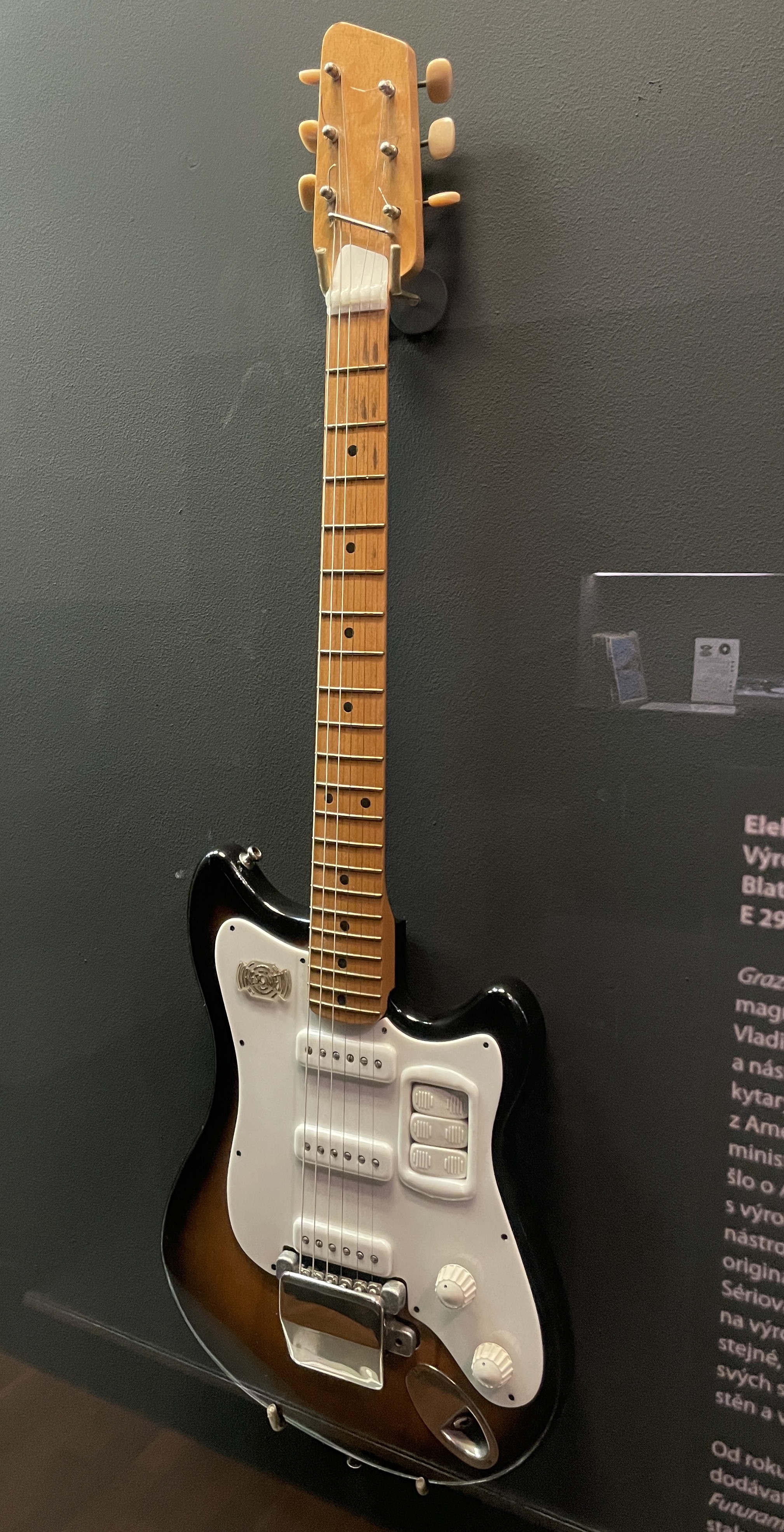
Photo: ChickSR / Wikimedia Commons / CC BY-SA 4.0 Resonet
Futurama
1955
Britain couldn't buy a Stratocaster, so George Harrison and Jimmy Page started on this.
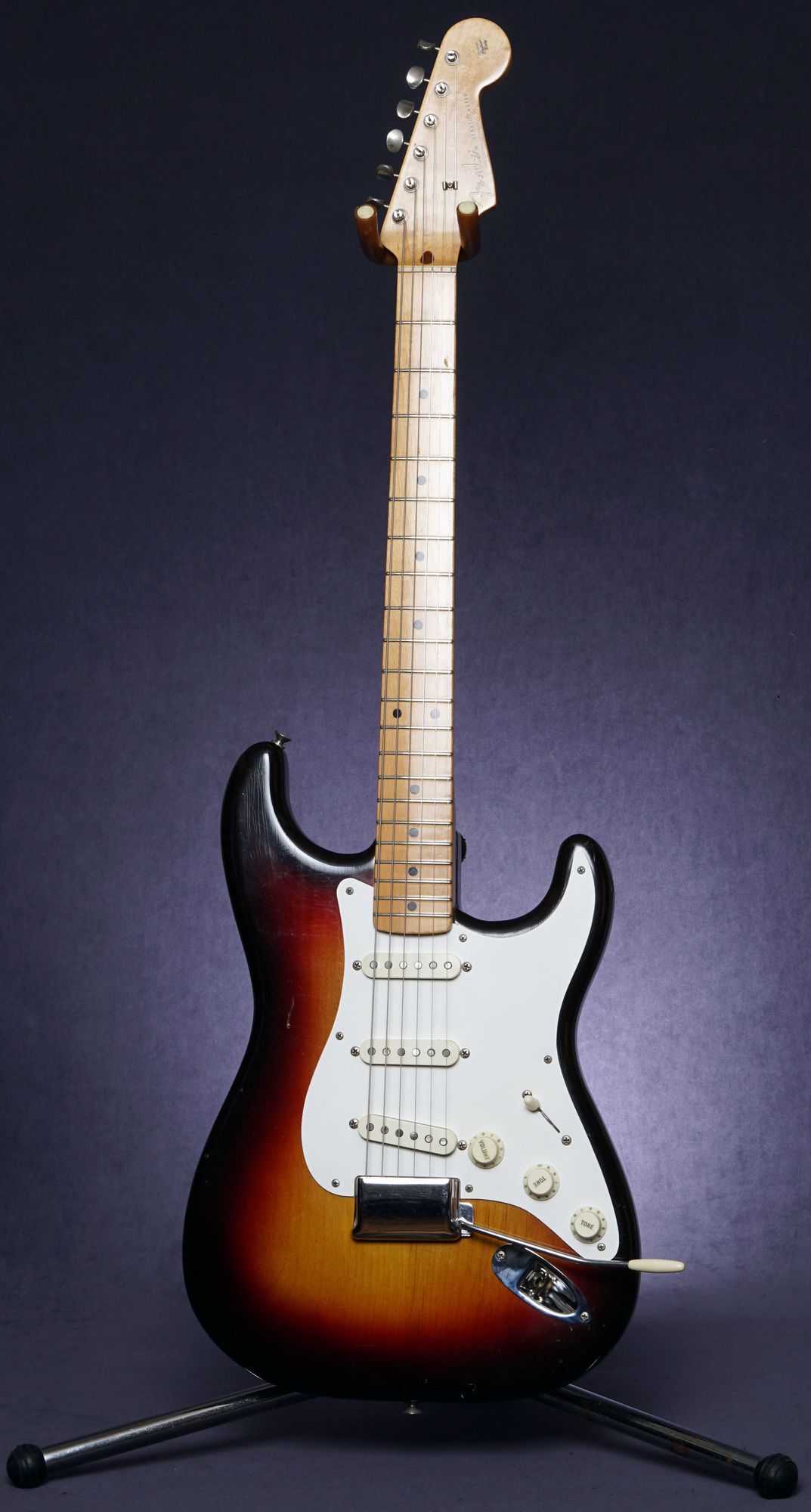
Photo: Lightburst / Wikimedia Commons / CC BY-SA 4.0 Fender
Stratocaster
1954
The guitar most people mean when they say “electric guitar.” Designed by a man who didn’t play one.
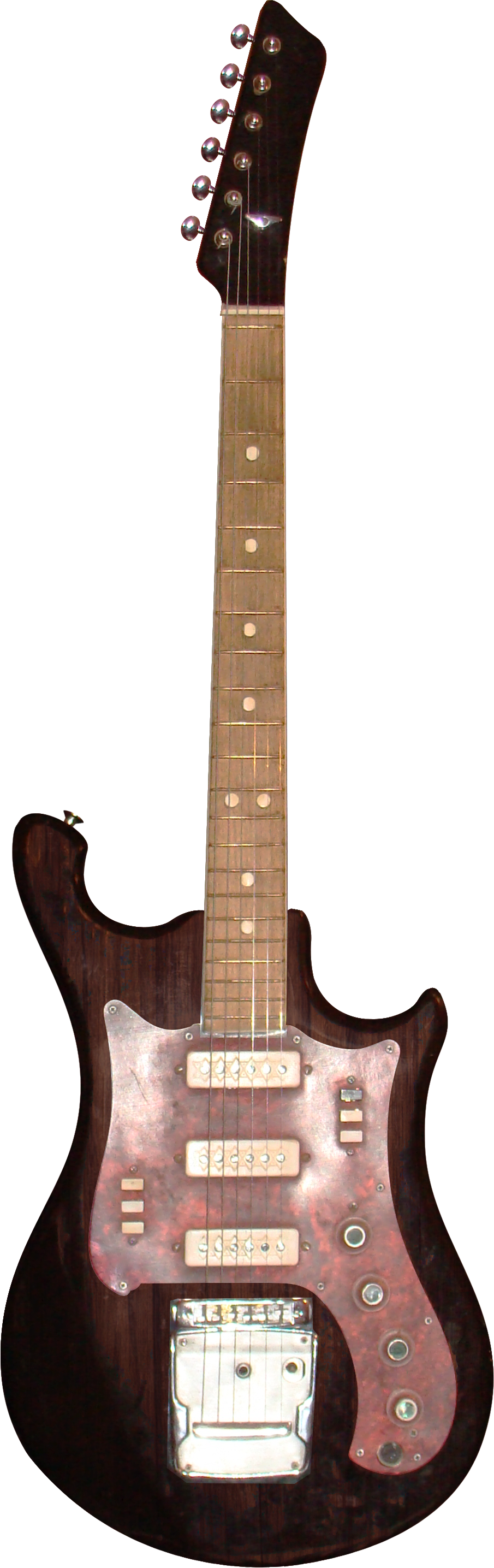
Photo: Fargoh / Wikimedia Commons / CC BY-SA 4.0 Ural
650
1975
A Soviet piano factory took a Yamaha apart, flipped it over, and gave the kids something to learn on.