Ural
650
A Soviet piano factory took a Yamaha apart, flipped it over, and gave the kids something to learn on.
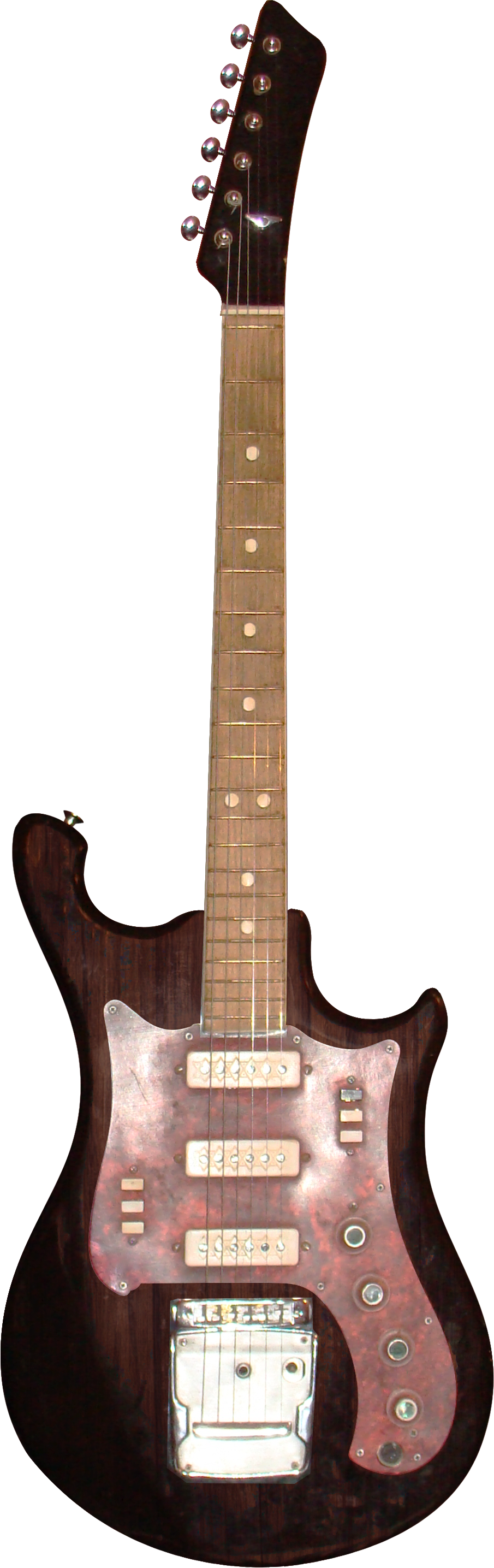
The Ural 650 came out of a keyboard works in Sverdlovsk in 1975: a bolt-on solidbody with three pickups, six push-buttons, and a horn turned the other way round from the Yamaha it was patterned on. It isn't a Yamaha, and it isn't a Gibson SG. It's the guitar a lot of Soviet kids learned on, because it was the one they could get.
- Introduced
- 1975
- Type
- Solidbody electric
- Class
- Production
The short version
1969
The Tonika
The Sverdlovsk keyboard works starts making guitars with the Tonika, a copy of a Leningrad solid.
1975
By the anniversary
The plant is told to master a new solo electric called Ural by May, for the thirtieth anniversary of the victory over Germany. The first batch is 240 guitars.
1977
The Quality Mark
The guitar earns the state Quality Mark in the autumn, and by mid-December the first thousand wearing it have left the plant.
1984–87
The plain one
A later, plainer version takes over, with flat colors in place of the hand-shaded bursts. Collectors date it anywhere from 1984 to the end of 1987.
1992
Furniture
In November the works passes to its staff as Etude-Ural, and the bet is on furniture. Guitars carry on out of habit.
1994–98
The last ones
The last guitar collectors know of dates from about May 1994. A local paper says guitars stopped in 1998.
2007
Gone
Ural-Etude ceases.
Side A
A1
The guitars that never reached the school
Sverdlovsk. The railway is rich enough to spend hard currency, and it spends some of it on Yamaha SG-series guitars, on paper for the ensemble at the railway technical school.
The guitars never get to the school. They go to the city's keyboard factory, with orders to take them apart, work out how they're made, and make something like them.
Somebody needed to. Kids were learning in circles at schools and Houses of Culture, and they needed guitars. The restaurant bands got the Czech Jolanas and the East German Musimas when they could. The bands on television already had Gibsons and Fenders. Everybody else got whatever Sverdlovsk could ship.
A2
Turn it the other way
Nobody at the plant had designed a guitar. They had a deadline, though: master a new solo electric called Ural by May 1975, for the thirtieth anniversary of the victory over Germany and the Twenty-Fifth Party Congress.
The model they started from, by one owner's reading, was the SG-5, which Yamaha had been selling since 1966. They copied a lot of it: the zero fret, the headstock and binding, the bridge, the tremolo, the pickups, the layout of the controls.
Then they flipped the body. On the Yamaha the long horn sits low. On the Ural it sits up top, which the newspaper writers who told the story think looks better, and which stops the offset shape from looking upside down.
The paper says they hit the date, with a first batch of 240 in 1975. Collectors start the series at the end of that year. Either way, it was a Ural from then on.
A3
Six buttons and a brick
The name is the scale: 650 millimetres, nut to saddle. That's the one spec that doesn't move.
Nearly everything else does. The body is a sandwich of whatever was around, beech bars under birch plywood on the early ones, spruce on others, and one man who worked there says the milling machines had been built for tank parts. He also says the neck is beech, which moves, and a neck shouldn't. The bolt-on neck has its truss rod nut in the heel, so in practice you take the neck off to adjust it.
The controls look like a car radio. Three latching buttons choose the pickups, three more are filters, there's a volume for each pickup and a master, and the cable goes into a five-pin socket, not a quarter-inch jack. The circuit was borrowed from another Soviet guitar, the Aelita from Rostov. Where the pickups were wound depends on who you ask: a military plant in Snezhinsk, an optics works in Sverdlovsk, or the factory itself.
The joke is that it's a brick. It weighs about 3.5 kilos, or up to 4, depending on the wood.
Flip the record · By the numbers
650 mm
The scale length. It's also the name.
185
Rubles, the list price. A Sverdlovsk paper called it 30 percent over the average monthly wage.
240
Guitars in the first batch, 1975.
100,000+
Six-strings, going by the serial numbers. A local paper counts more than 200,000 Urals in all.
Side B
B1
Piano wire
It cost 185 rubles, which one Sverdlovsk paper put at 30 percent over the average monthly wage.
The strings came from Leningrad. They were flatwounds, and Sergey Bobunets, the leader of Smyslovye Gallyutsinatsii, said they sounded flat. He unwound one. Under the wrap was piano wire, which he said was never meant to be played by hand.
Change the strings and it was a different guitar. Alexander Pantykin, who played Urals with the Leningrad sets swapped out, put it this way:
"Clean, transparent, and unique in timbre."
Yuri Mishkov, who played in Yekaterinburg bands, was less romantic. A decent beginner guitar, weak tuners, the wood probably poor. And it was what they had, so it was what they learned on.
B2
Floor paint
It got plainer. A later version took over sometime between 1984 and the end of 1987, depending on the source. The hand-shaded bursts gave way to flat colors, and after 1982 the "Ural" script came off the headstock.
By 1994 a collector's example has lost its body contours. It's painted a grey-white enamel he compares to floor paint, and on the late ones the tremolo base is often screwed in crooked.
In November 1992 the works passed to its own staff, and the new firm bet on furniture. Guitars kept coming out of habit. The last one collectors know of dates from about May 1994. A local paper says they stopped in 1998. By 2007 the firm was gone.
B3
The one in the video
Ural guitars still turn up in strange places. Sergey Mavrin plays one in a film for a Russian amplifier maker. Josh Klinghoffer holds one in the Red Hot Chili Peppers' "Monarchy of Roses" video. Whether that's a 650 or its twin, the 650A, depends who you ask, and nothing says the part was recorded on it.
Nobody at the plant had designed a guitar before. They copied one the kids could never have bought, built it out of what they had, and a generation of kids learned to play on it.
Put this on
You’ve read about it. Now hear it. Here’s what this guitar sounds like, and what to listen for.
Ural guitar, R&R (SOLO)
A film from the amplifier maker, titled as Mavrin playing an Ural. Nobody has said whether its plate reads 650 or 650A.
Watch it on YouTube (opens in a new tab)
The cast
The people, and the specific guitars, that made the legend.
Yuri Mishkov
A Ural
Yekaterinburg guitarist with Aprelsky Marsh and Banga Jazz. Called it a decent beginner guitar with weak tuners and probably poor wood. It was what there was to learn on.
Sergey Bobunets
A Ural, with the factory strings
Leader of Smyslovye Gallyutsinatsii. Unwound one of the flatwound strings the guitar came with and found piano wire inside.
Alexander Pantykin
Urals
Played them with the Leningrad strings swapped out, and liked what he heard.
2011
Sergey Mavrin
A Ural, in an amplifier advertisement
Played one for the Russian amp maker R&R (SOLO). Nobody has pinned down whether it's a 650 or a 650A.
2011
Josh Klinghoffer
A Ural in the "Monarchy of Roses" video; a late-'70s Ural 650A in his collection
Gear lists call his guitar a 650A, the parallel plate, and a dealer calls the video guitar a 650. Nothing says the song was recorded on it.
Liner notes
Specs, construction, rarity, value, and every source we used.
The model number is the scale, the horn is a Yamaha SG-5 turned the other way, and six buttons run three pickups.
- Body
- Solid double-cut. Furniture-board sandwich, not one recipe. Muzeum's article 422: beech bars faced with birch plywood, belly and forearm cuts, thick polyester. The sovietguitars primer prints the passport line, hardwood. Eduard Sokolov, to Oblastnaya Gazeta: a spruce deck, while the passport said high-quality hardwood. Muzeum's late example: beech, spruce, and birch under birch ply, contours gone. Primer overall: 1050 × 325 mm. OECC's 2009 sheet, one table: 42 mm thick.
- Neck
- Bolt-on beech, four screws through the body. Often three pieces. Adjustable truss; the nut sits in the heel, and the hole is under the plate. Muzeum and Habr: in practice you take the neck off. Not a through-neck. Not a set neck.
- Fingerboard
- Beech. Early boards veneered in mahogany; later ones plain, white dots. Fret count is not one figure. The primer: 21. Habr and the OECC sheet: a zero fret and 21. Fretwire splits too. Muzeum's 422r: wide brass. OECC's table says brass; the same site's article-422 prose says thick steel on that guitar.
- Scale
- 650 mm. The digits are the scale. Sovietguitars: that is what the numbers mean on this firm's electrics, and the 510 bass is the exception (passport scale 805 mm, not 510). No source gives an inch figure.
- Pickups
- Three single-coils. Early covers follow the Yamaha SG-5 and use three height screws, no ornament. Later covers use two screws and a gold "mogendavid" pattern (Muzeum; Habr). They can look like humbuckers. A sovietguitars pickup note: a single-coil with the pole pieces outside the coil. Where they were wound is not settled. Sokolov: a military plant in Snezhinsk, delivered finished. The same pickup note lists four stories: Sverdlovsk optical-mechanical, the Vector combine, a Snezhinsk defense shop, or the Ural firm itself.
- Hardware
- Tune-o-matic-style bridge, individual roller saddles, overall height. Primer: a metal plate under the studs until mid-1978, after serial 24000; then the studs go straight into the body. Tremolo patterned on the Yamaha SG-5. Muzeum's 422r: the lever raises and lowers, and a screw limits the spring. Muzeum's late guitar: lowering only. Six-in-line closed tuners, Sverdlovsk, silumin, and they break. When those ran out, Muzeum's 1994 guitar wears ordinary Alapayevsk machines. Strap buttons are white plastic and split.
- Electronics
- Passive, and not a blade switch. Three latching buttons choose the pickups. Three more are filters. A level for each pickup, plus a master. Output is a five-pin SG-5 / ONTs-RG-5, not a quarter-inch jack. Habr's capacitor values and ohm readings are one 1981 guitar. Not a factory sheet.
- Finish
- Article 422: polyester, hand-shaded bursts. Habr's is red, yellow, and black; he says collectors treat black-and-green as the scarcer burst. OECC's sheet also prints black/red, black/yellow, and black/green/yellow. Article 422r and after: flatter color, then Muzeum's late grey-white enamel, which he compares to floor paint.
- Nut
- No factory nut width. OECC's sheet: neck 42 mm at the nut, 52 mm at the 12th, 22 mm thick at the 1st. One 2009 table, not a drawing. Mike & Mike's one refretted 1970s guitar: a metal nut, spacing "closest to" 1 5/8".
Open the full research fileConstruction details, the complete player record, production numbers, dated value estimates, and sources
The spec above is a Sverdlovsk Ural 650, article 422, the beech-and-ply solidbody with the horn up top. No current model carries the name. 422r is the later, plainer article of the same model, not a second guitar. 650A is the parallel neckplate (its own TU), a different plate, and not a bass. Tonika EGS-650 is the factory's earlier solid, a different outline. Ural 510G / 510L are the basses. A Reverb "Ural 650 Style" is somebody else's new build. Not a Yamaha SG-2000. Not a Gibson SG. Weights differ: Oblastnaya Gazeta 3.5 kg; the primer up to 4 kg, depending on the wood; OECC about 3.5 kg; Mike & Mike's one upgraded 1970s guitar 8 lb 4 oz.
Construction
The job was a solo electric the keyboard factory could actually ship. Sverdlovsk, not Hamamatsu. The circles at schools and Houses of Culture needed something. A Jolana or a Musima was what the restaurant bands wanted, when they could get one.
Oblastnaya Gazeta (Vladimir Vasiliev and Maria Ivanovskaya, 21 November 2015): the firm was a keyboard works. Guitars start in 1969, as the Tonika, a copy of Leningrad's Ritm-Solo. Once that was in hand, the plant was told to make its own. The certificate they cite from the State Archive of Sverdlovsk Oblast, "Fulfillment of socialist obligations," says the works was to master a new solo electric called Ural by the thirtieth anniversary of the victory over Germany and for the Twenty-Fifth Party Congress. That is May 1975.
Nobody at the plant had designed a guitar. The paper's account: Sverdlovsk Railway, rich enough to spend hard currency, bought Yamaha SG-series instruments as if they were for the ensemble at the railway technical school. They did not go to the school. They went to the factory, with the order to take them apart, understand them, and make something like them. Oleg Kholuev, master of the experimental section in 1980–81, remembered on the collectors' site, and the paper quotes him: the drawings for the first signal sample were Ivan Kozlenko's, head of the design bureau. The paper says the plant hit the date. First batch, 1975, 240 guitars. It does not say whether those 240 left with a plain 650 plate or a 650A plate.
Collectors date the series later in that year, and they do not bury it. Muzeum: from the end of 1975 until the works died in the mid-1990s. The sovietguitars primer "Ural for beginners": end of 1975 to mid-1994. The 1975 date is the obligation year and the year of that first 240. It is not a claim that every plate left in May, and it is not the Tonika's 1969.
It is not a Yamaha once you look. The paper: the Japanese horn sits low, so the Sverdlovsk body was mirrored and the horn sits high, which the writers think sits better. Habr (Lunathecat, 20 February 2025) names the model they started from as the SG-5, on sale from 1966, and lists what was copied: zero fret, headstock and binding, retainer, bridge, tremolo, pickups, the control layout. He says the outline was flipped so an offset, Strat-like shape stopped looking upside down. That SG-5 is not the SG-2000. The 2000 is Hamamatsu, 1976, through-neck, T-Cross, a brass plate. This is a bolt-on from a piano factory. It is not a Gibson SG either: no carved-maple flagship, no Kalamazoo tenon.
The scale in the name is the one spec that does not move: 650 mm. The wood does. Sokolov, experimental section from the mid-1980s through 1991, told the paper the milling machines had been built for tank parts and weigh several tons, and that the neck is beech, which moves, where a neck should not. The deck, he said, was spruce. The passport said hardwood. Muzeum's article 422 is beech bars under birch plywood. The circuit, he says, is borrowed from the Rostov Aelita: a button for each single-coil, a second bank of filters, a volume each, a master. The weight joke says the guitar is a brick. The paper's figure is 3.5 kg. The primer allows up to 4 kg. One already-refretted American shop guitar is 8 lb 4 oz.
The electronics were never going to be tightened up in Sverdlovsk. Sokolov: pickups and tone blocks arrived finished from Snezhinsk. Strings were not theirs either. Leningrad's Svetlana sent flatwounds. That is a supply line, not a player's setup. Habr's one 1981 article 422, original circuit, measured neck 4.9 kΩ, middle 4.4, bridge 4.5, north poles toward the strings. On that guitar the bridge pickup sees 6.8 nF or 1 nF, the middle 6.8 nF or 250 nF. One instrument. Not a factory sheet.
650 and 650A share a year and do not share a plate. The primer: TU 205 RSFSR 931-75 for the 650a, TU 205 RSFSR 932-75 for the 650. Plates marked 650a run beside 650 from the start through 1978 (last one he knows, 19840), about half the known examples in that overlap. The same primer then prints two shares that fight: about 50 percent of all the electrics, and about 10,000 guitars, which it also calls 10 percent of the run. Cdur, on the same forum (20 July 2026), quotes Muzeum: the first 1975 batches all carried the A, Soviet shorthand for an installation batch, and leftover plates were still being used in 1977 when the ordinary ones ran short. A guitar can say 650a on the plate and 650 in the passport. Zarya Vostoka, 3 March 1977, still called the 650-a "Solo" a novelty. That is a newspaper word two years into the run. It does not move the introduction. Guitar-list's "tuners and a few cosmetics" is a thinner account of the same split. On the passport thread, Vasily remembers the experimental shop building a "standard Ural" with the same tremolo and tuners set 3+3, two or three of each prototype, and that shop closing in 1985–86. That is not the production six-in-line.
The standard they built to changed on the plate. Habr, reading his own 1981 badge, serial 57170, article 422, price 185 rubles: older plates carry a diploma, second degree, and a grammatical error in "republic," and no Quality Mark; his, after 1978, has dropped the diploma and cites RST RSFSR 508-75 instead of the two TU numbers. He thinks the Quality Mark arrived with that change. Vecherny Sverdlovsk, 17 December 1977, as quoted by aelita85 on sovietguitars (20 July 2026): the Mark was awarded in the autumn, on the eve of the October anniversary, and the first thousand guitars wearing it had left by mid-December. The poster's guess that 1977 output can be extrapolated from that thousand is his, not the newspaper's.
Then the article number slips. Muzeum: 422r appears in 1984 and is the bulk of a run he puts at more than 100,000 across about twenty years. Habr: from 1986, article 422r, solid color, no more hand bursts, and the "Ural" script is gone from the headstock after 1982. The primer: sparkle celluloid guards, orange and red, dominate until the end of 1987, when 422r is mastered, and he parks 422r at serials 76000 to 95000. So the three dates for 422r are Muzeum's 1984, Habr's 1986, and the primer's end of 1987. Two-screw pickup covers, filters on circuit boards, shorter knob caps. The late guitar, no article on the plate, is another step down. Muzeum's April 1994 example, serial 101319: mixed bars, contours deleted, beech board, plastic dots, grey-white enamel, logo gone, Alapayevsk tuners, tremolo base often screwed in crooked. The primer's post-Soviet stretch, mid-1991 to mid-1994, serials about 95000–101500, paints the article, the price, and later the model off the plate. The manual still has a yearly "S" article: 1s5 in mid-1991 (number 96520, 30 July 1991), S94 in 1992 (99383), S122 in 1994 (101274).
Chapt's OECC page (2009) says Rostov, Ordzhonikidze, and Borisov also built Urals. The paper, Muzeum, and the primer describe one line, in Sverdlovsk. No second source confirms a Borisov or Rostov badge.
The end is two clocks. The primer's last guitar is 101530, which he dates about May 1994, and he doubts anything later moves that by much. The paper: in November 1992 the works became the collective's, as TOO "Firma muzykalnykh instrumentov Etude-Ural," and the bet was furniture. Guitars continued by inertia, smaller, and stopped in 1998. In 2007 "Ural-Etude" ceased. The primer ends at mid-1994; the paper, at 1998. A passport signed to press on 11 April 1975, print run 30,000 copies, is a booklet run. It is not a guitar count.
Classic against current: a Sverdlovsk 650, article 422, horn up, six buttons, five-pin jack, against nothing that factory sells. A new "Ural 650 Style" on Reverb is alder and a modern jack. It is not a Sverdlovsk guitar.
Players
The Tonika and the 510 bass are different instruments, and a 650A is the other plate. The school-and-club scene is real, and it is not a discography.
Oblastnaya Gazeta: the guitar went to ensembles at schools and Houses of Culture. Professionals in restaurants and the VIA groups preferred Jolana and Musima. The bands on television already had Gibsons and Fenders. The paper names no circle, no song, and no serial. That is the whole scene.
Yuri Mishkov. Guitarist with the Yekaterinburg groups Aprelsky Marsh, Banga Jazz, and Stambulchik brothers. To the paper: he played an Ural, and it was a decent beginner guitar. Weak tuners. The wood, he allows, was probably poor. It was what they had in order to learn. No track named.
Sergey Bobunets. Leader of Smyslovye Gallyutsinatsii, to the same paper. The Svetlana strings were flatwound and sounded flat. He unwound one. Under the wrap, piano wire, which he said is not meant to be played by hand at all. A string story. Not a session log.
Alexander Pantykin. The paper says he played Urals. With the Leningrad strings swapped, he called the sound "clean, transparent, and unique in timbre." No record is named.
Sergey Mavrin. The paper answers a joke page that had him refusing the guitar. He plays one. The photograph they mean is the advertisement for the Russian amplifier R&R (SOLO), and the paper says that guitar is not the Gibson or the Fender he also owns. The amplifier channel's own film is titled as an Ural, 24 December 2011. Not an Aria album credit. The sources do not say 650 or 650A. Artist demo, not a comparable sale.
Josh Klinghoffer. The paper's caption on the Monarchy of Roses clip: the guitar in his hands is an Ural. It does not say 650 or 650A, and it does not say the part was tracked on it. English Wikipedia's instrument list, and Ultimate Guitar (20 February 2020), call a guitar in his collection a late-1970s Ural 650A. Mike & Mike's listing copy calls the video guitar a model 650. The accounts differ. A 650A is the other plate. The song is not a Sverdlovsk session.
The paper's other 2015 name is the bassist of the jazz quartet Kultrain, with Karen Souza. A bass, not tied to a 650. No other players are named beyond the four Sverdlovsk names above. Mavrin and Klinghoffer are the disputed cases.
Rarity
You cannot order a new 650 from Sverdlovsk. The works stopped making them, on one clock in the mid-1990s and on the paper's clock in 1998, and the firm was gone by 2007. Restored ones, and new guitars shaped like them, are not a catalog.
It was common because the institutions bought it. The paper: more than 200,000 Urals made and sold in a little over twenty years, at 185 rubles, which it calls 30 percent over the average monthly wage. No ledger line is shown for the 200,000, and the sentence sits in an article that also describes the basses. The primer: about 101,500 six-strings, read off a serial run whose last known guitar is 101530. Muzeum's 422r page says that article is most of a run of more than 100,000. Reverb News (30 August 2017) prints a different calendar in its Sverdlovsk table: 650A for 1975–77, then a 650 for 1976–80 and another for 1980–95, each with a quantity. Those quantities are the table's. They are not a factory book, and they are not added to the 101,500 or the 200,000. Guitar-list, citing cheesyguitars, prints about 10,000 a year from 1975 and 150,000 a year in the 1980s. That rate is not a factory total. It does not fit the primer's ceiling or the paper's 200,000. A neckplate dates a guitar. It does not, by itself, count a year. The primer's 101,500 is the ceiling treated as a count.
What is actually thinner: the 1975 batch of 240; a 650A plate, last known 19840; a black-and-green burst, which Habr says turns up less often; an early article 422 that still has the contours, the mahogany veneer, the silumin tuners, the five-pin jack, and the passport; the Quality Mark guitars of late 1977 as a dated slice, not as a rare model. The grey enamel guitar of 1994 is thin too, and Muzeum treats it as the careless end, not the one to hunt. A Tonika is not a 650. A 510 is not a 650. A Borisov or Rostov Ural has no second source behind its badge.
Value
Informal estimate, 27 October 2026. Not an appraisal.
Prices below are asking prices unless marked sold. No median is given. Ruble prices are not converted to dollars unless a source did. Celebrity and advertisement guitars are not comps. A Tonika, a 510, a 650A, and a new "style" build are not comparable.
185 rubles is the Soviet list, on the plate and in the paper. The paper's "30 percent over the average wage" is the paper's comparison. It does not print the wage. A Riga-12 moped, a Sonata-308 recorder, and a Moscow–Magadan ticket are Habr's 2025 way of spending those 185 rubles. Not a 2026 price.
New street. None under Ural 650. Etude-Ural is gone. A Reverb ask, "Ural 650 Style," new, $382.50, is a modern build with an alder body. Not a Sverdlovsk guitar. Shopozz lines at 50,590–79,190 ₽ use the same export titles ("rare USSR," "style," "custom"). Not a Sverdlovsk median.
Used modern. There is no modern Sverdlovsk production, so there is no used-modern band.
Vintage / collectible. Reverb's Price Guide shows no band for the Sverdlovsk 650. Few sold prices are public. Named asks, not hammers. A Reverb brand-page snapshot, 27 October 2026, is mostly repeating export titles: fair $240–$270, good $298, a 1980s sunburst $169, "all original" and "no repair" $335, "authentic 70s" $250. One ended Mike & Mike's ask, an upgraded 1970s (jack swapped, refret, setup), was listed at $349.99. Not a stock guitar, and not a confirmed hammer. Named ruble asks on Festima, not hammers: a 1980 article 422, serial 46947, original electronics, ask 8,600 ₽, the page saying it found that ad a year earlier. Other Festima asks in the same scrape sat on tired or incomplete guitars at 2,500 ₽, 3,600 ₽, 4,301 ₽, and 5,000 ₽. A parts guitar, a clean 1980, and a $335 export ask are three different markets. Not comparable sales: Mavrin's amplifier-ad guitar, Klinghoffer's video guitar, whatever Pantykin, Bobunets, and Mishkov actually held. One object each, and none of them has a published price.
See also
- yamaha-sg-2000 — Hamamatsu's 1976 through-neck. The guitar Sverdlovsk took apart was the earlier SG-5, not this one
- gibson-sg — thin mahogany double-cut. Not the horn they flipped
- fender-stratocaster — the bolt-on the weight joke measures this against; not a Sverdlovsk six-button guitar
Sources
- *Oblastnaya Gazeta*, Vasiliev and Ivanovskaya, "Legendary Sverdlovsk brands: the Ural guitar" (21 November 2015) — keyboard works; Tonika from 1969; archive obligation by May 1975; Yamaha SG bought via the railway, taken apart; Kozlenko via Kholuev; first 240 in 1975; mirrored body; Mishkov, Sokolov, Bobunets, Pantykin; 3.5 kg; 650 and 650a; 510G and 510L; Jolana, Musima, Gibson, Fender; more than 200,000; 185 rubles; November 1992 Etude-Ural; production stopped 1998; firm gone 2007; Mavrin and the R&R (SOLO) ad; Klinghoffer in the Monarchy of Roses clip; Kultrain's bassist
- May Muzeum, Ural 650 art. 422 — end of 1975 to the mid-1990s; beech and birch ply; 650 mm; silumin tuners; SG-5 tremolo; Aelita-derived switching; 1977 example, serial 29942
- May Muzeum, Ural 650 art. 422r — 422r from 1984; most of a run he puts above 100,000; beech board, brass frets; SG-5 tremolo raises and lowers; 1988 example, serial 86508
- May Muzeum, late Ural 650 — beech, spruce, birch; contours deleted; grey-white enamel; lever lowers only; April 1994, serial 101319
- sovietguitars, "Ural for beginners" — end of 1975 to mid-1994; about 101,500; 21 frets; 1050 × 325 mm; up to 4 kg; bridge plate until mid-1978 after no. 24000; 650a parallel to 1978, last no. 19840; the 50 percent / about 10,000 / 10 percent split; 422r from the end of 1987, serials 76000–95000; post-1991 articles 1s5, S94, S122; last known no. 101530, about May 1994
- sovietguitars, aelita85 and Cdur (20 July 2026) — Zarya Vostoka, 3 March 1977, 650-a called a novelty; Vecherny Sverdlovsk, 17 December 1977, Quality Mark and the first thousand; Muzeum on the 1975 "A" plates
- sovietguitars, passport thread — passport print run 30,000, signed to press 11 April 1975; a 650A plate can carry a 650 passport; serial 8560 dated inside 1976
- sovietguitars, scale note on the 510 — the model number is the scale in millimetres; 510G / 510L passport scale 805 mm
- Habr, Lunathecat, «Прокачанная, играбельная, легендарная электрогитара Урал» (20 February 2025) — SG-5 from 1966 as the design start; what was copied, including the zero fret; the mirror; serial 57170 as 1981, article 422, 185 rubles; RST RSFSR 508-75; 422r from 1986; headstock script gone after 1982; one guitar's pickup ohms and filter capacitors; five-pin ONTs-RG-5
- OECC, Chapt, Ural model 650 (2009) — 185 rubles; 42 mm body; frets 0–21; neck 42 mm / 52 mm / 22 mm; about 3.5 kg; other-factory claim for Rostov, Ordzhonikidze, Borisov
- OECC, Chapt, Ural 650 art. 422 (2009) — SG-V as the outline they started from, not a copy; steel frets on that one guitar, against the brass in the specs above
- Reverb News, guide to Soviet-era guitars (30 August 2017) — Sverdlovsk table: 650A 1975–77, 650 1976–80 and 1980–95, 185 rubles; the quantities are that table's, and they are not a factory ledger
- Guitar-list, Ural 650 — dates from 1975; cheesyguitars rate of about 10,000 a year, then 150,000 a year, not used as a count
- Wikipedia, "Ural (guitar)" — lead only; its 1975–1998 span and its unit total cite the Oblastnaya Gazeta piece and are not a second source
- Mike & Mike's / Reverb, 1970s Sverdlovsk Ural 650 — one upgraded guitar, 8 lb 4 oz, metal nut closest to 1 5/8"; dealer copy files Klinghoffer on a 650; ended ask $349.99
- Ultimate Guitar, Klinghoffer gear (20 February 2020) — a late-1970s Ural 650A in the collection
- Wikipedia, Josh Klinghoffer, instruments — the same 650A, in the "previously used" list
- YouTube, rnramp.ru, "Sergey Mavrin. Ural guitar, R&R (SOLO)" (24 December 2011) — the amplifier-channel film titled as an Ural
- Reverb brand page, Ural electric guitars — 27 October 2026 ask snapshot, $169–$335; not sold medians
- Reverb, "Ural 650 Style" new build — new, alder, $382.50; not a Sverdlovsk guitar
- Festima, Ural mod. 650 — 1980 article 422, serial 46947, ask 8,600 ₽; ad found a year earlier
- Festima, Ural 650 asks — parts and tired-guitar asks at 2,500 ₽, 3,600 ₽, 4,301 ₽, 5,000 ₽; not a median
- Shopozz, "Ural electric" — 50,590–79,190 ₽ lines on export "rare" and "style" titles; not this row
Keep digging
Guitars this one gets compared to, confused with, or descended from.
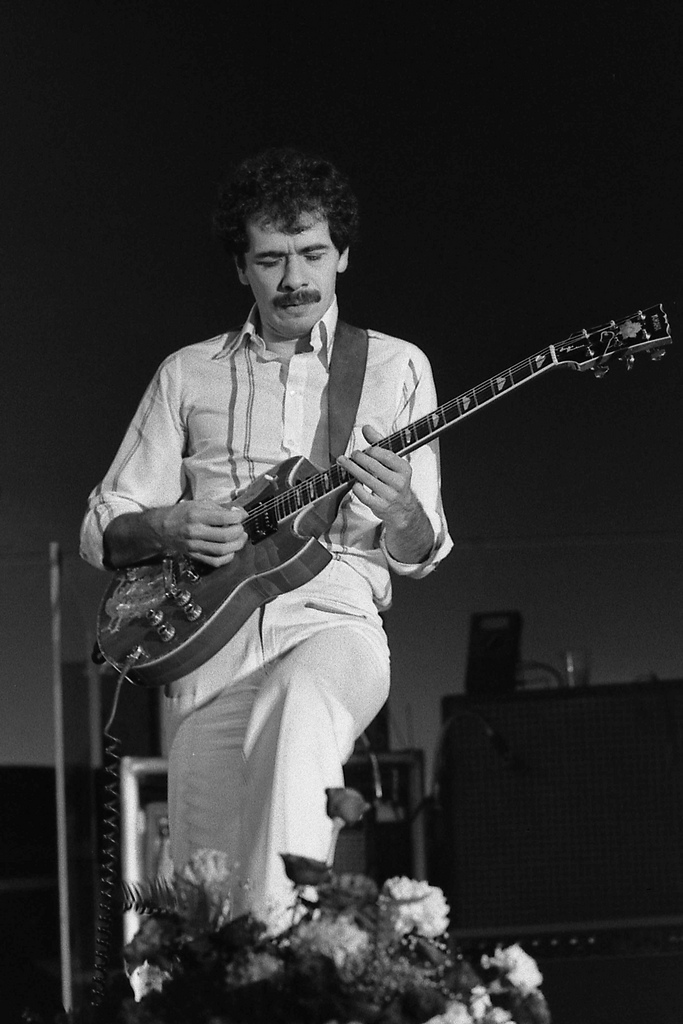
Photo: Chris Hakkens / Wikimedia Commons / CC BY-SA 2.0 Yamaha
SG-2000
1976
Santana told Yamaha to put a chunk of metal under the strings. They listened, and the notes stopped dying.
Gibson SG Standard ’61 Reissue, photographed 18 March 2010. Photo by John Tuggle. Licensed under CC BY 2.0. Via Wikimedia Commons. Gibson
SG
1961
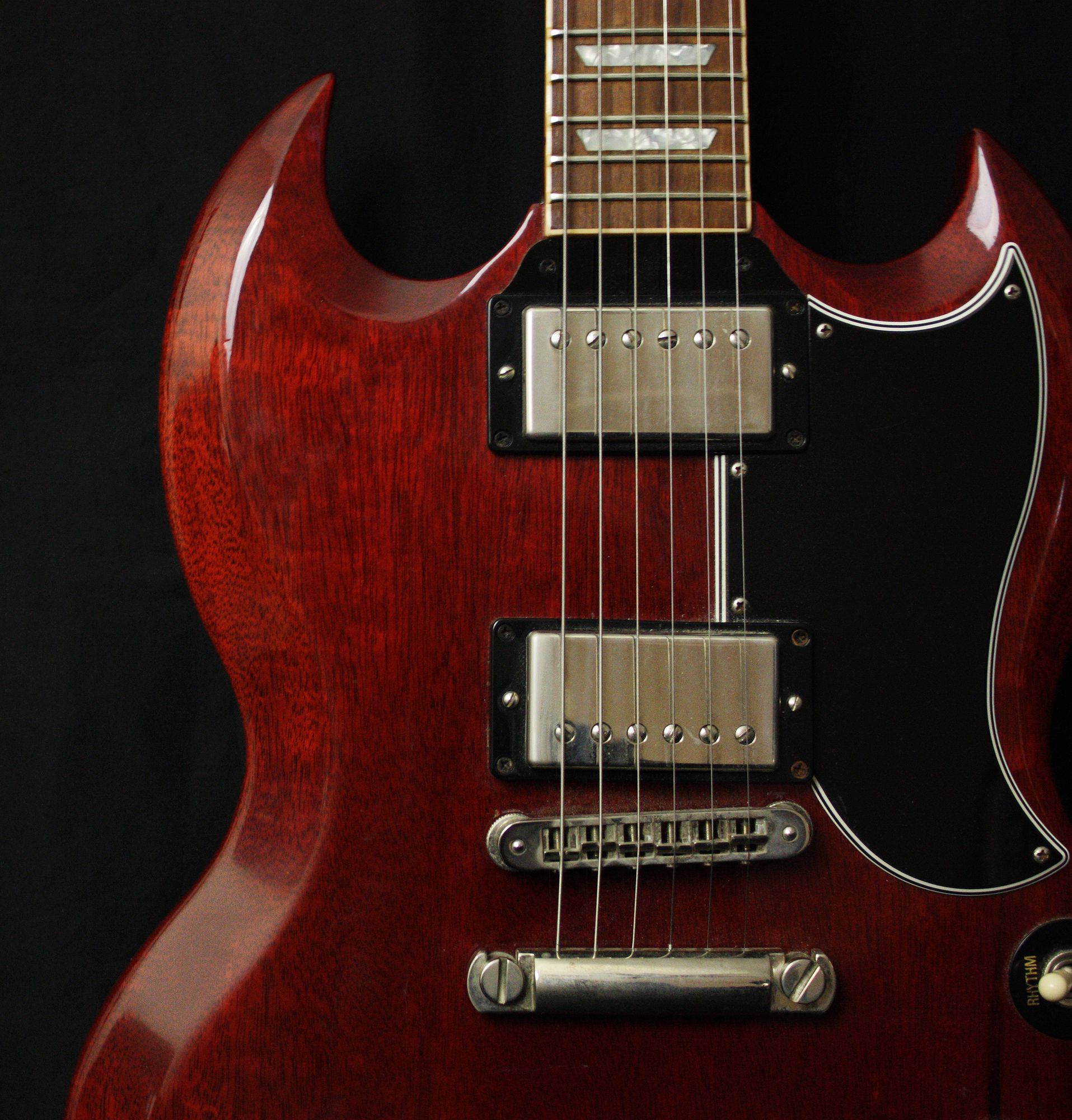
Gibson has never stopped making SGs. Angus Young has lost count of his. He still only means one.
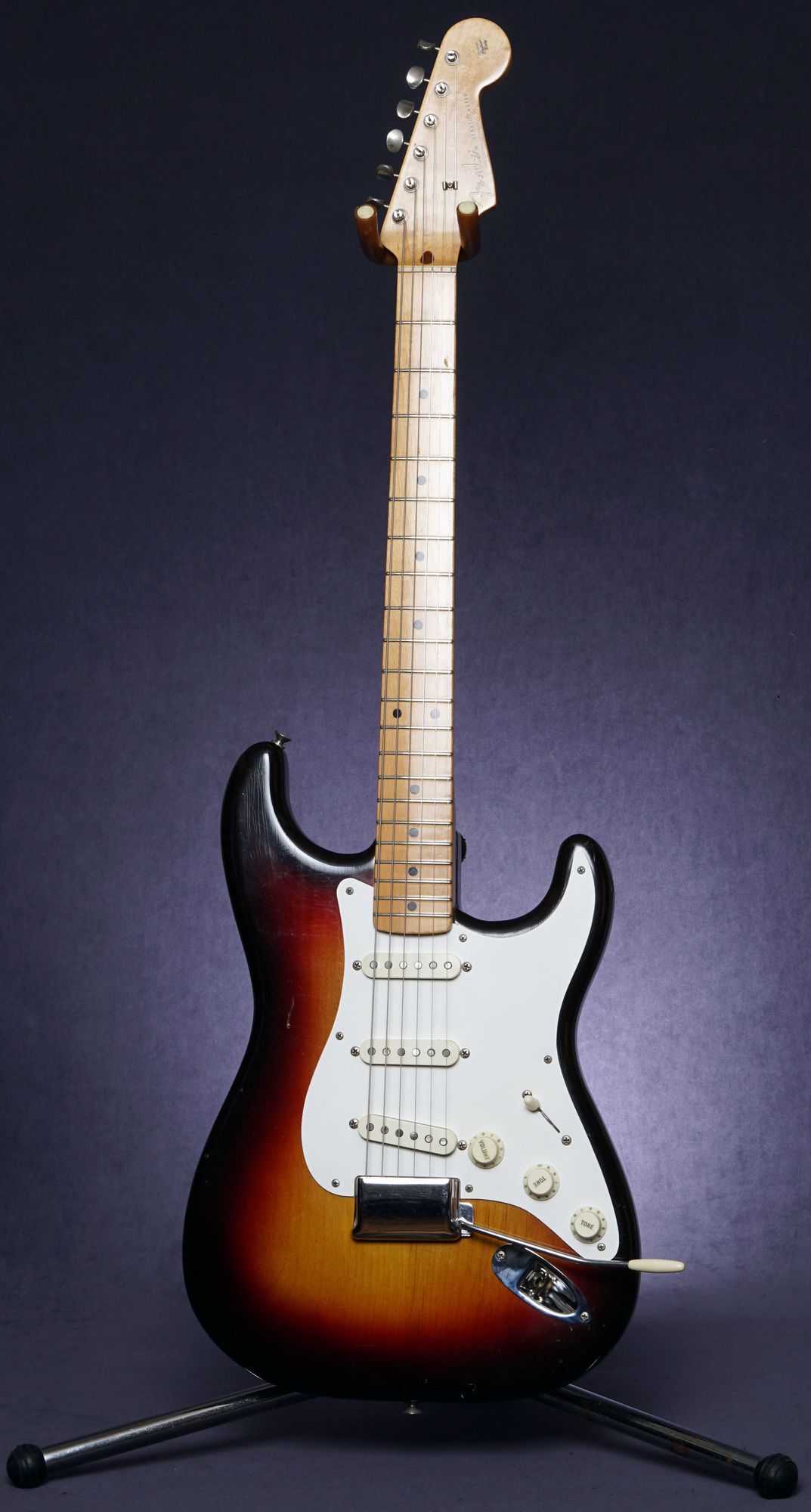
Photo: Lightburst / Wikimedia Commons / CC BY-SA 4.0 Fender
Stratocaster
1954
The guitar most people mean when they say “electric guitar.” Designed by a man who didn’t play one.