Kay
Barney Kessel
Chicago’s catalog house put a jazzman’s name on its best archtops. The name left. The headstock stayed.
In 1957, Kay of Chicago, a catalog house better known for student guitars, built three archtops for people who played for a living and signed them with Barney Kessel’s name. Collectors still call them by the shape of the headstock.
- Introduced
- 1957
- Type
- Hollowbody electric
- Class
- Production
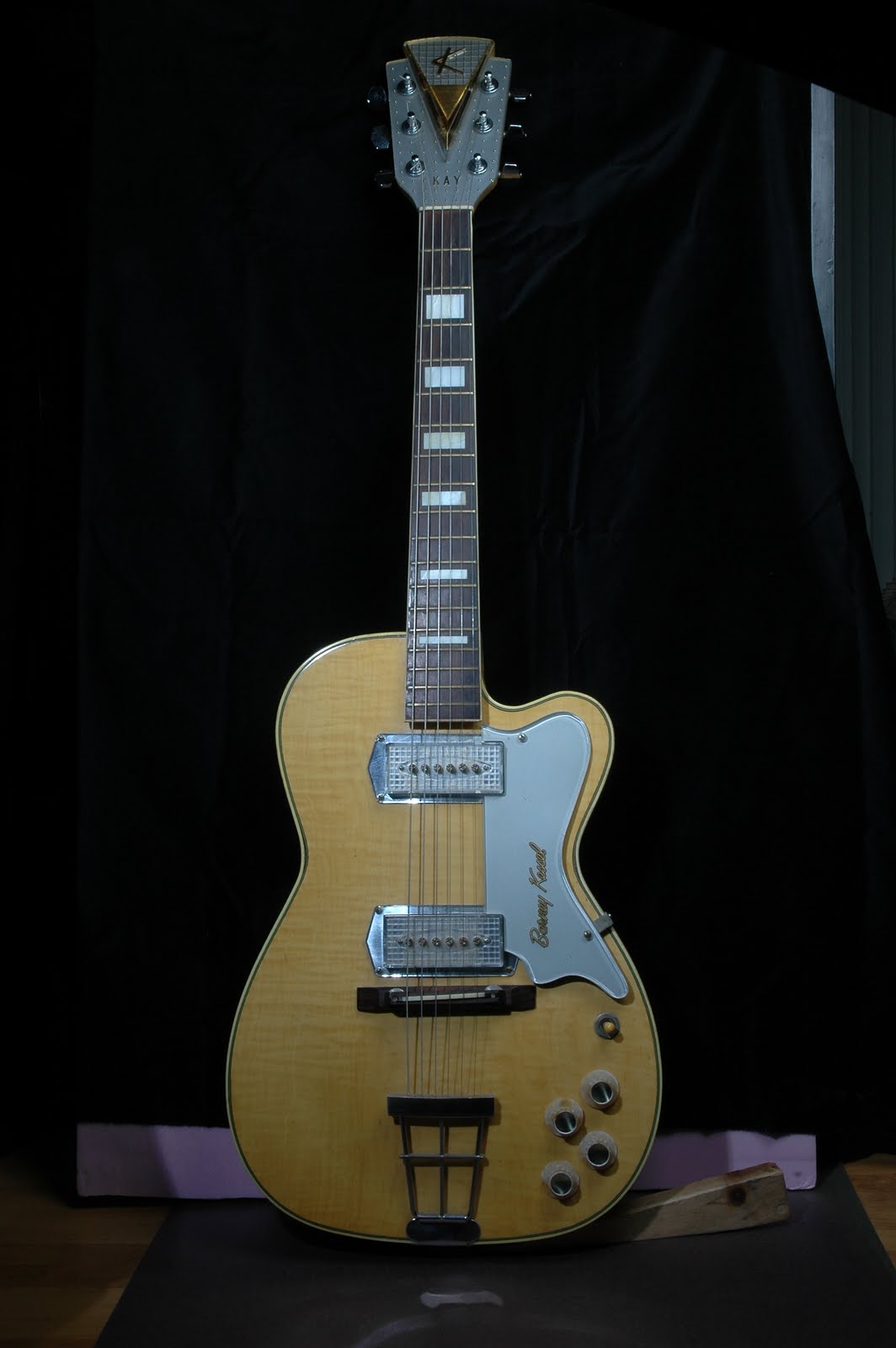
The short version
1956
The approach
Some accounts have Kay approaching Kessel, or even introducing the line, this year.
1957
Gold K
Under Sidney Katz, Kay launches the Barney Kessel Pro, Artist, and Jazz Special for working players.
1959
The catalog spread
Kay’s catalog runs from a $24.50 student guitar to a $400 professional electric.
1960
The name comes off
Kessel has moved to Gibson. His signature leaves the Kays, though some 1960 guitars still have it.
1961
Gone from the book
The Kessel models aren’t in Kay’s 1961 catalog.
2019
Back, from China
Kay Vintage Reissue brings all three models back.
Side A
A1
From $24.50 to $400
Open Kay’s 1959 catalog and you can see the whole company in one spread. It starts at a $24.50 student guitar. It ends at a $400 professional electric.
That’s the problem Kay had. It was Chicago’s catalog house, and the top of its book still didn’t have a professional’s name on it. Gibson had Les Paul. Gretsch had Chet Atkins. In 1957, under Sidney Katz, a man who’d come over from Harmony, Kay went after the same thing: a line of Gold K guitars for working players, not the pawnshop counter, with a working player’s name on it.
The name was Barney Kessel. Exactly when he signed is the usual fight. Some say he was approached in 1956, and one account has the line introduced that year. The catalogs start in 1957.
A2
Three widths
It came in three sizes, and the sizes were the pitch.
The Jazz Special was the big one, 17 inches across, built to stand next to Gibson’s L-5CES and Super 400CES and Epiphone’s Zephyr Regents. That’s the company Kay wanted to be in. Its pickguard was painted from the back with the logo and Kessel’s name.
The Artist was the middle guitar, about 15½ inches, a little deeper, a spruce top over laminated curly maple, with one pickup or two. It listed at $300, which was a lot of money for a Kay. The Pro was the small one, 13 inches.
Past that, the guitars don’t agree with the books. Scales, fingerboards, fret counts, even whether the top is spruce or maple: measure three and you get three answers. Call it a family, not a spec sheet.
A3
The Kelvinator
Nobody calls it the Barney Kessel Jazz Special in a shop. They call it the Kelvinator.
Look at the headstock. The big K on it matches the Kelvinator badge of the period, the one on the refrigerator. It’s the least jazz thing about the guitar, and it’s the reason anybody still says the name.
Then the pickups: single-coils under a molded cover with a cross-hatched pattern and Phillips screws for poles, a box shape that got them called Kleenex boxes. Underneath, it’s close to a P-90 with bigger poles. So think P-90 grit, on a big hollow jazz box.
Here’s the trap. The Kleenex-box pickup outlived the signature and ended up on plenty of later Kays, and dealers file any of them as a Barney Kessel. A Montgomery Ward Airline Swingmaster has the pickups and a plain headstock. The real thing is the Kelvinator peghead, and, while the contract held, his name in the guard.
Flip the record · By the numbers
3
Sizes. The 13-inch Pro, the middle Artist, the 17-inch Jazz Special.
$300
List on the Artist in the 1950s. A lot for a Kay.
$24.50
Where Kay’s 1959 catalog started. It topped out at $400.
Side B
B1
The man on the guard
So what did Kessel actually play on all those records?
Mostly not this. For jazz he settled on a Gibson ES-350 and stayed with it, Charlie Christian pickup and all, and he mostly kept to it through the years the Kays were on sale. His movie calls, playing rhythm in a big band, were almost always on one of two 1930s Gibson L-5s that had belonged to George M. Smith.
The Kays turn up in photographs. Pop sessions, in the years after the launch, show him holding them. The company that owns the name now says he took the Artist to Wrecking Crew dates for Elvis, Sam Cooke, and Ike & Tina. That’s their sentence. There’s no session log behind it, and no named hit is tied to one of these guitars.
He liked plainer guitars. When the deal was up, he let it go.
B2
Off by 1960
Exactly when depends on who’s counting.
One account stops the factory in 1958. Others call it a three-year run, or say the guitars were on sale for four. The signature came off in 1960, once Kessel had gone to Gibson, and by the 1961 catalog the line was gone. Some 1960 guitars have no name on the guard. A 1960 Artist that turned up still has it. Call 1960 a changeover, not a date.
Gibson’s Barney Kessel came out of Kalamazoo around then: double cutaways, two humbuckers, nothing like the Kays. Different guitar, same name.
B3
The headstock came back
In 2019, Roger Fritz’s Kay Vintage Reissue brought all three back: Pro, Artist, and Jazz Special, built in China. The Artist that got reviewed has ceramic magnets in place of the old Alnico V. Kessel’s name is back on all three.
And the headstock is back, the full Kelvinator, the K from the refrigerator. Kay tried to make a guitar that looked like it belonged next to an L-5. What people kept was the part that looked like a kitchen.
The cast
The people, and the specific guitars, that made the legend.
1957
Barney Kessel
His name on the pickguard, 1957–60
Photographed with these Kays on pop sessions. For jazz he mostly stayed with his Gibson ES-350.
1957
Sidney Katz
Ran Kay at the launch
An ex-Harmony man who aimed the Gold K line at working players instead of the pawnshop counter.
2019
Roger Fritz
Kay Vintage Reissue
His line brought the Pro, Artist, and Jazz Special back, Kelvinator headstock and all.
Liner notes
Specs, construction, rarity, value, and every source we used.
A Kelvinator headstock and Kleenex-box coils on three Chicago archtops — Kay’s Barney Kessel, not his ES-350, and not Gibson’s later signature.
- Body
- Single-cut hollow archtop, bound f-holes. Pro 13" wide (Blue Book). Artist catalogued at 15½"; RetroFret measured one c. 1958 at 15¼" (38.7 cm) and 3½" (8.9 cm) deep, 41¾" (106 cm) overall. Jazz Special 17" wide; Jay Scott, 2¾" thick. Blue Book calls the line a semi-hollowbody. RetroFret and Premier Guitars Sydney call examples fully hollow. No center block in those sources. Mix flagged. Do not average 15¼" / 15½", or 2¾" / 3½".
- Neck
- Set maple
- Fingerboard
- Bound. Blue Book: ebony, split-pearl blocks on Pro and Jazz Special, pearl blocks on the Artist; 18 frets (Pro), 20 (Artist, Jazz Special). Jay Scott and RetroFret: rosewood on the Artist (Scott: Brazilian, squares). Cream City’s 1957 Pro: Brazilian rosewood. Premier Guitars Sydney’s 1959 Jazz Special: Brazilian rosewood, 20 frets. Sylvan’s 1959 Jazz Special: ebony. GuitarPoint counted 19 frets on a 1957 Artist. Mix flagged. Do not average 18 / 19 / 20. Do not pick ebony over rosewood.
- Scale
- Blue Book 24.75" on the Artist and the Jazz Special (the free Pro line does not print a scale). Cream City measured a 1957 Pro at 24¾". RetroFret measured the c. 1958 Artist at 25½" (648 mm). Premier Guitars Sydney measured a 1959 Jazz Special at 25.75". Mix flagged. Do not average.
- Pickups
- One or two Gold K single-coils, the “Kleenex box.” Jay Scott: cross-hatched molded covers, Phillips pole screws. Artist: one or two (Scott). Jazz Special: 8700 two-pickup, 8701 one-pickup (Blue Book). Reverb’s Pro page: the Pro in both. Cream City calls the pair on its 1957 Pro DeArmond. Scott and Dan Orkin do not.
- Hardware
- Trapeze. Melita Synchrosonic on Artist and Jazz Special (Jay Scott; RetroFret spells the bridge Melita). Grover — Rotomatic on RetroFret’s Artist, Sta-Tite open-gear on Cream City’s Pro, Imperial on Sylvan’s Jazz Special. Not one tuner model.
- Electronics
- Two pickups: volume and tone each, 3-way. One pickup: volume and tone (Blue Book 8701).
- Finish
- Blonde / natural and sunburst. Blue Book: 1700B/S, 6700B/S, 8700B/S, 8701B/S.
- Nut
- Cream City’s Pro and RetroFret’s Artist: 1 11/16" (RetroFret also 43 mm). Empire’s Pro: 1.65". Premier Guitars Sydney’s 1959 Jazz Special, via Reverb: 42.95 mm. Mix flagged. Do not average 1.65" and 1 11/16".
Open the full research fileConstruction details, the complete player record, production numbers, dated value estimates, and sources
Classic living example = 1957–60 Chicago Kay Barney Kessel — Pro (K1700), Artist (K6700), Jazz Special (K8700) — one card. Living new cart, not this table: Kay Vintage Reissue K1700V Pro, listed at $1,099.99 (Guitar Center, Musician’s Friend, Music & Arts). Artist K6700V and Jazz Special K8700V are the 2019 reissues; no new street confirmed on those two this pass. Reissue scale: 24.75" (Premier Guitar, Guitar.com, Musician’s Friend) against Jazz Guitar Today’s 25¾" “update.” Reissue Pro: 22 frets (Musician’s Friend). Kay told Premier Guitar the old coils were Alnico V; the Artist reissue Hunter reviewed is ceramic 8. Not Gibson’s Barney Kessel. Not the K5970 Jazz Special bass. Not a Kleenex-box Airline. No Gibson SKUs. Mixed inch/mm flagged where RetroFret printed both. Do not invent millimetres for 13", 17", 24.75", 25.75", or 2¾".
Construction
The job was a professional archtop Chicago could stand next to a Gretsch and a Gibson. Three widths. His name in the guard. A headstock that reads like a kitchen appliance.
Kay was already the catalog house, the same city as the Thin Twin (kay-thin-twin). RetroFret: in 1957, under ex-Harmony man Sidney Katz, the company aimed a Gold K line at working players instead of the pawnshop counter, and put Barney Kessel on it the way Gibson had used Les Paul and Gretsch had used Chet Atkins. Premier Guitar (Dave Hunter, 25 June 2019): deal and launch in 1957, signature models on sale for four years. Blue Book: manufactured 1957–1960. Reverb News’s player profile: introduced 1957, discontinued 1960. Vintage Guitar (Rusty Russell, February 2022) says Kay introduced the Jazz Special, the Artist, and the Pro in 1956. Empire Guitars says he was approached in 1956. Kay’s reissue pages say the Pro “originated in 1954” and eventually became this model. Keep 1954 as reissue marketing, 1956 as Vintage Guitar’s introduction, and 1957 as the launch the catalog sources use. This plate starts in 1957.
How long it lasted is the same split. Wikipedia’s Barney Kessel page dates manufacture to 1957–1958. RetroFret calls it a three-year run: he did not renew after three years, the last 1960 guitars lack his signature, and the line is gone by the 1961 catalog. Blue Book: the signature was off by 1960, once he had moved to Gibson. Hunter’s “four years” and RetroFret’s “three” both end before that 1961 book. A 1960 Artist that Fretted Americana sold still has the signature on the guard, and that page quotes Jay Scott that the name came off in 1960. 1960 is a changeover, not one Monday.
The sizes are the catalog. Jay Scott (’50s Cool: Kay Guitars, via Fretted Americana): Jazz Specials introduced in 1957 to sit with the L-5CES, the Super 400CES, and Epiphone’s Emperor Zephyr Regent and Deluxe Zephyr Regent. Seventeen inches, 2¾" thick, guard painted from the back with the logo and his name. The Artist is the 15½" middle, “somewhat deeper,” solid spruce over laminated curly maple, one or two Gold K pickups. The Pro is 13". Widths, scales, boards, and fret counts disagree across Blue Book and measured guitars. Those numbers stay in the table. Do not average them. Blue Book’s word is semi-hollowbody, spruce over maple. RetroFret’s blond Artist is a hollow archtop, laminate maple with a spruce top, list $300 — “a lot for a Kay.” Cream City’s 1957 Pro is flame maple top and back. Spruce versus maple on the Pro is the book against the guitar.
The headstock is why a shop still says the name. Collectors call it the Kelvinator: the K matches a Kelvinator badge of the period (Hunter; Dan Orkin, Premier Guitar, 6 June 2021). Reissue copy spells it Kelvonator or Kel-von-a-tor. The coils are Gold K single-coils under a Kleenex-box cover, cross-hatched, Phillips screws in the poles (Scott). Orkin: a P-90 with larger poles, and the nickname followed the pickup onto later Kays that are not this signature. Hunter, from the reissue company: ceramic 8 magnets “rather than the alnico V of old.”
Not every Kleenex-box Kay. Orkin: dealers file any of those pickups as a Barney Kessel. A 1965 Montgomery Ward Airline Swingmaster P-5 has the coils and a plain headstock. This card is the Kelvinator peghead and, while the contract held, the signature in the guard.
Not the K5970. Vintage Guitar (April 2014): the 1960 catalog also had a Jazz Special bass, double-cut, $195, a big K with the same nickname. Four strings. Off this table.
Not Gibson’s Barney Kessel. Russell: BK-C and BK-R debuted in 1960 — 3" laminate, double Florentine cutaways, two humbuckers, a Tune-o-matic — and in that piece ran to ’72. Wikipedia dates the Gibson artist model 1961–1974. Keep both pairs. Kalamazoo, not Chicago. No Gibson SKU.
What you can order now is not that factory. Kay Vintage Reissue, Roger Fritz’s line, brought the three back in 2019 as K1700V, K6700V, and K8700V. Hunter’s China-built Artist is fully hollow, 24¾", nut 1 11/16", street $1,299 in June 2019. Guitar.com: flame-maple top on the Pro, three-ply spruce on the other two, 13" / 15.6" / 17", 24.75" throughout. Jazz Guitar Today, the same season, calls 25¾" an update. Pro pages say “semi-solid.” Hunter’s Artist is fully hollow. This pass the tobacco-sunburst Pro is $1,099.99 at Guitar Center, Musician’s Friend, and Music & Arts, case included; Guitar Center marked limited stock. Artist and Jazz Special were not on those new carts. Classic versus current: a Chicago archtop with his name under the guard, against a Pro reissue still on the shelf.
Players
Do not hang “Cry Me a River” here. Wikipedia puts it on Julie Is Her Name (1955). Vintage Guitar (Rich Kienzle) calls the hit 1954. Either year is before this line. Do not hang the Poll Winners records here either. Russell: once Kessel settled on a Gibson ES-350 for jazz, he stayed with it, Charlie Christian pickup and all. Bruce Forman cut Reunion! on Barney’s own late-’40s 350. Do not hang Gene Cornish’s Rascals guitar here. Vintage Guitar’s interview with Cornish: that one is a Gibson Barney Kessel.
Barney Kessel. The signature, and a bad guitar to pin the famous sides on. Russell: photos from pop sessions in the years after the launch show him holding these Kays. Movie calls, where he was playing rhythm in a big band, were almost always one of two ’30s Gibson L-5s that had belonged to George M. Smith. Russell: he is also said to have used an L-5 on Barbra Streisand’s “On a Clear Day,” on some Sonny and Cher dates, on four Elvis Presley movies, and on many Phil Spector sessions. Said. Those are L-5s. Hunter: across the years the signature Kays were on sale, Kessel mostly stayed with the ES-350. RetroFret: he liked plainer guitars and let the endorsement lapse. Kay’s own reissue copy says he used the Artist with the Wrecking Crew for Elvis, Sam Cooke, and Ike & Tina, and Jazz Guitar Today’s announcement calls that Artist the guitar he took to record dates. Company sentences. Not a session log. The sourced picture is the photographs (Russell) and the 350 he actually preferred (Hunter, Russell). No named hit is tied to a Kay serial here.
Also known to play stays empty on purpose. Reverb’s Pro overview names Jack White, Bob Dylan, and Ry Cooder as Kay players. That is the brand. None of the three is sourced on a Kelvinator Kessel.
Rarity
You cannot buy a new Barney Kessel from Kay of Chicago. RetroFret: the Gold K Kessel line was not a major sales success, a short run, out of the catalog by 1961. Wikipedia stops the factory at 1958. Same shortage, different end date. Kay published no unit total. None invented. A plate on the headstock dates a guitar. It does not count a year.
What is thinner is the guitar the name means. A 17" Jazz Special, not every 13" Pro. A guard that still has the signature, against a 1960 with the name off the spec. A Kelvinator headstock, not a later Kay that only kept the Kleenex box. Orkin, 2021: a Swingmaster at $1,995 was about a third to a half of the ask on a two-pickup Kay with the real designation. One column’s ratio. Not a census. The ES-350 he played, and the Gibson with his name on it, are other objects.
China is another factory. One ended Kay Vintage Reissue listing called a Jazz Special serial “one of 21 built from 2008–17.” Their sentence. Not a Chicago total.
Value
Informal estimate, 22 October 2026. Not an appraisal.
Ask versus sold, labeled. No Kessel-owned Kay showed up as an auction comp this pass. No invented medians, no factory counts. $300 is RetroFret’s period retail for the Artist, 1950s money, not 2026 street. Orkin quotes a 1959 Kay catalog that ran from a $24.50 student guitar to a $400 professional electric. He does not say the Jazz Special was the $400. Don’t assign it. The K5970 bass at $195 is a different instrument.
New street. The Pro reissue is the one on a cart. Guitar Center, Musician’s Friend, and Music & Arts: K1700V tobacco sunburst $1,099.99, case included; Guitar Center, limited stock. A tracker had Guitar Center at that price on 1 September 2026, and the store pages still showed it. Artist and Jazz Special: no confirmed new price this pass. Older reissue figures, not this month’s shelf: Reverb News, 25 February 2019, the three between $832 and $1,394; Hunter’s Artist street $1,299 (June 2019); Guitar.com, 21 March 2019, lists from $800; an ended Kay Vintage Reissue Jazz Special listing, MSRP $1,800, ask $1,449.99. Don’t fold 2019 into the $1,099.99.
Used modern. Musician’s Friend listed a used Barney Kessel reissue at $849.99, great condition, on the Kay Vintage Reissue electrics page. An ask, not a hammer. No Reverb Price Guide band isolated on the reissues this pass. No midpoint invented.
Vintage / collectible. Reverb has a price-guide page for the 1958 Pro. The dollar range did not print this pass. Flag: thin sold-comp access. Named asks, not hammers: Cream City’s 1957 Pro on Reverb $1,799 (cut from $1,999); Empire Guitars, a Pro, $1,749; Gary’s Classic Guitars, 1957 natural, $3,995; Southside Guitars, 1959 Jazz Special, $2,950; Sylvan Music, 1959 Jazz Special, listed $3,500; Premier Guitars Sydney’s 1959 Jazz Special on Reverb $3,691.59, with a replacement pickguard and knobs, so not a clean parts-original; Kurosawa, Tokyo, 11 October 2026, a late-’50s Jazz Special at ¥418,000 (was ¥458,000). Named solds, sale dates not printed on the listings: Southside’s 1958 Pro $2,950; a 1958 Jazz Special on Reverb $2,395.68. A $1,749 played Pro and a $3,995 blond are not one market. Gibson Regular and Custom prices are the other signature. Not a comp.
See also
- kay-thin-twin — same Chicago factory; a 2¾" hollow with no f-holes, not this Kelvinator archtop
- gibson-l-5-ces — the carved electric Jay Scott says the Jazz Special was built to sit beside; not the ’30s L-5s Russell says Kessel used on movie dates
- gretsch-6120 — the flash hollow this Gold K push was answering; Chet’s 6120, not a Kleenex-box Kay
Sources
- Blue Book of Guitar Values, Kay Electric: Barney Kessel models — mfg. 1957–1960; signature off by 1960; 8700 / 8701, 6700, 1700; 17" / 15.5" / 13"; 24.75" on Artist and Jazz Special; ebony and fret counts in the free text; blonde and sunburst
- RetroFret, Kay Barney Kessel Artist, c. 1958 — 1957 Gold K launch under Sidney Katz; Artist the middle model, $300; 15½" in the essay, measured 15¼" (38.7 cm) / 3½" (8.9 cm) / 41¾" (106 cm); scale 25½" (648 mm); nut 1 11/16" (43 mm); spruce over laminate maple; rosewood; Melita; Rotomatic; Kelvinator; three-year run; 1960 guitars without the signature; gone by the 1961 catalog
- Premier Guitar, Dave Hunter, Kay Barney Kessel Artist K6700V, 25 June 2019 — 1957 deal and launch; four years on sale; he mostly stayed with the ES-350; Kelvinator name; reissue fully hollow, 24¾", nut 1 11/16", ceramic 8 “rather than the alnico V of old,” street $1,299
- Vintage Guitar, Rusty Russell, Barney Kessel’s ES-350 Rides Again (Feb. 2022) — Kay introduced Jazz Special, Artist, and Pro in 1956; pop-session photos; movie dates on two ’30s L-5s; Gibson BK-C / BK-R from 1960 to ’72; jazz stayed on the ES-350
- Vintage Guitar, Rich Kienzle, Reunited (12 Oct. 2022) — Poll Winners revisited on Kessel’s late-’40s ES-350; “Cry Me a River” called a 1954 hit
- Jay Scott, *’50s Cool: Kay Guitars*, via Fretted Americana — Jazz Special introduced 1957 against L-5CES, Super 400CES, Emperor Zephyr Regents (p. 9); Artist 15½", deeper than a 2¾" Jazz Special, solid spruce, Brazilian rosewood, one or two Gold K, signature removed 1960, dropped 1961 (p. 15); Melita Synchro-Sonic, cross-hatched covers (p. 12); this 1960 Artist still signed
- Premier Guitar, Dan Orkin, Airline Swingmaster, 6 June 2021 — Gold K included the Kessel models; 1959 catalog $24.50 to $400; Kelvinator and Kleenex-box names; dealers mislabel any Kleenex-box Kay; Swingmaster ask $1,995 was about a third to a half of a two-pickup Kelvinator Kessel; he had switched to Gibson by 1961
- Reverb News, Player profile: Barney Kessel, 14 Oct. 2015 — endorsement and introduction 1957; discontinued 1960; Kelvinator; Kleenex-box pickups
- Reverb News, Kay reissues, 25 Feb. 2019 — K8700V / K6700V / K1700V; late-1950s originals; Full Kelvinator; priced $832–$1,394; Pro also jet black on the reissue
- Guitar.com, Daniel Ong, 21 March 2019 — reissue woods and 13" / 15.6" / 17"; 24.75" scale; lists from $800
- Jazz Guitar Today, 25 March 2019 — company announcement; 13" / 15½" / 17"; “25¾" scale” called an update; Artist as his recording guitar (company copy)
- Wikipedia, Barney Kessel — series manufactured 1957–1958; Pro, Artist, Jazz Special; Gibson signature 1961–1974; Julie Is Her Name 1955
- Vintage Guitar, Kay Jazz Special and Value Leader (April 2014) — K5970 bass, 1960 catalog, $195; Kelvinator nickname on that bass’s K
- Vintage Guitar, The Rascals’ Gene Cornish (26 April 2019) — his Rascals guitar is a double-cutaway Gibson Barney Kessel, not this Kay
- Cream City Music / Reverb, 1957 K1700 Pro — ask $1,799 from $1,999; flame maple; 24¾"; nut 1 11/16"; Kleenex boxes called DeArmond; about 1957–60
- GuitarPoint, 1957 K6700 — 15½"; rosewood; 19 frets counted; Kelvinator; Gold K pickups
- Empire Guitars, Barney Kessel Pro — approached 1956; maple top; 24.75"; nut 1.65"; 18 frets; ask $1,749
- Premier Guitars Sydney / Reverb, 1959 Jazz Special — spruce and maple; Brazilian rosewood; scale 25.75"; 20 frets; nut 42.95 mm; ask $3,691.59; replacement guard and knobs
- Sylvan Music, 1959 K8700 — ebony board; listed $3,500
- Gary’s Classic Guitars, 1957 natural — ask $3,995; model size not stated
- Gbase, Southside 1959 Jazz Special — ask $2,950
- Gbase, Southside 1958 Pro — sold $2,950; sale date unpublished
- Reverb, 1958 Jazz Special, sold — sold $2,395.68; sale date unpublished
- Kurosawa, Digimart, 11 Oct. 2026 — late-’50s Jazz Special ask ¥418,000 (was ¥458,000); laminate spruce; ebony; split-block and oval inlays
- Musician’s Friend, K1700V Pro — $1,099.99; 24.75"; 22 frets; nut 1.69" (43 mm); “originating in 1954” (company copy)
- Guitar Center, K1700V Pro — $1,099.99; limited stock
- Music & Arts, K1700V Pro — $1,099.99; in stock
- Musician’s Friend, Kay Vintage Reissue electrics — used Barney Kessel reissue ask $849.99
- Kay Vintage Reissue listing, K8700V, ended — MSRP $1,800; ask $1,449.99; “one of 21 built from 2008–17” (seller copy); designed 1956 (company copy)
- getmyguitar price tracker — Guitar Center at $1,099.99 on 1 September 2026
Keep digging
Guitars this one gets compared to, confused with, or descended from.
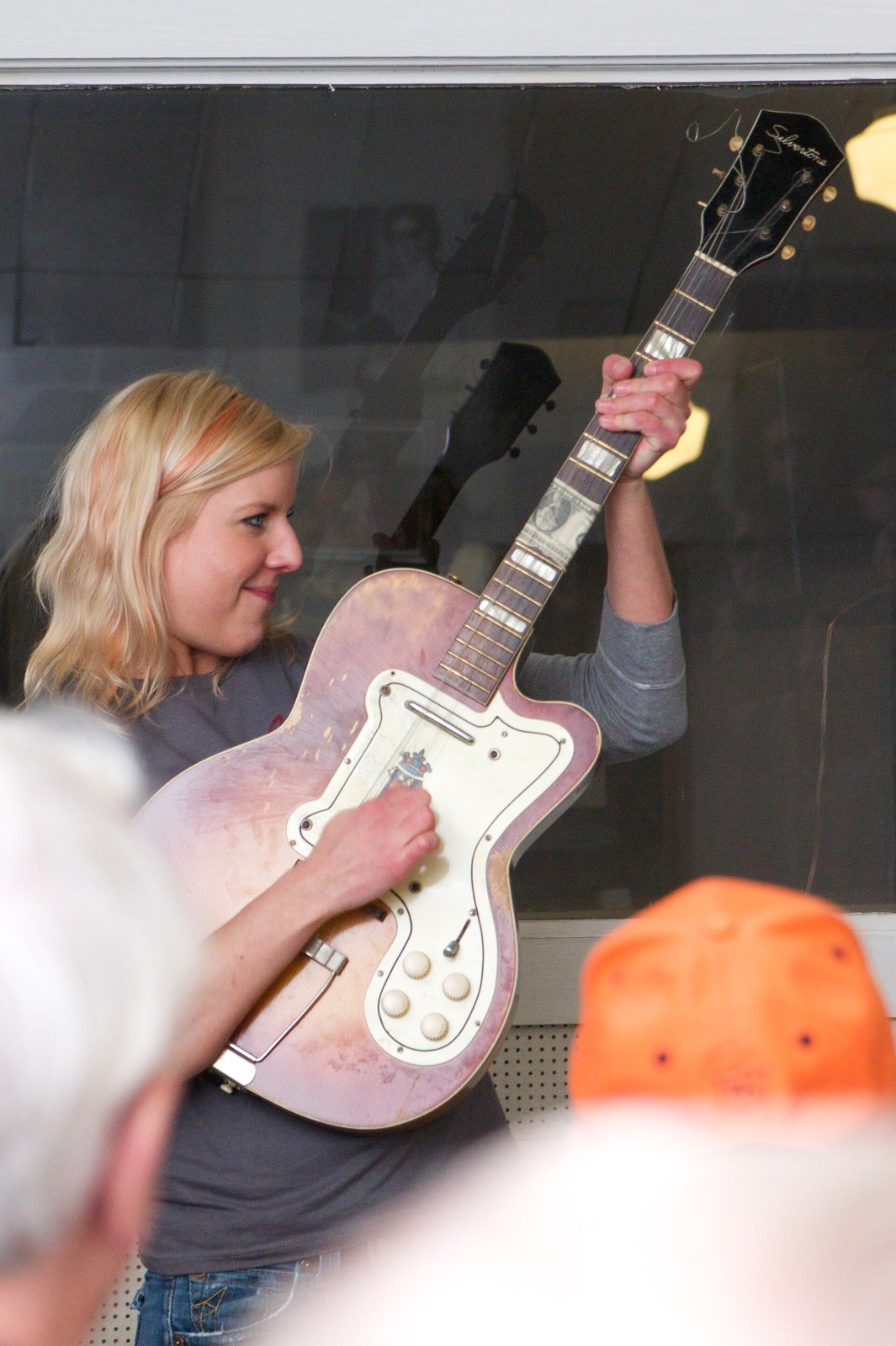
Photo: H. Michael Miley / Wikimedia Commons / CC BY-SA 2.0 Kay
Thin Twin
1952
Kay gave it a catalog number. Chicago blues gave it a name: the Jimmy Reed.
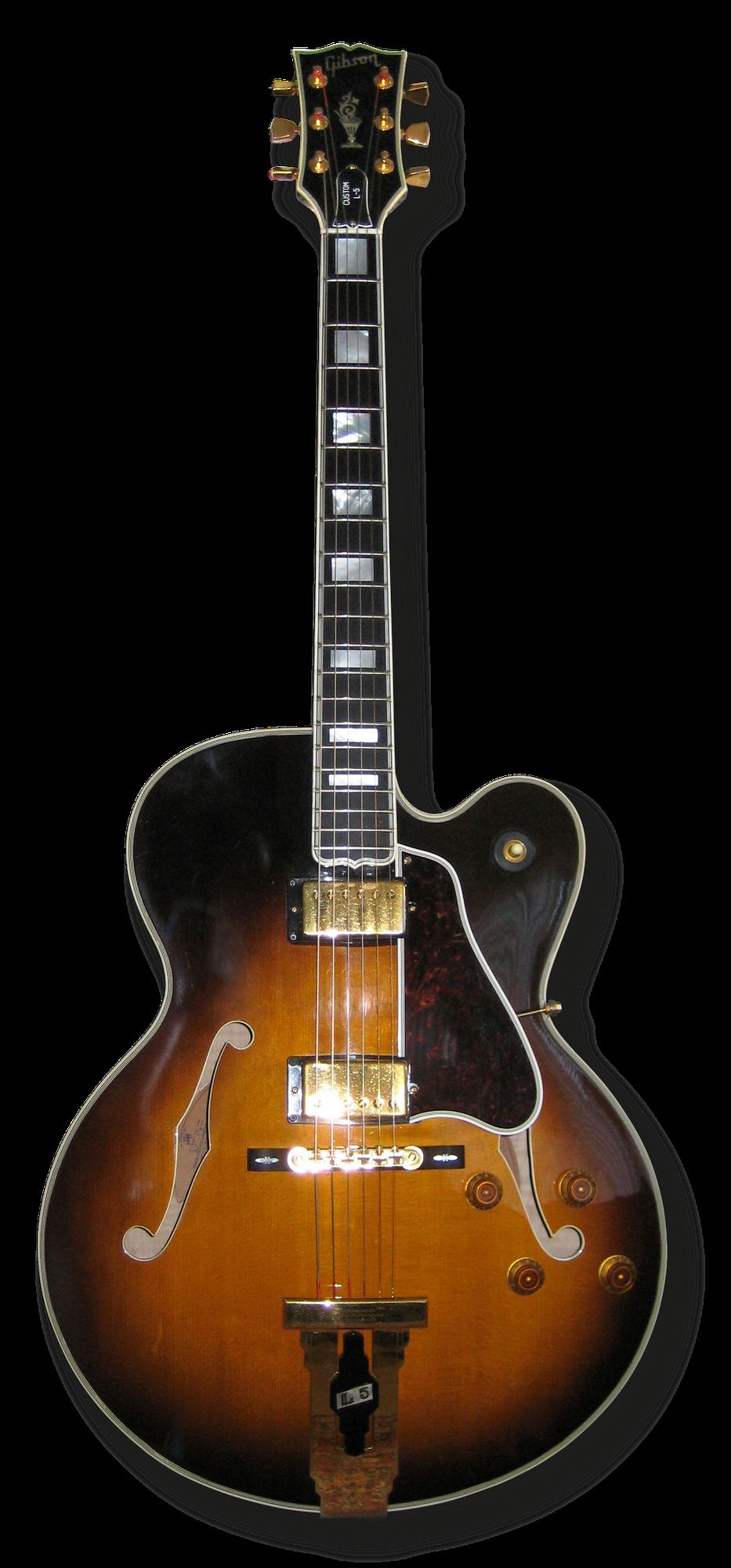
Gibson L-5 CES Tobacco Burst. Photo by Cruciniacus; isolated background by Auge=mit. Licensed under CC BY-SA 3.0. Via Wikimedia Commons. Gibson
L-5 CES
1951
In the ’50s Gibson shipped a few dozen a year. Wes Montgomery and Scotty Moore made them count.
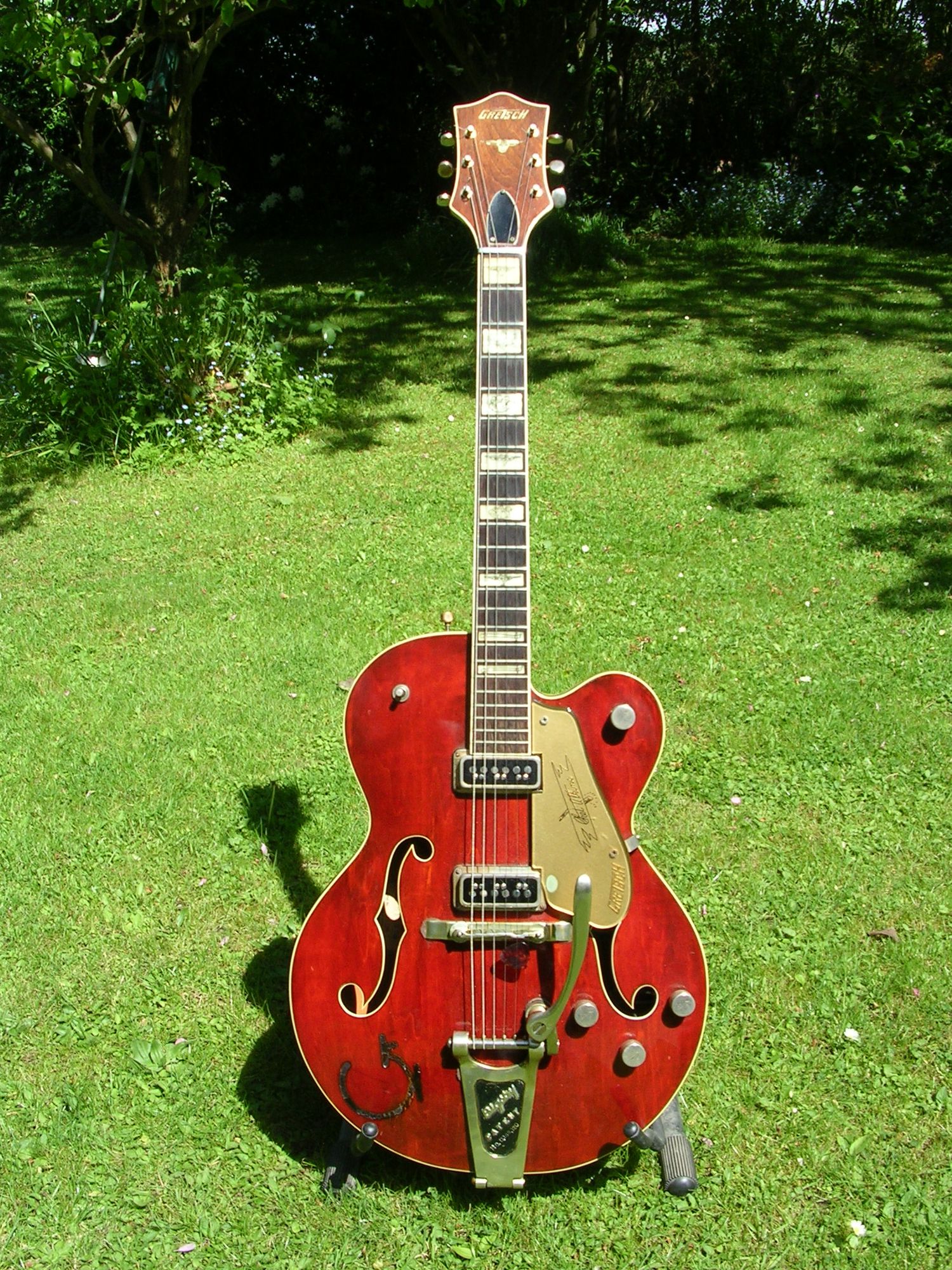
Gretsch 6120 G-Brand 1955. Photo by Francis pullen. Public domain (PD-self). Via Wikimedia Commons. Gretsch
6120
1955
Joe Walsh gave Pete Townshend one. Steve Miller gave Brian Setzer one. Chet Atkins just lent it his name.