Stromberg
Master 400
Nineteen inches across, so the guitar player nobody watched could still be heard over the horns.
A father and son in Boston, who mostly made drums and banjos, built an archtop wider than Gibson’s biggest for the man in the back row of the band. They made it until both of them died in the autumn of 1955, a few weeks apart.
- Introduced
- 1937
- Type
- Archtop acoustic
- Class
- Closed run
Have a photograph of this guitar? Send a picture
The short version
1906
Charles A. Stromberg & Son
Charles Stromberg opens his shop in Boston. Elmer joins in 1910, and the name stays singular.
1927
The first guitars
Sixteen-inch G-1 and G-2 models, mostly Elmer’s work, in a shop still living on drums and banjos.
1937
The Master 400
The 19-inch Master 400 arrives with its plainer sister, the Master 300. Some accounts say 1937 or 1938.
c. 1940
One diagonal brace
Carved, graduated tops and a single diagonal brace on the top models, by one account. Another puts the brace in from the start.
1940
Fred Guy’s blonde
Duke Ellington’s guitarist gets a 19-inch blonde Master 400. It is his main guitar through the 1940s.
1940
The photograph
On 28 October Freddie Green is photographed at a Benny Goodman rehearsal in New York with a blonde Master 400.
1955
Six weeks
Charles dies on 29 September. Elmer dies less than six weeks later, and the shop closes.
2025
The name comes back
A limited Master 300 and Master 400 are built in the Czech Republic. Not a Boston guitar.
Side A
A1
The man in the back row
Early in 1940, Fred Guy got a new guitar. Guy played rhythm in Duke Ellington’s orchestra, which is a job where you are felt more than heard. You sit behind the horns and play four chords to the bar, all night, so the band has a floor to stand on.
The guitar was a blonde Stromberg Master 400, nineteen inches across the lower bout. At the 15th fret it carried his initials, F. L. G., for Frederick Lee Guy. It was his main guitar with Ellington through the 1940s, and in 1968, when a magazine sat him down for an interview, he still had it.
Nineteen inches is enormous. That was the point.
A2
Drums and banjos paid the rent
Charles Stromberg learned his trade at Thompson & Odell and opened his own shop in Boston in 1906: Charles A. Stromberg & Son. His son Elmer joined in 1910.
It was not a guitar shop, mostly. By the end of 1933 it had turned out roughly a thousand banjos, four hundred drums, two hundred mandolins, and about a hundred guitars. The guitars started in 1927, sixteen-inch models, mostly Elmer’s work. The shop was at 41 Hanover Street.
A3
The arms race
Through the 1930s, a guitar in a swing band had one problem: it vanished under the brass.
The big makers answered with size. Gibson took the L-5 to seventeen inches in 1934, then the Super 400 to eighteen. Epiphone’s Emperor went a little past that, to eighteen and three-eighths or eighteen and a half, depending on who measured. The Strombergs widened their own guitars, put maple on the back, and carved the spruce.
Then, in 1937, or maybe 1938, they went to nineteen inches and stopped there. The Master 400 was the fancy one, gold hardware and split-block pearl in an ebony board. The Master 300 was its plainer sister at the same width. Neither had a cutaway. You don’t need to reach the top frets when your job is the chord at the bottom.
Flip the record · By the numbers
19"
Across the lower bout, wider than Gibson’s Super 400 and Epiphone’s Emperor.
~640
Stromberg guitars of every model, ever. The counts don’t agree, and none of them is just Master 400s.
$420
A natural finish, quoted in a letter from the shop. The case was another $60. The year isn’t on it.
18½"
The cutaway version. Seven were made, or fewer than ten, depending who you ask.
Side B
B1
One brace, two stories
Inside, the Master 400 is a small argument.
One account has the shop putting a single diagonal brace under the top from the very first Masters, when everyone else was using an X or two parallel bars. A later account, with the serial numbers in hand, says the early tops were pressed and braced with parallel bars, and the diagonal arrived around 1940 along with carved, graduated tops. Both come from the same historian. Keep both.
The backs won’t settle either. Some are carved maple, some laminated, and the laminated ones keep turning up in the same years as the carved ones. There was also a cutaway, at eighteen and a half inches. One writer, with a 1953 cutaway in front of him, says Stromberg made seven. A dealer selling another says fewer than ten. It was a fraction of the run, whichever it was.
Stromberg only ever made seven cutaways.
B2
Whose guitar is in the photograph
Freddie Green played rhythm for Count Basie from 1937, and he is the man most people picture behind a Stromberg. Mostly, it was a Master 300. A sunburst 300 from 1939 was his everyday guitar until about 1955.
The Master 400 drifts in and out. On 28 October 1940, at a Benny Goodman rehearsal in New York, with Basie, Lester Young, Buck Clayton and Charlie Christian in the room, Green is photographed holding a blonde Master 400. Fred Guy was in Chicago that day, so it wasn’t Guy’s. Probably a trial, or a loaner. Where it went is anyone’s guess. Then there’s a later account that in the late 1940s Green put a DeArmond pickup on “his large Stromberg Master 400,” and that when the guitar got too valuable to take on the road he switched to a Gretsch.
Irving Ashby had one built for him, around 1939 to 1941, and played with Lionel Hampton and then Nat King Cole. That one is in the Smithsonian. Oscar Moore owned one built around 1947. Hank Garland is said to have had one, though another account puts him on the smaller G-5.
No record by any of them is pinned to a Master 400. That’s rhythm guitar for you. It’s on everything, and nobody writes it down.
B3
Six weeks in 1955
Charles Stromberg died on 29 September 1955, at 89. Elmer died less than six weeks later, at 60, with a G-5 left unfinished. The shop closed.
In all those years it made somewhere around six hundred and forty guitars, every model counted. From 1940 to 1955, about a hundred and fifty. Not many were Masters, and nobody published how many.
Fred Guy died in 1971. When Freddie Green died in 1987, there was a Master 400 among the guitars he left. It was number 499: a blonde, with another rhythm player’s initials still at the 15th fret.
The cast
The people, and the specific guitars, that made the legend.
1940
Fred Guy
A blonde 19-inch Master 400, number 499
His main guitar with Duke Ellington through the 1940s, his initials at the 15th fret. Still his in 1968.
1940
Freddie Green
A Master 300 day to day; a Master 400 at times
Photographed with a blonde Master 400 in 1940, likely a trial or a loaner. Put a DeArmond on a Master 400 in the late 1940s, by one account.
1940
Irving Ashby
A custom Master 400, about 1939–1941
Played with Lionel Hampton, then Nat King Cole. The guitar is in the Smithsonian.
1947
Oscar Moore
A natural Master 400, about 1947
Formerly owned and used by him, then by R. C. Allen.
1950
Hank Garland
A Stromberg, model in dispute
One account gives him a 1950 blonde Master 400. Another lists him among G-5 players. No session is pinned to it.
Liner notes
Specs, construction, rarity, value, and every source we used.
Nineteen inches across, built in Boston so a rhythm guitar could answer a horn section — the Master 400, not Gibson’s Super 400 and not a Chicago Stromberg-Voisinet.
- Body
- Non-cutaway archtop, fully hollow. Gruhn: 19" lower bout. Blue Book description: 19 in. wide × 21.75 in. long; carved graduated spruce, .875 in. thick in that writeup. National Music Museum serial 571 (1946), one guitar: lower bout 485 mm (19-1/8"), back 554 mm (21-13/16"), ribs 88–90 mm (3-7/16" at the waist to 3-9/16" at the heel; end block 3-1/2"). Mix flagged. Do not average 19" with 19-1/8", or 21.75" with 21-13/16". Do not invent millimetres for 19", 21.75", or .875". Cutaway Master 400s are 18½" (Gruhn). Not this row.
- Neck
- Maple. Blue Book description: five-piece rock maple, ivoroid binding on the board. Davidson, probable 1946: maple laminate, two mahogany stripes. His 1953 cutaway: laminated maple, very full. Not one cell. Gruhn: adjustable truss, the nut under a removable bone string nut, with the diagonal-brace change.
- Fingerboard
- Ebony, pointed end, split-block pearl. Blue Book: three-segment blocks. No factory fret count in the sources used here.
- Scale
- No factory scale. NMM 571, one guitar, nut to bridge: high E 646 mm (25-7/16"), low E 650 mm (25-19/32"). Do not average the two strings. Do not call that 25½".
- Pickups
- None as built. A DeArmond is a later add.
- Hardware
- Gold. Five-cutout “Y” tailpiece, Stromberg engraving (Blue Book; Freddie Green site). Adjustable compensating rosewood bridge (Blue Book). Tortoiseshell-style guard, black-and-white ivoroid border.
- Electronics
- None.
- Finish
- Sunburst or natural.
- Nut
- Bone where Gruhn puts the truss adjustment under a removable bone string nut. Width is not a factory cell. NMM 571: 44 mm (1-21/32"). GuitarPoint’s one 1952 cutaway: 43.27 mm / 1.70". Mix flagged. Do not average. A cutaway nut is not this row.
Open the full research fileConstruction details, the complete player record, production numbers, dated value estimates, and sources
Classic living example = the non-cutaway Boston Master 400. Master 300 is the plainer 19-inch sister. G-5 is the 1950s 17-inch short-scale cutaway. A cutaway Master 400 is 18½". The 2025 Czech guitar is another factory. Stromberg-Voisinet of Chicago became Kay, not this shop. No Gibson SKUs. Standalone. Mixed inch/mm flagged. Blue Book’s structured fields say bolt-on and a rosewood body; they contradict its own description and are not used.
Construction
The job was to be heard. A guitar in a swing band disappeared under the horns. Gibson took the L-5 to 17 inches, then the Super 400 to 18. Epiphone’s Emperor went wider — the Music Museum of New England says 18½ inches; Gruhn and Carter, in Vintage Guitar’s Super 400 piece, say 18⅜. Keep both. Boston’s answer was 19 inches, and no cutaway.
Not the Chicago name. Stromberg-Voisinet is Kay’s ancestor (kay-thin-twin). Charles Stromberg learned the bench at Thompson & Odell and opened Charles A. Stromberg & Son in Boston in 1906. The singular stayed. Elmer joined in 1910. Harry left in 1927. Drums and banjos paid the rent. The guitar-era shop is 41 Hanover Street (MMONE).
Wikipedia and MMONE date the first guitars to 1927: 16-inch G-1 and G-2, mostly Elmer’s. Burrluck’s 2025 review says carved tops “possibly as early as 1927.” That year is not a Master 400. Ayars, via MMONE: by the end of 1933 the shop had roughly 1,000 banjos, 400 drums, 200 mandolins, and about 100 guitars.
Then the bodies grew. After the 17-inch L-5 (1934) and Epiphone’s Deluxe at 17⅜ (1935), Stromberg widened the G models, put maple on the back, and carved the spruce (MMONE). The 19-inch pair is next. Wikipedia and MMONE: Master 400, and the plainer Master 300, in 1937. Gruhn and Carter, Vintage Guitar, October 2009: 1937 or 1938. YAML introduced: 1937 is the year two of those accounts print as a single date. The “or 1938” stays. No separate prototype year is documented here.
The brace is Gruhn against Gruhn. The 2009 article, and MMONE after it, put a single diagonal bar on the Masters at that introduction, against everyone else’s X or double tone-bar. The December 2004 Master 400 article is later, and it has serials. Early Strombergs there: pressed tops, two parallel braces, cross braces, laminated backs and sides, three-piece f-holes. About 1940 the tops are carved and graduated, the f-holes are one piece, and the top models take one diagonal. Earliest he names: Master 300 497. Master 400 498, natural. 500, another 400. 501, a 300. A Master 300 in the mid-480s still has parallel braces. Blue Book’s description matches 2004: diagonal “began about 1940.” Keep both dates. The National Music Museum’s card for serial 571 says “spruce bassbar.” That is their word. Do not silently make it Gruhn’s diagonal.
Serial 503 is the guitar he calls typical of that moment: 19 inches, carved top, one diagonal, one-piece f-holes, pearl on the peghead instead of the engraved celluloid veneer used before and after. The pearl head was brief. 498 and 503 still have laminated backs. Carved backs start during or not long after 1940, and laminated backs keep turning up almost at random. The Freddie Green site’s “carved maple back,” and Davidson’s figured maple on the 1953 cutaway, are one practice. Laminated is the other. Same years.
The neck turns on the same hinge. Truss rod under a removable bone string nut (Gruhn, 2004). Blue Book: five-piece rock maple. Davidson’s probable 1946: maple laminate, two mahogany stripes, a veneer overlay rather than a painted stinger. The 1953 cutaway: laminated maple again. Do not average those sticks.
A cutaway is a different width. Gruhn: cutaway Master 400s are 18½"; the non-cutaway is 19". Only a fraction of the 300s and 400s were cutaways. Davidson, 5 October 2026, on a 1953 Master 400C: “Stromberg only ever made seven cutaways.” GuitarPoint’s 1952 blonde, from the Chinery collection: “less than 10.” Keep seven, less than 10, and a fraction. Wikipedia’s pre-war cutaways, “most notably the G-5,” do not move the G-5. Gruhn and MMONE put that model in the 1950s — MMONE says 1952, 17", scale 23½", list $315, “no more than a dozen.” Other guitar.
Charles died 29 September 1955 (Nick Rossi). Elmer died less than six weeks later. MMONE: Charles was 89, Elmer 60, one G-5 left unfinished. Gruhn: within a few months, and about 150 guitars of every model across 1940–55. Not 150 Master 400s. The shop closed.
The name came back without the shop. Early 2000s: Larry Davis sold Korean guitars around $1,200 — Newport, Montreux, Monterey — which MMONE says are not copies of the Boston models (Jazz Times, July 2003). 2025: Aurora Music Works, in Switzerland, a limited Czech-built Master 300 and Master 400 (Burrluck, 21 April 2025; Aurora, 27 April 2025). The site’s Master 400 Cutaway is $6,999, sold out, inventory on the way: nickel hardware, and “single transverse” bracing with X also offered. Not a gold Y tail, and not a claim that transverse means Gruhn’s diagonal. Mak’s sold-out full-body sample is £3,999, 19" × 3 5/8", X-braced, titled Antique Natural and specced Vintage Sunburst on the same page.
Not a Super 400 (gibson-super-400). Not a New Yorker (dangelico-new-yorker). Not a Master 300, which is the Stromberg Rossi has Freddie Green playing day to day. Not a G-5. Not Stromberg-Voisinet. No Gibson SKUs.
Players
Do not put the 1939 sunburst Master 300, Guy’s serial 499, the 28 October 1940 photograph, a G-5, a Gretsch Eldorado, an Emperor, or a D’Angelico Excel on the same guitar. Chicago’s Stromberg-Voisinet is a different company.
Fred Guy — blonde Master 400, serial 499. Rossi (December 2020, revised 6 April 2022): early 1940, a 19" blonde, his main guitar with Ellington through the 1940s. Still his for a Down Beat profile published April 1969 from a May 1968 interview. F. L. G. at the 15th fret is Frederick Lee Guy. A 1947 Ellington tour manifest matches 499. A circa-1938 Levin stayed the backup. The manifest is a packing list. No Ellington side is pinned here.
Freddie Green — three accounts. He joined Basie in 1937 (Jazz Journal, June 1962: March). Rossi: a 1935 Epiphone Triumph, then an Emperor, then a 1939 sunburst Master 300 as the primary from early 1939 through 1955. A March 1937 photo is a D’Angelico Excel. He parked the 300 around the Strombergs’ deaths.
The Master 400 is the other instrument, and the year will not sit still. On 28 October 1940, at a Benny Goodman rehearsal in New York — Basie, Lester Young, Buck Clayton, Charlie Christian — he is photographed with a 19" blonde Master 400. Guy was in Chicago. Rossi: not Guy’s guitar; likely a trial or a loaner; where it went is open. Ashby, Guitar Player, September 1974, via Rossi, remembered readying three instruments for Green. Not three Master 400s.
Burrluck, 21 April 2025, compresses it: pictured with a blonde Master 400 by late 1940, and he “only stopped using” it in the late ’50s. Jim Ferguson, Guitar Player, August 1987, citing Al Green: in the late 1940s Freddie put a DeArmond on “his large Stromberg Master 400,” into a Gibson amp that then gathered dust, and when the Stromberg was too valuable to tour he moved to a blonde Gretsch Eldorado. A thesis on the Freddie Green site, citing “Photos of Guitars,” lists three instruments at his death in 1987: Gretsch El Dorado 6041, a Master 400, and a Master 300. Rossi’s estate Master 400 is 499, Guy’s, acquired sometime after May 1968. Guy died 22 November 1971. The family could not date the handoff. Keep the 1940 photograph, Ferguson’s late-1940s DeArmond guitar, and post-1968 499. No Basie side is pinned to a Master 400 here. The Gretsch is the later road guitar.
Irving Ashby — serial 507. Smithsonian: Charles A. Stromberg and Son, about 1939–1941, custom for Ashby, gift of Pauline Randolph Ashby. Overall 43¼ × 19 × 4½ in (109.855 × 48.26 × 11.43 cm). That 19 inches is the museum’s overall dimension, not Gruhn’s lower bout and not the NMM’s 19-1/8". Not on view. Hampton, then Nat King Cole. The label names the career, not a Cole side. Not Guy’s blonde. Not the 300.
Hank Garland — model contested. Davidson, 5 October 2026, has “Hank Garland’s Master 400” beside the 1953 cutaway. Norman’s, a Reverb listing ended about eleven years before this pass: a 1950 blonde “that belonged to Hank Garland,” signed, ask $45,000. MMONE puts Garland with the players of a G-5. Keep both. No session is pinned.
Oscar Moore. Gruhn AR4467, a c. 1947 natural, sold: “formerly owned and used by Oscar Moore and later by R. C. Allen.” No price on the page. No Cole record named. Not Ashby’s 507.
Also known stays short. MMONE’s shop list — Almeida, Osborne, Rizzi, Krolewicz, Galbraith — is Stromberg players. Galbraith and Rizzi are in the G-5 sentence. The site’s “said to have complained about the price” is a hedge, not a quote from Green.
Rarity
You cannot order a Master 400 from Hanover Street. Both men were dead before the end of 1955. A Czech Master 400 with a choice of braces does not restock a non-cutaway original. A Korean Newport is not this model.
No Master 400 total was published. None invented. Gruhn: almost no written records. That is why a first-year count is unknown.
The company figures that do exist do not agree, and none of them is this model. Wikipedia, MMONE, and the Freddie Green site: about 640 guitars. Smithsonian’s Ashby label: about 600. Gruhn, 2004: serials from about 300 to 636. Davidson, 2024: up to 686, from around 300. Burrluck, 2025: some 636. Ayars: about 100 guitars by the end of 1933, before this model. Gruhn and Davidson: about 150 guitars of every model in 1940–55, and few of those were a 300 or a 400. Do not subtract 300 from either ceiling.
Thinner than that: a 19-inch non-cutaway with the diagonal and a carved back; an 18½-inch cutaway; Guy’s 499; Ashby’s 507. A laminated back from the same year is not a second model. A 2025 Czech guitar is not in the count.
Value
Informal estimate, 23 October 2026. Not an appraisal.
Asks are not hammers. Artist guitars are not comps. A Master 300, a G-5, a Super 400, a New Yorker, and a Czech copy are not this market. No invented medians.
Historical list, not 2026 street. A Stromberg letter, quoted by Davidson (5 October 2026): natural finish $420, case $60. The correspondence also has a Master 400 and a cutaway on display, and a promise that a Master 400 would be ready “one week from next Saturday, June 6th.” The year of that Saturday is not in the extract. The Freddie Green site only says he was “said to have complained about the price.”
New street. None from Charles and Elmer. Revival prices, and they do not match. stromberg-guitars.com Master 400 Cutaway: $6,999, sold out, inventory on the way. Aurora, 27 April 2025: around £8,000. Your Next Guitar, 9 February 2026: £4,999. Mak’s sample: £3,999, sold out. Burrluck: “a hair under eight grand,” Master 300 at £6,999. Do not average dollars and pounds. Korean WD Music at about $1,200 was other models.
Used modern. No sold band on the Czech Master 400 this pass. Hanover Street series names — Newport, Monterey, Montreux, Fremont — are the cheaper new line, from £2k in Burrluck and £1,999 on Your Next Guitar. Not a used Boston 400.
Vintage / collectible. No Reverb Price Guide median this pass. Flag: thin sold-comp access. Named asks. GuitarPoint, in stock: 1952 blonde cutaway, Chinery, DeArmond added, €65,000. Prose says serial 563; the spec glance says 623. Lark Street via Gbase: 1946 blonde, ask $35,000, “down from $50,000.” Ended Reverb asks: a 1940 sunburst at $36,838.06, the seller saying serial 496 with a diagonal brace; another 1940 sunburst, new price $29,950, listed eight years ago. Gruhn’s earliest diagonal 400 is 498. The seller’s 496 stays the seller’s. Do not average any of those with the euro ask.
Davidson, same October 2026 piece: cutaways “at one time” around $100,000, and someone might spend $50,000 commissioning a copy “but for the same money, they could buy the real thing.” His sentence, not a tape, and not the tag on the 1953 in the room. MMONE, citing Guitar Muse: Strombergs in general, $16,000–$20,000. Every model. Not a Master 400 band.
Artist-owned, not a comps tape. MMONE: Gruhn’s 2013 ask on the Master 400 Freddie Green owned, F.L.G. in the marker, was $90,000. Not a hammer. Norman’s $45,000 Garland ask is an ended listing. Gruhn’s archive card for a modified c. 1940, offered at $22,500 and marked sold, prints no hammer.
See also
- gibson-super-400 — Kalamazoo’s 18-inch carved flagship, the width this Boston guitar went past; later a factory electric
- dangelico-new-yorker — Kenmare’s 18-inch carved flagship; one bench, not Elmer’s
- kay-thin-twin — Chicago Kay; Stromberg-Voisinet in that file is Kay’s ancestor, not Charles and Elmer
Sources
- Vintage Guitar, George Gruhn, Stromberg Master 400 (December 2004) — 19" non-cutaway; cutaway 18½"; diagonal from about 1940; serials 497–503; laminated backs after; truss under a bone nut; serials about 300 to 636; about 150 guitars 1940–55; few were 300/400
- Vintage Guitar, Gruhn and Carter, Stromberg G-5 (October 2009) — 19" Masters in 1937 or 1938, diagonal bar introduced with them; G-5 is the later 17" / 23½" / $315 cutaway
- Vintage Guitar, Gruhn and Carter, Gibson Super 400 — Emperor at 18⅜" in that account; Stromberg’s 19" top model named Master 400
- Wikipedia, Stromberg Guitars — 1906; Elmer 1910; first guitars 1927; Master 300 and 400 in 1937 at 19"; about 640; both deaths in 1955
- Music Museum of New England, Charles A. Stromberg & Son (29 August 2025) — 41 Hanover Street; 1937; Ayars’s 1933 counts; Ashby at the Smithsonian; G-5 in 1952, no more than a dozen; 2013 Gruhn ask $90,000; Korean line about $1,200; Guitar Muse $16,000–$20,000 for Strombergs generally
- Smithsonian, guitar used by Irving Ashby — Master 400 serial 507, about 1939–1941; overall 43¼ × 19 × 4½ in
- National Music Museum, eMuseum 17871 — 1946 Master 400 serial 571; 485 mm (19-1/8") lower bout; scales 646 mm and 650 mm; nut 44 mm; “spruce bassbar”
- Blue Book of Guitar Values, Master 400 description — 19 × 21.75 in; spruce .875 in; five-piece maple; diagonal from about 1940; five-cutout Y tail. Structured bolt-on / rosewood fields are not used
- Freddie Green site, Nick Rossi (December 2020; revised 6 April 2022) — Guy’s 1940 serial 499; Green’s primary was a 1939 Master 300 through 1955; 28 October 1940 is a different blonde; 499 reaches Green after May 1968; Charles died 29 September 1955
- Freddie Green site, guitars he played — most often a Master 300 in the 1940s–50s; Master 400 feature list; price complaint as “said to”; later Gretsch; about 640
- Guitar Player, Jim Ferguson (August 1987), via freddiegreen.org — late-1940s DeArmond on his Master 400; then a blonde Gretsch Eldorado
- Jazz Journal (June 1962), via freddiegreen.org — joined Basie March 1937
- Butterman thesis, via freddiegreen.org — at death in 1987, citing “Photos of Guitars”: Gretsch El Dorado 6041, Master 400, Master 300
- Guitar World, Dave Burrluck (21 April 2025) — Czech revival; under eight grand; Master 300 £6,999; some 636 guitars; late-1940 blonde compressed through the late ’50s
- Guitar World, David Davidson (20 April 2024) — serials to 686; about 150 in 1940–55; probable 1946 neck; “trombone cutters”
- Guitar World, Dave Davidson (5 October 2026) — 1953 Master 400C; seven cutaways; Garland’s Master 400; $420 plus $60 case; cutaways once around $100,000; $50,000 commission against “the real thing”
- Aurora Music Works (27 April 2025) — Czech Republic; around £8,000
- stromberg-guitars.com, Master 400 Cutaway — $6,999; sold out; nickel; single transverse or X
- Mak’s Guitars, full-body sample — £3,999 sold out; 19" × 3 5/8"; X-brace; title and finish line disagree
- Your Next Guitar (9 February 2026) — UK cutaway £4,999; Hanover models £1,999
- GuitarPoint, 1952 cutaway — €65,000; serial printed 563 and 623; nut 43.27 mm / 1.70"; “less than 10”
- Gruhn AR4467, c. 1947 — sold; Oscar Moore, then R. C. Allen; no price
- Gruhn archive AR3737, c. 1940 — offered at $22,500; marked sold; no hammer; de-electrified
- Lark Street / Gbase, 1946 blonde — ask $35,000, down from $50,000
- Reverb, ended 1940 ask, seller serial 496 — $36,838.06
- Reverb, ended 1940 sunburst — new price $29,950; listed eight years ago
- Reverb, Norman’s, Garland 1950 blonde — ended ask $45,000
Keep digging
Guitars this one gets compared to, confused with, or descended from.
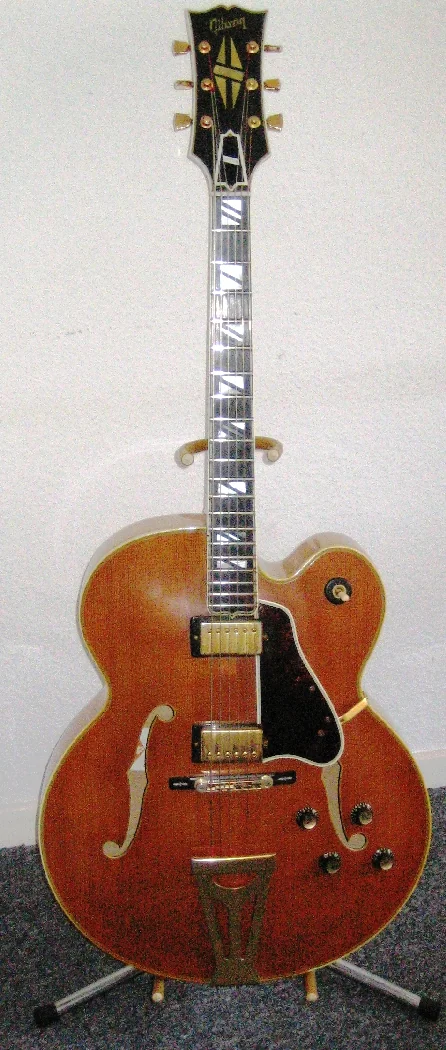
Photo: Cuetty / Clusternote / Wikimedia Commons / CC BY-SA 3.0 Gibson
Super 400
1934
Gibson priced it at $400 in the middle of the Depression and put the price right in the name.
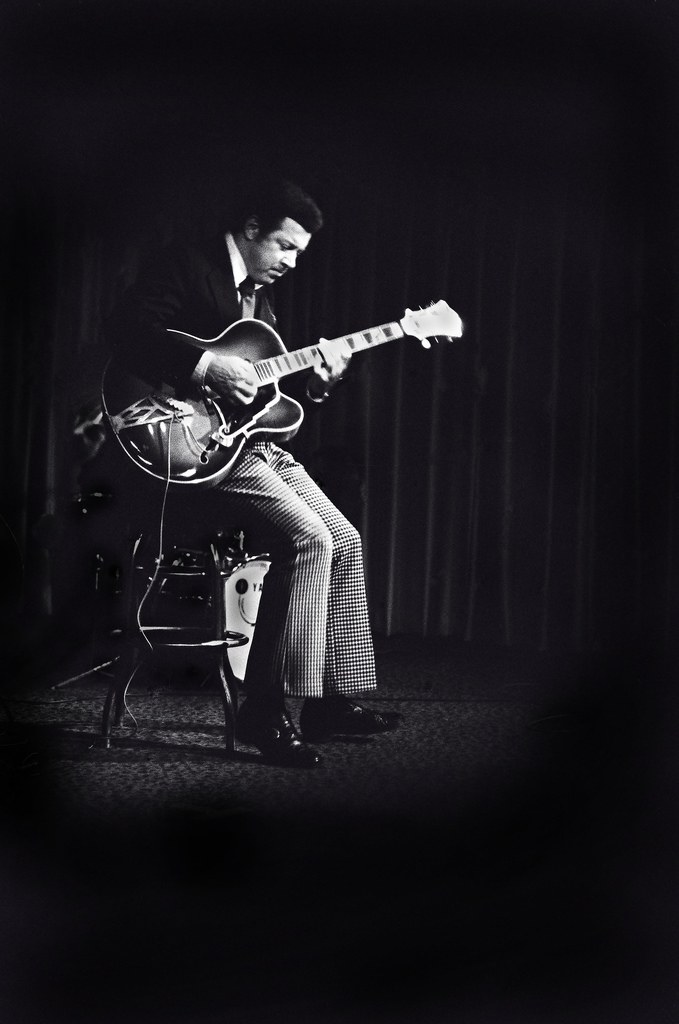
Photo: Tom Marcello / Wikimedia Commons / CC BY-SA 2.0 D'Angelico
New Yorker
1936
One man carved them by hand on Kenmare Street. When he died in 1964, the name kept going. The guitar didn’t.
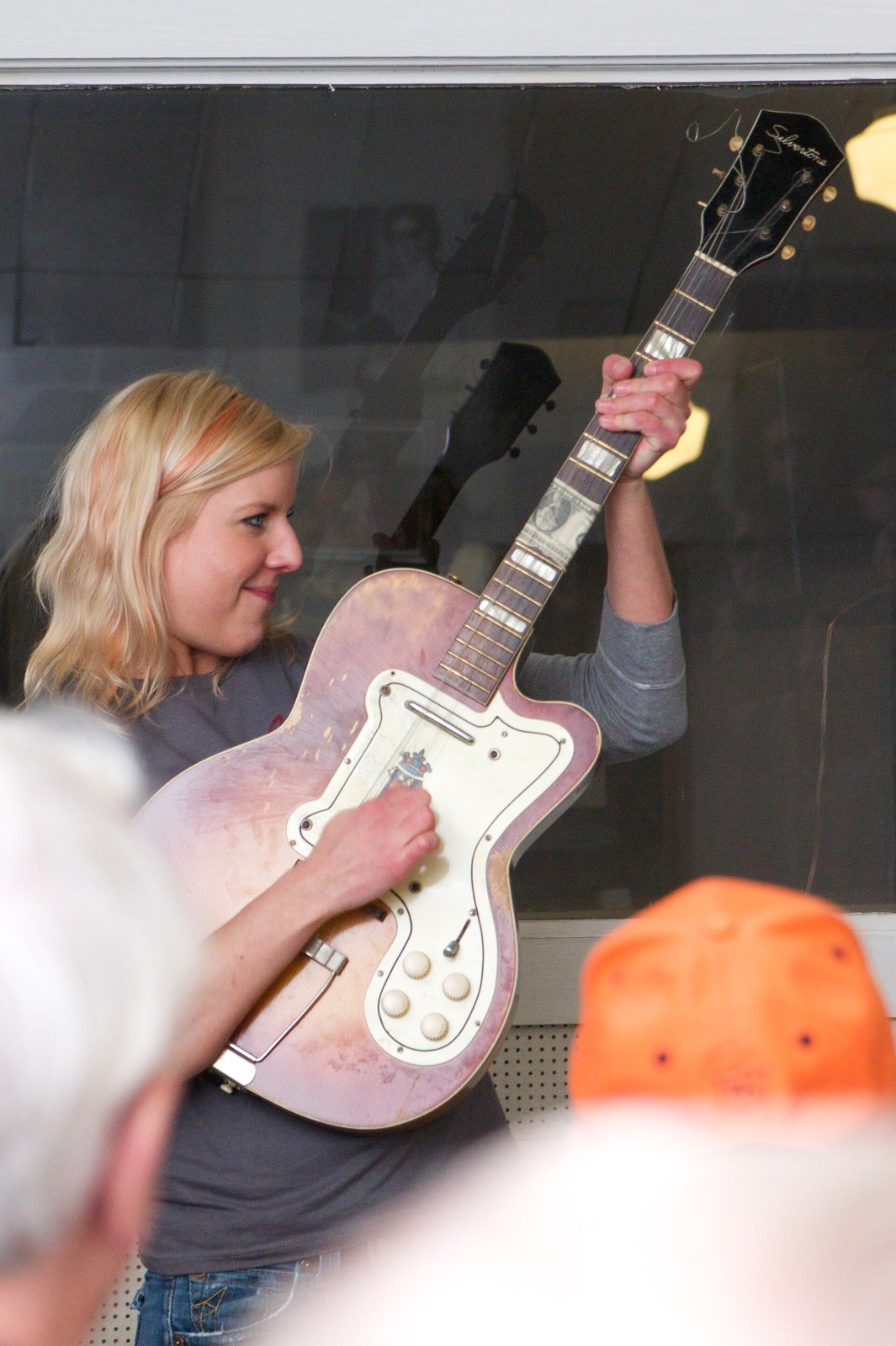
Photo: H. Michael Miley / Wikimedia Commons / CC BY-SA 2.0 Kay
Thin Twin
1952
Kay gave it a catalog number. Chicago blues gave it a name: the Jimmy Reed.