Manzer
Pikasso
Pat Metheny asked for as many strings as possible. Linda Manzer stopped at forty-two.
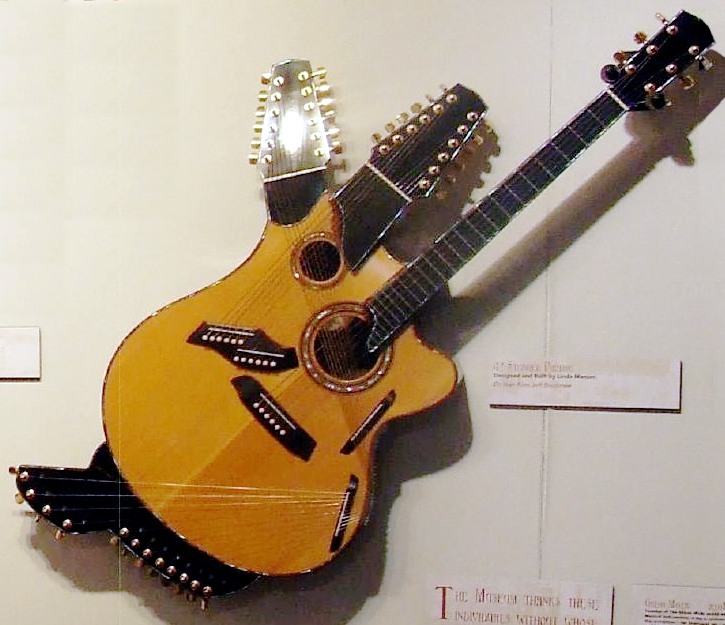
Four necks, two soundholes, and strings that cross each other on the way to the bridge. Linda Manzer built the Pikasso in Toronto for Pat Metheny in 1984, and he is still taking it on tour. It is not a Gibson harp guitar, and there is no catalog version to order.
- Introduced
- 1984
- Type
- Acoustic harp guitar (multi-neck)
- Class
- Closed run
The short version
1974
Larrivée's shop
Manzer talks Jean Larrivée into an apprenticeship and stays three and a half years.
1978–79
Backstage in Toronto
She meets Metheny after a concert, then shows him two guitars in a hotel room. He orders one.
1983–84
As many strings as possible
Metheny asks for the guitar. She starts drawing, and the drawing takes four months.
1984
The Wedge
To let him see the strings, she tapers the body, a shape she'll later put on her smaller guitars.
1992
A second one
Collector Scott Chinery asks for a strictly acoustic copy. Pikasso II is finished in 1995.
1997
Into the Dream
Metheny records a solo piece on the Pikasso alone, with no overdubs, for Imaginary Day.
2023
Still on the road
His tech says it's on the solo tour, and that tuning it in a hurry takes just under ten minutes.
Side A
A1
Two guitars in a hotel room
Toronto, 1978 or '79. Linda Manzer has just watched Pat Metheny play, and she has a note to get backstage.
She's a few years out of Jean Larrivée's shop. She got into building because she wanted a dulcimer like Joni Mitchell's and couldn't afford one, so she bought a kit, then went to art college and spent her time in the wood shop. In 1974 she talked Larrivée into taking her on, and stayed three and a half years. Gordon Lightfoot bought one of her early guitars through a store.
She showed Metheny two guitars in a hotel. He ordered something that combined them, and she delivered it in two months. That started a run of instruments she eventually stopped counting, somewhere around twenty-five.
Then, as she tells it, he asked a question in his Boston office: "How many strings can you put on a guitar?"
A2
The windmill
Her first drawing had all the strings running parallel. He said no. He wanted them all over the place, and he made a windmill with his hands to show her.
She drew for four months.
What came out of it is a flattop with four necks, two soundholes, and forty-two strings, some of them crossing others on their way across the top. One section is a six-string tuned "pretty standard," in the words of Metheny's tech. Around it are banks of strings he describes as "kind of a harp sound." Indian rosewood back and sides, German spruce top, mahogany necks, ebony boards and bridges. The name is Picasso's, spelled with a K.
How long it took depends on which time you hear her tell it. The year on the guitar is 1984. She has also said she started in 1983, that it was about nine months from order to delivery, that it took a year, and that it was two years and roughly a thousand hours. All of those are her.
A3
Safety glasses
Forty-two strings at pitch pull on that box with about a thousand pounds of force. The top needed new bracing, and the back and sides had to be reinforced. When the strings went on for the first time, Manzer said:
"I was terrified it was just gonna explode. I even wore safety glasses just in case."
It didn't. It weighs 14¾ pounds, and it has two access doors cut into it, because forty-two strings will need work and somebody has to reach inside. There are brass insets on the knee side so it can sit on a stand and leave both his hands free.
The other problem was that Metheny had to see what he was playing. The body was wider than any six-string she made, and he needed to look down over it. Her answer was to taper the box: thinner under his right arm, thicker on his knee, same volume of air inside, so it didn't lose any tone or volume. She called it the Wedge. It was invented for this guitar, and from the mid-eighties she started putting it on her ordinary models too.
Flip the record · By the numbers
42
Strings, on four necks
~1,000 lb
Pressure on the guitar with every string at concert pitch
14¾ lb
What it weighs
~25
Instruments Manzer had built for Metheny by 2017, by her rough count. She'd lost track.
Side B
B1
A saxophone in the guitar
Under each bridge there's a piezo pickup. On the six-string section there's also a hexaphonic pickup, one signal per string, that ran to Metheny's Synclavier. Manzer says that's how the saxophone sampling on "Mob Job," from Song X with Ornette Coleman, got triggered. That's the pickup talking to a sampler, not the Pikasso as the guitar sound on the record.
The real test is "Into the Dream," on Imaginary Day in 1997. Metheny's own notes say it's played entirely on the Pikasso, solo, no overdubs, in a tuning with the guitar strings very low and the ringing strings very high. He took it back out with Jim Hall, and again on Trio → Live. Ten years on, it shows up for a duet on "The Sound of Water," and in 2011 for "The Sound of Silence," the only track on that record not played on a baritone.
Manzer did build a second one, much later. In 1992 the collector Scott Chinery asked for a strictly acoustic copy, with no pickups at all, and she finished it in 1995. Later Pikasso-style guitars went in other directions, one with fifty-two strings and five necks, an archtop with thirty-six. The original stays Metheny's.
B2
Pretty much original
It has been around the world dozens of times. It was dropped once, and the rear peghead cracked; Manzer replaced that whole section and redesigned it a little. In one 2011 clip it's out with the top neck taken off. By 2023 his tech is counting four necks again.
"Otherwise it's pretty much original," she says, and she calls it "remarkably resilient and tough."
In 2023 it was still on Metheny's solo tour. In a hurry his tech can tune it in just under ten minutes. He'd rather have twenty.
Metheny asked his question and waved his arms around, and Manzer spent four months turning that into a drawing. Forty years later he's still playing it.
Put this on
You’ve read about it. Now hear it. Here’s what this guitar sounds like, and what to listen for.
Into the Dream
Metheny's own notes say this is played entirely on the Pikasso, no overdubs, in a special tuning with the guitar side very low and the ringing strings very high. Every sound is this guitar.
Find it on YouTube (opens in a new tab)The Sound of Water
A duet from Metheny Mehldau Quartet, and the album credits the Pikasso on this track. It's the guitar in a two-person conversation rather than a solo.
Find it on YouTube (opens in a new tab)The Sound of Silence
The opener of What's It All About. The rest of the record is baritone guitar; this one track is the Pikasso.
Find it on YouTube (opens in a new tab)As a Flower Blossoms (I Am Running to You)
The Secret Story track where the Pikasso gets its own credit. Manzer lists other songs on the album too, but this is the one the personnel sheets single out.
Find it on YouTube (opens in a new tab)
The cast
The people, and the specific guitars, that made the legend.
1984
Pat Metheny
The 1984 Pikasso, piezos and a hex pickup
Asked for it, designed it with Manzer, and has toured with it for four decades.
1984
Linda Manzer
Builder
Larrivée apprentice, and later archtops with Jimmy D'Aquisto. Built it in Toronto without a CNC machine.
2023
André Cholmondeley
Metheny's tech, keeper of the tunings
Tunes it on tour. Just under ten minutes in a rush, and he'd rather have twenty.
1992
Scott Chinery
Pikasso II, strictly acoustic
The collector who asked for the second one, finished in 1995.
Liner notes
Specs, construction, rarity, value, and every source we used.
Forty-two strings on four necks, and a wedge so he could see them — Linda Manzer’s Pikasso for Pat Metheny, not a Kalamazoo harp guitar.
- Body
- Indian rosewood back and sides, German spruce top. Two soundholes. Two access doors: one on the upper player’s side, one at the tail block (Abraham Wechter’s panel, per Manzer). The Wedge™: thinner under the arm, thicker on the knee. 6.7 kg (14 3/4 lb).
- Neck
- Four mahogany necks. Manzer’s count. Some later write-ups say three.
- Fingerboard
- Ebony, four of them, plus ebony bridges and face plates. Fret count unpublished.
- Scale
- Unpublished on Manzer’s page, in Guitar.com, and in Premier Guitar.
- Pickups
- Piezo on each bridge, Mark Herbert, Boston. Hexaphonic pickup on the six-string section for Metheny’s Synclavier. Pikasso II is strictly acoustic: no pickups on that guitar.
- Hardware
- Brass side bridges, Manzer with machinist Bruce West. Two brass insets on the treble (knee) side for a stand. Pau abalone trim; boxwood, rosewood, abalone rosette.
- Electronics
- Herbert’s piezo system plus the hexaphonic six-string feed. Synclavier sampling. No onboard controls are published.
- Finish
- No factory finish name published. The woods are the colour.
- Nut
- Unpublished.
Open the full research fileConstruction details, the complete player record, production numbers, dated value estimates, and sources
The spec above is Pat Metheny’s 1984 Pikasso (Toronto). No current model carries the name. Pikasso II is the Chinery acoustic twin: asked 1992, completed 1995 (Reverb News). Medusa (52 strings, five necks, Henrik Andersen) and the 2011 Pikasso Archtop (36 strings, Gregg Miner) are later Pikasso-type harp guitars, different instruments. Not a Gibson Style U harp guitar. Manzer gives the weight as 6.7 kg / 14 3/4 lb. Scale, nut, and fret count unpublished.
When the 42 strings are at concert pitch, Manzer puts the guitar under about 1,000 lb of pressure.
Construction
The job was a guitar with as many strings as possible. Metheny’s words. Toronto, not Kalamazoo. Not a catalog Style U, and not a six-string with a bass arm bolted on.
Linda Manzer builds in Toronto. Berklee (Spring 2017): a Joni Mitchell dulcimer she could not afford, a kit at the Folklore Centre, then art college and the wood shop. 1974, she talked Jean Larrivée into an apprenticeship and stayed three and a half years. Own shop after that. Gordon Lightfoot was an early customer, through a store. Jimmy D’Aquisto later, Long Island, archtops. Premier Guitar (Pat Smith, 17 June 2009): no CNC. The Pikasso is not her OM.
She met Metheny after a concert, 1978 or ’79 on her telling, then a note backstage in Toronto. Two guitars in a hotel. He ordered a combination. She delivered it in two months. Premier Guitar’s Signature 6 note dates that first steel six — the “Linda 6” — 1982, on “Lonely Woman” from Rejoicing. About 25 instruments for him by the Berklee interview; she had lost count. The Pikasso is one of those, not the six-string.
Sources give two starting years. Manzer’s own Pikasso page, the Wedge page, Premier Guitar, and Guitar.com (Justin Beckner, 24 May 2022): in 1984 he asked her to design and build a guitar with “as many strings as possible.” Berklee: she started it in 1983, after a conversation in his Boston office. “How many strings can you put on a guitar?” First drawing had them all parallel. He said no, all over the place, and did a windmill with his hands. Four months of drawings. “From when he ordered it to when he got it was about nine months.” Premier Guitar, in her words: it took a year. Guitar.com: a year to design and complete. Her site: two years, about 1,000 hours. 1984, the date those four sources give, is not a verdict against the 1983 start, the nine months, the year, or the two years.
She settled on 42. Four necks. Two soundholes. Strings that crisscross the top. Guitar.com: four playable sections. André Cholmondeley, Metheny’s tech, to Premier Guitar (24 November 2023) and on camera at the Sheldon: four necks. He misspoke “five” in the rundown, then corrected: “It’s FOUR necks!!!” Some later copy says three — Premier Guitar’s “Lots of Strings Attached” (10 July 2008), the Hartford Courant on the MFA show, She Shreds. Manzer prints four. André’s working tunings, not a factory chart: the six-string “pretty standard,” middle two an octave up, low strings flatwound; a D-minor bank; “a strange arpeggio”; “kind of a harp sound.” Ultimate Guitar’s 2023 write-up of that rundown treats the remaining 36 as harps in three sections that cannot be fretted. UG’s reading. Not Manzer’s spec sheet.
The body had to be wider than her six-string, and he had to see the strings from above. That is the Wedge: taper the box, keep the air, cut depth under the right arm. Tony Duggan-Smith, another Larrivée apprentice, in the room. First use 1984, on this guitar. From the mid-eighties she put it on smaller models. ASIA symposium 1989. Experimental Musical Instruments, April 1989, the interview. She noticed no change in tone or volume, because the internal air stays the same. Bruce Cockburn later traded a deep Manzer for a wedged one after a pinched nerve; that is a six-string story, not the Pikasso.
Indian rosewood, German spruce, mahogany necks, ebony. Guitar.com: the extra tension needed new bracing under the top, and the back and sides had to be reinforced. First string-up, Manzer: “terrified it was just gonna explode. I even wore safety glasses just in case.” Access doors, because 42 strings will need work. Brass insets so it can sit on a stand and leave both hands free. Herbert’s piezos, and the hexaphonic six-string feed into the Synclavier. Manzer and Premier Guitar point at saxophone sampling on “Mob Job.” That is the pickup talking to a sampler. It is not a claim that the Pikasso is the guitar voice on Song X.
Guitar.com, Manzer: “remarkably resilient and tough even with circling the globe dozens of times on tour.” Dropped once. The rear peghead cracked. She replaced that whole section and redesigned it a little. “Otherwise it’s pretty much original.” Gregg Miner, 17 March 2011: a clip of Metheny with Anna Maria Jopek, “he had the top neck removed, so it looks a bit decapitated.” André in 2023 still counts four.
Pikasso II. Scott Chinery asked in 1992 for a strictly acoustic version of Metheny’s. Reverb News (8 October 2021), on Lark Street Music’s listing: she finished it in 1995. Same woods, four necks, two holes, two doors. No Herbert piezos on Manzer’s “strictly acoustic” line. MFA Boston, Dangerous Curves: Art of the Guitar, 5 November 2000–25 February 2001. Manzer: Pikasso II was in that show. The Hartford Courant (26 January 2001) describes a three-necked, two-holed, 42-string Pikasso made for Metheny in the same exhibition. The two accounts of what was in that show differ.
Later Pikasso-types followed. Guitar.com: Medusa, 52 strings, five necks — fretted, fretless, baritone, scalloped, harp — from Henrik Andersen’s cartoon sketch. Miner, 16 August 2011, Healdsburg: a new Pikasso Archtop, 36 strings, the fourth Pikasso-type she had done and the first carved-top, Tony McManus demoing it. Those are other guitars.
Not a Gibson harp guitar. Ten unfretted sub-basses on a carved Style U, Kalamazoo, 1903 catalog. This is 42 strings, four necks, a Toronto flattop, 1984. Not a Larrivée OM-03. She learned in that shop. She did not build this there.
Metheny’s 1984 piezo Pikasso has 42 strings, four necks and the first Wedge. There is no catalog Pikasso to order. Pikasso II is the acoustic copy Chinery asked for.
Players
The Linda 6, the Manzer baritone, the Medusa, and the Style U are different guitars. Lightfoot, Cockburn, Santana, Paul Simon, and Julian Lage own other Manzers. Chinery collected Pikasso II. That is not a session.
Pat Metheny. The guitar is his. Manzer and Metheny designed it together. André, 2023: still on the solo tour; in a hurry he can tune it in just under ten minutes, and he would rather have twenty.
Song X with Ornette Coleman, recorded 12–14 December 1985, released 1986. Manzer and Premier Guitar: saxophone sampling on “Mob Job” through the hexaphonic pickup and the Synclavier. Album personnel lists guitar and guitar synthesizer. Her sampling credit is for “Mob Job,” not the rest of the date.
Secret Story (1992). Manzer lists “Finding and Believing,” “Rain River,” and “As the Blossom Flowers (I will Come to You).” Discogs and MusicBrainz isolate Pikasso guitar on “As a Flower Blossoms (I Am Running to You).” Finding and Believing and Rain River are album guitar credits, not Pikasso isolations on those two sheets. Manzer lists three; Discogs and MusicBrainz isolate one.
Pat Metheny Group, Quartet, recorded May 1996, released November 1996. Discogs and patmetheny.com: 42-string Pikasso on the album sheet. No track is isolated.
Imaginary Day, recorded spring 1997, released 7 October 1997. Metheny’s own track notes: “Into the Dream” is played entirely on the 42-string Pikasso. No overdubs. A solo. “There are no overdubs, just a solo piece.” A special tuning, guitar side very low, ringing strings very high. Discogs: Pikasso also on “A Story Within the Story,” with electric guitar. Manzer’s page dates that CD 2000. The album is 1997.
Jim Hall & Pat Metheny (1999). Personnel: 42-string Pikasso. Manzer and Premier Guitar, 2008: “Into the Dream” on that disc.
Trio → Live (2000). Personnel: 42-string Pikasso. “Into the Dream” is on the set. Manzer dates the trio disc 2001; Wikipedia gives 2000.
Metheny Mehldau Quartet (2007), from December 2005 sessions. Personnel: 42-string Pikasso on track 2, “The Sound of Water,” a duet.
What’s It All About (2011). Nonesuch and All About Jazz (John Kelman, 7 June 2011): 42-string Pikasso on “The Sound of Silence.” Baritone is the rest of that record. Not this guitar.
Manzer also lists Kenny Garrett’s Pursuance (1996), “After the Rain.” Discogs and the album sheet say guitar. Her credit, not a Pikasso isolation on that release.
Premier Guitar, 2008: seen on the Speaking of Now Live and Imaginary Day DVDs. Manzer’s page: live in Warsaw with Anna Maria Jopek. Visuals. Not a second studio log.
No other Pikasso players are named. McManus’s Healdsburg set is the archtop. Andersen is the Medusa.
Rarity
You cannot order a Pikasso from a cart. Manzer’s custom page is a conversation with her, not a SKU. The waiting list on ordinary Manzers is closed in older reports; that is not a Pikasso census.
She does not publish a Pikasso total. Lark Street, selling Pikasso II: “the only other one she has built after Pat Metheny’s.” Miner, August 2011: the new archtop was the fourth Pikasso-type harp guitar she had done. Medusa is 52 strings. The archtop is 36. Those are not a third 42-string flattop you can shop. Serials are not the story. There is no year ledger.
What is actually thinner: Metheny’s original, piezo and hexaphonic, still touring. Pikasso II, Chinery’s acoustic, MFA 2000–01, Lark Street 2021. The dropped-and-repaired rear peghead on Metheny’s. Miner’s 2011 missing-top-neck clip. Those are unique objects. They are not a used Pikasso.
Value
Informal estimate, 27 October 2026. Not an appraisal.
Prices below are asking prices unless marked sold. Celebrity instruments are not comparable sales. There is no median and no factory count. A Gibson Style U, a Medusa, a Manzer six-string, and a Larrivée OM are not Pikasso comparables. Historical Manzer deposits ($1,000 flattops, $3,000 archtops on an undated studio PDF) are not 2026 street, and they are not this guitar.
New street. No new Manzer Pikasso listed. No reissue. Custom only, quoted per instrument; no list price is published.
Used modern. There is no modern Pikasso production to make a used-modern band.
Vintage / collectible. Reverb’s Price Guide shows no band for the Pikasso. Few sold prices are public. Named ask, not a hammer: Lark Street Music / Reverb, Pikasso II, 1995, excellent, ended ask $79,500 plus $250 shipping, listed October 2021 (Reverb News 8 October 2021; listing ended). Acoustic Guitar Forum, 25 October 2021: “just south of $100,000.” That is the same ask, not a second guitar. No public hammer price on that listing. An ended ask is not a market price. Artist-owned, not a comparable sale: Metheny’s 1984 original. One object.
See also
- gibson-harp-guitar — Kalamazoo Style U, ten sub-basses on carved spruce; not Toronto, not 42 strings
- larrivee-om-03 — the shop she apprenticed in; a six-string OM, not this
- weissenborn-style-2 — hollow-neck Hawaiian, Los Angeles; Knutsen’s path, not a Manzer harp
Sources
- Manzer Guitars, Pikasso — created for Metheny 1984; “as many strings as possible”; Pikasso II, Chinery 1992, MFA Dangerous Curves; Indian rosewood, German spruce, mahogany necks, ebony; four necks, two soundholes, two access doors (Wechter); Wedge; Herbert piezo and hexaphonic six-string / Synclavier; “Mob Job” sampling; brass insets and Bruce West side bridges; 2 years / ~1000 hours; ~1000 lb; 6.7 kg (14 3/4 lb); recording list
- Manzer Guitars, The Wedge — invented 1984 on the Pikasso; 42 strings; Tony Duggan-Smith; ASIA 1989; EMI April 1989; later standard; Cockburn pinched-nerve trade (six-string)
- Premier Guitar, Pat Smith, Builder Profile: Linda Manzer (17 June 2009) — Wedge 1984 on the 42-string; year to build; 14 3/4 lb; ~1000 lb; Herbert / Synclavier / “Mob Job”; Bruce West; “Into the Dream” / Imaginary Day; Larrivée then D’Aquisto; no CNC; Signature 6 / first guitar 1982
- Premier Guitar, Lots of Strings Attached (10 July 2008) — 1984, 42 strings, three necks; “Into the Dream”; Quartet, Imaginary Day, Jim Hall & Pat Metheny, Trio Live, Metheny Mehldau Quartet; Speaking of Now Live and Imaginary Day DVDs
- Premier Guitar, Pat Metheny’s 42-String Pikasso Guitar (24 November 2023) — André Cholmondeley; spelling with a K; napkin drawing; ~1000 lb; four necks (correction in comments); six-string standard, middle two an octave up, flatwound lows; tuning time
- Guitar.com, Justin Beckner, The story of the Pikasso guitar (24 May 2022) — project began 1984; 42 strings, four necks, two soundholes, four sections; Wedge; ~1000 lb; safety glasses; bracing; Herbert piezos plus hexaphonic; 6.7 kg; rear peghead repair; Picasso name; a year to design and complete; Pikasso II 1992; Medusa 52 / five necks
- Berklee Today, Expert Testimony: Linda Manzer (Spring 2017) — Toronto; Larrivée 1974, 3½ years; Lightfoot; D’Aquisto; Metheny 1978 or ’79, then the hotel; started Pikasso 1983, Boston; windmill / crisscross; four months of drawings; ~nine months order to delivery; ~25 guitars for Metheny
- Reverb News, Find of the Week: Linda Manzer’s Pikasso II (8 October 2021) — first Pikasso 1984; Pikasso II completed 1995 for Chinery; Lark Street listing
- Reverb, Linda Manzer’s Pikasso II, item 45105800 — ended ask $79,500 + $250 shipping; “only other one she has built after Pat Metheny’s”; 1995; Manzer copy as quoted
- Museum of Fine Arts, Boston, Dangerous Curves (5 November 2000–25 February 2001) — Art of the Guitar
- Hartford Courant, Art of the Guitar (26 January 2001) — three-necked, two-holed, 42-string Pikasso made for Metheny in the MFA show
- Pat Metheny, Imaginary Day: about the tracks — “Into the Dream” entirely on the 42-string Pikasso; no overdubs; solo; special tuning
- Discogs, Pat Metheny Group, Imaginary Day — 1997; solo 42-string Pikasso on “Into the Dream”; Pikasso on “A Story Within the Story”
- Discogs, Pat Metheny, Secret Story — 1992; Pikasso guitar on “As a Flower Blossoms (I Am Running to You)”
- Discogs, Pat Metheny Group, Quartet — 1996; 42-string Pikasso on the album sheet
- patmetheny.com, Quartet — May 1996, Right Track; 42-string pikasso guitar on the personnel list
- Wikipedia / Discogs, Jim Hall & Pat Metheny — 1999; 42-string Pikasso; “Into the Dream”
- Wikipedia, Trio → Live — 2000; 42-string Pikasso; “Into the Dream”
- Wikipedia, Metheny/Mehldau Quartet — 2007; 42-string Pikasso on “The Sound of Water”
- Nonesuch, What’s It All About — 2011; 42-string custom “Pikasso” on “The Sound of Silence”
- All About Jazz, John Kelman, What’s It All About (7 June 2011) — 42-string Pikasso on track 1
- Killer Guitar Rigs, How Difficult Is It to Tune a 42-String Guitar? (24 November 2023) — André transcript; napkin; 1000 lb; standard with middle two an octave up; D minor; “The Sound of Water”
- Sheldon Concert Hall, Meet the “Pikasso” Guitar! (19 June 2023) — André: four necks, 42 strings, Toronto, about 25 guitars for Pat, “only one on earth”
- Gregg Miner, Henrik Andersen and the Manzer Medusa (17 March 2011) — Medusa as “Pikasso on steroids”; Metheny/Jopek clip, top neck removed
- Gregg Miner, Healdsburg Trip, Part 1 (16 August 2011) — Pikasso Archtop, 36 strings, fourth Pikasso-type, first arch-top; Tony McManus
- Premier Guitar, Manzer Guitars Introduces Metheny-Manzer Signature 6 (19 November 2008) — Linda 6, 1982; Rejoicing / “Lonely Woman”; Wedge from the Pikasso; three-neck line in that news brief
- She Shreds, Meet the Luthier (11 August 2016) — 1984 commission; 42-string, triple-necked in the body copy
- Acoustic Guitar Forum, Linda Manzer’s Pikasso II for sale (25 October 2021) — Reverb listing; “just south of $100,000”
- Wikipedia, Song X — recorded 12–14 December 1985; released 1986; “Mob Job”
- Wikipedia, Imaginary Day — released 7 October 1997; 42-string Pikasso guitar in personnel