Gibson
Harp Guitar
Gibson’s most expensive guitar had sixteen strings. The future went with six.
Before the Les Paul, before the L-5, the top of the Gibson catalog was a carved archtop with a second neck of open bass strings. It was built for the mandolin orchestras, and Gibson kept selling strings for it long after it stopped making the guitar.
- Introduced
- 1903
- Type
- Archtop harp guitar
- Class
- Closed run
Have a photograph of this guitar? Send a picture
The short version
1898
Orville’s “12-string”
The Kalamazoo paper reports Orville Gibson building a guitar with six extra bass strings.
1901
Number 8
Orville finishes a harp guitar for Joseph Bistolfi in Brazilian walnut and Washington cedar.
1902
The company
In October, five businessmen buy Orville’s name and patent.
1903
The first catalog
Mailed around February, though some call it the 1902 catalog. Harp guitars sit at the top of it.
1906
Ten basses
The Style U drops from twelve sub-basses to ten.
1907–08
The redesign
A floating bridge, a trapeze, a shorter scale, birch in the back. The year depends who you ask.
1937
Hula Heaven
Eddie Peabody plays a Style U in a film short. It’s still in the catalog, by some counts.
1942
The last strings
Gibson still lists harp-guitar strings, for the people who already own one.
Side A
A1
Number 8, for Mr. Bistolfi
In November 1900, a harp guitarist named Joseph Bistolfi ordered an instrument from Orville Gibson in Kalamazoo. A year later to the day, the local paper reported it finished: Brazilian walnut, Washington cedar, apparently the eighth he had made, valued at $150.
Orville had been building harp guitars since at least 1898. They weren’t his invention. German makers had built them all through the 1800s, and Martin made a handful. But Orville carved his, like his mandolins, and when five businessmen bought his name and his patent in October 1902, the harp guitar came with them.
It went straight to the top of the price list.
A2
The notes a guitar doesn’t have
Gibson was selling to mandolin orchestras, and that music didn't stay in E, A, and G. A guitar in an orchestra needs a low E-flat, a low C-sharp, notes below the bottom of a six-string. So Gibson gave it more strings.
Your left hand stays on the six-string neck the usual way. Your picking thumb reaches up to the bass arm, a second, fretless neck of open strings, each one tuned to a single note. Picture a guitar with a small harp bolted to its shoulder.
The first catalog went out around February 1903. Some call it the 1902 catalog, and the price list in it had the Style U at $265.96, when the best mandolin, the F-4, was $221.63. There were four harp models, or three, depending who counted, with six or twelve sub-basses. Survivors turn up with anywhere from six to twelve.
How long it stayed Gibson’s most expensive instrument is its own argument. One account says until 1922, when Lloyd Loar's Master Models came along. Another says until the Super 400 in 1934.
A3
Too long, then shorter
The early Style U had a 27¼-inch scale. That's not a baritone. It was for tension: ordinary strings, at pitch, pulled hard enough to drive a thick carved top. Gibson's advice was to move every string over one slot and put a cello string on the low E.
By 1906 the Style U was down to ten basses. Then came the big change, and nobody agrees on the year. One account says 1907, another 1908, when the glued bridge gave way to a floating bridge and a trapeze, and the scale dropped to 24¾ inches. Head engineer George D. Laurian's name is on the patent. The body narrowed and the width settled by 1913, on one count. The catalog said the back was maple. It was usually birch.
The 1921 catalog put the result at forty-five inches long and about twelve pounds. A 1917 one measured by a magazine came in nearer nine and a half.
Flip the record · By the numbers
$265.96
The Style U in the first catalog. The top mandolin, the F-4, was $221.63.
10
Unfretted sub-basses on the classic Style U, on top of the usual six.
8 or 9
Early long-scale, twelve-bass Style U’s known to survive.
1942
The last year Gibson listed harp-guitar strings.
Side B
B1
Walter Boehm’s chart
Gibson didn't settle the tuning. A player named Walter A. Boehm did. He got the company, Orville included, to toss out the tunings it had been using. The ten-bass chart that went into the 1921 catalog is his, and the catalog says so.
It's a strange, clever thing. The first four basses, nearest the neck, sit above the open low E: G-sharp, G, F-sharp, F. Then the run skips E and falls chromatically from D-sharp to A-sharp. Ten bass notes, on strings you never have to fret.
Lewis Williams was sure this was the future, and gave his essay a title to match:
When Gray Hairs Applaud, Progress May Well Ask: What Have I Done Amiss.
The harp guitar would be to the guitar what the piano was to the harpsichord. It didn't happen.
B2
Vaudeville, a banjo king, and a closing credit
The players were orchestra players, and orchestra players mostly didn't make records. Vardon, Perry and Wilber took harp guitars around the vaudeville circuit from 1904 to 1924 and never recorded at all. Vardon's Gibson was a six-bass custom, not the catalog ten.
Eddie Peabody, the banjo man, is the one you can watch. He played a Style U with a plectrum in Strum Fun, and in a stretch of the 1937 short Hula Heaven. He was still bringing it out by special request as late as 1962.
Robbie Robertson plays one over the closing credits of The Last Waltz. On one reading, the fixed tailpiece puts it before 1907: probably a Style U, possibly a Style R. On Pat Metheny's 1977 album Watercolors the credit just says 15-string harp guitar. It's been identified as a Gibson, which would make it a nine-bass. The sleeve never names a maker.
B3
Strings for the faithful
The six-string guitar rose without it. The serials seem to stop around 1925. The catalog kept the picture going anyway, through 1936, 1937, or 1939, depending which book you trust, and on one reading that was leftover stock on the shelf.
But Gibson kept one thing going longer than the guitar. String set number 275 stayed in the list through 1942, for the people who already owned one.
Somebody out there was still restringing.
Put this on
You’ve read about it. Now hear it. Here’s what this guitar sounds like, and what to listen for.
Hula Heaven
Better known for the banjo, Peabody plays his Gibson Style U in the harp-guitar stretch of this film short, with a plectrum, reaching for the basses only now and then.
Watch it on YouTube (opens in a new tab)The Last Waltz (closing credits)
Over the final soundstage credits, Robbie Robertson plays a Gibson harp guitar with a fixed tailpiece. Most likely a Style U, though it could be a Style R. Not “The Weight.”
Watch it on YouTube (opens in a new tab)1919 Gibson Style U, backstage
A short backstage clip from 3 March 2015 that he captioned “a 1919 Gibson Style U.” The report didn’t say whose guitar it was; a year later he listed a Gibson U-Style harp guitar among his own.
Watch it on YouTube (opens in a new tab)
The cast
The people, and the specific guitars, that made the legend.
1901
Joseph Bistolfi
Orville Gibson’s harp guitar, number 8
Ordered one from Orville in 1900. A 1917 Gibson ad called him the “Concert Harp-guitarist of Italy.”
1921
Walter A. Boehm
Style U, the long-scale twelve-bass
Got Gibson to throw out its old bass tunings. The ten-bass chart in the 1921 catalog is his.
1904
Vardon, Perry and Wilber
A six-bass custom Gibson (Vardon’s)
A vaudeville act that played harp guitars for twenty years and never recorded.
1937
Eddie Peabody
Gibson Style U
Played it on film in Strum Fun and Hula Heaven, and still by request as late as 1962.
1978
Robbie Robertson
A Gibson harp guitar, probably a Style U
Plays it over the closing credits of The Last Waltz.
1977
Pat Metheny
A 15-string harp guitar
Credited on Watercolors with no maker named. It’s been identified as a Gibson, which did build nine-bass U’s, but the sleeve never says Style U.
Liner notes
Specs, construction, rarity, value, and every source we used.
Ten sub-basses that start above the low E, on carved spruce — Gibson’s Style U, not a flat-top Dyer and not an ES.
- Body
- Common later Style U. 1921 catalog: length 45", width 18¾", “extreme” depth 6", about 12 lb. Carved spruce top, scroll on the upper bass bout, oval soundhole. Six fretted strings plus ten unfretted sub-basses. Catalog: maple rim and graduated back. The wood is usually birch.
- Neck
- British Honduras mahogany, set (1921 catalog). Dovetail on the c. 1908 form (Meulle-Stef). Nickel turnbuckle, a straining rod to the head-block — external, not a modern truss. Gruhn: adjustable truss only by late 1921.
- Fingerboard
- Ebony, 19 narrow frets, pearl dots (1921 catalog). RetroFret’s 1917 #39406 is described as rosewood. One guitar. Do not average.
- Scale
- 24¾" nut to bridge (1921 catalog; Meulle-Stef at the c. 1908 change). Sub-bass nut-to-bridge 34" in that catalog. Not the early 27¼".
- Pickups
- None
- Hardware
- Hard-maple bridge, ebony saddles, feet on the top, not glued (1921 catalog). Celluloid trapeze, strings on short pins (Meulle-Stef; Ford). Friction pegs on the bass arm. Geared tuners on the six-string head. Elevated finger-rest.
- Electronics
- None
- Finish
- Dark mahogany into sunburst (1921 catalog, via Izzy Miller). Black tops exist. Not a modern poly SKU.
- Nut
- Pearl, the material, in that catalog paragraph. Width is not in it. RetroFret 1908 #7554 (still the 21" body): 1¾" (44 mm).
Open the full research fileConstruction details, the complete player record, production numbers, dated value estimates, and sources
Classic living example = the post-1907/08 Style U: ten sub-basses, 24¾", body on the order of 18¼"–18¾". No gibson.com harp guitar this pass (22 October 2026). No reissue. Not the first-catalog U (21", twelve sub-basses, 27¼" — Gruhn). Not a Style R. Not Orville’s one surviving floor-stander.
1921 catalog tuning, first sub next to the fingerboard: G♯, G, F♯, F, D♯, D, C♯, C, B, A♯. The first four match frets 4, 3, 2, and 1 of the low E — above the open string — then the run skips E and falls to D♯. Walter A. Boehm gets the note in the catalog. The Met and the National Music Museum say “chromatically from A-sharp to G-sharp.” Same ends. Looser.
Measured guitars miss that catalog line. Vintage Guitar’s reduced U is 18¼". Miner’s c. 1916 #29740 is 18.25". RetroFret calls the restyle 18½". Smithsonian 1919 #56064: 47½ × 19⅛ × 4¾ in (120.65 × 48.5775 × 12.065 cm). Premier Guitar’s 1917: about 45.5" × 18.75", rim 3.5", about 9.5 lb — not a 6" depth or 12 lb. Do not average. Mix flagged. RetroFret #7554: 47½ in (120.6 cm), 21 in (53.3 cm), 3½ in (8.9 cm) at the rim, scale 25¾ in (654 mm), nut 1¾ in (44 mm).
Construction
The job was the bass a six-string does not have. Gibson was selling to mandolin orchestras, and the repertoire was not going to sit in E, A, and G. Vintage Guitar names the missing notes: a low E-flat, a C-sharp. Thumb on the arm, left hand on the six (National Music Museum). Kalamazoo. Carved. Not a flat-top Dyer, and not anything with a pickup.
It is not the invention of the harp guitar, and 1903 is not the only year in the story. German makers built them through the 1800s. Martin made a handful (Vintage Guitar). Orville’s own are earlier. The Kalamazoo Gazette, via Gregg Miner: 20 December 1898, a “12-string,” meaning six sub-basses. 24 November 1900, Joseph Bistolfi orders one. 24 November 1901, it is finished, apparently number 8, Brazilian walnut and Washington cedar, valued at $150. One Orville harp guitar survives, a floor-standing zither-bass with twelve sub-basses, at Gibson’s headquarters. Walter Carter treats its “1898 patent” label as suspect (Miner). That guitar is not a catalog Style U.
The company is October 1902. Five businessmen bought the name and the patent (Met). The label in Smithsonian #56064 still reads patented Feb. 1, 1898, and March 30, 1906. This plate’s year is not 1898.
The catalog does not collapse onto the company date. Miner: mailed about 1 February 1903. No new factory built those woodcuts between October and then. Cadenza ads in March and April 1903 already show the Style U. Fretboard Journal: four harp models in 1903. Christie's puts the four-model lineup in 1903, and also says produced 1902–1925, catalogs 1902–1937. Vintage Guitar and Gruhn call the book the 1902 catalog and price the U at $265.96, against $221.63 for an F-4. The Met: “introduced in 1902,” “discontinued in 1939.” Keep both years. YAML is the mailing Miner dates. It is not Bistolfi’s guitar, and it is not a verdict against Gruhn’s price year.
That catalog, per Vintage Guitar and Gruhn: R and R-1, 17⅞", six sub-basses; U and U-1, 21", twelve. The National Music Museum counts three — R, R-1, U — and omits the U-1. The line was then cut to the U. Gruhn: R-1 only in that first catalog; R until about 1907. A c. 1906 R at Gruhn’s has seven sub-basses, not six (Miner). Early Gibsons survive with anywhere from six to twelve.
The U moved under its own name. Gruhn: 21" and 27¼" with twelve sub-basses, then by 1906 ten sub-basses and 25½". Vintage Guitar, on a 1906 or ’07: ten basses, the standard peghead, “The Gibson” in pearl. The bridge is the fight. Vintage Guitar says 1907: glued bridge out, movable bridge and trapeze in, body 21" to 18¼", walnut to birch, catalog still said maple. Meulle-Stef and Miner say 1908 for the floating bridge, the 24¾" scale, the dovetail, and the birch, and Miner names head engineer George D. Laurian on the patent. RetroFret #7554, second half of 1908, is still a 21" pin-bridge, “one of the last.” Gruhn puts the 18¾" width at 1913, not in the same year as the scale. Keep 1907, 1908, and 1913.
Catalog maple is the ad. Early backs are walnut (Vintage Guitar). After the change they are birch, and the catalog still said maple (Meulle-Stef; Premier on a 1917). Smithsonian #56064: spruce, birch, 6+10. The Met’s 1917 #26084 medium line says maple. Do not paint one wood on every label.
The long scale was tension, not a baritone. Miner: ordinary strings at 27¼", at pitch, to drive a thick carved top. Gibson’s advice, gut or steel, was to shift each string over one and put a cello string on the low E. Still the advice on trapeze U’s through the 1920s. The shorter neck did not retire it.
Lewis Williams’s essay, quoted by the museum and by Vintage Guitar: “When Gray Hairs Applaud, Progress May Well Ask: What Have I Done Amiss.” Harp-guitar against guitar, as piano against harpsichord. It did not happen. The U sat in the middle of the catalog and the six-string rose without it. Cataloged through 1937 (Vintage Guitar), still in a 1936 book (Fretboard Journal), listed by Gruhn until 1939. Miner, on strings, not guitars: set #275 stays in the string list through 1942, “the last year the harp guitar was listed,” for people who already owned one. Keep 1936, 1937, 1939, and 1942.
Vintage Guitar had not seen a serial past 1925. Gruhn reads the later catalog years as leftover stock. Christie's: produced 1902–1925. How long it was the most expensive Gibson is also split. Vintage Guitar: through the F-5 and the L-5, until the Super 400 in 1934. Gryphon, February 2026: until the Loar Master Models in 1922. Do not pick.
No new one. Gibson’s October 2026 acoustic news is flat-tops.
Players
An orchestra guitar. The tuning has a name. The hit records mostly do not.
Walter A. Boehm. Miner (16 September 2025): friends with Lewis Williams; he got the company, Orville included, to toss out the tunings it was already using. He started on the long-scale U with twelve sub-basses. The ten-bass chart is his, and the 1921 catalog says so. Miner infers he then played that ten-bass, 21" U. Inference. Not a serial. Larson harp guitars in his orbit are Chicago.
Joseph Bistolfi. The 1900 order, the 1901 guitar, number 8, $150. A 1906 testimonial still addressed to Orville. The 1917 Cadenza ad calls him “Concert Harp-guitarist of Italy” (Miner). A 1915 photo shows him with an early Gibson. Miner and Meulle-Stef will not lock it to the walnut guitar of 1901. Twelve sub-basses, possibly c. 1904. Leave it.
Vardon, Perry and Wilber are not a ten-bass U by default. Miner: vaudeville, 1904–1924, harp guitars, never recorded. Vardon’s Gibson was a six-bass custom. A January 1918 Cadenza photo has him off it. Matt Redman’s 2020 recreation says “the Gibson Style U harp guitar of Vardon.” Redman’s phrase. Miner’s count is six. Do not move the act onto the 1921 chart.
Eddie Peabody — a Style U on film, not the banjo. Miner: plectrum tremolo in Strum Fun, and the harp-guitar stretch of the 1937 short Hula Heaven. Neil G. Christian, via Miner: still that Gibson by special request as late as 1962, told to Christian in 1970. Sub-basses only now and then.
Robbie Robertson — the credits, not the Strat. Reverb News, on The Last Waltz: the final soundstage credits, a Gibson harp guitar, fixed tailpiece, so before 1907 on that reading, “most likely a Style U (though it could be a Style R).” The bronze Strat, the EMS-1235, and the Style O are other guitars in the same film. Not “The Weight.”
Pat Metheny — fifteen strings on Watercolors, not the catalog ten. ECM: February 1977, Oslo; guitar, 12-string, and a 15-string harp guitar. No maker, no track. Miner calls it his one Gibson harp-guitar solo on the album. Fifteen is six plus nine. Gibson did build nine-bass U’s. The credit never says Style U.
Later hands. Miner, April 2019: Matt Redman on Miner’s teens U, Boehm tuning, a bit of Strum Fun, then “Till We Meet Again.” Guitar World (Damian Fanelli, 2 September 2015): Bonamassa’s 3 March 2015 backstage clip, captioned by him “a 1919 Gibson Style U.” Fanelli does not know whose guitar. Bonamassa’s 2016 Gibson note lists “a Gibson U-Style Harp guitar.” A video and a line. Not one serial.
Also short. Miner: Mrs. J. J. Hamilnon — his spelling — with a new early-1907 U, just gone to ten sub-basses. Izzy Miller owns a 1908, the photo on his 9 July 2024 post of the 1921 text. Owner, not a record.
Not this. Wikipedia’s stub names Jimmy Page, and James Iha in “Tonight, Tonight.” Neither is pinned to a Style U in a source used here. John Doan’s first harp guitar was “the small Gibson,” Miner’s words, and the records people mean are not this plate. Vintage Guitar: players who use a harp guitar now mostly prefer the Dyer. Hedges is that world. So is Knutsen.
Rarity
You cannot order one. No reissue turned up this pass. What exists is a Kalamazoo Style U.
No factory total was printed. None invented. Vintage Guitar: a fair number before the 1920s, then a catalog that outlived the orders. Ford’s “quite a number” is not a count. The stop is the serials. Vintage Guitar had not seen one past 1925. Gruhn reads later catalog years as stock on the shelf. That is why a first-year census is unknown.
The thin slice is the early U. Miner, with Meulle-Stef and Steve Sjuggerud: eight or nine long-scale, 12-bass U’s known, condition all over the map. A survival note, not a production run. The 1903 catalog shape — bass tuners 2×6, the big soundhole — Miner knew from photographs, not from a second survivor. Style R and U-1 are shorter stories. Orville’s floor-stander is one guitar.
What dealers actually have is the teens trapeze U. Ten sub-basses, sunburst, birch, the script logo. Not L-00-common. A 21" pin-bridge is not the same object as a 1917. Peabody’s, the Last Waltz guitar, and Metheny’s 15-string are single instruments. They are not “a Style U.”
Value
Informal estimate, 22 October 2026. Not an appraisal.
Ask versus sold. One recent public hammer. No reissue sitting under it. Period prices are not 2026 money, and they disagree: Vintage Guitar’s $265.96; Premier’s 1917 list $248.21; RetroFret’s 1917 “net” $161.50 with the case; Ford’s “more than $400” on a c. 1915. Do not average a list into a net. Bistolfi’s $150 is an Orville guitar in 1901, not a company U.
New street. None. No list price.
Used modern. No modern Gibson harp guitar. A cut-down or rebuilt U is a different instrument.
Vintage / collectible. Reverb’s Style U guide: used estimate unavailable. Flag: thin sold-comp access. Named hammer: Cottone, 20 November 2025, lot 258, 1908 #13861, $6,405 with buyer’s premium. Named asks, not hammers: Gryphon, c. 1916, Frank Ford’s, $7,500 (Mandolin Cafe, 25 March 2025); Gryphon 1917, $8,500 (4 February 2026); RetroFret #7554, the late 21" form, $12,500; Miami Vintage’s 1915, $12,999; a French 1917 at €9,300 (was €9,900). Do not fold the 21" ask into the teens cluster. Older, not a 2026 comp: Mandolin Brothers’ 1909 at $7,733 (Fretboard Journal, August 2014); Miner’s c. 1907–08 scroll-bridge, sold $3,995 (listing 2015). No celebrity lot. Peabody’s U and the film guitar are not comps.
See also
- gibson-super-400 — on Vintage Guitar’s account, the 1934 carved guitar that finally cost more than a Style U. Not a harp. Gryphon’s date for that passing is 1922
- gibson-eds-1275 — the doubleneck. Premier calls the U an ancestor. It is not this guitar, and it is not Robertson’s Strat
- weissenborn-style-2 — hollow-neck Hawaiian. Knutsen’s path, not a Kalamazoo bass arm
Sources
- Vintage Guitar: Gibson Style U (October 2005) — first catalog R/R-1 at 17⅞" and six sub-basses, U/U-1 at 21" and twelve; $265.96 vs F-4 $221.63; most expensive through F-5 and L-5 until the Super 400 in 1934; ten sub-basses by c. 1906; 1907 trapeze, 18¼", walnut to birch, catalog still maple; through 1937; no serial past 1925; low E-flat and C-sharp; players now prefer Dyer.
- Gruhn Guitars: Style R — 1902 catalog; R to c. 1907; U to 25½" by 1906, 24¾" by 1908, 18¾" by 1913; adjustable truss by late 1921; catalog to 1939 as leftover stock.
- Miner: Orville’s Harp Guitars (28 August 2015) — Gazette 1898, 1900, 1901 (no. 8, $150); company October 1902; catalog about 1 February 1903; April 1903 Cadenza; floor-stander and Carter on the label; Bistolfi 1906, 1917 ad, 1915 photo.
- Miner: Huge, Huger, Hugest (7 February 2015) — eight or nine long-scale 12-bass U’s; #29740 at 18.25" / 24.75"; #4142 at 27.25"; tension, not baritone; the string-shift.
- Meulle-Stef, ed. Miner, chapter 3 — 1908 floating bridge, 24¾", dovetail, birch vs catalog maple.
- Miner: Walter A. Boehm (16 September 2025) — the tuning change. PDF: he began on the 12-bass U; Laurian’s redesign by the end of 1908.
- Miner: tunings — 1903 charts and the later 10-bass re-entrant.
- Miner: Early Gibson strings (PDF) — set #275 through 1942, “the last year the harp guitar was listed”; Peabody.
- Miner: Peabody, *Hula Heaven* (13 September 2020) — Strum Fun and the 1937 short.
- Miner on Neil G. Christian — Peabody as late as 1962; Metheny on Watercolors; Doan’s “small Gibson.”
- Miner: Gibson Gals (14 March 2021) — March 1903 Cadenza; Mrs. J. J. Hamilnon, early 1907.
- Miner: Vardon and Perry (25 February 2011) — six-bass custom; January 1918 Cadenza. They never recorded.
- Miner: Matt Redman (8 April 2019) — teens U, “Till We Meet Again.”
- Smithsonian #56064, 1919 — 6+10, spruce, birch; 47½ × 19⅛ × 4¾ in and the centimetre line; patents 1898 and 1906.
- Met #26084, 1917 — introduced 1902, discontinued 1939; A♯ to G♯; maple on the medium line.
- National Music Museum #21789, 1915 — 1903 catalog of three; thumb and fretboard; “When Gray Hairs Applaud.”
- Premier Guitar: 1917 Style U — birch vs maple; about 45.5" × 18.75", rim 3.5", 9.5 lb; list $248.21.
- Frank Ford, FRETS.COM — c. 1915; birch, ebony; turnbuckle; list “more than $400.”
- Izzy Miller, 1921 catalog text (9 July 2024) — 45" / 18¾" / 6" / 34" / 24¾" / about 12 lb; 19 frets; tuning and Boehm. Photo is his 1908.
- RetroFret #7554, 1908 — still 21" late in 1908; inch/mm line; ask $12,500.
- RetroFret #39406, 1917 — sold, no hammer; 1917 net $161.50 with case; rosewood on this one.
- Fretboard Journal, August 2014 — four models in 1903; orderable in 1936; Mandolin Brothers $7,733.
- Christie's — four models in 1903; produced 1902–1925; catalogs 1902–1937.
- Reverb News: *The Last Waltz* gear — credits harp guitar, U or R; Strat and EMS-1235 separate.
- ECM: *Watercolors* — February 1977; 15-string harp guitar, maker unnamed.
- Guitar World, 2 September 2015 — Bonamassa’s 1919 clip; ownership not claimed.
- Bonamassa, Gibson Guitar Greats (2016) — owns “a Gibson U-Style Harp guitar.” No serial.
- Cottone, 20 November 2025, lot 258 — #13861, $6,405 with buyer’s premium.
- Gryphon / Mandolin Cafe, 25 March 2025 — Ford’s c. 1916, ask $7,500.
- Gryphon / Mandolin Cafe, 4 February 2026 — 1917 ask $8,500; most expensive until the Loar models in 1922.
- Reverb: Style U — guide unavailable; 1915 ask $12,999; French 1917 ask €9,300.
- Gibson Gazette, 13 October 2026 — current acoustics are flat-tops. No harp guitar.
Keep digging
Guitars this one gets compared to, confused with, or descended from.
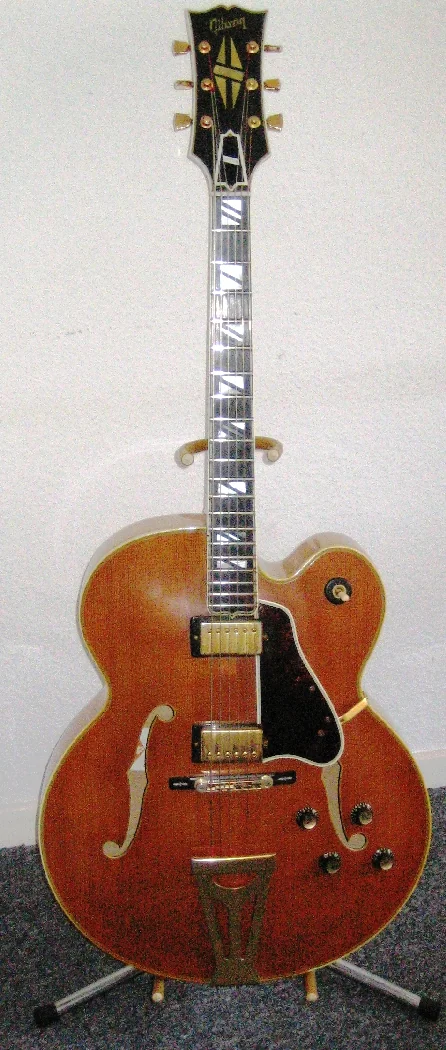
Photo: Cuetty / Clusternote / Wikimedia Commons / CC BY-SA 3.0 Gibson
Super 400
1934
Gibson priced it at $400 in the middle of the Depression and put the price right in the name.
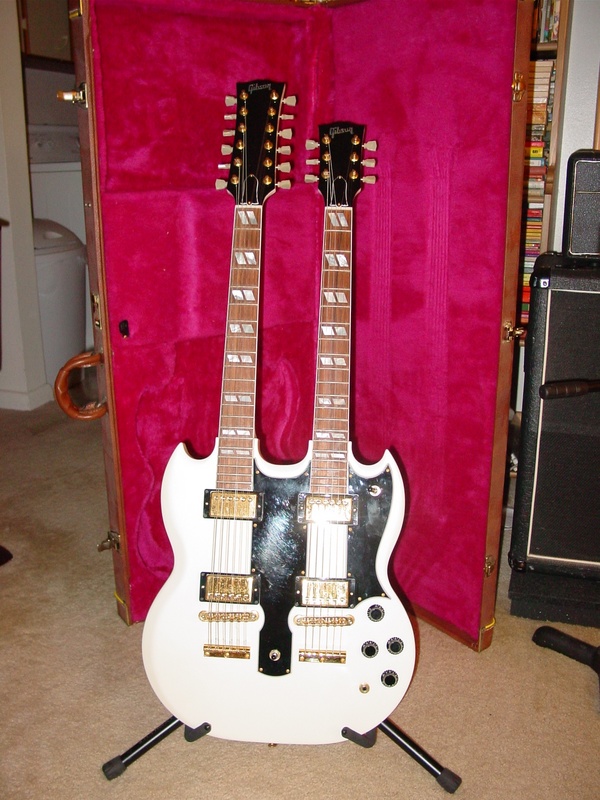
Gibson EDS-1275. Photo by T. Wesley. Public domain. Via Wikimedia Commons. Gibson
EDS-1275
1958
Jimmy Page had no way to play “Stairway to Heaven” live. So he ordered a guitar Gibson had stopped selling.
- Send a picture
Weissenborn
Style 2
1925
Built to be played flat on your lap. Within a couple of years, a louder guitar had taken its job.