Mike Lull
M4V
Mike Lull didn’t want to reinvent Leo Fender’s wheel. He just made it about a fifth smaller.
A kid in Bellevue whose parents wouldn’t buy him a bass made one in shop class. Twenty-odd years later, Seattle’s biggest bands were coming through his repair bench. The M4V is the Jazz Bass he built after all that: smaller, lighter, and passive first, always.
- Introduced
- 1995
- Type
- Bass
- Class
- Production
Have a photograph of this guitar? Send a picture
The short version
1954
Born in Eugene
The family moves to Bellevue, Washington, when he’s five.
1970
The repair bench
A repair job at sixteen.
1976
Guitar Works
His own shop in Bellevue, at twenty-one.
1983
His name on top
The shop and its owners blow apart. He reopens it with his name on top.
1995
The custom line
The factory’s date. Another count puts the first basses in 1996 and 1997. Keep all three.
2005
The earliest M4V on record
Swamp ash, birdseye maple, Fralin pickups, an Aguilar preamp. The letters may be older.
2008
The PLEK
The only one in the Pacific Northwest, the shop said that November.
2020
The family carries on
Mike dies on 12 February. His son Spencer runs the shop.
Side A
A1
Two dollars and a shop class
Ninth grade, Bellevue, Washington. Mike Lull wants a bass, and his parents won’t let him buy one. So he gets a wrecked one for two dollars, a crushed Teisco or some cheap hollow-body depending on the telling, makes a solid body in shop class, and bolts the neck and pickups onto it.
That’s the whole origin story, and it explains the rest. He was never trying to dream up a new instrument. He was trying to get a working one in his hands.
He was born in Eugene, Oregon, in 1954, and the family moved to Bellevue when he was five. At sixteen he had a repair job. At twenty-one, in 1976, he had his own shop, Mike Lull’s Guitar Works. In 1983 the business and its owners blew apart, and he reopened it with his name on top.
A2
The bench the whole city came through
The early ’90s are the part Seattle still remembers. Pearl Jam, Queensrÿche, Soundgarden, Screaming Trees, and Nirvana all came through the repair bench, and bands started naming him in interviews.
Queensrÿche’s Eddie Jackson is the clearest line from the bench to the basses. Lull was already doing the band’s repairs, and when Jackson’s Fernandes years ended in 1996, he moved to Lull. Two of his basses are M4Vs. Operation: Mindcrime and Empire are older than that. Different basses.
Then Bass Player got involved. Jim Roberts sent him a 1959 maple-neck Precision to re-fret. That turned into an article, then a four-string sent out for review, then a five. Somewhere in there Lull decided, in his words:
“I should really take this building thing seriously.”
The factory dates the custom line to 1995. An early owner counts the first basses in 1996 and 1997, thirty of them, and about fifty more by the end of 1998. Keep both. Either way, the repairman was now a builder.
A3
Leo had it right
Here’s what he said about the job in 2011: “Leo Fender had it totally right when it came to a P-bass and a J-bass. I don’t want to reinvent the wheel. I just want to improve upon original ideas.”
So the M4V is a Jazz Bass, and it doesn’t pretend otherwise. The V is for Vintage, a nod to the ’60s and ’70s Jazz: vintage-style pickguard, a control plate, 60s pickup spacing, 21 frets on a 34-inch neck. The M is for Modern, and that’s where the fixing happened. Graphite in the maple neck so it stays put. A contoured heel so your hand doesn’t hit a block up high. A bone nut. Hipshot Ultralite tuners, which he said he’d used “since day one.”
And the body is smaller. Stu Cook, who had a signature bass built on it, put a number on it: “about 20% smaller than the Vintage Jazz body.” You notice that the second hour of a gig, not the first minute in the store.
When the letters M4V first appeared is still open. The earliest dated one in hand is a 2005 swamp ash bass. Owners were using the name online by 2007, and the shop listed it among recent builds by 2010. There’s a classified ad titled “1999,” and nobody has seen the ad itself.
Flip the record · By the numbers
20%
How much smaller the M4V body is than a vintage Jazz, by Stu Cook’s reckoning.
30
Custom basses in the first two years, 1996 and 1997, by one early owner’s count.
300
Instruments out of the shop in 2011. Mike was still assembling every bass himself.
21
Frets on a 34-inch neck. The 24-fret bass is a different model.
Side B
B1
A passive bass, always
The M4V has a preamp, and the shop is almost stubborn about not leaning on it. The factory copy reads: “Regardless of active/passive capabilities, the first and foremost goal is a great passive bass, ALWAYS.”
Pull the tone knob and you’re passive. An owner quoting Mike in 2011 said the preamp was set to unity gain with the passive side, so flipping between them doesn’t jump in volume. The preamp itself changed under the same outline: Aguilar on the early ones, then Bartolini, and Trickfish on some current builds. Fralin single-coils on the four-string, or Lull’s own hand-wound J pickups now.
The wood changed too. Today’s M4V is chambered alder or swamp ash. Spencer Lull says they started cutting chambers years ago because light swamp ash and alder were getting hard to find, and then found the chambers opened the bass up. He doesn’t date the first one, and the earliest examples aren’t described as chambered. An old solid M4V isn’t a mistake. It’s just older.
Late in 2008 a PLEK machine arrived, the computer-guided rig that dresses the frets and the nut. That November the shop said it was the only one in the Pacific Northwest.
B2
Everything goes through Tom
In 2011 the shop was four people: Mike, Paul Schuster, Jeff Hope, and Tom Albert, who’d been there almost twenty years. They made about three hundred instruments that year, and Mike still assembled every bass himself.
Mike Lull died on 12 February 2020, after a brief fight with cancer. The company said his staff and family would carry on, “as this is what Mike wanted.” His son Spencer owns and runs it. Tom Albert, hired in 1992, is the master luthier, and everything that leaves the shop goes through him. Every instrument still goes on the PLEK once the neck has settled.
It’s still the same Jazz Bass. Same 34 inches, same 21 frets, same preamp you can switch off. Leo’s wheel, about a fifth smaller, from a kid who once had to build his own because nobody would buy him one.
The cast
The people, and the specific guitars, that made the legend.
Mike Lull
The M4V and everything on the bench
Bellevue’s repairman first, from 1970. Built his first bass in ninth-grade shop class and assembled every bass himself as late as 2011.
Eddie Jackson
M4Vs in sunburst and black
Queensrÿche’s bassist. One M4V carries Seymour Duncan pickups, the other EMGs. Operation Mindcrime and Empire came earlier, on other basses.
Stu Cook
SC5 on the M4V body
The one who measured the shrink. His own signature is a five-string with different pickups, built on this smaller body.
Tom Albert
Master luthier, since 1992
Everything that leaves the shop goes through him.
Spencer Lull
Owner, since 2020
Mike’s second-oldest son. Still puts every instrument on the PLEK after the neck has settled.
Liner notes
Specs, construction, rarity, value, and every source we used.
A slightly downsized Jazz Bass with a vintage guard and a preamp you can pull out of — Bellevue’s working four-string, not a Fodera Monarch, not a Sadowsky NYC, and not the 24-fret Modern.
- Body
- Chambered alder or swamp ash; slightly downsized J double-cut. Vintage-style pickguard and control plate.
- Neck
- Bolt-on maple, graphite-reinforced; slim-taper C; contoured heel. Roasted maple on some current customs.
- Fingerboard
- Birdseye maple, rosewood, or ebony; 12" radius, 21 frets. Order form: Jescar medium .095×.047 nickel.
- Scale
- 34". No millimetres on the factory M4V page. None invented.
- Pickups
- Custom Fralin single-coil Jazz, or Mike Lull hand-wound J. Order form: 60s spacing. Hum-cancelling optional on older sheets.
- Hardware
- Hipshot A-style aluminum bridge; Hipshot Ultralite tuners. Current shop cards print 20 mm spacing. A 2005 dealer card prints 19 mm. Mix flagged.
- Electronics
- Active/passive. Current cards: Bartolini NTBT 2-band, or Trickfish IPA 2-band. Typical layout: volume, blend, passive tone (push/pull active/passive), stacked bass/treble. Aguilar on older examples. Full electrostatic shielding.
- Finish
- Custom colours, trans, sunburst. Satin neck typical on dealer cards.
- Nut
- Bone. Factory 1.54". Dealers 1 1/2". Named cards also 39.4 mm, 40 mm, 38.5 mm. Mix flagged.
Open the full research fileConstruction details, the complete player record, production numbers, dated value estimates, and sources
Current typical = M4V 4-string (Bellevue). Factory order form, fetched 2 October 2026: “A Custom Mike Lull MV4 starts at $5,699.” The page titles it MV4; the model page is M4V. Same bass. Mix flagged: millimetre spacing and millimetre nut widths against an inch scale. Do not invent 864 mm. Do not average 1.54" with 1 1/2" or with those millimetre nuts. M5V is the five: full-size body, 35" standard, Lull/Duncan coils. V4 is the passive, full-size J. M4 is the 24-fret maple-top Modern. JT4 puts T-pickups on this body family. P4 is the Precision. Signatures — JAXT4, BBM5, SC5, Pik Funk — are other sheets. Not a Jazz Bass (fender-jazz-bass). Not a Fodera Monarch. Not a Sadowsky NYC. Not a Tobias Classic. Not a Ken Smith BSR.
Construction
The job was a Jazz Bass a working player would wear for three hours and still like. Slightly smaller body. Graphite in the neck. A preamp you can pull out of, because the shop’s first rule on this model is still a passive bass. Factory copy: “Regardless of active/passive capabilities, the first and foremost goal is a great passive bass, ALWAYS.”
Mike Lull was born in Eugene, Oregon, in 1954. The family moved to Bellevue, Washington, when he was five (factory bio; Seattle Times, 22 June 2012). No Treble (Kevin Johnson, 15 December 2011): he built his first bass in ninth-grade shop class because his parents would not let him buy one. A crushed Teisco or cheap hollow-body, two dollars, a solid body he made, the neck and pickups bolted on. Repair job at sixteen, 1970. 1976, at twenty-one, Mike Lull’s Guitar Works in Bellevue.
Seattle Times: Guitar Works and its owners “blew apart” in 1983; he reopened it with his name on top. The early-1990s work is the repair bench the city still means. No Treble: Pearl Jam, Queensrÿche, Soundgarden, Screaming Trees, Nirvana coming through. Bands named him in interviews. Jim Roberts at Bass Player sent a 1959 maple-neck Precision to re-fret, then an article, then a four-string for review, then a five. “I should really take this building thing seriously.” Factory bio: Mike Lull Custom Guitar and Bass lines, 1995. Bryan Beller (16 February 2020): the first Custom Guitars & Guitarworks basses were 1996 and 1997, 30 in total; serials started at #200; about 50 more by the end of 1998. Keep 1995, 1996, and 1997. This plate’s year is 1995 because that is the factory date for the custom line. It is not a claim that an M4V left the bench that year.
The letters came later. Factory: M is for Modern, V is for Vintage. Downsized J body, vintage guard and control plate, active/passive, 21 frets, 34". No Treble (17 February 2020): the V stands for vintage, a homage to the ’60s and ’70s Jazz Bass. Stu Cook, on his SC5 page: “the Lull M4V passive body is about 20% smaller than the Vintage Jazz body.” His sentence. The SC5 is a five-string JT on that smaller body, T-pickups, Tele guard. Not this table. The earliest dated M4V in hand is Bass Direct’s 2005 serial 859 — swamp ash, birdseye maple, Fralin, Aguilar. TalkBass has the name in 2007. The shop’s own recent-builds page lists M4V by March 2010. A TalkBass classified titled “1999 Mike Lull M4V” exists as a seller date; the ad itself did not render this pass. Keep the first year of the letters open.
He was not trying to invent a new bass. No Treble, quoting the 2011 interview: “Leo Fender had it totally right when it came to a P-bass and a J-bass. I don’t want to reinvent the wheel. I just want to improve upon original ideas.” Graphite in the maple neck. Contoured heel. Bone nut. Hipshot Ultralite tuners — he told Hipshot at NAMM 2012 he had used them “since day one.” Full electrostatic shielding. PLEK at final assembly. TalkBass, 20 November 2008: the shop’s email that month, “the only PLEK machine in the Pacific Northwest.” Seattle Times, 2012: one of the few West Coast luthiers with one. Spencer Lull (Plug Play Love, 18 July 2025): every instrument still goes on the PLEK after the neck has settled.
The body got lighter on purpose. Current factory page: alder or swamp ash, chambered. No Treble 2020 still listed mahogany. Keep it. Spencer: they started chambering “years and years ago” because lightweight swamp ash and alder were getting harder to buy, then found the chambers opened the bass up. He does not date the first chambered M4V. A Reverb mid-2000s M4V is described as solid ash. Bass Direct’s 2005 #859 does not say chambered. Do not flatten early solids into the living chambered spec.
The circuit moved under the same outline. #859: Aguilar. TalkBass 2015: Bartolini on a 2008, $2,100 new that year. No Treble 2020: Aguilar or Bartolini. Current cards: Bartolini NTBT 2-band, or Trickfish IPA. Volume, blend, passive tone with a pull for passive, stacked bass/treble. A TalkBass owner, 20 June 2011, quoting Mike: the preamp is set unity-gain with passive. Pickups: Fralin single-coils on the four-string, Lull/Duncan on the five, hum-cancelling as an option on the 2020 sheet. Living page: Fralin or Mike Lull hand-wound J. 60s spacing stays.
The catalog then split one idea into other names. V4 is this J without the preamp, full-size body. M4 is the 24-fret Modern with a 5A maple top — Beller’s red Modern 5 lives on that side, as the BBM5. JT4 is T-pickups in a J body; factory dates those pickups to a reverse-engineered 1964 T-bass, 2008. P4 is the Precision he built to replace his own 1964. None of those are this table.
He assembled every bass himself as of the 2011 interview. Four people in the shop then: Paul Schuster, Jeff Hope, Tom Albert (“almost 20 years”). Seattle Times: 2,000 signature basses in the previous sixteen years; 300 instruments in 2011. About $3,000 each in that piece. Historical street, not 2026. Mike died 12 February 2020 after a brief fight with cancer (factory bio). The company: “Mike’s dedicated staff and family will be carrying on his legacy as this is what Mike wanted.” Spencer Lull, second-oldest son, owns and runs it. Tom Albert, hired 1992, is master luthier; “everything that leaves the shop goes through him.” Preston Lull is shop administrator. The crew page still lists the bench.
Classic vs current: a 2005 #859 — swamp ash, Fralin, Aguilar, 34", dealer 19 mm — against a living chambered M4V. PLEK’d at final assembly. Fralin or Lull coils. Bartolini or Trickfish. Order form $5,699. Same downsized J. Same slug.
Players
Do not hang a Fodera Monarch, a Sadowsky NYC, a Tobias Classic, or a Ken Smith BSR on this plate. Do not hang Bryan Beller’s red Modern 5, Jeff Ament’s JAXT4, or Stu Cook’s SC5 as if they were this four-string. Do not flatten Queensrÿche’s Operation: Mindcrime or Empire onto a Lull.
Eddie Jackson (Queensrÿche). The named M4V player in print. Wikipedia’s equipment list: an M4V sunburst with custom Seymour Duncan Bassline J pickups, Bartolini, Hipshot Bass Xtender; an M4V black with active EMG J pickups and preamp, same Xtender; plus two M5Vs. The 2008 Glasgow Carling Academy caption on that page is the black custom M5V, not the four. Wikipedia: he endorsed Fernandes 1994–96 on the Promised Land tour, then Lull, who had already been doing Queensrÿche’s repair. Operation: Mindcrime and Empire are Spector years. They are not this bass. Queensrÿche’s official page still puts him on “his trusty Mike Lull bass” in 2025. Which model on which night is unpublished here.
Stu Cook. The 20% smaller M4V body is his observation. The bass he asked for is a 35" JT5 on that body — the SC5, T-pickups, Tele guard, $6,499. Not this table. His first Lull was #838, a used PJ5, early 2010.
Bryan Beller. Factory BBM5 page: 1999, red Modern 5 off the SWR showroom wall, Mike Keneally at the Baked Potato, his #1 for twenty years — Steve Vai, Joe Satriani, The Aristocrats. That is the 24-fret Modern. The Dethklok bass is a T-bass. The BBMF5 is EMG, 16" radius, 24 frets. None of them are an M4V.
Jeff Ament. Seattle Weekly (29 November 2011) and No Treble: JAXT4, January 2012, first Pearl Jam member signature on an instrument. 20% larger than the shop’s regular T4, reverse headstock. Seattle Times: a 1994 graphite-neck Jazz copy for Ament is an earlier custom, model unstated. Mother Love Bone and Pearl Jam repair is the shop, not this four-string. The JAXT4 is a T-bass. Not this table.
Also known to play stays short. Factory 2010 homepage: Randy Jackson, Mike Merritt. Seattle Times: Merritt’s candy-apple-red Lull with a white logo, Conan O’Brien’s band. Model unpublished. Merritt’s 2025 Blues Blast interview lists a ’64 Jazz, a Sadowsky, and a Fodera Monarch — no Lull. Rob Byus (Blake Shelton), Seattle Times 2012: a Lull five-string jazz. A five. Ann Wilson’s blue swamp-ash Lull is a bass she bought off him; the Times does not call it an M4V.
Rarity
You can order a new M4V from Bellevue. The wait is the bench, not a closed book. The order form asks for a non-refundable deposit; the remaining balance is due on completion. No dollar on that deposit this pass.
No M4V total was published. None invented. Beller’s 30 first basses and #200 are the whole custom line, 1996–97. Seattle Times: 2,000 signature basses in sixteen years to 2012; 300 instruments in 2011. Shop-wide. A serial dates a place in line. It does not count a model. #859 is a 2005 M4V. Japanese dealer serial #462, labeled M4V, is another object. Do not turn those numbers into a census.
What is actually thinner: an unchambered body from before the shop started cutting chambers; a pre-PLEK neck (the machine is late 2008); a Mike-assembled bass from before 12 February 2020. The 24-fret Modern, the passive V4, and the signatures are other names. They do not make this four-string common, and they are not a vintage M4V.
Value
Informal estimate, 2 October 2026. Not an appraisal.
Ask vs sold labeled. Celebrity lots are not-comps. No invented medians or factory counts. No clean Reverb Price Guide band isolated this pass. Flag: thin sold-comp access.
New street. One named floor, not a discount band. Factory M4V order form: from $5,699. Shop.mikelull.com cards this pass: $4,950, $5,899, $6,199 — optioned showroom basses, several marked sold out. Music Store Live tobacco-sunburst ask $4,860. Andy Baxter Trans Surf Green: web export £3,912.50, Reverb UK £5,095 incl. VAT. Pounds. Not converted. Don’t average any of that into one street. Adjacent, not this table: V4 order form from $4,999; BBM5 $6,699; BBMF5 $6,999; SC5 $6,499. TalkBass dealer sheet, March 2017: M4V list $5,400 / MSP $4,050. A 2017 street. Seattle Times ~$3,000 is 2012, shop-wide.
Used modern. Named 2026 marketplace asks, not hammers: 2008 Transparent Blonde Excellent $3,200; John Fox 2015 orange, mint, $3,299. UK dealer, 2005 #859: £2,350, out of stock. A 2016 NAMM-show quilted-top custom, 24 frets, ask $4,975 — the seller says Spencer and Preston would build it now at $7,000. That 24-fret top is not this 21-fret table. TalkBass 2015 memory: $2,100 new in 2008, $2,900+ for a later new one. Memory, not a list. Don’t average the asks.
Vintage / collectible. Early Mike-built M4Vs sit in the same used band when they trade. No Vintage Guitar band this pass. Japanese dealer serial #462, ended ask $2,208.75 plus shipping, three years old, is one object. Jackson’s M4Vs, Ament’s JAXT4, Beller’s #266, Cook’s #838 are not comps.
See also
- fender-jazz-bass — the 1960 Fullerton silhouette this downsized Bellevue J is not
- sadowsky-nyc-bass — the other working bolt-on J with a boost preamp; Long Island City, not Bellevue
- lakland-55-94 — Chicago’s 1996 five, soapbar and J; not this four-string M4V
Sources
- Mike Lull, M4V / M5V — M for Modern, V for Vintage; Bellevue; PLEK and electrostatic shielding; downsized M4V vs full-size M5V; chambered alder or swamp ash; graphite maple; birdseye / rosewood / ebony; 21 frets; 12"; bone; Hipshot; vintage guard; 34"; 1.54"; Fralin or Lull hand-wound J; “great passive bass, ALWAYS”; fetched 2 October 2026
- Mike Lull, M4V order form — “Custom Mike Lull MV4 starts at $5,699”; 34"; 12"; slim-taper C; bone; 1.54"; 21 frets, Jescar .095×.047; 60s spacing; deposit, balance on completion
- Mike Lull, V4 / V5 — passive; full-size body
- Mike Lull, V4 order form — from $4,999
- Mike Lull, M4 / M5 — 24-fret Modern; 5A maple top
- Mike Lull, JT4 / JT5 — T-pickups from a reverse-engineered 1964 T-bass; 2008; M4V-style body
- Mike Lull, P4 / P5 — Precision; his 1964 P
- Mike Lull, founder — born Eugene 1954; Bellevue at five; repair 1970; Guitar Works 1976; custom lines 1995; died 12 February 2020; Spencer owns the shop
- Mike Lull, Meet the Crew — Tom Albert hired 1992, master luthier; Spencer president; Preston administrator
- Mike Lull, Stu Cook SC5 — M4V body “about 20% smaller than the Vintage Jazz body”; #838 PJ5, early 2010; $6,499
- Mike Lull, BBM5 / BBMF5 — Beller 1999 red Modern 5; BBM5 $6,699; BBMF5 $6,999
- Mike Lull, Pik Funk — based on M5V; extra-heavy swamp ash
- Mike Lull, contact — 12031 Northup Way, Suite 206, Bellevue, WA 98005
- shop.mikelull.com, M4V Custom — $5,899; chambered alder; Lull hand-wound J; Trickfish IPA; 20 mm
- shop.mikelull.com, M4V Custom — $6,199; roasted maple; ebony; Bartolini NTBT; 20 mm
- shop.mikelull.com, M4V Custom — $4,950; roasted pine solid; Aguilar OBP-1
- No Treble, Custom Shop: An Interview with Mike Lull, Kevin Johnson, 15 December 2011 — ninth-grade bass; 1970s parts; early-1990s Seattle repair; Bass Player reviews; ~300/year, he assembled each; four-person shop; Tom Albert almost 20 years; Leo / P and J quote; T-bass four or five years earlier; Ament 22 years of work
- No Treble, In Memoriam: Mike Lull, 14 February 2020 — died after a brief fight with cancer; ninth-grade quote; 1976 shop
- No Treble, Bass of the Week: M4V/M5V, 17 February 2020 — workhorse; downsized body; V = vintage; alder / swamp ash / mahogany; Fralin on M4V, Duncan on M5V; Aguilar or Bartolini; Hipshot; family carrying on
- Seattle Times, Bellevue’s Mike Lull keeps guitar stars shining, 22 June 2012 — born Eugene 1954; Bellevue at 5; 1976 shop; 1983 split; 1994 Ament graphite-neck Jazz copy; Ann Wilson blue swamp ash; T-bass; Merritt candy-apple-red; PLEK; 2,000 signature basses in 16 years; 300 in 2011; ~$3,000
- Seattle Weekly, Pearl Jam’s Bassist Makes His Pitch, Chris Kornelis, 29 November 2011 — JAXT4; $5,300 list; first Pearl Jam member signature
- Vintage Guitar, Ward Meeker, Ament basses for 826 Seattle, 30 January 2012 — two hand-painted JAXT4s, $8,501 each
- Premier Guitar, JT5-24 review, 9 July 2012 — almost two decades; street $3,255; T-pickups in a J body
- Bryan Beller, 16 February 2020 — first Custom Guitars basses 1996–97, 30 total; serials from #200; ~50 more by end of 1998; Modern 5 #266
- Wikipedia, Eddie Jackson (musician) — Fernandes 1994–96 Promised Land tour, then Lull; equipment list two M4Vs and two M5Vs; 2008 Glasgow caption is the black M5V
- TalkBass, Mike Lull’s PLEK machine, 20 November 2008 — only PLEK in the Pacific Northwest
- TalkBass, Lull owners, 6 September 2007 — “M4V owner here”
- TalkBass, How do people feel about the Mike Lull M4V?, 25 August 2015 — 2008 M4V $2,100 new; later new $2,900+
- TalkBass, Mike Lull pricing, 30 March 2017 — M4V list $5,400 / MSP $4,050
- Wayback Machine, mikelull.com recent builds, 15 March 2010 — M4V listed among recent builds
- Bass Direct, 2005 M4V serial 859 — year 2005; swamp ash; Fralin; Aguilar; 34"; 21 frets; 19 mm spacing; 40 mm nut; £2,350
- Andy Baxter, M4V Trans Surf Green — serial 3947; chambered ash; roasted maple; Lull hand-wound J; Trickfish IPA; 34"; 39.4 mm nut; 21 mm depth at first fret
- Music Store Live, M4V Tobacco Sunburst — $4,860; chambered alder; Fralin; Bartolini NTBT; 1 1/2" bone
- Plug Play Love, An interview with Spencer Lull, 18 July 2025 — PLEK at final assembly; chambering for weight, then resonance
- Hipshot, Builder Profile: Mike Lull, 3 February 2012 — JT4; Ultralite “since day one”
- Reverb, Mike Lull basses — 2026 asks: 2008 Transparent Blonde Excellent $3,200; no Price Guide widget isolated this pass
- Reverb, M4V mid-2000s Natural — seller: solid ash; 1.5" nut; Bartolini NTMB; Lull/Duncan; 8 lb 7 oz; sold
- Reverb, M4V serial 462 — Japanese dealer; 38.5 mm nut; 20 mm spacing; ended ask $2,208.75 plus shipping; listed three years ago
- Reverb, 2016 NAMM quilted M4V — 24-fret custom; ask $4,975; seller: Spencer and Preston would build it now at $7,000
- John Fox Bass, 2015 M4V — $3,299; swamp ash; Fralin; Bartolini NTBT-918
- TalkBass, lull m4v tag — classified title “1999 Mike Lull M4V”; the ad 404’d this pass
- TalkBass, M4V weak acoustically, 20 June 2011 — owner quoting Mike: preamp set unity-gain with passive
- Wayback Machine, mikelull.com homepage, 23 March 2010 — endorsers listed: Bryan Beller, Eddie Jackson, Darryl C. Anders, Randy Jackson, Mike Merritt
- Blues Blast Magazine, Featured Interview – Mike Merritt, 18 February 2025 — favorite instruments: ’64 Jazz, Sadowsky, Fodera Monarch; no Lull named
- Queensrÿche, 19 August 2025 — “trusty Mike Lull bass”; model unstated
Keep digging
Guitars this one gets compared to, confused with, or descended from.

Fender Jazz Bass from 1966 in Olympic white with the transition fingerboard (bindings and dot inlays). Photo by Th. Ott. Licensed under CC BY-SA 3.0. Via Wikimedia Commons. Fender
Jazz Bass
1960
Built for jazz players who mostly passed on it. Then bass players started using it to take the solo.
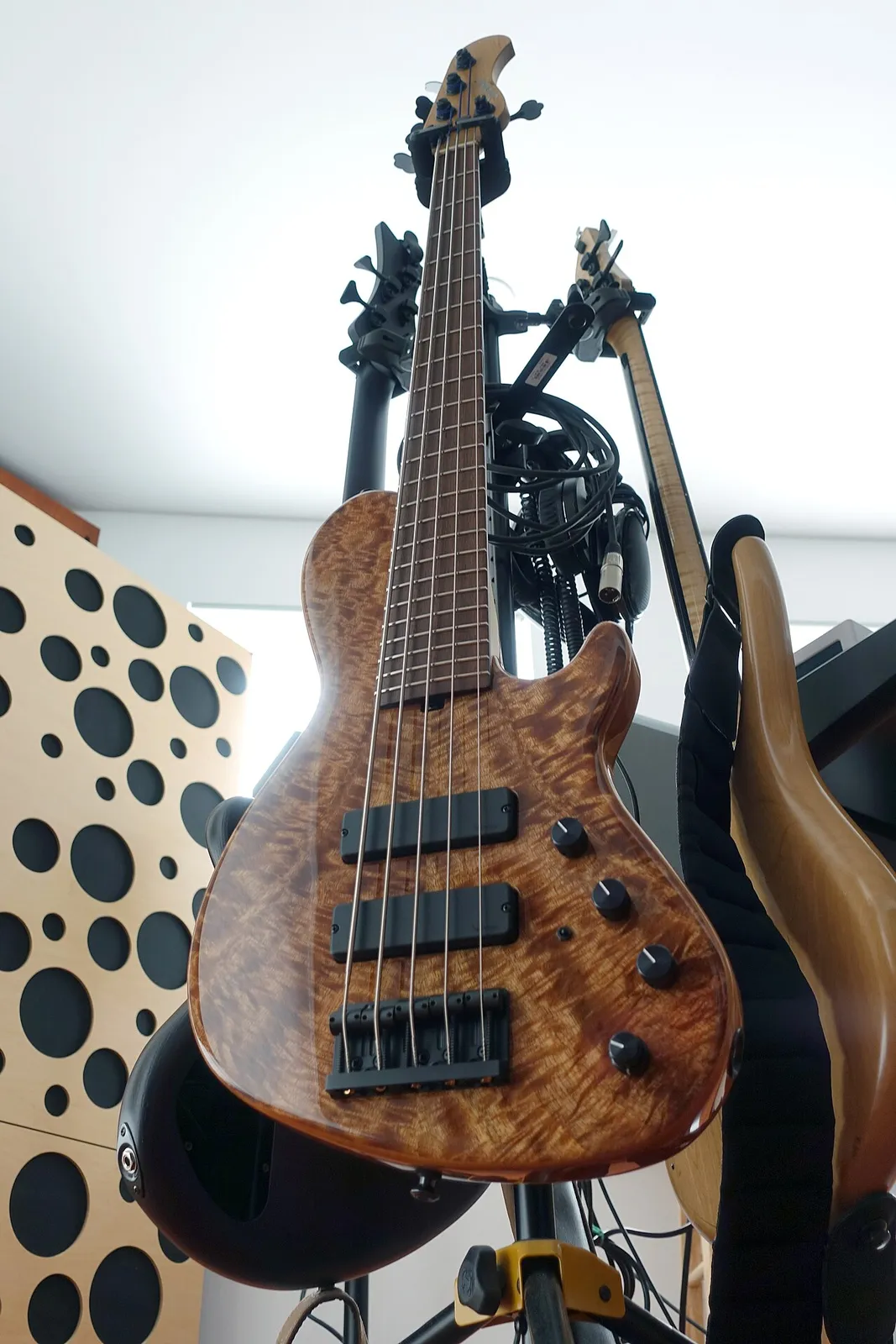
Photo: Nir Yaniv / Wikimedia Commons / CC BY-SA 4.0 Sadowsky
NYC Bass
1982
Built for the New York session bassist whose engineer wasn’t going to reset the board for him.
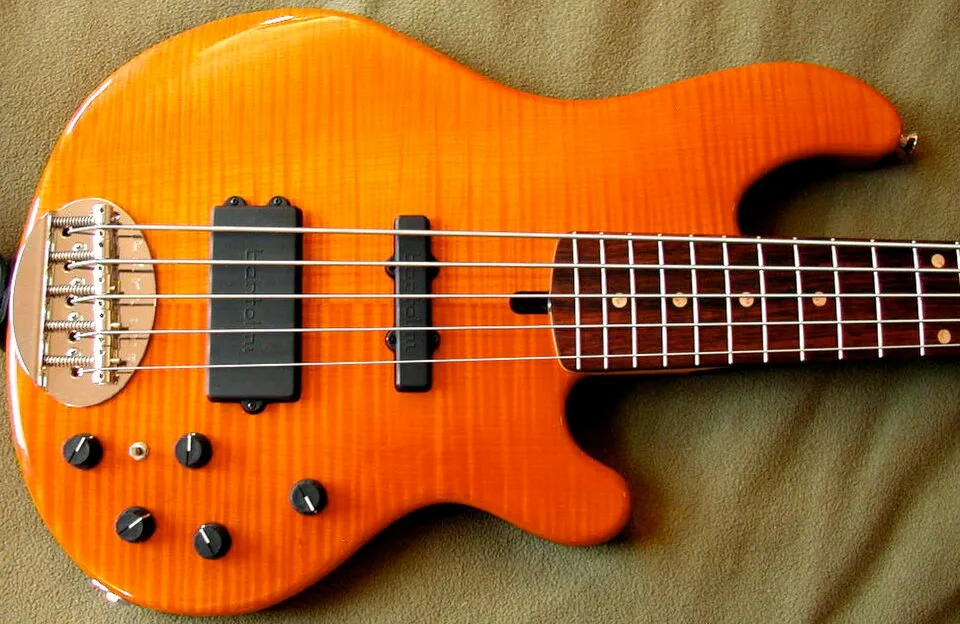
Photo: Dale Cruse / Wikimedia Commons / CC BY 2.0 Lakland
55-94
1996
A five-string for bass players who never wanted one: an extra inch of scale, and a neck that feels like home.