Lakland
55-94
A five-string for bass players who never wanted one: an extra inch of scale, and a neck that feels like home.
Chicago, 1994. Dan Lakin and Hugh McFarland take out a $20,000 home-equity loan and put their names together. Lakin plus McFarland: Lakland, as in lake-land. The first two basses are four-strings. The five comes a little later, and it’s still in the catalog.
- Introduced
- 1996
- Type
- Solidbody bass (5-string)
- Class
- Production
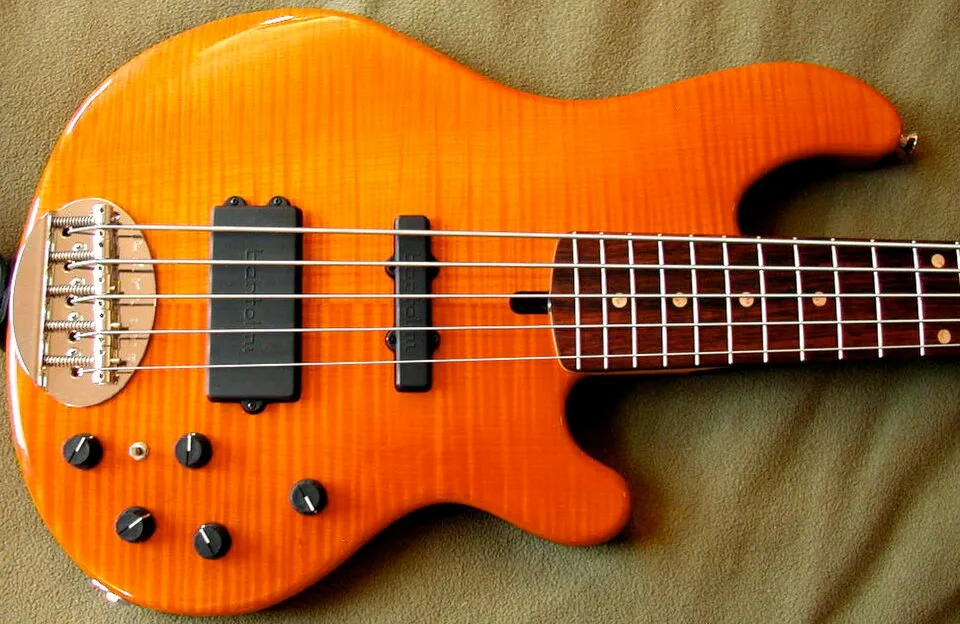
The short version
1994
Lakland
Dan Lakin and Hugh McFarland start the company. Their first bass goes to summer NAMM that July.
1996
The five
The first 55-94s appear, and the magazines get their hands on one.
1996
A partner leaves
McFarland is gone by late 1996 or 1997, depending on who’s telling it.
1997
What’s an inch worth?
A Bass Player review tries to answer that about the 35-inch scale.
2000
New owners
The Pirruccello brothers invest, and later bring the American building in-house.
2001
Second flagship
Lakland’s catalog calls the 55-94 its second flagship. A cheaper Skyline line starts in Korea.
Side A
A1
Nobody wants a five
Ask a room full of bass players about five-strings and you’ll get a lot of opinions. The low B is great, until it goes floppy and vague. The neck is fine, until your thumb can’t find where it’s supposed to go. Plenty of four-string players have picked one up, felt like a stranger on their own instrument, and put it back on the wall.
In Chicago in 1994, Dan Lakin and Hugh McFarland borrowed $20,000 against a house and started Lakland. The company’s own 2001 catalog says there were three principals, a luthier and two musicians. Nobody seems to have written down the third name.
McFarland’s first design leaned so hard on the classic basses that Fender sent a cease-and-desist letter. That wasn’t this bass.
Their first two basses were four-strings, one for Dan in July 1994 and one for a player named Greg Rzab that September. The five-string came next.
A2
What’s an inch worth?
The 55-94 shows up in 1996, and the magazines have it by that summer. The “94” in the name isn’t the year this bass shipped; the company dates itself to 1994. Lakland called it “our first five-string.”
The big idea is one extra inch. A Fender bass is 34 inches from nut to bridge. The 55-94 is 35. That extra length pulls the low B tighter, so it sounds like a note instead of a rumor. The headstock puts the B tuner 2¼ inches from the nut, and the string runs through the body.
Bass Player tested one in January 1997 and asked the obvious question: what’s an inch worth? Their answer was that stringing through the body doesn’t add tension, but it does change the feel. And the players who tried it missed the extra inch.
A3
A Jazz neck with one more string
Now the neck. A lot of five-strings are wide. The 55-94 has Jazz Bass spacing at the bridge, three-quarters of an inch between strings, on a neck Lakland calls slightly narrower than other fives. If your right hand learned on a Jazz, it knows where it is.
The pickups borrow from two famous basses. At the bridge there’s a big soapbar humbucker, the Music Man sound, all punch and growl. At the neck there’s a J-style pickup, the Fender sound, warm and round. One German review summed up the outline as some Leo Fender with a Music Man likeness, and that’s about right: Leo designed both of the basses it’s borrowing from. Pull the volume knob and the preamp switches off, and you’re playing a passive bass.
The early ones had Bartolini pickups and electronics. Later Lakland went to its own. The paperwork doesn’t even agree on whether the neck pickup was a single J or a dual-coil for a stretch in there, so I won’t pretend to settle it.
Flip the record · By the numbers
35″
Scale length. One inch longer than a Fender bass, for a tighter low B.
2¼″
How far the B tuner sits from the nut, on a bass built around the low string.
.75″
String spacing at the bridge. Jazz Bass spacing, on a five.
$20,000
The home-equity loan that started Lakland.
Side B
B1
Tires and bass guitars
Small companies get messy, and this one did. In 1996 Lakland became part of A. Lakin & Sons, Dan’s grandfather’s tire recycling business. Hugh McFarland was gone by late 1996, or a year later, depending on who’s telling it. Even the birthday is loose: most accounts say 1994, but a 2005 newspaper story about a tenth-anniversary party points to 1995.
In 2000 John Pirruccello and his brothers invested, and they eventually became the majority owners. For years the necks and bodies came from about a dozen American shops and got finished in Chicago. The Pirruccellos brought that building in-house. A cheaper Skyline line started in Korea in 2001, but that’s a different bass with a different number.
B2
Still the first five
You can still order a 55-94 from Chicago. Swamp ash or alder, a maple neck with graphite bars, 35 inches, a soapbar and a J. Lakland will tell you the fancy quilted top on the Deluxe makes “negligible” difference to the tone, which is an honest thing for a company to say about its own upgrade.
The famous Lakland names mostly play other models. Darryl Jones has his own signature. Duck Dunn and Joe Osborn have theirs. Lakland lists the bassists behind Switchfoot, Jason Aldean, Whitesnake, and Alice Cooper among its 55-94 players. Working bassists, out on the road with a low B.
Plenty of bassists still say they don’t want a five. The 55-94 was built for them. A little more string, a neck their hands already know.
The cast
The people, and the specific guitars, that made the legend.
1994
Dan Lakin
Co-founder
The “Lak” in Lakland. His first bass, a quilted four-string, went to summer NAMM in July 1994.
1994
Hugh McFarland
Co-founder
The “land.” His first design drew a cease-and-desist from Fender. He left soon after the five-string arrived.
1994
Greg Rzab
The first customer bass
Got Lakland’s second bass, a flamed four-string, in September 1994. Not a 55-94, but where it all started.
Tim Foreman
55-94
Switchfoot’s bassist, on Lakland’s own list of 55-94 players.
Tully Kennedy
55-94
Jason Aldean’s bassist, on the same list.
Darryl Jones
Not this one
The Rolling Stones bassist’s Lakland is his DJ signature, a 34-inch Jazz-style bass. People mix them up.
Liner notes
Specs, construction, rarity, value, and every source we used.
A 35-inch five, soapbar at the bridge and a J at the neck — Lakland’s first five-string, not a Jazz Bass, not a StingRay, and not the Darryl Jones signature.
- Body
- Swamp ash on Standard and Deluxe; alder on Classic. Deluxe adds a quilted or flamed maple top over the ash. Offset double-cut, contoured.
- Neck
- Bolt-on quarter-sawn rock maple with graphite bars. Five bolts on the December 1996 review bass, and on ESP Japan’s current page. The January 1997 Bass Player bass joined the body at the 16th fret.
- Fingerboard
- Birdseye maple with ebony dots, or Indian laurel with birdseye dots, on the current US sheet. Fretless: ebony side dots, lined or unlined. Compound 10–13" radius, 22 frets, wire .041" / .085". ESP Japan still prints East Indian rosewood.
- Scale
- 35". The 2011 factory page offered 34" at no charge, not swappable later. The current spec table does not print 34".
- Pickups
- Lakland MM–J. Bridge: LH3 quad-coil soapbar, 3-way (all four coils, neck-side pair, or bridge-side pair). Neck: dual-coil J.
- Hardware
- Hipshot Ultralite tuners. Lakland Dual Access bridge, through the body or through the bridge, .75" spacing. Factory strings: stainless rounds .045"–.105", .128" B.
- Electronics
- Lakland LH3. Bass, mid, and treble, cut and boost. Pan-style blend. Master volume, pull for passive. Internal mid-frequency select and gain trim. 9V.
- Finish
- Sunburst and translucent on ash. Solid metallic, plus a pickguard, on the alder Classic. Neck: hand-rubbed oil and a thin wax. A 2025 dealer sheet calls one neck satin.
- Nut
- Bone, 1.81". No millimetres on the US sheet.
Open the full research fileConstruction details, the complete player record, production numbers, dated value estimates, and sources
Current typical = USA Series 55-94 (Chicago), the bass you can still order. Classic living recipe in the magazines is the 1996–97 Deluxe: swamp ash, often a figured maple top, Bartolini MM and dual-coil J, Bartolini 3-band. Skyline 55-02, 55-14, 55-60, DJ-5, and 55-64 are other models. Not a Jazz Bass (fender-jazz-bass). Not a StingRay (music-man-stingray). Mix flagged: this sheet is inches; the same FAQ gives Skyline truss and saddle wrenches as 4 mm and 1.5 mm. Do not convert 35" or 1.81".
Construction
The job was a low B a four-string hand could use. Dan Lakin and Hugh McFarland, Chicago, put their names together and pronounced it lake-land. The 2001 catalog says three principals, a luthier and two musicians. Forbes, the Tribune, and Dan name two. The third name is unpublished. Forbes (5 July 2004): a $20,000 home-equity loan. McFarland’s first drawing borrowed from classic basses and drew a Fender cease-and-desist. That drawing was not this five.
Dan (20 January 2014): the first two, not yet called 4-94, were four-strings. X01, quilt, for himself, finished July 1994 and taken to summer NAMM. 001, flame, for Greg Rzab, September 1994. The serial sheet is another clock. 4-94 numbers start in 1995 (1–104). The 55-94 block starts in 1996, 5001–5068, pooled with the 55-63, 55-76, and 55-07. Australian Guitar, which Lakland dates to July 1996, already had one. Gitarre & Bass, December 1996. Bass Player, January 1997. The “94” is not the year this five shipped. This plate starts in 1996.
Bass Player asked what an inch is worth. 35" scale. The B tuner sits 2¼" from the nut. The string runs through the body. They wrote that this does not add tension, and that it changes the feel. Players in that room missed the extra inch. Nut 1.81". Bridge spacing .75", Jazz spacing, on a neck the factory calls slightly narrower than other fives. The joint is cut so the twenty-two frets stay in reach.
The review basses are the early recipe. Quarter-sawn maple, graphite bars, five bolts, tung oil. Bass Player’s teal Deluxe: swamp ash, bookmatched quilt, birdseye board, neck joint at the 16th fret, chrome-plated brass bridge. Gitarre & Bass: headstock not tilted, so a retainer; Hipshot Ultralites rather than Gotoh; strings from the back or the front. Bartolini. A Music Man humbucker at the bridge, a dual-coil J at the neck, both split 3+2. Toggle: bridge coil, both, or neck coil. NTMB-L. Pull the volume and you are passive. That review’s outline: some Leo Fender, and a Music Man likeness.
Then the coils changed, and the neck pickup does not sit still in the paperwork. The 2001 catalog, still calling this the second flagship, prints Bartolini MM–J, Duncan Basslines optional, and “a single j-style” at the neck. The 1996–97 reviews say dual-coil. The 2011 product page still says single J. The 2011 catalog already prints preamp LH3 and “Lakland MM-J.” The current US page: dual-coil J, and a quad-coil soapbar — all four coils, the neck-side pair, or the bridge-side pair. ESP Japan calls Bartolini the old spec. Keep the single-J line. Do not average it into the dual-coil.
Current FAQ: ash on Standard and Deluxe, and the figured top is “negligible” for tone. Alder on the Classic, with a guard — the midrange they associate with a pre-CBS Jazz. The US table now says Indian laurel. ESP Japan still prints East Indian rosewood. The 2011 page offered 34" at no charge, not swappable onto a 35" bass. The current table does not. Left-hand is a current option. A 1999 left-hand Deluxe has already been through the used market.
Hugh was gone before the LH3. Dan: late 1996. Forbes: the firm became a unit of A. Lakin & Sons, the grandfather’s tire recycler, in 1996, and McFarland left a year later. The 24 April 2005 Tribune covered a tenth-anniversary party “last month,” which points at March 1995. Dan and Forbes put the birth in 1994. The five-string’s sheet still starts in 1996.
Tribune, 2 October 2014: John Pirruccello and his brothers had been majority owners about four years, after a 2000 investment, and had brought the American line in-house. Before that, necks and bodies came from about a dozen US companies and were finished in Chicago. Twelve people, North Center. Skyline is the other factory — 2001, Korea, finished in the US; by 2014, made in Asia and finished here. The 55-02 is that line’s MM/J. The 55-14 Classic on the available-now page, alder, $3,650, is a different number. Neither is this table.
Players
The famous Lakland names are other basses.
Darryl Jones. The signature is the DJ-4 / DJ-5: Jazz outline, 34" scale, more contour than the vintage J, a guard, blocks, passive volume-volume-tone. Factory DJ serials start in 2006 (DJ01–DJ09). Current DJ-5 list $4,510, on the same page as this model. Guitar World (4 July 2024): Laklands on a few Stones tunes, and a Jones Musical Instruments Precision-style on “Miss You.” Reverb News (13 September 2019): the Lakland he names is the DJ, next to a 1966 Jazz. Not a 55-94.
Joe Osborn is the 44-60 / 55-60. His fours on the serial sheet start in 1998. Duck Dunn is the 44-64 Custom. Bob Glaub is the 44-64 / 55-64. Jerry Scheff starts on that sheet in 2001. Adam Clayton, on Lakland’s artist list, is a 44-60. The 2014 Tribune mentions customs for Clayton and for Geezer Butler, Butler’s engraved on the back. It does not call either a 55-94. Rzab’s 1994 bass was a four-string.
Lakland’s own 55-94 page, a module and not a session log: Tim Foreman (Switchfoot), Uriah Duffy (Whitesnake), Tully Kennedy (Jason Aldean), Keith Moseley (String Cheese Incident), Concord Nkabinde (Johnny Clegg), Erik Scott (Alice Cooper, Sonia Dada, Flo & Eddie). No serial, year, or song in the blurbs.
Also known to play, same module. John Howard, Jason Duggins, John McNeil, Frank Russell. No record credit attached. A Reverb seller called one 1997 sunburst Tony Garnier’s, from Bob Dylan’s Vatican show. Uncorroborated. Not a player credit.
Rarity
You can order a 55-94. It is a current Chicago catalog bass, not a closed run. What is thin is an early one you can prove is this model.
The serial sheet pools 55-94 numbers with 55-63, 55-76, and 55-07, and it stops open-ended in 2009 (the 2008 and 2009 lines both touch 7160). A 2025 Bass Direct Deluxe is serial 8004, past the sheet. The first block is 1996, and it is a 55-94 count only if you pretend the siblings are not in it. Serials date a bass inside the table. They do not count a year. No 55-94 factory total. None invented.
Company volume is not this bass. Tribune, 24 April 2005: Lakin, 1,700 to 2,000 guitars a year, the whole brand. Same paper, 2014: about 2,000 Skyline and about 300 American-made a year, after US sales had flattened near 250 in the recession. Every USA model, not this one.
Thinner, if you can separate it: a 1996-block bass that is actually a 55-94; a Bartolini USA five from before the LH3, which the catalogs put between 2001 and 2011; a left-hand from those years. The used bass at the other price is usually a Skyline 55-02.
Value
Informal estimate, 22 September 2026. Not an appraisal.
Ask versus sold, labeled. Celebrity claims are not comps. No invented median. The 2014 American-line retail of $2,500 to $4,000 is company history, not a 2026 cart.
New street. Lakland’s page, this pass: USA 55-94 from $4,645, options extra. An in-stock Deluxe, cherry sunburst, quilt, birdseye: $4,995. A new orange-quilt Deluxe sold on Reverb at $3,750 (Yandas). A new black-gloss ask of $3,999.99 ended. Do not average the list and the sold. Bass Direct, a 2025 Ocean Blue Deluxe, serial 8004, £4,750 including VAT — a UK dealer price, not US street. ESP Japan prints 1,100,000 yen including tax. Not converted.
Used modern. Named asks, not hammers: a 2015 mint Deluxe at $3,900; a 1998 Deluxe at $3,380; one 55-94 ask cut from $3,900 to $3,200. A Reverb page for a 2003 amber-quilt printed an estimated used band of $2,077–$2,770. Guide widget, not a sold series, and not opened here as its own Price Guide table. Flag: thin sold-comp access on recent used USA 55-94s.
Vintage / collectible. No 1950s object in the name. The older market is a Bartolini USA five from the Dan Lakin years. Named older solds, not a 2026 ladder: a circa-2000 Shoreline Gold at $1,750; a 1999 left-hand Deluxe at $2,350. A 2000 natural with Bartolinis ended at an ask of $2,100. Do not average those. The Garnier / Dylan Vatican claim was a seller’s line on a sold listing. Hammer not in the fetch. Not a comp.
See also
- fender-jazz-bass — the 34" bolt-on this outline keeps being mistaken for
- music-man-stingray — the soapbar and the active preamp the bridge pickup is answering
- sadowsky-nyc-bass — the other boutique session bass; Gitarre & Bass set them side by side in 1996
Sources
- Lakland, USA Series 55-94 — original five-string; LH3 quad-coil soapbar and dual-coil J; spec table (1.81" bone nut, 35", 22 frets, .75" bridge, 10–13" compound, graphite-reinforced quarter-sawn maple, ash or alder); list from $4,645; artist module (Foreman, Duffy, Kennedy, Moseley, Nkabinde, Scott, and others); review dates July 1996, December 1996, January 1997
- Lakland, 5- and 6-string category — 55-94 $4,645; DJ-5 $4,510; 35" scale and string-through as the factory’s B-string claim; necks “slightly narrower,” “J” spacing
- Lakland, About / FAQ — Lake-land, Lakin + McFarland; Classic alder + guard, Standard/Deluxe swamp ash, Deluxe top “negligible”; string set .045–.105 plus .128; oil-and-wax neck; US truss 5/32" and saddle 1/16" against Skyline 4 mm and 1.5 mm
- Lakland, Available Now — Deluxe cherry sunburst quilt $4,995; 55-14 Classic alder $3,650, a different model
- Lakland serial-number sheet (PDF) — 55-94 / 55-63 / 55-76 / 55-07 pooled; 5001–5068 in 1996 through an open 2009 line; 4-94 from 1995; DJ from 2006; Osborn fours from 1998; Scheff from 2001
- Lakland 55-94 page, July 2011 capture — “our first five-string”; MM plus “a single J-style”; 34" no-cost option, not swappable; Classic alder vs Standard/Deluxe ash
- Lakland 2001 catalog (PDF) — company “born” 1994, “three principals”; 55-94 “second flagship”; Bartolini MM–J, Duncan Basslines optional; “single j-style”; 35" and string-through; 2044 North Dominick, Chicago
- Lakland 2011 catalog (PDF) — LH3 and Lakland MM–J already the printed spec; 55-02 described as the same MM/J and 3-band idea
- Bass Player, January 1997, via Lakland — 35" scale; B tuner 2¼" from the nut; string-through; 16th-fret joint; Bartolini MM and J humbuckers; NTMB-L; split 3+2; quilted swamp ash; brass bridge
- Gitarre & Bass, December 1996, via Lakland — five-bolt quarter-sawn neck; graphite; tung oil; Bartolini dual-coil MM and dual-coil J; three-way coil switch; pull-passive; Hipshot Ultralites; through-body or through-bridge; compared with Sadowsky
- Australian Guitar, July 1996 dating on the product page; text via Lakland — 35" against 34"; Bartolini MM humbucker and dual-coil J; birdseye, ebony, or rosewood
- Forbes, Emily Lambert, “His Own Beat,” 5 July 2004 — $20,000 launch; McFarland; Fender cease-and-desist on the first model; 1996 fold into the tire recycler; McFarland a year later
- Chicago Tribune, “The aces of bass,” 24 April 2005 — tenth anniversary “last month”; Lakin, 1,700 to 2,000 guitars a year; signature series for Jones, Dunn, Glaub, Scheff, Osborn
- Chicago Tribune, “Made from scratch in Chicago,” 2 October 2014 — founded 1994, Lakin and McFarland; Skyline 2001, Korea then Asia, finished in the US; ~300 American-made and ~2,000 Skyline a year; American retail then $2,500–$4,000; Clayton and Butler customs; parts previously from about a dozen US shops
- Dan Lakin, “D. Lakin Basses,” 20 January 2014 — 1994 start with McFarland; X01 July 1994 and 001 September 1994, both four-strings; Hugh left late 1996
- Lakland artist list — Adam Clayton listed on a USA 44-60, not a 55-94; other roster lines name a 55-94 without a record credit
- Guitar World, Joel McIver, Darryl Jones, 4 July 2024 — Laklands “on a few tunes”; not identified as a 55-94
- Reverb News, Darryl Jones on his favorite basses, 13 September 2019 — the Lakland DJ signature, beside a 1966 Jazz
- No Treble, 22 January 2012 — DJ reissue: 34" scale, more contour than the 44-60 / 55-60, guard, blocks, passive volume-volume-tone; not the 55-94
- ESP Japan, US 55-94 — 5-bolt; East Indian rosewood still printed; Bartolini called the old spec; 1,100,000 yen including tax
- Bass Direct, 55-94 Deluxe Ocean Blue — 2025, serial 8004, £4,750 incl. VAT; swamp ash, quilt, ebony; gloss body
- Reverb, Yandas, new 55-94 Deluxe, sold — sold new at $3,750; 9 lb 8 oz on that bass; 1.81" nut
- Reverb, 2003 amber quilt listing — estimated used widget $2,077–$2,770; not a hammer
- Reverb, 2015 Deluxe ask — ask $3,900
- Reverb, circa-2000 Shoreline Gold, sold — sold $1,750; Bartolini; seller-dated 2000
- Reverb, 1999 left-hand Deluxe, sold — sold $2,350
- Reverb, Tony Garnier claim, sold — seller provenance, 1997, Bartolini; hammer not in the fetch; not a comp
Keep digging
Guitars this one gets compared to, confused with, or descended from.

Fender Jazz Bass from 1966 in Olympic white with the transition fingerboard (bindings and dot inlays). Photo by Th. Ott. Licensed under CC BY-SA 3.0. Via Wikimedia Commons. Fender
Jazz Bass
1960
Built for jazz players who mostly passed on it. Then bass players started using it to take the solo.
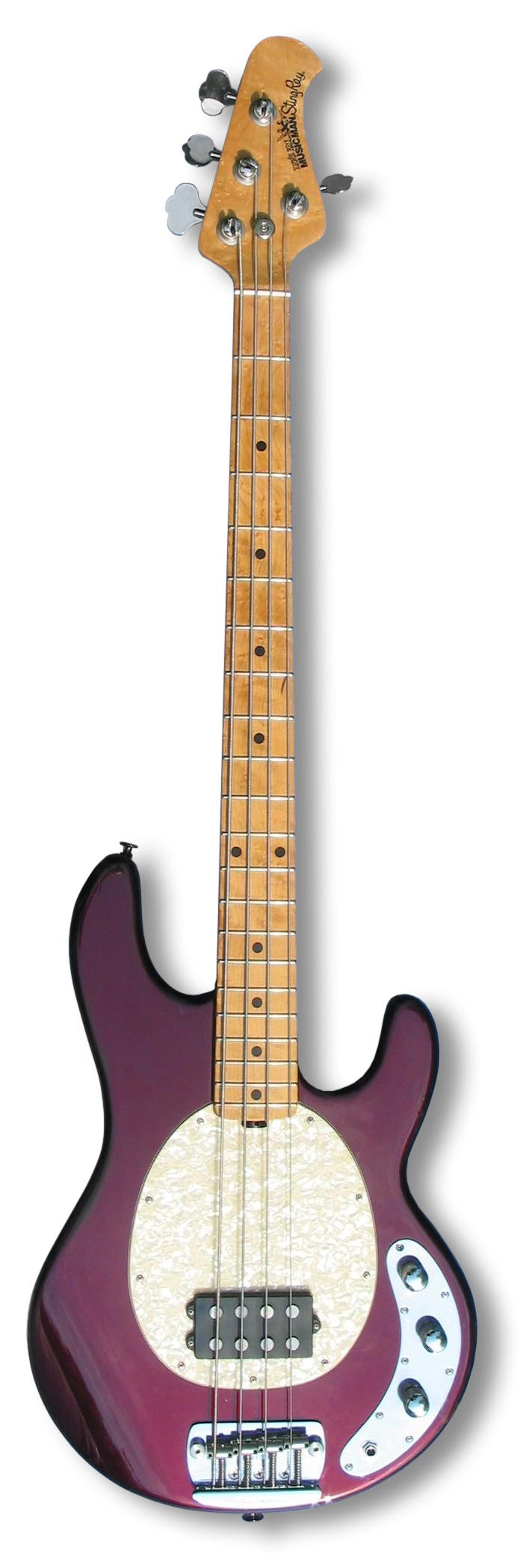
Photo: Th. Ott / Wikimedia Commons / CC BY-SA 3.0 Music Man
StingRay
1976
Leo Fender wanted a wide, bright bass. Louis Johnson hit it with his thumb, and funk had its sound.
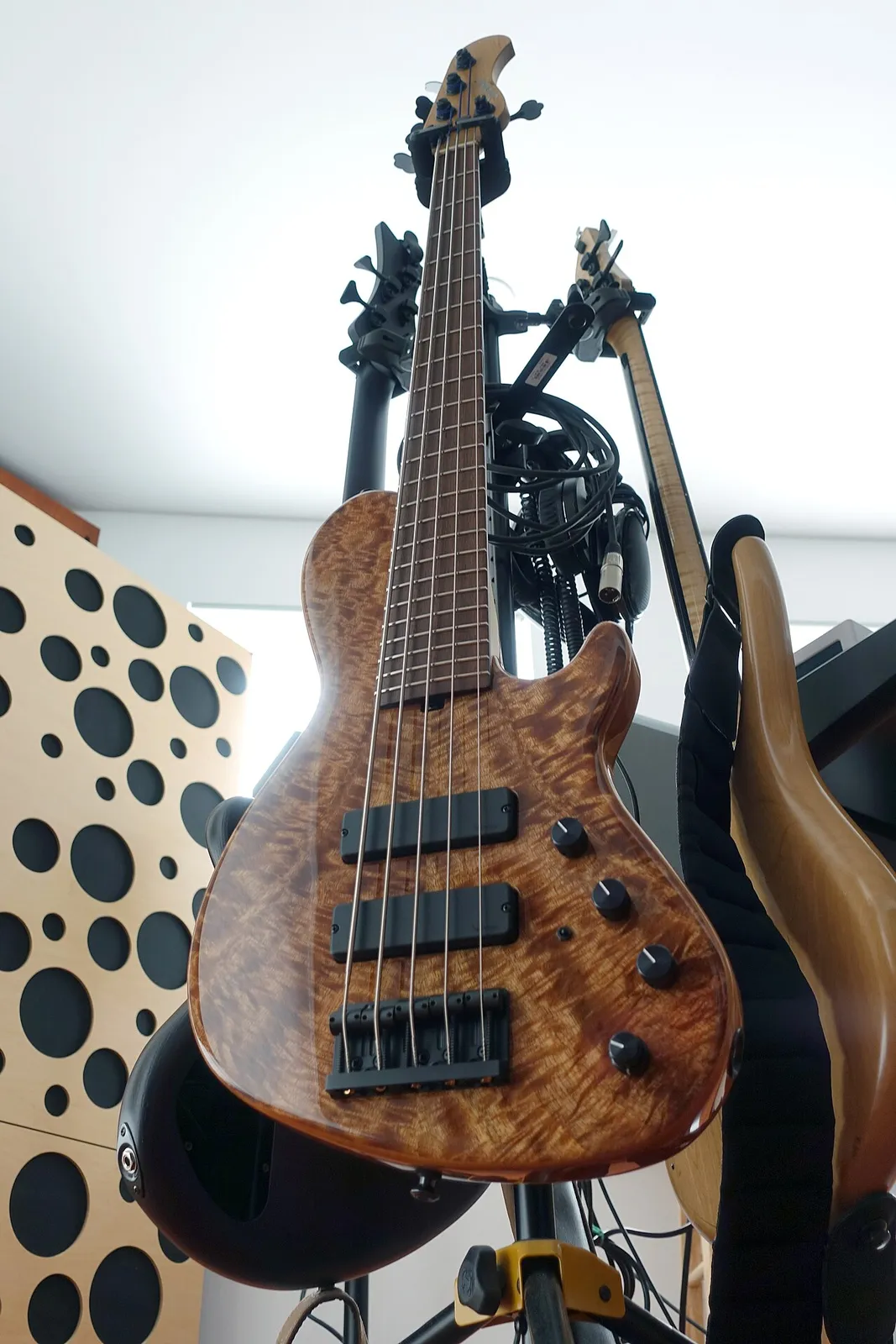
Photo: Nir Yaniv / Wikimedia Commons / CC BY-SA 4.0 Sadowsky
NYC Bass
1982
Built for the New York session bassist whose engineer wasn’t going to reset the board for him.