Sadowsky
NYC Bass
Built for the New York session bassist whose engineer wasn’t going to reset the board for him.
Manhattan, around 1980. A session bassist walks into a shop at 33rd and Madison with a Fender that needs shielding and a little more punch. The man behind the bench, Roger Sadowsky, doesn’t play bass. He fixes it anyway.
- Introduced
- 1982
- Type
- Solidbody electric bass
- Class
- Production
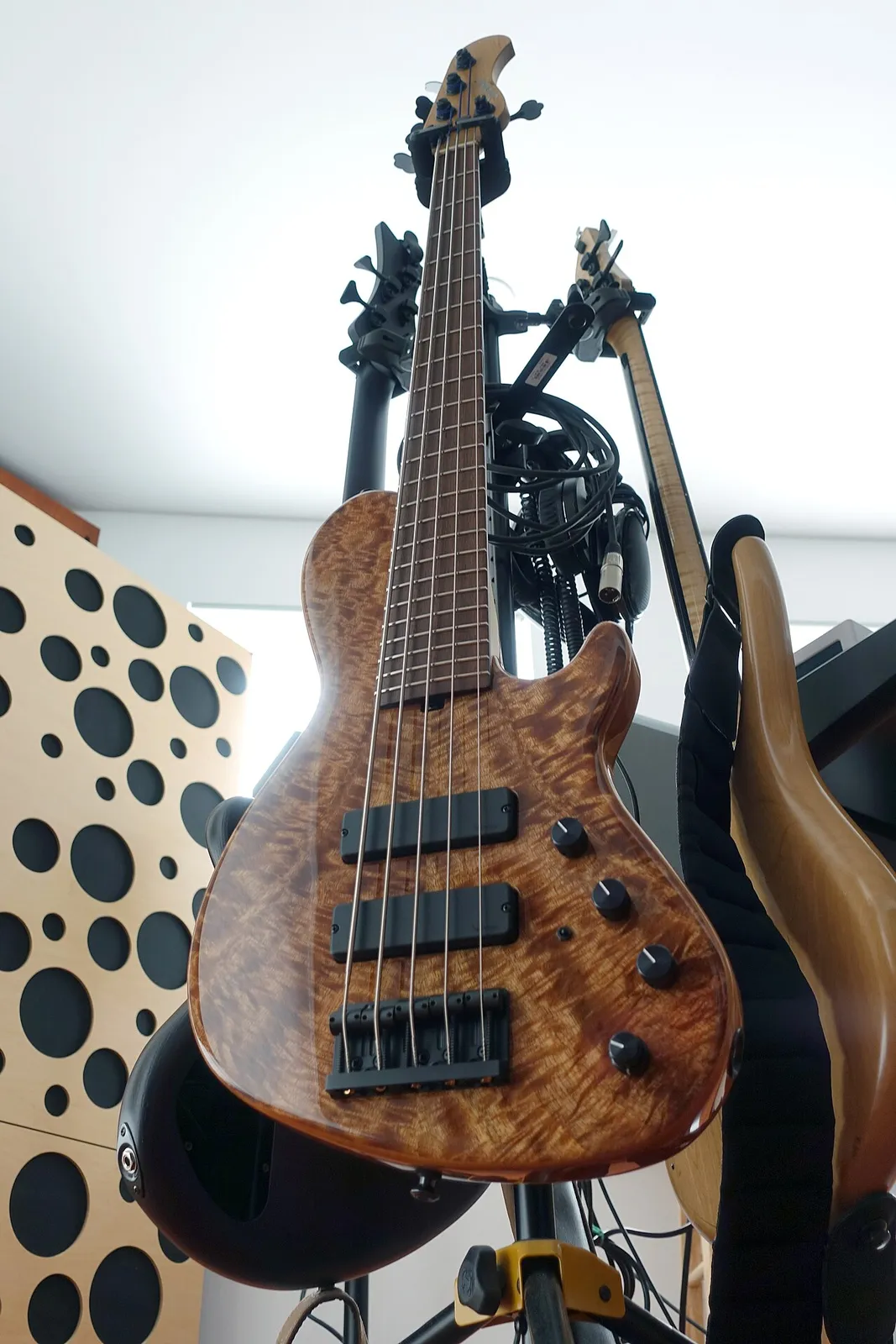
The short version
1979
33rd and Madison
Roger Sadowsky opens his repair shop, in August or September depending on who’s telling it.
1982
The first bass
A PJ four-string, built for Will Lee.
1996
Newsted’s order
Jason Newsted orders four 4-strings and three 5-strings for Metallica.
2004
Chambered
Around now the bodies get hollowed chambers and the necks get two graphite strips.
2009
Will Lee Model
Lee’s own signature, with 22 frets and a narrower nut.
2011
Long Island City
The shop moves to Queens, where it still is.
2019
Orange dots
Colin Greenwood picks up a custom NYC bass with side dots he can see under blue lights.
Side A
A1
Two chapters in the union book
In the book for Local 802, the New York musicians’ union, there were two chapters for bass. One was Acoustic Bass. The other was Fender Bass.
That tells you the room Roger Sadowsky walked into. In the session world, the engineer already had the board set up for a Jazz Bass or a Precision, and on a forty-minute jingle he wasn’t going to reset it for your weird boutique instrument. You showed up with a Fender, or something that sounded like one.
Sadowsky opened his shop at 33rd and Madison in 1979, in August or September depending on who’s telling it, and I’m not going to argue about a month. He isn’t a bass player. He’s a fingerpicker. What he was good at was listening to the people who came in, and fixing exactly the thing they needed fixed.
A2
Hot-rodding the Fenders
The first customers were session bassists: Will Lee, Neil Jason, Oscar Cartaya, Hugh McDonald. They brought in their basses for shielding, new hardware, and an active circuit that could boost the treble and bass. The first circuit came from Ron Armstrong at Stars Guitars. Marcus Miller’s 1977 Jazz Bass got one soon after, in 1979 or 1980 depending on who’s counting.
Then old Fenders stopped being cheap. When a vintage Jazz Bass was a used bass under $800, drilling it up for a preamp was just good sense. Once they turned into collector’s items, hot-rodding them started to feel like vandalism.
So in August 1982 Sadowsky built his own. The first one was a PJ four-string for Will Lee. The next was a slightly smaller-bodied bass for Miller that later went to Matt Garrison. Undersized Jazz-style body, bolt-on maple neck, 34-inch scale. He wasn’t trying to reinvent anything.
Leo got so much right the first time around. I’ve never strayed too far from the Fender paradigm.
A3
A preamp that only goes up
The preamp is the argument. After the Stars circuit was discontinued, Sadowsky used a Bartolini circuit “for the next eight years,” and then built his own, later working with Alex Aguilar.
It’s boost only. The bass knob adds low end around 40 Hz and the treble knob adds sparkle around 4 kHz. There’s no cut. At zero, you’re flat, and the bass sounds like a good Fender. The Vintage Tone Control is a passive treble roll-off that still works with the preamp on, and if you pull it, the preamp is out and the bass is passive.
That design makes sense if you picture the engineer again. Start from the sound he expects, and add a little. Don’t take anything away he might need.
Flip the record · By the numbers
2
Chapters for bass in the New York musicians’ union book. Acoustic Bass, and Fender Bass.
under $800
What an old L-series Jazz Bass cost, used, back when hot-rodding one didn’t feel like a crime.
+13 dB
Bass boost at 40 Hz, per Sadowsky’s own spec sheet. Aftermarket listings say +18. Either way, it only boosts.
8
People in the Long Island City shop in 2017. A CNC machine does the rough cut; they do the rest by hand.
Side B
B1
Holes in the body
Around 2004 the bodies started getting chambers. Alder and ash were coming in heavier, so Sadowsky began routing out pockets inside. At about the same time the necks got two graphite strips and a thicker headstock, not because they were unstable, but to fight the dead spot around the G at the seventh fret that Fender-style bolt-ons are known for.
The shop moved with the work: 1600 Broadway in 1986, Brooklyn in 2002, Long Island City in 2011, where it still is. In 2017 there were eight people there, with a CNC machine for the rough cut and everything else by hand. The Japanese MetroLine, the German Metros, and the other lines are made elsewhere. The NYC Bass comes out of Queens.
B2
Salt water and orange dots
Jason Newsted ordered four four-strings and three five-strings in 1996 and took them through Metallica’s Garage Inc. and S&M. He tested them by dunking them in salt water, to see what his sweat would do on tour. Only the Sadowsky passed. He called it a “turbo-Fender.”
Verdine White of Earth, Wind & Fire said it plainly in 2004: “Right now I’m using a Roger Sadowsky bass.” Tal Wilkenfeld got her first one that year and later played a five-string with a capo on “Haunted Love.”
And in June 2019, Colin Greenwood of Radiohead came by the shop to pick up a custom P-style NYC bass, a stand-in for his 1963 Precision. It has orange side dots, because Greenwood is color-blind and has to find them under blue stage lights.
Forty years after a fingerpicker started fixing whatever working bassists carried through his door, a bassist carried in a problem with his eyes and the stage lights. The fix was the color of a dot.
Put this on
You’ve read about it. Now hear it. Here’s what this guitar sounds like, and what to listen for.
Haunted Love
An NYC five-string, tuned E–A–D–G–C, with a capo at the third fret. That’s not a typo. It’s a bass with a capo.
Find it on YouTube (opens in a new tab)Garage Inc.
Jason Newsted’s Sadowskys, the ones that passed the salt-water test. (Load was a ’58 Precision and a Spector, not these.)
Find it on YouTube (opens in a new tab)
The cast
The people, and the specific guitars, that made the legend.
1982
Will Lee
The first Sadowsky bass, a PJ
The origin. One of the session players bringing basses in to be fixed, and the man the first one was built for.
1996
Jason Newsted
NYC four- and five-strings
Metallica. Dunked his basses in salt water as a sweat test. Only the Sadowsky passed. He called it a “turbo-Fender.”
2004
Tal Wilkenfeld
NYC five-string
Her first Sadowsky came in 2004. The Crossroads clip with Jeff Beck is a Metro, which is a different factory.
2004
Verdine White
A Sadowsky, then a P/J signature
Earth, Wind & Fire. “Right now I’m using a Roger Sadowsky bass.” The ’70s hits were made on other basses.
2019
Colin Greenwood
Custom P-style NYC
Radiohead. A stand-in for his ’63 Precision, with orange side dots because he’s color-blind under blue stage lights.
Liner notes
Specs, construction, rarity, value, and every source we used.
An undersized Jazz-Bass body, two skinny coils, and a boost-only preamp — Roger Sadowsky’s New York session bass, not a Fender, not a MetroLine, and not a Tokyo TYO.
- Body
- Chambered swamp ash, alder, or okoume; undersized double-cut J silhouette. Vintage (pickguard and plate) or Standard (no pickguard).
- Neck
- Bolt-on maple; two graphite strips. Thin matte nitro typical on recent customs.
- Fingerboard
- Maple, rosewood, or ebony; 12" radius on documented 4-21 builds. 21 nickel/silver frets, .090" × .051".
- Scale
- 34". Bass Gear Mag measured a Custom 4-21 at 34". Warwick German listings print 34" (864 mm) on sibling lines. Mix flagged. No millimetres invented for this NYC table.
- Pickups
- Sadowsky single-coil or hum-cancelling J; soapbars in ’60s J locations or P/J. Super P / Super J optional.
- Hardware
- Gotoh / Hipshot tuners; Sadowsky brass bridge with quick-release. Bridge spacing: 20 mm (4-string), 19 mm (5-string). Mix flagged.
- Electronics
- Sadowsky 9V boost-only preamp: master volume, pickup blend, Vintage Tone Control (VTC) with preamp bypass, stacked treble/bass boost.
- Finish
- Custom colours, trans, and figured tops. Satin Series: solid colours, satin, roasted pine.
- Nut
- 1.5" or 1-3/4" on 4-string J; 1-3/4" or 1-7/8" on 5-string. Sold 4-21 sheets: 1.5" (39 mm). Mix flagged.
Open the full research fileConstruction details, the complete player record, production numbers, dated value estimates, and sources
Current typical = NYC Custom 21 Fret (Long Island City). Factory: “the classic Sadowsky Bass.” 2026 list $6,800 / $7,100 (4-/5-string; Portabag included, $350 value). Will Lee (22-fret, 1.45" nut, mid-boost) and Verdine White (P/J) are NYC signatures, not this table. Satin Series is the limited-option NYC SKU. MetroLine (Japan 2003–2020, then Germany), TYO, MetroExpress, and German MasterBuilt are other factories. Not a Jazz Bass (fender-jazz-bass). Mixed inch/mm flagged on factory millimetre spacing against inch nut and scale.
Construction
The job was a Fender-style bass a New York session player could walk into a forty-minute jingle with. Engineers already had the board set for a Jazz or a Precision. They were not going to reset it. Roger Sadowsky is not a bassist. Fingerpicker. Factory timeline: shop at 33rd and Madison, August 1979. Bass Player (2000): he moved in September 1979. Keep both.
The 802 union book had two chapters for bass: Acoustic Bass and Fender Bass. That is the room. Will Lee, Neil Jason, Oscar Cartaya, Hugh McDonald — factory names the first customers bringing instruments in for shielding, hardware, and an active treble/bass circuit. Bass Player (2000): the first circuit came from Ron Armstrong at Stars Guitars, sold to Tony Conniff; Marcus Miller’s 1977 Jazz Bass was next. Factory timeline dates that Miller job August 1980; Rigoni (2015) prints 1979. The Jazz Bass plate keeps the preamp story. This plate does not recruit the blond ’77 as an NYC Bass.
When vintage L-series Jazz Basses left the “used, under $800” bin, hot-rodding them started to devalue the objects. Roger built his own. Factory timeline: first bass guitar, August 1982. Bass Player (2000) and the 2017 profile: a PJ four-string for Will Lee. Then a slightly smaller-bodied bass for Miller that later went to Matt Garrison. Undersized J body, bolt-on maple, 34" scale. “Leo got so much right the first time around,” he told Premier Guitar (2009). “I’ve never strayed too far from the Fender paradigm.”
The preamp is the argument. Stars first. Premier Guitar: when Stars discontinued, Armstrong pointed him at the Bartolini TCT, used “for the next eight years.” Then his own boost-only circuit, later with Alex Aguilar (Bonedo; Bass Magazine, 2025). Factory spec sheet: bass +13 dB @ 40 Hz, treble +13 dB @ 4 kHz, 9V. Aftermarket carts print +18 dB at those frequencies — keep both, do not flatten. VTC is a passive treble roll-off that still works with the preamp up; pull it and you are passive. Boost only. No cut. DiMarzio wound the hum-cancelling pickups to his spec (Bass Quarterly, 2016).
Shop moves with the work. First full-time hire, JW Black, 1985. 1600 Broadway, 1986. 20 Jay Street, Brooklyn, 2002. Long Island City, 2011 — 2107 41st Avenue, still. 2017 Bass Player: eight people; CNC for the rough cut of body and neck, the rest by hand.
About 2004 the bodies are chambered. Bonedo and Bass Quarterly the same year. Rick Suchow’s shop interview: alder and then ash were coming in heavier, so he started cutting chambers. Two graphite strips in the neck and a thicker headstock at the same stretch, against the 7th-fret-G dead spot on Fender-style bolt-ons — not because the necks were unstable. Japanese MetroLine, launched 2003 under Yoshi Kikuchi, copied the models without chambers and without graphite. TYO was Japan custom, Japan market, a different preamp (Roger on TalkBass). MetroExpress Japan 2017–2020, then China. Warwick licence 2019/2020: German MetroLine and MasterBuilt, Chinese Express. Those are other factories. This table is Long Island City.
2009, Will Lee signature: 22 frets, 1.45" nut, Hipshot D-tuner, switchable mid-boost at 500 or 800 Hz. Adjacent SKU. 2016: Single Cut, Satin Series. Okoume later joins ash and alder as a chambered body wood. Six-string prototypes exist; they are not this four-string.
Classic vs current: 1982 solid PJ for Lee — against a living Custom 21 Fret, chambered, VTC, graphite, $6,800. Same silhouette idea. Same slug. No Gibson SKU.
Players
Do not hang a 1960 Jazz Bass on this plate. Do not recruit a MetroLine, a TYO, or a German MasterBuilt as if it were Long Island City. Do not flatten Earth, Wind & Fire or Radiohead records onto a Sadowsky.
Will Lee. The origin object. First Sadowsky bass, 1982, a PJ. Roger, on video: Lee playing his instruments from about 1984. Vintage Guitar (2015): four- and five-string signatures on Late Show With David Letterman and on Love, Gratitude & Other Distractions; a vintage Precision-turned-Jazz with EMG pickups is a different bass, from “way before he was making basses.” The 2009 Will Lee Model is the later SKU. Not every Letterman cue is that 22-fret.
Jason Newsted (Metallica / Voivod). WhichBass / Cunning Stunts: Sadowskys on the Poor Touring Me tour; original 1996 order four 4-strings and three 5-strings. Garage Inc. (1998) and S&M (1999). Load was a ’58 Precision and a 1981 Spector — not this bass. Guitar.com (2023), via Bass Player: salt-water dunk as a sweat test; only the Sadowsky passed. He called it a “turbo-Fender” (TopGuitar). A later NYC signature exists (factory discontinued page). It is not this table.
Tal Wilkenfeld. Factory timeline: first of many basses, 2004. MusicRadar (2019): NYC five-string on “Haunted Love,” E–A–D–G–C, capo at the third fret. Not Crossroads. Gitarre & Bass: the 28 July 2007 Jeff Beck clip is a Metro UV70 four-string. Keep the split.
Verdine White (Earth, Wind & Fire). Guitar World (2004): “Right now I’m using a Roger Sadowsky bass.” Factory: artist more than twenty years when the 2017 signature landed — P/J, 1.5" nut, chambered alder, based on his first Sadowsky, Satin Series at the time. “September” and “Shining Star” are 1970s records. They are not this bass.
Colin Greenwood (Radiohead). Sadowsky shop, 10 June 2019: custom P-style NYC as a stand-in for his ’63 Precision; orange side dots because he is color-blind under blue lights. Bass Magazine (2019) lists it among “new additions.” King of Gear: little Radiohead stage use. Do not stamp OK Computer on it.
Also known to play, last and short: Rickey Minor; Tully Kennedy; Tom Hamilton (Aerosmith). Marcus Miller’s identity instrument stays on the Jazz Bass page.
Rarity
You can order a new NYC Bass from Long Island City. Satin Series is the limited-option current line. MetroLine, MetroExpress, TYO, and MasterBuilt are other factories on this silhouette. They are not an NYC Bass.
Sadowsky does not publish NYC Bass unit totals. None invented. Factory: “over 20,000 NYC and Japanese Metro instruments in the world” — combined, guitars and basses, not an NYC Bass census. Serials are a shared NYC sequence. They date an instrument. They do not count a model.
Pre-1987: serials 101–234. 2020: 8761–8850. Those windows are thin because the shop is small, not because a factory total exists. What is actually thinner: unchambered pre-2004 bodies; first-year 1982 instruments; complete early PJ examples. Lee’s first bass, Newsted’s salt-tested tour pair, Greenwood’s orange-dot P, and Hamilton’s named objects are unique. They are not a vintage NYC Bass.
Value
Informal estimate, 16 September 2026. Not an appraisal.
Ask vs sold labeled. Celebrity lots are not-comps. No invented medians or factory counts. No clean Reverb Price Guide band isolated this pass. Flag: thin sold-comp access.
New street. Factory 2026 custom-order list (Portabag included): 4-string NYC $6,800; 5-string $7,100. Will Lee $7,500 / $7,800. Verdine White $7,000 / $7,300. Single Cut 5-string $7,800. Satin Series: 4-string $4,900; 5-string $5,100; Verdine White Satin $5,300 / $5,400. Figured tops and mid-boost extra.
Used modern. Named 2026 marketplace asks, not hammers: 2015 4-21 Seafoam Green Excellent $4,250 (dropped from $4,500); 2016 Will Lee Black Excellent $4,400 (dropped from $5,200); Vintage 4-string J Good $6,238.86; 2015 Shoreline Gold Very Good $4,699; Standard 4 Good $4,156.66. A 2021 5-24 Mint $7,750 (dropped from $8,750) is one five-string. Do not average it with the four-string asks. Japanese MetroLine and German MetroLine trade lower; they are other factories.
Vintage / collectible. Early unchambered NYC four-strings sit in the same used band as later customs when they trade at all; no separate 1982 hammer isolated this pass. Tom Hamilton’s Aerosmith NYC #83 (Reverb ask $17,095, dropped from $19,066) is celebrity, not a street tape. Later NYC signatures are new SKUs, not vintage comps.
See also
- fender-jazz-bass — 1960 Fullerton silhouette this NYC bass is not
- music-man-stingray — the other 1970s active 34" four-string; not a Jazz body
- fender-precision-bass — Greenwood’s identity instrument; Verdine’s P/J is not this table
Sources
- Sadowsky, Roger Sadowsky profile — shop 1979; first bass August 1982; Miller 1977 Jazz August 1980; MetroLine Japan 2003; Will Lee 2009; LIC 2011; Satin / Single Cut 2016
- Sadowsky, NYC Custom 21 Fret — classic 21-fret spec; 2026 list $6,800 / $7,100
- Sadowsky, NYC Custom Will Lee Signature — 22-fret; 1.45" nut; mid-boost 500/800 Hz; $7,500 / $7,800
- Sadowsky, The Sadowsky WILL LEE Signature Bass (YouTube, 4 January 2025) — Lee on Sadowsky instruments from about 1984; signature talk around 2008
- Sadowsky, NYC Custom Jason Newsted Signature 21 Fret Bass — later NYC signature SKU, discontinued page
- Sadowsky, NYC Satin Series — roasted pine; graphite; 12" / 1.50"; $4,900 / $5,100
- Sadowsky, 2026 NYC price list (PDF) — 4-string $6,800; 5-string $7,100; Will Lee / Verdine / Single Cut; Portabag $350 value
- Sadowsky, serial numbers — NYC 101–234 pre-1987; yearly ranges through 2024; Japanese MetroLine M-prefix 2004–2020
- Sadowsky, instrument specs — “over 20,000 NYC and Japanese Metro instruments”; Japanese Metro solid vs Express chambered
- Sadowsky bass preamp / VTC sheet (PDF) — +13 dB @ 40 Hz / 4 kHz; 9V; VTC flat at 10
- Sadowsky previously sold 21-fret 4-strings — 12" radius; 1.5" (39 mm) nut; chambered ash / alder / okoume
- Premier Guitar, Roger Sadowsky: A Vintage Man of Modern Means, 21 April 2009 — union book; L-series under $800; Stars then Bartolini TCT eight years; Fender paradigm
- Bass Player, Roger Sadowsky profile, 2000 (PDF) — first bass 1982 PJ to Will Lee; smaller-body Miller bass later to Matt Garrison; Stars circuit / Conniff / Miller 1980
- Bass Player, Roger Sadowsky profile, 2017 (PDF) — first bass 1982 Will Lee; eight-person LIC shop; CNC rough cut
- Bass Musician Magazine, Alberto Rigoni interview, December 2015 — first basses 1982; Miller 1979 preamp still in use
- Rick Suchow, Carving Out a Legacy in New York — chambering; graphite strips and thicker headstock vs 7th-fret-G dead spots; Will Lee 1.45" nut
- Bonedo, Firmenportrait: Sadowsky Basses, 11 September 2019 — NYC chambering since 2004; Aguilar boost-only; DiMarzio-wound pickups; VTC
- Bass Quarterly, Sadowsky profile, 2016 (PDF) — chambered ~2004; DiMarzio to spec
- Bass Magazine, Sadowsky Tour: From High Cs to Okoume Trees, 4 March 2025 — 34" scale kept on 6-string; okoume; Aguilar reconnection
- Bass Magazine, Partners: Will Lee & Sadowsky, 24 September 2019 — 1.45" nut; mid-boost; Metro Line Japan by Kikuchi
- Vintage Guitar, Will Lee — Late Show signatures; Love, Gratitude & Other Distractions; earlier EMG Precision-Jazz
- Will Lee, Sadowsky WL Model — 22-fret compromise; mid-boost piggyback
- Bass Gear Mag, Bass Lab: NYC Custom 4-21, 22 March 2024 — measured 34" scale; 12" radius
- TalkBass, Roger Sadowsky on Metro / TYO / Express — MetroLine 2003–2020 unchambered; TYO Japan custom; Express Japan 2017–2020 then China; MetroLine Germany from 2020
- guitarguitar, MetroExpress Q&A with Roger Sadowsky, 17 December 2020 — Japanese production ended; Warwick licence; MetroLine from about $2,900
- Sadowsky Germany FAQ — Warwick licence; NYC Custom Shop continues
- For Bass Players Only, Jon Liebman interview, 22 April 2013 — first electrics 1979, basses 1982
- Guitar World, Verdine White classic interview, 14 December 2021 (2004) — “Right now I’m using a Roger Sadowsky bass”
- Sadowsky, Verdine White Signature, 23 August 2017 — based on his first Sadowsky; P/J; 1.5" nut; Satin Series
- MusicRadar, Tal Wilkenfeld, 15 April 2019 — NYC five-string on “Haunted Love”
- Gitarre & Bass, Tal Wilkenfeld / Crossroads — 28 July 2007 Crossroads on a Metro UV70
- Guitar.com, Jason Newsted saltwater test, 3 July 2023 — Load on ’58 P and 1981 Spector; only Sadowsky passed the dunk
- TopGuitar, Jason Newsted on Sadowsky — “turbo-Fender”
- WhichBass, Jason Newsted bass rig — 1996 order; Garage Inc. / S&M; Cunning Stunts
- Bass Magazine, Colin Greenwood, 29 March 2019 — Sadowsky NYC among new additions; Precision identity
- Sadowsky NYC Custom Shop, Colin Greenwood pickup, 10 June 2019 — P-style stand-in for ’63 Precision; orange side dots
- Reverb, Sadowsky NYC listings — 2026 used asks cited in Value; Tom Hamilton #83 celebrity ask
Keep digging
Guitars this one gets compared to, confused with, or descended from.

Fender Jazz Bass from 1966 in Olympic white with the transition fingerboard (bindings and dot inlays). Photo by Th. Ott. Licensed under CC BY-SA 3.0. Via Wikimedia Commons. Fender
Jazz Bass
1960
Built for jazz players who mostly passed on it. Then bass players started using it to take the solo.
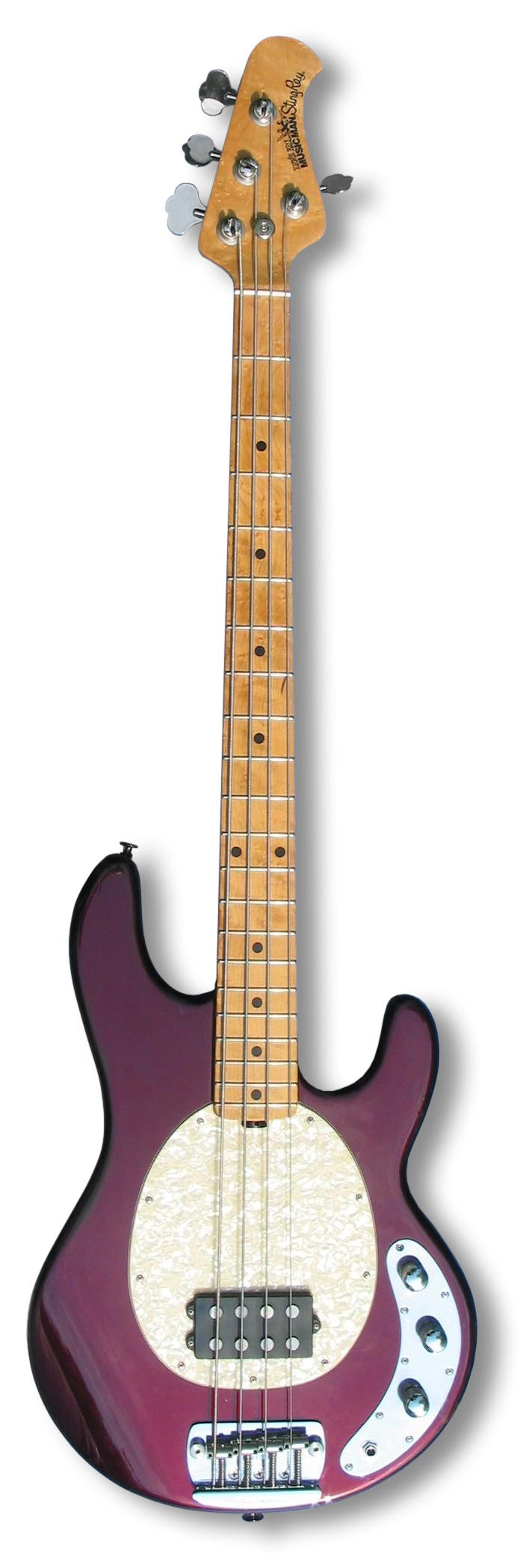
Photo: Th. Ott / Wikimedia Commons / CC BY-SA 3.0 Music Man
StingRay
1976
Leo Fender wanted a wide, bright bass. Louis Johnson hit it with his thumb, and funk had its sound.

Photo: Infrahertzz / Wikimedia Commons / CC BY-SA 3.0 Fender
Precision Bass
1951
Leo’s bass let the player at the back be heard. You know their lines by heart. You mostly don’t know their names.