National
Tricone
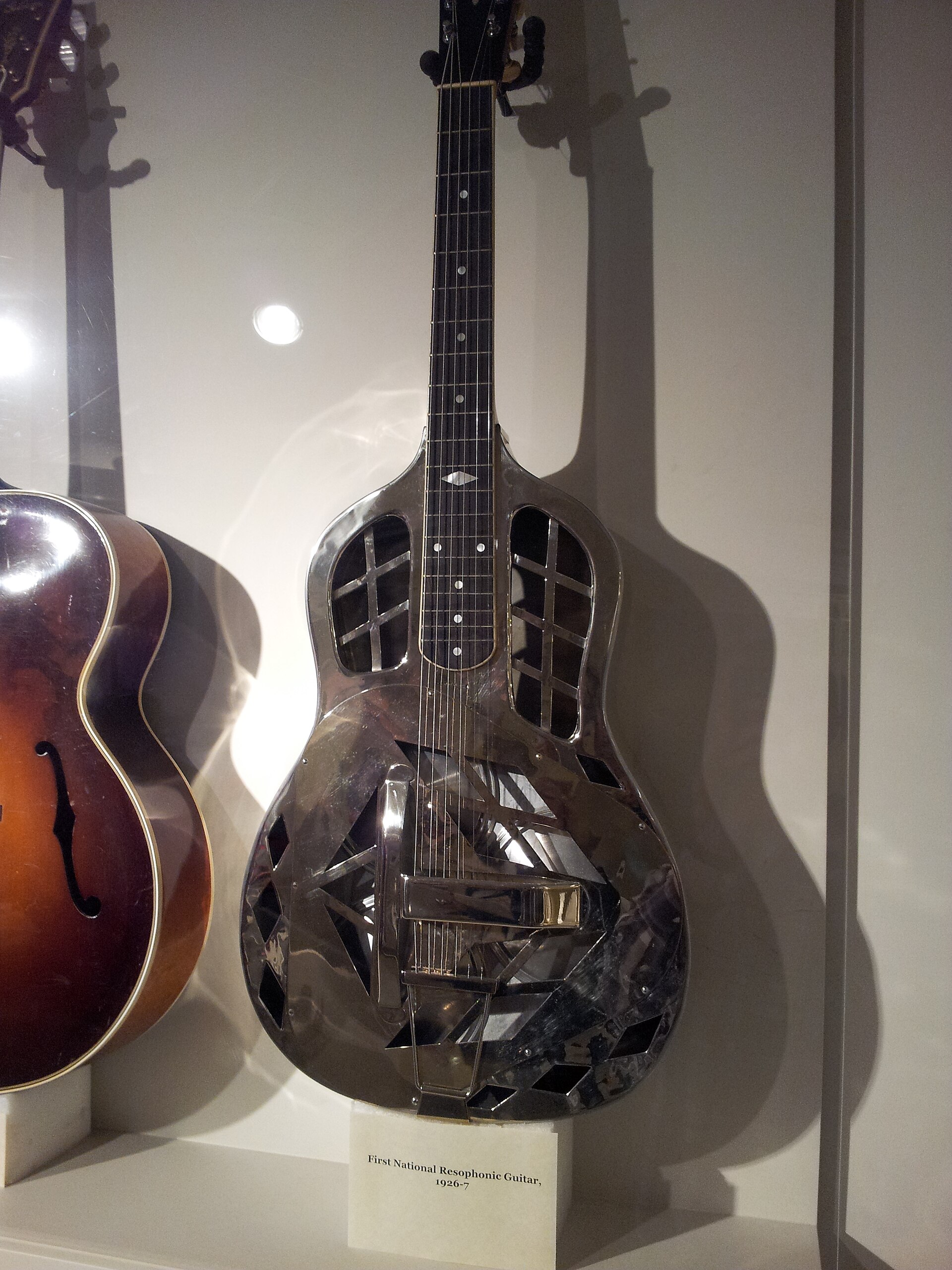
Three aluminum cones in a metal box, so a Hawaiian steel guitar could be heard over a band.
In the 1920s a vaudeville steel player asked an instrument maker for a louder guitar. What he got was the National tricone: German silver, three spun cones, and a T-shaped bridge. A cheaper single cone soon took over the factory. The tricone never quite went away.
- Introduced
- 1927
- Type
- Metal-body resonator
- Class
- Production
The short version
1926
Farewell Blues
On 18 October Sol Hoopii records for Columbia in Los Angeles, on a tricone prototype by two histories’ account.
1927
National
John Dopyera files the three-cone patent in April. The National String Instrument Corporation, probably founded this year, starts production.
1928
Tampa Red
He becomes the first black musician to play a National steel resonator, a gold-plated tricone with chrysanthemums on the back.
1928
The biscuit
George Beauchamp rushes the cheaper single-cone Triolian into production late in the year.
1929
Dopyera leaves
In January or in the middle of the year, depending who you ask. He goes on to Dobro.
1941–42
The end of the run
The old Los Angeles company stops making tricones. The sources split on the year.
1989
National Reso-Phonic
Don Young, who learned from John Dopyera, starts a new company with McGregor Gaines in a Long Beach garage.
2002
Brozman retires his last old one
Bob Brozman starts playing new tricones on stage every day.
Side A
A1
Loud enough for a band
On 18 October 1926, in Los Angeles, Sol Hoopii’s Novelty Trio recorded “Farewell Blues” for Columbia, with Hoopii on steel guitar. Two histories say the guitar in his lap was a prototype metal square-neck, given to him so Hollywood would hear it. The label on the record doesn’t say.
Hawaiian music was the loud ensemble music of the 1920s, played lap-style with a steel bar. The trouble was the guitar. A koa Hawaiian guitar couldn’t sit in with horns.
So George Beauchamp, a vaudeville steel player, asked John Dopyera for a louder one.
A2
Three cones and a T
Dopyera started from the phonograph: a disc feeding a horn. What he built was a stamped metal body with three handspun aluminum cones inside, linked under the bridge by a cast aluminum bar shaped like a T. Two cones sit on the bass side, one on the treble.
The cones throw the sound back, then out through the ports in the cover. Everything you hear goes through that T. Dobro would later turn a single cone the other way. This one doesn’t.
He filed the patent for it in April 1927. Probably that same year, Dopyera, Beauchamp, Ted Kleinmeyer and Paul Barth started the National String Instrument Corporation in Los Angeles, with Dopyera’s brothers Emil and Rudy in the mix, and production began. Decades later, Dopyera described it in one line.
The Tricone guitar flowed like a river.
A3
Plain, rose, lily, chrysanthemum
The tricones came in German silver, an alloy of copper, zinc and nickel, nickel-plated. Then they came in four dresses. Style 1 was plain. Style 2 was engraved with wild roses, Style 3 with lily of the valley, and Style 4 with chrysanthemums, purportedly drawn by Beauchamp himself.
They came two ways, too. Square neck for the lap, Hawaiian style. Round neck to play upright, Spanish style. Almost every Style 4 that survives is a square neck, which tells you how popular lap-style playing was.
A Style 4 listed for $195 in 1929, and still did in 1932, which is a hard number in the middle of the Depression. Not many sold.
In 1928, Tampa Red became the first black musician to play a National steel resonator, a gold-plated tricone with the chrysanthemum on the back. In 1994 a man named Randy Clemons found it in Belleville, Illinois, with “Tampa Red” on it. It arrived green with corrosion. He polished it for three weeks. George Gruhn called it “the most significant National in existence.” It went to a museum in Seattle.
Flip the record · By the numbers
3
Cones, two on the bass side and one on the treble, tied together by one T-shaped bridge.
4
Styles, by engraving. Plain, wild rose, lily of the valley, chrysanthemum.
$195
A Style 4 in 1929, still the price in 1932, the middle of the Depression.
1989
The year the name came back, from a garage in Long Beach.
Side B
B1
The cheaper cone wins
Late in 1928, Beauchamp rushed a cheaper National into production, the Triolian, with one cone and a wooden biscuit on top of it. Dopyera had wanted that biscuit for a ukulele, not a guitar.
He left in 1929, in January or the middle of the year, depending who you ask, and went on to build Dobros. National kept making tricones. But from 1930 the bulk of its work was the single cone, then electrics. The tricone didn’t turn into the biscuit guitar. It just got rarer beside it.
The old company stopped making them in 1941 or 1942. The records don’t agree.
B2
Out of the box
Don Young learned to build resonators from John Dopyera. In 1989 he and McGregor Gaines started National Reso-Phonic in Young’s garage in Long Beach. A year later they moved up the coast, and today the shop is in San Luis Obispo. You can order a Style 1 from them: brass under bright nickel, where the old ones were German silver, three cones, a T-bridge.
Bob Brozman wrote the book on these guitars, literally, in 1993. He worked with the new company from the early 1990s, and in 2002, he said, he started using new tricones on stage every day, “when I retired my last old one.” A new tricone, he said, sounded as good out of the box as an old one, except for the first string. Play it six months and the bass gets better.
Old ones in new condition, he said, took a few months to open up too. A hundred years after Hoopii’s session, the river still runs the same way.
Put this on
You’ve read about it. Now hear it. Here’s what this guitar sounds like, and what to listen for.
Farewell Blues
Hoopii is on steel. Two histories call this session the tricone’s debut, on a prototype National gave him. The record label doesn’t name the guitar.
Find it on YouTube (opens in a new tab)Stack o’ Lee Blues
Cut the same day as “Farewell Blues.” One history names both sides as the tricone’s debut. The label doesn’t name the guitar.
Find it on YouTube (opens in a new tab)
The cast
The people, and the specific guitars, that made the legend.
1926
George Beauchamp
Asked for it
A vaudeville steel player who wanted a louder guitar. The chrysanthemums on the Style 4 are said to be his drawing.
1927
John Dopyera
Designer
Built three spun aluminum cones into a metal body. Decades later he said it “flowed like a river.”
1926
Sol Hoopii
A square-neck tricone prototype
Given one so Hollywood would hear it, by one account. Moved to an electric frying pan in 1931.
1928
Tampa Red
A gold-plated chrysanthemum National
Found in Illinois in 1994 with his name on it, green with corrosion. It went to a museum in Seattle.
2002
Bob Brozman
A 1992 tricone prototype; new tricones from 2002
Wrote the book on National resonators and worked with National Reso-Phonic from the early 1990s.
Liner notes
Specs, construction, rarity, value, and every source we used.
Three cones under a T-bridge, so a Hawaiian guitar could cut a band — National’s tricone, not a Style O biscuit and not a Dobro spider.
- Body
- Current Style 1: brass, bright nickel, coverplate and tailpiece nickel. Factory depth 3.125". Vintage cards say German silver (nickel silver), nickel-plated — Guitar Player, guitarhq, RetroFret, Carter, Vintage Instruments. National’s page says the brass is the brothers’ alloy. Keep both. guitarhq: grid soundholes on the upper body, bass side and treble side. Not a wood Dobro. Not a biscuit.
- Neck
- Mahogany, slotted head, satin polyester (factory Style 1). Vintage Spanish: mahogany. Vintage Hawaiian: metal neck, mahogany headstock (guitarhq). Square vs round is two guitars.
- Fingerboard
- Ebony, ivoroid-bound, 16" radius, dots on the current Style 1 (factory; Musician’s Friend). Vintage guitarhq: flat radius; dots on Styles 1 and 2; pearl diamonds on Styles 3 and 4. Early Style 1 sometimes unbound. Do not treat 16" as a 1929 board.
- Scale
- Factory Style 1: 25 21/32". Carter’s 1930 roundneck measures 25". RetroFret’s 1932 Style 4 square neck: 25 in. (635 mm). Mix flagged. Do not average. Do not invent millimetres for 25 21/32" or for Carter’s 25".
- Resonator
- Three aluminum cones, T-bridge (factory calls it a T-bridge; patent 1,741,453 says a common spider). Musician’s Friend, this Style 1: three 6" cones. guitarhq: two cones on the bass side, one on the treble. Not a single biscuit. Not an eight-leg Dobro spider.
- Hardware
- National tuners; bone nut; T-bridge. Vintage: maple saddle, lightly engraved tuner plates, white buttons (guitarhq). Square-neck nut is a different width.
- Electronics
- None on the classic card. National Slimline is a listed option, not this table.
- Finish
- Bright nickel over brass (current Style 1). Neck satin polyester. Engraved Styles 2–4 are other dresses. NRP Steel is rubbed steel. Raw Series is wax.
- Nut
- Factory 1.82"; string spacing E-to-E 2.31". Musician’s Friend prints 1-13/16". Carter’s 1930: 1.839". RetroFret’s 1932 square neck: 2 in. (51 mm). Mix flagged. Do not average. Do not convert 1.82", 1-13/16", or 1.839".
Open the full research fileConstruction details, the complete player record, production numbers, dated value estimates, and sources
Classic living example = National Reso-Phonic Style 1 Tricone, San Luis Obispo, brass under bright nickel, round neck. Factory list $5,900 / direct $5,310; deluxe hardshell included. Weight listed 8 lb 14 oz. Options on that page, not this table: 12-fret, 14-fret, cutaway, German silver, baritone, Slimline. The same page lists Style 1.5, Style 2, and Style 3; this pass did not open a separate spec card for 1.5. guitarhq’s vintage “1 1/2” is a Style 1 with wriggly edge lines after 1930, and “2 1/2” is a Style 2 with roses on the cover. Not extra cone designs. NRP Steel Tricone is steel, unbound board, list $5,100 / direct $4,590. Raw Series is wax, maple neck, steel or brass or German silver. M-1 is a laminated-mahogany wood tricone, listed 5 lb 14 oz, depth 3.32" — not this metal body. Reso Rocket N is a single-cone (list $5,800 / direct $5,220) with tricone-style grills. A Scheerhorn tricone is another maker’s wood guitar on National cones. Vintage Los Angeles tricones, about 1927 into the early 1940s, are the old object: German silver on the dealer cards, square neck or round neck, Styles 1–4. Not a 2026 Style 1. Not Style O (national-style-o). Not a Dobro (dobro-model-27). Not a Weissenborn. Not an A-22. Standalone. No Gibson SKUs. Mixed inch/mm flagged where RetroFret printed both. Factory Style 1 dimensions are inches only.
Construction
The job was volume. Hawaiian music was the loud ensemble of the 1920s, played lap-style with a bar, and a koa Weissenborn (weissenborn-style-2) could not sit with horns. George Beauchamp, a vaudeville steeler, asked John Dopyera for a louder guitar. Premier Guitar (Richie Owens, 5 June 2018): Dopyera started from the phonograph idea, a disk feeding a horn, and what he built was three handspun aluminum cones, a cast aluminum T-bar under the bridge, and a stamped metal body. The cones throw the sound back, then out the ports in the cover. Dobro later turned a single cone forward. This one does not.
The paper trail is two filings, not one birthday. Patent 1,741,453 says it improves a pending application filed 12 October 1926, serial 141,115. The patent that describes the guitar players mean — a body of thin sheet metal or wood (the patent allows both; the catalog bodies in these sources are metal), preferably three diaphragms, joined at their axes by one spider that is the bridge — was filed 9 April 1927, serial 182,424, and issued 31 December 1929. John Dopyera assigned it to George D. Beauchamp, T. E. Kleinmeyer, and Paul Barth. Vintage Guitar (Michael Wright): Dopyera, Beauchamp, Ted Kleinmeyer, and Paul Barth founded the National String Instrument Corporation, probably in 1927, in Los Angeles, when production and advertising began. Wright’s Ted and the patent’s T. E. are the two printings of that name. The company was certified as a California corporation in 1928. Owens adds Emil and Rudy among the people who formed it. Keep the four names and the brothers. YAML introduced: 1927 is that production-and-advertising year, and the year of the three-cone patent, not the October 1926 filing and not Sol Hoopii’s October 1926 session.
Wright also has Adolph Rickenbacker supplying cones, coverplates, and tailpieces to both National and, later, Dobro. Guitar Player (Dave Hunter, 17 August 2021) puts Rickenbacker in the 1927 collaboration itself. Keep both. He is not on Wright’s founder list.
What you hear is the T. Three cones, two on the bass side and one on the treble (guitarhq), linked by that bar. Players say T-bridge. The patent says spider. Same part. A biscuit puts one wooden disc at the apex of one cone. A Dobro spider stands on the rim of an inverted bowl. National’s own page quotes Dopyera, decades later in RetroFret’s telling: “The Tricone guitar flowed like a river.” guitarhq’s other name for the instrument is triplate.
The dresses are the catalog, not different machines. guitarhq and the Fretboard Journal: Style 1 plain; Style 2 wild rose (some 1927–29 covers engraved too, sometimes called 2 1/2); Style 3 lily of the valley; Style 4 chrysanthemum. Diamonds on 3 and 4. Dots on 1 and 2. guitarhq: all four “available 1927 to 1942,” discontinued 1942, German silver, nickel plated, 12 frets clear, flat board, maple saddle. RetroFret, on a 1932 Style 4: top of the line from its introduction in 1928 until production ended in 1941. The Los Angeles Times (13 April 1991) has the old company out of business since 1941. Keep 1927, 1928, 1941, and 1942. Clear pickguard on Styles 3 and 4 from 1936 (guitarhq). Early bodies: hand-soldered grids. Fretboard Journal: Style 4 listed at $195 in 1929. RetroFret: $195 in 1932, a hard price in that depression year, so few were selling. Guitar Player: the chrysanthemums were purportedly drawn by Beauchamp. German silver, on that page, is copper, zinc, and nickel.
Square neck or round neck is the other split. Hawaiian square: metal neck, mahogany head, the guitar in the lap. Spanish round: mahogany neck, played upright. Vintage Instruments’ 1930 roundneck Style 1 meets the body at the 11-1/2 fret, and that one wears Style 3 inlays. guitarhq’s general line is 12 frets clear. Do not average them into one joint.
Then the cheaper cone won the factory argument. Vintage Guitar (Tom Gray): Beauchamp rushed the Triolian, a single cone with a wooden biscuit, into production in late 1928. John had wanted that biscuit for a ukulele, not a guitar. He left in January 1929 (Gray) or mid-1929 (Wright). Keep both. Dobro is the wood guitar with the inverted cone (dobro-model-27). National kept building tricones, and it also built biscuit single-cones. Style O (national-style-o) is that biscuit, in nickel, from 1930. A tricone is not a Style O. A Style O is not a tricone. From 1930 on, RetroFret says, the bulk of National’s work was the cheaper single cone, then electrics. The tricone did not become the biscuit. It got rarer beside it.
The name on a new guitar is a different company. National Reso-Phonic’s about page: Don Young learned to build resonators from John Dopyera, then with McGregor Gaines founded National Reso-Phonic in 1989, in Young’s Long Beach garage. They moved to the Central Coast in 1990. The shop is San Luis Obispo. The 1991 Times piece that closes the old firm at 1941 is about that firm. It is not a denial of the garage shop. You can order a Style 1 from the new company. You cannot order a 1929 German-silver square neck from it.
The table is the living Style 1: brass, nickel, mahogany, bound ebony, 25 21/32", nut 1.82", 16" radius, 8 lb 14 oz, polyester on the neck. Vintage measured cards do not match those numbers, and they do not match each other. Carter’s 1930 Style 1: German silver, scale 25", nut 1.839", maple bridge. RetroFret’s 1932 Style 4 square neck, serial 2601: 38 7/8 in. (98.7 cm) long, 14 1/8 in. (35.9 cm) wide, 3 1/8 in. (7.9 cm) deep, scale 25 in. (635 mm), nut 2 in. (51 mm). Mix flagged. The wide nut is a Hawaiian square neck. It is not a misprint of 1.82". Current National also sells the cone system in steel (NRP Steel), in wax (Raw), and in mahogany (M-1). Those are other bodies. The Reso Rocket N’s grills look like a tricone and the cone count is one.
Players
Do not hang a Style O, a Duolian, a Triolian biscuit, a Dobro, a Weissenborn, or a frying pan on this plate. Do not give Hoopii’s 1926 session a later serial. Do not give Tampa Red’s chrysanthemum to every National he might have touched. Son House and Bukka White are photo claims on the Style O plate, not this one.
Sol Hoopii — a prototype, on Columbia, before the catalog year. The session is dated. The instrument is named by two histories, not by the disc label. DAHR: Columbia matrix W142793, “Farewell Blues,” Sol Hoopii’s Novelty Trio, 18 October 1926, Los Angeles, issued on Columbia 797-D; Hoopii is the steel guitar. Same day, “Stack o’ Lee Blues,” matrix W142794. The label does not say National. Vintage Guitar (Wright): he was the first to record with the ampliphonic guitars, on a prototype, that first Columbia session, “Farewell Blues.” HistoryLink (Peter Blecha, 7 June 2017): those two sides are the debut recording of National’s tri-cone, a metal square-neck the company gave him so Hollywood would hear it. Columbia recordings run through 1931 (HistoryLink). That is not a claim that every later Columbia side is this same prototype. Six days before the session, serial 141,115 was already on file. Patent 1,741,453 was not filed until 9 April 1927. So “Farewell Blues” is a prototype, not a Style 1 from a 1927 catalog. In 1931 he introduced the electric frying pan, a different instrument (rickenbacker-a-22). Around 1935 he moved to a Bakelite Electro (HistoryLink). Those are not this plate. Named surviving “Hoopii tricones” get argued whenever one is offered. None is used here as the 1926 guitar.
Tampa Red — the chrysanthemum National, not a session log. Wikipedia: in 1928 he became the first black musician to play a National steel-bodied resonator, a gold-plated tricone, later found in Illinois and sold to the Experience Music Project in Seattle. The Oklahoma Gazette (Stephen Carradini, 5 April 2011) is the scene behind that sentence, and it does not use the word tricone. Randy Clemons (Wikipedia spells it Clemens) got the guitar in 1994 in Belleville, Illinois. It said “Tampa Red.” Chrysanthemum on the back. It had been reported gold and arrived green with corrosion. He polished it for three weeks. An expert passed it. George Gruhn, in that article, calls it “the most significant National in existence.” After three years Clemons sold it to the Experience Music Project for $85,000. Chrysanthemum is the Style 4 pattern (guitarhq, Fretboard Journal, Guitar Player, RetroFret). Wikipedia’s “gold-plated tricone” and the Gazette’s engraved National are the same story told at two resolutions. Keep both. Clemons’s own 1928 National, “like Tampa’s minus the chrysanthemum,” is a different guitar. Museum sale. Not a street tape. By the 1940s Red was on an electric (Wikipedia). Do not pin “It’s Tight Like That” or a Bluebird matrix to this instrument from these sources.
Bob Brozman. Vintage Guitar (Willie G. Moseley, May 2010): the book is The History & Artistry of National Resonator Instruments (Centerstream, 1993). He had worked with National Reso-Phonic since the early 1990s. The cover of Post-Industrial Blues is a one-of-a-kind 1992 tricone prototype, circular brushed metal on the top. He told VG he started using new tricones every day onstage in 2002, “when I retired my last old one,” and that a new tricone sounds as good out of the box as an old one except the first string; play it six months and the bass is better, and the intonation is better from day one. Old tricones in new condition, he said, also took a few months to open up. He played other Nationals too. The Style O is the other plate. The 1992 cover guitar and the 2002 stage tricones are the ones this page can name.
Rarity
You can buy a new Style 1 from San Luis Obispo. You cannot buy a new 1929. The Los Angeles run ends in the 1941 / 1942 split above. The 1989 company is a revival, not a continuous serial.
National did not publish a tricone census. None invented. guitarhq’s serial tells you where to look — roundnecks by the endpin until 2400, squarenecks on the back of the metal neck until 2400, then at the top of the peghead — and that is how a year gets argued. It is not a count. The modern shop’s tech page prints serial bands by year for everything it builds, Scheerhorns included. Those bands do not isolate tricones. That is why a first-year total is unknown, not the chapter.
What is actually thinner: Style 4 against Style 1 (RetroFret: much rarer). Fretboard Journal: almost all Style 4s that survive are square necks — how popular Hawaiian lap style was, not a factory total. guitarhq rates the roundneck more collectible than the square neck on Styles 1–4. A grade, not a census. A 1926 prototype, and Tampa Red’s chrysanthemum, are single objects. A 2024 brass Style 1 is production. It is not a prewar German-silver body.
Value
Informal estimate, 23 October 2026. Not an appraisal.
Ask vs sold labeled. The EMP sale is a museum object, not a comp. No invented medians or factory counts. A Style O price is not a tricone price. A Dobro 27 price is not a tricone price. $195 is 1929 (Fretboard Journal) and 1932 (RetroFret) list money, not 2026 street.
New street. Style 1, factory list $5,900, direct $5,310 (nationalguitars.com). Musician’s Friend $5,310. Named new ask, not a hammer: Reverb Style 1 serial-card listing, was $5,517.50, ask $4,596.97. NRP Steel Tricone, a steel body, list $5,100 / direct $4,590. Not the brass card. No separate Style 4 list isolated on the factory shop this pass.
Used modern. No clean sold series this pass. Flag: thin sold-comp access. Named ended ask, not a hammer: Reverb, a 2024 Style 1, $3,794.69. Do not average that with a new direct price, and do not average it with a prewar ask.
Vintage / collectible. No clean Reverb Price Guide band isolated this pass. Named dealer asks, not hammers: RetroFret 1932 Style 4 square neck, serial 2601, $9,000; Vintage Instruments 1930 roundneck Style 1 (Style 3 inlays on that guitar), $8,500. Do not average those asks. Fretboard Journal’s Elderly Style 4 at $6,500 is an August 2014 ask. Not a 2026 tape. Not a comp: Tampa Red’s chrysanthemum National, Experience Music Project, $85,000 (Oklahoma Gazette; Clemons had it three years after 1994). One guitar, behind glass.
See also
- national-style-o — National’s biscuit single-cone in nickel; one cone, not three, and not this T-bridge
- dobro-model-27 — Dopyera’s wood guitar after he left; inverted cone, eight-leg spider, not a National tricone
- rickenbacker-a-22 — the electric frying pan Hoopii took up in 1931; not the 1926 prototype, and not a cone
Sources
- US patent 1,741,453, John Dopyera — filed 9 April 1927, serial 182,424; issued 31 December 1929; improves the application filed 12 October 1926, serial 141,115; preferably three diaphragms and a common spider; assigned to Beauchamp, T. E. Kleinmeyer, and Paul Barth
- Vintage Guitar, Michael Wright, Supro Part I — patent filed 9 April 1927, granted 31 December 1929; company probably 1927 (Dopyera, Beauchamp, Kleinmeyer, Barth), California corporation 1928; Hoopii prototype, Columbia, 18 October 1926, “Farewell Blues”; Rickenbacker supplied cones and plates; Dopyera left mid-1929
- Vintage Guitar, Tom Gray, A Guide to Vintage Dobros — Triolian biscuit rushed late 1928; Dopyera left January 1929; Dobro is the inverted cone
- Premier Guitar, Richie Owens, Resonator Guitars 101 (5 June 2018) — Beauchamp, Weissenborn volume, three handspun cones, T-bar, stamped metal body; company 1927 with Emil and Rudy; sound back, then out the ports; Dobro cone reversed
- National Reso-Phonic, Style 1 — brass, nickel, mahogany, ebony, bone, 1.82", 2.31" E-to-E, 3.125" deep, 25 21/32", 16" radius, 8 lb 14 oz; 1927 invention copy
- National Reso-Phonic, Style 1 deposit — list $5,900 / direct $5,310; “flowed like a river”; San Luis Obispo; case
- National Reso-Phonic, About — Young learned from John Dopyera; founded with McGregor Gaines, 1989, Long Beach garage; Central Coast 1990
- National Reso-Phonic, Tech FAQ — shop-wide serial bands by year, Scheerhorn included; not a tricone census
- National Reso-Phonic, NRP Steel Tricone — steel body, unbound ebony, same inch block as Style 1
- National Reso-Phonic, NRP Steel Tricone deposit — list $5,100 / direct $4,590
- National Reso-Phonic, Raw Series Tricone — wax; maple neck; steel, brass, or German silver
- National Reso-Phonic, M-1 — laminated mahogany wood tricone; 5 lb 14 oz; depth 3.32"
- National Reso-Phonic, Reso Rocket N deposit — single-cone; tricone-style grills; list $5,800 / direct $5,220
- guitarhq, Tricone Style 1, Style 2, Style 3, Style 4 — 1927–1942; German silver; cone layout; square vs round necks; engraving by style; “1 1/2” and “2 1/2”; serial moves at 2400; discontinued 1942
- Guitar Player, Dave Hunter, 1929 Style 4 (17 August 2021) — German silver; chrysanthemums purportedly Beauchamp’s; three spun aluminum cones; Rickenbacker in the 1927 collaboration
- Fretboard Journal, 1929 Style 4 (August 2014) — Style 1 plain, 2 wild rose, 3 lily of the valley, 4 chrysanthemum; list $195 in 1929; Elderly ask $6,500 then
- RetroFret, 1932 Style 4 square neck, serial 2601 — German silver; introduced 1928, production to 1941; $195 in 1932; 38 7/8 in. (98.7 cm) / 14 1/8 in. (35.9 cm) / 3 1/8 in. (7.9 cm) / 25 in. (635 mm) / 2 in. (51 mm); Dopyera “flowed like a river,” decades later; ask $9,000
- HistoryLink, Peter Blecha, Sol Hoopii, essay 20370 (7 June 2017) — Columbia 797-D as the tricone’s debut; prototype from National; Columbia through 1931; frying pan 1931; Bakelite about 1935
- DAHR, Columbia matrix W142793 — “Farewell Blues,” 18 October 1926, Los Angeles; Hoopii, steel guitar; Columbia 797-D. Label does not name the guitar
- Wikipedia, Tampa Red — 1928, first black musician on a National steel resonator; gold-plated tricone; EMP. Cites the Gazette
- Oklahoma Gazette, Stephen Carradini, “From Red to Randy” (5 April 2011) — Clemons, Belleville, 1994; “Tampa Red”; chrysanthemum; reported gold, found corroded; Gruhn, “the most significant National in existence”; EMP $85,000 after three years; his own 1928 National is the one without the engraving
- Vintage Guitar, Willie G. Moseley, Bob Brozman (May 2010) — 1993 book; National Reso-Phonic since the early 1990s; 1992 tricone on Post-Industrial Blues; new tricones onstage from 2002
- Los Angeles Times, Bob Brozman (13 April 1991) — old National company out of business since 1941
- Musician’s Friend, Style 1 Tricone — $5,310; three 6" cones; nut printed 1-13/16"
- Carter Vintage, 1930 Style 1 — German silver; scale 25"; nut 1.839"; maple bridge
- Vintage Instruments, 1930 Style 1 roundneck — German silver; neck joins at the 11-1/2 fret; Style 3 inlays on this example; ask $8,500
- Reverb, new Style 1 ask — nut 1.82", scale 25 21/32"; ask $4,596.97, was $5,517.50
- Reverb, 2024 Style 1, ended — ended ask $3,794.69
Keep digging
Guitars this one gets compared to, confused with, or descended from.
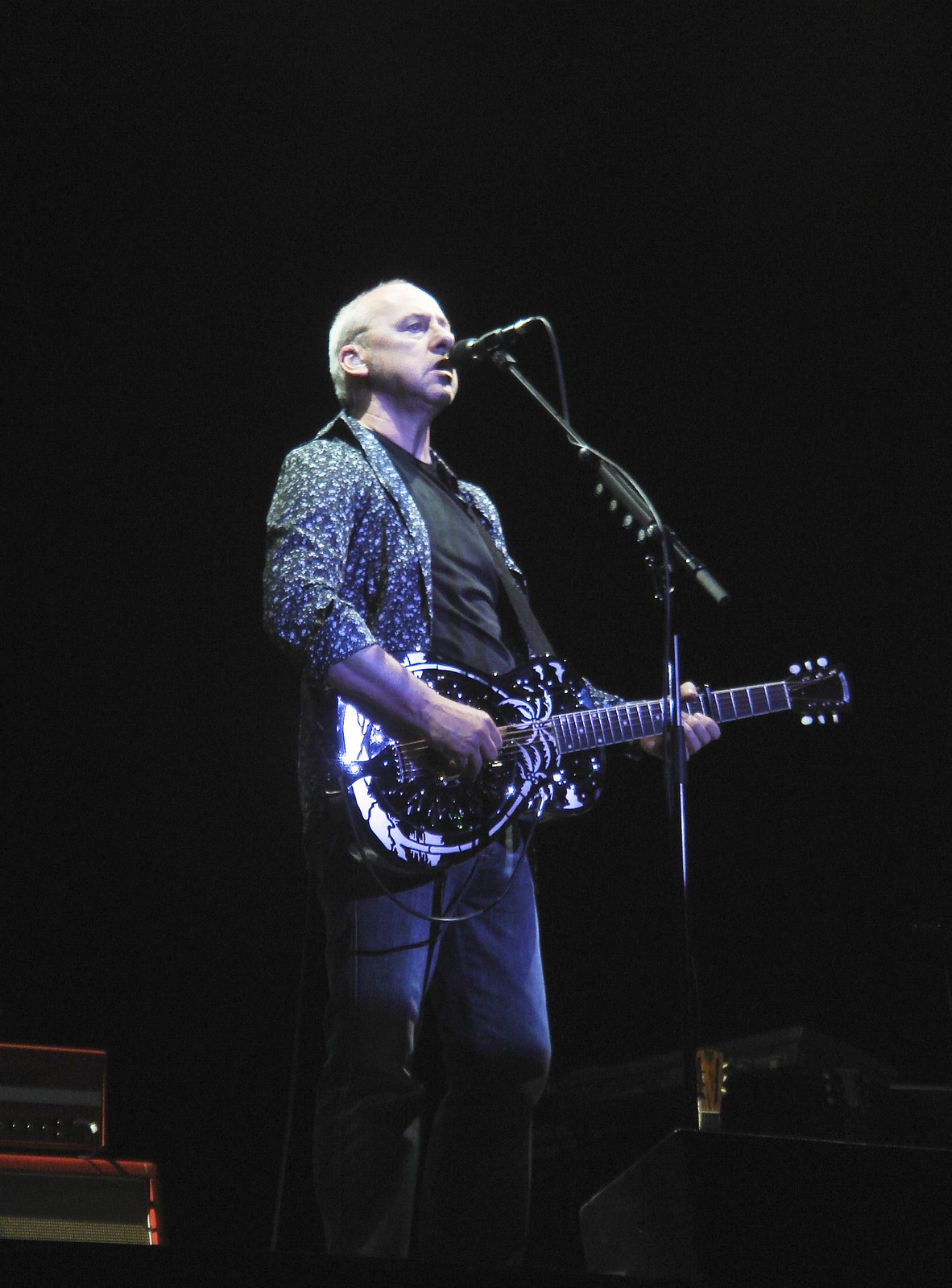
Photo: Chris J Bowley / Wikimedia Commons / CC BY 2.0 National
Style O
1930
A nickel-plated brass guitar from 1930s Los Angeles, and the one Mark Knopfler wouldn’t sell.
- Send a picture
Dobro
Model 27
1932
It cost $27, so Dobro called it the Model 27. Josh Graves called his Julie.
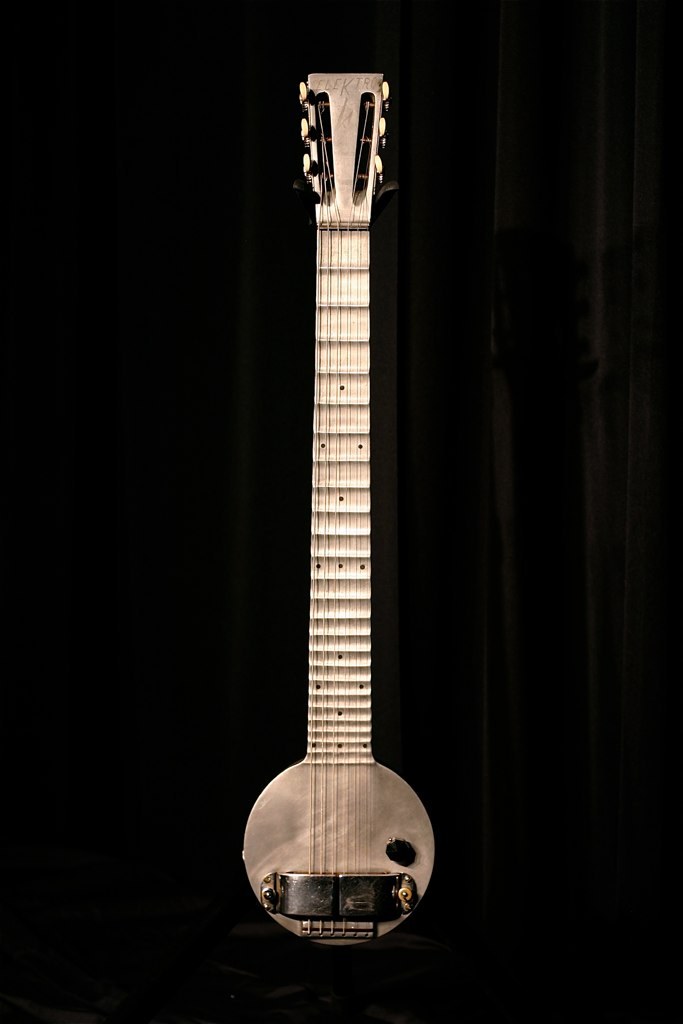
Photo: Museum of Making Music / Wikimedia Commons / CC BY 3.0 Rickenbacker
A-22 Frying Pan
1932
The first electric guitar you could buy looked like a frying pan. The patent office didn’t believe it worked.