Shergold
Masquerader
Two men spent twenty years making guitars with other people’s names on them. Then they made this.
In November 1975 a small shop that had carved necks for Burns, Hayman, and anybody else who asked put out a solid of its own. It wore leftover parts at first and a misspelled name in the ads. Bernard Sumner played one in Joy Division.
- Introduced
- 1975
- Type
- Solidbody electric
- Class
- Production
The short version
1968
Shergold Ltd
Jack Golder and Norman Houlder set up on their own after twenty years with Jim Burns. One history says 1967.
1974
Other people’s guitars
A Burns UK range is built on Shergold wood. When the contracts fold, the parts stay on the shelves.
1975
The first run
Production starts on 8 November. An all-black prototype sat in front of it.
1976
Its own head
The Hayman necks run out around summer. A plainer Shergold head and a six-piece bridge take over. A twelve-string joins.
1977
Custom
The word Custom goes on the plate. Built in volume through 1981.
1982
Official stop
Production ends. Customs keep coming out of leftover parts, and a Limited Edition returns in 1991.
1992
Jack Golder
Dies on 9 April, aged 70.
2023
The attic, and the Barney
The prototype turns up in an attic in Milford Haven. The new owners of the name build a one-off copy of Sumner’s guitar.
Side A
A1
Lounging around on the shelves
By the mid-1970s, Shergold had a problem made of wood.
Jack Golder and Norman Houlder had worked with Jim Burns for twenty years before they set up on their own, in 1968 or 1967 depending who you ask. After that the bench still turned out other people’s names: Hayman, Ned Callan, a 1974 Burns UK range built on Shergold wood. Good necks, with other people’s names on the head.
Then the contracts folded, and hundreds of prepared necks and bodies were left, as one writer put it, “lounging around on the shelves at Romford.”
So they built a guitar of their own. They called it the Masquerader. For a guitar from two men who’d spent their careers behind other people’s badges, it’s a good name.
A2
Wearing Hayman
The first production run started on 8 November 1975. In front of it sat an all-black prototype, which turned up in an attic in Milford Haven in 2023.
The early ones were literally made from what was on the shelf. Hayman necks, with a waisted head and often a plug where the Hayman logo was going to go. A big scratchplate carrying the pickups. A Hayman three-piece bridge. One early guitar even has a sprung wooden box behind the bridge, untuned, that its owner reads as a reused Hayman body. By one count, the first 250 or so had Hayman necks, until about the summer of 1976.
The ads, meanwhile, often spelled it Masquerador. That never made it onto a guitar.
From 1976 the neck got a plainer Shergold head, still with a Perspex badge nailed on, and a six-piece bridge. In 1977 the word Custom went on the plate. Later that year came pickup rings and a small separate scratchplate, and that’s the Masquerader most people mean, built in volume through 1981.
A3
Three sounds a pickup
Here’s why a player kept one.
Two humbuckers, and a three-position switch on each, on top of a master volume, a master tone, and a three-way selector. A Strat gives you five sounds and calls it a day. On one reading of a 1977 Masquerader, each pickup could be a single-coil, a humbucker, or out of phase with the other, which is the thin, hollow, slightly honky sound you get when two coils fight. Someone else who played one remembers sliders that split the coils and also ran them in series. Keep both memories.
Shergold wound its humbuckers bright, on purpose: brightness and clarity, not a full range. A reviewer in 1980 wanted more warmth from them.
The neck is the bit people still praise. Hard maple with a maple cap, a zero fret, a sealed board, a double-acting truss rod. No production Shergold ever left the shop with a tremolo. If you see one with an arm, somebody had an idea later.
Good necks, with other people’s names on the head.
In 1975 a Masquerader was £150.40 in the ads. In January 1977 the Custom was £160.60, about ten pounds more.
Flip the record · By the numbers
£150.40
A Masquerader in the 1975 ads, and again in January 1977. The Custom was about £10 more.
250 or so
Early guitars on leftover Hayman necks, before summer 1976, by one count.
3
Positions on the switch for each humbucker. One reading of a 1977 guitar says single-coil, out-of-phase, humbucker.
Side B
B1
Sumner’s, and not Hook’s
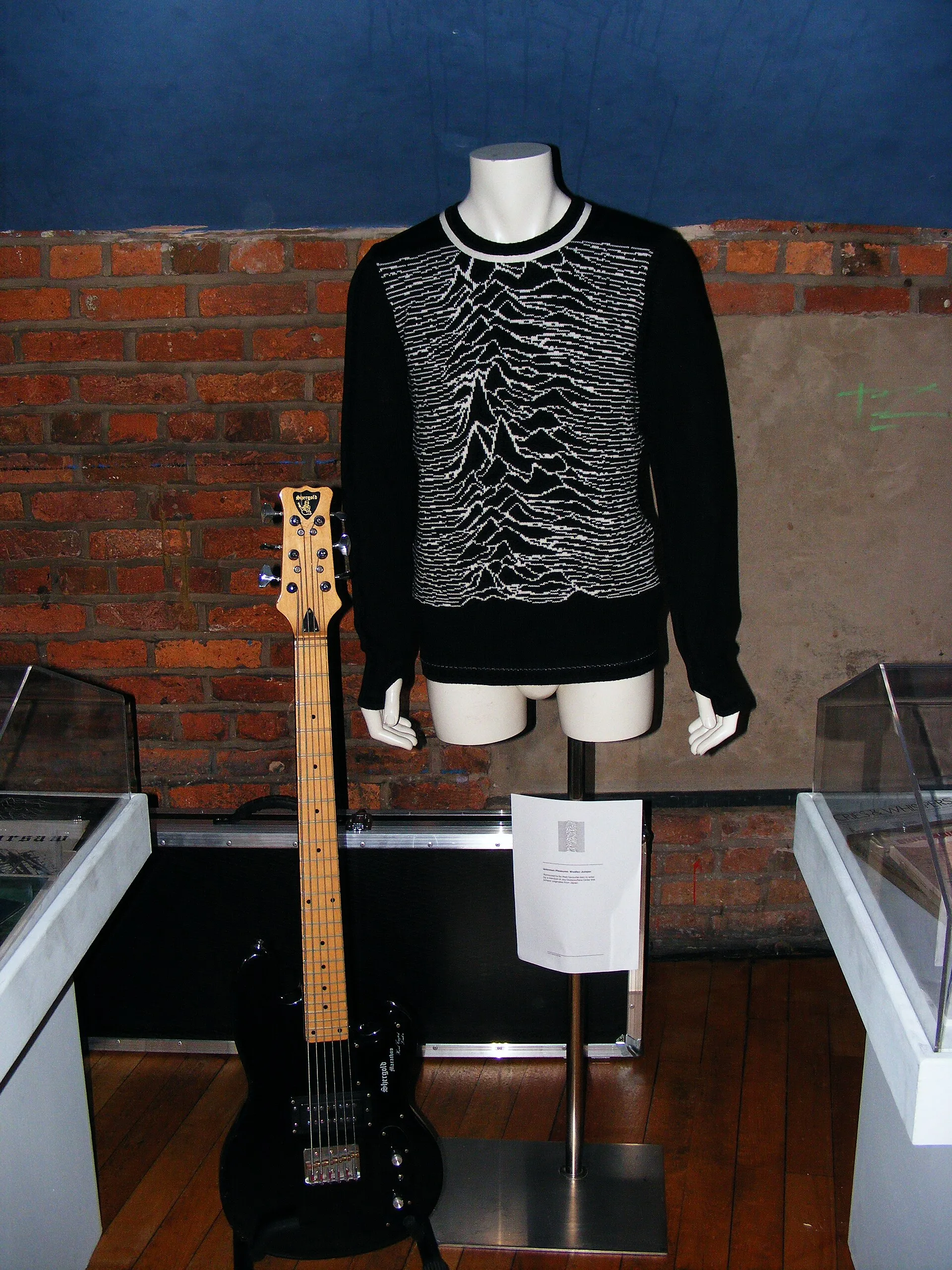
Bernard Sumner played a late-1970s Masquerader in Joy Division, already modified. That’s the guitar this story can put in a player’s hands.
Which Joy Division recordings it’s on isn’t written down, so don’t go hunting for it on a particular track. And keep the band straight: Peter Hook’s Shergold, in the same band and later in New Order, is a Marathon six-string bass. Ian Curtis sang.
Julian Cope had a six-string Masquerader refinished as a goldtop, with the electronics left alone. He says he wants the Hayman and the Burns in his Shergolds.
B2
A non-style
Official production stopped in 1982. Customs kept coming out of leftover parts, and in 1991 there was a short Limited Edition with the words engraved on a black plate.
Jack Golder died in the early hours of 9 April 1992. He was 70. Paul Day’s obituary called him the godfather of the English electric guitar, and remembered necks that were praised while the looks were not. Day wrote that Jack’s refusal to restyle the “non-style” turned it into a style.
B3
The Barney
In 2015 the old distributor, Barnes & Mullins, bought the name. Brian Cleary’s first proper guitar had been a Shergold, and in 1979, at sixteen or seventeen, he bought a black Custom. When the brand came back in 2017 with Patrick James Eggle, the new guitars were never meant to be retro reissues, and they aren’t. Today’s Masquerader is made in China, poplar, with a P90 and a humbucker. Same name, a different guitar.
But Cleary spent months finding original parts: black West German Schaller tuners, a Masquerader bridge and saddles, a cream DiMarzio Super Distortion for the bridge, a DiMarzio PAF for the neck. Eggle built them into one copy of Sumner’s guitar in his UK shop, out-of-phase switching and all. They called it the Barney.
Golder and Houlder spent twenty years building other people’s guitars. Now the brand built one of theirs, by hand, just the once.
The cast
The people, and the specific guitars, that made the legend.
Bernard Sumner
Late-1970s Masquerader, modified
Of Joy Division. The one guitar this plate can put in a player’s hands. Which recordings it is on isn’t written down.
Julian Cope
Six-string Masquerader, refinished as a goldtop
Mick Deering did the refinish and left the electronics alone. Cope says he wants the Hayman and Burns in his Shergolds. No album is pinned to it.
1979
Brian Cleary
Black Custom, bought 1979
Bought it at sixteen or seventeen. Decades later he spent months finding original parts so Sumner’s could be built again.
1975
Jack Golder
Builder
Co-founder of Shergold with Norman Houlder. Called the godfather of the English electric guitar when he died.
Liner notes
Specs, construction, rarity, value, and every source we used.
Two humbuckers and a switch on each — Shergold’s Masquerader, the Romford solid Bernard Sumner played in Joy Division, not Hook’s Marathon and not Rutherford’s double-neck.
- Body
- Double-cut solid. shergold.co.uk, on old Shergolds generally: obeche (wawa), poly over the whole guitar; some later pieces swamp ash, or a maple-and-mahogany laminated centre. Early 1975 bodies can be leftover Hayman. Not one wood
- Neck
- Bolt-on hard maple, double-acting truss rod. The 1981 Mark 2 is glued-in
- Fingerboard
- Maple cap over the truss trench. Rosewood on the Mark 2, and on customs. Zero fret. Fret count unpublished
- Scale
- 25½" (shergold.co.uk). No millimetres published on the Romford guitar
- Pickups
- Two Shergold humbuckers. Robin Millar, on the company’s humbuckers in 1980: wound for brightness and clarity, not a full range
- Hardware
- Six-piece Shergold bridge from 1976; Hayman three-piece on the earliest. Bridge cover. No factory tremolo. Japanese tuners at the start; Schaller from about August 1976 (blackguitars)
- Electronics
- Master volume, master tone, 3-way. A three-position switch on each pickup. A 1977 shop spec: single-coil, out-of-phase, humbucker. Guitar.com: sliders that split the coils and also run them in series. Mix flagged
- Finish
- Poly. Natural, black, sunburst, and cherry show up on period guitars. Not a full catalog list
- Nut
- Width unpublished
Open the full research fileConstruction details, the complete player record, production numbers, dated value estimates, and sources
Classic living example = 1977–81 six-string Custom Masquerader (Romford). The SM11 Standard on sale in 2026 is Patrick James Eggle’s redesign, built in China. Not this table. 1975–early 1976 Hayman-neck guitars, the 1981 Mark 2, the 1991 Limited Edition, and the 12-string (from 1976) are other cuts of this name. Modulator, Marathon, Custom Double, Meteor, and Activator stay off this slug. No Gibson SKUs. Mixed inch/mm flagged on the living SM11: scale 648 mm / 25.5", nut 42.5 mm, radius 305 mm / 12", about 3.6 kg / 8 lb. Do not paste those millimetres onto the 1970s 25½". One 1980 seller listing prints 21 frets and a 12" (305 mm) radius. One guitar. Not a catalog number.
Construction
The job was a British solid with a Burns neck on it, after Burns and then Hayman had stopped. Jack Golder and Norman Houlder had cut those necks. Robin Millar, Sound International, 1980: they worked with Jim Burns for twenty years, Baldwin included, then set up on their own. “1968 and Shergold Ltd were underway.” The company’s own history says the same year, London, making guitars for Burns, Rosetti, and Barnes & Mullins. Millar puts the shelves at Romford. Guitar Collecting, 11 March 2009, says the firm started in 1967 in Harold Wood. Keep 1967 and 1968. Keep Harold Wood, Romford, and London. The Masquerader is 1975 on either telling. Don’t average the towns.
Through the early 1970s the bench was still other people’s names. Hayman, for Dallas, until that brand died. Ned Callan. A 1974 Burns UK range built on Shergold wood. Millar: when those contracts folded, hundreds of prepared necks and bodies were left “lounging around on the shelves at Romford.” The Masquerader is what they did with a guitar of their own.
The company dates the launch to 1975, and marked fifty years in November 2025. An all-black prototype, serial 3100, turned up in an attic in Milford Haven in 2023. Music Instrument News, 28 February 2023, calls it the prototype that preceded the first production run, 8 November 1975, from the London workshop. blackguitars dates production from serial 3101 that same day, and a 3111 to the week ending 3 December 1975. Same year. The prototype is not a different introduction. It is the guitar that sat in front of the run. Ian Feber owns 3100.
Early ones still wear Hayman. shergold.co.uk: 1975 to early 1976, Hayman necks — waisted head, carved edge, often a plug where the Hayman logo was going to go — a large scratchplate carrying the pickups, and a Hayman three-piece bridge. blackguitars, on 3111: a “Vibrosonic Chamber,” an untuned sprung wooden box behind the bridge, which he reads as a repurposed Hayman body. That is one early guitar, not the whole model. He puts Hayman necks on the first 250 or so, before summer 1976. His count. Not a factory ledger. Ads of the time often spell the name Masquerador. shergold.co.uk: the misspelling never made it onto a guitar.
From 1976 the neck is the plainer Shergold head, still with a nailed Perspex badge, and the bridge is a six-piece unit. 1977 brings the word Custom on the plate. The transitional ones keep the big scratchplate; most pickups now sit on three screws, so you can tip them. Later that year the common Custom arrives: pickup rings, a small separate plate. That is the guitar in the table, built in volume through 1981. Twelve-strings from 1976, same 25½" scale. A twelve is this name. It is not this row.
The switching is why a player kept one. Not a Strat’s five sounds. Two humbuckers, and a three-position switch on each, plus a master volume, a master tone, and a 3-way. Guitar Village’s reading of a 1977: single-coil, out-of-phase, humbucker. Simon Bradley, Guitar.com, 17 July 2017, remembers sliders that split the coils and also combined them in series, and gothic script on the plate. Keep both accounts of the switch. Millar, reviewing a Modulator 12, wanted more warmth from Shergold humbuckers. They were wound bright on purpose. No production Shergold, and no known custom, left the shop with a tremolo (shergold.co.uk). A routed arm is somebody’s later idea.
The neck is the part players actually praise. Hard maple, a maple cap over the truss trench, a zero fret, the fingerboard sealed. Rosewood boards are customs, or late limited runs, or the Mark 2. The truss is double-acting. Before 1979 you adjust it through a plate on the back, and that plate carries the serial. The company history: some late 1978 guitars already have the newer neck, so the plate is not a clean dating rule. Pickup mounts go from two bolts to three screws around 1977. blackguitars: Japanese tuners at the start; Schaller, and string trees, from serial 7001, August 1976.
Body wood will not sit still. The care notes on shergold.co.uk say obeche, sometimes called wawa, poly everywhere, and that the finish cracks. Some later guitars are swamp ash, or a maple-and-mahogany laminated centre. blackguitars dates three-piece laminated bodies from serial 9266, March 1979. The same historical site associates that laminate, and a foil headstock badge instead of Perspex, with clear-finish guitars built 1982–1991. Keep March 1979 and 1982. Don’t pick one.
1981. The Mark 2 shows up beside a Nu Meteor and a Mark 2 Marathon. Mahogany or ash in the literature; of the few known, only mahogany has turned up. Satin polyurethane, no scratchplate, controls through the wood, rosewood board, glued neck. A different guitar wearing the name. The historical site’s price table, from a 1980/81 leaflet in Paul Day’s archive: £258.35.
Official production stops in 1982. Customs continue from leftover parts, harder to tell from the earlier Customs except when the centre is laminated and the badge is foil. 1991: a short return. “Limited Edition” engraved on a black plate, the Custom tag dropped, a little Strat-like contour added. Guitarist, September 1991, via shergold.co.uk: £528.75, the twelve £587.50. Jack Golder died in the early hours of Thursday 9 April 1992. He was 70. Paul Day’s tribute in Making Music, June 1992, calls him the godfather of the English electric guitar, and remembers necks that were praised while the looks were not. Day: Jack’s refusal to restyle the “non-style” turned it into a style.
2015. Barnes & Mullins, the old distributor, bought the name. Early 2017 they relaunched it with Patrick James Eggle. MMR, 3 January 2017: Brian Cleary’s first proper guitar was a Shergold, and the new ones “couldn’t be retro re-issues.” Dave Burrluck, MusicRadar, 16 March 2017: the new guitars retain little of the original’s style. Indonesian Classics, mahogany, a solid rosewood neck, Seymour Duncans. 2024–25: the SM11 Standard, China, poplar, roasted Canadian maple, laurel, an Alnico V P90 and an Alnico V humbucker, master volume and tone, a 3-way. Factory guide £409. Neville Marten, Guitar World, 10 February 2025, on the old outline: a strange meld of a Strat and a Music Man StingRay, with the slab sides of a Tele. His line. The new one is the conventional guitar. Same name. Not this table.
Period money, not 2026 street. shergold.co.uk’s compiled ads: Masquerader £150.40 (“Shergold Shows the flag for Britain!,” filed as 1975) and £151.90 (Sounds, November 1975). 1976 “British and Best” advert: £136.71 — the site’s note says the drop tracks VAT from 25% to 12.5%. Guitar, January 1977, Barnes & Mullins: Masquerader £150.40, Custom £160.60. The historical site calls that an extra £10. 1978: £170.28 (International Musician, February) and £182.26 (Shergold’s own IM advert). July 1980 price list: Custom £234.86. David Lawrenson, The Complete Guitar Guide (1982): £235.00. Millar’s 1980 “just over £200” is the floor of the handmade line, written while he was reviewing a Modulator 12. Not this SKU.
Players
Do not hang a Modulator, a Marathon, a Meteor, or a Custom Double on this plate. Do not give Ian Curtis the guitar. He sang. A dealer listing that puts him on a Masquerader is mashing the band onto the instrument.
Bernard Sumner. The guitar this plate can actually name. MusicRadar, Rob Laing, 16 March 2023, and Shergold’s own account: a late-1970s Masquerader he played in Joy Division, already modified. The company and Patrick James Eggle built a one-off replica, the “Barney,” in Eggle’s UK shop, from original parts Cleary spent months finding: West German black Schaller tuners, a Masquerader bridge and saddles, a cream DiMarzio Super Distortion at the bridge, a DiMarzio PAF at the neck, and the out-of-phase switching. That replica is one object, made because Cleary wanted Sumner’s guitar. It is not a 1977 production Custom, and it is not a 2026 SKU. Which Joy Division sides were tracked on the original is unpublished here. Don’t invent Unknown Pleasures.
Julian Cope. Guitar World files him with Sumner as someone the original model mattered to. shergold.co.uk is more precise, and it has Cope’s own words on Shergolds generally: he wants the Hayman and Burns in them, and he refinishes. The site records a six-string Masquerader done up as a goldtop, refinished by Mick Deering, electronics left alone. His 6/12 and 6/4 Custom Doubles are the other Shergold, the one Mike Rutherford’s idea put into the catalog. Not this slug. No album is pinned to the goldtop.
Mike Rutherford. Not this guitar. Beat Instrumental, 1977, via shergold.co.uk: he tried a Shergold 12-string in a shop — model unnamed — asked if they made basses, then asked for a double-neck that could come apart. Millar: several months of work, and a promise that the public double-neck would not be the demountable one. The Custom Double is that production answer. Genesis on a Shergold press release is this story, or a bass. It is not a Masquerader solo.
Peter Hook. Not this guitar either. Wikipedia’s equipment list: a Shergold Marathon six-string bass, used with later Joy Division and with New Order. The company’s 2025 fiftieth-anniversary copy groups Genesis, Joy Division, and New Order as bands that played Shergolds. True of the brand. Hook’s Shergold is the bass. Don’t move it onto a Masquerader.
Also known to play stays short. Cleary bought a black Custom of his own in 1979, when he was sixteen or seventeen. That is the future owner’s guitar, not Sumner’s. Manic Street Preachers and The Sherlocks appear in the 2025 company note. No vintage Masquerader is pinned to either. None invented.
Rarity
You can buy a new Masquerader tomorrow. Poplar, China, P90 and humbucker. It is Eggle’s guitar with this name on the head. It is not a 1977 Custom.
Shergold did not publish a Masquerader total. None invented. shergold.co.uk: the six-string is the only Shergold guitar in continuous production from 1975 to 1991, and the Custom is the common one, in volume 1976–1981, then to order. blackguitars’ 250 or so is the Hayman-neck stretch before summer 1976, and he says “or so.” A seller’s “a few thousand,” or “250 of the transitional Customs,” is a listing. Not a book. The historical site publishes serials for 1975–1980. They date a guitar. They don’t count a model. That is why a first-year census is unknown.
What is actually thinner: 3100; Hayman-neck 1975 and early 1976 guitars, complete with the three-piece bridge; Mark 2 set-necks, of which the site says few are known, and only mahogany so far; a 1991 Limited Edition; an original bridge cover, which goes missing so often the buying guide tells you to look for the screw holes. Sumner’s modified original is a unique object. The Barney is another. Neither is a vintage Masquerader.
Value
Informal estimate, 15 October 2026. Not an appraisal.
Ask vs sold labeled. No celebrity hammer on this slug. No invented medians or factory counts. The 1975–82 lists above — £136.71 up through the Custom at £234.86 / £235, and the Mark 2 at £258.35 — are period money. The 1991 Limited Edition at £528.75 is 1991 money.
New street. Factory guide on the SM11, inc. VAT, £409 (shergoldguitars.com, this pass). Named UK prices, not averaged: Absolute Music £379; GigGear £374; Brittens £409. Manns lists £319 against an RRP of £409, and was waiting on stock. Guitar World, 10 February 2025, put the SM11 at about $509 / £409, and the Indonesian Classics then at SM01 £765, SM04 £799, SM03 £809, SM02 £835. Those Classic figures are the review’s, not a cart re-checked on 15 October 2026. A Pro Music News line, “from £379,” is the range floor. The Telstar Standard on the same site is £379. Not a Masquerader.
Used modern. Indonesian Classics from 2017, and Chinese Standards from late 2024. No clean Reverb Price Guide band isolated this pass. Don’t invent a midpoint. A new SM02 sold at $680.47 is a new sale, not a used Classic.
Vintage / collectible. Flag: thin sold-comp access. Don’t invent a Good-to-Mint band. Named hammer, not a series: Gardiner Houlgate, 10 March 2026, a 1978 cherry Custom, fair, maple neck and board, 3.55 kg, estimate £300–400, sold for £580. An earlier Gardiner Houlgate Custom, 14 June 2023, hammered at £400 before fees. That is 2023. Named asks, live this pass, and not the same guitar: an early-1980s wine-red Custom, Very Good, serial 9676, $913.31 (cut from $1,369.96); Guitar Village’s 1977 black, £799, with a reshaped headstock, a refinished body and neck, a replacement guard, and a refret. The refin is a different market from a complete cherry. Do not average £580, £400, £799, and $913. Feber’s 3100 and the Barney are one object each. Not comps.
See also
- burns-marvin — the Romford necks Golder and Houlder were already carving; Millar’s twenty years with Jim Burns
- burns-flyte — 1974 Burns UK guitars built on Shergold wood, the year before this name
- burns-bison — the other British solid from that bench; Jack Golder flattened its scroll in 1966, long before the Masquerader
Sources
- Shergold Guitars, history — London 1968; Hayman, Burns, Rosetti, Barnes & Mullins; 1974 Burns UK woodwork; own-name guitars after Hayman; pre-1979 heel truss, with late-1978 exceptions; two-bolt pickups then three screws; 1982–1992 customs and Limited Editions; Barnes & Mullins 2015; Eggle relaunch early 2017. Cites shergold.co.uk as the historical record
- shergold.co.uk, models — 25½"; six-string continuous 1975–1991; 12-string from 1976; Custom in volume 1976–1981, to order after; Hayman neck and bridge 1975–early 1976; six-piece bridge 1976; transitional Custom 1977, then rings and a small plate; Mark 2 1981; Limited Edition 1991; Masquerador misspelling never on a guitar; Custom was about £10 more in the January 1977 advert
- shergold.co.uk, original costs — 1975 £150.40 and £151.90 (Sounds, November 1975); 1976 advert £136.71; January 1977 £150.40 / Custom £160.60; 1978 £170.28 and £182.26; July 1980 list Custom £234.86; 1980/81 leaflet Mark 2 £258.35; Lawrenson 1982 £235; Guitarist September 1991 Limited Edition £528.75 / 12-string £587.50
- shergold.co.uk, care notes — obeche; later ash or maple/mahogany laminate; poly; maple neck and maple cap; rosewood on customs and late runs; sealed board; zero fret; double-acting truss; finish cracks
- shergold.co.uk, buying guide — no production or known custom Shergold left with a factory tremolo; bridge-cover screw holes
- Sound International, Robin Millar, 1980 — twenty years with Burns; 1968; Romford shelves; Rutherford’s demountable double; humbuckers wound bright; line starting just over £200, written on a Modulator 12
- Making Music, Paul Day, June 1992 — Jack Golder died 9 April 1992, aged 70; necks praised, cosmetics criticised
- Music Instrument News, 28 February 2023 — prototype 3100; first production run 8 November 1975; Ian Feber
- blackguitars, 1975 Masquerader — production from 3101 on 8 November 1975; 3111, week ending 3 December 1975; Hayman necks on the first 250 or so; Vibrosonic chamber on that early body
- blackguitars, Masquerader timeline — spec changes by serial; Schaller from 7001, August 1976; laminated bodies from 9266, March 1979
- MIA / Shergold, 50 years, December 2025 — launched 1975; Genesis, Joy Division, New Order named as Shergold players; 3100; current Standard is poplar, roasted maple, laurel, P90 and humbucker. Brand claim, not a session log
- MusicRadar, Rob Laing, 16 March 2023 — Sumner’s late-1970s Joy Division Masquerader; Cleary’s 1979 Custom; Barney replica; Schallers, Masquerader bridge, DiMarzio Super Distortion and PAF, out of phase
- Shergold, Sumner Vibes — same replica, Eggle’s UK workshop, original parts
- Guitar World, Neville Marten, 10 February 2025 — Sumner and Cope named; old outline vs the SM11; China; poplar; 648 mm (25.5"); nut 42.5 mm; laurel; 22 frets; 12" / 305 mm; P90 and humbucker; 3.6 kg / 8 lb; £409 / about $509; Classic prices as of that review
- Guitar.com, Simon Bradley, 17 July 2017 — original Masquerader 1975 to around 1981; gothic script; sliders, coil-split, series and out of phase
- MusicRadar, Dave Burrluck, 16 March 2017 — new guitars retain little of the original; Masquerader 1 at £765
- MMR, 3 January 2017 — B&M bought the name 2015; Cleary’s first guitar; not retro reissues; 2017 prices £765 / £835 / £809
- shergold.co.uk, Julian Cope — Cope on refinishing Shergolds; a goldtop six-string Masquerader; Custom Doubles are the other instrument
- shergold.co.uk, Rutherford / Beat Instrumental 1977 — 12-string in a shop, model unnamed; the demountable double-neck. Not a Masquerader
- Wikipedia, Peter Hook — Marathon six-string bass with later Joy Division and New Order. Not this slug
- Shergold SM11 Quartz White — guide £409 inc. VAT this pass; poplar; 3.6 kg / 8 lb
- Absolute Music, SM11 — street £379; 648 mm / 25.5"; nut 42.5 mm
- GigGear, SM11 — £374
- Brittens, SM11 — £409
- Manns, SM11 — listed £319 against RRP £409; waiting on stock this pass
- Gardiner Houlgate, 10 March 2026 — 1978 cherry Custom, 3.55 kg, estimate £300–400, sold £580
- Gardiner Houlgate, 14 June 2023 — late-1970s Custom, hammer £400 before fees; 3.58 kg
- Reverb, early-1980s wine-red Custom — live ask $913.31 this pass; serial 9676
- Reverb, 1980 Masquerader, listing ended — one seller’s spec: 21 frets, 12" (305 mm) radius, zero fret, obeche. Not a catalog number. The same listing’s “a few thousand” is not a factory total
- Reverb, SM02-SD Thru Cherry, sold new — new sale $680.47, not a used price
- Guitar Village, 1977 black refin — ask £799; reshaped head, refin, new guard, refret. Not a clean original
- Guitar Collecting, 11 March 2009 — 1967 and Harold Wood. Against Millar and the company on 1968
Keep digging
Guitars this one gets compared to, confused with, or descended from.
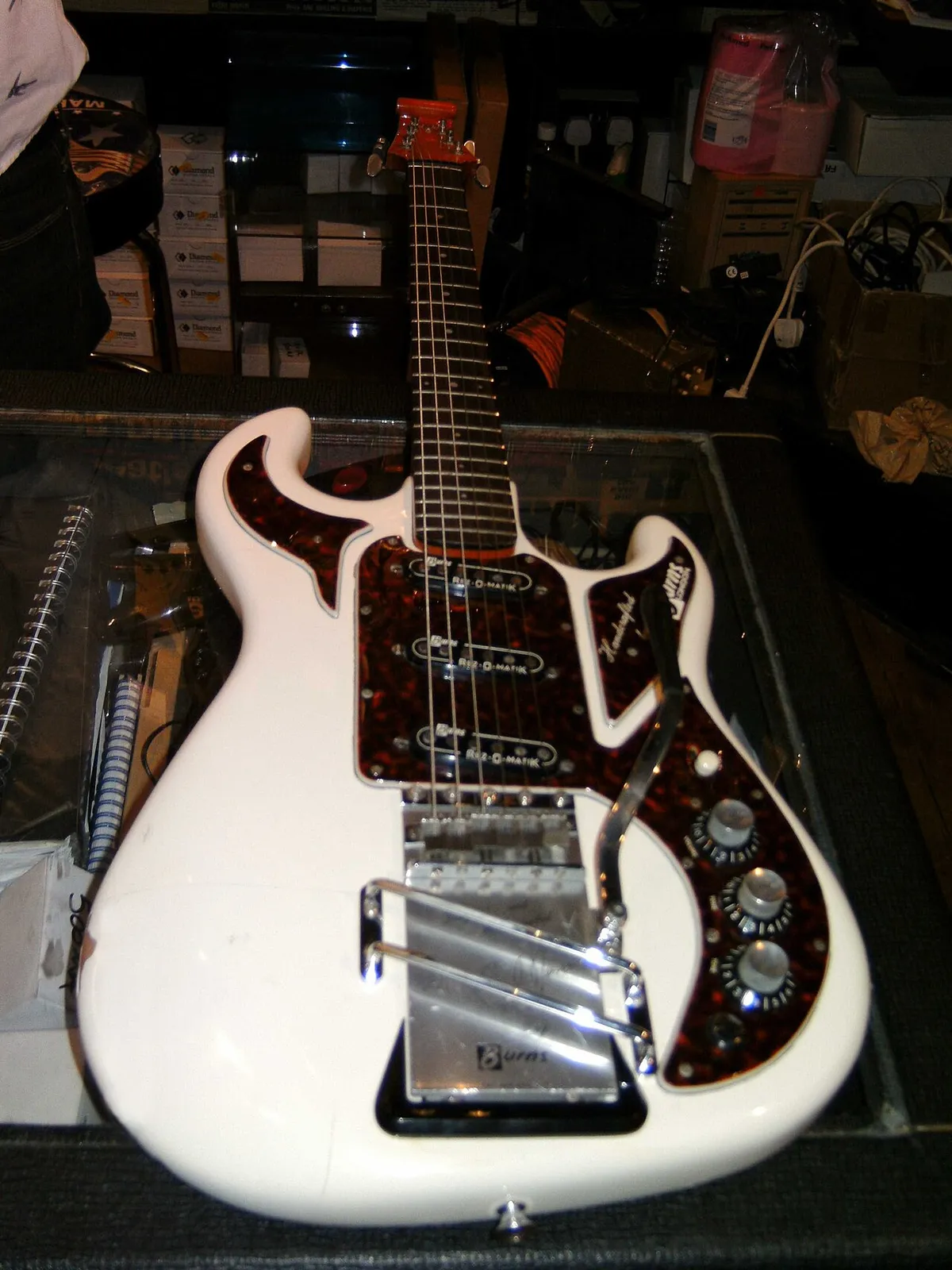
Photo: Bruce Marvin / Wikimedia Commons / Public domain Burns
Marvin
1964
Burns built Hank Marvin more than 30 prototypes to keep him in tune. Then somebody checked his jacket.
- Send a picture
Burns
Flyte
1974
Pop stars posed with it for the cameras. The guy in David Essex’s band paid full price and played it.
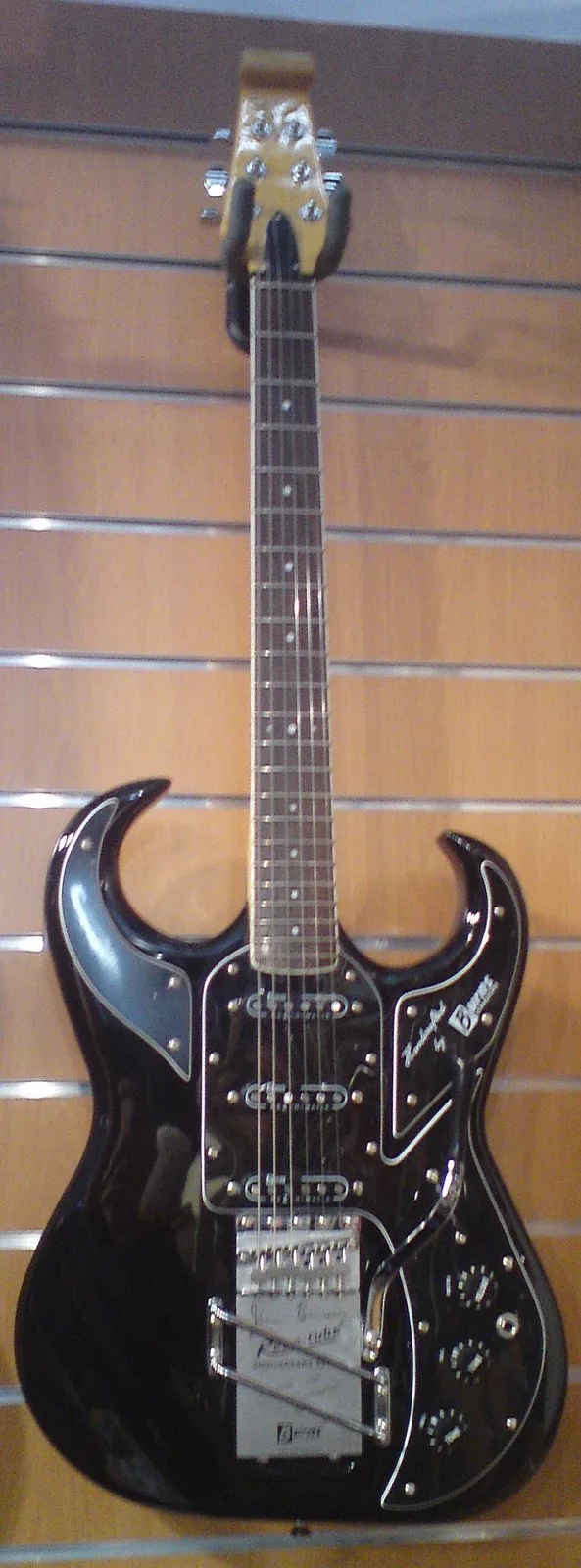
Photo: Bruce Marvin / Wikimedia Commons / Public domain Burns
Bison
1961
Ike Isaacs said it looked like a bloody bison. Burns changed almost everything else about it. Not that.