Zemaitis
Metal Front
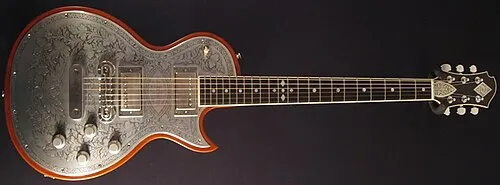
A sheet of metal stopped the hum. A shotgun engraver made it the thing you stare at.
A cellar in Balham, south London, around 1969. Tony Zemaitis, a cabinet-maker who builds guitars one at a time, has just been asked by Eric Clapton what a silver guitar would sound like. He doesn’t know. So he finds out the quick way.
- Introduced
- 1970
- Type
- Solidbody electric
- Class
- Production
The short version
1955
The first guitar
A nylon-string classical, the first one Tony Zemaitis was happy with.
1965
On his own
Zemaitis goes self-employed, building in a cellar in Balham.
1969
Electrics
He starts building electric guitars, around the time Clapton asks his question.
1970
The first Metal Front
Tony McPhee of the Groundhogs buys it. Dates run from the late ’60s to 1971.
1971
Top of the Pops
Ronnie Wood plays his Metal Front with the Faces on British television.
1978
The Stones tour guitar
Wood commissions a Metal Front engraved for the Rolling Stones’ North American tour.
2002
Tony dies
He retired in 2000 and died two years later, at 67.
2004
Made in Japan
With the family’s blessing, Kanda Shokai starts building Zemaitis guitars in Japan.
Side A
A1
A silver guitar, the quick way
Tony Zemaitis was a cabinet-maker, not a factory. He was born in London in 1935, started an apprenticeship in 1951, and by 1965 he was building guitars on his own in a cellar in Balham. He started with acoustics. The electrics came around 1969.
Around then, Eric Clapton asked him what a silver guitar would sound like. Tony didn’t know, so he took a test guitar and stuck a plain sheet of aluminium on the front, “to save time.”
What happened next wasn’t what anybody expected. The metal worked like the chassis in an old radio, a shield. The feedback went away. Even the tuning seemed better. He sold the test guitar cheap and started building a proper one.
It was a practical fix for a practical problem. Nobody had said anything yet about making it beautiful.
A2
Who got the first one
Depends who you ask. Some say late ’60s, some say 1970, some say 1971. The buyer, at least, is agreed: Tony McPhee of the Groundhogs.
Tony told the story himself. He hung the finished guitar on the wall of his drawing room. McPhee was the first person to see it, and a deal was struck.
A3
Under the metal
Take the plate off in your head and it’s a set-neck single-cut, but not a Les Paul. The waist is tighter, the horn sharper, the scale a little longer, and there’s no carved maple. The body is three pieces of Honduras mahogany glued together, which Tony said was “to keep the resonance very high and ‘wolf’ notes down.” The neck is three pieces too, with a steel truss rod coming out high on the headstock so the nut isn’t the weak spot.
He liked 24 frets. He made a lot of his own hardware. He didn’t make two guitars the same, and he asked to see your left hand before he started. The tops weren’t quite flat, and he explained why:
so on stage the light dances over it, instead of flashing when it’s totally flat — like Alf Garnett’s glasses!
Flip the record · By the numbers
1.5 mm
Thickness of the Duralumin plate on the front. An aluminium alloy, and a shield, not decoration.
8–10
Guitars a year, roughly, from Tony’s whole shop. Acoustics included.
3
Ronnie Wood’s Metal Front was number three, the second one Danny O’Brien engraved.
24
Frets. Tony liked 24. The standard Japanese Metal Front today has 22.
Side B
B1
The shotgun man
The plate is 1.5 mm of Duralumin, an aluminium alloy. It could have stayed plain. It didn’t, because of Danny O’Brien.
O’Brien engraved shotguns for a living, and he was also one of Tony’s customers. Who suggested the engraving is another story that comes in two versions. One says O’Brien had been engraving headstock plates and proposed doing the fronts. Tony said he asked Danny himself and gave him a free hand. Either way, O’Brien’s name is at the bottom of the plate, and that part isn’t in dispute.
Ronnie Wood bought metal front number three, the second one O’Brien engraved. In 1971 he played it with the Faces on Top of the Pops, and orders came in faster than one man in a cellar could fill. Wood kept coming back. For the Rolling Stones’ 1978 North American tour, Tony built him another Metal Front, with the band and the tour engraved in the plate and “Custom Ron Wood 1978” on the truss cover.
B2
Ten a year, and the fakes
Tony moved to Kent in 1972. Even in the busy years of the ’70s and ’80s he built only eight or ten guitars a year, and never many more. He kept no systematic serial numbers. That made the fakes easy. Copies built from scratch, fake plates on real wood-front Zemaitises, real parts on ringers, made-up histories on real guitars. In 1992 one Japanese fan club counted about thirty Zemaitis guitars in Japan and reckoned about a dozen of them were fake.
He retired in 2000 and died in 2002. His wife and son agreed a deal with a Japanese company, and Metal Fronts have been made in Japan since 2004, with acid-etched plates instead of Danny’s hand. They’re good guitars. They aren’t Tony’s.
It all started as a shortcut. A plain sheet of metal, stuck on “to save time,” because it was the fastest way to answer Clapton. Then a shotgun engraver got hold of it, and the thing that stopped the hum became the reason people still stop and stare.
Put this on
You’ve read about it. Now hear it. Here’s what this guitar sounds like, and what to listen for.
Faces on Top of the Pops
Ronnie Wood’s engraved Metal Front on British TV, the appearance that sent orders pouring in to a one-man shop. Watch the light move across the plate.
Watch it on YouTube (opens in a new tab)
The cast
The people, and the specific guitars, that made the legend.
1970
Tony Zemaitis
Builder
A London cabinet-maker who built guitars by hand, never two the same, and asked to see your left hand before he started.
1971
Danny O’Brien
Engraver
A shotgun engraver and a customer. His name is at the bottom of the plates he cut.
1970
Tony McPhee
The first Metal Front
The Groundhogs’ guitarist. The first person to see the engraved guitar hanging on Tony’s wall, and the first to buy one.
1971
Ronnie Wood
Metal Front number three, and a 1978 tour guitar
Put the plate on television with the Faces. His 1978 one reads “Custom Ron Wood 1978” on the truss cover.
1970s
Marc Bolan
A Metal Front
Photographed with a guitar captioned as a Metal Front. The photograph is the evidence; which night it was isn’t on record.
1969
Eric Clapton
The question, not the guitar
Asked what a silver guitar would sound like. His own famous Zemaitis is a twelve-string acoustic.
Liner notes
Specs, construction, rarity, value, and every source we used.
A 1.5 mm duralumin chassis on a mahogany single-cut, engraved by a shotgun man — Zemaitis’s Metal Front, not a Les Paul, and not the Disc Front.
- Body
- African mahogany; acid-etched Duralumin top; single-cut. Factory MFG22 does not print depth. Burrluck on a 2016 Japanese Metal Front: ~42 mm, slab, dead-flat top. Mix flagged.
- Neck
- Set African mahogany, C-carve. Factory: ~21.5 mm (27/32") at 1st, ~23 mm (29/32") at 12th. Mix flagged.
- Fingerboard
- Bound ebony, 305 mm (12") radius, 22 medium-jumbo frets. Mix flagged.
- Scale
- 635 mm (25"). Mix flagged.
- Pickups
- Two Zemaitis Dragon Classic humbuckers
- Hardware
- Deluxe locking tuners (factory). Japanese Metal Fronts typically carry a house Tune-o-matic-style bridge and Duralumin tailpiece (Burrluck). Mix flagged.
- Electronics
- Two volume, two tone, 3-way toggle
- Finish
- Matte lacquer. Factory card: black. Natural also listed.
- Nut
- Bone, 43 mm (1 11/16"). Mix flagged.
Open the full research fileConstruction details, the complete player record, production numbers, dated value estimates, and sources
Current typical = Japan MFG22 (zemaitisguitarcompany.com, fetched 22 September 2026). Factory mixed mm/inch flagged; no millimetres invented for Tony’s handmade guitar beyond named sources. Classic living example is still a Tony Zemaitis Metal Front (Balham, then Kent): three-piece Honduras mahogany, often 24 frets, Danny O’Brien hand-engraved 1.5 mm Duralumin, elongated truss cover. Disc Front is the round plate. Pearl Front is the mosaic. No Gibson SKU. Standalone — not a Les Paul family card.
Construction
The job was a guitar that would not hum. Tony Zemaitis was a cabinet-maker who built in a house, not a factory. Born Antanus Casimere Zemaitis, London, 1935 (Wikipedia: 10 April). Five-year apprenticeship 1951. First repair 1952. First acceptable guitar, a nylon classical, 1955 (Vintage Guitar, Adrian Ingram, Aug. ’97). Self-employed 1965. Balham cellar. House and shop to Kent 1972 (Blue Book, citing Tony, March 1996, and Keith Smart).
Electrics, he estimated, from 1969 (MusicRadar, Jamie Dickson, 18 October 2016). Around then Eric Clapton asked what a silver guitar would sound like. Tony, later, in The Z Gazette: he stuck a plain aluminium front on a test guitar “to save time.” The metal acted as a chassis. Feedback gone. Tuning seemed better. He sold the test cheap and started a proper metal-front.
Who first, and when, is split. Ingram: first metal-front for Tony McPhee of the Groundhogs, late ’60s. Wikipedia’s Tony page: experiments 1970; McPhee bought the prototype. Dave Hunter (Guitar Player, 20 August 2021): first for McPhee 1971, another later that year for Ronnie Wood. Keep late ’60s, 1970, and 1971. This plate starts in 1970.
What he built is a set-neck single-cut with a tighter waist and a sharper horn than a Les Paul, a Duralumin plate across the face, pickups and pots on the metal. Dickson, from Tony: three-piece Honduras mahogany body, Cascamite, “to keep the resonance very high and ‘wolf’ notes down.” Three-piece mahogany neck, harder centre, grain-matched outers. 3/16-inch stainless truss through that centre, emerging high on the head so the nut is not the thin point. Rosewood or ebony board, compound radius, four-diamond cluster at the 12th. Scale often 635 mm (25"). Mix flagged. Tops slightly curved, “so on stage the light dances over it, instead of flashing when it’s totally flat — like Alf Garnett’s glasses!” Hand-rubbed acid-catalysed lacquer. He made the hardware himself on the upmarket ones: oversized Tune-o-matic-style bridge, Duralumin tailpiece, Z badge, long truss cover, pickup rings.
The plate is 1.5 mm Duralumin — aluminium alloy with copper, magnesium, manganese (Burrluck, MusicRadar, 26 October 2009). Conductive. Chassis, not jewellery. Danny O’Brien, shotgun engraver and a customer, put pictures on it. Who asked whom is split. Ingram: O’Brien had been engraving headstock plates and suggested the fronts. Tony, to Dickson: he asked Danny, “given a free hand.” Keep both. The name at the bottom of the plate is the fact.
Pickups were whatever he could get, or what the player walked in with. Wood brought Gibson humbuckers. Mighty Mite. Kent Armstrong. Later Seymour Duncan for Rich Robinson and Gilby Clarke (Dickson). Early active preamps; by the early ’80s, “pickups and amps are so good… I no longer use them unless I’m asked.” Hunter: he favoured 24 frets. Each guitar was a conversation. He asked to see your left hand.
Not a Les Paul (gibson-les-paul-standard). Kalamazoo, carved maple, 24.75", two humbuckers, a stop. This is a London, then Kent, mahogany single-cut with a metal lid and a 25-inch scale. Ancestor in the dual-humbucker job. Not that guitar. No Gibson SKU.
Not the Disc Front. Round plate, centred. Hunter: Wood commissioned it a year after the Metal Front, black body. Andy Babiuk, Rolling Stones Gear (Premier Guitar excerpt, 6 February 2014): pirate-map engraving; mahogany body hollow and stuffed with cotton; Wood’s slide guitar, open E. Dickson prints that guitar at 650 mm (25 5/8"). Tony glued the neck and added a plate and four screws so it would look bolt-on. Premier Guitar’s 2014 Generation 2 review collapses Wood’s “second prototype” into a round plate on A Nod Is As Good As a Wink… to a Blind Horse (1971). That is the Disc Front mix-up. Metal Front stays the full plate. Not the Pearl Front. Abalone mosaic, mid-1970s (Wikipedia Guitars: first for Wood and James Honeyman-Scott). Different lid. Same shop.
Ingram: Wood bought metal-front number three, the second Danny engraved. Faces on Top of the Pops, 1971. Orders he could not fill. Student electrics 1980, “too popular and time-consuming,” dropped (Dickson; Blue Book). He never made two the same. Dickson: no systematic serials. Fakes followed. Japanese Z Club to Tony, February ’92: about 30 Zs in Japan, about 12 fakes. He retired 2000. Died 17 August 2002, Chatham, 67. Wife Ann and son Tony Jr. agreed with Kanda Shokai 2003. Blue Book: Kanda production 2004. Current US card is MFG22, Japan, acid-etched Duralumin, 22 frets, Dragon Classic humbuckers, locking tuners. Burrluck on a 2016 Antanus Metal Front: one-piece neck, truss nut behind the nut, flat top — not Tony’s three-piece, not the high adjuster, not the light arch. MFG-AC-24 is the 24-fret sister on the same name, not this table.
Classic vs current: a Tony Metal Front — three-piece Honduras, Danny’s hand, 1.5 mm plate, often 24 frets — against a Japan MFG22 you can order, acid-etched, 22 frets, and against nothing you can order from Balham.
Players
Do not hang a Disc Front, a Pearl Front, or an acoustic on this plate. Clapton’s Ivan the Terrible is a 12-string box. Harrison’s hearts and stars are soundholes. Hendrix, Dylan, Donovan, Gilmour’s 1978 acoustic bass, Lane’s basses stay off. Honeyman-Scott’s is the pearl. Keith Richards’s five-string “Macabre” / “Skull & Bones” is a Zemaitis (Guitar World, 1974, one PAF); Voltage calls the ornaments abalone inlay, RVR&O a metal-front. Keep the split. Do not flatten it onto this table.
Tony McPhee (The Groundhogs). The first Metal Front. Tony’s own story, to Dickson: he hung the engraved guitar on the drawing-room wall; McPhee was the first person to see it; a deal was struck. Ingram the same first owner, late ’60s. Hunter 1971. Named first guitar. No Groundhogs session log pinned here.
Ronnie Wood. The guitar that put the plate on television. Ingram: metal-front number three, second Danny engraved; Faces, Top of the Pops, 1971. Hunter: built later in 1971, after McPhee. Babiuk: a later Metal Front commissioned for the Stones’ 1978 North American tour, Stones and tour engraved in the plate, boost battery under a black back plate, truss cover “Custom Ron Wood 1978,” still one of his main guitars. Wikipedia’s Tony page: four 24-fret metal-tops, 1971–1995 — citation-needed on that page, not a factory ledger. Keep TOTP and the 1978 object. The Disc Front is the other guitar. The pearl got stolen (Tony, to Dickson).
Marc Bolan (T. Rex). Hunter’s Guitar Player plate is a Keith Morris photograph captioned as a Metal Front. Which night, which side, unpublished here. The picture is the fact.
Also known to play stays last and short. Ingram, 1997: Rich Robinson and Gilby Clarke were waiting on custom orders from Tony. Dickson: they asked for Seymour Duncans. James Hetfield and Hotei play later Japanese instruments (Dickson). None invented.
Rarity
You can buy a new Metal Front from Japan. MFG22, MFG-AC-22, MFG-AC-24, custom-shop plates. That is current production. It is not a Tony.
Tony did not publish Metal Front unit totals. None invented. Hunter: latter career some eight or 10 guitars a year, “never much higher than that during the peak years of the ’70s and ’80s.” Blue Book, from Tony and Smart: limited to ten a year. Those are attributed yearly caps for the whole shop, acoustics included. They are not a Metal Front census. No systematic serials (Dickson). A date on a letter dates a guitar. It does not count a year. That is why a first-year total is unknown, not the chapter.
What is actually thinner: London-marked early plates; McPhee’s first; Wood’s TOTP guitar and the 1978 tour Metal Front; 24-fret Tony boards against the current 22-fret card; Danny’s hand against acid-etch; engraved back plates. Fakes are the other scarcity problem. Ingram, 1997: metal-fronts already forged. Dickson: copies from scratch, fake plates on real wood-fronts, genuine parts on ringers, fake provenance on real guitars. Tony’s ’92 Japan split — about 12 fakes in about 30 — is one club’s letter, not a world census. Wood’s objects are unique. They are not a vintage Metal Front.
Value
Informal estimate, 22 September 2026. Not an appraisal.
Ask vs sold labeled. Celebrity lots are not-comps. No invented medians or factory counts. Tony’s own new price for a 1970s Metal Front is unpublished here.
New street. Factory MFG22 $3,799 (zemaitisguitarcompany.com, fetched 22 September 2026). A Japan dealer Reverb listing for a new MFG22 Satin Black sold at $3,179.09. Do not average those with Custom Shop or Korean Casimere. Historical lists, not 2026 carts: Burrluck AC Custom MF501-BL £6,799 (2009); A24MF 60th £2,999 (2016); Premier Guitar Generation 2 MFA-101 NT street $2,400 (2014).
Used modern. Japanese and Korean Metal Fronts trade used. Named asks, not a 2026 hammer: 2014 C24MF Very Good £1,995; 2015 A24MF 60th Excellent £2,800. No clean Reverb Price Guide band isolated this pass. Don’t invent a midpoint.
Vintage / collectible. Burrluck, 2009: original Metal Fronts “valued at $30k upwards” — dated, not a 2026 median. Named asks, not hammers: 1999 Custom Deluxe Metal Front $42,500 (ended, listed five years ago); another 1999 $45,000 (ended). Named sold: Gardiner Houlgate, 5 March 2024, 1999 Custom Deluxe, Danny-engraved top and back plates, hammer £17,500 (fees apply). Flag: thin sold-comp access. Do not average those asks with the hammer. Greg Lake’s 1972 Metal Front at Denmark Street, £59,999, is a celebrity ask. Not a comp.
See also
- gibson-les-paul-standard — the carved dual-humbucker single-cut this mahogany plate is not
- veleno — all-aluminum Florida, bolt-on, not a Duralumin lid on mahogany
- travis-bean-tb1000 — aluminum through-neck into koa, 1974 Sun Valley; not this chassis
Sources
- Vintage Guitar, Adrian Ingram, Zemaitis Guitar (Aug. 1997) — apprenticeship 1951; first repair 1952; first guitar 1955; self-employed 1965; first metal-front McPhee late ’60s; radio-chassis idea; O’Brien suggested fronts; Wood metal-front number three, second engraved; Faces exposure; fakes; Custom Deluxe pearl as ornate sister
- MusicRadar, Jamie Dickson, Precious metal: the history of Zemaitis guitars (18 October 2016) — Clapton ~1969 silver-guitar talk; Tony on the test aluminium chassis; McPhee first sale; electrics from 1969; three-piece body and neck; 3/16" truss; 635 mm / Disc Front 650 mm; curved tops; pickups and preamps; Kent 1972; Wood TOTP-era wall sale; Student 1980; no two alike; no systematic serials; fakes; Japan club ~30 / ~12 fakes Feb ’92; Kanda 2003; Hetfield / Hotei on legacy instruments
- Guitar Player, Dave Hunter, Zemaitis: King of Custom-Made Guitars (20 August 2021) — Clapton 1969; first Metal Front McPhee 1971, Wood later 1971; O’Brien on Wood’s plate; TOTP; Disc Front a year later; 24-fret preference; pearl for Wood and Honeyman-Scott; 8–10 a year; retired 2000, died 2002; Kanda with family blessing; Bolan Metal Front photograph
- MusicRadar, Dave Burrluck, AC Zemaitis Custom MF501-BL (26 October 2009) — 1.5 mm Duralumin; 40/44 mm body; three-piece neck 21/23 mm; elongated truss cover vs Japanese nut-adj; house bridge; originals $30k upwards; AC list £6,799; Kanda 2003; self-employed 1969 (Burrluck arithmetic — keep VG 1965)
- MusicRadar, Dave Burrluck, Zemaitis A24MF 60th Anniversary (16 May 2016) — Tony on chassis then O’Brien engraving; 1.5 mm Duralumin; 635 mm (25"); ~42 mm slab, flat top; one-piece neck; list £2,999; Disc Front as Buccaneer Island
- Premier Guitar, Ted Drozdowski, Zemaitis Generation 2 MFA-101 NT (13 November 2014) — street $2,400; Korean Generation 2; O’Brien still designing; Wood “second prototype” / A Nod Is As Good As a Wink round-plate mix-up flagged
- Premier Guitar, Book Excerpt: Rolling Stones Gear (6 February 2014) — Wood 1978 Metal Front for NA tour; Disc Front pirate map, cotton-stuffed, open E, fake bolt-on
- Blue Book of Guitar Values, ZEMAITIS — Kent 1972; Student 1980; ten a year; died 2002; Kanda sale completed after death; production 2004; source Tony March 1996 / Keith Smart 2001, 2006
- Zemaitis Guitar Company, MFG22 — current typical spec; $3,799; Japan; mixed mm/inch
- Zemaitis Guitar Company, Metal Front collection — live Metal Front SKUs including MFG22 / MFG-AC-22 / MFG-AC-24
- Wikipedia, Tony Zemaitis — 10 April 1935 – 17 August 2002; 1970 experiments; McPhee prototype; Wood TOTP 1971; four 24-fret metal-tops (citation-needed); retired 2000
- Wikipedia, Zemaitis Guitars — first metal-front McPhee late 1960s; mid-1970s pearl for Wood and Honeyman-Scott; Kanda / Greco; US distributor
- Guitar World, Jonathan Horsley, Keith Richards’ guitars (24 May 2021) — 1974 single-cut Zemaitis, skull-and-bone graphic, one PAF, five-string; not pinned as Metal Front
- Gardiner Houlgate, 1999 Custom Deluxe (5 March 2024) — hammer £17,500; Danny-engraved top and back; last-period Tony
- Reverb, 1999 Tony Zemaitis Metal Front Superior Plus — ask $42,500 ended
- Reverb, Zemaitis Custom Deluxe Superior Metal Front — ask $45,000 ended
- Reverb, ZEMAITIS Metal Front Series MFG22 Satin Black — new sold $3,179.09
- Reverb, Zemaitis Metal Front owned and used by Greg Lake 1972 — celebrity ask; not a comp
- Guitar Magazine, ZEMAITIS MFG-AC-24 DUO (13 January 2026) — 24-fret current sister; 635 mm; African mahogany; Dragon Classic; not this table
Keep digging
Guitars this one gets compared to, confused with, or descended from.

2006 Gibson Les Paul Standard (SN 000660573). Photo by wetwebwork. Licensed under CC BY-SA 2.0. Via Wikimedia Commons. Gibson
Les Paul Standard
1952
Gibson made about 1,500 sunburst Les Pauls, decided nobody wanted them, and stopped. Then the British blues boom happened.
- Send a picture
Veleno
Veleno
1970
A rocket-parts machinist built an aluminum guitar, hid it in a closet, and waited to be asked twice.
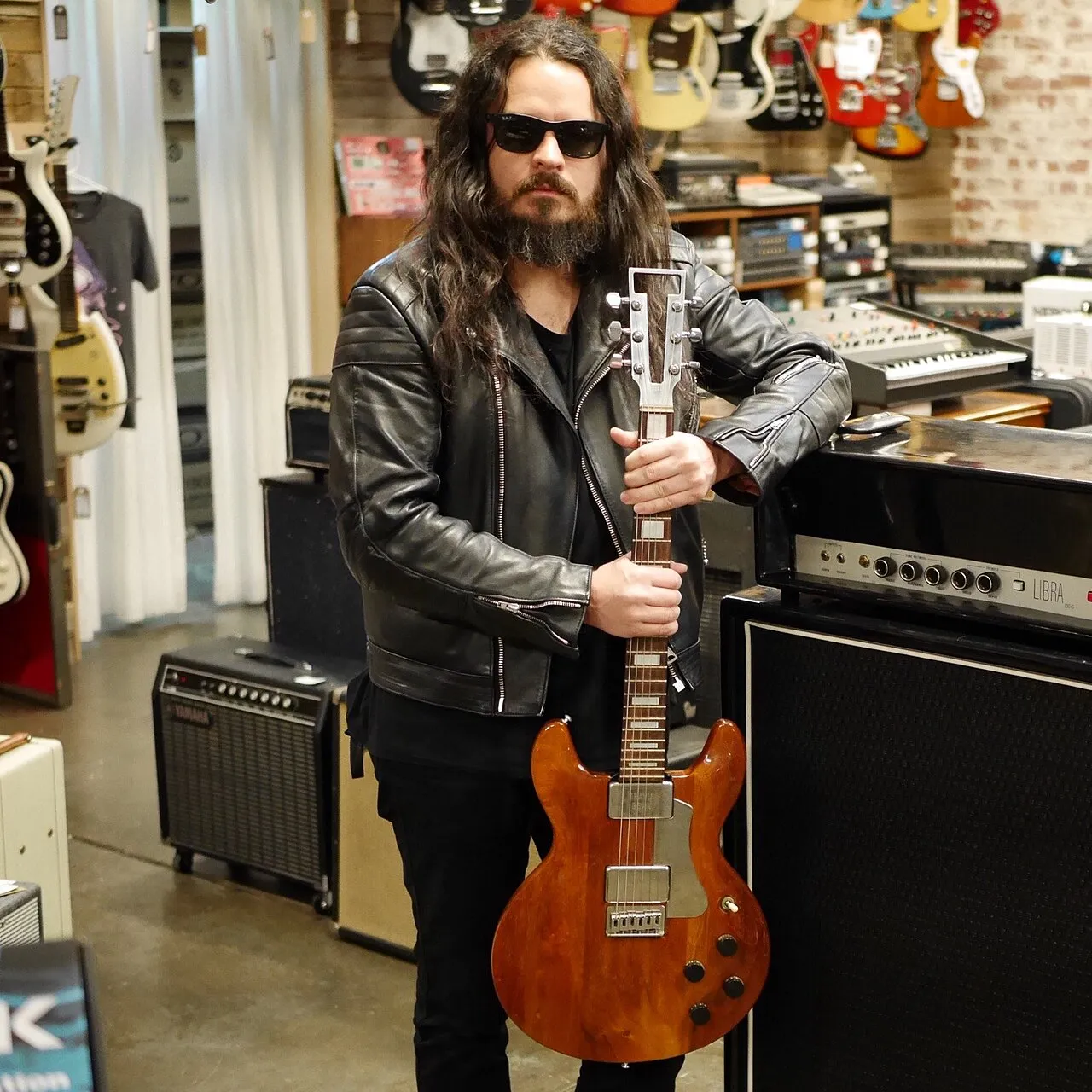
Photo: Somalley / Wikimedia Commons / CC BY-SA 4.0 Travis Bean
TB1000
1974
A motocross racer watched a repairman fight wooden necks all day. So he made one out of aluminum.