 Guitaripedia
Vivi-Tone
Vivi-Tone
Lloyd Loar's first electric guitar had no body at all. The customers made him give it one.
Kalamazoo, the early 1930s. The man behind Gibson's Master Model L-5 starts his own company with his old boss and builds an electric Spanish guitar that takes gut or steel. It's a Vivi-Tone, not a Gibson, and within a few years the company is gone.
- Introduced
- 1932
- Type
- Hollowbody electric
- Class
- Closed run
The short version
Early 1920s
Loar at Gibson
Gibson's acoustical engineer in the early '20s. The L-5 guitar and F-5 mandolin are that work, and they're Gibsons.
1924
Loar leaves
He walks out of Gibson in December, a year after general manager Lewis Williams was pushed out.
1932
The Skeleton
A brochure is out by August, and the first bodiless electrics are in production. Labels already say Vivi-Tone.
1932
Fewer than 100
By late in the year they've built under 100 instruments of every kind, and they start re-tooling.
1933
A box after all
Hollow guitars that play acoustic or electric. On 1 November the company is incorporated, which some date as its founding.
1934
The World's Fair
Loar plays a Vivi-Tone Clavier, and a Skeleton guitar goes into the same big amplifier.
1936
Detroit
Headquarters move to Gratiot Avenue in Detroit. Production is probably over within a year or two.
Side A
A1
A guitar with nothing around it
Kalamazoo, 1932. Lloyd Loar is back in town, and the guitar on his bench doesn't have a body.
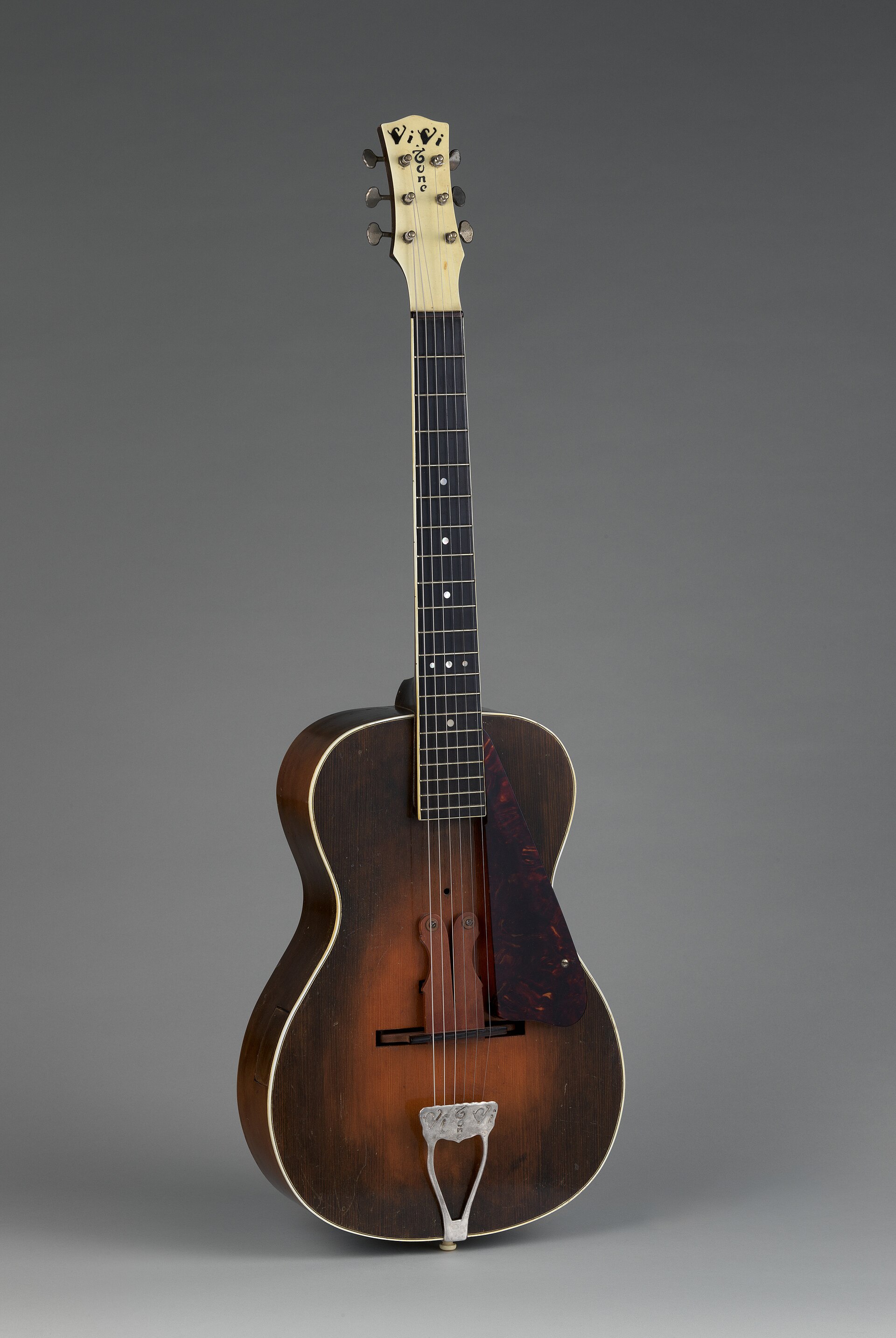
There's a mahogany core about two and a quarter inches deep. Around it is a thin plate cut in the shape of a guitar, bound three times, with f-holes painted on. No back. No sides. The bridge sits over a wooden box with the pickup in it, and there's a lever on the bass side for volume. The company called it the Skeleton.
This is the man who did the L-5 and the F-5 for Gibson in the early 1920s, the Master Model archtop guitar and mandolin. Those are Gibsons. He left in December 1924. Lewis Williams, the general manager who'd hired him, had been pushed out the year before and gone into radio and PA. By 1932 the two of them were back together in Kalamazoo, building electrics under their own name.
What Loar wanted, as one historian puts it, was "pure string tone," without the "interfering" resonance of a hollow body. He'd spent years making wooden boxes sing. Now he wanted the box gone.
A2
Gut or steel
The pickup is the clever part. It isn't a magnet under the strings. The wooden bridge sits on a metal plate, and a coil underneath senses the plate moving. Whatever shakes the bridge makes a signal, so the strings didn't have to be steel. Gut worked.
Out in Los Angeles, Rickenbacker's horseshoe pickup needed steel strings, and on a Spanish guitar it sat right where your picking hand wanted to be. It was also louder through a 1930s amp. Loud won the Hawaiian players, and they went to Los Angeles. Loar's guitar didn't get them.
When the company started depends on who you ask. One researcher puts it in August 1932, when the first brochure was out. The incorporation papers are dated 1 November 1933. Another telling has a patent company called Acousti-Lectric in 1934 and the Vivi-Tone name in 1936. But guitars were already wearing Vivi-Tone labels in 1932, and the complete outfit cost $175.
By late 1932 they'd built fewer than 100 instruments of every kind.
A3
Heard over the air
One Skeleton-based guitar went to a bandleader. In late 1932 Vivi-Tone made Alvino Rey a thin semi-hollow, the plank with a back and sides added. By the end of the year he was playing it, and a Ro-Pat-In frying pan as well.
In February 1933 Metronome noticed:
"An electrical guitar that can be heard over the air but not in the studio has been introduced by Alvino Rey at the NBC headquarters here."
That's an electric guitar, explained for people who'd never seen one. You heard it on the radio. In the room it barely made a sound.
Very few of those semi-hollows were made. Looking back, one writer says Loar essentially invented the ES-335, without the cutaways or the humbuckers. That's a comparison, not a Gibson.
Flip the record · By the numbers
$175
The complete 1932 outfit, guitar and all
Under 100
Instruments of every type built by late 1932
600–700
Rough count of all Vivi-Tones ever, guessed from serials. Nobody published a total.
24½"
Scale on the 1933 hollow electric
Side B
B1
Pretending to be a guitar
The public wasn't ready for a plank. In 1933, as Premier Guitar's Joel Handley put it, "public sentiment forced the company to at least pretend their instruments were traditional."
So Loar gave it a body, his way. Spruce top and spruce back, with the f-holes cut in the back, which was set in so your stomach wouldn't choke it. Two wooden arms under the bridge passed the vibration down to it. The electronics slid out of the bass-side rim in a drawer. A lever at the bridge took the pickup out of the circuit so you could play it acoustic, or electric, or both. It came in a Cremona Brown sunburst with a huge tortoise pickguard, and it took gut or steel.
Then they built the same guitar with no pickup at all and called it the Acousti-Guitar. Going by the serials, most Vivi-Tones ever made were those.
B2
Cost $200, will sell for $100
In December 1933, the same issue of Crescendo that reported the company reincorporating carried a classified: "Vivi-Tone guitar and power case. Cost $200, hardly used. Will sell for $100 cash."
At the 1934 World's Fair, Loar played a Vivi-Tone keyboard he called the Clavier, Charles D. Stein played violin, and a young woman billed as Miss Stanger played a first-generation Skeleton, all through one big amplifier. In New York, a teacher named Dennis Hartnett was selling Vivi-Tones and playing his own Acoustic-Lectric hard enough to dent the plate under the bridge.
In February 1936 the company moved to Gratiot Avenue in Detroit, with Loar mostly in Chicago. Production was probably over within a year or so. Depending on the account it folded in 1937, or 1938, or sputtered out before the war. The last patent was filed in October 1937. Count the serials and you get somewhere around 600 or 700 instruments, mandolins and keyboards included.
B3
The trade-in label
Open up an Acousti-Guitar, the hollow box with no pickup, and some of them still have a paper label inside. It offers you a trade toward an Acousti-Lectric, "selling for not less than $99.00 retail."
Loar's first idea was a guitar with nothing around the strings. The customers wanted a box, so he built them one with a drawer in its side. The box sold better without the drawer, and some went out with a label inside offering to trade you up to the electric.
One 1933 Acoustic-Electric, drawer and all, is in the Metropolitan Museum of Art now, bought with a gift from Steve Miller.
The cast
The people, and the specific guitars, that made the legend.
1932
Alvino Rey
Thin semi-hollow built for him from the Skeleton design
Made for him late in 1932. He played it on the air from NBC early the next year, and used a Ro-Pat-In frying pan too.
1934–35
Dennis E. Hartnett
A 1934–35 Acoustic-Lectric
Teacher, dealer, and Vivi-Tone's man in New York. The wear on his guitar says he played it electric-only as well as both ways at once.
1934
Miss Stanger
A first-generation Skeleton
Played it at the World's Fair beside Loar's Clavier and Charles D. Stein's violin, all through one large amplifier.
1932
Lloyd Loar
Designer
Gibson's acoustical engineer in the early '20s. At Vivi-Tone he set out to get rid of the hollow body he'd made his name on.
1932
Lewis A. Williams
Partner
Gibson's general manager until 1923, then radio and PA. Back in Kalamazoo with Loar by 1932.
Liner notes
Specs, construction, rarity, value, and every source we used.
A wooden bridge on a metal plate, a coil in a drawer — Loar’s Kalamazoo Spanish electric, gut or steel, and not a Gibson.
- Body
- Thick-rimmed Spanish outline, fully hollow. Spruce top and back, laminated maple rims (Met; RetroFret). Recessed back with two f-holes, meant to be the primary soundboard. Met object 2016.415a, b: 39 1/8 × 13 1/8 × 4 5/8 in. (99.4 × 33.3 × 11.7 cm). RetroFret on a matching 1933: overall 39 1/8 in. (99.4 cm), lower bout 13 1/8 in. (33.3 cm), depth at the rim 3 3/4 in. (9.5 cm). Commons additional fields on the Met guitar match that rim depth. The Met’s 4 5/8 in. and RetroFret’s 3 3/4 in. are different published depths of the same outline.
- Neck
- Set mahogany, heavy “V,” Gibson-like (RetroFret). Ivoroid heelcap. 14-fret join on the Acousti-Guitar body this electric shares (dealer sheets).
- Fingerboard
- Bound ebony, pearl dots (RetroFret 1933; Met medium lists ebony).
- Scale
- RetroFret 1933: 24 1/2 in. (622 mm). Met Commons: 24 1/2 in. (62.2 cm). National Music Museum serial 300 (a 1934–35 Acoustic-Lectric, not the Met guitar): high E 617 mm (24-9/32″), low E 625 mm (24-5/8″).
- Pickups
- One hybrid magnetic/electrostatic unit under the bridge (Vintage Guitar; RetroFret). Wooden bridge sits on a metal plate (armature); a coil and magnet in a removable bass-side drawer sense the plate. Gut or steel. U.S. patent 2,025,875 (filed 27 January 1934, granted 31 December 1935) describes the drawer and a magnetic generator.
- Hardware
- Cast manganese tailpiece with the Vivi-Tone logo; compensated ebony-cap bridge; enormous raised tortoise-celluloid pickguard; Grover tuners with grained ivoroid buttons; ivoroid-veneered headstock, screened logo (Met; RetroFret).
- Electronics
- Pickup in the sliding drawer. Lever or posts at the bridge to put string pressure on the pickup, on the two soundboards, or both (Premier Guitar; patent 2,025,875). Early Skeletons: lever volume and screw terminals or twin mini-plugs, no drawer (Vintage Guitar). Passive.
- Finish
- Cremona Brown sunburst varnish on the 1933 hollow guitars (RetroFret).
- Nut
- RetroFret 1933: 1 7/8 in. (48 mm). Met Commons: 1 7/8 in. (4.8 cm).
Open the full research fileConstruction details, the complete player record, production numbers, dated value estimates, and sources
The specs above are a 1933 Acoustic-Electric six-string, Kalamazoo — the Met’s object 2016.415a, b (Purchase, Steve Miller Gift, 2016) and RetroFret’s measured example of the same outline. No current model carries the name. The 1932 Skeleton (the company’s word) is the earlier plank, no resonant chamber. The Acousti-Guitar is this hollow body without a pickup. The Hi-Fret with an Acousti-Lectric bridge is a later Detroit guitar. Tenor and plectrum necks, mandolin-family instruments, the Clavier, and the Aggrandizer amplifier are other objects. It is not a Gibson L-5. It is not a Rickenbacker Electro Spanish Model B, and not an A-22.
Construction
The job was a Spanish guitar loud enough for a band, that would take gut as well as steel. Kalamazoo, not a Gibson.
Lloyd Allayre Loar had already done the other half of his reputation there. He was Gibson’s acoustical engineer in the early 1920s — Wikipedia’s Loar page: 1919–1924; Roger Siminoff: full-time from February 1920, hired by general manager Lewis A. Williams. The Master Model L-5 guitar and F-5 mandolin are that work. They are Gibson instruments. Williams was pushed out in late 1923 (Vintage Guitar). Loar left in December 1924 (Vintage Guitar, January 2018). Walter Fuller, who joined Gibson in 1933, later found round electrostatic pickups Loar had tried under archtop tops; those factory leftovers are not this guitar (A. R. Duchossoir, via Wikipedia).
Williams went into radio and PA. By 1932 he and Loar were back in Kalamazoo building electrics. The founding date is a fight. Lynn Wheelwright, to Dave Hunter in Vintage Guitar (September 2015): Vivi-Tone “came into being in Kalamazoo in August of 1932 — nearly a year earlier than many accounts claim.” Peter Stuart Kohman, Vintage Guitar (February 2025), citing Wheelwright: “Skeleton” or “plank” guitars in production by mid-1932; first Skeletons in a brochure issued by August of 1932. RetroFret, on serial 68: built at the latest in the summer of 1932. Siminoff: Loar, Williams, “and five other local businessmen” founded the Vivi-Tone Company in Kalamazoo on 1 November 1933, for manufacture of acoustic and electric instruments. Wikipedia, citing Tom Wheeler’s American Guitars (1982, p. 357): Loar, Lewis A. Williams, and Walter Moon, incorporated that same day, executive offices in Detroit. Duchossoir, on Wikipedia’s Loar page, dates Acousti-Lectric to 1934 and a rename to Vivi-Tone in 1936. Siminoff’s books and the National Music Museum treat Acousti-Lectric as a 23 January 1934 holding company — Loar, Moon, and Williams, seeking $33,000 from the same seven stockholders — not a new brand. Guitars already wore Vivi-Tone labels in 1932. Sources differ: August 1932 for the company Wheelwright dates, 1 November 1933 for the incorporation Wheeler and Siminoff print, 1934 / 1936 for Duchossoir’s patent-company telling. The brochure year for the first guitars is 1932.
What they sold first was not a box. Kohman: Loar wanted “pure string tone” and to kill the “interfering” resonance of a hollow body. The Skeleton is a 19" mahogany core, 2¼" deep (RetroFret serial 68; Vintage Guitar). RetroFret calls that core 19" long; Vintage Guitar prints 19″-wide. The guitar-shaped “body” is a thin plate — Vintage Guitar 3/16", RetroFret 1/8" on 68 — triple-bound, painted f-holes, no back, no sides. Serials on blue labels counted every instrument, not guitars only. 47 and 68 are the two six-strings Kohman and RetroFret walked: ivoroid on the headstock, screened nouveau logo, mahogany neck with an ivoroid center strip. Vintage Guitar puts rosewood boards on both. Sources differ on 68: RetroFret’s header prints ebony, the body rosewood. Tuners and tailpieces were not one spec. 47: plastic-button Grovers, the cast Vivi-Tone tailpiece, ebony bridge, two screw terminals marked Speaker+ and Speaker−. 68: Waverly strips, a cheap stamped tailpiece also seen on Alvino Rey’s 97, maple bridge with an ebony cap, twin mini-plugs. The pickup lives in a wooden box under the bridge, lever volume on the bass side. Kohman: by late 1932 they had built fewer than 100 instruments of all types and started re-tooling.
The pickup is the point, and it is not a horseshoe. Vintage Guitar: Loar’s is a hybrid magnetic/electrostatic type — bridge vibration moves a metal plate, sensed by a solenoid beneath. RetroFret uses the same hybrid sentence. Any string would work. Beauchamp’s Rickenbacker horseshoe needed steel and sat in the player’s way on a Spanish neck; it was also louder through 1930s amps. That is why the Hawaiian market went to Los Angeles and this one did not. U.S. patents 2,025,875 (filed 27 January 1934, granted 31 December 1935) and 2,020,557 (filed 14 May 1934, granted 12 November 1935), both assigned to Acousti-Lectric, are the later hollow-body drawings: a drawer through the rim, an armature bar, a horseshoe magnet and coil, posts that can lift the bridge off the pickup so the guitar is acoustic, electric, or both.
Public taste pushed them toward a box. Kohman: in 1933 they began building hollow guitars and mando-family instruments that could be played either way, then offered the Acousti-Guitar, the same eccentric body with the pickup left out. Joel Handley, Premier Guitar (11 September 2023), on serial 220: the 1932 Skeletons had no back or sides; in 1933 “public sentiment forced the company to at least pretend their instruments were traditional.” Spruce top and back; sources differ on the rims — Premier Guitar composite, RetroFret and the Met maple. F-holes on the back, the back inset so a player’s body would not mute it. Two pivoting wooden arms under the bridge feed vibration to that back. The Met’s ca. 1933 Acoustic-Electric is this guitar. The electronics slide out of the bass rim in a drawer. Premier: a lever at the bridge uncouples the pickup for acoustic playing. National Music Museum serial 300, labelled Acoustic-Lectric, 1934–35, still Kalamazoo, is the same idea with metal posts through the bridge onto the armature.
They advertised the loudness, and they priced it like a luxury. Kohman: the 1932 complete unit was $175. December 1933 Crescendo, in the same piece: a news item on reincorporating to market the electric Clavier, and a classified, “Vivi-Tone guitar and power case. Cost $200, hardly used. Will sell for $100 cash.” Hunter: a circa-1935 Aggrandizer amp $125. Exchange labels inside Acousti-Guitars (Reverb serial 382, RetroFret serial 587) offer a trade onto an Acousti-Lectric “selling for not less than $99.00 retail.” Period money. Webster Electric of Racine, Wisconsin, built the amps (Wheelwright, via Hunter); Loar did not.
An experiment between the plank and the full hollow is thinner still. Kohman: a back and sides added to the Skeleton, a thin semi-hollow. Very few. One made for Alvino Rey in late 1932. Kohman: essentially Loar invented the ES-335, without cutaways or PAFs. A comparison. Not a Gibson model.
Then the company moved and ran out of road. Siminoff: headquarters to 6330 Gratiot Avenue, Detroit, February 1936; Loar mostly in Chicago. National Music Museum serial 623, a Hi-Fret with an Acousti-Lectric bridge, is labelled 6321 Gratiot, Detroit, and called one of the latest numbers known. Sources differ on the street number. NMM’s Clavier record: the 1936 restructuring, production likely over within a year. Premier Guitar: folded in 1937, “just around 600” instruments. Hunter / Wheelwright: demise in ’38. Kohman: sputtering close sometime before World War II, Loar and Williams already gone; documented serials suggest around 700 of all types, most of them Acousti-Guitars. RetroFret: no more than 6–700. Siminoff: by 1938 Loar was living on a Northwestern teaching stipend and writing. Arian Sheets (National Music Museum talk, 2018): a last patent applied for in October 1937, assigned to Frank Holton, Vivi-Tone “pretty much gone.” No factory total was published. The 600, 6–700, and 700 figures are serial guesses across guitars, mandolins, violins, and keyboards. They are not a guitar census.
Players
Alvino Rey is the named player, and his guitar is not the 1933 Acoustic-Electric described above. Kohman: a thin semi-hollow Skeleton-based guitar made for him in late 1932. RetroFret: serial 97, the same stamped tailpiece as six-string 68. Lynn Wheelwright, quoted on prewargibsonl-5.com (24 August 2021): by the end of 1932 Rey was using one of the first Vivi-Tone electrics as well as a Ro-Pat-In A-25 frying pan. Arian Sheets, from Metronome, February 1933: “An electrical guitar that can be heard over the air but not in the studio has been introduced by Alvino Rey at the NBC headquarters here.” Serial 97 in that talk. Rey’s later Gibson ES-150 and pedal-steel work is a different career. No Vivi-Tone session title is attached.
Dennis E. Hartnett (1870–1949) is the player the National Music Museum can put a serial on. Teacher, Gibson dealer, Vivi-Tone representative in New York. Object 10811, Acoustic-Lectric serial 300, plus a mandola and a mandocello, all used hard. Indentations on the armature and worn post-ends say he ran it electric-only as well as acoustic-and-electric. Preserved with a Webster amp and a foot pedal.
At the 1934 World’s Fair, Loar played a Vivi-Tone Clavier; Charles D. Stein played violin; a young woman identified as Miss Stanger played a first-generation Skeleton, all into one large amplifier (Kohman). A demonstration. Not a discography.
No other six-string player has been sourced. Bill Monroe’s F-5 and Maybelle Carter’s L-5 are Gibson Master Models, not Vivi-Tones. Les Paul is not documented on this guitar.
Rarity
You cannot order a new one. Closed run. Not a reissue.
No factory total. Premier’s around 600, RetroFret’s no more than 6–700, and Kohman’s around 700 are serial inferences for every Vivi-Tone type. The bulk, Kohman says, are Acousti-Guitars. Serials date an instrument. They do not count a year of six-strings.
Thinner inside that pile: the 1932 Skeleton six-string. Kohman and RetroFret: no more than 96 Skeletons of all types, unknown how many guitars, “only a handful” documented to survive. Serials 47 and 68 are the two published six-strings. Rey’s 97 is the thin semi-hollow, another object. A 1933 Acoustic-Electric with the drawer still in it and the cable still hard-wired (Premier, serial 220) is the hollow electric people mean. Hartnett’s 300 is one museum guitar. Late Detroit Hi-Frets (NMM serial 623 among them) are the tail of the run. An Acousti-Guitar is the common cousin and a different market — the same small spruce box, no pickup, sometimes a trade label still promising an electric that the company could barely sell.
Wheelwright has logged 46 Vivi-Tone amplifiers of all types. That is amps. Hunter: only a handful are known. They are not this guitar.
Value
Informal estimate, 28 October 2026. Not an appraisal.
Asking prices are not sold prices. The 1932 outfit at $175, the Crescendo ad’s $200 cost / $100 ask, the Aggrandizer at $125, and the Acousti-Lectric floor of $99 are period lists and classifieds. Celebrity lots are not a comp. No factory count to multiply by a price.
New street. None. No current Vivi-Tone. No reissue.
Used modern. There is no modern Vivi-Tone production to make a used-modern band.
Vintage / collectible. Named asks, hammers unpublished unless marked. RetroFret’s 1932 Skeleton serial 68, item 11585, listed on Reverb at $35,000; the shop page reads sold. RetroFret’s serial 47 with an amplifier, Reverb item 69763766, ended at an ask of $60,000. Premier Guitar, September 2023: Jay Rosen’s 1933 Acoustic-Electric serial 220 listed at $10,500; a Reverb listing for that serial ended at $7,980. Reverb’s Vivi-Tone brand page on 28 October 2026 showed a vintage 1935 electric at $7,500 (was $8,500) and Acousti-Guitar asks from about $1,500 to $4,500 (RetroFret #239 $3,850, #587 $3,750; SS Vintage $3,500; Jay Rosen 1933 acoustic $2,990; Guitar Broker #625 $2,495). A 1933 electric mandolin, serial 301, $5,750 ask. A 1934 Acoustic-Lectric body, sold $650 years ago, is not a guitar. No 2024–26 auction hammer for a six-string electric was published. Rey’s 97, Hartnett’s 300, and the Met’s 2016.415 are museum or named objects, not comps.
See also
- rickenbacker-model-b — 1935 Bakelite Spanish with a horseshoe; another early electric you hold upright, not this drawer-and-plate guitar
- rickenbacker-a-22 — 1932 cast-aluminum lap steel; the Hawaiian contemporary Loar did not build
- gibson-l-5-ces — Loar’s Gibson L-5, later made electric by Gibson; a different maker and a different guitar
Sources
- Metropolitan Museum of Art, Acoustic-Electric Guitar, ca. 1933, 2016.415a, b — Kalamazoo; spruce, maple, mahogany, ebony; 39 1/8 × 13 1/8 × 4 5/8 in. (99.4 × 33.3 × 11.7 cm); drawer pickup; bridge to metal plate to coil; dual soundboard, f-holes on the back; Grover ivoroid; cast tailpiece; raised tortoise guard. Steve Miller Gift, 2016
- Wikimedia Commons, Met 2016.415a, b — additional: rim depth 3 3/4 in. (9.5 cm); scale 24 1/2 in. (62.2 cm); nut 1 7/8 in. (4.8 cm)
- Vintage Guitar, Peter Stuart Kohman, Vivi-Tone “Skeleton” (February 2025) — mid-1932 production, August 1932 brochure; Skeleton / plank; hybrid magnetic/electrostatic pickup; serials 47 and 68; 19″ / 2¼″ mahogany core; 3/16″ plate; <100 instruments by late 1932; ≤96 Skeletons; ~700 all types; $175 unit 1932; World’s Fair 1934, Miss Stanger; Alvino Rey late-1932 semi-hollow; Crescendo Dec. 1933 $200 / $100 ad
- Vintage Guitar, Dave Hunter, The ViVi-Tone Aggrandizer (September 2015) — Wheelwright: company August 1932; demise ’38; Webster Electric, Racine; Aggrandizer $125 c. 1935; 46 amps logged
- Premier Guitar, Joel Handley, Vintage 1933 Vivi-Tone (11 September 2023) — serial 220; 1932 Skeleton then 1933 hollow; drawer; lever uncouples pickup; ~600 instruments, folded 1937; listed $10,500; period “around $175”
- RetroFret, Vivi-Tone Solid Body Electric Guitar (1932), serial 68, item 11585 — summer 1932; 19" long, 2¼" deep core; 1/8" plate; 37 7/8 in. (96.2 cm) / 13 7/16 in. (34.1 cm) / 2 7/16 in. (6.2 cm); scale 24 1/4 in. (616 mm); ≤96 plank, 6–700 all types; Alvino Rey #97 tailpiece
- RetroFret, Vivi-Tone Acoustic-Electric Guitar (1933), item 3369 — spruce top and back, maple rims, mahogany / ebony; 39 1/8 in. (99.4 cm) / 13 1/8 in. (33.3 cm) / 3 3/4 in. (9.5 cm); scale 24 1/2 in. (622 mm); nut 1 7/8 in. (48 mm)
- RetroFret, Vivi-Tone Acousti-Guitar, serial 239 — same hollow construction, no pickup; 39 1/2 in. / 13 1/4 in. / 3 7/8 in.; ask $3,850
- National Music Museum, Acoustic-Lectric serial 300, object 10811 — 1934–35, Kalamazoo; Dennis E. Hartnett; high E 617 mm (24-9/32″), low E 625 mm (24-5/8″); patent 2,020,557; Webster amp
- National Music Museum, Hi-Fret serial 623, object 13574 — Detroit, 6321 Gratiot; among latest numbers; Acousti-Lectric bridge
- National Music Museum, Vivi-Tone Clavier — Loar, Williams, Walter Moon; 1933 founding; Acousti-Lectric patents; 1936 Detroit move; production likely over within a year
- Roger Siminoff, Lloyd Loar biography — 1 November 1933, Loar, Williams, five other businessmen; Acousti-Lectric 23 January 1934, Loar, Moon, Williams, $33,000; Detroit 6330 Gratiot, February 1936; by 1938 teaching stipend
- Wikipedia, Vivi-Tone — Wheeler 1982 p. 357: Loar, Williams, Moon; incorporated Kalamazoo 1 November 1933, executive offices Detroit
- Wikipedia, Lloyd Loar — Gibson 1919–1924; Duchossoir: Acousti-Lectric 1934, renamed Vivi-Tone 1936; Fuller on leftover electrostatic pickups at Gibson
- U.S. patent 2,025,875 — Loar, assigned Acousti-Lectric; filed 27 January 1934, granted 31 December 1935; drawer pickup; acoustic, electric, or both
- U.S. patent 2,020,557 — Loar, assigned Acousti-Lectric; filed 14 May 1934, granted 12 November 1935; pickup drawer through the rim
- prewargibsonl-5.com, Lynn Wheelwright on Gibson’s first production electric (24 August 2021) — Rey on a Vivi-Tone by the end of 1932, and on a Ro-Pat-In A-25
- Arian Sheets, Vivi Tone — Recent Discoveries and Revised Timeline (2018) — Metronome February 1933, Rey at NBC; serial 97; Hartnett as New York agent; last patent October 1937 to Holton
- Reverb, Vivi-Tone brand — asks on 28 October 2026, including 1932 serial 68 at $35,000 and a 1935 electric at $7,500
- Reverb, 1932 serial 47 with amplifier — ended ask $60,000
- Reverb, 1933 Electric Guitar serial 220 — ended $7,980; Jay Rosen; The Pinecaster
- Reverb, Acousti-Guitar serial 382 — exchange label, Acousti-Lectric not less than $99.00 retail; ask $4,500
- The Guitar Broker, Acousti-Guitar serial 625 — Detroit label; 13" lower bout, 14-fret, 24.25" scale, 1-3/4" nut; ask $2,495
- Vintage Guitar, Roger Siminoff, Lloyd Loar (January 2018) — Loar left Gibson December 1924; Vivi-Tone with Williams in 1933
Keep digging
Guitars this one gets compared to, confused with, or descended from.
- Send a picture
Rickenbacker
Electro Spanish Model B
1935
In 1935 Rickenbacker built a fretted electric with a bolt-on neck and strings through the body. Out of Bakelite.
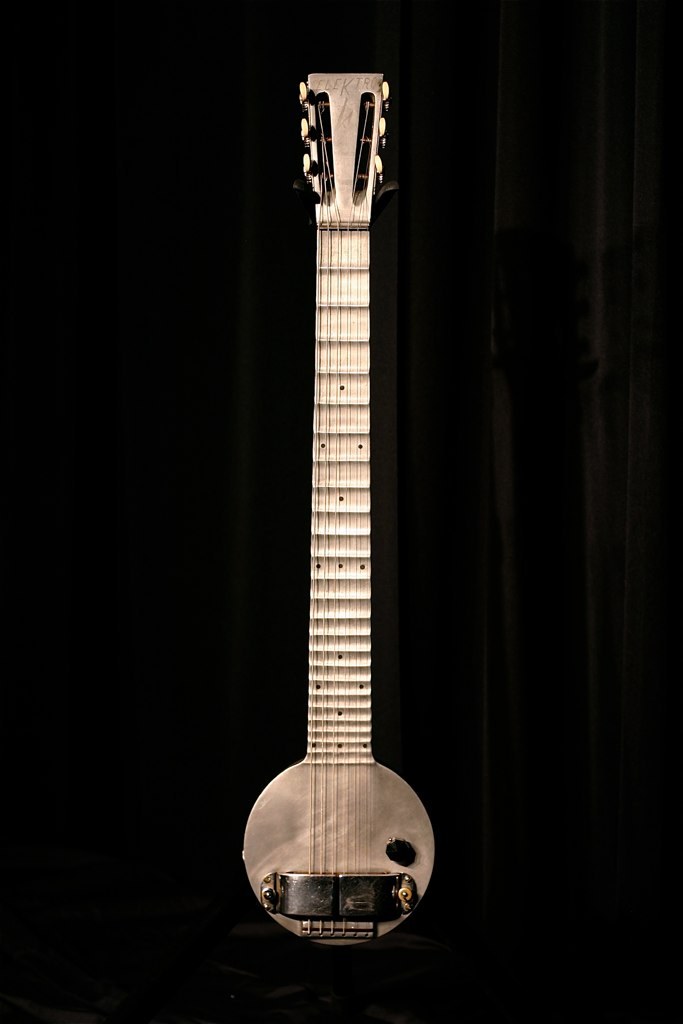
Photo: Museum of Making Music / Wikimedia Commons / CC BY 3.0 Rickenbacker
A-22 Frying Pan
1932
The first electric guitar you could buy looked like a frying pan. The patent office didn’t believe it worked.
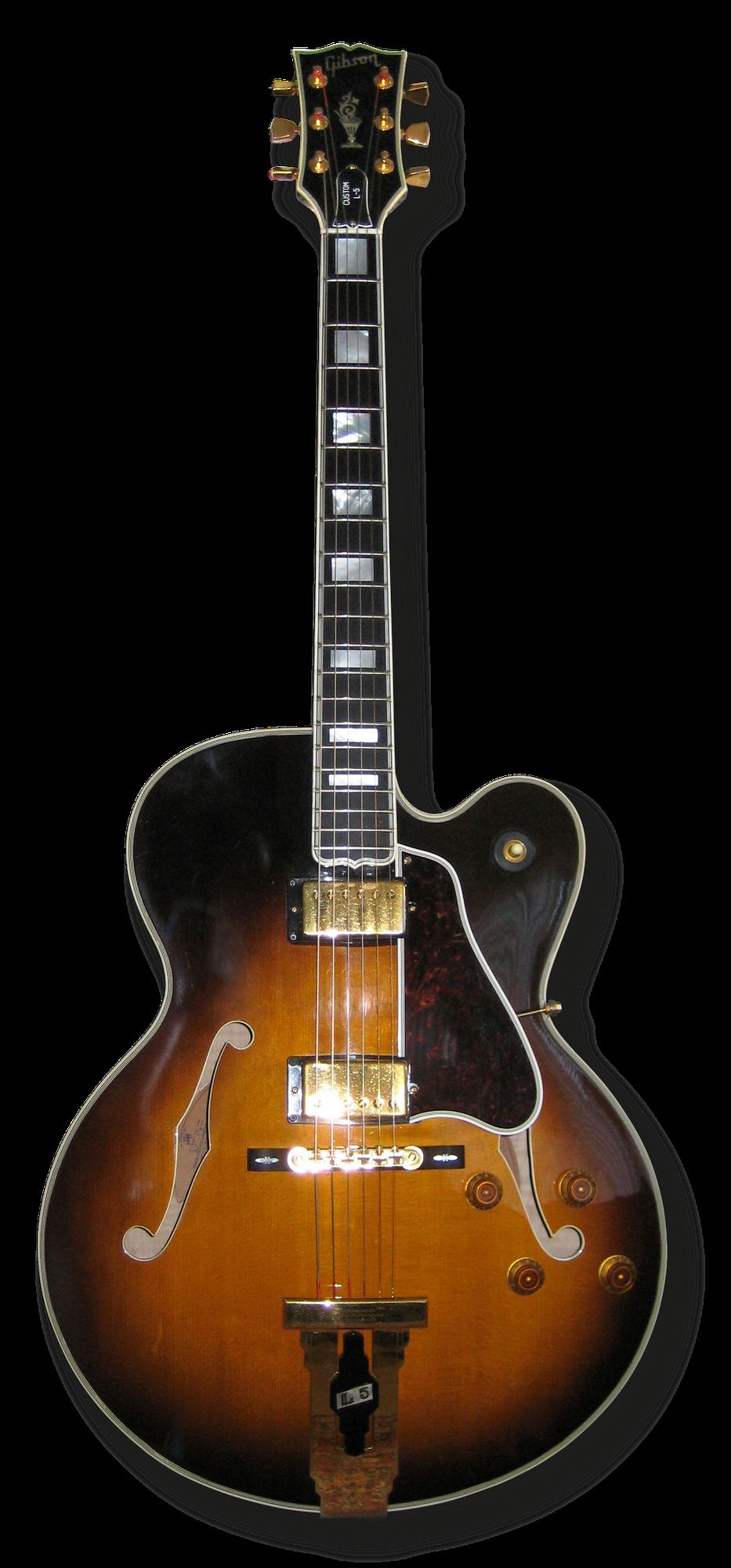
Gibson L-5 CES Tobacco Burst. Photo by Cruciniacus; isolated background by Auge=mit. Licensed under CC BY-SA 3.0. Via Wikimedia Commons. Gibson
L-5 CES
1951
In the ’50s Gibson shipped a few dozen a year. Wes Montgomery and Scotty Moore made them count.