Wandré
Rock Oval
An Italian partisan built a flying saucer with an aluminum neck, and painted every one differently.
Antonio Pioli's nickname meant "go in reverse." From a small town in Emilia, he sent out a hollow guitar scooped like a spaceship, with a metal neck and a paint job that never repeated. Adriano Celentano played it in a film. Bob Dylan stared at it through a shop window.
- Introduced
- 1959
- Type
- Hollowbody electric
- Class
- Production
Have a photograph of this guitar? Send a picture
The short version
1926
Born in Cavriago
Antonio Pioli is born on 6 June, the son of a man who spent years building a flying machine.
1957
Back to the family trade
Pushed out of a building cooperative for siding with the workers, he goes back to making instruments.
c. 1959
The Oval
The first Rock Oval, by the account of Wandré's historian, is made for Adriano Celentano. Other sources say 1958, or 1961.
1960
Urlatori alla Sbarra
Lucio Fulci's film opens in Bari on 23 March, with Celentano singing and playing his Oval.
1963
Out of the catalogue
The Oval leaves the Italian catalogue, though a few keep going abroad under other badges.
1965
The shop window
On tour in England, Dylan stops at a window full of them, in a scene filmed for Dont Look Back.
1968–70
The round factory closes
The factory shuts on 31 December 1968. Other accounts run the guitars to 1969, or 1970.
2025
Sanremo
Lucio Corsi plays a loaned Rock Oval on the festival's closing night.
Side A
A1
Go in reverse
Somewhere in England in 1965, Bob Dylan stops in front of a shop window. D. A. Pennebaker's camera is on him. Behind the glass hang guitars shaped like nothing Dylan has seen at home, scooped and swirled and painted.
They don't have those guitars in the States, man.
The papers can't agree whether that window was in Newcastle or London, and Dylan isn't playing one, only looking. But you can see why he stopped. The guitars came from Cavriago, a small town in Emilia, and from a man whose nickname, in the local slang, meant "go in reverse."
A2
The son of the flying machine
Antonio Pioli was born in Cavriago on 6 June 1926. His father, Roberto, ran an instrument shop and spent years building himself a flying machine. The son fought with the partisans, then ran building sites, until in the spring of 1957 the cooperative he worked for pushed him out for siding with the workers.
So he went back to the family trade. He signed it Wandré.
He wanted guitars that wouldn't warp, and wouldn't look like anybody else's. Italian maple, he found, wasn't American maple, and wooden necks bowed. So he built them on a spine of aluminum, sheathed in plastic so your palm wasn't resting on cold metal. Travis Bean's aluminum necks didn't arrive in America until 1974.
A3
A saucer for Celentano
The man who wrote the book on Wandré, Marco Ballestri, puts the first Rock Oval at about 1959. Other accounts say 1958, or around 1961. What everybody agrees on is who it started with.
It was made for Adriano Celentano, extra-thin, with his signature on the top and his portrait hand-painted on the back. He sang and played it in Lucio Fulci's Urlatori alla Sbarra, which opened on 23 March 1960. By one account it was his first electric guitar.
Pioli had already drawn a thicker guitar called the Rock'n'Roll. The Oval thinned it toward a flying saucer. The treble side is scooped away nearly to the control plate, and some have no real sides at all, just a curved top meeting a curved back.
What it was made of depends on the guitar in front of you: wood, molded plastic, fiberglass. Scale lengths run from 23¾ to 25 inches across the ones people have measured. The single-coil pickups were designed by Athos Davoli, and they sat on a floating pickguard. That's why so many people have looked at a Wandré and called it a Davoli.
Flip the record · By the numbers
1
Of each finish. Swirls, sparkle, candle smoke sealed in the lacquer. No two Ovals match.
23¾–25"
Scale lengths measured on three different Ovals. It was never one factory recipe.
2nd
Place for the Rock Oval in 1986, from a Guitar Player jury chaired by Frank Zappa.
35,000–70,000
Wandré instruments of every model, depending who's counting. Nobody counted Ovals.
Side B
B1
Candle smoke in the lacquer
The paint is the part you remember. Airbrushed swirls, ovals, sparkle, glitter. Some had smoke from a candle sealed into the lacquer. No two were done the same.
Much of that was done in the round factory. Pioli built it in Cavriago and moved in sometime between 1958 and 1960, depending who you ask. It was round so the people working inside could see the sky.
The Oval left the Italian catalogue in 1963. It kept going abroad in small numbers, under badges like Avalon, Framez and Rockette, the same silhouette with another name on it.
B2
The only electric he played
Francesco Guccini got a Rock Oval as a gift at the start, and played it with his band I Gatti. It was dark red, and the sequins caught the dance-hall lights. He played it, he said, until it wrecked his fingers. It was the only electric guitar he ever played.
He never met Pioli. Years later, in the preface to Ballestri's 2014 book, he described the shape as absurd, with oversized details that made you imagine a future nobody had worked out yet.
The round factory shut on 31 December 1968. Some accounts run the guitars into 1969, or 1970. Pioli went on to leather, then to Fluxus art. In 1986 a Guitar Player jury chaired by Frank Zappa gave a Wandré Scarabeo its prize for originality and put the Rock Oval second. Pioli didn't hear about it until 1991. He died in August 2004.
B3
Still from the future
In February 2025 Lucio Corsi wanted a Rock Oval for Sanremo. He didn't own one. He chose one from the Partigiani di Wandrè, the people who restore and lend Pioli's guitars, and Marco Ballestri handed it over. On the festival's closing night, Corsi played "Volevo essere un duro" on it. That May he took the same guitar to Eurovision rehearsals in Basel.
The guitar that made Celentano look like the future in 1960 made Corsi look like the future sixty-five years later.
Put this on
You’ve read about it. Now hear it. Here’s what this guitar sounds like, and what to listen for.
Urlatori alla Sbarra
The launch. Celentano sings and plays the Oval made for him, his signature on the top, in Lucio Fulci's film.
Watch it on YouTube (opens in a new tab)Volevo essere un duro (Sanremo 2025)
The closing night of Sanremo, on a Rock Oval lent to him by the people who look after Wandré's guitars.
Watch it on YouTube (opens in a new tab)
The cast
The people, and the specific guitars, that made the legend.
c. 1959
Antonio "Wandré" Pioli
Designer
Partisan, builder, later a leather worker and a Fluxus artist. He died in August 2004.
1959–60
Adriano Celentano
The first Oval, his signature on the top and his portrait painted on the back
By one account his first electric guitar. He played it on screen in Urlatori alla Sbarra.
1960s
Francesco Guccini
A dark red Rock Oval, a gift
The only electric he ever played, with I Gatti. He never met Pioli.
2025
Lucio Corsi
A loaned Rock Oval, dated 1958 by one account
Handed over by Marco Ballestri for Sanremo, then taken to Eurovision rehearsals in Basel.
Liner notes
Specs, construction, rarity, value, and every source we used.
A scooped hollow like a flying saucer, a sheathed Duraluminio neck, and a paint job that never repeated — Wandré's Rock Oval, not a Travis Bean.
- Body
- Thin hollow, extreme scooped treble cutaway. Construction is not one factory recipe: RetroFret's 1962 is wood and plastic; its c. 1963 Avalon is plastic; Mike & Mike's 1960s example is slender fiberglass. Guitar Magazine Japan: curved top and back joined without sides — an irregular hollow. Ultimate Guitar: laminate wood, molded plastic, or fiberglass. Mix flagged. RetroFret 1962, one guitar: 44 1/4" (112.4 cm) long, 16" (40.6 cm) wide, 1 7/8" (4.8 cm) deep. Do not treat that tape as a factory drawing.
- Neck
- Duraluminio aluminum spine (Guitar Magazine Japan prints Duraluminum), plastic or polystyrene sheath, rosewood board. Premier Guitar: three-bolt junction on a 1960. RetroFret: bolt-on, angle adjustable. A 1963 seller: most Rock Ovals are convex/convex with a tilting neck; that one guitar is the full neck-through T-bar to a tremolo tailpiece. Mix flagged. Do not flatten the typical three-bolt Oval onto Vintage Guitar's later headstock-to-tailpiece T-bar.
- Fingerboard
- Bound rosewood. Zero fret on the Mike & Mike's example. Guitar Magazine Japan: “mod Rock Oval Wandre” at the 3rd fret; position marks of mixed materials. Fret count is not one factory figure. Mike & Mike's: 16" radius, dot inlays, slender vintage wire.
- Scale
- Mix flagged. Premier Guitar, a 1960: 23 3/4". RetroFret 1962: 24 3/4" (629 mm). Mike & Mike's 1960s: 25". Do not average. Do not invent millimetres for 23 3/4" or 25".
- Pickups
- One or two. Athos Davoli trapezoid single-coils typical (Premier Guitar; Vintage Guitar). RetroFret 1962: one Davoli, branded Wandré, on a floating metal-and-plastic assembly. Barnebys c. 1963: twin early Davoli, Framez markings. Mike & Mike's: “Made Italy Davoli” covers, Davoli logo on the guard. Guitar Magazine Japan: Framez coils 1960–63, then Davoli through 1965. Mix flagged.
- Hardware
- Floating pickguard that carries pickups and, on many, the bridge. Round control plate. Cast “W” tailpiece on named examples. RetroFret 1962: 3-in-line on a thin aluminum head, aluminum nut. Mike & Mike's: open-gear strip tuners, white plastic buttons; rosewood bridge; chrome tailpiece.
- Electronics
- Passive. Mike & Mike's: independent volume per pickup, two-way tone switches, two-way pickup selector.
- Finish
- Polyurethane lacquer on the RetroFret 1962 (red, yellow, cream, black) and the Avalon c. 1963 (blue, red, gold). Airbrushed swirls, smoke, sparkle. Each finish is unique.
- Nut
- Mix flagged. RetroFret 1962: aluminum, 1 5/8" (41 mm). Mike & Mike's: 1 11/16" at the zero fret, ahead of a modern bone nut on that guitar. Guitare Collection: 44.6 mm. Do not average. Do not invent millimetres for 1 5/8" or 1 11/16".
Open the full research fileConstruction details, the complete player record, production numbers, dated value estimates, and sources
Classic living example = a Cavriago Rock Oval, Ballestri's ~1959 origin through the Italian catalogue into 1963. No current typical SKU this pass. Rock'n'Roll is the thicker predecessor. BB, Bikini, Karak, Scarabeo, Cobra, Spazial, Selene, and Roby are other Wandré numbers. Rockette Mod. 604 and Avalon are badges on this silhouette, not other guitars. Eastwood's Wandré Doris is a later tribute to a different model. Not a Travis Bean (travis-bean-tb1000). Not a Veleno (veleno). Standalone. No Gibson SKUs. Mixed inch/mm flagged. Do not invent millimetres for 23 3/4", 25", 1 5/8", or 1 11/16".
Mike & Mike's fiberglass example: 6 lb 2 oz. Guitare Collection: 2.5 kg, nut 44.6 mm. Mix flagged. Do not average those weights.
Construction
The job was a guitar that would not warp, and would not look like a Strat. Cavriago, not Fullerton. A body like a flying saucer because he had already drawn the Rock'n'Roll and then thinned it.
Antonio Pioli was born in Cavriago on 6 June 1926. Fetishguitars and Jacques Stompboxes: he learned in his father Roberto's shop. Vintage Guitar (Michael Wright, 2 November 2017): Roberto spent years on a personal flying machine. Keep both. Jacques: the nickname Wandré means “go in reverse” in Reggio slang. That is the name on the guitar. He fought with the partisans. He ran building sites. Emilia-Romagna's heritage page: spring 1957, after the Consorzio Cooperative pushed him out for siding with the workers, he took up the family trade. This plate is not that year. It is the Oval.
Fetishguitars splits the shop into phases. 1957–60: Meazzi and Davoli; double basses and the BB, Rock and Roll, Waid, Selene, Spazial, Oval, Blue Jeans, Piper. 1960–63: the move into the Fabbrica Rotonda; BJ Major, Roby, Rock, Bikini, Twist. Rock.it prints a photograph from the Meazzi stand at the 1960 Milan fair: a Rock & Roll, a Waid, an Oval, a BB. The Oval is already on the wall.
Marco Ballestri, in Wandré — The Artist of the Electric Guitar, is the book RetroFret treats as the essential text. RetroFret, citing him: origin about 1959, just in time for an extra-thinline to sit in Adriano Celentano's hands in Lucio Fulci's Urlatori alla Sbarra. English Wikipedia: first release 23 March 1960, Bari. Fingerpicking.net: Celentano used a Rock Oval 1959–60. YAML introduced: 1959 is Ballestri's origin, not a claim that every later Oval left that week. Keep Ultimate Guitar's “roughly 1958 through the mid-’60s.” Keep Guitar Magazine Japan's “around 1961.” Keep Dieter Gölsdorf / Heinz Rebellius: built about 1960 to 1966. RetroFret: out of the Italian catalogue in 1963, still sold in very small quantities abroad. Do not pick a winner.
The round factory is its own split. Guitare Collection: created 1957, the round plant in service February 1958. Wright: 1959, back in Cavriago, a radical round factory. Wandré: Guitars with a Rebel Soul (January 2026): work began May 1959, operational February 1960. Fetishguitars puts the transfer in the 1960–63 phase. Keep 1958, 1959, and 1960. The building was round so the people inside could see the sky. That is the context the Oval comes out of.
What you get is a scooped hollow that eats the treble side all the way to the control plate. Guitar Magazine Japan: top and back meet without sides. Gölsdorf: plywood hollow, narrowed at the rim, so it reads as a solid. Celentano's first one, RetroFret: extra thinline. The 1962: thicker hollow, a slight carve, a heavy finish. Mike & Mike's: slender fiberglass, 6 lb 2 oz. Do not average those bodies.
The neck is why this is not a Bean, and not a Veleno. Guitar Magazine Japan names the metal Duraluminum. Guitar Player (Dave Hunter, 2 May 2023), on a Roby: aluminum so it would not warp, wrapped in thin adhesive plastic so the palm is not on cold metal. Jacques: Italian maple is not American maple, and the wooden necks bowed. Premier Guitar (Dan Orkin, 24 February 2020): on this 1960 Oval, a three-bolt junction, aluminum 23 3/4" scale. RetroFret: bolt-on, the angle adjustable, a removable plastic sheath that is often long gone. Vintage Guitar's Karak column describes the later Wandré idea as a T-bar from headstock to a cast W tailpiece, sitting above a concave body. That is the Karak, ca. 1965. A 1963 Rock Oval seller calls a full neck-through with tremolo the only one they have seen; most Ovals, that listing says, are convex/convex with a tilting neck. Keep three-bolt. Keep the rare through. Do not hang Bean's 1974 pan (travis-bean-tb1000) or Veleno's Florida bolt-on (veleno) on Cavriago. Rickenbacker's A-22 was a cast lap steel in 1932. No Gibson SKU.
Premier Guitar: every Wandré on that page has pickups and electronics designed by Athos Davoli, and the company issued some guitars under the Davoli name. Vintage Guitar: trapezoidal Davoli units, which is why people misread these as Davoli guitars. Guitar Magazine Japan: Framez coils 1960–63, Davoli through 1965. Fetishguitars: Meazzi and Davoli in the first phase. RetroFret names Framez, Avalon, Noble, Rockette. Equipboard adds Dallas and Lipsky. A Framez logo is not a second maker. A Rockette Mod. 604 is this silhouette for the States. The Avalon plaque is an export badge; RetroFret's c. 1963 still wears “Rock Oval” at the 7th fret.
Each finish is a painting. Wright: airbrushed swirls, ovals, sparkles. Denmark Street Guitars: smoke from a candle sealed into the lacquer. Ballestri's Bologna show notes, via DIRE.it: candle smoke and glitter in the round factory. Do not treat two Ovals as the same colour.
The Fabbrica Rotonda shut on 31 December 1968 (Wandré: Guitars with a Rebel Soul; l'Unità, 13 May 2025). Premier Guitar runs the brand to 1969. DIRE.it: guitar-making ended 1970. Keep 1968, 1969, and 1970. Pioli went to leather, then Fluxus. He died in August 2004.
Classic vs current: a Cavriago Oval — Duraluminio spine, scooped hollow, Davoli or Framez coils on a floating guard, a finish that does not repeat — against nothing you can order from that factory, and against an Eastwood Doris that is not this table.
In D. A. Pennebaker's Dont Look Back, filmed on Dylan's 1965 England tour, released 17 May 1967, Dylan stops at a shop window. MOJO (Michael Simmons, 15 January 2025): Newcastle; “They don't have those guitars in the States, man.” RetroFret transcribes “What are those guitars -- man, we don't have those in the STATES!” Ultimate Guitar, citing SUONO: incredible, and they did not have those guitars in the States. Italian papers often say London. Keep Newcastle and London. He is looking. He is not playing.
Players
Do not hang a Bikini, a Scarabeo, a Roby, or a Soloist here. Do not recruit Ace Frehley (Rock.it: the Bikini) or Buddy Miller (Equipboard: Soloist; Premier Guitar: “a Wandré” on a live “Deeper Well”). Do not make Dylan a player. Dealer copy that lists Hendrix stays off.
Adriano Celentano. Identity instrument for the launch. RetroFret, citing Ballestri: the catalogue Oval begins with the one made for him — his signature on the top, a hand-painted portrait on the back — and he sings and plays it in Urlatori alla Sbarra. Fingerpicking.net: 1959–60. Artribune (11 April 2014): the Rock Oval was his first electric. Il Resto del Carlino (18 February 2025): the same silhouette is the one the film waves around with Mina, Joe Sentieri, and Chet Baker. That is the picture. It is not a session log for the other three. Artist-owned custom — not a comps tape.
Francesco Guccini. The only electric he played. Gazzetta di Reggio (26 August 2026): a Rock Oval, a gift at the start, used with I Gatti (Franco Fini Storchi, Victor Soliani). He never met Pioli. The meeting is the preface he wrote for Ballestri's 2014 book. Artribune quotes him: “dalla forma assurda, con dettagli acromegalici che facevano immaginare un qualcosa di futuribile non ancora ben immaginato.” He played it “fino a distruggermi le dita,” dark red, sequins under dance-hall lights. Keep the preface. Do not invent a Guccini studio side on this guitar.
Lucio Corsi. The one that put the silhouette on television again. Il Resto del Carlino: he chose a Rock Oval from the Partigiani di Wandrè for Sanremo 2025; Marco Ballestri handed it over. l'Unità: closing night, “Volevo essere un duro,” a loan, not his guitar. Ultimate Guitar dates that instrument 1958. Keep UG's year on that object. Same papers: Eurovision 2025, Basel, the same Oval in rehearsal; contest rules barred live instruments, so the guitar's voice was recorded. Tommaso Ottomano's red Wandré that night is another model.
Also known to play stays empty on purpose. The Nomadi line in Artribune is Wandré, not a pinned Oval.
Rarity
You cannot buy a new Rock Oval from Cavriago. The round factory is a warehouse. Partigiani di Wandrè restore and loan; they are not a 2026 cart. Eastwood's Doris is a different shape.
Pioli published no Oval total. None invented. Brand-wide guesses do not count this model: Fetishguitars about 70,000 instruments; l'Unità the same; Rock.it a bit under 50,000; Wandré: Guitars with a Rebel Soul 35,000–40,000; Gölsdorf about 35,000. Keep the spread. It is not an Oval census. A firebrand inside the body dates a guitar. It does not count a year.
What is actually thinner: Celentano's extra-thinline with the portrait; a Framez-badged early one with the long W tailpiece; a fiberglass body with the polystyrene sheath still on; the Avalon / Rockette export; the one 1963 seller's neck-through. A Bikini is not an Oval. A Scarabeo is not an Oval. In 1986 a Guitar Player jury chaired by Frank Zappa gave Scarabeo the most-original prize; a Rock Oval placed second (Il Resto del Carlino; Fanpage). Pioli heard in 1991. Exhibition objects, including the Bologna Museo internazionale della musica show 11 May–8 September 2024, are not a street Oval.
Value
Informal estimate, 26 October 2026. Not an appraisal.
Ask vs sold labeled. Celebrity and loaned guitars are not-comps. No invented medians or factory counts. A Travis Bean, a Veleno, a Wandré Bikini, and an Eastwood Doris are not Oval comparables. Premier Guitar's “low-five-figure” (24 February 2020) is 2020 talk, not a 2026 median.
New street. None under Wandré Rock Oval this pass. No reissue of this silhouette from Cavriago, from the Partigiani, or from Eastwood.
Used modern. There is no modern Wandré production to make a used-modern band. Tribute copies (“The Wanderer,” Reverb: “THIS IS NOT A WANDRE”) are other people's saucers. Not this table.
Vintage / collectible. No Reverb Price Guide band isolated on Rock Oval this pass. Flag: thin sold-comp access. Named hammer, not a series: Guernsey's, 2 December 2017, c. 1963, red/blue/copper metallic, original tweed case, twin early Davoli, Framez markings — $12,000 (estimate $14,000). Named dealer asks, not hammers, fetched 26 October 2026: RetroFret 1962 $15,000; RetroFret Avalon c. 1963 $15,000; Mike & Mike's 1960s fiberglass £10,271.57 / $16,649.99. Named older asks, ended: Southside 1960 Framez $25,000 (listed nine years ago); Guitare Collection early-1960s psychedelic $30,422.37 (listed six years ago); WelcomeGuitars Framez €26,000; a 1963 neck-through £10,000 / $14,050.85. DIRE.it (9 May 2024) prints values that can arrive at €25,000; l'Unità (13 May 2025) prints up to €20,000 for the kind Corsi played. Gölsdorf, 2014: connoisseurs at least €10,000; Scott Freilich had already seen asks over $15,000. Do not average a 2017 hammer with 2026 asks. Artist-owned and loaned, not a comps tape: Celentano's portrait guitar, Guccini's I Gatti Oval, Corsi's Sanremo loan. Those are one-off objects.
See also
- veleno — all-aluminum Florida bolt-on, 1970; not a Cavriago Oval
- travis-bean-tb1000 — aluminum through-neck into koa, 1974 Sun Valley; the American one this neck predates
- eko-ranger-6 — Recanati's other Italian factory of the boom; a dreadnought, not this saucer
Sources
- Premier Guitar, Dan Orkin, This Colorful Aluminum-Neck Italian Guitar Foreshadowed the Psychedelic Era (24 February 2020) — 1960 Rock Oval; most iconic representative; low-five-figure; Antonio Vandrè Pioli ~1957–1969 Cavriago; aluminum necks before Bean; three-bolt junction; 23 3/4" scale; Davoli electronics; some guitars issued under the Davoli name
- Vintage Guitar, Michael Wright, Wandré Modele Karak (2 November 2017) — born 1926; Roberto and a flying machine; resistance; 1959 round factory; most hollow, some solid; Davoli trapezoid pickups; T-bar aluminum neck headstock-to-tailpiece on the later idea; plastic sheath; airbrushed swirls
- Guitar Player, Dave Hunter, A Rare Treat Among Vintage Treasures, This Wandré Roby (2 May 2023) — aluminum neck to avoid warpage; thin adhesive plastic for a warmer feel
- Guitar Magazine Japan, Framez by Wandre Rock Oval (16 February 2021) — around 1961; irregular hollow, curved top and back without sides; Duraluminum neck; “mod Rock Oval Wandre” at the 3rd; Framez pickups 1960–63, Davoli through 1965
- RetroFret, Wandre Rock Oval (1962), item 13573 — Ballestri origin ~1959; Celentano custom / Urlatori alla Sbarra; Italian catalogue out 1963; wood and plastic hollow; bolt-on aluminum, adjustable angle; plastic sheath; one Davoli; 44 1/4" (112.4 cm) / 16" (40.6 cm) / 1 7/8" (4.8 cm); scale 24 3/4" (629 mm); nut 1 5/8" (41 mm); ask $15,000; Dylan window quote as transcribed there; Rockette Mod. 604
- RetroFret, Wandre Avalon Rock Oval, c. 1963, item 13574 — plastic body; export / Avalon plaque; “Rock Oval” at the 7th; ask $15,000; removed from Italian catalogue, first formally distributed abroad
- Mike & Mike's Guitar Bar / Reverb, 1960s Wandré Rock Oval — fiberglass hollow; 6 lb 2 oz; 25" scale; 16" radius; 1 11/16" at zero fret; .905" deep 1st and 12th; polystyrene sheath; Davoli covers; independent volumes, two-way tones, two-way selector; ask £10,271.57 / $16,649.99 (fetched 26 October 2026)
- Fetishguitars.com, Wandrè — ~70,000 instruments; 1957–60 Meazzi and Davoli, Oval in that phase; 1960–63 Fabbrica Rotonda; 1963–67; 1967–68
- Rockit, Antonio Pioli “Wandrè” (16 February 2025) — Meazzi 1957–60, Davoli from 1959; Milan fair 1960 Oval on the wall; Guccini quote; under 50,000; factory close 1968
- Artribune, Wandrè. Vita chitarra e opere (11 April 2014) — Celentano's first electric; Guccini's only; Ballestri preface quotes; 1957–68; 1986 Zappa / Scarabeo
- Gazzetta di Reggio, Guccini e la sua chitarra Wandrè (26 August 2026) — Rock Oval gift; I Gatti; only electric; never met Pioli
- Il Resto del Carlino, Il genio dimenticato (18 February 2025) — Corsi Sanremo Rock Oval from Ballestri / Partigiani; Celentano, Mina, Sentieri, Baker in the film; Scarabeo first, Rock Oval second, Zappa jury; factory 1968
- Il Resto del Carlino, All’Eurovision. Corsi sul palco con le Wandrè (13 May 2025) — Eurovision 2025, Basel; same Oval; live instruments barred; Ottomano on a red Wandré
- l'Unità, La leggenda di Wandrè (13 May 2025) — ~70,000; up to €20,000; factory 31 December 1968; died August 2004; Corsi loan
- Fanpage, La storia della chitarra usata da Lucio Corsi a Sanremo 2025 (20 February 2025) — 1986 Miss Off The Wall; Scarabeo first, Rock Oval second; learned 1991; Celentano / Guccini
- Fingerpicking.net, Wandrè (1 December 2021) — Celentano Rock Oval 1959–60; Guccini's first electric
- DIRE.it, Non chitarre ma “sculture sonore” (9 May 2024) — Bologna show 11 May–8 September 2024; values to €25,000; production end 1970; candle smoke and glitter
- Paese Italia Press, Wandrè La chitarra del futuro (13 May 2024) — Rock Oval keeps the Rock'n'Roll outline, thinned toward a flying saucer
- Patrimonio culturale Emilia-Romagna, Wandrè: la chitarra del futuro — born 6 June 1926; spring 1957; factory to 1968
- Wikipedia, Urlatori alla sbarra — Fulci; Bari 23 March 1960
- Wikipedia, Dont Look Back — Pennebaker; 1965 England tour; released 17 May 1967
- MOJO, The Making Of Bob Dylan’s Dont Look Back (15 January 2025) — Newcastle shop window; “They don't have those guitars in the States, man.”
- Ultimate Guitar, The Wandrè Rock Oval Bob Dylan Called Incredible (9 August 2026) — ~1958 through mid-’60s; SUONO on Dylan and on the late-’60s collapse; Corsi's Sanremo guitar dated 1958; ~70,000 brand-wide
- Guitare Collection / Reverb, Wandre Davoli Rock Oval 1960's Psychedelic — created 1957; round plant February 1958; to 1968; 2.5 kg; nut 44.6 mm; ask $30,422.37, listed six years ago
- Barnebys / Guernsey's, c. 1963 Wandre “Rock Oval” (2 December 2017) — $12,000 hammer; estimate $14,000; twin early Davoli; W tailpiece; Framez markings
- Dieter Gölsdorf history, 2014 Wandré Expo Cavriago — Rebellius: plywood hollow narrowed at the sides; ~1960–66; ~35,000; collector value at least €10,000; Freilich had seen over $15,000
- Jacques Stompboxes, Wandre Guitars — born 6 June 1926; nickname; father's shop; aluminum broomstick, wooden board, adhesive tape; tilt on a hinge
- Eastwood Guitars, Eastwood Wandre Doris — 2006 tribute to the Doris, not a Rock Oval
- Reverb, Wandre Rock Oval 1960 (Southside Guitars) — Framez; ask $25,000; listed nine years ago; ended
- Reverb, WANDRÉ Wandre Rock Oval 1963 — seller: only full neck-through with tremolo they had seen; most Ovals tilting; ended ask £10,000 / $14,050.85
- Reverb search, RetroFret Wandre — 1962 Rock Oval $15,000; Avalon c. 1963 $15,000 (fetched 26 October 2026)
- Equipboard, Wandré — Framez 1960–63, Davoli 1963–65; Dallas, Avalon, Noble, Lipsky; ~70,000; Buddy Miller on Soloist
- Wandré: Guitars with a Rebel Soul (6 January 2026) — May 1959 factory work; February 1960 operational; 31 December 1968 close; 35,000–40,000; Rock Oval thinned from the Rock'n'Roll toward a flying saucer
- Vintage and Rare / Denmark Street Guitars, Wandre Rock Oval 1964 Smoke — candle smoke sealed into the finish; Dylan window quote as that shop transcribed it
- Reverb, Wandrè rock oval Super Rare Framez (WelcomeGuitars) — Framez pickups; long W tailpiece; seller: similar to Celentano's; ended ask €26,000 / £16,674.86
- Lospennato, The Life and Work of a True Dreamer, Wandré — Ballestri book; Rock Oval as a named model
Keep digging
Guitars this one gets compared to, confused with, or descended from.
- Send a picture
Veleno
Veleno
1970
A rocket-parts machinist built an aluminum guitar, hid it in a closet, and waited to be asked twice.
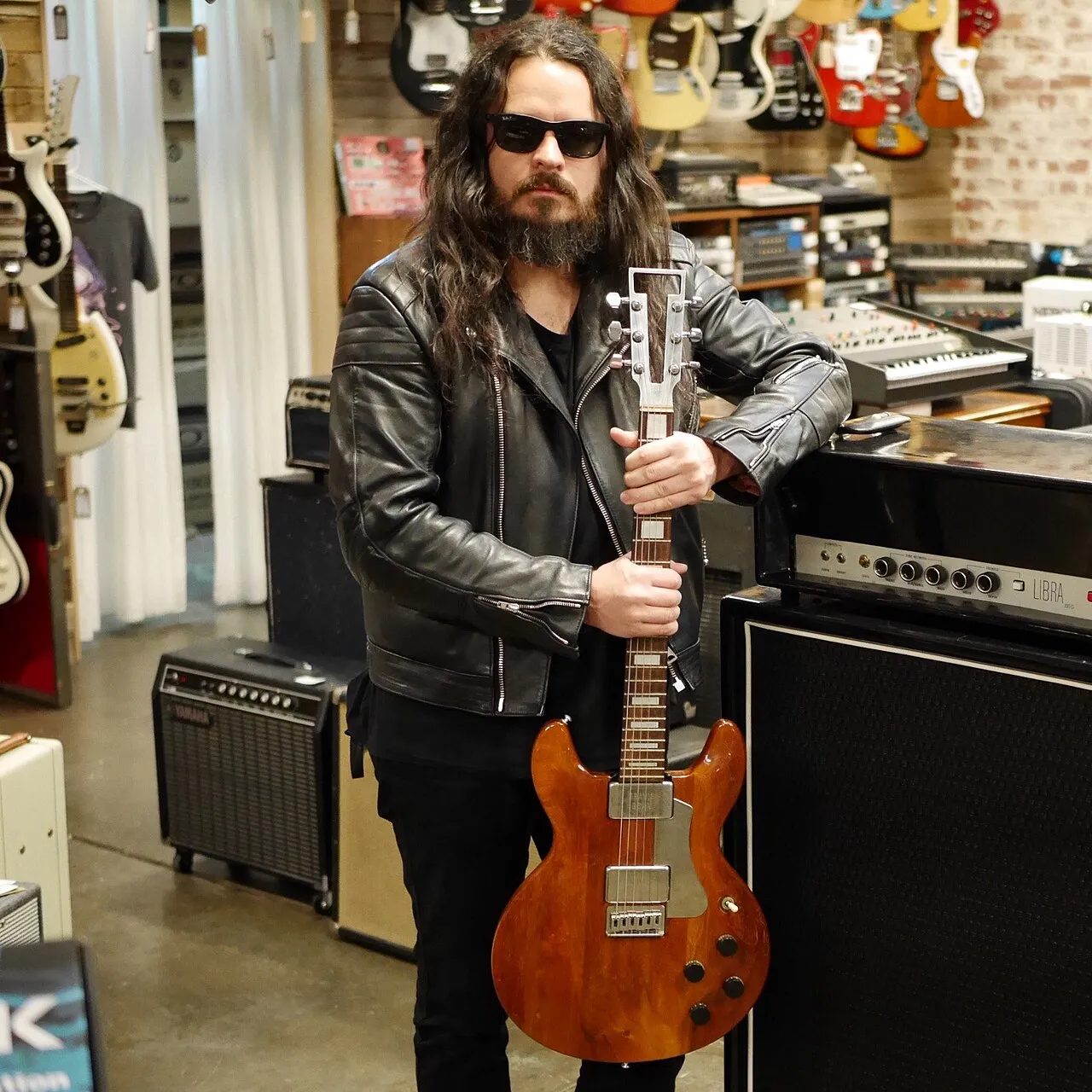
Photo: Somalley / Wikimedia Commons / CC BY-SA 4.0 Travis Bean
TB1000
1974
A motocross racer watched a repairman fight wooden necks all day. So he made one out of aluminum.
- Send a picture
Eko
Ranger 6
1967
Not the dreadnought anybody dreamed about. The one Europe could actually get.