 Guitaripedia
Warr
Warr Guitar
Mark Warr spent weeks making a touch guitar hang from a strap. Its best-known player laid it back down.
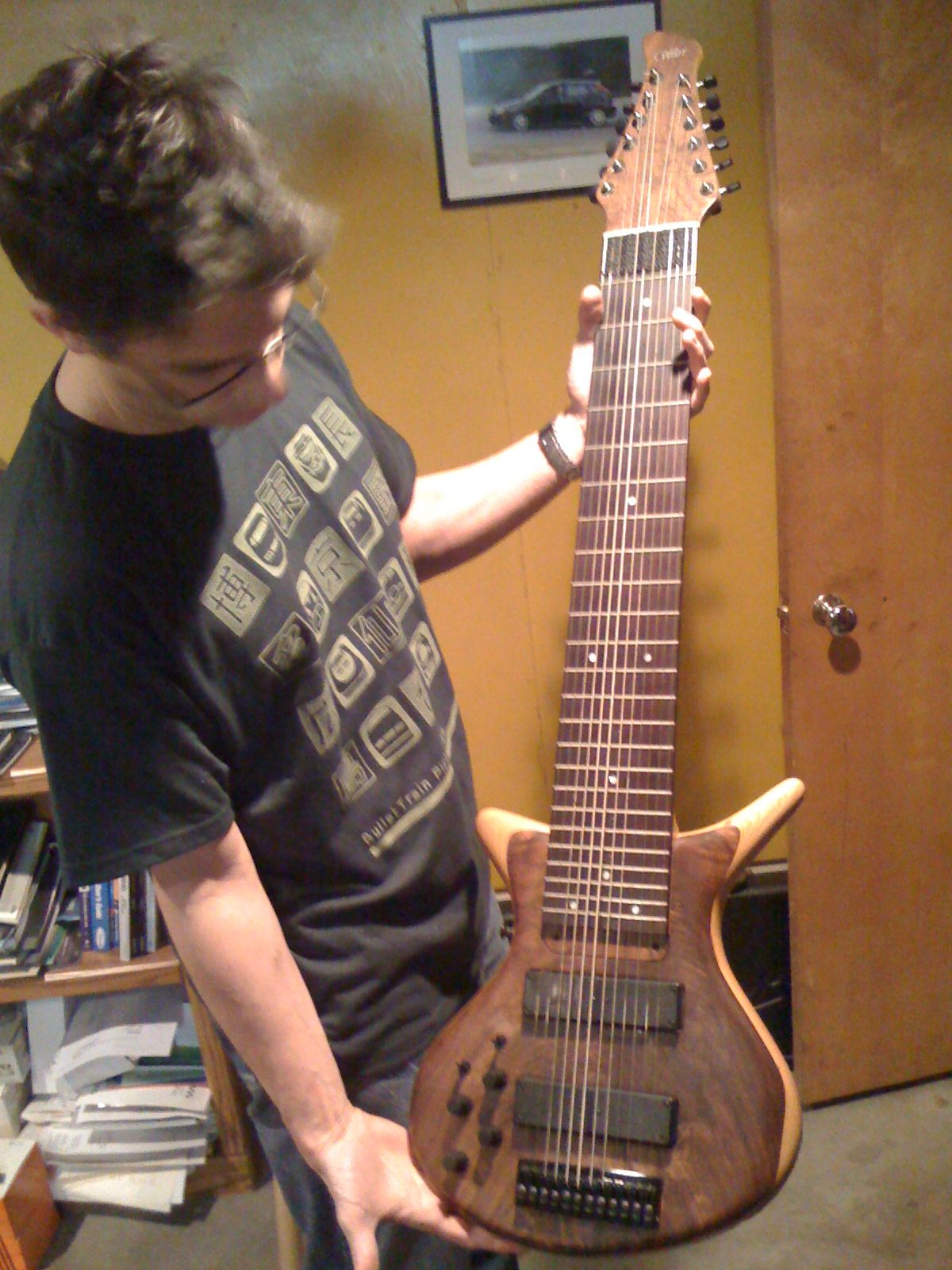
One wide board, bass strings and melody strings side by side, both hands tapping, on a solid body with a strap. A fire captain built the first one that hung right in his California garage in 1991. It's Mark Warr's own design, not a Chapman Stick.
- Introduced
- 1991
- Type
- Solidbody electric (touch guitar)
- Class
- Production
The short version
Before 1991
On drum stands
Mark Warr's first touch instruments are huge and lie flat. He retires them or gives them away.
1991
3 a.m.
After weeks fighting the balance, he wakes up with an idea, and within a week a guitar hangs right.
1994–95
The Crimson tour
Trey Gunn takes his Warr out on the King Crimson tour after the THRAK sessions. It isn't on the studio record.
c.2001–03
Flat again
Gunn starts playing it lying horizontal. He's given three different years for when.
2008
A staff of four
Every guitar is built to order, and the uncrossed tuning is about half of sales.
2019
Still taking deposits
The price page asks $1,100 down, the balance when it's done.
2019–22
Closed or not
Warr says he isn't taking new orders. Others say the designs are still being built, and in 2022 a headless model appears.
Side A
A1
A keyboard player with a fire captain's hours
Mark Warr played keyboards and was a fire captain. In his garage he designed touch instruments for himself, the kind you play by tapping strings onto frets with both hands. He went to Bill Bartolini for pickups wound for the job.
The first ones were huge. They lay flat on drum stands, like a keyboard. As the design moved on he retired them or gave them away.
A guitarist named Randy Strom kept after him to build one. Warr finally did, he says, because he needed the money for a keyboard.
A2
Three in the morning
The hard part was making it hang from a strap. Warr fought the balance for weeks and quit.
Then he woke up with another idea. Garage, 3 a.m., saws and drills going. It was close that night and working within a week.
"That was 1991," he says.
What hangs from that strap is one wide board with two instruments on it. The lowest bass string sits in the middle, bass strings fan out to one side and melody strings to the other. That's the crossed tuning. You can stand it up and tap it, or hang it like a guitar and strum, pick, or slap it. A Chapman Stick is the other famous tapping instrument, and it's a different thing, a beam on a belt hook. Warr wanted a body.
A3
Priced to make him go away
Then the answering machine. A drummer friend had mentioned an article saying King Crimson was forming again, and now Trey Gunn was calling. Warr priced the job hoping Gunn would go away.
He didn't. Warr built a prototype. Gunn sent back three pages of changes, and about four weeks later there was a new instrument. Gunn calls it The Beast.
"That King Crimson tour, right after the 1994 THRAK recording, is the first time I took the instrument out, and I've been playing it ever since."
Note the timing. It's the tour, not the studio. If you're listening to THRAK for a Warr, you won't find it.
Gunn's ten-string is tuned in fifths on both sides, an octave apart, with the bottom string a low C under an electric bass. The gauges run from a .009 to a .128. The high strings have to come out as loud as the low ones, and the custom Bartolini winding is how the shop evened them.
Flip the record · By the numbers
24
Frets, for a four-to-five-octave range
.009–.128
The gauges on Trey Gunn's ten-string, top to bottom
14°
Headstock tilt on the Trey Gunn Signature
1,000 ft
Board feet of wood the shop looked through to find one neck
Side B
B1
Built for one person at a time
That job turned the garage into a shop, and it stayed small. In 2008 there were four people. Each guitar was built to the player's wood and electronics, and the shop once looked through a thousand board feet to find wood for one neck.
The signature model is everything Gunn asked for. The headstock tilts back 14 degrees. The bridge sits near the middle of the body on what the shop called drum theory, that the center of a drum is the full tone. His wood, pudauk, stains the tools red. The low end growls, and the shop tried to talk other customers out of it.
There was also an uncrossed version, the Phalanx, set up like a six-string bass on one side and a guitar an octave up on the other. By 2008 it was about half of sales. In 2019 an Artist 8 listed at $3,795, with $1,100 down and the rest when it was done.
B2
Lying down
Sometime early in the 2000s, still in King Crimson, Gunn started playing the Warr flat, back toward the old horizontal instruments. When exactly depends on the day you ask him. He's said around 2001, on a Crimson tour. He's guessed about 2002. In 2008 he called it about five years earlier. Later it mattered for his wrists: a straight wrist and gravity, he said, change the dynamic.
He used the fretless Warr on a good chunk of The Power to Believe. The final solo of "The Deception of the Thrush" is the fretted one, played flat.
Colin Marston plays twelve-strings in Behold the Arctopus. He got his first one cheap at a guitar camp when he was 15, and the second was a gift from Warr.
B3
Still building
Late in the 2010s Warr said he had colon cancer and wouldn't take new orders. A man who'd worked customer service at the shop for eight years said in 2020 that people were wrong to read the stale website as a closed shop, because Pete Hanewinckel was still building the designs. In 2022 a forum post pointed to a headless, multiscale Phoenix page on the site and said Warr was beginning to build again. By October 2026 the site had expired.
Warr spent weeks getting a touch guitar to hang from a strap, so you could stand up and play it. A decade later his most famous customer was playing it flat, the way the drum-stand ones lay. It works either way. That was always the idea.
Put this on
You’ve read about it. Now hear it. Here’s what this guitar sounds like, and what to listen for.
The Deception of the Thrush
Gunn says the final solo is on his fretted Warr, played lying flat. Wait for the end.
Find it on YouTube (opens in a new tab)The Power to Believe
Gunn says a good chunk of this album is the fretless Warr. No frets, so the low notes slide; listen for that.
Find it on YouTube (opens in a new tab)Alcoholocaust
Colin Marston filmed on a Warr for Guitar One. You can watch bass and melody come off one board at once.
Watch it on YouTube (opens in a new tab)
The cast
The people, and the specific guitars, that made the legend.
1994
Trey Gunn
"The Beast" and his signature Warrs, eight and ten strings, fretted and fretless
The player who turned the garage into a shop. King Crimson, the ProjeKcts, TU, KTU, and Quodia.
1991
Randy Strom
The 1991 guitar, the first that hung
Kept asking Warr to build him one until he did. Plays bass and melody at once, like a jazz pianist.
2007
Colin Marston
Twelve-string Warrs, including a Raptor
Got his first one cheap at a guitar camp at 15. The second was a gift from Warr.
1991
Mark Warr
Builder
Keyboard player, fire captain, and a garage full of saws.
2019
Pete Hanewinckel
Builder
Built many of the later guitars, and was building the Warr designs in 2020.
Liner notes
Specs, construction, rarity, value, and every source we used.
A body and a strap under bass and melody strings — Mark Warr’s California touch guitar, built to be tapped or strummed.
- Body
- Solid, contoured, guitar-shaped. Bolt-on, or neck-through as a paid option. Woods are the order, not a standard species.
- Neck
- Two-way adjustable truss rods (2003 brochure). Premier Guitar (2008): graphite reinforcement and dual truss rods under the wide board.
- Fingerboard
- 24 frets. 18% nickel-silver wire. Radius unpublished. Ebony was “call for availability” on the 2 February 2019 price page.
- Scale
- No scale on the 2003 brochure or that price page. Dealer sheets on Artist examples print 34".
- Pickups
- Bartolini, wound for this board. Artist 8: full-range mono, stereo optional. Artist 10, 11, and 12: full-range stereo. Piezo optional.
- Hardware
- Sperzel locking tuners. WarrBridge: solid brass, locking graphite saddles. Strap with security locks. Artist models include a soft gig bag.
- Electronics
- 18-volt active. Artist 8: three-band EQ, and an optional stereo split into two groups of four. Artist 10, 11, and 12: dual 18-volt preamps, two pickup selectors, groups of 6/6 or 5/7. MIDI, when fitted, is piezo into a 13-pin output.
- Finish
- Hand-rubbed oil in the 2003 brochure. On the 2019 price page, high-gloss poly or traditional lacquer was $660, stain or sunburst $340.
- Nut
- No factory width. One 2000s Artist at the Bass Shop: 3 1/8". One 2000s Artist 10 at Jack’s Gear Locker: 3 1/4". Inches only.
Open the full research fileConstruction details, the complete player record, production numbers, dated value estimates, and sources
The specs above are the Artist series, the earliest commercial Warr Guitar, as the 2003 brochure described it. Eight, ten, and twelve strings, crossed tuning. An eleven-string was priced with the twelve. The Artisan is the semi-hollow. The Phalanx is the uncrossed twelve and fourteen. The Trey Gunn Signature is the neck-through with the tilted headstock. On 28 October 2026, warrguitars.com returned an expired Squarespace page, so there is no newer factory sheet.
Construction
The job was a touch guitar with a body. Both hands on one wide board, bass strings and melody strings together, and a strap, so the same instrument could stand up for tapping or lie over like a guitar for strumming, picking, and slapping. The Chapman Stick is a different instrument: Emmett Chapman’s beam, a belt hook, Stick Enterprises. This one was built so it would hang.
Mark Warr was a keyboard player and a fire captain. Premier Guitar (Winston Barclay, 14 April 2008) has him designing touch instruments in his garage, for himself, and going to Bill Bartolini for pickups wound to that job. The first instruments were huge, laid flat on drum stands. As the design moved on, he retired them or gave them away. That piece does not date those stands.
The year he does date is the one that hangs. Guitarist Randy Strom had been after him to build one. Warr says he finally did it because he needed the money for a keyboard, then fought the balance for weeks, quit, and woke up with another idea. Garage, 3 a.m., saws and drills. Close that night. Working within a week. “That was 1991.” The Blue Book of Guitar Values, fetched 28 October 2026, dates the company to 1991 in Long Beach, then Thousand Oaks, and prints Moorpark as current, while also saying instruments are “currently built” in all three cities. The 2003 brochure letterhead is Warr Guitars, Inc., 572 Lotus Ave., Thousand Oaks, CA 91360. Jedistar prints a Camarillo address, 4023 Camino Ranchero #D, and “made since 1991,” without a date on the address. The 1991 year is the hanging guitar. The towns are not one town.
What he sold after that is still the Artist idea. Crossed tuning: the lowest bass string in the middle, bass strings on the top, melody strings on the bottom. Premier’s 2008 range is seven to fourteen strings. The price page archived 2 February 2019 starts at eight: Artist and the Trey Gunn Signature in eight, ten, eleven, and twelve; Artisan in eight, ten, and twelve; Phalanx in twelve and fourteen; a Metal series in eight, ten, and twelve. A seven-string is in the magazine’s range and not on that list.
The 2003 brochure is the shop talking. Upright or horizontal. Tap, pick, strum, pluck, slap, or pop. Twenty-four frets, “four to five-octave range.” Sperzel tuners, the brass WarrBridge, oil finish, Bartolini. Artist 8 mono unless you paid for stereo. The wider Artists stereo, 6/6 or 5/7. Artisan: semi-hollow, piezo, bronze or nylon allowed, floating Bartolinis optional, and a hard case. Phalanx: uncrossed, bass side tuned like a six-string bass, guitar side an octave up, wider spacing on the bass side so a normal plucking hand still works. By 2008 Warr told Premier the uncrossed tuning was about half of sales.
The signature guitar is the one he kept building for Trey Gunn with everything on it. Headstock tilted back 14 degrees, string trees, the nut raised a little so the low frets have somewhere to go. The brochure calls the bridge placement drum theory: the bridge near the center of the body, on the idea that the middle of a drum is the full tone. Graphite in the neck. A custom Bartolini preamp for the bottom. Gunn’s wood, which Premier and the price page both spell “pudauk,” stains the tools red. The 2019 page charged $500 for it. He told the magazine the low end growls. They tried to talk other people out of it.
None of it was a shelf guitar. Premier, 2008: a staff of four, each instrument to the player’s wood and electronics, and a thousand board feet looked through to find wood for one neck. The 2019 page took an $1,100 deposit and the balance when the guitar was done. Neck-through was $550 extra on an Artist or a signature, $680 on a Phalanx.
The Blue Book, same fetch, says luthier Magnus Krempel builds the Warr Guitar for Europe with Mark Warr’s permission, with a Wilkinson tremolo as an option on the four or five high strings. That is his shop’s option. It is not the California Artist.
Pete Hanewinckel’s name is on the later guitars. A 2007 Artist 12 on Reverb had been set up by him; the seller calls him a luthier who built many of the guitars for Mark Warr. Jim Wright, who did customer service, final inspection, and setup at Warr Guitars from 2000 to 2008, wrote on 22 April 2020 that Hanewinckel was building the Warr designs. Wright’s own newest, delivered in 2019, is one of those.
Players
The Chapman Stick is a different instrument. Tony Levin’s Stick parts with King Crimson are not this guitar. The studio album THRAK is not this guitar either.
Randy Strom. The 1991 hanging guitar was the one he had been asking for. Premier’s 2008 photograph shows him on an Artist, and the piece has him using the range the way a jazz pianist uses a keyboard: bass and melody at once. No song title is attached.
Trey Gunn. He calls it The Beast, and he is why the garage became a shop. Warr’s account in that Premier piece: a drummer friend, an article that Crimson was forming again, then Gunn on the answering machine. Warr priced the job hoping Gunn would go away. He didn’t. Gunn: a prototype, three pages of changes, a new instrument about four weeks later. “That King Crimson tour, right after the 1994 THRAK recording, is the first time I took the instrument out, and I’ve been playing it ever since.” Ultimate Guitar (30 October 2016) has the same split in his words: one on the Thrak tour, not in the studio for THRAK.
MusicRadar (David Mead, 11 March 2016) is Gunn describing the 10-string. Mead’s introduction sets the interview in the Thrak years; the sentences above put the instrument on the tour, not in the studio. Both sides in fifths, an octave apart, hands crossed. The bottom string a low C under electric bass. Gauges from a .128 to a .009. Premier prints the same pair as 9 and 128. The high strings have to come out as loud as the low ones, and the custom Bartolini winding is how the shop evened them. His main guitars in that 2008 interview: magnetic and piezo, four batteries, a volume and a fade between piezo and magnetic, no tone knobs. MIDI he used some with King Crimson and the ProjeKcts, for a fake feedback, and had dropped.
Premier says the shop also built him a stripped eight-string mono for the ProjeKcts, and a nylon-string fretless with piezo and no magnetics, used with King Crimson and on Music for Pictures, the film-score record due at the end of May 2008. The same article has the Warr, that year, in TU with Pat Mastelotto, in KTU, and in Quodia. His own post of 23 February 2025: a good chunk of The Power to Believe on the fretless Warr, and the final solo of “The Deception of the Thrush” on the fretted one, played flat.
The flat position has three dates. The Other Side Reviews (interview 13 October 2025): he found it around 2001, touring with King Crimson, and only later took it seriously for his wrists. His February 2025 post guesses about 2002, from wanting the fretless and the fretted in the same tune, one on a stand. Premier, April 2008: about five years earlier, still in the band, back toward the old horizontal instruments, because a straight wrist and gravity change the dynamic.
Colin Marston. An interview archived 7 September 2019 (the interview itself is undated there): a 12-string Raptor, which he calls discontinued, in Behold the Arctopus, “standard” 6×6 tuning, and about eight years on the instrument. Guitar One, February 2007, films him on a Warr for “Alcoholocaust,” from Nano-Nucleonic Cyborg Summoning. RVA Mag (15 March 2013), quoting him: lowest notes in the middle, melody side in fourths, bass side in upside-down fifths. Bandcamp Daily (Grayson Haver Currin, 13 July 2020): he plays a Warr in Krallice, Behold the Arctopus, and Indricothere; the first 12-string came cheap at a guitar camp when he was 15, and the second was a gift from Warr. Disposable Underground (27 November 2013) has him on a plain guitar in Krallice and the Warr in Behold the Arctopus. The two accounts of Krallice do not match.
Kai Kurosawa, in that Bandcamp piece, had moved past a 14-string Warr onto a 15-string Kubo and a 24-string Beartrax he designed. Those are later instruments of his. They are not Warr Guitars.
Rarity
For years you ordered one. Deposit, then they built it. A staff of four in 2008 is not a catalog wall. It is also not a closed 1950s run. Warr Guitars has not published a production total. There is no serial census to count a year with.
What is actually thinner sits inside that custom pile. The horizontal drum-stand instruments, retired or given away before the hanging design. Strom’s 1991 guitar, the first one that balanced. Gunn’s eight-string mono and the nylon fretless, built for him. The Raptor, which Marston calls discontinued. A fourteen-string Phalanx, the wide end of the 2019 list.
Whether a new one can be ordered is its own argument, and the dates disagree. The price page archived 2 February 2019 was still taking the $1,100 deposit. Bandcamp Daily, 13 July 2020: late in the previous decade Warr said he had colon cancer and would not take new orders for the foreseeable future. Wright, 22 April 2020: the website had sat unchanged, people read it as closed, and that reading was wrong, because Hanewinckel was building the designs. A SevenString.org post of 10 September 2022 pointed at a Phoenix page on warrguitars.com, headless and multiscale, and said Mark Warr was beginning to build again. On 28 October 2026 that site returned an expired Squarespace page. The Phoenix drawings were not there to read.
Value
Informal estimate, 28 October 2026. Not an appraisal.
No live factory price was up that day. The figures below from the maker are the list archived 2 February 2019, not 2026 street. Asks are labeled. A signed headstock is not Gunn’s guitar. A Chapman Stick is not a comparable. No median is published.
New street. Nothing to order off a live page on 28 October 2026. Last published list, that February 2019 capture: Artist 8 $3,795, Artist 10 $3,995, Artist 11 and 12 $4,095. Piezo and MIDI climbed from there. An Artist 12 with twelve piezos and twelve MIDI outputs was $5,595. Trey Gunn Signature 8 and 10 $4,395; signature 12 $4,495; signature 12 with twelve piezos and twelve MIDI outputs $5,995. Phalanx 12 $4,600; Phalanx 14 $4,800; Phalanx 14 with fourteen piezos and twelve MIDI outputs $6,300. Metal 8 $3,895, Metal 10 $3,995, Metal 12 $4,095. Artisan, the semi-hollow, ran from $4,285 (eight-string, piezo only) to $5,494 (twelve-string, piezo, twelve MIDI, and magnetics). Neck-through, the pudauk upcharge, gloss, stain, and lacquer were the extras named above. Deposit $1,100, balance at completion. Bandcamp’s “might cost $5,000 and take a year” is that article’s sketch, not this list.
Used modern. Reverb showed no Price Guide band for the model on 28 October 2026. Named listings, not a series. Marked sold: Steve’s Gear, a 2007 Artist 12 in excellent condition, last price $2,900, the listing about three years old when checked. Ish Guitars, a 1990s Artist 8, marked sold at $3,499.99, also about three years on the listing. Odrive, an Artist 12 completed in May 2008, marked sold, last price $1,675, the listing about ten years old. Ended asks, not marked sold: the Bass Shop, a 2000s Artist at $3,099, Gunn’s autograph on the headstock, about seven years on the listing. A Trey Gunn Signature eight-string in Florence, $2,951.97, about seven years. A UK Artist 10, $2,110.13, about nine years. The $1,675 and the $3,499.99 are not the same guitar and not the same year.
Vintage / collectible. There is no separate old-market band. These are 1990s and later custom-shop guitars. The drum-stand prototypes, Strom’s first hanging guitar, and Gunn’s own instruments are single objects. They are not a used Artist. No auction of a Gunn-owned Warr turned up for this estimate.
See also
- chapman-stick — Emmett Chapman’s bodiless tapping board, a belt hook, Stick Enterprises. A different maker. Trey Gunn played one before this guitar
- chapman-ml1 — Rob Chapman’s later S-type. A different Chapman, and not a touch board
- steinberger-gl — Ned Steinberger’s graphite headless bass. Not a wide tapping neck, and not this body
Sources
- Premier Guitar, Winston Barclay, “Gunning for Warr,” 14 April 2008 — 1991 hanging design for Randy Strom; fire captain and keyboard player; Bartolini; drum-stand instruments; Gunn’s prototype and the tour after the 1994 THRAK recording; Artist 8/10/12 crossed; Phalanx uncrossed, about half of sales; signature series, 14-degree headstock, “pudauk”; seven to fourteen strings; gauges 9 and 128; staff of four; eight-string mono on the ProjeKcts; nylon fretless; Music for Pictures; TU, KTU, Quodia
- Warr Guitars 2003 brochure (Jedistar PDF) — 24 frets, four to five octaves; Sperzel; two-way truss rods; WarrBridge; oil finish; Artist 8/10/11/12 electronics and 6/6 or 5/7; Artisan; Phalanx 12 and 14; TGSS, 14-degree headstock, drum theory; 18% nickel-silver; 572 Lotus Ave., Thousand Oaks, CA 91360
- Warr Guitars price page, archived 2 February 2019 — list prices; $1,100 deposit; neck-through, pudauk, finish extras; Metal series; eleven-string priced as twelve
- warrguitars.com, fetched 28 October 2026 — Squarespace “Website Expired”
- Blue Book of Guitar Values, WARR — founded 1991, Long Beach; Thousand Oaks; Moorpark; Magnus Krempel, Wilkinson option on the high strings (fetched 28 October 2026)
- Jedistar, Warr Guitars — made since 1991; Camarillo address; links to the brochure and price lists
- MusicRadar, David Mead, 11 March 2016 — Gunn’s 10-string; fifths, octave apart, hands crossed; low C; .128 to .009; split bass and guitar rigs
- Ultimate Guitar, Trey Gunn interview, 30 October 2016 — Warr on the Thrak tour, not in the THRAK studio; Stick from 1988, Warr seven years later in the introduction
- The Other Side Reviews, interview 13 October 2025, published 20 November 2025 — 10-string Warr a favorite; horizontal around 2001 on the Crimson tour; King Crimson 1994–2003 in the introduction
- Trey Gunn, Instagram, 23 February 2025 — horizontal since about 2002, his guess; fretless on a good chunk of The Power to Believe; “The Deception of the Thrush” solo on the fretted Warr, flat
- Guitar World, Andrew Daly, 4 January 2024 — same horizontal account; the writer’s lede prints King Crimson 1993–2003
- Behold the Arctopus interview, archived 7 September 2019 — Marston: 12-string Raptor, discontinued; standard 6×6; about eight years; Behold the Arctopus. Interview undated on the capture
- RVA Mag, 15 March 2013 — Marston via Nefarious Realm: lows in the middle; fourths and upside-down fifths; band formed 2001
- Disposable Underground, 27 November 2013 — Warr in Behold the Arctopus; plain guitar in Krallice
- Bandcamp Daily, Grayson Haver Currin, 13 July 2020 — early ’90s; 7 to 14 strings; Marston in Krallice, Behold the Arctopus, Indricothere; camp guitar at 15; second a gift; colon cancer and no new orders; “might cost $5,000”; Kurosawa’s Kubo and Beartrax
- Jim Wright, Facebook, 22 April 2020 — customer service 2000–2008; Hanewinckel building the designs; the stale site was not a closed shop
- YouTube, “The 2019 Warr Guitar,” 22 April 2020 — description: Wright’s 2019 Warr, built by Pete Hanewinckel
- SevenString.org, 10 September 2022 — Phoenix page reported on warrguitars.com; headless, multiscale; post says Mark Warr was beginning to build again
- Wikipedia, Warr Guitar — developed 1991, citing Premier Guitar; 7 to 14 strings; Raptor captioned discontinued; Trey Gunn, Colin Marston
- Reverb, 2007 Artist 12, Steve’s Gear — marked sold, last price $2,900; 34" scale; 24-fret wenge; Pete Hanewinckel setup; listing about three years old when checked
- Reverb, 1990s Artist 8, Ish Guitars — marked sold at $3,499.99; listing about three years old when checked
- Reverb, Artist 12 completed May 2008, Odrive — marked sold, last price $1,675; 34" scale; 7-piece bolt-on; listing about ten years old when checked
- Reverb, Bass Shop Artist, 2000s — ended $3,099; 34" scale; nut 3 1/8"; 9 lbs 2 oz; Gunn autograph on the headstock
- Reverb, Jack’s Gear Locker, Artist 10, 2000s — marked sold, hammer not printed on the summary; 34" scale; nut 3 1/4"
- Reverb, Trey Gunn Signature 8, Florence — ended $2,951.97; neck-through; 8 strings, piezo and MIDI
- Reverb, Artist 10, UK listing — ended $2,110.13; 34" scale
- TalkBass, Dave Grossman, 10 March 2002 — his instrument, 34" scale; not a factory scale
Keep digging
Guitars this one gets compared to, confused with, or descended from.
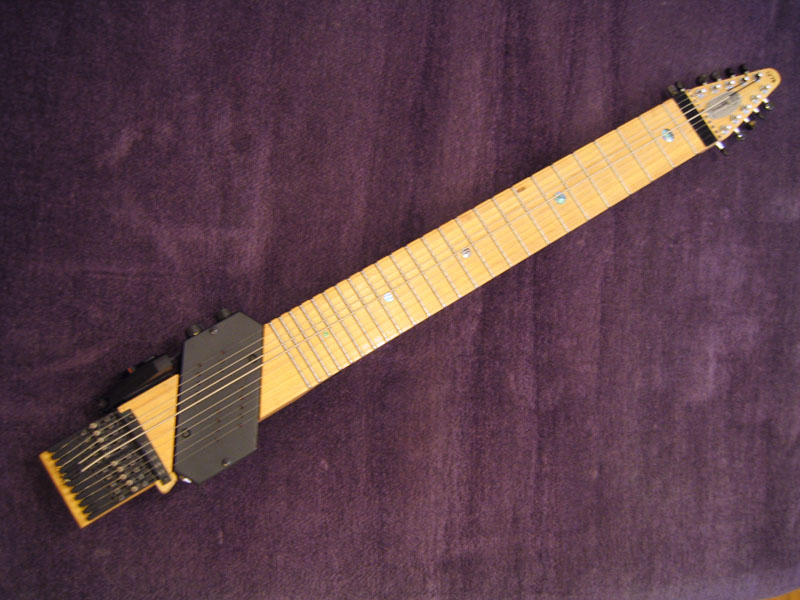
Photo: Mperry / Wikimedia Commons / CC BY-SA 3.0 Stick Enterprises
Chapman Stick
1974
One night in 1969 Emmett Chapman turned his right hand around. Then he had to build something to hold it.
- Send a picture
Chapman
ML-1
2009
A signature guitar where the signature belonged to the audience.
- Send a picture
Steinberger
GL
1984
No headstock, no wood, and designed by a man who didn’t play. Eddie Van Halen wrote two songs on it in days.