Stick Enterprises
Chapman Stick
One night in 1969 Emmett Chapman turned his right hand around. Then he had to build something to hold it.
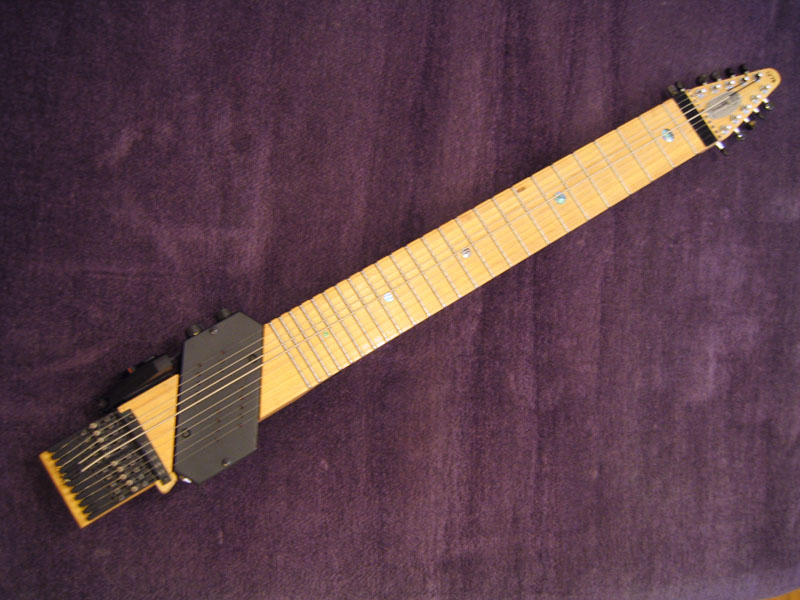
Ten strings, no body, a belt hook, and both hands coming at the frets from opposite sides. The Stick isn't a guitar you tap on. It's the board one man built for the way he'd started playing, and it has been made by hand in the Los Angeles area since 1974.
- Introduced
- 1974
- Type
- Solidbody electric (tapping instrument)
- Class
- Production
The short version
1969
Free Hands
On 26 August, in Laurel Canyon, Chapman starts tapping with his right hand at right angles to a homemade guitar's neck.
1970
The Electric Stick
The first cut-down instrument, a Macassar ebony board with violin pegs and a square headstock.
1973
Ten strings
Five melody strings and five bass, with the lowest notes in the middle of the board.
1974
The first six
Chapman builds the first production run by hand. The first commercial Stick is delivered in October.
1976
Levin opens the case
Tony Levin brings his new Stick to Peter Gabriel's first solo sessions. The producer tells him to put it away.
1981
Discipline
Levin has a Stick part for King Crimson's "Elephant Talk" he likes enough to ask the band to start with him.
2003
The long scale
The first hardwood-laminate 36-inch Stick, the scale the shop still builds.
2021
Chapman dies
Emmett Chapman dies at home on 1 November. Grace Chapman runs the shop and builds the instruments.
Side A
A1
The night the hand turned around
Laurel Canyon, 26 August 1969. Emmett Chapman is sitting with a guitar he has already pulled out of shape: widened, lengthened, strung with nine strings. He puts his right hand over the board at right angles and starts tapping out the high strings while his left hand holds the chords.
He called it Free Hands.
People had tapped on guitars before. Harry DeArmond, Jimmie Webster, and Dave Bunker all did it with the guitar held the normal way, right-hand fingers lying along the strings. To run a scale, they had to move the whole arm. Chapman's fingers lined up with the frets, each one locked to its own fret space, the way the left hand's are. Both hands could now play the same way, from opposite sides.
That night was the method. The instrument came later, because no guitar was built to be played like that.
A2
Five years of cutting things off
He spent the first year on the homemade guitar, the action low, a damper at the nut.
Then he started taking the guitar away. In 1970 he built a cut-down board out of Macassar ebony, with a square headstock and violin pegs, and called it the Electric Stick. Between 1970 and 1974 he built five prototypes. In 1973 he went from nine strings to ten, and settled the layout that makes a Stick a Stick: five melody strings tuned in fourths, five bass strings tuned in fifths, and the lowest notes of each group meeting in the middle of the board.
In 1974 he built the first production run, six of them, with hand tools. Ironwood beam, 34 inches nut to bridge, ten strings, a wooden pickup box, a belt hook. No body at all. You wear it nearly upright, hooked at the belt and held by a shoulder strap, so both hands can reach the board.
A3
Explaining it to Soupy Sales
The first commercial Stick went out in October 1974. On 10 October, Chapman took one on What's My Line?, in front of Soupy Sales, Gene Shalit, Beverly Sills, and Arlene Francis. The company counts it as the method's first national TV.
When the company started depends on who's telling it. The company's archive says that October. Chapman, in his own words, says he and his wife Yuta formed the California corporation in 1975, and signed a distribution deal with Gibson's parent, Norlin. Gibson handled sales. It never made the instrument.
Joe Zawinul found it early. Chapman tells it: after a set at the Five Spot, Weather Report's keyboard player picked the thing up, stood on a table, and played it. He bought one of the first five.
Flip the record · By the numbers
10
Strings on The Stick, in two groups of five, melody on one side and bass on the other.
6
Instruments in the first production run, 1974, all built with hand tools.
25
Frets on the early Sticks, good for 5¼ octaves.
34" → 36"
The original scale, and the one the shop builds now.
Side B
B1
Put that thing away
Tony Levin heard about the Stick in the mid-seventies, bought one in Los Angeles, and opened the case at Peter Gabriel's first solo sessions in July 1976. The producer, Bob Ezrin, did not like what he saw:
"Put that thing away. I don't even want to see it."
So it isn't on that record. It went on the tour instead, and Levin was playing it with Gabriel, live and in the studio, from 1977. For years he played only the bass side.
By 1981 he was in King Crimson, and on Discipline he had a Stick part for "Elephant Talk" he liked so much he asked the band to start with him. Ezrin came round, too. On Pink Floyd's A Momentary Lapse of Reason, he asked Levin for the Stick on the introduction of a piece.
Alphonso Johnson put his on record on Spellbound in 1977; "Face Blaster" is the one to hear. Nick Beggs took it up around 1983 and flanged it through "Big Bubbles, No Troubles."
B2
The shop kept changing everything but the job
What didn't change is the two groups of five. Nearly everything else did. In May 1976 the board widened to about its present width. Jumbo frets came in 1977, a metal pickup module that year. In November 1985 the Stick went to injection-molded black polycarbonate with stainless fret rods. Hardwood came back in 1989. The first three Grand Sticks, with twelve strings, came in December 1990; Levin plays a 12-string of his own. Then laminates, then stainless Rails standing on their points where frets used to be, and in 2003 the long-scale Stick at 36 inches, the scale you order today. Bamboo arrived in 2005.
It's still made by hand in the Los Angeles area, from a queue, not off a wall.
Chapman got his own instrument into a film once. In the director's cut of David Lynch's Dune, Patrick Stewart mimes a baliset on a gold-painted Stick, and the cue is Chapman's "Back Yard," the track on his 1985 album Parallel Galaxy.
B3
Same two hands
Emmett Chapman died at home on 1 November 2021. The company called him what he was: the inventor of Free Hands and The Stick, and the founder of Stick Enterprises.
Grace Chapman runs the shop now and builds the instruments. The one you'd order this week has a different scale, different frets, different wood, and a different pickup than the six he built by hand in 1974.
The right hand still crosses the board at right angles, the way it did in Laurel Canyon in 1969.
Put this on
You’ve read about it. Now hear it. Here’s what this guitar sounds like, and what to listen for.
Elephant Talk
Tony Levin had a Stick part for this one he liked enough to ask the band to start with him.
Find it on YouTube (opens in a new tab)Face Blaster
The showcase track from Spellbound, which credits Johnson on Chapman Stick. He wrote two of the album's songs on it.
Find it on YouTube (opens in a new tab)Big Bubbles, No Troubles
Nick Beggs says the flanged part is his Stick, run through a TC flanger.
Find it on YouTube (opens in a new tab)Back Yard
The inventor on his own instrument, from Parallel Galaxy. It's also the cue when Patrick Stewart mimes on a gold-painted Stick in the director's cut of Dune.
Find it on YouTube (opens in a new tab)
The cast
The people, and the specific guitars, that made the legend.
1969
Emmett Chapman
The Stick, from the Electric Stick on
Invented the Free Hands method, then the instrument to play it on. Recorded Parallel Galaxy in 1985.
1976
Tony Levin
A Stick bought in Los Angeles, later a 12-string Grand Stick
Played the bass side for years with Peter Gabriel and King Crimson. Later formed Stick Men, two Stick players and a drummer.
1970s
Joe Zawinul
One of the first five
Picked up Chapman's instrument after a set at the Five Spot, stood on a table, and played. Then bought one.
1977
Alphonso Johnson
Chapman Stick on Spellbound
An early public Stick player. Spellbound, recorded at Cherokee that summer, is the record that pins it.
1983
Nick Beggs
A Stick, first as a bass instrument
On it since about 1983, by his own account. "Big Bubbles, No Troubles" is the named track.
Liner notes
Specs, construction, rarity, value, and every source we used.
Ten strings, a belt hook, and both hands on the board — Stick Enterprises’ Chapman Stick, not Chapman Guitars.
- Body
- Through-neck beam. No conventional body. Hardwood laminate (padauk, tarara, maple, Indonesian rosewood, machiche) or bamboo. Factory: tarara only on The Stick, Stick Bass, and Alto Stick.
- Neck
- The same beam. Rear bevels, not a guitar-neck curve. Divided 4-way truss (flush, rear-mounted).
- Fingerboard
- Flat, no arch, no taper. Stick Rails stainless, 5/32" (0.4 cm) square stock, points up. 25 Rails: X-fret at the nut through Rail 24. Dot or linear inlays; factory dots 1/2" (12.7 mm), every five frets from the second space. Mix flagged.
- Scale
- 36" (91.4 cm). Mix flagged. Older production 34" (86.4 cm). Railboard is 34". Alto Stick and SG12 are 26.5" (67.3 cm).
- Pickups
- Stickup: original passive stereo module, carbon-fiber-impregnated housing, hex-head pole pieces. Or ACTV-2 Block: removable dual-EMG module, active or passive. PASV-4 Villex Block is discontinued.
- Hardware
- Hipshot open-gear tuners; 3-D adjustable bridge; Flaps Dual Nut; adjustable belt hook and shoulder strap.
- Electronics
- Separate volumes for melody and bass groups on the Stickup; TRS stereo jack, Stick “Y” cable. Block modules add tone and stereo/mono.
- Finish
- Natural hardwood or bamboo laminate. No factory sprayed-color chart this pass.
- Nut
- Flaps Dual Nut Unit, tripodal adjustment per string group. Current width unpublished. Mahar’s 1982 ironwood: 3 1/8". Bass Shop 1976 ebony serial 242: 3 1/4". Mix flagged. Do not invent millimetres for 3 1/8" / 3 1/4".
Open the full research fileConstruction details, the complete player record, production numbers, dated value estimates, and sources
Classic living example = The Stick, the original 10-string, 36" (91.4 cm), hardwoods or bamboo, handmade in the Los Angeles area. Factory $4,000 (stick.com, fetched 23 October 2026). Average weight 7.0 lbs (3.17 kg), wood and pickup dependent. Mix flagged. Grand Stick 10 (wider spacing) and Grand Stick 12 are $4,300. Railboard is hard-anodized aluminum, 34" (86.4 cm), $3,100. Alto Stick is guitar-scale, 26.5" (67.3 cm), 22 frets, $3,400. NS/Stick, SB8 Stick Bass, and SG12 Stick Guitar stay on this plate as family, not second slugs. Not Chapman Guitars (chapman-ml1). Not a Warr Guitar. Standalone. No Gibson SKUs. Mixed inch/mm flagged on every factory pair. Do not invent millimetres for 3 1/8" or 3 1/4".
Construction
The job was a board you could play with both hands. Not a guitar you tapped on. A dedicated tapping instrument: ten strings in two groups, worn nearly vertical on a belt hook, both hands coming at the frets from opposite sides, fingers parallel to the frets.
26 August 1969. Emmett Chapman, Laurel Canyon, on a homemade long-scale guitar he had already widened, lengthened, and strung to nine. He put his right hand at right angles over the board and started tapping the high strings while the left kept chords. He called the method Free Hands. Harry DeArmond, Jimmie Webster, and Dave Bunker had tapped with the guitar held the usual way, right-hand fingers parallel to the strings; to run a scale they had to move the whole arm. Chapman’s hands locked to sequential fret spaces. That night is the method. It is not the production instrument.
He spent the first year on that guitar, action low, a damper at the nut. 1970: the first abbreviated instrument, a 3/4-inch Macassar ebony board he named the Electric Stick — square headstock, violin pegs, a pickup in an ebony box facing the strings (Guitar International, 16 December 2010). Between 1970 and 1974 he built five prototypes. 1973: nine strings to ten. Five melody in descending fourths, five bass in ascending fifths, lowest pitches in the middle of the board. In 1974 he built the first production run of six, all with hand tools (his Electronic Musician account, reprinted by Stick Enterprises; Mel Bay Guitar Sessions, December 2005). Factory timeline: first commercial Stick delivered October 1974, ironwood, ironwood pickup housing, ironwood belt-hook. 10 October 1974 he took one on What’s My Line? — Soupy Sales, Gene Shalit, Beverly Sills, Arlene Francis, host Larry Blyden. Company archive: first national TV of the method, shortly after he started Stick Enterprises that October. Mel Bay, in his own words: he and his wife Yuta formed the California corporation in 1975, and signed a sales distribution deal with Gibson/Norlin. Keep October 1974 delivery and 1975 corporation. This plate starts in 1974. The 1969 night and the ebony Electric Stick are the door, not a second slug. Gibson/Norlin is distribution. It is not a Gibson SKU.
What you get on a 1974–early Stick is a bodiless ironwood beam, 34" (86.4 cm) nut to bridge, ten strings, a wooden pickup module, a belt hook, a shoulder strap. Jumbo guitar frets are 1977. Chapman, in Electronic Musician: two non-adjustable spring-tempered steel rods in black epoxy down the back of the fretted area; 25 frets; 5 1/4 octaves. He lowered all ten strings a whole step at the start of production in ’74, then raised them a whole tone in May 1976 — the same month the neck/fingerboard widened to approximately present width (factory timeline; his interview with Greg Howard). Reverb’s #120, February 1975, is the 20th production Stick by Stick Enterprises’ handwritten records: Brazilian ironwood, original narrow board, 34", predating serial 230 in May 1976. Do not treat that listing as a factory census.
Then the shop kept replacing the bits that had been frozen on the first six. Jumbo guitar frets, January 1977. Sheet-metal pickup module that year, height-adjustable in 1978. Round-wound bass strings and a screw-adjustable nut, 1982. November 1985: injection-molded black polycarbonate with stainless Fret Rods — Chapman’s own dimensions, 3 1/2-foot (106.7 cm) long by 3 1/4-inch (8.2 cm) wide. Mix flagged. Hardwood returned in 1989 with a single adjustable truss. First three Grand Sticks, December 1990; commercial 12-string production, July 1991. Laminate hardwood, 1996. Rails — stainless bar stock rotated 90 degrees, points up — 2000, then Flaps, then graphite with Moses. First hardwood laminate long-scale 10-string “Stick X36,” January 2003 — that is the living 36" scale. Bamboo, 2005. Divided 4-way truss, 2009. Medium 5/32" Rails on wood and bamboo, December 2019.
Not Chapman Guitars (chapman-ml1). Rob Chapman’s ML-1 is a 2009 S-type from a different company. Emmett Chapman, Stick Enterprises, Woodland Hills. Different factory, different instrument, different Chapman. Not a Warr Guitar. Mark Warr’s touch guitar is a later, separate shop; Trey Gunn moved to it after the Stick. Not Eddie Van Halen’s tapping. EVH’s right hand stays parallel to the strings on a guitar held the usual way. Not a Gittler (gittler). Not a Steinberger GL (steinberger-gl). The NS/Stick, first prototype August 1997, first dual-role tapping/plucking basses February 2000, is a hybrid co-designed with Ned Steinberger. It is family on this plate. It is not The Stick.
Classic vs current: 1974 ironwood, 34", six handmade, wooden module, narrow board until May 1976 — against a Stick you can order this week, 36", laminate hardwood or bamboo, Rails, Flaps, 4-way truss, Hipshot, Stickup or ACTV-2, $4,000. Same job. Same two groups of five. Different scale, different frets, different shop years. Emmett Chapman died at home 1 November 2021. Guitar World, 3 November 2021, quoting the company: inventor of Free Hands and The Stick, founder of Stick Enterprises. Grace Chapman is head of the shop and the builder now.
Players
Do not hang a Chapman ML-1 here. Do not hang a Warr Guitar. Do not recruit Van Halen, Stanley Jordan, or a Guitar Craft tapping credit as if they were this board. Do not pin Peter Gabriel’s first solo album on the Stick. Do not pin Kajagoogoo’s “Too Shy” on it.
Emmett Chapman. Identity instrument, because he built it to play it. Parallel Galaxy, 1985, Backyard Records, remastered CD 1999. Stick Enterprises: ten pieces, some solos, some duets; “Back Yard” is the cue when Patrick Stewart mimes Frank Herbert’s baliset on a gold-painted Stick in the director’s cut of Lynch’s Dune. The album is 1985; the film is 1984. Keep both. Hands Across the Board, 1987, is the performance video.
Joe Zawinul. One of the first five. Chapman, Mel Bay, December 2005: Weather Report’s Zawinul came to the Five Spot, picked up the instrument after the set, stood on a table, played. Jim Reilly (Bass Guitar Magazine, reprinted by Stick Enterprises): he bought one of the first five. Ownership, not a Weather Report session log. Do not flatten Black Market onto this board.
Alphonso Johnson. Early public Stick. Discogs and the Spellbound (Epic, 1977) credit: Chapman Stick [Electric Stick], recorded Cherokee, July–August 1977. He wrote two songs on that album with it (Michael Barackman, quoted by Zero to 180). “Face Blaster” is the named showcase. Stick Enterprises later saw him playing with Zawinul in Weather Report; the Stick credit that pins a record is Spellbound, after he left the band.
Tony Levin. The Stick most people have heard. Premier Guitar (19 January 2017): he heard about it about 1976, got one right away, and for years played only the bass side with Peter Gabriel and King Crimson. Baltimore Post-Examiner (10 July 2021): he bought it in Los Angeles; the year is 1976 because he opened the case at Gabriel’s first solo sessions in July 1976. Producer Bob Ezrin: “Put that thing away. I don’t even want to see it.” Not on that record. On the tour. Stick Enterprises: live and in the studio with Gabriel as early as 1977. King Crimson, 1981, Discipline: Reverb interview (23 October 2017), a Stick part on “Elephant Talk” he liked, so he asked the band to start with him. Mine has 12 strings, he said — a Grand Stick, not the 10-string table. Pink Floyd, A Momentary Lapse of Reason (1987): Ezrin asked for the Stick on the introduction of a piece (Ultimate Guitar, 1 April 2022, from Levin). Stick Men is the later band: two Stick players and a drummer. Artist-owned — not a comps tape.
Nick Beggs. His own words, TC Electronic gear run (21 November 2013): Stick since about 1983, first as a bass instrument; the TC flanger on the Stick is “Big Bubbles, No Troubles.” Ellis, Beggs & Howard, 1988. That is the named track. Kajagoogoo’s “Too Shy” is a Wal bass on Equipboard’s own citation. Off this table. Company copy puts him on Kajagoogoo, then Belinda Carlisle, Warren Cuccurullo, Gary Numan, and a solo Stick record, Stick Insect. Keep the 1988 single as the pinned credit.
Trey Gunn is the Warr trap. Premier Guitar (14 April 2008): he picked up the Stick, wore it a week, then met Mark Warr. The King Crimson tour after the 1994 THRAK recording is the first time he took the Warr out. Do not hang THRAK, The ConstruKction of Light, or the double-trio years on this board as if they were Stick.
Also known to play stays short. Stick Enterprises (Reilly): Fergus Marsh on Bruce Cockburn’s Stealing Fire; Pino Palladino with Paul Young — company credit, no session isolated this pass. Greg Howard, guest on Dave Matthews Band’s Before These Crowded Streets. No invented track list.
Rarity
You can order a new Stick from Woodland Hills this week. Handmade, request queue, deposit, then the production queue. Delivery depends on wood and where they are in the cycle. That is still production. It is not a Strat on a wall.
Stick Enterprises does not publish a model census. None invented. Serials date a guitar. They don’t count a year. That is why a first-year census is unknown, not the chapter.
What is actually thinner: the first six, late 1974. Narrow-board ironwood before May 1976 (serial 230 on the #120 listing). Bass Shop, quoting Stick Enterprises: seven ebony 10-strings; serial 242 is one. Polycarbonate, November 1985 into the late 1980s, no truss on early examples. First three Grand Sticks, December 1990. Levin’s 12-string and Chapman’s own gold Dune prop are unique objects. They are not a used 10-string.
Value
Informal estimate, 23 October 2026. Not an appraisal.
Ask vs sold labeled. Celebrity instruments are not-comps. No invented medians or factory counts. A Chapman Guitars ML-1 is not a Stick comparable. A Warr Guitar is not a Stick comparable. Historical lists are not 2026 street.
New street. Factory, fetched 23 October 2026: The Stick $4,000. Grand Stick 10 and Grand Stick 12 $4,300. Railboard $3,100. Alto Stick $3,400. Custom queue, not a cart. Historical list, not 2026 street: 1980s brochure, via Zero to 180 — $945 for instrument, case, stereo cord, and instructional book; $21 a 10-string set; $295 effects pedal.
Used modern. Reverb Price Guide for Stick Enterprises “Chapman” Stick, 1974–present Natural, Good to Mint, based on 86 orders: $1,533–$3,275 (page dated 19 October 2026). Named recent solds on that tape, not a series: 1 October 2026, Very Good $2,275; 20 August, Very Good $2,125; 16 August, Excellent $4,860; 28 July, Very Good $2,750; 26 July, Excellent $2,400; 6 July, Excellent $2,700; 20 June, Good $2,250. Do not average the $4,860 excellent with the mid-$2,000 very-goods. The guide band is the mixed-condition used market. A new Stick at $4,000 sits above most of those hammers.
Vintage / collectible. Early ironwood, narrow-board, and the seven ebonies are the scarce end of the same handmade line, not a separate 1950s market. Named ask, not a hammer: Bass Shop 1976 ebony 242, ended $1,999. Mahar’s 1982 ironwood-or-padauk, sold, no hammer printed on the listing this pass. #120 (February 1975, 20th production) is a dealer object, not a comps tape. Levin’s Grand Stick and the Dune baliset are one-off. They are not a used 10-string.
See also
- chapman-ml1 — Rob Chapman’s 2009 S-type; Chapman Guitars, not Stick Enterprises, and not this board
- steinberger-gl — Ned Steinberger’s 1984 graphite paddle; the NS/Stick is a later hybrid with this shop, not a GL
- gittler — another 1970s bodiless experiment; a stainless spine with a pickup per string, not a tapping Stick
Sources
- Stick Enterprises, The Stick — original 10-string; 36" (91.4 cm); $4,000; Rails, 4-way truss, 3-D bridge, Flaps, belt hook; average 7.0 lbs (3.17 kg); hardwoods or bamboo; Hipshot; Stickup or Block (fetched 23 October 2026)
- Stick Enterprises, Instruments — living family: Railboard, The Stick, Grand Stick 10, Alto Railboard, NS/Stick, Grand Railboard, Grand Stick 12, SB8, Alto Stick, SG12
- Stick Enterprises, Grand Stick 12 — 12-string, 36" (91.4 cm); $4,300; average 7.6 lbs (3.45 kg)
- Stick Enterprises, Grand Stick 10 — 10-string, wider spacing .350" (0.9 cm) vs .315" (0.8 cm); $4,300
- Stick Enterprises, Railboard — 10-string aluminum, 34" (86.4 cm); $3,100; 25 Rails, X-fret through 24; overall 45 3/8" (115.3 cm); average 8.5 lbs (3.85 kg)
- Stick Enterprises, Alto Stick — 10-string, 26.5" (67.3 cm), 22 frets; $3,400; average 5.6 lbs (2.54 kg)
- Stick Enterprises, Hardwood laminates — tarara, padauk, maple, Indonesian rosewood, machiche; tarara limited to Stick, Stick Bass, Alto
- Stick Enterprises, Pickup modules — Stickup; ACTV-2 Block from 1998; PASV-4 discontinued; EMG-RB10 on Railboards
- Stick Enterprises, The Stickup — original passive stereo; carbon-fiber housing; hex poles; two volumes; TRS
- Stick Enterprises, Rails — patented 2000, 3/16" (0.48 cm); 1/8" (0.32 cm) from 2013 on wood/bamboo; medium 5/32" (0.4 cm) now
- Stick Enterprises, Divided 4-way truss — rear flush; 4-way from 2010; Alto, SG12, NS/Stick keep a single nut
- Stick Enterprises, History — first production model sold 1974; Grace Chapman, Head of Stick Enterprises and master builder
- Stick Enterprises, Timeline of Stick Advancements — first commercial Stick October 1974; May 1976 wider board and raised tuning; polycarbonate November 1985; Grand Stick 1990/91; X36 January 2003; Alto October 2004; bamboo January 2005
- Stick Enterprises, The Evolution of a Musical Art — Emmett Chapman, originally Electronic Musician; August 1969 Laurel Canyon; 1970 Electric Stick; five prototypes; ten strings 1973; first six 1974; ironwood rods; 34" (86.4 cm); 25 frets; 5 1/4 octaves; polycarbonate 3 1/2-foot (106.7 cm) × 3 1/4-inch (8.2 cm)
- Stick Enterprises, The Birth of Two-Handed Tapping — Jim Reilly, Bass Guitar Magazine; 26 August 1969; DeArmond / Webster / Bunker contrast; first production 1974; Zawinul one of the first five; Levin bought 1976, Gabriel from 1977; Beggs, Palladino, Marsh, Howard, Adelson, Culbertson named
- Stick Enterprises, Origin of the Classic 10-string tuning — Greg Howard interview; lowered a whole step at ’74 production, raised a whole step in ’76
- Stick Enterprises, Emmett Chapman, Founder — Parallel Galaxy 1985; “Back Yard” in Dune; gold Stick as baliset; Patrick Stewart, director’s cut; Hands Across the Board 1987
- Stick Enterprises, *What’s My Line?* archive — 10 October 1974; Sales, Shalit, Sills, Francis; Larry Blyden; company started October 1974
- Stick Enterprises, Patents — Rails, Railboard, Divided Truss, Flaps, The Block, belt hook, 4ths/5ths tuning, others
- Mel Bay Guitar Sessions, Stephen Rekas (December 2005) — first six late 1974; Zawinul at the Five Spot; Stick Enterprises corporation 1975; Gibson/Norlin distribution; Grand Stick 1990; Stick Bass 1998
- Guitar International, Emmett Chapman (16 December 2010) — 1966 eight-string; 1970 Electric Stick, 3/4-inch Macassar ebony
- Guitar World, Emmett Chapman dies (3 November 2021) — died 1 November 2021; company statement; 10-string unveiled 1974; Dune / “Back Yard”
- No Treble, Kevin Johnson (5 November 2021) — company statement; Alphonso Johnson early; Levin with Gabriel, King Crimson, Liquid Tension Experiment, Stick Men
- Premier Guitar, Stick Men (19 January 2017) — Levin heard about the Stick about 1976; bass side for years with Gabriel and Crimson; guitar side from Discipline; Stick Men
- Premier Guitar, Tony Levin (16 August 2024) — Stick shortly after he learned of it; Gabriel first-album sessions, Ezrin put it away; tour 1976; by 1981 in Crimson about 50 percent of the time
- Reverb, Tony Levin on The Chapman Stick (23 October 2017) — 12-string of his own; July 1976 Gabriel session, Ezrin; same day met Fripp; “Elephant Talk” on Discipline
- Ultimate Guitar, Levin on Ezrin (1 April 2022) — first Gabriel album, case closed; Pink Floyd, Stick on the introduction
- Baltimore Post-Examiner (10 July 2021) — heard 1975; bought in L.A. 1976; not on Gabriel’s first record; on the tour
- St Pete Catalyst (4 March 2024) — July 1976 Gabriel session; Stick on the tour; Crimson 1981
- Premier Guitar, Gunning for Warr (14 April 2008) — Gunn on Stick then Warr; Crimson tour after 1994 THRAK is the Warr
- Discogs, Alphonso Johnson, *Spellbound* — Electric Stick credit; Cherokee July–August 1977; Epic JE 34869
- Zero to 180, Alphonso Johnson and the Stick — 1980s brochure $945 / $21 / $295; Johnson quote on Spellbound; “Face Blaster”; two songs written on Stick
- TC Electronic, Nick Beggs gear run (21 November 2013) — Stick since about 1983; TC flanger on Stick for “Big Bubbles, No Troubles”
- Reverb Price Guide, Stick Enterprises "Chapman" Stick — $1,533–$3,275, 86 orders, 1974–present Natural, Good to Mint; named solds June–October 2026 (fetched 19 October 2026)
- Reverb, #120 1975 — Stick Enterprises (Jeff): 20th production, February 1975, Brazilian ironwood, narrow board before serial 230 / May 1976, 34"
- Reverb, Bass Shop 1976 ebony serial 242 — Stick Enterprises: seven ebony 10-strings; 34"; nut 3 1/4"; 6 lbs 10 oz; ended ask $1,999
- Reverb, Mahar’s 1982 — 34" scale; 25 frets; nut 3 1/8"; overall 43"; 5 lbs 5 oz; sold
- Wikipedia, Chapman Stick — 10/12 strings; 36" current, older 34" marked citation-needed; Alto/SG12 26.5"; Warr / Megatar related
- Wikipedia, Emmett Chapman — born 28 September 1936; died 1 November 2021, Woodland Hills; Stick Enterprises 1974
Keep digging
Guitars this one gets compared to, confused with, or descended from.
- Send a picture
Chapman
ML-1
2009
A signature guitar where the signature belonged to the audience.
- Send a picture
Steinberger
GL
1984
No headstock, no wood, and designed by a man who didn’t play. Eddie Van Halen wrote two songs on it in days.
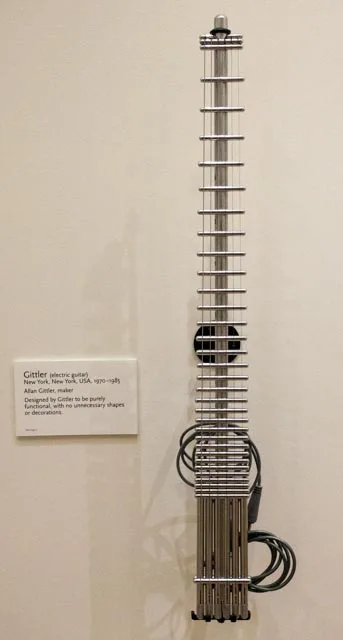
Photo: Frank Kovalchek from Anchorage, Alaska, USA / Wikimedia Commons / CC BY 2.0 Gittler
Gittler
1975
Allan Gittler kept taking parts off a guitar until all that was left was the guitar.