Yamaha
TRB-5
When the synthesizers came for the low end, bassists added strings. This was the five you could buy.
1985. John Patitucci is playing in Chick Corea’s Elektric Band, and he trades four strings for six. Four years later Yamaha debuts a bass line built for exactly that fight. The TRB-5 is where that line turns into a five-string for everybody else.
- Introduced
- 1994
- Type
- Solidbody electric bass
- Class
- Production
Have a photograph of this guitar? Send a picture
The short version
1984
The BB5000
Yamaha’s earlier five-string. Some call it the first commercially available five.
1985
Four to six
Patitucci moves to a six-string with Chick Corea’s Elektric Band.
1989
The TRB
Yamaha debuts the series. It starts life as a six-string, with a low B and a high C.
1992
Prototypes
Patitucci’s electrics are TRB prototypes, among them a five built for popping strings.
1994
The TRB-5
Carved ash, bolt-on maple, two stacked humbuckers, five knobs. Patitucci’s TRBJP six arrives the same year.
1996
The through-neck goes
The TRB-5P, the through-neck five with a piezo, is discontinued.
1998
The TRB-5II
The bolt-on five is replaced by a 35-inch version.
Side A
A1
The synthesizer players
In 1985 John Patitucci joined Chick Corea’s Elektric Band and put down his four-string for a six. He names two reasons. One was Anthony Jackson. The other was the keyboards:
The synthesizer players were trying to take over the world.
Six strings meant a low B under the usual bottom and a high C above the top. That six was a Ken Smith, and it’s the bass on three Elektric Band albums, plus John Patitucci and On the Corner.
Yamaha heard the same problem. Its own history of the TRB says the series was born a six-string at the end of the 1980s, debuting in 1989, because synthesizers were taking the bottom. It gave the bass a low B, a high C, and a longer scale “to increase crisp tonal character in low range.”
A2
Bolt it back on
Yamaha’s first TRB sixes were neck-through, with one long piece of wood from headstock to tail. Patitucci told them the old sound was the bolt-on. That’s why later TRB necks bolt on.
By 1992 his electrics were all TRB prototypes: three sixes, one of them with a whammy bar, and a five “with a body modified to facilitate string popping.” His signature bass, the TRBJP, came out in 1994. It has six strings.
The five-string that ordinary players could walk out of a shop with arrived the same year.
A3
What was on the wall
The TRB-5 ran from 1994 to 1998, made in Japan. It has a carved ash body with an offset double cut, a bolt-on maple neck, and a rosewood board with pearl dots and 24 frets. The bridge is brass, the tuners are brass, three on one side and two on the other, and the hardware is gold. It came in Amber Stain, Blue Stain, Charcoal Gray, or Cherry Sunburst.
The pickups are two humbuckers, described as stacked in one listing and as double-coil Alnicos in another. Humbucking means the low B comes through without the hum. The electronics are active, with five knobs: volume, treble, mid, bass, and a mix to slide between the neck and bridge pickups. One spec sheet adds a three-position mid switch. Yamaha’s own brochure puts that switch on Patitucci’s TRBJP instead. All three accounts stay on the table.
What it isn’t matters too. It isn’t a through-neck. That was the TRB-5P, with a piezo in the bridge, and it was gone by 1996. It isn’t a Broad Bass, either. Yamaha’s BB5000 was a five-string in 1984, and some people call it the first commercially available one.
Flip the record · By the numbers
5
Knobs. Volume, treble, mid, bass, and a mix between the two pickups.
24
Frets on a rosewood board. Two full octaves above that low B.
34 / 35
Inches of scale. 34 on the 1994 bass, 35 on the TRB-5II that replaced it.
4
Finishes. Amber Stain, Blue Stain, Charcoal Gray, Cherry Sunburst.
Side B
B1
The inch everyone argues about
Yamaha’s own story of the TRB says 35 inches, for tension on the low strings. The TRB-5 from 1994 is listed at 34, the same as a Jazz Bass.
The extra inch belongs to the next bass. The TRB-5II arrived in 1998 at 889 mm, which is 35 inches, and ran into the early 2000s. Later TRBs stayed long. So if you pick up a TRB five and it feels like a stretch, check the badge. The 1994 bass and the 1998 bass aren’t the same length, and nobody should split the difference.
B2
A five with nobody’s name on it
Look for a famous player on a stock TRB-5 and you come up empty. Patitucci’s five was a prototype. His signature is a six. Abraham Laboriel is in the brochure next to the through-neck TRB-5PII. Phil Lipscomb took a TRB5PII on tour and into the studio for Taproot’s Blue-Sky Research. Nathan East had a pair of TRB sixes, and his signature bass is a BB. There’s no album credit anywhere for a production TRB-5.
That’s not a knock on it. The prototypes were built for one virtuoso with a whammy bar and a modified body. The TRB-5 was the version that went on a shop wall, in Cherry Sunburst, with the low B already on it.
The synthesizer players were trying to take over the world. This was how the rest of the bass players got some of the bottom back.
The cast
The people, and the specific guitars, that made the legend.
1992
John Patitucci
TRB prototypes and the TRBJP six
His TRB five was a prototype with a body modified for popping. His signature is a six. Neither is a street TRB-5.
Abraham Laboriel
TRB-5PII
Yamaha’s brochure puts him on the through-neck 35-inch five with a piezo. Not the 1994 bolt-on.
2005
Phil Lipscomb
TRB5PII
Taproot. Used one on tour and on Blue-Sky Research. A through-neck, not this bass.
Nathan East
TRB6P six-strings
A pair of TRB sixes. His signature is the BBNE, from his BB5000.
Liner notes
Specs, construction, rarity, value, and every source we used.
Two stacked humbuckers, a five-knob active EQ, and a 34-inch scale — Yamaha’s 1994 five-string, not a BB, and not the 35-inch TRB that replaced it.
- Body
- Offset double-cut, carved ash (Blue Book).
- Neck
- Bolt-on maple. Not a through-neck.
- Fingerboard
- Rosewood, pearl dot, 24 frets (Blue Book). Radius unpublished on that line.
- Scale
- 34 in. (Blue Book, mfg. 1994–98). TRB-5II service manual: 889.0 mm. Yamaha TRB1005J: 35" (889.0 mm). Mix flagged. Do not average.
- Pickups
- Blue Book: two stacked humbuckers. Guitar-list: two double-coil Alnicos. Same window, two descriptions.
- Hardware
- Brass fixed bridge. 3-and-2 brass tuners. Gold.
- Electronics
- Active. Volume, treble, mid, bass, mix (Blue Book). Guitar-list adds a 3-position mid. Yamaha’s brochure puts that switch on the TRB JP, and a continuous mid on the II.
- Finish
- Amber Stain, Blue Stain, Charcoal Gray, or Cherry Sunburst (Blue Book).
- Nut
- Unpublished on Blue Book. Guitar-list prints 1.81". TRB-5II manual and TRB1005J: bone, 43.0 mm at fret 0. Mix flagged. Do not average.
Open the full research fileConstruction details, the complete player record, production numbers, dated value estimates, and sources
Classic living example = Japan TRB-5, Blue Book 1994–98. No current TRB-5 SKU this pass. TRB-5II / 5IIF / 5IIL are the 35-inch bolt-ons. TRB-5P is the through-neck piezo. TRB1005J is the later Indonesia five-string, also discontinued. TRBJP / TRBJP2 are Patitucci six-strings. BB5000 (1984) and BB-2000 are Broad Basses. SG-2000 is six strings. No Gibson SKU. Mixed inch/mm flagged. Do not average 34 in. with 889.0 mm, or 1.81" with 43.0 mm.
Construction
The job was a low B a four-string doesn’t have, on a bass Yamaha would ship. The TRB page — same paragraph, UK and Canada — says the series was born a six-string at the end of the 1980s, debut 1989, synthesizers taking the bottom: a low B under the usual range, a high C above it, and a longer scale “to increase crisp tonal character in low range.” That telling is 35". The model named TRB-5 is the five-string, and Blue Book’s scale for it is 34 in.
Not a Broad Bass. The BB-2000 (yamaha-bb-2000) is the 1978 through-neck PJ. Bass Musician Magazine (December 2020) puts Yamaha’s earlier five at the 1984 BB5000 and calls that the first commercially available five-string. Attribute the “first.” This plate doesn’t settle it. The TRB-5 is not that bass, and not an SG (yamaha-sg-2000).
Blue Book’s window for that guitar is 1994–98: carved ash, bolt-on, 34 in., two stacked humbuckers, five knobs, gold. Guitar-list matches the years and the scale, calls the coils double-coil Alnicos, and adds a 3-position mid Blue Book doesn’t name. Yamaha’s brochure puts that switch on the TRB JP, and a continuous “New Active 3-band EQ” on the II. Keep all three. Japan, on guitar-list and the listings. This plate starts in 1994. Not a set neck. Not a piezo.
The inch people argue about is printed on the next guitar. Yamaha’s TRB-5II / TRB-5IIF service manual, printed in Japan in February 1998: 889.0 mm, bolt-on, light ash 41.0 mm deep, net 4.5 kg, rosewood, bone nut 43.0 mm at fret 0 and 65.9 mm at the 12th, double-coil Alnico V, bridge BPX-5D, Amber Burst, Magenta Burst, Translucent Blue. Blue Book: TRB 5 II, 1998–2003, 35 in. Brochure radius 20" (500 mm) — Yamaha’s pair, and 20 × 25.4 is not 500. Twelfth Fret runs the II to 2004 and dates a blue example to August 2000, nut 1.69 in / 43 mm, the shop’s pair. Fretless is TRB 5 F II. Lefty is TRB 5 L II. 889.0 mm is not this table. Do not average it with 34 in. Do not invent a millimetre Blue Book didn’t print.
TRB-5P is the other early five. Blue Book: figured maple/rosewood/maple, maple/mahogany through-neck, still 34 in., ebony, P/J plus a piezo, disc. 1996. Elderly dates serial 2114023 to 1990, 34", nut 1-13/16". A TalkBass seller dates serial 1X22068 to 22 October 1992. The TRB-5PII manual is through-neck at 889.0 mm. Through-neck, then a longer through-neck. Neither is the bolt-on ash guitar.
Patitucci is why later TRB necks are bolt-on, and why a six gets hung on this five. Bass Magazine (Jim Roberts, 1 December 2019): Yamaha’s first TRB sixes were neck-through; he told them the old sound was the bolt-on. The signature, TRBJP, 1994, is still a six — brochure 34" (863.6 mm), ebony, radius 40" (1000 mm), another pair that isn’t exact, figured maple / ash / alder. Yamaha Japan on TRBJP2: his request took the scale from 34" to 35" and the frets from 24 to 26, list ¥506,000 (tax in). Not five strings.
TRB1005J is the five-string Yamaha still prints a spec for. Bolt-on, 35" (889.0 mm), five-piece maple/mahogany or nato, rosewood, 24 frets, bone nut 43 mm, hum-canceling Alnico V, volume / balancer / 3-band, solid brass, 18 mm spacing. Japan’s sheet: radius 500R. Asia-Oceania: 23-5/8" (600 mm). Mix flagged. Do not average. Indonesia, per Bajos y Bajistas (2012) and an Ishibashi listing, serial HIX153000, year 2012. Blue Book’s TRB 1005 window is 2005–2011. That 2012 bass sits outside it. Yamaha Japan: 生産完了, orders stopped, list ¥132,000 (tax in). The six, TRB1006J, ¥154,000. Cousins. Not a 1994 TRB-5.
Players
Do not hang a BB5000, a BBNE, a TRB-6, or a TRBJP on this plate.
John Patitucci. The sourced five-string is a prototype. Bass Magazine: in 1985 he left four strings for six on Chick Corea’s Elektric Band — Anthony Jackson, and “the synthesizer players were trying to take over the world.” That bass was a Ken Smith, on three Elektric Band albums plus John Patitucci and On the Corner. By the May/June 1992 Bass Player his electrics were TRB prototypes: three sixes, one with a whammy, and a five “with a body modified to facilitate string popping.” The catalog signature is the 1994 TRBJP, six strings, 34". The red bass he had played for twenty years (the interview is 2019) carries the TRBJP2 preamp. Brooklyn (2015) is one of the semi-hollow prototypes. Dapron said Yamaha had no plans to market them. None of them is a street TRB-5.
Abraham Laboriel. Yamaha’s brochure sets his name on the TRB-5PII: through-neck, piezo, 35". Bajos y Bajistas (2012): a clinic on a bass identical to the TRB1005J. Two sightings. Neither is the 1994 bolt-on.
Phil Lipscomb. Yamaha Artists, 26 September 2005: on tour and in the studio for Taproot’s Blue-Sky Research, a TRB5PII and an RBX375. Neck-through. Not this guitar.
Nathan East. Wikipedia: a pair of TRB6P six-strings, and the BBNE taken from his BB5000. The signature is the BBNE. Not this guitar.
The II brochure also prints Oscar Cartaya, David Carpenter (Allan Holdsworth), Philip Bynoe (Steve Vai), Dave Santos (Billy Joel), and Chris Minh Doky (Mike Stern, David Sanborn) next to the 4/5/6 II photos. Brochure names. Not a 1994 TRB-5.
Also known to play stays empty. No album credit for a production TRB-5 in the sources this pass.
Rarity
You cannot order a new TRB-5. Blue Book closes the bolt-on in 1998. The 35-inch II is a separate closed run, 1998–2003 there and 2004 at Twelfth Fret. Yamaha Japan has stopped TRB1005J orders. None of that is a new 1994 guitar.
Yamaha publishes no TRB-5 total. None invented. A serial dates a bass. It doesn’t count a year. That is why a first-year census is unknown.
Thinner in the hand: a 1994 bolt-on; the through-neck TRB5 P, Blue Book disc. 1996; an original whose stacked coils and five-knob circuit were never replaced. The factory fretless is the TRB-5IIF, a different bass.
Value
Informal estimate, 25 September 2026. Not an appraisal.
Ask vs sold labeled. Celebrity instruments are not-comps. No invented medians or factory counts. No period US list for the 1994 TRB-5 turned up this pass. ¥132,000 (tax in) is Yamaha Japan’s discontinued TRB1005J list, orders stopped — not 1994 money, and not a cart. ¥506,000 is the TRBJP2.
New street. No current TRB-5. No current TRB1005J from Yamaha this pass.
Used modern (TRB1005J, not a TRB-5). Reverb Price Guide, 2010s Natural Quilt, Good to Mint: $625–$986, 27 orders. Named finals on that guide: 22 May 2025 Mint $1,000; 15 September 2025 Very Good $711.55; 3 October 2025 Very Good $650; 22 November 2025 Excellent $926; 2 December 2025 Very Good $850; 9 December 2025 Mint $825. Named new-condition solds, kept separate: MusicStreet UK, black, $1,276.94; Doctorbass (Spain), Trans Black, $1,614.97; Apollon (Niigata), $592.50. Do not fold those into the quilt band.
Vintage / collectible (Japan TRB-5). No Price Guide band for the 1994–98 bolt-on this pass. Flag: thin sold-comp access. Named ask, not a hammer: Augusto’s Domus, 1994 cherry sunburst, Very Good, $1,608.28 (from $2,170.56). Ended listings, hammers unpublished: Francis’s Gear Bazaar, 1997 amber, Good, $1,644.68; JJ Vintage Shop, 1994 amber, the ad’s “Slap Cut,” Mint, $2,353.58. Do not average. Patitucci’s sixes are not comps.
See also
- yamaha-bb-2000 — 1978 through-neck PJ; the 1984 BB5000 is Yamaha’s earlier five
- fender-jazz-bass — the 34-inch bolt-on; two singles, no five-knob preamp
- music-man-stingray — 1976 active four-string; that plate already separates the StingRay 5
Sources
- Blue Book of Guitar Values, Yamaha TRB 5 — carved ash; bolt-on maple; 34 in.; 24-fret rosewood, pearl dot; brass bridge; 3/2 brass tuners; gold; two stacked humbuckers; volume/treble/mid/bass/mix; active; Amber Stain, Blue Stain, Charcoal Gray, Cherry Sunburst; mfg. 1994–98. TRB5 P: through-neck, 34 in., piezo, disc. 1996
- Blue Book, Yamaha electric bass TRB series — TRB 5 II 35 in., mfg. 1998–2003; TRB 5 F II and TRB 5 L II same window; TRB 1005 mfg. 2005–2011
- Guitar-list, Yamaha TRB5 — 1994–1998, then TRB5-II; two double-coil Alnicos; 5-control active system; 3-position mid; 34 in.; Japan; nut width 1.81 in. (crowd spec)
- Yamaha UK, TRB — series born a 6-string, end of the 1980s; debut 1989; 35" for low-range tension; 3-band active circuit. Same paragraph on the Canada page
- Yamaha, TRB-5II / TRB-5IIF service manual (printed Japan, February 1998) — 889.0 mm; bolt-on; light ash, 41.0 mm deep; 4.5 kg; rosewood; bone; 43.0 mm at fret 0, 65.9 mm at the 12th; double-coil Alnico V; BPX-5D; Amber Burst, Magenta Burst, Translucent Blue
- Yamaha brochure, TRB / TRB JP (usa.yamaha.com) — II: bolt-on, 35" (889 mm), rosewood, 20" (500 mm) radius, ash, double-coil Alnico V, continuous 3-band EQ. TRB JP: bolt-on 6-string, 34" (863.6 mm), ebony, 40" (1000 mm), figured maple/ash/alder, 3-position mid. TRB-5PII: through-neck, 35" (889 mm). Laboriel on the 5PII spread; Cartaya, Carpenter, Bynoe, Santos, Doky on the II spread
- Yamaha, TRB-5PII / TRB-6PII service manual — TRB-5PII through-neck, 889.0 mm
- Yamaha Japan, TRB — TRB1005J 生産完了, orders stopped, ¥132,000 tax in; TRB1006J ¥154,000; TRBJP2 ¥506,000, scale from 34" to 35", 24 to 26 frets, at Patitucci’s request
- Yamaha Japan, TRB specs — TRB1005J: bolt-on, 35" (889 mm), rosewood, 500R, bone nut 43 mm, 24 frets, maple+alder, maple/nato 5-piece, brass, 18 mm, hum-cancel Alnico V, 3-band EQ
- Yamaha Asia-Oceania, TRB specs — TRB1005J radius 23-5/8" (600 mm); nut 43.0 / 65.9 mm; hum-canceling single-coil Alnico V. Radius disagrees with the Japan sheet
- Bass Magazine, Jim Roberts, “Partners: John Patitucci & Yamaha,” 1 December 2019 — 1985 Elektric Band, Ken Smith six on three Elektric Band albums, John Patitucci, On the Corner; 1992 Bass Player: TRB prototypes, including a 5-string; TRBJP 1994; bolt-on at his request; TRBJP2 preamp, “20 years”; Brooklyn (2015) semi-hollow prototype, not catalogued
- Bass Musician Magazine, Yamaha BB history, 7 December 2020 — 1984 BB5000 called the first commercially available five-string; TRB as the later line, including Yamaha’s first six-string
- Bajos y Bajistas, issue 9 (PDF) — TRB series from 1989; TRB-J / TRB1005J built in Indonesia; Laboriel clinic on an identical bass
- The Twelfth Fret, Yamaha TRB 5 ii, blue, 2000 (archive) — line since 1989, six-string first; II until 2004; this bass August 2000, Japan; 35 in / 889 mm; nut 1.69 in / 43 mm
- Yamaha Artists, Phil Lipscomb, 26 September 2005 — TRB5PII and RBX375 on Taproot, Blue-Sky Research
- Wikipedia, Nathan East — BBNE from the BB5000; a pair of TRB6P six-strings
- Elderly Instruments, Yamaha TRB-5P (1990), Reverb — serial 2114023; 1990; neck-through; 34"; 1-13/16" nut; piezo
- TalkBass classified, 1992 TRB-5P — seller dates serial 1X22068 to 22 October 1992
- Reverb Price Guide, TRB1005J 5-String Natural Quilt — $625–$986, 27 orders, Good to Mint; named finals May–December 2025
- Reverb, 1994 TRB5 cherry sunburst (Augusto’s Domus) — ask $1,608.28, was $2,170.56; Japan; 34 in.
- Reverb, 1997 TRB-5 (Francis’s Gear Bazaar) — listing ended $1,644.68; hammer unpublished; seller: 34 in.
- Reverb, 1994 TRB-5 “Slap Cut” (JJ Vintage Shop) — listing ended $2,353.58; hammer unpublished; “Slap Cut” is the ad’s wording
- Reverb, Ishibashi TRB1005J HIX153000 — year printed 2012; Indonesia
- Reverb, TRB1005J black, MusicStreet (sold) — new, sold $1,276.94
- Reverb, TRB1005J Trans Black, Doctorbass (sold) — new, sold $1,614.97
- Reverb, TRB1005J/NT, Apollon (sold) — new, sold $592.50
Keep digging
Guitars this one gets compared to, confused with, or descended from.
- Send a picture
Yamaha
BB-2000
1978
Andy Rourke’s main bass was a Precision. For the funky stuff, he picked up a Yamaha.

Fender Jazz Bass from 1966 in Olympic white with the transition fingerboard (bindings and dot inlays). Photo by Th. Ott. Licensed under CC BY-SA 3.0. Via Wikimedia Commons. Fender
Jazz Bass
1960
Built for jazz players who mostly passed on it. Then bass players started using it to take the solo.
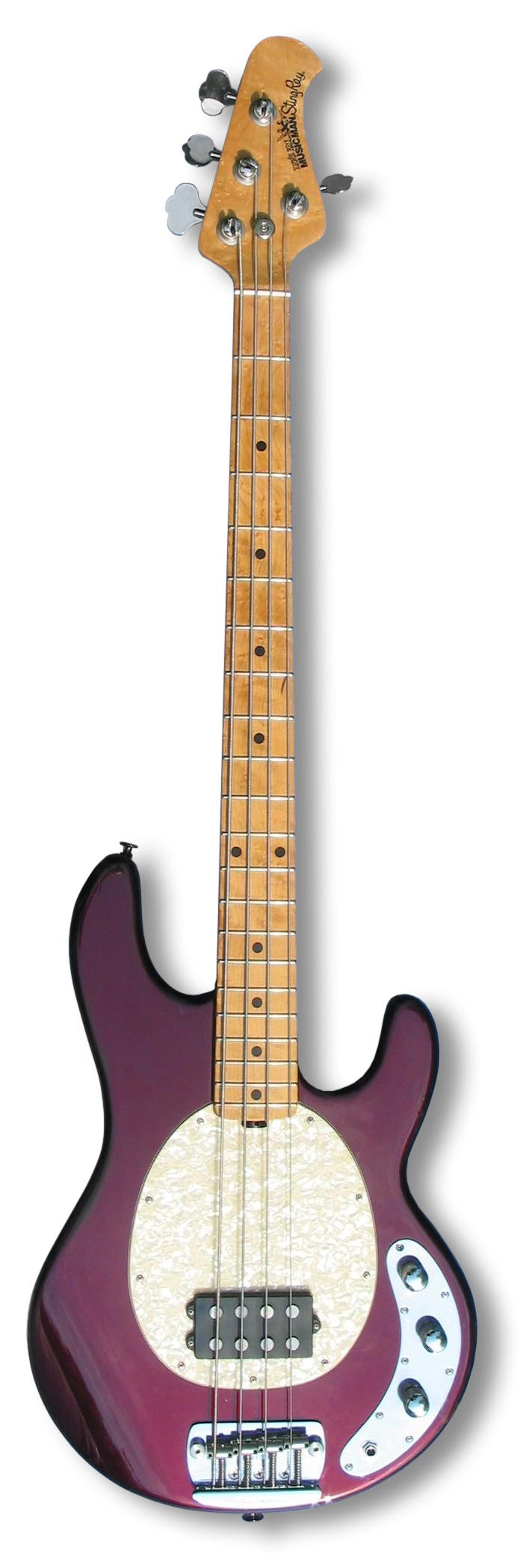
Photo: Th. Ott / Wikimedia Commons / CC BY-SA 3.0 Music Man
StingRay
1976
Leo Fender wanted a wide, bright bass. Louis Johnson hit it with his thumb, and funk had its sound.