 Guitaripedia
Dallas
Rangemaster Treble Booster
Brian May asked Rory Gallagher how he got that sound. The answer was a little grey box with one knob.
The Marquee, London, 1969. The club has emptied, and a young Brian May has hung back to ask Rory Gallagher how he gets that sound. “Well, it’s easy,” Gallagher tells him. “I have the AC30 and this little box, and I turn it up and it sings for me.”
- Introduced
- 1965 or 1966
- Effect
- Boost
No photograph of this pedal yet. Have one? Send a picture
The short version
1965 or 1966
A box for dark amps
Dallas in London makes a one-transistor treble booster to sit on top of the amp. The counts don’t agree on the year, and nobody knows who designed it.
c. 1967
Gallagher finds one
Rory Gallagher plugs a Rangemaster into his Vox AC30’s normal channel and turns everything up.
1969
“How do you get that sound?”
Brian May asks Gallagher at the Marquee, then finds his own AC30 and a treble booster.
1972
Queen’s first album
May records Queen’s debut with a secondhand Rangemaster between the Red Special and an AC30.
1973
Left at a gig
A roadie leaves May’s Rangemaster behind and says he didn’t think it did very much. May moves on to other boosters.
1979
“It was crap”
After all the early Sabbath albums, Tony Iommi’s modified Rangemaster goes out with the rubbish when a tech comes in to build him some Marshalls. That’s Iommi’s year; others say 1982.
2025
Rory’s number one
The Gallagher family gives Rory’s number one Rangemaster to Joe Bonamassa. It still works.
Side A
A1
How do you get that sound?
The Marquee, London, 1969. The gig is over and everyone has gone home, except for one young guitarist who has managed to stay behind. Brian May walks up to Rory Gallagher and asks the question every guitarist has asked somebody: “Rory, how do you get that sound?”
Gallagher doesn’t make a secret of it. “Well, it’s easy,” he says. “I have the AC30 and this little box, and I turn it up and it sings for me.”
The next day May goes shopping. Depending on which time he tells it, he comes home with one battered AC30 or two secondhand ones. Then he finds the little box, a treble booster. “I plugged it in with my guitar, turned it all the way up and it just melted my stomach,” he said. “That’s my sound.”
He’s never been shy about where it came from. “It made guitar speak, so it was Rory that gave me my sound and that’s the sound I still have.”
A2
A box for dark amps
The box was a Dallas Rangemaster, and it was made to fix a very English problem. British players in the ’60s ran Vox AC30s and Marshalls, and those amps could go dark and muddy when you pushed them. The high end got lost.
Roger Mayer, who built boosters of his own, explained the fix. Those amps weren’t very detailed, he said, and “one of the secrets of getting a good guitar sound is to use equalisation before the signal hits the front-end of the amplifier. And it’s about how hard you push the first tube.”
Dallas, a London instrument firm, made the Rangemaster around 1965 or 1966. The sources don’t agree on the year, nobody knows who designed it, and nobody knows how many were built. It was a plain, folded-metal box painted battleship grey, with musical notes climbing up it. It wasn’t really a pedal. It sat on top of the amp, you flicked it on by hand, and a cable came straight out the back into the amp’s input.
A3
One transistor
Inside, there’s hardly anything: one germanium transistor, usually a Mullard OC44, a few resistors and capacitors, a Boost Set knob, a switch and a battery. That’s it.
The name is a little off. A small input capacitor decides what gets boosted, and what it lets through is mostly upper mids and lower treble. One pedal designer, Adrian Thorpe, says it should really be called a “frequency dependent booster.”
The magic is in what happens next. The old transistor starts to growl and clip when you hit the strings hard, and then the amp’s first valve clips too. The pedal designer Dan Coggins describes it as two kinds of distortion stacked up: “from the Rangemaster on one lot of peaks and then from the valve on the other lot of peaks.” That’s where the singing comes from.
Flip the record · By the numbers
1
Germanium transistor, usually a Mullard OC44. That’s the whole engine.
2
Controls. A Boost Set knob and an on/off switch, set on top of the amp and worked by hand.
5nF
Input capacitor that decides what gets pushed. Mostly upper mids and lower treble, not just treble.
38 dB
Voltage gain, by one circuit analysis. Plenty to shove an amp’s first valve into distortion.
Side B
B1
Rory turned it up
Gallagher found his Rangemaster in about ’67, his nephew Daniel says, and ran it into the Normal channel of the Vox with his Stratocaster. From ’68, with the second line-up of Taste, “that’s when you really hear that combination.” He’d run the amp all the way up and work the volume from the guitar. “And the booster really made it scream.”
He stuck with that sound through his first two solo records and Live in Europe in 1972. When he added a Fender Twin around 1973, the Rangemaster stayed where it was. “The Rangemaster belonged to the Vox,” Daniel says. “You don’t see him putting it into any of the Fenders.”
Up in Cumberland, Tony Iommi borrowed one to give his sound more oomph, and a man from another band offered to make it better. “He took it off me and brought it back the next day. I don’t know what he did to it, but it was really good.” Iommi ran the modified box into a Laney. “I used that treble booster on all the early Sabbath albums.” Put on “Iron Man” and that’s the sound. It was noisy enough that Black Sabbath cancelled some gigs, because he couldn’t get his sound without it.
B2
Lost and binned
May recorded Queen’s first album, from June to November 1972, with the Red Special plugged into a secondhand Rangemaster plugged into an AC30. Then, sometime in 1973, a roadie left the box behind at a gig. His explanation, as May tells it: “oh I didn’t think it did very much.” Everything May played afterwards went through other boosters.
Iommi kept his longer. In 1979, by his count, a tech came in to build him some new Marshalls. Others put it at 1982. Either way, the treble booster disappeared. “He said, ‘Oh that? I threw it away. It was crap.’ I couldn’t believe it.”
The two of them understood each other. “The only person who understood how I felt in those days was Brian,” Iommi said, “because he had the same problem. We both had a bit of noise but were ultimately getting the sound we wanted.”
B3
Rory’s number one
Gallagher’s box didn’t get lost. In February 2025, before a show at the Beacon Theatre in New York, his nephew Daniel, with his father Donal’s blessing, gave Joe Bonamassa Rory’s number one Rangemaster. It was still in fine working order.
Bonamassa’s verdict: “We plugged it in and it turned that tweed Vibrolux into Irish Tour 74.”
Fifty-odd years after a kid stayed behind at the Marquee to ask a question, the answer was still being handed on: an amp, turned up, and this little box.
Put this on
You’ve read about it. Now hear it. Here’s what this pedal sounds like, and what to listen for.
Iron Man
Iommi’s modified Rangemaster pushing a Laney. He says he used it on all the early Sabbath albums.
Find it on YouTube (opens in a new tab)Queen
Recorded in 1972 with the Red Special, a secondhand Rangemaster and an AC30. The box was lost the next year, so this is the Queen record it’s documented on.
Find it on YouTube (opens in a new tab)Live in Europe
His nephew Daniel says Rory kept the AC30-and-Rangemaster sound through his first two solo records and this live album.
Find it on YouTube (opens in a new tab)
The cast
The people who built it, and the players who made it famous.
1972
Brian May
Queen
Took Gallagher’s advice, plugged a Rangemaster into an AC30 with his homemade guitar, and recorded Queen’s first album that way. “It made guitar speak.”
c. 1967
Rory Gallagher
Taste
Ran a Rangemaster into a Vox AC30 with his Stratocaster. His nephew Daniel says the box “really made it scream,” and that it stayed with the Vox, never the Fenders.
1970
Tony Iommi
Black Sabbath
A modified Rangemaster into a Laney. “I used that treble booster on all the early Sabbath albums.”
2025
Joe Bonamassa
Keeper of Gallagher’s Rangemaster
Given Rory’s number one box by the Gallagher family. “We plugged it in and it turned that tweed Vibrolux into Irish Tour 74.”
Often paired with
The pedals and guitars it usually shares a board or a record with.
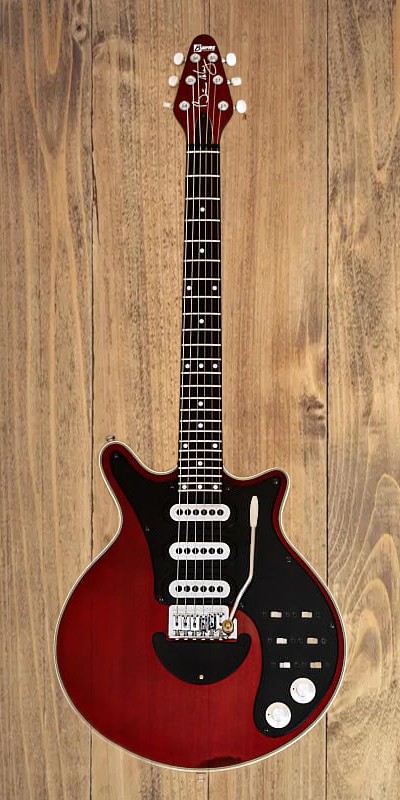
Photo: Wikidave22 / Wikimedia Commons / CC0 Brian May / Brian May Guitars
Red Special
1964
A teenager and his dad built it from a fireplace mantel, a knitting needle, and motorcycle parts. It played every Queen show.
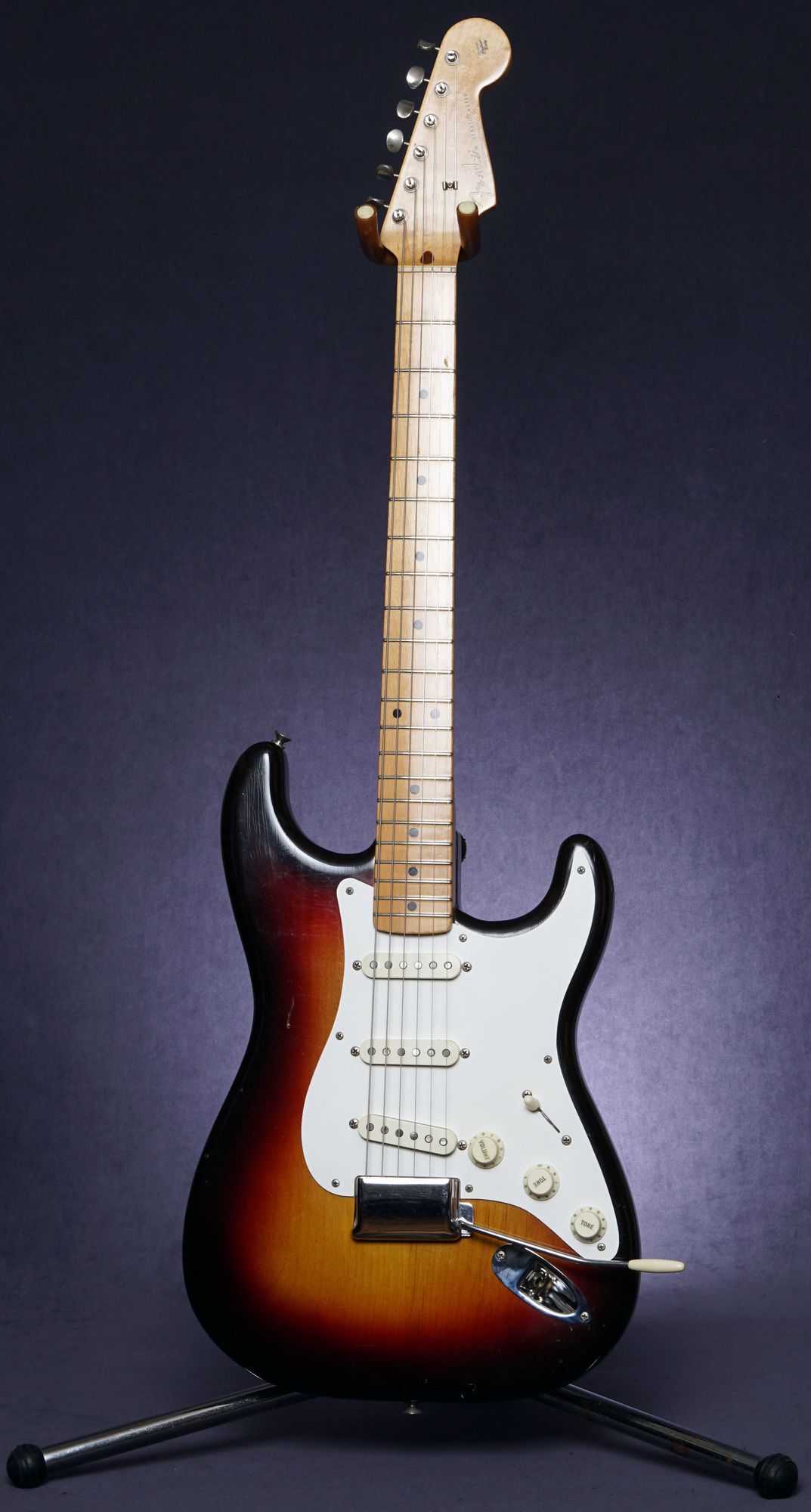
Photo: Lightburst / Wikimedia Commons / CC BY-SA 4.0 Fender
Stratocaster
1954
The guitar most people mean when they say “electric guitar.” Designed by a man who didn’t play one.
- Send a picture
Gibson
SG Special
1961
Townshend smashed them. Iommi stuck a monkey on one. Nobody was ever gentle with an SG Special.