Electro-Harmonix
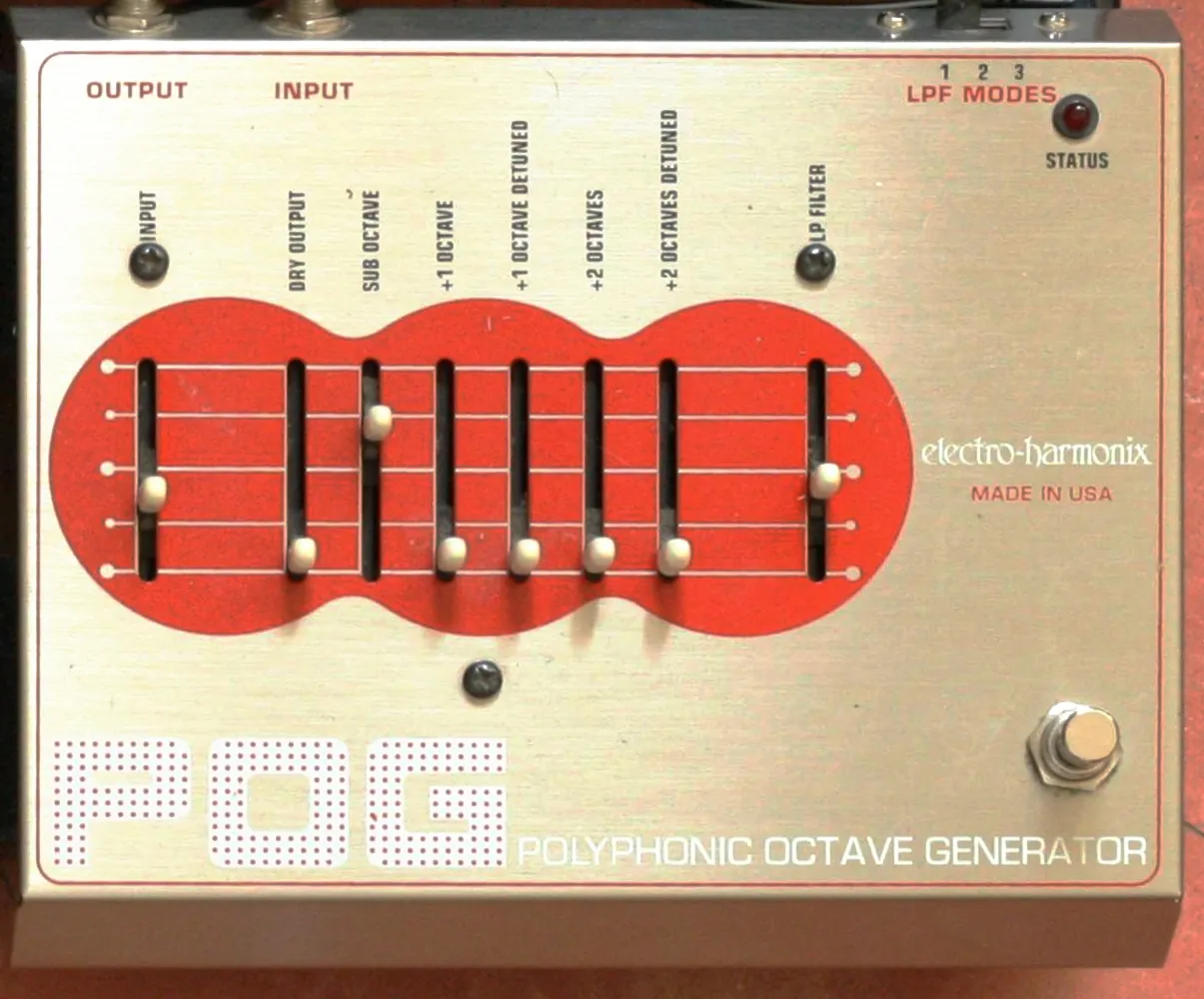
POG
A present from Electro-Harmonix, and one guitar in a two-piece band got far too heavy.
Detroit, early 2005. The White Stripes are cutting Get Behind Me Satan at Jack White’s house, and a box turns up from Electro-Harmonix, a present. He stacks octaves on the note, and the riff on “Blue Orchid” comes out enormous. “It’s just so heavy.”
- Introduced
- 2005
- Effect
- Other
The short version
2005
A present for Jack White
Electro-Harmonix puts out the POG, a Polyphonic Octave Generator, and sends one to the White Stripes, who use it on “Blue Orchid.”
2006
Giants and organs
Joe Satriani uses it, subtly, on the “Super Colossal” riff, and John Frusciante makes his guitar sound like an organ on “Snow (Hey Oh).”
2007
Icky Thump, and a smaller box
White plays the ascending riff on “Icky Thump” through the POG, and EHX brings out the compact Micro POG.
2009
The POG2
The original is discontinued, and the POG2 arrives with a second sub-octave, an attack control, and presets.
2010
Sometimes, I use a POG
White lists his rig as a Big Muff, a Whammy, and, sometimes, a POG.
2024
The POG3
EHX announces a third generation and calls it the most powerful POG yet.
Side A
A1
A present in the middle of a session
Detroit, early 2005. The White Stripes are making Get Behind Me Satan at Jack White’s house, in about two weeks, from late February into March. It’s a two-piece band: Jack on guitar, Meg on drums, no bass player. Whatever weight the songs have, the guitar has to supply it.
In the middle of all this, a box arrives from Electro-Harmonix. “Electro-Harmonix sent me one as a present when we were recording Get Behind Me Satan,” White remembered. It was a POG.
He put it on a riff and stacked octaves on the note. The basic tracks for “Blue Orchid” went down on 10 March. Here’s how he describes what came out:
It’s just so heavy. The riff is actually pretty simple, but it’s all about the one. It’s a funk-based idea.
One guitar, one drummer, and suddenly it sounded like a lot more people.
A2
Chords, not just notes
Pitch-shifting pedals weren’t new. The Whammy had been around for years, but its tracking could be erratic, with an alien warble that didn’t suit everybody. Digital octave pedals tended to sound artificial, and most could only follow one note at a time.
The POG, short for Polyphonic Octave Generator, came out in 2005 and could follow a whole chord, strummed or picked one note at a time, without glitching. David Cockerell, back working for Electro-Harmonix once more, is the designer credited with it.
The original gives you three extra voices on top of your dry note: one octave down, one octave up, and two octaves up, each with its own level. You can detune the upper octaves, roll off the top end with a filter, and give that filter a resonant peak. It came with an 18-volt power supply in the box.
Electro-Harmonix pitched it as a way to make your guitar sound like a 12-string, or an 18-string, or a drawbar organ, or a bass guitar. For a band with no bassist, that last one is not a small thing.
A3
First on record?
White thinks he got there first. “I think I was the first person to record with one on the White Stripes song ‘Blue Orchid,’” he said in 2010. “‘Blue Orchid’ came out two weeks after the session, so it had to be the first song to feature the POG.”
Two weeks is his memory. The single came out on 18 April 2005, which is more like five weeks after the basic tracking. Joe Satriani had one too, and Guitar World tells it as a race between the two of them to get it on record, with “Blue Orchid” just beating Satriani’s “Super Colossal.” He started recording that album around September 2005 and released it in March 2006.
Satriani used his very differently. He was after something enormous and slow:
I came up with a sound that I thought would bring to mind a guitar player that was standing 50, 70, 100 feet tall, and walking through your town playing a big, slow riff.
And he says he used the POG “in a very subtle way” to get there. Put on the title track and listen to the main riff. That’s the giant.
Flip the record · By the numbers
3
Octave voices on the original. One down, one up, two up, each with its own level against the dry note.
18V
The supply that came in the box with the original.
2009
The year the original was discontinued and the POG2 added a second octave down.
Side B
B1
An organ in the outro
John Frusciante found the organ hiding in it. On the Red Hot Chili Peppers’ Stadium Arcadium in 2006, he used the POG on “Snow (Hey Oh).” In his words: “During the outro section I used an Electro-Harmonix POG, which adds multiple octaves and makes the guitar sound like an organ.”
So wait for the outro. The guitar stops sounding quite like a guitar. He did the same trick on the second chorus of “She Looks to Me.”
B2
“That’s the POG”
The White Stripes went back to it. In January 2007, at Blackbird Studio in Nashville, they tracked “Icky Thump.” Asked in 2010 how he got the tone for the ascending riff, White kept it short: “That’s the POG.”
Careful with the rest of that song. The solo is a different chain, a Zvex Wooly Mammoth and a DigiTech Whammy. And careful with “Seven Nation Army,” too. That famous low riff is the Whammy, not this. Electro-Harmonix also brought out the compact Micro POG in 2007, and White never said which one he used on “Icky Thump,” only that it was the POG.
By 2010, playing with the Dead Weather, he described his effects the same way as in the White Stripes: “I have a Big Muff and a Whammy... Sometimes, I use a POG pedal.”
B3
Bigger, then smaller
The original POG was big, and the smaller versions that followed found more pedalboards. In 2009 it was discontinued, and the POG2 replaced it, with a second octave down, an attack control for slow swells, and presets. In 2024 Electro-Harmonix announced the POG3 and called it the most powerful POG ever.
It started with a present, sent to a house in Detroit where two people were making a record. One of them played guitar. On “Blue Orchid” he sounds like a whole band.
Put this on
You’ve read about it. Now hear it. Here’s what this pedal sounds like, and what to listen for.
Blue Orchid
The riff, with octaves stacked on the note. White says he thinks this was the first record to feature a POG.
Find it on YouTube (opens in a new tab)Super Colossal
The main riff. Satriani says he used the POG “in a very subtle way,” to sound like a giant walking through your town.
Find it on YouTube (opens in a new tab)Snow (Hey Oh)
Wait for the outro. Frusciante used the POG there to make the guitar sound like an organ.
Find it on YouTube (opens in a new tab)Icky Thump
The ascending riff is the POG, in White’s words. The solo is a different chain, a Zvex Wooly Mammoth and a Whammy.
Find it on YouTube (opens in a new tab)
The cast
The people who built it, and the players who made it famous.
2005
David Cockerell
Designer, Electro-Harmonix
Back at Electro-Harmonix once more, he’s credited with designing the POG.
2005
Jack White
POG, The White Stripes
Got his as a present while making Get Behind Me Satan and thinks “Blue Orchid” was the first record to feature one. He used it again on “Icky Thump.”
2006
Joe Satriani
POG, Super Colossal
Used it “in a very subtle way” on the title track, chasing the sound of a guitarist 50, 70, 100 feet tall.
2006
John Frusciante
POG, Stadium Arcadium
Used it to turn his guitar into an organ, on the outro of “Snow (Hey Oh)” and the second chorus of “She Looks to Me.”
Often paired with
The pedals and guitars it usually shares a board or a record with.
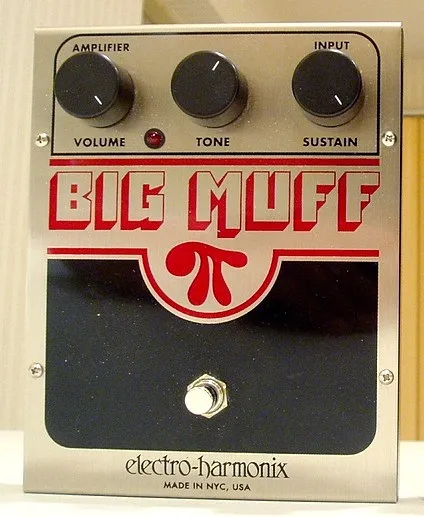
Photo: NIRVANA2764 / Wikimedia Commons / CC BY-SA 3.0 Electro-Harmonix
Big Muff Pi
1969 · Fuzz
Built to chase Hendrix, it missed, and made the smallest amp in the house sound like a wall.
- Send a picture
DigiTech
Whammy
1989 · Other
Tom Morello used it to chase hip-hop’s high wail; Jack White used it to fake a bass line.