MXR
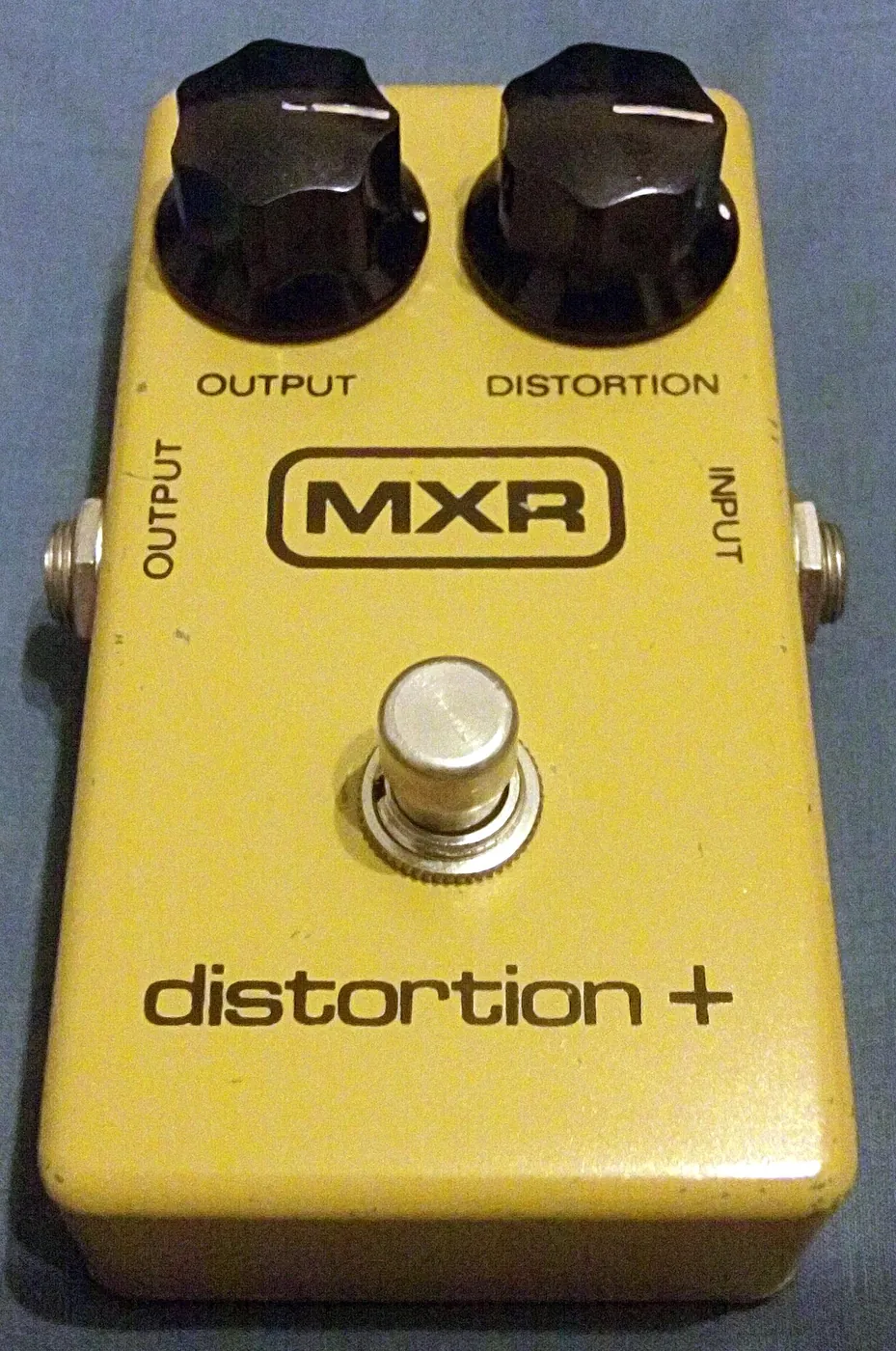
Distortion+
Two knobs, no tone control, and the one gadget Randy Rhoads said he used a lot.
Los Angeles, 2022. At the Musonia School of Music, the Rhoads family opens up Randy’s old pedalboard for MXR’s engineers, the first time anyone has examined it in over forty years. On it sits a small MXR box with two knobs.
- Introduced
- 1974
- Effect
- Distortion
The short version
1972 or 1973
Rochester
Keith Barr and Terry Sherwood, who met at high school near Rochester, start MXR. The dates differ by a year depending on who you ask.
1974
The trio
After the Phase 90 sells, MXR puts out three more pedals, and the Distortion+ is one of them.
c. 1976
Script to block
The cursive logo gives way to block letters. The circuit inside stays the same.
Late ’70s
Garcia
Jerry Garcia uses it for his distortion with the Grateful Dead.
1980
Blizzard of Ozz
Randy Rhoads cuts the riffs for “Crazy Train” and “Mr. Crowley” with a Distortion+ in his rig.
1987
Dunlop
MXR closed in 1984. Dunlop buys the name and puts the Distortion+ back in production.
2022
The Chip Pan opens
Rhoads’s family lets MXR’s team examine his pedalboard at the family’s Musonia School of Music, the first time in over forty years.
2024
His pedal, copied
MXR releases a Randy Rhoads Distortion+, spec’d from his own unit with his sister Kathy.
Side A
A1
The Chip Pan
Los Angeles, 2022. The Rhoads family runs a music school called Musonia, and there they open up Randy’s pedalboard for a team from MXR. It has spent time at the Rock and Roll Hall of Fame, but nobody has examined it this closely in over forty years. They film it, record it, and document every part.
His sister Kathy knows what it’s called. “Randy always referred to it as ‘The Chip Pan!’”
On it is a small MXR box with two knobs and no tone control. It’s a Distortion+, and it’s the one Randy leaned on.
A2
Two kids from Rochester
MXR began near Rochester, New York, with Keith Barr and Terry Sherwood, who had met at Rush-Henrietta Senior High School. They started the company in 1972 or 1973, depending on who’s counting, and the idea was a practical one. Other makers’ pedals broke. Effects came in big boxes. MXR’s would be small and reliable.
The first ones had a cursive logo, silk-screened in the founders’ basement. Barr was the company’s chief designer, and he went on, years later, to found Alesis.
Their phase shifter, the Phase 90, did well. In 1974 they followed it with a trio of pedals, and one of the three was the Distortion+.
A3
One chip, two diodes
Inside, there’s barely anything. One op-amp turns your signal up. After it, two germanium diodes run to ground, one for each side of the wave, and they chop off whatever goes past their limit. That chopping is the distortion. Turn the Distortion knob up and you get more of it, and more treble at the same time.
The range is wider than it looks. At the bottom of the knob it adds about 3.5 dB of gain, barely a nudge. At the top it adds about 46.5 dB. The other knob, Output, sets the volume. There’s no tone control at all.
What it doesn’t do is paint over your amp. Plug it into two different amps and you still hear two different amps, mostly. It suits anybody who already likes their amp and wants more of it.
Around 1976 the cursive logo went and block letters came in. The circuit didn’t change. Until 1981 there was no LED and no power jack, either: you found out it was on by listening.
Flip the record · By the numbers
2
Knobs. Output and Distortion. No tone control.
1
Op-amp for the gain, feeding two germanium diodes that do the clipping.
46.5 dB
Gain with the Distortion knob maxed. At the bottom it’s about 3.5 dB.
3
Pedals in MXR’s 1974 follow-up to the Phase 90. The Distortion+ was one of them.
Side B
B1
A stone room under the control room
- Ozzy Osbourne has a new guitarist, Randy Rhoads, and they’re making Blizzard of Ozz. The producer, Max Norman, remembered where the amps went:
Randy’s amps were set up in a stone room underneath the control room; they were facing into the stone steps that led down to the stone room.
The amp was a 100-watt Marshall Plexi with two 4×12 cabinets. The guitars included a 1974 Les Paul Custom and a polka-dot V. And the pedalboard had a Cry Baby, the Distortion+, an MXR 10-band EQ, an MXR Stereo Chorus, an MXR Flanger, and a Roland volume pedal.
Rhoads used the Distortion+ to slam that amp with harmonics, and it’s in the riffs for “Crazy Train” and “Mr. Crowley.” He said it himself, plainly: “The MXR Distortion Plus is the only gadget I use a lot.”
So put on “Crazy Train” and listen to the riff. The pedal’s in there. So are the Marshall and that stone room. It’s part of the sound, not the whole of it.
B2
Other floors
He wasn’t the only one. In the late ’70s Jerry Garcia used a Distortion+ for all his distortion with the Grateful Dead.
MXR closed in 1984. Dunlop bought the name in 1987 and put the Distortion+ back into production, and it has stayed there, a yellow box on the shelf next to far fancier ones.
Dave Murray of Iron Maiden, overdubbing on The Book of Souls in 2015, described his method like this: “I plug straight in, put on a Uni-Vibe or a Distortion +, maybe a flanger, and then I just feel it out.” Bob Mould had one on his board in 2013 for an Austin City Limits taping, playing a 1987 Stratocaster.
B3
His, copied
In 2024 MXR put out a Randy Rhoads Distortion+, polka dots and all. Dunlop’s engineers built it to match Randy’s own pedal, the one from the Chip Pan, with Kathy Rhoads working with them directly.
It’s a tribute, not the pedal on the record. That one is still Randy’s.
Two knobs, one chip, two diodes. Every Distortion+ comes out of the same simple circuit. The one Dunlop copied was special for a single reason: Randy had stood on it.
Put this on
You’ve read about it. Now hear it. Here’s what this pedal sounds like, and what to listen for.
Crazy Train
The Distortion+ is in the riff, with a 1974 Les Paul Custom and a 100-watt Marshall in the same rig.
Find it on YouTube (opens in a new tab)Mr. Crowley
The other Blizzard of Ozz riff the Distortion+ helped cut.
Find it on YouTube (opens in a new tab)
The cast
The people who built it, and the players who made it famous.
Keith Barr
MXR co-founder, chief designer
Co-founded MXR in Rochester and was its chief designer. He went on to found Alesis.
1980
Randy Rhoads
Ozzy Osbourne, Les Paul Custom
Used it to slam his amp with harmonics, and it’s in the Blizzard of Ozz riffs. In his words, “The MXR Distortion Plus is the only gadget I use a lot.”
2024
Kathy Rhoads
Randy’s sister
Worked directly with MXR’s engineers to copy Randy’s own Distortion+, from the pedalboard he called “The Chip Pan.”
Late ’70s
Jerry Garcia
Grateful Dead
In the late 1970s it was the only pedal he used for distortion.
2015
Dave Murray
Iron Maiden, Stratocaster
“I plug straight in, put on a Uni-Vibe or a Distortion +, maybe a flanger, and then I just feel it out.”
2013
Bob Mould
1987 Stratocaster
Had one on his board for his Austin City Limits taping, next to a delay, a freeze pedal and a compressor.
Often paired with
The pedals and guitars it usually shares a board or a record with.
- Send a picture
Dunlop
Cry Baby
1967 · Wah
An amp engineer’s shortcut, built into an organ pedal for horn players. Guitarists plugged in anyway.
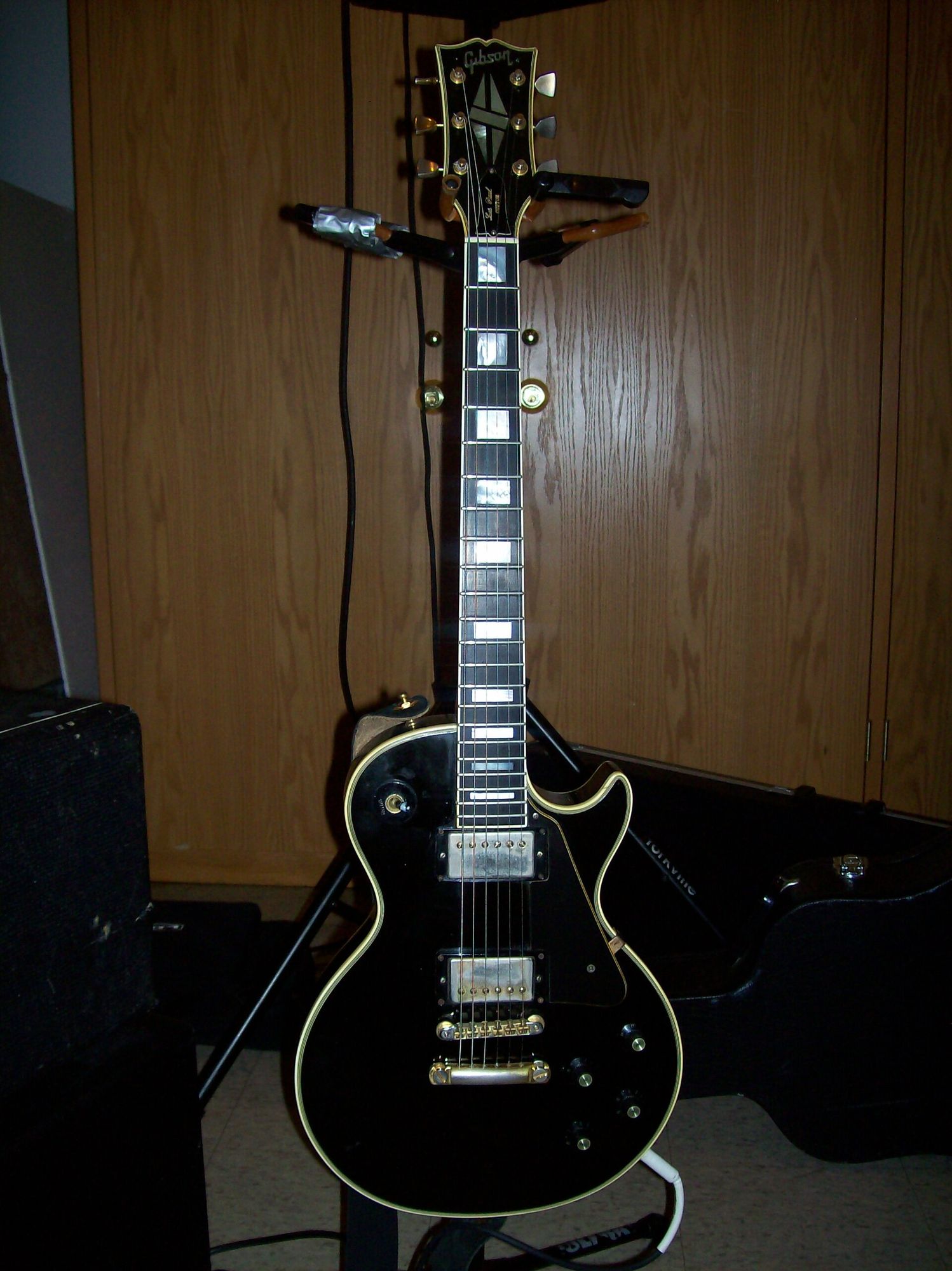
A 1974 Gibson Les Paul Custom guitar. Photo by Ibanez Guy. Licensed under CC BY-SA 3.0. Via Wikimedia Commons. Gibson
Les Paul Custom
1954
Jimmy Page paid his off in installments at 18. It was stolen in 1970. He got it back over 40 years later.
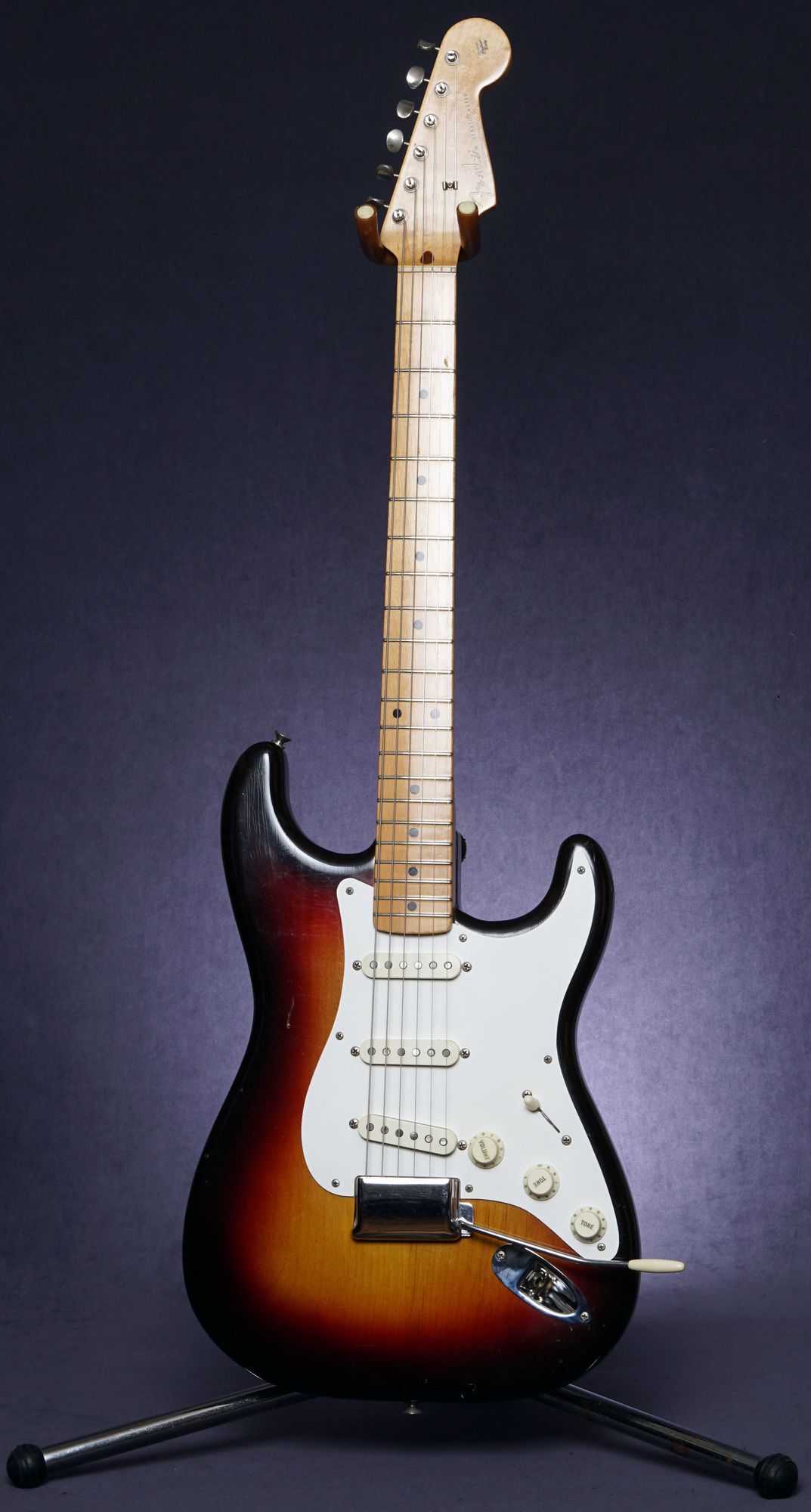
Photo: Lightburst / Wikimedia Commons / CC BY-SA 4.0 Fender
Stratocaster
1954
The guitar most people mean when they say “electric guitar.” Designed by a man who didn’t play one.