Alembic
Series I
The sound wizards behind the Grateful Dead got tired of noisy pickups, so they built bass players a better one.
1969. Ron and Susan Wickersham have started a company to make live sound better for the Grateful Dead, Jefferson Airplane, and Crosby, Stills, Nash & Young. Live sound comes first. Then Ron looks at the instruments. The pickups are noisy, and they only hear a narrow slice of what the strings are doing. So the sound company starts rebuilding them.
- Introduced
- 1972
- Type
- Solidbody electric bass
- Class
- Production
Have a photograph of this guitar? Send a picture
The short version
1969
A sound company
The Wickershams start Alembic in March. Some tell it as a 1970 company, with Rick Turner and Bob Matthews as partners.
1972
Bass 72-01
The first numbered Alembic bass goes to Jack Casady, at more than $4,000.
1973
Stanley Clarke
The first short-scale Alembic is built for him. A Rolling Stone story helps pay for a standard line.
1975
Entwistle signs up
The Who’s bassist makes the Series I his main bass for a year, then orders Explorer-shaped Alembics.
1976
Manny’s, New York
Muscle Shoals bassist David Hood buys a long-scale Series I for about $1,100.
1978
Turner leaves
Rick Turner goes off to found Turner Guitars.
2026
Still in the family
Twelve people in Rohnert Park, the family included, still build the Series I.
Side A
A1
The sound crew fixes the bass
For most of rock’s early years, the bass got whatever was left over. The guitar player got the attention, the amp, and the solo. The bass player got a Fender and a spot next to the drummer.
Alembic started on the other side of the stage, at the mixing desk. Ron and Susan Wickersham opened it in March 1969 as sound consultants for the Grateful Dead, Jefferson Airplane, and Crosby, Stills, Nash & Young. There’s a second version of the story, with Owsley Stanley’s workshop in Novato and a 1970 company split three ways between Wickersham, Rick Turner, and Bob Matthews. Both end up in the same place.
That place was the pickups. The usual kind was noisy and narrow. Ron designed low-impedance pickups that heard much more of the string, then put a preamp inside the instrument to make up the lost volume. The factory calls it the first active electronics in an electric guitar. Turner had a word for doing this to somebody’s old bass: “Alembicizing.”
A2
Bass number one
The first numbered Alembic bass, 72-01, was built in 1972 for Jack Casady of Jefferson Airplane. It cost more than $4,000, and its pickups could slide along brass tubes so he could move them around. Nothing like it had come before.
The numbers started at 1 that year and kept counting across every model, because Alembic was building these before it had model names or a catalog. So the Series I is “offered” from 1971 while the first numbered bass is 1972. Nobody was keeping a tidy ledger. They were busy.
A3
A mixing desk you can play
The production Series I is plainer than Casady’s, which is saying very little. The neck runs all the way through a body the shop still calls the hippie sandwich: layers of wood around a mahogany core, with a brass nut and a brass tailpiece shaped like a bird.
Two single-coils do the work, and a dummy coil between them cancels the hum. Instead of a normal tone knob, each pickup gets its own low-pass filter and a switch that changes how hard the filter bites. You don’t turn it darker so much as tune it, the way an engineer would at the desk. The power comes from a box on the floor.
The pointed shape was supposed to make you put it in a stand. Broken headstocks were the shop’s most common early repair.
Flip the record · By the numbers
72-01
Serial of the first numbered Alembic bass, built for Jack Casady.
3×
Up to three times the price of a new Fender, in the early standard line.
~$1,100
What David Hood paid for his long-scale Series I at Manny’s in 1976.
12
People in the Rohnert Park shop today, including the family.
Side B
B1
Stanley Clarke makes it a bass company
In 1973 Stanley Clarke got famous, and his basses got famous with him. That’s the year Alembic became a bass company. Rick Turner had come to one of his gigs, told him his Gibson sounded awful, and had a bass for him. That first short-scale Alembic was stolen shortly after. The second arrived in 1974 and later became the template for his signature Brown Bass.
His 1974 solo album has the new bass on the cover. “I played my old Alembic bass on it,” Clarke said later. “There were only 10 of them made at the time.” That’s his memory, not a factory count.
A Rolling Stone story the same year helped pay for a standard line. These basses could cost up to three times what a new Fender did, and people bought them anyway. The high-quality, high-price bass, a whole category that’s still with us, more or less starts here.
B2
Entwistle ordered three more
John Entwistle found a second-hand Alembic in Los Angeles, and it was wired wrong. Once Pete Cook fixed it, it blew his mind at rehearsal. He flew to San Francisco and ordered three more. From October 1975 to October 1976 a Series I was his main bass, before the Explorer-shaped Alembics took over.
John McVie bought the Alembics Turner brought to the Rumours sessions, including the first one with a carbon-fiber neck. And in 1976 David Hood of the Muscle Shoals rhythm section walked into Manny’s in New York and paid about $1,100 for a long-scale Series I. It was his number one for more than a decade, on Bob Seger’s “Old Time Rock and Roll,” “Mainstreet,” “We’ve Got Tonight,” and “Fire Lake.”
B3
Twelve people in Rohnert Park
The catalog grew around the same electronics: a five-string for Jimmy Johnson in 1976, graphite necks, the cheaper Distillate in 1979. Turner left in 1978. The shop moved. The idea didn’t.
Today the factory is in Rohnert Park, twelve people with the family among them, and the Series I is still two single-coils and a dummy coil, a filter for every pickup, and a sandwich of wood with a mahogany middle. The Series II piles on more. The Series I is the one in this story.
Put on those Seger records and listen past the vocal. That round, clean bottom end is a bass wired by people who came up at the mixing desk, finally making sure the bass player came through the speakers as well as everybody else.
Put this on
You’ve read about it. Now hear it. Here’s what this guitar sounds like, and what to listen for.
Stanley Clarke
Clarke says he played his Alembic on this album, and the new bass is on the cover. Listen to how clear the top end stays when he plays fast. That’s the low-impedance pickups doing their job.
Find it on YouTube (opens in a new tab)Old Time Rock and Roll
One of the Seger sides David Hood played on with his long-scale Series I. A studio bass, on the radio, for years.
Find it on YouTube (opens in a new tab)Mainstreet
Another Seger track with Hood’s Alembic on it. Softer, so you can hear how round the low notes are.
Find it on YouTube (opens in a new tab)
The cast
The people, and the specific guitars, that made the legend.
1972
Jack Casady
Alembic bass 72-01
Jefferson Airplane and Hot Tuna. Alembic number one, with pickups that slid along brass tubing. A one-off, not a catalog Series I.
1974
Stanley Clarke
Short-scale Series I
Return to Forever. His first Alembic was stolen shortly after he got it. The second became the template for the Brown Bass.
1975
John Entwistle
Series I
His main bass from October 1975 to October 1976. The Explorer-shaped Alembics came after.
1976
David Hood
Long-scale Series I
Muscle Shoals. His number one for more than a decade, on Bob Seger records among others.
1976
John McVie
Alembics from Rick Turner
Fleetwood Mac. Bought the Alembics Turner brought to the Rumours sessions, including the first carbon-fiber neck. Close kin to the Series I, not stock ones.
1972
Rick Turner
Builder
The Alembic partner who called the retrofits “Alembicizing,” and who once told Stanley Clarke his Gibson sounded awful.
Liner notes
Specs, construction, rarity, value, and every source we used.
A laminated through-neck, low-impedance single-coils, and a dummy coil between them — Alembic’s Series I, not a Series II, and not the later Stanley Clarke signature.
- Body
- Walnut top and back, maple accent laminates, mahogany core; 1.65" depth. Factory sandwich.
- Neck
- Neck-through 5-piece maple and purpleheart; dual body-adjust truss rods; Crown 4 headstock
- Fingerboard
- Ebony, mother of pearl ovals
- Scale
- 30.75, 32, or 34" (factory). Table is 4-string.
- Pickups
- Alembic SC-1 4 + HX dummy coil
- Hardware
- Solid brass bird tailpiece; chrome Alembic-Gotoh; height-adjustable brass nut
- Electronics
- Pickup selector, volume ×2, low-pass filter ×2, 3-position Q-switch ×2; 5-pin + DS-5 supply
- Finish
- Polyester gloss with satin neck
- Nut
- Solid brass, height adjustable, 1.625"
Open the full research fileConstruction details, the complete player record, production numbers, dated value estimates, and sources
Current typical = 4-string Series I (Rohnert Park, CA; alembicguitars.com, fetched 2 September 2026). Factory inches only; no millimetres invented. Factory retail $35,500 (price list effective 6 May 2024). DS-5 supply $745, 20-foot 5-pin cable $595. 5-string $37,500, 6-string $39,500. Default sandwich from the factory reference pages: walnut / maple accent / mahogany / back. Spec table also says “any standard or premium wood” for the top. Series II is a different electronics suite (continuously variable Q, gold hardware, side LEDs) — not this table. Stanley Clarke Standard / Deluxe / Brown Bass are short-scale signatures on this plate, not this table. Series I guitar is not this bass.
Construction
The job was the rest of the sound chain. Ron and Susan Wickersham started Alembic in March 1969 as a consulting shop for the Grateful Dead, Jefferson Airplane, Crosby Stills Nash & Young — live sound first, then the instruments (Mica Wickersham Thomas, factory history). High-impedance pickups were noisy and narrow. Ron designed low-impedance pickups for bandwidth, then an onboard preamp to make up the lost output. Factory: the first active electric-guitar electronics. Rick Turner called retrofitting them “Alembicizing” (Tony Bacon and Barry Moorhouse, The Bass Book, via Wikipedia). Wikipedia also keeps Owsley Stanley’s Novato workshop and a 1970 incorporation with Wickersham, Turner, and Bob Matthews as equal shareholders. Keep both origin stories.
The first numbered Alembic bass is 72-01, built for Jack Casady of Jefferson Airplane. Factory: 1972, more than four thousand dollars, pickups that could travel on brass tubing, nothing that had come before. Serials start at 1 that year, across every model. The factory Series I page still dates the living bass to 1972. The serial-number guide lists Series I as offered 1971–; Blue Book of Guitar Values prints 1971–present. Factory again: they were making these before they had model names or a catalog. Keep 1971 as the “offered” date and 1972 as the first serial. This plate starts in 1972.
Production Series I is less ornate than Casady’s one-off. Wikipedia: PF-5 circuit, later PF-6; single-coils plus an active hum-cancelling coil between them — the HX on the current spec sheet. Neck-through laminates. Factory still calls the body stack a hippie sandwich: top, 1/8" accent, mahogany core, accent, back. Brass nut, brass bird tailpiece, dual truss rods you adjust from the body. Low-pass filters instead of a conventional tone knob. Each pickup gets its own volume, filter, and 3-position Q-switch. A 5-pin jack feeds an outboard DS-5 supply; you can also run batteries. Model names stay tied to the electronics, not the silhouette. Short-scale Series I basses default to Small Standard or Standard Omega; long-scale to Standard Point or Balance K Omega. Wikipedia: the pointed Standard shape was meant to make players put the bass in a stand — headstock breaks were the shop’s most common early repair.
1973 is why they became a bass company. Factory: Stanley Clarke got famous, and the basses with him. Bacon and Moorhouse: Alembic started the high-quality, high-price bass. Wikipedia: a Rolling Stone story that year helped fund a standardized line; basses cost up to three times a new Fender. Cotati built the instruments; the office sat in Sebastopol. Matthews left 1974.
Then the catalog grew around the same electronics. Wikipedia / Bacon: 1976, a five-string tuned B–E–A–D–G for Jimmy Johnson; a January 1977 price list already called the five-string a “standard” option. Graphite necks, Geoff Gould (later Modulus), first shown 1977 (Wikipedia) / first two to Clarke and John McVie in June 1976 (factory long history) — keep both. Rick Turner left 1978 to found Turner Guitars. Distillate 1979: the first lower-priced line, not this bass. Factory still builds Series I in Rohnert Park, twelve people including the family (Mica history). Current spec table: 100% made in Rohnert Park. Wikipedia still says Santa Rosa. Keep the factory origin for living instruments.
Not a Series II. Series II is the same sandwich with continuously variable Q, a master volume, stereo output, gold hardware, and side LEDs — factory “top of the line,” $41,300 for a 4-string on the same May 2024 list. Not a Stanley Clarke Signature (30.75", AXY45 pickups, 1986 Deluxe / 1990 Standard). Not a Brown Bass (serial 80 tribute, oil finish, mahogany neck). Not a Distillate, Essence, Rogue, or Excel. Not a Series I guitar. Not an Alembicized Guild Starfire — those are Phil Lesh and Casady’s earlier mods, other objects.
Classic vs current: 1972–78 Turner-era through-neck — Casady’s sliding-pickup one-off, then PF-5/PF-6 production, Schaller tuners, caramel covers on early examples — against the living Rohnert Park 4-string: SC-1 4 + HX, Alembic-Gotoh, polyester gloss, $35,500. Same electronics idea. Same sandwich. Same slug.
Players
Jack Casady (Jefferson Airplane / Hot Tuna). The origin object. Factory: bass 72-01, 1972, more than $4,000. Movable pickups on brass tubing. It is Alembic #1, not a later catalog Series I. Do not hang Phil Lesh’s Alembicized Guild on this plate.
Stanley Clarke (Return to Forever). Factory Stanley Clarke page: first short-scale Alembic in 1973. Stolen shortly after. Second Series I, 1974, serial 80 — the Brown Bass template. Guitar World (16 March 2025): Rick Turner came to a gig, told him the Gibson sounded awful, and had a bass for him. MusicRadar (Joe Bosso, 30 March 2012), on the 1974 Stanley Clarke album: “I played my old Alembic bass on it. There were only 10 of them made at the time.” That “10” is Clarke’s memory, not a factory total. The same album’s cover is the new bass (Guitar World). Signature Standard / Deluxe / Brown Bass are later SKUs. They stay on this plate as siblings, not this table.
John Entwistle (The Who). Guitar Player, August 1989, via WHOTABS: a second-hand Alembic in Los Angeles, wired wrong; Pete Cook fixed it; it blew his mind at rehearsal; he flew to San Francisco and ordered three more; Alembic later built the Explorer-shaped models. WHOTABS: Series I as primary from October 1975 to October 1976, then the Explorers. Those Explorers are not this bass. Sotheby’s 2003 zebrawood Series I (estimated £2,000–£3,000, sold £13,200) is celebrity, not a street tape.
John McVie (Fleetwood Mac). Factory Series I page names him. Rick Turner (rickturnerguitars.com): Rumours sessions at the Record Plant, Sausalito; McVie bought Alembics Turner brought to the studio, including the first carbon-fiber neck and a long-scale stainless fretless heard on “The Chain.” Those two objects are adjacent, not a generic Series I.
David Hood (Muscle Shoals). Vintage Guitar (Ward Meeker, June 2022): long-scale serial 76 410, bought at Manny’s in 1976 for about $1,100. #1 for more than a decade. Named on Bob Seger’s “We’ve Got Tonight,” “Mainstreet,” “Old Time Rock and Roll,” and “Fire Lake.” Later sold; VG’s 2022 piece puts the ask over $15,000.
Also known to play (factory / dealer lists, last, short): Alphonso Johnson; Jimmy Johnson (the 1976 five-string). Mark King’s signatures are Series II. Do not recruit them here. Jerry Garcia’s Doug Irwin Eagle is not this bass.
Rarity
Alembic does not publish Series I unit totals. None invented. Current Series I / II / Signature / Brown Bass are regular custom-order production in Rohnert Park.
Serials date a bass, they don’t count a model. Factory: year code, then a running number from 1 in 1972, regardless of model. That shared sequence is why the Series I count is unknown, not the chapter. Guitar Gavel (David Still, 2023) puts 1977 output at about 20–25 instruments a month, company-wide, about 85% basses. That is not a Series I census. Early Casady-style one-offs, Turner-era 1972–78 instruments, and Omega cutouts are the scarce end. Celebrity objects — 72-01, Clarke’s serial 80, Entwistle’s zebrawood, Hood 76 410 — are unique. They are not a vintage Series I.
Value
Informal estimate, 2 September 2026. Not an appraisal.
Ask vs sold labeled. Celebrity lots are not-comps. No invented medians or factory counts.
New street. Factory Series I 4-string $35,500; 5-string $37,500; 6-string $39,500 (price list effective 6 May 2024). Series II 4-string $41,300 — different electronics, labeled adjacent. Stanley Clarke Deluxe $19,975, Standard $18,300, Brown Bass $19,400. DS-5 $745, 5-pin cable $595. Exotic wood is extra, per laminate; Series I has a back, so two.
Used modern. Reverb Price Guide for Series I 4-String Bass: $6,483–$13,720 based on 54 orders Good to Mint (all years on that product page) — labeled estimate, not a 2026 sold median computed here. Named 2025–26 solds on that guide, not a midpoint: 24 September 2025 Excellent $5,979; 2 November 2025 Good $6,999; 26 April 2026 Good $5,775; 1 May 2026 Excellent $8,495; 7 July 2026 Very Good $7,595.25; 12 August 2026 Mint $22,999; 20 August 2026 Excellent $9,499.99. The Mint $22,999 is one object. Do not average it with the Good $5,775.
Vintage / collectible. Named asks this pass, not hammers: 1978 Series I $11,500 (dropped to $9,000); 1977 Series I $18,164 (dropped to $16,949); 1980 left-handed $10,500 (dropped to $9,750). Hood’s 76 410 over $15,000 in 2022 is a named ask, not a 2026 hammer. Casady’s $4,000+ is 1972 list, not a 2026 street. Entwistle’s Sotheby’s zebrawood £13,200 (2003) is celebrity, not a Series I average. Clarke’s serial 80 is unique.
See also
- music-man-stingray — 1976 active four-string, bolt-on slab; not a through-neck Alembic
- fender-jazz-bass — Hood’s earlier identity; two skinny single-coils, no onboard preamp
- rickenbacker-4003 — neck-through bass, 33.25", not Alembic electronics
Sources
- Alembic, Series I Bass — 1972; SC-1 4 + HX; 30.75 / 32 / 34"; walnut/maple/mahogany sandwich; Rohnert Park; Clarke, McVie, Entwistle
- Alembic, History (Mica Wickersham Thomas) — March 1969; first active electronics; 72-01 Casady 1972 more than $4,000; Clarke 1973; Distillate 1979; twelve people
- Alembic, Reference Pages — Series I offered 1971–; serials from 1 in 1972; hippie sandwich; nut 1.625"
- Alembic, Retail Price List — effective 6 May 2024; Series I 4-string $35,500; Series II $41,300; DS-5 $745; 5-pin $595
- Alembic, Stanley Clarke Signature & Brown Bass — 1973 first short-scale; serial 80 / 1974; stolen first; 30.75"; Brown Bass
- Alembic, Series II Bass — 1972; CVQ; gold; side LEDs; not Series I
- Wikipedia, Alembic Inc. — 1972 Casady; Rolling Stone 1973; Bacon/Moorhouse high-price trend; PF-5/PF-6; Johnson 5-string 1976; graphite 1977; Turner 1978
- Blue Book of Guitar Values, Alembic Series I (LBI4) — mfg. 1971–present
- Vintage Guitar, David Hood’s Alembic — Ward Meeker, June 2022; serial 76 410; ~$1,100 in 1976; Seger titles; $15,000-plus ask
- Guitar World, Stanley Clarke bass gear — 16 March 2025; Turner at a gig; 1974 album cover
- MusicRadar, Stanley Clarke on his early solo albums — Joe Bosso, 30 March 2012; 1974 album Alembic; “only 10 of them made at the time”
- Rick Turner Guitars, Fleetwood Mac / Model 1 — McVie Rumours; first carbon-fiber neck; stainless fretless on “The Chain”; Turner leaves 1978
- WHOTABS, John Entwistle 1975–1985 — Guitar Player August 1989; Walecki / Pete Cook; Series I Oct 1975–Oct 1976; Explorer-shaped later; Sotheby’s 2003 £13,200
- Reverb Price Guide, Alembic Series I 4-String Bass — $6,483–$13,720 / 54 orders; named 2025–26 solds
- Guitar Gavel, Alembic Guitars and Basses — David Still, 2023; ~20–25 instruments/month in 1977, ~85% basses
- Rolling Stone, Alembic: Sound Wizards to the Grateful Dead — Charles Perry, 27 September 1973
Keep digging
Guitars this one gets compared to, confused with, or descended from.
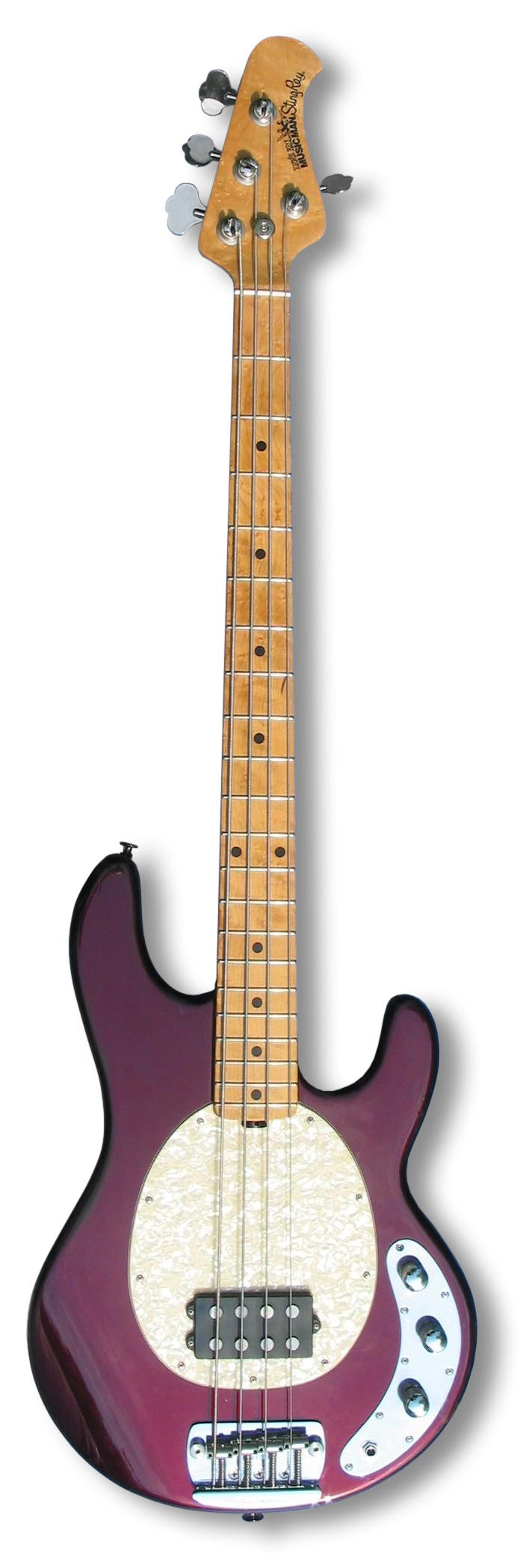
Photo: Th. Ott / Wikimedia Commons / CC BY-SA 3.0 Music Man
StingRay
1976
Leo Fender wanted a wide, bright bass. Louis Johnson hit it with his thumb, and funk had its sound.

Fender Jazz Bass from 1966 in Olympic white with the transition fingerboard (bindings and dot inlays). Photo by Th. Ott. Licensed under CC BY-SA 3.0. Via Wikimedia Commons. Fender
Jazz Bass
1960
Built for jazz players who mostly passed on it. Then bass players started using it to take the solo.
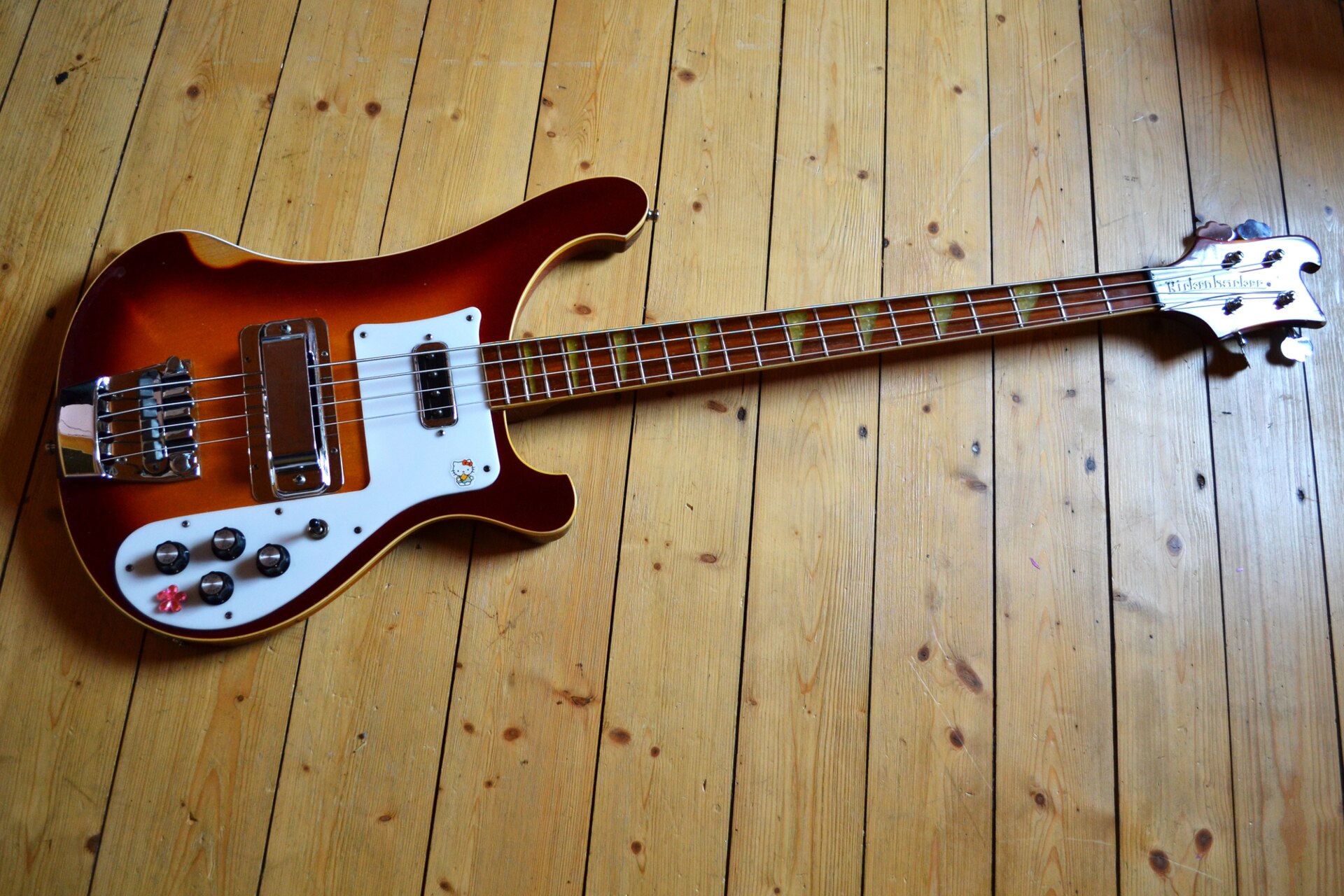
Rickenbacker 4003 (33 1/4" scale). Photo by DeLerkim. Licensed under CC BY-SA 2.0. Via Wikimedia Commons. Rickenbacker
4003
1980
Rickenbacker’s first answer to players’ new strings was to void the warranty. The 4003 was the better answer.